Mar 18, 2014

WHO says 24g of sugar a day is the safe limit

DRAFT GUIDELINES ISSUED IN BID TO COMBAT OBESITY AND RELATED ILLNESSES
The next time you order lunch, you may want to pass up on the can of soda. Or think twice about dousing your fries in ketchup. According to the latest World Health Organisation draft guidelines, a can of soda contains 10 teaspoons of sugar, and every tablespoon of ketchup 1 teaspoon of sugar, which pushes you over your recommended ‘sugar’ limit for the day. 
In a bid to combat obesity and related illnesses such as diabetes, WHO drafted ‘sugar intake’ guidelines, which recommend that the intake of free sugar in both adults and children not exceed 10% of total energy intake (around 50g or approx 12 tsp). And, says Francesco Branca, who presented the guidelines, a further reduction to less than 5% of total energy gives additional health benefits. Doctors recommend 12g or 3 tsp of sugar a day for children under 8, while pre-teens and teens can go up to 24g. 
WHO guidelines refer to the added sugar and the sugar naturally present in fruit juices, honey, syrup. Intrinsic sugar, present in fruit and vegetables, is not counted. It’s a bitter pill to swallow, say doctors, adding that the guidelines should have come sooner. 
Dr Nihal Tomas, Professor and Head, Department of Endocrinology, Diabetes and Metabolism, Christian Medical College, Vellore, believes this is perhaps one of the most important guidelines WHO has drafted, considering that an estimated 101.2 million people in India will have diabetes by 2030. 
“The average Indian consumes anything from 6 tsp to 10 tsp a day of sugar. But in young adults I would say the amount of sugar consumed is much higher, perhaps even double on average,” says Dr Thomas. “While people may count the number of teaspoons they put into their coffee or tea it is the hidden sugars that are never taken into account. In some places they use sugar in certain gravies like a shahi kurma or a tikka masala,” he says. 
Dietitian Dharini Krishnan says the changing dietary habits of young adults are a cause for concern. “Most Indians don’t usually exceed the 6 tsp of sugar a day limit if they stick to regular Indian food — idlis, dosas and chapatis — which do not have free sugars. But when you begin eating something like breakfast cereals or use flavouring agents in milk, that is when you can tip over,” she says. 
The intake is more worrying for children. “If you take the sugary flavouring or fortified powders one adds to milk, a tablespoon, which is actually 3 tsps, contains approximately 12g of sugar. Give the child this kind of milk twice a day and they have already doubled their daily quota,” says Krishnan.

In a study in ‘PLOS Medicine’, researchers suggested adding a 20% tax on sugar-sweetened beverages (SSBs) in India, estimating it could prevent 11.2 million cases of overweight/obesity and 400,000 cases of type 2 diabetes between 2014 and 2023. 
“A taxation on SSBs could reduce the buying capacity and that in turn could mean fewer people buying those beverages,” says Sutapa Agrawal, population scientist at the Public Health Foundation of India who co-authored the study. 
“Governments have seen consumption of tobacco reduce because of taxation, so why not do the same with sugar-sweetened beverages?” she says. In fact, Branca refers to sugar as perhaps being the new tobacco in terms of public health action.

Keralites want ban on pan masala and gutka

Thiruvananthapuram, March 17 (IANS) Taking a cue from Assam, which has banned consumption of harmful tobacco-based pan masala and gutka products, a cross section of people in Kerala have called for a similar legislation in the state.
People say the desired impact of the ban - of reducing the public health burden - cannot be achieved unless consumption is also prohibited.
"Since our state banned these products in 2012, we have been taking stringent action against violators," said K. Anil Kumar, commissioner for food safety, the regulating department for the effective implementation of the ban on pan masala and gutka.
"The smuggling of these products into our state has been a major challenge in implementing the effective ban on pan masala and gutka containing tobacco and nicotine.
"As such, any positive step in addition to this ban or strengthening this ban would be highly desirable. This would also help in curbing use among children in their vulnerable years," he said.
Kerala was the second state in the country after Madhya Pradesh to ban the manufacture, storage, sale or distribution of gutka and pan masala containing tobacco or nicotine as ingredients under the Food Safety and Standards (Prohibition and Restriction on Sales) Regulations 2011.
K. Ramadas of the Regional Cancer Centre here said that while oncologists and the medical fraternity at large can treat and provide care to the cancer afflicted, a legislative reform, as has been effected in Assam, would have far-reaching positive implications.
"Chewing tobacco, whether it is pan masala and gutka, is a major cause of cancer in the head and neck in Kerala," he said.
"I have seen several youngsters who have lost their taste buds, parts of their tongue and jawbones due to use of these smokeless tobacco products. This sorry state can be corrected to a great extent if Kerala can also legislatively ban the consumption of chewing tobacco products."
Assam has banned consumption of pan masala, gutka etc under the Assam Health (Prohibition of manufacturing, advertisement, trade, storage, distribution, sale and consumption of zarda, gutka, pan masala, etc, containing tobacco and/or nicotine) Act, 2013.
Vimala Menon, secretary of charity organisation Cheshire Home here, said that as someone who has seen the suffering of cancer victims in palliative care, "I feel that everything possible should be done to bring down cancer incidence in our state".
"Banning consumption of all forms of chewing tobacco products by law and imposing strict penalty on violators would be an effective move," Menon said.

Mar 17, 2014

KUMUDAM ARTICLE


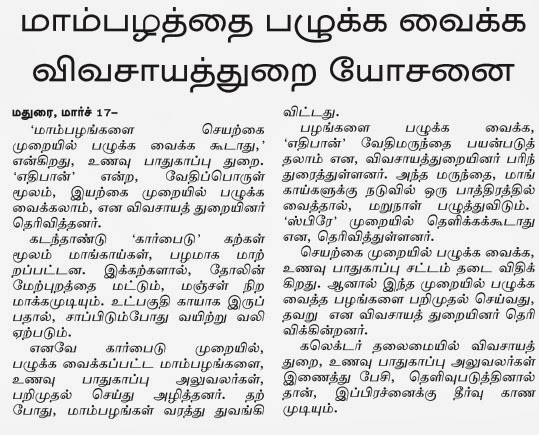
DINAMALAR NEWS


Anti-adulteration drive targets sweet shops in Noida

NOIDA: The district food safety department has launched a drive against sweet shops selling adulterated food items on the eve of Holi. Department officials have been asked to conduct surprise checks at such shops across the city.
"Officials will conduct raids at shops selling adulterated food items. Samples collected will be sent to Lucknow for investigation and strict action will be taken against the guilty," said Ajay Kumar, chief food safety inspector.
Buyers can also lodge complaints related to food adulteration on the department's emergency numbers.
The department officials warned people that bright-coloured sweets could contain harmful chemicals that cause food poisoning, stomach ache, vomiting and infection.

Adulterated food items seized

INDORE: Food department under the direction of district administration raided three shops in Palda and Aerodrome areas on Saturday. During the raid, 1,000 packets of adulterated 'namkeen', which were to be sold in the wholesale market, were seized.
The administration had received a complaint against Ganesh Namkeen for preparing snacks using poor quality of raw material in unhygienic environment. "Utensils used for preparation were not up to the mark. The product had no batch number and packing date. Samples have been taken and appropriate action will be taken following lab reports," said food safety officer, Manish Swamy.
The team also raided Sai Kripa Dairy and Sneh Sweets in Aerodrome area. Two samples each were taken from both the shops, though no major lapses were found.

‘Food Safety Act will affect livelihood of small traders’

Odisha Byabasayee Mahasangh, the organisation of traders in the State alleged that the norms of Food Safety and Standards Act if implemented would lead to drastic affect on livelihood of small traders.
Leaders of the traders’ Mahasangh such as its general secretary Sudhakar Panda and its working president C. Rabindranath, who were present during the 46th annual general meeting of Ganjam Chamber of Commerce held in the city on Sunday said the norms of the Food Safety and Standards Act seemed to be aimed at promoting large business houses and multi-national companies involved in retail trading in the country. Mr. Panda and Mr. Rabindranath as well as members of Ganjam Chamber of the Commerce were of the opinion that if implemented this Act would give rise to corruption as it favours the MNCs involved in retail business. As per the Odisha Byabasayee Mahasangh, there are around six lakh retail traders in Odisha who would be affected by this Act, which may lead to monopoly of MNCs and large trading houses involved in retail business. They said most small time traders were not in a position to get all their products tested.

Sweet shops raided, three samples sent to laboratory

Mussoorie, March 16
The Food Safety Department, Dehradun, carried out a drive against adulterated food items in Mussoorie yesterday. The department officials raided sweet shops in the Library Bazaar area and collected three samples from two shops. They sent the samples for testing to a laboratory at Rudarpur. 
Food Safety Officer Rachna Lal, who led the team of officials, told mediapersons that the sweet shops were raided to check the sale of adulterated food items during the festival season. She said the samples of sweets and gujias collected from two shops had been sent for testing to the Rudarpur laboratory.
Rachna directed the restaurant and sweet shop owners to maintain quality and hygiene in their products. She said more raids would be conducted in the near future to check the sale of adultrated food items.

செயற்கை வண்ணம் கூட்டப்பட்ட உணவுகளால் புற்றுநோய் ஏற்படும் கருத்தரங்கில் அதிர்ச்சி தகவல்


சேலம், மார்ச் 16: 
செயற்கை வண்ணம் சேர்க்கப்பட்ட உணவுகளால் உணவுக்குழல் புற்று நோய் ஏற்படும் என நுகர்வோர் உரிமைகள் விழாவில் உணவுப் பாதுகாப்பு மாவட்ட நியமன அலுவலர் அனுராதா கூறினார். 
தமிழ்நாடு நுகர்வோர் மற்றும் மக்கள் உரிமைகள் புலனாய்வுக் கமிட்டி சார்பில் உலக நுகர்வோர் உரிமைகள் தின விழா அரசு தொழிற்பயிற்சி நிலையத்தில் கொண்டாடப்பட்டது. அமைப்பின் தலைவர் செல்வம் நிகழ்ச்சிக்கு தலைமை வகித்தார். தொழிற்பயிற்சி நிலையத்தில் துணை இயக்குனர் ராஜேந்திரன், உதவி இயக்குனர் சுப்ரமணி, நுகர்வோர் அமைப்பின் இக்பால் ஆகியோர் முன்னிலை வகித்தனர். நாட்டுநலப்பணித்திட்ட அலுவலர் விஜயமுருகன் வரவேற்றார். 
மாவட்ட வழங்கல் மற்றும் நுகர்வோர் பாதுகாப்பு அலுவலர் அருணாச்சலம் கருத்தரங்கை துவக்கி வைத்து போட்டியில் வென்ற மாணவ, மாணவியருக்கு பரிசு வழங்கினார். மாவட்ட தொழிலாளர் ஆய்வாளர் வெங்கடேசன் எடை அளவு மோசடி குறித்துப் பேசினார். டீத்தூள், பருப்பு, மிளகாய்ப்பொடி உள்ளிட்ட உணவுப் பொருட்களில் செய்யப்படும் கலப்படத்தை கண்டறிவது குறித்து மாணவர்களுக்கு உணவு பாதுகாப்பு நியமன அலு வலர் அனுராதா செயல் விளக்கம் அளித்தார். மேலும் இவர் பேசியதாவது: 
மக்கள் அன்றாடம் பயன்படுத்தும் டீத்தூள், மிளகாய்ப்பொடி மற்றும் பருப்பு வகைகளிலும் செயற்கையாக நிறம் ஏற்றப்படுகிறது. பல்வேறு பொருட்களில் எடையைக் கூட்ட கலப்படம் செய்யப்படுகிறது. இனிப்பு வகைகள், சிப்ஸ், சில்லி சிக்கன், சில்லி காலிபிளவர் போன்ற உணவுகளில் மக்களைக் கவர்வதற்காக செயற்கை வண்ணம் சேர்க்கப்படுகிறது. தொடர்ந்து இது போன்ற உணவுகளைப் பயன்படுத்தி வந்தால் உணவுக்குழல் புற்று நோய் உருவாக வாய்ப்புள்ளது. மேலும் பல்வேறு கலப்படப் பொருட்களை தொடர்ச்சியாக உட்கொள்வதும் உடல் நலத்துக்கு எதிரானது. 
பொருள் வாங்கும் பொது அதனைப் பற்றிய முழு விவரமும் பேக்கின் மேல் பகுதியில் உள்ளதா என்பதைப் பார்த்து வாங்க வேண்டும். கோடை காலத்தில் பெயர் இல்லாத போலி குளிர்பானங்கள் பயன்படுத்துவதைத் தவிர்க்க வேண்டும். புகையிலைப் பொருட்கள் விற்பது தெரிந்தாலோ, பொருட்களின் கலப்படம் குறித்தோ 94435 20332 என்ற எனது செல்போன் எண்ணில் தொடர்பு கொண்டு தகவல் தெரிவிக்கலாம். இவ்வாறு அனுராதா பேசினார். 
தமிழ்நாடு நுகர்வோர் மற்றும் மக்கள் உரிமைகள் புலனாய்வுக் கமிட்டி நிர்வாகிகள் கலந்து கொண்டு பேசினர். சேலம் அரசு தொழிற்பயிற்சி நிலைய மாணவ, மாணவியர் நிகழ்ச்சியில் கலந்து கொண்டனர்.

Mar 15, 2014

Food-related traders asked to register with FSSAI before August 4


Panelists at a discussion on Food Safety and Security Act at the Puducherry University on Friday.

“Vendors simply have to declare that they are running a food-based business”
Although the Food Safety Standards Act has been in place for several years now, and it is now mandatory for all food-related businesses, including street food vendors, to register with the Food Safety Standards Authority of India, many restaurants and smaller vendors hesitate to apply for the licenses.
All food related businesses have been asked to register with the FSSAI before August 4 this year.
Since the experience in the past of many of these food vendors has been bad when it came to licensing and policing by the officials, many people have refused to apply for their unique identity cards.
The FSSAI, however, is very different since the emphasis is not on policing from outside, but on self regulation, Member of the scientific committee of the FSSAI J.S. Pai said on the sidelines of the One day workshop on Food Safety Act: “Know the Act & Regulations” here on Friday.
The intentions of this Act are good, and through its provisions, there is very little scope of harassment and problems. It is up to the State government and universities to raise awareness among the people, he said.
Even though the procedure is very simple, the vendor simply has to fill a form to declare that he is running a food-based business, many do not apply. The onus is on State government to ensure this happens, since it will make the vendors accountable, Senior Scientist of the National Institute of Nutrition R.V. Sudershan said.
Through their unique identity numbers, the name and location of the vendor as well as contact details will be available to the consumer. This will make them answerable, he said.
In terms of the consumers, there is a section of the FSSAI website that invites whistleblowers. These people will be working with the Centre or State governments to help ensure the quality of food is maintained, Aruna Kumar from the Central Food Technology Research Institute said.
The one-day workshop organised by the Food Science and Technology Department was aimed at educating business people in the food industry on the Act.

Study on convenience food released

CHENNAI: The Consumers Association of India (CAI) along with the Centre for Consumer Education, Research, Teaching, Training and Testing (CONCERT) has released a study on convenience food.
Director of CAI G Santhanrajan said convenience food comprised heat and eat, ready to eat and ready to cook products.
It provides a vast array of choices like rice preparations, chapattis, desserts and non-vegetarian food. Such food items have to be tested for packaging and labelling, quality along with health and safety.
While the quality parameters included nutritional label claims verification results and chemical characteristics verification, health and safety meant a test for microbiological characteristics, said Santhanrajan
CONCERT secretary general G Rajan said quality and safety of food products was being regulated by Food Safety & Standards Authority of India (FS&SAI). However "at present, standards for ready to eat food products of 'heat and eat type' had not been prescribed either by FS&SAI or Bureau of Indian Standards ( BIS)."

WORLD CONSUMERS DAY 2014


Chandigarh:To Celebrate the World Consumers Day A seminar on Food Safety Act was organized by Consumers Association Chandigarh (CAC) at Community centre Sector 21, Chandigarh. Hon’ble Shri Harphool Chander Kalyan, Mayor Municipal Corporation Chandigarh presided over the function. Mr. Sukhwinder Singh Food Safety Officer Health Department Chandigarh Administration gave a talk on the topic. He apprised the gathering that Food borne illnesses are major health problems in our country. Food borne illnesses are prevalent in all parts of the world, and the toll in terms of human life and suffering is enormous. Contaminated food contributes to 1.5 billion cases of diarrhea in children each year, resulting in more than three million premature deaths according to the WHO. Accidental or intentional adulteration of food by toxic substances also can result in serious health incidents. Food safety remains a critical issue in India with frequent reports of outbreaks of food borne illnesses every year resulting insubstantial costs to individuals, health care system and the country. To regulate the manufacture, storage, distribution, sale and import of food item, and ensure the availability of safe and wholesome food for human consumption. The Food Safety and Standards Authority of India (FSSAI) have been constituted which will lay down science-based standards for food items. This new Food Safety and Standards Act has repealed different Act and orders such as, the Prevention of Food Adulteration Act, 1954, the Fruit Products Order, 1955, the Meat Food Products Order, 1973, the Vegetable Oil Products (Control) order, 1947, the edible oils packaging (Regulation) Order, 1998, the Solvent Extracted Oil, De Oiled Meal, and Edible Flour (Control) Order, 1967, the Milk and Milk Products Order, 1992 and any other order issued under the Essential Commodities Act, 1955 (10 of 1955) relating to food.
Shri Harphool Chander Kalyan, the Chief Guest appreciated the role of Consumers Association Chandigarh in awarieng the consumer about their rights and settling the Complaints. Emphasizing the need for educating more and more people about the Food Safety Act., he said that this will certainly help in improving the health of the people. Annual-2014 of the Association was also released on the occasion.Earlier in the day Shri R.K. Kaplash Chairman of the CAC briefed about the activists of the Association. CAC is working in the Chandigarh since 1979, much before the enactment of Consumer Protection Act, is also brain behind the Apni Mandi Concept. It operated consumer awareness cum sale counters in different sectors of Chandigarh to sell good quality daily need items at competitive rates in directly controlling the price line. Shri R.K. Sharma, President Complaints, CAC apprised the participants about the procedure of handling the consumer complaints. He told that more than 10,000 complaints have already been settled by the association till date and that too without charging any fee out of court settlement.The Chairman presented the memento to Chief Guest and. Food Safety Officer. Sh. H.S. Aulakh was honored with a Life Time Achievement Trophy for his sincere honest and continuous services for over twenty years. Sh. A.S Ahuja Convener Sector 23 was also honoured. Brig. J.S. Phoolka, Advisor to the Chairman CAC passed a vote of thanks. He also thanked the media, Health Department U.T. Chandigarh, media and participants for making the World Consumer Day a great success.

Consumer policy expert urges Odisha to frame legislation

Advocating a robust regulatory framework for the protection of genuine direct selling companies, noted consumer policy expert Bejon Misra today asked the Odisha government to frame a legislation.
A member of the first constituted central Consumer Protection Council, member of Food Safety & Standards authority of India (in 2008) and Quality Council of India, Misra had recently been inducted into the national Task Force on Direct Selling by FICCI as an advisor.
In that capacity, Misra has been advocating the need of direct selling across states including Odisha, Bihar, Uttar Pradesh, West Bengal and Assam.
"We submitted a memorandum to the Odisha government urging it to have a separate legislation to deal exclusively with direct selling companies," said Misra, who was here to attend a function.
"There is an urgent need to protect direct selling industry especially in a state like Odisha which is the highest growing state in the country in direct selling," he said.
They are able to find a gainful employment out of accessing good quality products, they are also being able to get into an engagement or fruitful employment and making them an entrepreneur, Misra said.
There are 20 Direct selling companies like Amway, Avon, Oriflame who are members of direct selling association in India, he said.
Stating that 60 per cent of direct selling people are women, the advisor to FICCI Direct Selling Task Force said, "Direct selling provides employment opportunity to 14 million to people in India in the organized sector only. In the unorganised sector it could be 5 million or 10 million people employed and 3000 direct selling companies who are operating across the country."
Rajat Banerjee, Co-Chair, FICCI National Task Force on Direct Selling, said: "As per National industry classification, it is classified as internal trade and internal trade is a state subject. Therefore we are talking to states. Legislation will help distinguish genuine companies from fake companies and also protect consumers.

Experts highlight R&D in dietary supplement and nutra to control aging

Global research and development (R&D) labs are now focussing on the development of dietary supplements and nutraceuticals that could keep aging cells at bay.
Although the consumption of red and orange fruits is seen to be as beneficial as that of green leafy vegetables, and Gac fruit is a great source of lycopene. But people are not seen to consume these on a regular basis.
This has led global nutraceutical companies like Amway to enhance their research investments and develop products to control cell aging.
A panel of experts highlighted the R&D innovations in functional foods and dietary supplements at the Ninth Nutra India Summit, which concluded in Bengaluru on Friday.
The session was chaired by Dr D B A Narayana, chairman, Herbal Products Committee, Indian Pharmacopoeia Commission (IPC).
Dr Deepa Shenoy, senior research scientist, open innovation, Amway Global R&D, USA, led the discussion on the topic, ‘A 360º Approach to Innovating Functional Foods And Dietary Supplements for the Healthy Aging Consumer’.
She stated that there has been considerable focus on the research of nutraceutical products.
Although Amway’s first product was detergents, and it gradually expanded to offer numerous health products and dietary supplements.
Currently, almost 50 per cent of Amway’s global business is driven out of nutrition products such as protein powder and other health supplements. Amway's science and technology has a worldwide presence.
Amway's has invested $81 million in a production plant for pharma and nutraceutical tablets. The company, which produces protein at this facility under the brand name Nutralite, has a range of options for optimum health.
“We are designing a protein food for health benefits like aging of skin and muscle. The product is a protein for the protection of skeletal muscle which approximately comprises for about 42-50 per cent of the total body mass,” she said.
“The aging disease, referred to as sarcopenia, is caused due to the loss of muscle under the skin which can be controlled by correcting nutritional habits, aiding metabolism and altering lifestyle of an individual,” stated Dr Shenoy.
“The intake of a protein-rich diet improves muscle mass that significantly improves cell proliferation under the skin that gradually helps to cure/improve the condition. We need to look at the problem scientifically and understand the problem only then able to find a solution,” she added.
Speaking on nutrition and human cell growth (the new frontier for new products), Prof Dr Helmut Weidlich, chairman, Institut Prof Dr Georg Kurz GmbH, Germany, said that one of the steps to tackle aging in cellular level was to make the cell fight by itself against any harmful substance like virus or other protein substances.
Cell debris and other undesired cell growth should be prevented and to suppress the mutation at a cellular level.
“It is possible for the human body to generate new cells naturally by making alterations at the cellular level with minute alterations. The food that helps cell proliferation is a chemical compound known as caratinocyte which helps in rejuvenating the skin cells,” Dr Weidlich said.
“There is need to increase the consumption of red and orange fruit or those that are in the citrus category. Further, amino acid found in beverages like green tea can help in cell proliferation and prevent aging,” he added.
“In the coming years, there would be software solutions to predict which particular compound can help a cell and this helps to devise a formula to come up with new and better solutions for the benefit of all,” Dr Weidlich stated.
Dr Priti Vaidyanathan, senior manager, technical service, Sami Labs Ltd, said that the company has commenced the cultivation of Gac fruit (whose botanical name is momordica cochinchinensi), which has adapted positively to the Indian soil conditions.
This plant is part of the cucurbitacae family, commonly known as baby jackfruit. The pulp of the fruit is very rich in fatty acids that aid in the absorption of caratenoids.
Gac fruit contains lycopene which is an amino acid. This content is 70 times more than that of tomatoes. In humans, absorption of lycopene is in the liver and kidneys among other glands.
Now, lycopene is that it is an anti-cancer agent, and is beneficial to treat different types of this disease. In addition, it is also acts as an antioxidant and use to treat osteoporosis.
However, factors affecting the absorption of lycopene in humans include aging, smoking and alcohol consumption.
Therefore, in order to prevent many aging and age-related disorders, it is vital to include red and orange vegetables along with green leafy varieties.
Integrated approach & ethical marketing critical for nutra: Dr Prakash Integrated approach and ethical marketing are critical to the success of the nutraceutical industry.
This was stated by Dr V Prakash, distinguished scientist, Council of Scientific and Industrial Research (CSIR) India; vice-president, International Union of Nutritional Science (IUNS), director, research and development (R&D) and innovation, JSS MVP, Mysore, and chairman, Ninth Nutra India Summit.
“Advanced science is the key for business safety in the field of nutrition and food industry. The phase from concept to product development of nutraceuticals is complicated, because of the lack of defined regulations which makes these products difficult to be approved,” he said.
“Therefore, the Indian nutraceutical industry needs to adopt an integrated strategy and ethical marketing route to ensure high-quality systems are in place,” said Dr Prakash.
Speaking on the topic, ‘The Sculptured Future of Health through Nutra with the Background of 5,000 years of Rich Epidemiology in India,’ he said that there were 12 key technology areas globally, and in this space the pharmaceutical sector topped with 23 per cent, followed by computer technology with 15 per cent.
The market for nutraceuticals could increase only with a rise in standard of living in India, as this was the main potential to drive the growth. The R&D investments in nutraceuticals are poised to touch $400 million by 2025, which would be key to industrial growth.
“An integrated approach is the key to success, and ethical marketing is critical in nutraceutical industry,” he stated.
In August 2011, the Food Safety and Standards Act (FSSA), 2006, which came into effect five years after it was passed in Parliament, subsumed various central Acts like the Prevention of Food Adulteration (PFA) Act, 1954; the Fruit Products Order (FPO), 1955; the Meat Food Products Order, 1973; the Vegetable Oil Products (Control) Order, 1947; the Edible Oils Packaging (Regulation) Order of 1988; the Solvent Extracted Oil, De- Oiled Meal and Edible Flour (Control) Order, 1967; the Milk and Milk Products Order, 1992, and any order issued under the Essential Commodities Act, 1955 relating to food. It would ensure prevention of fraudulent, deceptive or unfair trade practices which may mislead or harm the consumer, and unsafe, contaminated or sub-standard food.
“This law will give a fillip to the nutraceutical industry, because prebiotic food, probiotic food, novel food, unani, ayurveda and siddha also come under its purview. The approval of products is a complex process, and there are hundreds of brands of vitamin with biotin, where some are below the recommended dietary allowance (RDA) range, some are above the RDA range and some which are equal to the RDA range. We need to have some new standards and refine the approval process,” Dr Prakash said.
He added that customer acceptance and safety are more important than the profit of the industry. The infrastructure should match the market for the supply of the raw materials and the Ayur-nutraceutical industry is a $300-million-market, and is a growing sector.

Mar 14, 2014

Despite nationwide ban, calcium carbide used by traders to ripen fruit


Traders continue to use calcium carbide to ripen such fruit as mangoes, bananas, chikoos, oranges and watermelon, despite the ban by the Centre on the use of the chemical. They are undeterred by the fact that state food and drug administrations (FDA) conduct raids every mango season.
According to a trader from the Agricultural Produce Market Committee (APMC) market in Vashi, Navi Mumbai, the state FDA seize between 1,000 and 2,000 boxes of mangoes that have been artificially ripened, with the sole objective of making a quick buck.
“Until the rules are enforced with utmost strictness, traders would continue to be fearless and use calcium carbide to ripen the fruit,” he added. Alam Khan, another fruit trader at the market, stated that artificial ripening was rampant because of the manner in which the market was structured. 
“The mangoes that enter the market before the commencement of the actual season are sold at higher prices. To take advantage of this, traders ripen the fruit using chemicals and sell the fruit as early as possible,” he added.
Khan stated that calcium carbide was banned owing to its carcinogenic properties, and explained the procedure traders follow to ripen the fruit. “Acetylene gas, a by-product of calcium carbide, creates heat,” he said.
“It is mainly used as a fuel and in welding, and contains toxic impurities that affect the nervous system. When acetylene is filled amidst the fruit in a box, it heats the fruit on the outside, and thus the mangoes and oranges turn yellow or orange, as the case may be.”
H G Koshia, food and drug commissioner, Food and Drugs Control Administration (FDCA), Gujarat said, “In 2013, FDCA’s food safety officers destroyed over 30 tonne mangoes ripened using calcium carbide.” 
“In February 2014, we seized over 100 boxes of mangoes ripened using it. Despite knowing about it, most traders are still using it, although stringent action has been taken against on them on a number of occasions,” he added. 
“Since the mango season is approaching, we would be doing regular checks on both retailers and wholesalers of mangoes to find out whether they have stopped using calcium carbide or not,” Koshia said.
Mahesh Zagade, food commissioner, Food and Drug Administration (FDA), Maharashtra, said, “In 2012, our officials seized over 1,000 dozen mangoes ripened using calcium carbide from all over Maharashtra.”
“In May 2013, the officials seized 706 dozen mangoes, worth Rs 1.23 lakh from Pune’s Kasba Peth area. The use of calcium carbide is banned because it contain the traces of arsenic and phosphorus, which pose a serious threat to human health,” he added.
“Earlier we issued directives to the traders and warned them that they would be prosecuted if they continued to use calcium carbide. However, it is still being used in Maharashtra and across the country,” Zagade said. 
“In order to curb the use of calcium carbide to ripen fruit, we need to create awareness among the masses. We need to make the traders aware that instead of calcium carbide, they could use ethylene gas to ripen mangoes and other fruit,” he added.

DINAKARAN NEWS


979 ration shops operating without FDA registration

PUNE: Of the 1,800 ration shops in the district, 979 shops are operating without obtaining the mandatory licence or registration from the Food and Drugs Administration (FDA), said Shashikant Kekare, joint commissioner of FDA, Pune.
Of the total, as many as 800 ration shops are in the city, whereas the remaining shops are located in the rural parts of Pune. Kekare said ever since the new Food Safety and Standards Act 2006 and Rules and Regulations 2011 came into force from August 2011, about 747 ration shops in Pune district have sought registration, whereas 74 ration shops have applied for licences from the FDA.
Under the new Food Safety and Standards Act 2006, food business operators with an annual turnover of Rs 12 lakh and above have been directed to apply for licences. Those with a lesser annual turnover are required to register with the FDA.
"We often organize camps for ration shop owners, where they can apply for licences or register with the FDA easily. Most of them have sought fair price shop licence. Efforts are on to motivate others to get themselves registered as soon as possible," said Jyoti Kadam, district supply officer of Pune.
As per the conservative estimates, there are around 15 lakh food business operators in the state. FDA grants licences and registrations to big hoteliers, small canteens, roadside vendors, wholesalers, retailers, stockists and people selling food-item sellers including groceries as per their turnover.
The act ensures
* Prevention of fraudulent, deceptive or unfair trade practices which may mislead or harm the consumer
* Prevention of unsafe, contaminated or sub-standard food being used
* Regulation of manufacture, storage, distribution, sale and import of food items to ensure availability of safe and wholesome food for human consumption
Public distribution system
* Targeted Public Distribution System (TPDS) is operated under the joint responsibility of the Union and state/union territory (UT) governments
* The Union government is responsible for procurement, allocation and transportation of food grains to the designated depots of the Food Corporation of India
* The operational responsibilities for lifting and distributing the allocated food grains within the state/UT governments. They are also suppose to identify families below poverty line (BPL), issue ration cards to them and supervise distribution of allocated food grains to eligible card-holders through the fair price shops (FPS).
* The total number of fair price shops in the country as reported by states/union territories (UTs) up to 2011 are 5.05 lakh. Of the total, 50,555 ration shops are in Maharashtra

புளியந்தோப்பில் குட்கா, ஆட்டோவுடன் பறிமுதல்

பெரம்பூர், மார்ச் 14: 
புளியந்தோப்பு நாச்சாரம்மன் தெருவில் உள்ள ஒரு குடோனில், தடை செய்யப்பட்ட குட்கா பொருட்கள் பதுக்கி வைத்திருப்பதாக புளியந்தோப்பு போலீசாருக்கு தகவல் கிடைத்தது. போலீசார், நேற்று மதியம் அங்கு சோதனையிட்ட போது, சரக்கு ஆட்டோ ஒன்றில் நிறைய மூட்டைகளைள ஏற்றிக் கொண்டிருந்தனர். 
இதுகுறித்து அங்கிருந்த ஊழியர்களிடம் கேட்டபோது, தாம்பூலத்தில் வைக்கும் பாக்கு என கூறினர். ஒரு மூட்டையை பிரித்து பார்த்தபோது, குட்கா பாக்கு இருப்பது தெரிந்தது. இதையடுத்து, அந்த குடோனில் இருந்த 64 மூட்டைகளில் வைக்கப்பட்டு இருந்த குட்கா, ஆட்டோவுடன் பறிமுதல் செய்யப்பட்டது. அதன் மதிப்பு 6.5 லட்சம். 
இதுதொடர்பாக, அதே பகுதியை சேர்ந்த செந்தில் (37), தாஸ் (47), சிவகுமார் (32) ஆகியோரை கைது செய்து, சிறையில் அடைத்தனர். தலைமறைவாக உள்ள குடோன் உரிமையாளர் சசிகுமாரை தேடிவருகின்றனர்.

What is Food Packaging? What are the general requirements for packaged food materials?

Food Packaging is the packaging of the food product, to protect from contamination & damage besides conserving taste & quality during the shelf lifeof a food product.
The food packaged material should be made of high quality and it should be free from any chemical contamination. As per FSS (Packaging & Labelling) Regulations, 2011, the following type of containers shall deemed to be unfit for human consumption:
Containers with Rust.
Enameled containers which have become chipped or have turned rusty.
Containers made of Copper or Brass are not properly tinned.
Containers made of Aluminium not conforming in chemical composition to IS-20 specifications for the Cast Aluminium & Aluminium Alloy for utensils or IS-21 specification for Wrought Aluminium and Aluminium Alloy for utensils.
Plastic Material Containers being used for food packaging should follow the following Indian Standards Specifications:
a) IS : 10146 (Specification for Polyethylene in contact with Foodstuff.
b) IS : 10142 (Specification for Styrene Polymers in contact with Foodstuffs)
c) IS : 10151 (Specification for Polyvinyl Chloride (PVC) in contact with foodstuffs)
d) IS : 10910 (Specification for Polypropylene in contact with Foodstuffs)
e) IS : 11704 (Specification for Ethylene Acrylic Acid (EAA) copolymer.
f) IS : 12252 (Specification for Polyalkylene Terephadthalates (PET)
g) IS : 12247 (Specification for Nylon 6 Polymer.
h) IS : 13601 (Ethylene Vinyl Acetate (EVA)
i) IS : 13576 (Ethylene Metha Acrylic Acid (EMAA)
j) Tin and plastic containers once used, shall not be re-used for packaging of Edible oils and fats.
For Canned Food Products, the following general requirements have to be followed:
a) All containers shall be securely packed and sealed.
b) The exterior of the cans shall be free from major dents, rust, perforations and seam distortions.
c) Cans shall be free from leaks.
FSS Regulations have also defined product specific requirement of the packaged materials which are applicable to certain category of food products.

Centre set to ban sale of junk food, aerated drinks in schools

The junk is being taken out of children's lives across the nation. The Centre is set to ban the sale of junk food in school canteens and around school premises across the country soon. In its final guidelines submitted to the Delhi High Court on Wednesday on regulating the sale of junk food and aerated drinks in and around schools, the Centre's expert committee has said it wants to restrict the availability of junk food items such chips, fries, colas, chocolates, etc. inside schools and up to within 50 m of their boundaries.
It was in September last year that the high court had directed a 13-member expert committee to review and modify the Centre's draft guidelines on the issue.
The guidelines that the committee finalised earlier this week mention that schools must regulate the sale of junk food items such as burgers, pizzas, chips, samosas and colas to rein in obesity and hypertension among children. Schools have also been asked to discourage binge eating among students and develop a canteen policy to provide nutritious, wholesome food in schools.
The revised and final guidelines focus on "nutrition levels, health standards and on regulating such consumption in accordance with a child's nutritional and health needs. Among other things, the guidelines prescribe a uniform policy that includes labeling food items with reference to their ingredients, calorie contents and nutrition levels in three categories viz. Red, Yellow and Green with Red including popular HFSS (high fat, sugar and salt) food items, yellow consisting of some baked goods or dairy items whose ingredients can be tweaked to increase their nutrition levels and green consisting of healthy fresh food such as fruits, fresh juices, salads, etc," said committee head Sunita Narain, from the Centre for Science and Environment.
"The idea here is not to deny a child any food item entirely. During an earlier hearing, the High Court too had observed that no food is without some nutritional value and a child cannot be made to give up packaged or fried food entirely. However, the committee is keen on regulating such consumption in accordance with a child's nutritional and health needs," Narain said.
The guidelines are meant to be implemented across the country and hence, have a section dedicated to varied needs of each state in the country. For instance, as one of the measures to restrict access to junk food for students in Delhi, the committee recommends that school management authorities in the Capital must ideally "put restrictions on the movement of students outside the school and hence, naturally restrict the availability of junk food irrespective of whether such stalls or vendors exist near schools or not".
In August last year, the Centre had submitted its draft guidelines to regulate the sale of junk food in and around schools across the country. However, at the time, senior advocate Abhishek Manu Singhvi, appearing for the All India Food Processors' Association, had opposed the Food Safety and Standards Authority of India (FSSAI) draft guidelines, saying that private agency AC Nielsen could not be allowed to frame guidelines that would affect the entire nation. AC Nielsen ORG-MARG had been assigned the work of framing the guidelines by FSSAI. Responding to the same, Additional Solicitor General Rajeev Mehra, appearing for the Centre had told the court that the Centre already had an expert committee in place that could review the same. Following the court's permission and its suggestion, public health and industry experts were then roped in. The committee decided to take the draft guidelines made by AC Nielsen ORG-MARG as a "starting point".
"The problem of obesity among children is on the rise mainly due to reckless dietary habits. Based on a study conducted by the health ministry and the Food Safety and Standards Authority of India, we can say that junk food items such as burgers, pizzas, chips, fries, samosas, biscuits etc. sold rampantly in school and college canteens contain no vitamins or proteins and are instead high on salt, sugar and saturated fat. The committee largely wants to restrict the access of junk food to children in and around schools. Not much can be left to the canteens or to the children assuming that they will make the right choices. Instead, we wish to restrict the sale of unhealthy food," a committee member said.
The high court is to take cognisance of the report in the coming week.

Mar 13, 2014

Officials to launch drive against artificial ripening of mangoes

With the summer season having set in and mangoes slowly flooding the market, Food Safety Wing officials in the district are gearing up to launch a drive against the practice of artificial ripening of mangos.
The demand during peak season is estimated to exceed 10 tonnes every day in the district.
Supply
With the supply not always keeping up with the demand and given the high profit margins involved, some food businesses operators resort to artificial ripening, a senior Food Safety Wing official told The Hindu here on Wednesday.
Artificial ripening can be detected upon close examination of the mangos. Such mangoes will have uniform yellow colour across their surface with no traces of green.
The mangoes that ripe naturally will have traces of green and yellow and will not be uniform in colour.
Further, all mangoes in a batch will have the uniform colour.
Despite having yellow skin, the mango will be hard and not have the softness of ripe mangoes, the official said.
Artificial ripening was mostly done using calcium carbide, which was widely available at low costs and was predominantly used in arc welding.
When mixed with water, it emitted acetylene gas which caused the chlorophyll (green pigment) to change colour. However, none of the other processes involved in ripening takes place.
As calcium carbide was an industrial grade product, it contained arsenic and lead participles.
These toxic impurities affect the neurological system and reduce the oxygen supply to the brain. Consuming artificially ripened mangoes could result in sleeping disorders and headaches, memory loss, seizures, mouth ulcers, skin rashes, renal problems and possibly, even cancer, the official warned.
List
A list of the fruit shops had already been prepared. Inspections would be taken up soon in all the 12 blocks of Coimbatore district and the three municipalities, besides the Corporation limits.

South Goa chilly powder manufacturer fined

PANAJI: The adjudicating officer, South Goa, appointed and notified under the Food Safety and Standards Act, 2006, imposed a punishment penalty fine of 25,000 on Sahyas Spice, Benaulim, for manufacturing, distributing and selling misbranded chilly powder.
Anthony K D Kunnapally of Sahyas Spice has been penalized under the provisions of Food Safety and Standards (Packaging and Labeling) Regulation, 2011.
The chilly powder packets for sale did not contain the stipulated label declaration which was in contravention of Section 26(2)(ii), Section 26(2)(v) and Section 27(1) of the Food Safety and Standards Act, 2006, and punishable under Section 52 of the said Act with penalty only.
Samples of misbranded food articles were drawn by food safety officer Shivdas Naik of the Food and Drugs Administration, on April 9, 2012.
Thereafter, civil proceedings were filed by him before the district collector/adjudicating officer, South Goa.

Junk food high in fat, sugar and salt: panel

An expert group has suggested restricting the availability and consumption of junk food or food high in fat, sugar and salt in schools and in a 50 metre radius around them. It has also called for increasing the availability of wholesome food to schoolchildren across the country.
The committee has identified chips, fried foods, sugar-sweetened carbonated beverages, sugar-sweetened non-carbonated beverages, ready-to-eat noodles, pizzas, burgers, potato fries and confectionery items as the common foods containing fat, sugar and salt in high quantities.
It gave this suggestion in draft guidelines for making available quality and safe foods in schools. A copy of the guidelines was on Wednesday submitted to the Delhi High Court.
The Court has been hearing a petition by non-government organisation Uday Foundation in the matter. The Food Safety and Standards Authority of India had set up the expert committee on a direction by the Court to advise the Central Advisory Committee to develop guidelines for making available quality and safe food in schools.
The guidelines further state that steps should be initiated to develop a nationwide programme for identification of more foods based on the criterion and inform the schools accordingly.
Another category of concern is the non-standardised deep fried foods such as samosa, chana-bhatura, etc that are available in school canteens and nearby areas. The guidelines state that the school managements must ensure regulation of such foods through canteen policies that promote consumption of healthy, wholesome and nutritious foods alone.
Canteen in schools should not be treated as commercial outlets; they carry a social responsibility towards inculcating healthy eating behaviour, the guidelines noted. The canteens can be used to motivate children to consume healthy and hygienic food.
The guidelines also stress the need to regulate `the exposure and power of advertisements and promotional activities’ that are targeted at children.
``It is recommended that the government may advise the Advertising Standards Council of India or any other relevant body to consider developing such a framework for (1) regulating advertisements for foods high in fat, sugar and salt (2) limiting reach of such advertisements in the electronic media where the school children are the key audience (3) restricting celebrity endorsements for such foods and (4) regulating promotional activities of such foods targeted at the children,’’ the guidelines pointed out.
It has also been stated that FSSAI should ensure that the labels on all food packets should carry information on the type and quantity of various nutrients and how much the serving size contributes to the total daily requirement.

Experts shy from ban on junk food

NEW DELHI: A report submitted by an expert group on junk food has recommended regulation of such food items in school canteens but shied away from pushing for a total ban. 
The expert group, formed by the Food Safety and Standards Authority of India, on Wednesday informed HC about the guidelines on the subject of "making available quality and safe food in schools" and suggested food high in fat, sugar and salt (HFSS) be restricted in schools and "within 50 metres" radius as opposed to the demand for a total ban within 500 yards made by the petitioner. 
On being told that the guidelines have been framed, a bench comprising acting Chief Justice B D Ahmed and Justice S Mridul asked FSSAI to file them within two days with advance copies to the petitioner NGO Uday Foundation and the amicus curiae (senior advocate N K Kaul) who can then come up with their response. The report argues children are not "the best judge of their food choice" and admits that schools are not the right place for promoting HFSS foods. 
It termed "chips, fried foods, sugar sweetened carbonated beverages" etc as HFSS foods and suggested "the school management must ensure regulation of such foods through canteen policies that promote healthy, wholesome and nutritious foods". The panel has also suggested a canteen policy to provide nutritious food in school be developed to ensure that such canteens are not treated as "commercial outlets". 
"A school health team or a similar unit could be set up in each school comprising teachers, parents and school canteen operators which will coordinate, implement and monitor the canteen policy to make available quality and nutritious food to students in schools," the report, says. 
TOI, which published extracts of the report, had on Wednesday highlighted how the panel is split on the need to ban junk food completely from school premises. HC is hearing the PIL filed by Uday Foundation seeking an immediate ban on junk food and carbonated drinks in all unaided and private schools. The NGO has also sought a direction to initiate measures to discourage availability of fast food within 500 yards of schools in Delhi, apart from a canteen policy.

HC asks FSSAI to file guidelines on junk food in schools

The Delhi High Court today asked the Food Safety and Standards Authority of India (FSSAI) to file the draft guidelines on regulation of sale of junk food and aerated drinks in and around school premises in the country. 
The expert group, formed by FSSAI, has come out with a slew of guidelines on the subject of "making available quality and safe food in schools" and suggested the availability of food high in fat, sugar and salt (HFSS) be restricted in schools and area "within 50 meters". 
The report said the kids are not "the best judge of their food choice" and moreover, the schools are not the right place for promoting HFSS foods. 
It termed "chips, fried foods, sugar sweetened carbonated beverageas" etc as HFSS foods and suggested "the school management must ensure regulation of such foods through canteen policies that promote healthy, wholesome and nutritious foods...". 
It also suggested there are food items such as 'samosa' and other fried food and a nationwide propgramme can be started to find out as to which can be termed as HFSS food. 
The panel has also suggested a canteen policy to provide nutritious food in school be developed to ensure that such canteens are not treated as "commercial outlets". 
"A school health team or a similar unit could be set up in each school comprising teachers, parents and school canteen operators which will coordinate, implement and monitor the canteen policy to make available quality and nutritious food to students in schools," the report said. 
On being told that the guidelines have been framed, the bench, headed by acting Chiief Justice B D Ahmed, asked FSSAI to file them within two days with advance copies to the petitioner and the amicus curiae. 
The court is hearing the PIL filed by Uday Foundation seeking an immediate ban on junk food and carbonated drinks in all unaided and private schools. 
The NGO has also sought a direction to initiate measures to discourage availability of fast food within 500 yards of schools in Delhi, apart from a canteen policy.

Registration, licensing under FSSAI go online

Bathinda, March 12
The Health Department today started the online registration of food business operators under the Food Safety and Standards Authority of India (FSSAI) Act. 
Under the project, the department issued the first licence to Kewal Chand Sharma, a shopkeeper at Bhagu Road. District Health Officer and Nodal Officer under the FSSAI Dr Raghubir Singh Randhawa said the online facility will limit food operator’s visit to the health authorities.
“From the time of applying for registration or licence, till the inspections are conducted, the business operators will have to visit our office just once to give a hard copy and collect his licence or registration number,” he said.
Dr Randhawa said the business operator will have to register online through the website www.foodlicensing.fssai.gov.in Thereafter, he would be given a self-generated password and a login account using which he can see the status of his application. Within 15 days of applying online, hard copies will have to be submitted at the nodal officer’s office.
In the meantime, the district nodal officer will be informed about the application filed through the online system.
For the issuance of registration number, the food safety officer will conduct inspection and issue the number. However, for issuing licence, the inspection report will be verified by the nodal officer.
Since its introduction around two years ago, 620 licences and 4,000 registration numbers have been issued in the district.

Mar 12, 2014

குடோனில் பதுக்கிய 50 கிலோ குட்கா பறிமுதல்

சென்னை, மார்ச் 12: 
குடோனில் பதுக்கி வைத்திருந்த 50 கிலோ குட்கா பறிமுதல் செய்யப்பட்டது. 
கொருக்குப்பேட்டை தியாகப்ப செட்டி தெருவில் உள்ள ஒரு குடோனில், தடை செய்யப்பட்ட பான்பராக், ஹன்ஸ் உள்ளிட்ட குட்கா பொருட்கள் பதுக்கி வைத்து இருப்பதாக ஆர்கே நகர் போலீசாருக்கு தகவல் கிடைத்தது. 
போலீசார் அங்கு சென்று சோதனை நடத்தினர். அங்கு, மூட்டை மூட்டையாக குட்கா பொருட்கள் இருப்பது தெரிந்தது. அங்கிருந்த 50 கிலோ குட்கா பொருட்களை போலீசார் பறிமுதல் செய்தனர். இதுதொடர்பாக, செந்தில் (35) என்பவரை பிடித்து விசாரிக்கின்றனர்.

Food fair gives business tips on a platter

NEW DELHI: For those planning to turn their hobbies like baking and cooking into business, the ongoing Aahaar International Fair at Pragati Maidan is the place to be. From all kinds of appliances and utensils to sugar-free cakes and organic vegetables, the fair has a lot to offer.
With professionals and international chefs making food and giving tips that can save a dish, visitors can learn the art of cooking. "The cakes are so beautiful that it's impossible to resist them. One can also learn how to decorate the cakes," said Neerja Gulati, a visitor.
However, the fair is more of a treat for the eyes as most of the ready-to-eat food on display is not for sale. While one can sample some of the items, most of them are only for display.
"The food tastes really good but the platters aren't for sale. It's not for the foodies but for those who want to start up a business," said another visitor, Parul Khambuja. But the organic food and sugar-free cakes seems to be the favourite.
Pulses, veggies and fruits are available on discount and there are great deals for wholesalers. "Usually the organic food is quite expensive. But here one can get it raw materials and daily supplies at a cheap price," said the volunteer at a corporate's Organic food stall.
For diabetics, the fair has many things to offer, from juices and processed food to cakes, which are healthy and easy to make. At the Food Safety and Standards Authority of India's stall, people are told how to ensure their food is safe. All the safety measures that the producer should take are highlighted along with all kind of information for the consumers.
The fair will be there till Saturday, March 15, and from 10am-6pm. The entry is free for entrepreneurs and passes are available at all Metro stations.

Mar 11, 2014

பொதுப்பணி துறை அனுமதி பெற்ற குடிநீர் நிறுவனங்களுக்கு அனுமதி

சென்னை: 'பொதுப்பணித் துறையில் தடையின்மை சான்று பெற்ற, தனியார் குடிநீர் நிறுவனங்கள் செயல்படலாம்' என, தேசிய பசுமை தீர்ப்பாயம் உத்தரவிட்டுள்ளது.
தனியார் நிறுவனங்கள் விற்பனைக்கு அனுப்பும், 'கேன்' குடிநீரின் தரம் குறித்த சர்ச்சை எழுந்த நிலையில், தென்மண்டல தேசிய பசுமை தீர்ப்பாயம் தானாக முன் வந்து, வழக்குப் பதிந்து விசாரித்து வருகிறது. இதில், உரிய அனுமதி பெறாத நிறுவனங்கள் மீது நடவடிக்கை எடுக்கப்பட்டது. நிலத்தடிநீர் எடுக்க, பொதுப்பணித் துறையின் தடையின்மைச் சான்று பெறாத, 252 நிறுவனங்களின் செயல்பாட்டுக்கும் தடை விதிக்கப்பட்டது. தடையின்மை சான்று பெற, கால அவகாசம் தரப்பட்டது. பெரும்பாலான நிறுவனங்கள், பொதுப்பணித் துறையின் தடையின்மை சான்று பெற்றன. நேற்று நடந்த விசாரணையில், இத்தகவல் தெரிவிக்கப்பட்டது. இதையடுத்து, 'பொதுப்பணித் துறை சான்று பெற்ற குடிநீர் நிறுவனங்கள் செயல்படலாம்' என, தேசிய பசுமை தீர்ப்பாய தலைவர் சொக்கலிங்கம், உறுப்பினர் நாகேந்திரன் உத்தரவிட்டனர்.

Imported fruits, vegetables to come under pesticide watch following recommendations from Court panel

Are those beautifully packed and fresh looking exotic fruits displayed on the stands in posh markets really healthy? We'll find it out very soon as for the first time, imported fruits and vegetables are set to come under pesticide watch following the recommendations from a court appointed committee.
In the wake of the reports of rampant contamination of vegetables and fruits in Delhi's markets, the Supreme Court and Delhi High Court have initiated several steps to curb the use of pesticides and artificial colour for enhancing their size and appearance.
The amount of pesticides in fruits and vegetables in India, and especially those sold in Delhi markets, were as much as 750 times the European standards, NGOs Center for Public Interest Litigation and Consumer Voice claimed in the SC and HC, respectively. The NGOs claimed in their pleas that the fruits were a toxic cocktail of banned pesticides capable of causing headache, cancer, heart disease, infertility and pose a risk to the nervous system and liver.
The banned pesticides included chlordane, a rat poison that affects the nervous system and endrin, an insecticide that causes headache.
"Surprise checks will be conducted at major markets once in a month and there will not be any differentiation between local fruits and vegetables and those imported. The court panel's report says an eye has to be kept on them also as they too are susceptible to contamination because of lucrative business," Meera Bhatia, the lawyer for Delhi government said.
Terming the situation as "alarming", the court said 1.7 crore Delhiites everyday consume fruits and vegetables unfit for human consumption. It had recently asked the Delhi government to publicise the short-term measures and Dos and Don'ts suggested by the expert committee to minimise the presence of pesticides residue. Ordering intensification of the crackdown against the contamination, the court has sought a status report on April 15.
"No such consignment should be allowed to enter the country without pre-dispatch pesticide testing report by the exporter. Samples of imported fruits and vegetables should be drawn by plant quarantine stations at international arrival points and monitored for the presence of pesticide residues," said a report filed in the court by the panel headed by Sandhya Kulshreshta, additional deputy DG in the health ministry.
"Surprise inspections were conducted in many markets like Azadpur Mandi, Kotla, Mayur Vihar, Sarojini Nagar, INA, Defence Colony, Vasant Vihar and Lodhi Estate in the last three years. We found that pesticides, toxic colours and hormones are being used by farmers and traders to speed up growth, ripen and improve colour," said Bhatia.
The expert committee said results of tests should be posted on the website of the Delhi government's food department along with the name of the market.
The SC said: "Right to life and human dignity encompasses, within its ambit availability of articles of food without insecticides or pesticides residues. But the fact remains that food available in the market contain insecticides or pesticides residues, beyond the tolerable limits, causing serious health hazards. Fruit-based soft drinks also contain pesticides in alarming proportion, but no attention is made to examine its contents.
Harmful for kids
"Children and infants are uniquely susceptible to the effects of pesticides because of their physiological immaturity and greater exposure to soft drinks". The SC directed Food and Safety Standards Authority of India to coordinate with counterparts in all the states and conduct periodical inspections and monitoring of major fruits and vegetable markets.

Bid to implement Assam Health Act, 2013

GUWAHATI, March 10 – In an effort to effectively implement the recently enacted "Assam Health (Prohibition Of Manufacturing, Advertisement, Trade, Storage, Distribution, Sale and Consumption of Zarda, Guthka, Panmasala etc., containing Tobacco and/or Nicotine) Act, 2013," the Deputy Secretary of the State Health and Family Welfare Department has issued a notification to the Director General of Assam Police, all Deputy Commissioners and Superintendents of Police of the state informing that the said Act has come into force from February 20, 2014.
Other bodies/authorities/departments who have been informed about the same are Commissioner of Taxes (Assam), the Legal Remembrance (Assam), Mission Director-NRHM (Assam), Principal Secretary-Finance Dept. (Assam), the Principal Secretary (Home & Political Dept.-Assam), Board of Revenue/Chairman-Assam Administrative Tribunal, CEO-Food Safety & Standard Authority of India, PS to Parliamentary Secretary (Health & FW Dept)-Assam, PS to Health & Welfare Minister (Assam), Principal Secretary to the Chief Minister (Assam), the Commissioner & Secretary (to the Governor of Assam) and the Secretary to the Government of India (Ministry of Health & FW).
The notification further requested the DIPR to widely publicize the above piece of information. This has been done in exercise of the powers conferred under Section 1(3) of the above mentioned Act.
The Act, if implemented efficiently, is expected to control tobacco-related health issues in the state, which coincidentally has a very high rate of tobacco consumption and an alarming rate of tobacco-related oral cancer cases.

World Health Organisation slashes recommended daily sugar intake

TIMES VIEW
Scientific method works
The UN's World Health Organization (WHO) is proposing new draft guidelines that recommend people should consume less than 5% of their total daily calories from sugar, down from 10% according to current guidelines. The new guidelines mean not more than 25 grams or 6 teaspoons a day for an adult of normal body mass index. WHO's advocacy on sugar is in response to the growing incidence of non-communicable disease and obesity. Its recommendations are based on collation of extensive research. This approach is based on the scientific method, which has been the basis for all improvements in human health outcomes in the last couple of centuries.
Advocacy on sugar intake comes from identifying behavioural risk factors to a healthy and productive life. An unhealthy diet is a key risk factor and the extent of sugar intake is closely linked to it. Increasingly, as processed food comes to exercise dominance over our diet, sugar is consumed in insidious ways. For instance, WHO says one tablespoon of ketchup contains as much as one teaspoon of sugar. This kind of information is not widely known and WHO's advocacy plays an important role in raising the level of public awareness.
Following a scientific method does not imply that guidelines are definitive. Research will continue to push the envelope and subsequent conclusions will depend on new findings. But in the meantime it is WHO's job to reflect the current state of scientific knowledge, even if this isn't to the liking of the food industry. Information is power. Advocacy based on research has had beneficial spin-offs. For instance, once public awareness increases, it may trigger a demand for enhanced transparency and finer detailing of ingredients in food products. It could also lead to the invention of healthier alternatives to sugar. This can only be for the public good.
COUNTERVIEW
Take it with a pinch of salt

The warning on the consumption of sugar and the need to cut down use of the stuff has to be taken with a pinch of salt. After all it is only the most recent in the long list of products of daily use that have been labelled dangerous. Of late it has become such a fashion for health authorities, multilateral agencies and even independent establishments to bring out innumerable warnings based on so-called scientific studies, that it has become impossible to take them seriously any more. Very often these studies made by different agencies bring out unconvincing and even contradictory results.
Thus we find that while some studies extol virtues of white wines over red another set would argue quite to the contrary. Similarly, while some bring out the positive health impact of having coffee many others would focus on the medicinal impact of drinking tea or the benefits of regular consumption of alcohol in small doses. The mess created by such unilateral pronouncements is best brought out in the case of GM food. In this case while the US Food and Drug Administration finds nothing harmful in its consumption, the American Academy of Environmental Medicine argues physicians to issue health warnings on its use while the World Health Organisation calls for safety assessments on a product by product basis.
While too many such warnings leave the consumer confused, crying wolf too often also ensures that there will be little vigilance when a real threat emerges. In many cases recurring warnings have an impact opposite to what is intended. Consumers habitually forewarned about intake of red meat, oil laced snacks, salty processed food, pesticide laden vegetables and fruits, alcohol, tobacco and soft drugs slowly develop immunity against alarmist views, consuming more of these very products with added gusto.

Mar 9, 2014

Ranbaxy recalls two lots of generic Lipitor in U.S.

The action was taken after a complaint by a pharmacist who discovered a 20 mg tablet inside a sealed bottle of Atorvastatin 10 mg tablets. 
Ranbaxy Laboratories, which is reeling under regulatory action from the U.S. Food and Drug Administration (USFDA), has recalled more than 64,000 bottles of Atorvastatin calcium tablets, a generic version of cholesterol-lowering drug Lipitor, as some bottles could possibly contain a higher dose. 
Voluntary recall
“Ranbaxy Pharmaceuticals is conducting a voluntary recall in the U.S. limited to two lots of Atorvastatin calcium tablets, 10 mg manufactured in India, which expire in May, 2014,” the drug maker said in a statement. 
Complaint
The action was taken after a complaint by a pharmacist, who discovered a 20 mg tablet inside a sealed bottle of Atorvastatin 10 mg tablets. 
A Ranbaxy spokesperson stated the actual recall had happened in January. 
Ranbaxy, majority of which is owned by Japan’s Daiichi Sankyo, said it recalled the tablets “because of a remote possibility of the presence of a 20 mg Atorvastatin calcium tablet in a 10 mg bottle. This is the basis of the voluntary recall.” 
It also added that to date, the company has not received any product complaints related to these batches. 
Additionally, other lot numbers, package sizes and strengths are not affected by this recall, which is being conducted at the retail level. 
“Ranbaxy is proactively recalling the lots out of an abundance of caution, keeping the safety of its patients in mind and with the full knowledge of the USFDA,” it added. 
In January, the USFDA had prohibited Ranbaxy from producing and distributing drugs for the American market from its Toansa facility in Punjab. This was the company’s fourth plant to face regulatory action from the U.S. food regulator, after Mohali, Paonta Sahib and Dewas plants.

DINAMALAR NEWS


DINAMALAR, DINAMANI & DAILY THANTHI NEWS


Chewable tobacco products seized near Theosophical Club Lane

Police along with Food Safety and Standards Authority of India officials lifting chewable tobacco samples from a warehouse in the city on Saturday. 

Variety Hall Road Police along with officials from the Food Safety and Standards Authority of India on Saturday seized chewable tobacco products from a warehouse on Theosophical Club Lane, off Lingappa Chetty Street.
According to Inspector of Police C. Chandraseelan, following a tip off when a police team went to the spot, it found tobacco products stored in gunny bags. 
It then informed the Food Safety and Standards Authority of India officials, who arrived at the spot to lift samples.
The officials found that there were around five lakh sachets of chewable tobacco packed in the name of a popular brand. Ashok Kumar, who had taken on hire the warehouse, had bought the tobacco product from New Delhi. The consignment had arrived at the warehouse a little more than a week ago.
Kumar, a native of Rajasthan, had stored the sachets in 60 bags. Nicotine
The tobacco was worth around Rs. 5 lakh, the police officer said and added that the FSSAI officials had lifted samples to check if the tobacco product contained nicotine.
Sources in the FSSAI said that if the lab report confirmed the presence of nicotine, the officials would destroy the sachets at the Coimbatore Corporation’s dump yard in Vellalore.

Health officials inspect bakeries in Kannur

Health Department officials inspected bakeries here in view of the incidence of food poisoning following the consumption of snacks from a bakery here the other day.
The inspection followed the instruction of District Collector P. Bala Kiran here in the wake of the incidence of food poisoning among students of the C.H. Muhammad Koya Memorial Higher Secondary School at Valapattanam.
They reportedly showed symptoms of food poisoning after they had consumed the snacks supplied by a leading bakery unit here.
Hospitalised
Twenty-six students of the school had been hospitalised with the symptoms.
The Collector had already ordered the closure of the bakery.
The officials said that random inspections would be conducted in the bakeries to ensure that they strictly followed food safety measures.

உணவுப் பாதுகாப்பு அலுவலர்களுக்கு நடத்தை விதிகளை அறிவிக்கக் கோரிக்கை

நடத்தை விதிமுறைகளை விரைவில் அறிவிக்க வேண்டும் என உணவுப் பாதுகாப்பு அலுவலர்கள் கோரிக்கை விடுத்துள்ளனர்.
உணவுப் பாதுகாப்பு அலுவலர்கள் சங்க மாநில செயற்குழுக் கூட்டம், சங்கத் தலைவர் ஆ.போஸ் தலைமையில் கடலூரில் சனிக்கிழமை நடைபெற்றது. 
கூட்டத்தில் நிறைவேற்றப்பட்ட தீர்மானங்கள்:
மாவட்டம்தோறும் அடிப்படை கட்டமைப்பு வசதிகளுடன் அலுவலகங்களை ஏற்படுத்த வேண்டும். இன்றைய சூழலில் எல்லாமே ஆன்-லைன் என்ற முறையில் செயல்படுகிறது. எனவே, அனைத்து அலுவலர்களுக்கும் லேப்-டாப் வழங்குவதுடன், களப்பணி உதவியாளர்களை நியமிக்க வேண்டும். மத்திய அரசின் வழிகாட்டுதல்படி மாவட்ட நியமன அலுவலர் பதவியை ஏற்படுத்தவேண்டும்.
உணவுப் பாதுகாப்பு அலுவலர்களுக்கான நடத்தை விதிமுறைகளை விரைந்து முடித்திட வேண்டும்.
மாநில பொதுச்செயலர் ஈ.கோவிந்தசாமி, பொருளாளர் டி.ரவிச்சந்திரன், மண்டல ஒருங்கிணைப்பாளர் சி.ரவிக்குமார், மாவட்ட உணவுப் பாதுகாப்பு அலுவலர் எம்.பி.ராஜா உள்ளிட்டோர் பங்கேற்றனர்.


உணவு பாதுகாப்பு துறை அலுவலர் சங்க கூட்டம் 
கடலூர், மார்ச் 9: 
கடலூரில், தமிழ்நாடு உணவு பாதுகாப்புத்துறை அலுவலர் சங்க மாநில செயற்குழு கூட்டம் நடந்தது. 
மாநில தலைவர் போஸ் தலைமை தாங்கினார். மண்டல ஒருங்கிணைப்பாளர் ரவிக்குமார் வரவேற்றார். மாநில பொது செயலாளர் கோவிந்தசாமி வேலை அறிக்கை வாசித்தார். மாவட்ட உணவு பாதுகாப்பு அலுவலர் டாக்டர் ராஜா, வங்கி ஊழியர் சங்கம் மருதவாணன், சத்துணவு ஊழியர் சங்கம் ரங்கசாமி, தமிழ்நாடு அரசு பணியாளர் சங்கம் பச்சையப்பன் ஆகியோர் வாழ்த்துரை வழங்கினர். உணவு பாதுகாப்புத்துறை புதியதாக துவங்கப்பட்டு 2.5 ஆண்டுகள் கடந்த நிலையில் புதிய மேம்படுத்தப்பட்ட ஊதிய முறைகளை ஊழியர்களுக்கு வழங்கிட வேண்டும். உணவு பாதுகாப்பு துறையில் பணிபுரியும் உணவு பாதுகாப்பு அலுவலர்களுக்கு மடிக்கணினி உள்ளிட்ட அடிப்படை வசதிகள் செய்துதர வேண்டும் உள்ளிட்ட பல்வேறு தீர்மானங்கள் நிறைவேற்றப்பட்டன.