May 4, 2015

FDA tells food biz operators to file returns by May-end

PUNE: The Food and Drug Administration (FDA) has directed food manufacturers, repackers and relabellers to submit their annual returns by May 31, failing which they will be fined Rs 100 per day.
Last year, FDA officials had recovered fine of over Rs 18.77 lakh from food business operators in Pune district for not filing their annual returns for 2013-14 within the stipulated time. "Food manufacturers, repackers and relabellers have to submit annual returns of their transactions made between April 2014 and March 2015 by May 31, failing which a fine of Rs 100 will be imposed on them," said Shashikant Kekare, joint commissioner (food), FDA, Pune. 
Food business operators with annual turnover of Rs 12 lakh and above have been directed to seek licences and those below the Rs 12 lakh mark are required to seek registration papers from the FDA under the new Food Safety and Standards Act, 2006. 
There are over 9,000 licensed food business operators in the city with an annual turnover of Rs 12 lakh and above. They include food manufacturers, distributors, wholesalers, retailers and recyclers among others. "Of these, around 25% are manufacturers, repackers and relabellers who have to submit the annual returns every year," said Dilip Sangat, assistant commissioner (food), FDA, Pune 
As per the Food Safety and Standards Act and Regulations, 2011 (licensing and registration), food manufacturers, repackers and relabellers have to submit the returns in a particular format — Form 'D-1'. "Only owners of milk businesses have been asked to submit the returns in a half-yearly format as given in Form 'D-2'," Sangat said. 
"Awareness about filing the annual returns is very low among food business operators. The government has also not made substantial efforts to sensitise them on the issue," said office bearers of the Poona Merchant Chambers. 
The Food Safety and Standards Authority of India has exempted traders, restaurateurs and distributors from filing annual returns. The forms are available at the FDA office in the city and can also be downloaded from www.fssai.gov.in

Implementation of food safety Act put on the back burner

Minister for Health and Family WelfareU.T. Khader addressing presspersons in Mysuruon Sunday

Govt. reluctant to deploy medical officers as designated officers
Has the food safety regulation taken a back seat in the State? It seems so. The Department of Health and Family Welfare is averse to redeploying the government medical officers as the designated officers (DOs) for enforcing the Food Safety and Standards Act (FSSA) citing shortage of doctors.
As many as 21 senior medical officers, who were deployed as designated officers in the State have been repatriated to their respective districts. Some of them were holding additional responsibilities assigned to them by the Health Department, which was given the task of implementing FSSA. To a query related to this, Minister for Health U.T. Khader on Sunday said: “The Health Department works suffered when the medical officers were deputed to enforce FSSA. Health is our priority and not food safety enforcement. We had sent a request to the Centre to delink the Department of Health from enforcement of FSSA, requested that the department should be relieved of the responsibility of enforcing FSSA, but the Centre directed us to continue with the task of enforcing the Act.” According to the Minister, officers of the rank of the Assistant Commissioner or the Tahsildar may be given additional charge of designated officer to implement FSSA.Mr. Khader added that the government is mulling over roping in suitable candidates with relevant qualification for implementing FSSA without making any changes to the C and R Rules. “It’s tough to redeploy the government medical officers to the post of designated officer.”
As per the norms, the post of the designated officer for implementing the FSSA, should be held by a sub-divisional officer or a medical officer who has put in more than 10 years in the department, or a person with post-graduation in subjects such as chemistry, microbiology, biochemistry with the rank of a sub-divisional officer.
The food safety wings in several districts were under the control of the food safety officers since January this year. The absence of a ‘team leader’ (DOs) may come in the way of spreading the importance of food safety since the DOs had been empowered to monitor and sometimes lead the inspections/raids to check if food items were within the parameters of FSSA or adulterated.
Khader says they plan to appoint people of the sub-divisional officer’s rank as DOs

Food safety at stake

A separate authority for food safety was established by the government, comprising a Food Safety Commissioner and Food Safety Officers, to check adulteration. But, the response to grievances in this connection is disappointing. I had lodged a complaint on January 19 with the Food Safety Officer of North Circle in Kozhikode that the jaggery I had purchased from a hypermarket in the city was suspected to be adulterated. My request to take its samples for testing and to freeze the sale of the product did not yield any action from the officer. I contacted the officer in person with the same request and there was no action for two-and-a-half months. Then I took up the issue with the Food Safety Commissioner in Thiruvananthapuram. Reply is awaited.
C. Chandrasekharan, Kozikode

குட்கா பொருட்கள் 400 கிலோ பறிமுதல்

சென்னை, மே 4:
சைதாப் பேட்டை மார் கெட் பகு தி யில் உள்ள கடை களில் தடை செய் யப் பட்ட பான் பராக், குட்கா போன்ற பொருட் கள் விற பனை செய் யப் ப டு வ தா க உணவு பா து காப்பு அதி கா ரி களுக்கு தக வல் கிடைத் தது.
இதை ய டுத்து உணவு பாது காப்பு உயர் அதி காரி லட் சுமி நாரா ய ணன் உத் த ர வின் பேரில் உணவு பாது காப்பு அலு வ லர் கள் சதா சி வம், மணி மா றன், ராஜா தலை மை யி லான குழு வி னர் சைதாப் பேட்டை மார் கெட் பகு தி யில் அதி ரடி சோதனை நடத் தி னர். இதில் 23 கடை களில் நடந்த சோத னை யில் 400 கிலோ எடை கொண்ட போதை பொருட் களை பறி மு தல் செய் த னர்.
இதில் பான் பராக், குட்கா, ஹன்ஸ் புகை யிலை, மிராஜ் புகை யிலை, கைனி புகை யிலை, மாவா மசாலா ஆகி யவை கைப் பற் றப் பட்டது. இதன் மதிப்பு சுமார் ₹1 லட் சம் இருக் கும் என அதி கா ரி கள் தெரி வித் த னர். கைப் பற் றப் பட்ட அனைத்து பொருட் களும் நாளை (இன்று) கொடுங் கை யூர் குப்பை கிடங் கு களில் அழிக் கப் ப டும் என்று தெரி வித் த னர். இதே போல் சென் னை யில் எங் கெல் லாம் போதை பொருட் கள் விற் கப் ப டு கி றதோ அதை சோதனை நடத்தி கைப் பற் று வோம் என வும் தெரி வித் த னர்.

May 3, 2015

“Food business operators should ensure quality”

Food business operators should adopt necessary requirements specified in the Food Safety and Standards Act (FSSA), 2006, to ensure quality in food production, Collector M. Ravikumar has said.
The operators should renew licences from Food Safety Officers, he said at a meeting convened here on Friday.
The food business operators could access www.foodlicensing.fssai.gov.in to know more about the processes of registering and applying for licences. During the schedule, he sought cooperation from such operators to fully implement the FSSA and also ensured them that grievances, if any, could be redressed.
He also asked the consumers to be aware of unadulterated milk and salt.
Salt should contain 30 ppm of iodine at the producer level and 15 ppm of iodine at the consumer level.
The Food Safety Officers had been instructed to conduct checks to prevent artificial ripening of mangoes by vendors and initiate necessary action.
The Collector said efforts would be made to establish slaughterhouses to ensure quality of meat.
District Designated Officer of the FSSA M. Jegadis Chandrabose, Regional Transport Officer K. Anand and food business operators attended the meeting.

SOME PERSPECTIVES ON FOOD ADULTERATION

Adulteration of food is the addition of a non-food item to increase the quantity or enhance the appearance of the food item in raw form or prepared form, which may result in the loss of actual quality of the food item and/or cause harm to the consumer. The following important criteria define food adulteration:
  • It bears or contains any poisonous or deleterious substance which renders it injurious to health.
  • It is, or it bears or contains, an unsafe food additive.
  • It is, or it bears or contains, an unsafe colour additive.
  • It has been prepared, packed or held under unsanitary conditions whereby it may have become contaminated or rendered injurious to health.
  • It contains a dietary ingredient that presents a significant or unreasonable risk of illness or injury.
The last two criteria are especially relevant to the food processing and packing industries. Deliberate or inadvertent adulteration of food was so rampant and widespread that Parliament enacted The Prevention of Food Adulteration Act in 1954 in the interest of public health. Deliberate food adulteration was done at the wholesale level, and done for profit-at-any-cost, making it a social evil. It affected public health, causing loss of productive work-days and expenditure on medical treatment of acute and chronic illnesses. Apart from causing human suffering, food adulteration causes national loss while the adulterator makes a monetary profit. Thus, a food adulterator is not only a criminal but also a national enemy.
With the burgeoning of the food and food processing industries (including bulk storage and refrigeration), it was necessary to ensure availability of safe and wholesome food for human consumption, by controlling and regulating the food industry. Accordingly, The Food Safety and Standards Act was enacted in 2006, repealing The Prevention of Food Adulteration Act, 1954. The Act creates the Food Safety and Standards Authority of India, which works in close cooperation with enforcement agencies working in the field of Food.
Food adulteration detection
Adulterants are of different kinds: Stones of the right size, shape and colour are used to adulterate rice, pulses, mustard, etc; iron filings in sooji; papaya seeds in pepper; mashed potatoes and other starches in ghee; castor oil, argemone oil and mineral oils in edible oils; powdered date and tamarind seeds in coffee powder; artificial (toxic or carcinogenic) colouring chemicals to make food products more attractive, etc. There are simple tests which can be done at home to detect the presence of some adulterants listed above but some adulterants cannot be detected and quantified without expensive, time-consuming laboratory testing.
Practices of the marketplace
Some practices of the marketplace are connected with long-distance transportation and storage of foods, as food-miles increase with growing industrialisation of the economy. For example, fruits are sold in urban markets round the year, because most urban people have lost the wisdom of eating local and seasonal fruits and their purchasing-power has grown along with advertisement and other factors.
Growers do not allow fruit to ripen on the trees, but pluck them early, because ripe fruit cannot be transported to distant markets. Such fruit need to be ripened artificially at the destination market or retail outlets, and common practice is to use acetylene gas generated in a closed space by moisture in the air and fruit, acting on calcium carbide. Since industrial-grade calcium carbide contains traces of arsenic and phosphorus, and carbide has carcinogenic properties, such fruit are, by definition, adulterated. This ripening process is widespread, but public is unaware of the long-term hazards and health enforcement authorities are inactive due to a combination of ignorance, callousness and corruption.
Chemicals in food production and processing
Today, food production involves chemical fertilisers and pesticides, which inevitably appear in the food. These synthetic inputs are harmful to human health, but as frequently quipped, “the poison is in the dose.” Also, some poisons, within certain limits, are excreted by normal biological processes while others accumulate in the body. This reality has resulted in scientists prescribing “safe limits” for substances which are ingested, inhaled or absorbed by the human body. These “safe limits” are compiled into standards, which are legislated in the public interest, but enforcement is problematic. However, the safety of a combination of chemical adulterants, each within its safe limits, is neglected by both science and law.
Reality is that hundreds of chemicals are daily entering our bodies through the food-chain, and from polluted water or air. The incidence of several life-style diseases have been correlated with these chemicals. However, only a small proportion of these chemicals can be classified as adulterants, because of the way in which “adulteration” has been defined.
Chemical preservatives, flavourings, taste-enhancers, etc., are used in food processing. But indiscriminate or careless use of these chemicals, often toxic over the long-term, has become a major public health concern. Only approved laboratory testing to determine the identity of the harmful chemical and its concentration can legally prove adulteration. Also, use of chemicals in food processing can affect the natural goodness of foods by destroying ingredients like vitamins and minerals.
Nutrition - some questions
Food is consumed for its nutrition. Let us take two examples. Consider rice, the staple food for much of India’s population. The components of rice are carbohydrates, fibre, protein, vitamins and minerals; excepting carbohydrates, most of these are found in the outermost layers of each grain. The rice which we eat is first husked, since husk is not digestible. The industrial process of husking or hulling, includes polishing as a subsequent process, using extra energy to remove the outermost layers of each grain, and lose the nutritious components! But most people prefer white rice, not knowing that they are eating mostly carbohydrate (starch), to the detriment of their health. However, since polishing does not involve addition of any substance, it cannot be considered as adulteration.
Consider white sugar, manufactured from sugarcane. Its sucrose content has no nutritional value. But sugarcane jaggery contains 50% sucrose, 20% invert sugars (glucose and fructose), proteins and fibre. Sugar consumption is demonstrably linked with dental problems and obesity, whereas jaggery provides nutrition. But many people shun jaggery because it is not white, without knowing that consuming jaggery instead of sugar is more healthy. Since manufacture of sugar involves removal of nutritious content, it cannot be considered as adulteration. 
Does the Food Safety and Standards Act need amendment in the public interest to prevent destruction of nutrition in food?

May 2, 2015

5 rules for Fridge and freezer food safety

Here are important 5 rules for Fridge and freezer food safety, which you should follow:

1. Maintaining your fridge
There are some clues when your fridge is having trouble coping. If the motor stays on most of the time, or if your milk, cottage cheese, meat (particularly mince meat) or other perishables are going off quicker than they should, then this is a sign that your fridge is struggling and needs maintenance and/or adjustment.

2. Get a fridge thermometer
To check if your fridge is operating at the correct temperature you need to purchase a thermometer and place it in the fridge. When you have one you might get some surprises. The temperature inside your fridge will vary several degrees as the fridge goes through its cycle. It will also vary markedly from one section to another.

3. What foods to store in the fridge
All perishable and cooked food needs to be stored in the fridge. This will not only prevent the growth of food poisoning bacteria, but it will reduce spoilage. Check the labels on packaged food as that will provide storage instructions where necessary, for example ‘Refrigerate under 4°C’.

4. Where to store food in the fridge
Store ready to eat food (i.e. food that is eaten raw or will not receive any further cooking like a dessert) above raw food. Store raw meats, fish and poultry where it is coldest. In many fridges this is the bottom shelf. Wherever you store raw meats and poultry, make sure that juices don’t drip onto other foods. These juices might contain food poisoning bacteria which can contaminate other food if they drip onto it. If you have to store raw meats or poultry on higher shelves, put them in leak-proof, covered containers. Avoid raw and cooked foods touching and keep them separated in the fridge. Cover any cooked or ready-to-eat foods stored in the fridge to reduce the risk of cross contamination.

5. Freeze and defrost food safely
When freezing food, avoid freezing large amounts at a time. It’s better to split it into smaller quantities in separate containers. This also means you can defrost only the quantity you need.
When freezing food you’ve just bought, place it in freezer bags to maintain quality. You don’t need to unwrap pre-packaged raw meat on trays, just put it in a freezer bag. This will help minimise cross contamination in your kitchen. Tie the bag after squeezing out as much air as possible, label and date. If you are freezing cooked food or leftovers, the most important thing is to cool it quickly. Cool food on the bench only until it stops steaming. Then place the hot food directly into the container, cover with a lid and put it in the freezer.

Love mangoes? Learn how to spot harmful artificially-ripened ones

Mango season has begun, and we bet you are waiting to get the first carton home to spend the whole day relishing them. But be careful, lurking among those juicy mangoes are the not so healthy ones. Mango traders have started increasingly using calcium carbide to ripen them artificially. 
Calcium Carbide, a dangerous and corrosive chemical used to make fertilizers and steel, is known to have carcinogenic properties and cause digestive problems. Yet, it is still widely used to ripen mangoes quickly.
Farmers tend to pluck mangoes early as they need to be transported to the market. Once it is in the market, mango traders ripen them artificially to clear their stocks sooner. Moreover, the fruits look more attractive when they are artificially ripened garnering more consumers. But calcium carbide can cause cancer, permanent eye damage, ulcers and even lung issues. Read more about it here.
Here is how you can spot them.
Source: FSSAI

Officials from the Food Safety and Standards Authority of India (FSSAI) are trying to reduce this trend and crack down on offenders. Shivakumar, Joint Director, FSSAI Karnataka says, “The officials are visiting godowns that store mangoes and are educating the traders regarding the hazards of artificial ripening. As the season has just begun we haven’t received any complaints yet, but we have begun visiting these godowns.”
Artificial ripening of fruits was banned under the Food Safety and Standards Act (FSSA), 2006. But recently, the Food and Drugs Administration (FDA) made it an offence under Section 328 (causing hurt by means of poison, etc., with intent to commit an offence) of the Indian Penal Code (IPC). With this, the culprits will not be able to get a bail, and in case of conviction will face imprisonment up to 10 years.
“Using substances like Calcium Carbide doesn’t really ripen the mango. It only helps to change its colour to yellow faster,” says Manjunath G, President of Association of Food Scientists & Technologists.
Manjunath also recommends waiting for the peak mango season to buy the summer fruit. “Mangoes enter the market in the end of March, but at this time they are usually artificially ripened. The consumers should wait till the end of April to get the naturally ripened ones.” Washing the mangoes thoroughly and not consuming the skin can help minimize the impact of the artificial ingredients.
Consumers can lodge a complaints to jdphilabs@gmail.com, or call the toll free number 180042513825.

DINAMALAR NEWS


DINAMALAR NEWS


கோவை யில் உள்ள பழக் க டை யில் கார் பைடு பவு ட ரில் பழுக்க வைக் கப் பட்ட 1,500 கிலோ மாம் ப ழங் களை உணவு பாது காப்பு துறை அதி கா ரி கள் பறி மு தல்

கோவை, மே 1:
கோவை யில் உள்ள பழக் க டை யில் கார் பைடு பவு ட ரில் தயா ரித்த 1,500 கிலோ மாம் ப ழங் களை உணவு பாது காப்பு துறை அதி கா ரி கள் நேற்று பறி மு தல் செய் த னர்.
கோவை அவி னாசி சாலை சித்ரா பேருந் து நி லை யம் அருகே பழக் கடை ஒன்று உள் ளது. இந்த பழக் க டை யில் கார் பைடு பவு ட ரால் பழுக்க வைக் கப் பட்ட மாம் ப ழங் கள் விற் பனை செய் வ தாக உணவு பாது காப்பு துறை அதி கா ரி களுக்கு நேற்று ரக சிய தக வல் கிடைத் தது. தக வ லின் பே ரில், உணவு பாது காப்பு துறை நிய மன அலு வ லர் கதி ர வன் தலை மை யி லான அலு வ லர் கள் அந்த பழக் க டைக்கு விரைந்து சென்று சோத னை யிட்ட னர்.
அங்கு கார் பைடு பவு டர் மூலம் பழுக்க வைக் கப் பட்ட 3 வகை யான மாம் ப ழங் கள் விற் பனை செய் யப் ப டு வதை அதி கா ரி கள் உறு தி செய் த னர். பின் னர், விற் ப னைக் காக வைக் கப் பட்டி ருந்த 1,500 கிலோ கார் பைடு பவு ட ரால் தயா ரித்த மாம் ப ழங் களை பறி மு தல் செய்து, வெள் ள லூர் பகு தி யில் அதி கா ரி கள் அழித் த னர். இதன் மதிப்பு சுமார் 1.20 லட் சம் ரூபாய் என கூறப் ப டு கி றது. மீண் டும் கார் பைடு மாம் ப ழங் கள் விற் பனை செய் தால், கடும் நட வ டிக்கை எடுக் கப் ப டும் என பழக் கடை உரி மை யா ளரை உணவு பாது காப்பு துறை அதி கா ரி கள் எச் ச ரித் த னர். இந்த சம் ப வத் தால் சித்ரா பகு தி யில் பர ப ரப்பு ஏற் பட்டது.

DINAMALAR NEWS


1,500 artificially ripened mangoes seized

Food Safety Officials warn of more such raids
R. Kathiravan (right), Designated Officer of Tamil Nadu Food Safety and Drug Administration Department (Food Safety Wing), inspects seized artificially-ripened mangoes at a fruit outlet on Avanashi Road in Coimbatore on Thursday.
Food Safety Officials on Thursday seized more than 1,500 kg of artificially ripened mangoes from a fruit outlet at SITRA near a private hospital on Avanashi Road. The mangoes were destroyed at the Corporation Compost Yard at Vellalore.
A team led by Tamil Nadu Food Safety and Drug Administration Department (Food Safety Wing) Designated Officer R. Kathiravan and comprising Food Safety Officers A. Ramakrishnan, K. Shakthivel and S. Rajeshswaran raided the outlet. They found artificially-ripened mangoes of varieties such as Imam Pasand, centhuram and Bangamapalli.
The sale of mangoes shoots in the summer season. The demand during peak season is estimated to exceed 50 tonnes for every three days in the district.
This is far higher than what the market can supply. As a result, carcinogenic (cancer-causing) agents are being used to ripen the fruits quickly for higher volume of sales, said Dr. Kathiravan.
Artificially ripened mangoes can be spotted through a careful examination of the fruit. They will lack the aroma and will be less juicy compared to the naturally ripened ones.
He said that these mangoes were ripened using calcium carbide, an industrial grade product which contained arsenic and lead participles. These toxic impurities affect the neurological system and reduce the oxygen supply to the brain. Consuming artificially ripened mangoes could result in sleeping disorders and headaches, memory loss, seizures, mouth ulcers, skin rashes and renal problems besides cancer.
The Designated Officer warned that more such raids will continue in the future.

1500 Kg of artifically Ripened Mangoes Seized


DINAMALAR NEWS


கார் பைடு கற் க ளால் பழுக்க வைத்த மாம் ப ழங் கள் பறி மு தல்

திருப் பூர், மே.1:
திருப் பூ ரில் கால் சி யம் கார் பைடு கற் க ளால் மாங் காய் களை பழுக்க வைத்து விற் ப னைக்கு வைத் தி ருந்த மாம் ப ழங் களை உணவு பாதுகாப்பு துறை அதி கா ரி கள் நேற்று பறி மு தல் செய் த னர்.
தமி ழ கத் தில் மாம் பழ சீசன் களை கட்டத் தொ டங் கி யுள் ளது. திருப் பூ ருக்கு மல் கோவா, கிளி மூக்கு, நீலம் போன்ற பல் வேறு ரக மாம் ப ழங் கள் தமி ழ கத் தில் உள்ள பல் வேறு மாவட்டங் கள் மற் றும் ஆந் தி ரா வில் இருந்து விற் ப னைக்கு வரத் தொ டங் கி யுள் ளன.
மாம் ப ழங் கள் இயற் கை யான முறை யில் பழுக்க பல நாட் க ளா கும் என் ப தால், சில வியா பா ரி கள் ஒரே நாளில் பழுக்க வைக்க கால் சி யம் கார் பைடு என்ற ரசா யன கற் களை பயன் ப டுத் து வர். இக் கற் களை கொண்டு பழுக்க வைக் கப் ப டும் மாம் ப ழங் களை சாப் பி டு ப வர் களுக்கு வாந்தி, மயக் கம், வயிற்று வலி போன்ற உபா தை கள் ஏற் ப டும். எனவே கார் பைடு கற் களை கொண்டு பழுக்க வைப் ப வர் கள் மீது நட வ டிக்கை எடுக் கப் பட்டு வரு கி றது. இந் நி லை யில் திருப் பூர் தின சரி மார்க் கெட் பகு தி யில் கார் பைடு கற் க ளால் மாங் காய் களை பழுக்க வைத்து விற் பனை செய் யப் ப டு வ தாக எழுந்த புகா ரை ய டுத்து, நேற்று மாலை திருப் பூர் உணவு பாதுகாப்பு துறை அதி கா ரி கள் அப் ப கு தி களில் உள்ள கடை களில் திடீர் சோதனை மேற் கொண் ட னர். இதில் கார் பைடு கற் களை கொண்டு மாங் காய் கள் பழுக்க வைத் தது தெரிய வந் தது. இதை ய டுத்து, அங் கி ருந்த சுமார் 5 டன் கிலோ வுக் கும் மேற் பட்ட மாம் ப ழங் களை பறி மு தல் செய் த னர்.

குளிர்பானங்கள் ஆய்வு செய்ய கோரிக்கை

 
குஜி லி யம் பாறை, மே 1:
நாடு முழு வ தும் உணவு பாது காப்பு மற் றும் தர நிர் ணய சட்டம் அமல் ப டுத் தப் பட்டு உள் ளது. தமி ழ கத் தில் உணவு பொருட் கள், பால், குடி நீர் ஆகி ய வற் றின் தரத்தை உறு திப் ப டுத்த உணவு பாது காப்பு ஆணை ய ர கம் உரு வாக் கப் பட்டு உள் ளது. இதை ய டுத்து தமி ழ கத் தில் காலா வ தி யான உணவு பொருட் களை விற் பனை செய் வோர் மீது அதி கா ரி கள் நட வ டிக்கை எடுத்து வரு கின் ற னர்.
இந் நி லை யில் குஜி லி யம் பாறை பகு தி யில் கோடை வெயி லின் தாக் கம் அதி க ரித் துள் ளது. இதன் கார ண மாக குளிர் பான கடை மற் றும் பெட்டிக் க டை களில் குளிர் பா னங் கள் மற் றும் தண் ணீர் பாக் கெட் அதி க ள வில் விற் ப னை யா கி றது. இவ் வாறு விற் பனை செய் யப் ப டும் குளிர் பா னங் கள் மற் றும் தண் ணீர் பாக் கெட்டு கள் காலா வ தி யான பிற கும் விற் பனை செய் யப் ப டு வ தாக புகார் எழுந் துள் ளது.
இதனை உப யோ கிக் கும் போது, பயன் ப டுத் து வோ ருக்கு உடல் நலம் பாதிக் கப் ப டு கி றது. எனவே குளிர் பா னங் கள் மற் றும் தண் ணீர் பாக் கெட்டு கள் தரத் தினை ஆய்வு செய்ய வேண் டும். தவறு செய் ப வர் கள் மீது கடும் நட வ டிக்கை அதி கா ரி கள் எடுக்க வேண் டும் என்று பொது மக் கள் கோரிக்கை விடுத் துள் ள னர்.

Apr 30, 2015

DINAMALAR NEWS


தடைசெய்யப்பட்ட போதை பொருட்கள் பறிமுதல் உணவு பாதுகாப்பு அதிகாாிகள் அதிரடி

உளுந் தூர் பேட்டை, ஏப். 30:
உளுந் தூர் பேட்டை யில் விழுப் பு ரம் மாவட்ட உணவு பாது காப்பு துறையை சேர்ந்த மருத் து வர் ஆறு முகம் தலை மை யில் உணவு பாது காப்பு அலு வ லர் கள் முரு கன், பொன் ராஜ், ஜெய ராஜ், கதி ர வன் உள் ளிட்ட அதி கா ரி கள் நேற்று உளுந் தூர் பேட்டை பேருந்து நிலை யம் மற் றும் கடை வீ தி களில் உள்ள 30க்கும் மேற் பட்ட பெட்டிக் க டை கள், மளி கைக் க டை களில் அதி ரடி சோத னை யில் ஈடு பட்ட னர். அப் போது 10க்கும் மேற் பட்ட கடை களில் இருந்து தடை செய் யப் பட்ட பான் ம சாலா, குட்கா, ஹான்ஸ் உள் ளிட்ட போதை பொருட் கள், காலா வ தி யான குளிர் பா னங் களை பறி மு தல் செய் த னர்.
இதே போல் பழக் கடை கள் மற் றும் பழங் கள் வைத் துள்ள குடோன் களில் நடத் திய ஆய் வில் கார் பைடு வைத்து சப் போட்டா பழங் கள் பழுக்க வைத் தது கண்டு பிடிக் கப் பட்டது. இதனை தொடர்ந்து கார் பைடு வைத்து பழுக்க வைத்த 1 டன் சப் போட்டா பழங் களை அதி கா ரி கள் பறி மு தல் செய் த னர். உளுந் தூர் பேட்டை பகு தி யில் உணவு பாது காப் புத் துறை அதி கா ரி கள் நடத் திய இந்த சோத னை யில் ரூ 80 ஆயி ரம் மதிப் பி லான பான் மசாலா, குட்கா, ஹான்ஸ், காலா வ தி யான குளிர் பா னங் கள் மற் றும் கார் பைடு வைத்து பழுக்க வைத்த பழங் களை பறி மு தல் செய் த தால் உளுந் தூர் பேட்டை கடை வீ தி யில் பர ப ரப்பு ஏற் பட்டது.

DINAMALAR NEWS


கடைகளில் திடீர் ஆய்வு சுகாதாரமற்ற மாம்பழங்கள் பறிமுதல்

ஆலந் தூர், ஏப்.30:
ஆதம் பாக் கம், பரங் கி மலை பகு தி களில் உள்ள பழக் க டை களில் கார் பைடு கற் கள் மூலம் பழுக்க வைத்த மாம் ப ழங் கள் விற் பனை செய் யப் ப டு வ தாக உணவு பாது காப்பு அதி கா ரி களுக்கு புகார் கள் வந் தன. அதன் பே ரில், உணவு பாது காப்பு அதி காரி அமுதா தலை மை யில் தாம் ப ரம் அதி காரி வேல வன், அன கா புத் தூர் அதி காரி செந் தில் உள் பட 5 பேர் கொண்ட குழு வி னர் மேற் கண்ட பகு தி யில் உள்ள பழக் கடை, சாலை யோர கடை கள், குளிர் பான கடை களில் திடீர் சோதனை நடத் தி னர்.
அப் போது, ஆதம் பாக் கம் பகு தி யில் உள்ள கடை களில் கார் பைட் கற் கள் மூலம் பழுக்க வைக் கப் பட்ட மாம் ப ழங் கள் விற் ப னைக்கு வைக் கப் பட்டி ருந் தது தெரிந் தது. அவற்றை பறி மு தல் செய் த னர். மேலும், 500 கடை களில் சோதனை செய் த னர். பின் னர் கடை களில் வைக் கப் பட்டு இருந்த ஜூஸ், குளிர் பா னங் களை அதி கா ரி கள் ஆய் வுக் காக கொண்டு சென் ற னர்.
தொடர்ந்து இது போல் கார் பைடு கற் கள் மூலம் மாம் ப ழங் களை பழுக்க வைத்து விற் கக் கூடாது. சுகா தா ர மற்ற முறை யில் உணவு பொருட் களை விற் றால் கடும் நட வ டிக்கை எடுக் கப் ப டும்,’ என அதி கா ரி கள் எச் ச ரித்து சென் ற னர்.

DINAMALAR NEWS


Don't take action for three months: Bombay High Court

Maharashtra govt. told not to take any coercive action against citizens for possession of beef for a period of three months or till the final hearing of the petitions.
The Bombay High Court on Wednesday directed the Maharashtra government not to take any coercive action against citizens for possession of beef for a period of three months or till the final hearing of the petitions.
"We direct the State government that it shall not take any coercive steps or initiate prosecution for three months or till the pendency of this petition.
"Though an FIR can be registered (for possession of beef) no other steps shall be taken. The State shall not invade the privacy of citizens to find out if they are in possession of beef or other forms of beef," the court ruled.
A division bench of Justices V M Kanade and A R Joshi passed the order on a bunch of petitions challenging clause 5 (d) of the controversial Maharashtra Animal Preservation (Amendment) Act.
Section 5 (d) of the recently amended Act bans possession and consumption of the meat of cow, bull or bullock slaughtered outside the State of Maharashtra.
The court noted that the State government had brought in a sudden ban on possession without giving any time frame for individuals to dispose off their beef products.
"There is no material before us to show if the State had any compelling reasons to impose a ban overnight...As a result of sudden imposition of ban on imports, goods lawfully in possession of individuals or lawfully imported have suddenly become illegal. Therefore, we are of the view that the State government has not granted a reasonable time to the citizens of Maharashtra for disclosing beef products. The State's (imposition) is patently unwarranted," the court observed.
Advocates for the petitoners had contended that section 5 (d) of the Act was arbitrary and invaded the rights of the citizens to choice and privacy. Senior counsel Aspi Chinoy, representing one of the petitioners, said there was “no discernible public interest” behind section 5 (d) and it was in conflict with Food Safety and Standards Act, 2006 and Livestock Importation (Amendment) Act, 2001.
The Maharashtra government justified the ban arguing that eating beef was not a fundamental right and the particular section was needed to successfully implement the amended Act. Advocate-General Sunil Manohar said since Maharashtra’s economy was predominantly agricultural there was a need to protect and preserve cow progeny which was the backbone of the State’s agricultural economy. The decision was not rooted in religion the government said.
The Act came into force after President Pranab Mukherjee, on March 2, 2015, gave his assent to the almost 20-year-old Maharashtra Animal Preservation (Amendment) Bill 1995 that was pending for approval.

Apr 29, 2015

Top questions on Food Safety & Licensing; Answered by FoodSafetyHelpline

Question: Could you please clarify the latest on customs duty applicable on Vitamins & Minerals – are the all coming under the broader title of Supplements?? Also, are new product approval registrations required with FSSAI for standard vitamins and minerals ‘products? Do Standard Vitamins and Minerals sold as dietary supplements will NOT require product approval registration with FSSAI if there are similar products in the market?? Nor will they require DCGI approval – correct? For instance, products we plan to import and market under our own brand name are very similar to other imported products such as Nature’s Bounty – also being imported from USA.
Answer: Vitamins & Minerals have been defined under Section 22 of the Food Safety & Standards Act, 2006, which requires product approval. Section 22 of the FSS Act covers Vitamins & Minerals as; minerals or vitamins or proteins or metals or their compounds or amino acids (in amounts not exceeding the Recommended Daily Allowance for Indians) or enzymes (within permissible limits). Vitamins & Minerals have been allowed to be used in foods such as health supplements, dietary supplements etc. under the Food Safety & Standards Regulations but the prior approval of the authority is required to be taken before the manufacture, import, sale/distribution of such food products.
Food products like Dietary Supplements, Health Supplements, Nutraceuticals etc are regulated under Section 22 of FSS Act and the prior approval of the food authority is required to be taken before these are made available for sale in India. One has to take consent byapplying through the product approval process but relatively it would be easier to take approval if the safety assessment data of the food product along with the reference from global recognized organizations is being submitted with the application.

Question: We have a Cold Store at Kundli in Haryana. We have a License under FSSAI Act 2006. My quarry is do we have to submit Annual Return in Form D-1..We don’t manufacture any thing just store fresh fruit.
Answer: Last Year, The Food Safety & Standards Act, Rules & Regulations specified that only the food manufacturers, labellers, packers, re-labellers and re-packers and importers will be required to file their annual return. Rest all food businesses have been exempted from this.

Question: What is normal time line application for food product registration.
Answer: No time lines defined by FSSAI.

Question: Sugar, milk solids are plant and animal origin, so will these be covered under Form 1 (b) of Product Approval?
Answer: These are not considered as plant & animal origin, so, not covered under Food product approval system.

Question: For product approval what are the important parameters mandatory for the label and product approval.
Answer: The label should should be according to the packaging & labelling regulations.

Question: If my company is doing marketing only and product is manufactured by some other company in India, what approval should I have?
Answer: You also have to obtain a license/registration under Food Safety & Standards Act, Rules & Regulations for the marketing of the food product. If the product falls under the category defined Section 22 of the Food Safety & Standards Act, then the brand owner of the food product has to apply for the product approval.

FOOD SAFETY AND OUR COOKWARE: A POTS AND PANS STORY

The Universal concern with Food Safety and its undeniable link with wellness is the main premise of Science, Research, Society, Law, Governance and the most important stake holder,namely the Consumer. Interestingly, the role of the Food Handler has never been undermined,but have you ever thought of the very containers in which we cook,process and store food. Well, their role in the entire gamut of food safety is paramount. The average consumer is extremely concerned with the concept of food contamination due to “bleeding”, whereby the very pot or pan in a sense dissolves into the food through the cooking process and serves to contaminate it .The consequences of this are far reaching and undeniably dangerous.Thus I thought that we could take a whirlwind tour of our pots and pans and examine them to pronounce them as a boon or bane!


The main issue with traditional bakeware like non-stick and aluminum is that they can leach hormone disrupting chemicals and toxins into food… probably not the best choice! Some of the new-old-fashioned options are a lot better, and are much more fun to cook with once you get the hang of them!


Ceramic Cookware and Bakeware are the most inert cookware I’ve found and they don’t leach anything into food. The limitation with them, however, is that they are fragile and need to be handled with care. They are the absolute easiest option to clean, as you can use steel wool or scrubbing pads without scraping the surface. They have a non-scratch cooking surface, heat evenly and flavors in foods remain intact.A very important warning…..check out for lead in ceramic(read the labels please).
More for baking than cooking on the stove, stoneware is a great alternative to aluminum baking sheets or roasting pans. These can be tricky to clean but give amazing flavor to food and cook very evenly. You won’t want to use soap, as the stone absorbs the flavor, but a properly cared for stoneware piece can last a lifetime!
It is worthwhile realizing that the kitchen is actually a Laboratory of Gastronomical experiments with Acid(from vinegar and citrus juice) and Alkali (from baking and cooking soda) and oil and fat and astringent ingredients……oh, it is a lab alright!!! Hence, our poor vessels suffer at the hands of these caustic and corrosive chemicals and finally we do too……..
Aluminum can be eroded from cookware if acid foods are cooked or stored in them for several hours or days. It is best not to store acid foods in aluminum or other metal containers for long periods of time. Copper is often used in cookware because of its good heat conduction properties. Most copper cookware is lined with tin or steel so there is little chance of copper migration into the food. Copper cookware that is unlined or has lost the lining due to repeated use should not be used in food preparation. Pottery or ceramic cookware should be made especially for food purposes so that any lead in the glaze does not migrate into food. If a pottery or ceramic piece is not specifically manufactured for food purposes, it should be considered a decorative piece, only. Even in properly manufactured pieces, acid foods should not remain in them for any length of time.
What’s cooking in your kitchen? Maybe nothing at the moment, but next time you’re going to whip something up – consider your cookware, even your ladles and spoons! Whatever it’s made from can end up in your food, so if you’re reading ingredients labels, you should also be reading cookware labels. The irony is that cookware manufacturers aren’t required to spell out ingredients like food manufacturers. So here are some suggestions…fruitful and safe of course!!!!

1. Trash the Teflon.

Teflon is a coating typically made from chemicals from the perfluorochemical (PFC) family. EPA officials have a growing body of evidence showing them to be highly toxic, and extremely threatening to the environment they serve contaminate human blood and wildlife all over the globe.

2. A definite No- No to non-anodized aluminum

Most cookware today is made of anodized aluminum, but if you’re are using Heirlooms, they need to be consigned to the Museum….they bleed badly….and are non-GRAS(Generally Regarded As Safe).

3. Be careful with copper

Large amounts of copper from unlined cookware can cause nausea, vomiting, and diarrhea. Again, according to the National Institutes of Health, “some copper and brass pans are coated with another metal to prevent food from coming into contact with copper. Over time, these coatings can break down and allow copper to dissolve in food. Older copper cookware may have tin or nickel coatings and should not be used for cooking.”

4. Find something safer! 

Here are some viable and safe alternatives:
Glass.
Porcelain or Ceramic.
Stainless Steel.
Cast Iron.
So keep cooking safely and enjoy sustainable Good Health and Wellness

DINAMALAR NEWS


DINAMALAR NEWS


கார் பைடு கற் க ளால் பழுக்க வைத்த பழங் களை விற் றால் கடும் நட வ டிக்கை உணவு தரக் கட்டுப் பாட்டு அதி கா ரி கள் எச் ச ரிக்கை


ஊட்டி, ஏப்.29:
கார் பைடு கற் களை கொண்டு பழங் கள் பழுக்க வைத்து விற் பனை செய் தால், கடும் நட வ டிக்கை எடுக் கப் ப டும் என உணவு தரக் கட்டுப் பாட்டு அதி கா ரி கள் எச் ச ரித் துள் ள னர்.
நீல கிரி மாவட்டத் தில் கோடை சீச னி ின் போது சம வெ ளிப் பகு தி களில் இருந்து அதி க ளவு பழங் கள் கொண்டு வரப் ப டும். நீல கிரி மாவட்டத் தில் நில வும் குளி ரான சீதோஷ்ண நிலை யால், பழங் கள் சாதா ர ண மாக பழுக் காது.
இத னால், சில வியா பா ரி கள் அங் கி ருந்து லாரி மூலம் பழங் களை கொண்டு வரும் போது, சுண் ணாம்பு தண் ணீர் தெளித் தும், கார் பைடு கற் களை பயன் ப டுத் தி யும் பழுக்க வைத்து விற் கின் ற னர்.
இது போன்று கார் பைடு கற் களை பயன் ப டுத்தி பழுக்க வைக் கும் பழங் களை உட் கொள் வ தன் மூலம் உட லில் பல் வேறு நோய் கள் ஏற் ப டு கி றது.
எனவே, இதனை தடுக்க சுகா தா ரத் துறை அதி கா ரி கள் நட வ டிக்கை மேற்க் கொண்டு வரு கின் ற னர். இந் நி லை யில், நேற்று ஊட்டி யில் உணவு தரக் கட்டுப் பாட்டு அலு வ லர் ரவி தலை மை யில் சுகா தா ரத் துறை அதி கா ரி கள் ஊட்டி மார்க் கெட்டில் ஆய்வு மேற் கொண் ட னர்.
லாரி களில் கொண்டு வரப் பட்ட பழங் களை ஆய்வு செய் த னர். பின் ஒரு சில குடோன் களி லும் ஆய்வு மேற்க் கொண் ட னர். ஆனால், கார் பைடு கற் கள் மற் றும் ரசா யன பொடி களை கொண்டு பழுக்க வைத்த பழங் கள் சிக் க வில்லை. எனி னும், பொது மக் களுக்கு நோய் ஏற் ப டுத் தக் கூடிய கார் பைடு கற் கள் மற் றும் ரசா யண பொடி களை தூவி பழங் களை பழுக்க வைத்து விற் பனை செய் யக் கூடாது. யாரே னும், கார் பைடு கற் களை கொண்டு பழங் களை பழுக்க வைத்து விற் பனை செய் வது தெரி ய வந் தால், சம் பந் தப் பட்ட வியா பா ரி கள் மீது கடும் நட வ டிக்கை எடுக் கப் ப டும் என, சுகா தா ரத் துறை அதி கா ரி கள் தெரி வித் த னர்.

கார் பைடு மூலம் பழுக்க வைத்த மாம் ப ழம் விற் றால் நட வ டிக்கை


திருப் பூர், ஏப். 29:
கால் சி யம் கார் பைடு கற் க ளால் மாங் காய் களை பழுக்க வைப் ப வர் கள் மீதும், விற் பனை செய் ப வர் கள் மீதும் கடும் நட வ டிக்கை எடுக் கப் ப டும் என சுகா தா ரத் துறை அதி கா ரி கள் எச் ச ரிக்கை விடுத் துள் ள னர்.
தமி ழ கத் தில் மாம் பழ சீசன் களை கட்டத் தொ டங் கி யுள் ளது. திருப் பூ ருக்கு மல் கோவா, கிளி மூக்கு, நீலம் போன்ற பல் வேறு ரக மாம் ப ழங் கள் தமி ழ கத் தில் உள்ள பல் வேறு மாவட்டங் கள் மற் றும் ஆந் தி ரா வில் இருந்து விற் ப னைக்கு வரத் தொ டங் கி யுள் ளன.
மாம் ப ழங் கள் இயற் கை யான முறை யில் பழுக்க பல நட் க ளா கும் என் ப தால், சில வியா பா ரி கள் ஒரே நாளில் பழுக்க வைக்க கால் சி யம் கார் பைடு என்ற ரசா யன கற் களை பயன் ப டுத் து வர். இக் கற் களை கொண்டு பழுக்க வைக் கப் ப டும் மாம் ப ழங் களை சாப் பி டு ப வர் களுக்கு வாந்தி, மயக் கம் மற் றும் வயிற்று வலி போன்ற உபா தை கள் ஏற் ப டும். எனவே கார் பைடு கற் களை கொண்டு பழுக்க வைப் ப வர் கள் மீது நட வ டிக்கை எடுக் கப் பட்டு வரு கி றது. இந் நி லை யில், பொது மக் கள் மாம் ப ழம் வாங் கும் போது ரசா யன கற் க ளால் பழுக்க வைக் கப் பட்ட மாம் ப ழங் க ளா? என கண் ட றிந்து வாங்க வேண் டும் என சுகா தா ரத் துறை அதி கா ரி கள் கேட்டுக் கொண் டுள் ளார். இது தொடர் பாக திருப் பூர் மாந க ராட்சி சுகா தார அதி கா ரி கள் கூறு கை யில், ‘மாந கர பகு தி யில் மாம் ப ழங் களை கால் சி யம் கார் பைடு கற் க ளால் பழுக்க வைக் கும் நபர் கள் மற் றும் விற் பனை செய் ப வர் கள் கண் ட றி யப் பட்டால் அவர் கள் மீது சட்டப் படி நட வ டிக்கை எடுக் கப் ப டும். அந்த மாம் ப ழங் கள் பறி மு தல் செய் யப் பட்டு அழிக் கப் ப டும்’ என் ற னர்.

DINAMALAR NEWS


DINAMALAR NEWS


கிருஷ்ணகிரி மாவட்டத்தில் சுகாதாரமற்ற குடிநீர் விற்பனை தடை செய்ய வலியுறுத்தல் சமூக நுகர்வோர் சங்கம் கோரிக்கை


கிருஷ் ண கிரி, ஏப்.29:
கிருஷ் ண கி ரி யில் சுகா தா ர மற்ற குடி நீர் விற் பனை செய் யப் ப டு வதை தடுக்க நட வ டிக்கை எடுக்க வேண் டும் என சமூக நுகர் வோர் சங் கம் சார் பில் கோரிக்கை மனு அளிக் கப் பட்டுள் ளது.
இது குறித்து சமூக நுகர் வோர் நல பாது காப்பு சங்க மாநில பொதுச் செய லா ளர் சந் தி ர மோ கன் தலை மை யில் டேனி யல் சக் க ர வர்த்தி, கோபி நாத் ஆகி யோர், மாவட்ட வழங் கல் அலு வ லர் ராஜேந் தி ரன், கலெக் ட ரின் நேர் முக உத வி யா ளர் (பொது) பிரி ய தர் சினி ஆகி யோ ரி டம் கோரிக்கை மனு அளித் த னர். அதில் கூறப் பட்டுள் ள தா வது:
கிருஷ் ண கிரி மாவட்டத் தில் குடி நீர் தயா ரிப் பா ளர் கள், குடி நீர் கேன் களில் தயா ரிப்பு தேதியோ, நிறு வ னத் தின் பெயரோ குறிப் பி டு வ தில்லை. இதே போல் தண் ணீர் பாக் கெட்டு களும் விற் பனை செய் யப் ப டு கி றது. சில கேன் மற் றும் பாக் கெட் தண் ணீ ரில் துர் நாற் றம் வீசு கி றது. இதை பாமர மக் கள் வாங்கி பயன் ப டுத் து வ தால் பல் வேறு நோய் கள் வர வாய்ப் புள் ளது. எனவே, சுகா தா ர மற்ற குடி நீர் விற் பனை செய் வதை தடுக்க உரிய நட வ டிக்கை எடுக்க வேண் டும்.
இதே போல் கலப் பட டீ தூள் உற் பத்தி செய் வ தை யும், விற் ப னை யை யும் தடுக்க வேண் டும். தெரு வோர கடை களில், காலா வதி தேதி குறிப் பி டா மல் தின் பண் டங் கள் விற் பனை செய் யப் ப டு கின் றன. இத னால் பொது மக் கள் பல் வேறு இன் னல் களுக்கு ஆளா கின் ற னர். இது போன்ற மோச டி களில் ஈடு ப டும் கடை கா ரர் கள் மீது நட வ டிக்கை எடுக்க வேண் டும். இவ் வாறு அதில் தெரி விக் கப் பட்டுள் ளது.

Most cases of milk adulteration in Pune

PUNE: The problem of milk adulterated with sugar, glucose powder and edible oil persists in Maharashtra, with most cases registered in Pune in the last financial year. 
Food and drug administration officials have so far filed 36 criminal cases and recovered over Rs 25 lakh as penalty for various violations under the Food Safety and Standards Act 2006. Of the 36 cases, the highest number were filed in Pune (15), followed by Mumbai (11), Nagpur (5), Aurangabad (3) and a case each in Nashik and Amravati. 
Almost 25% of milk samples drawn between April 2014 and March 2015 were either unsafe or did not comply with the standards set by the Food Safety and Standards Authority of India (FSSAI). 
Officials found 89 samples unsafe for human consumption, of which over 90% of the samples were found adulterated with sugar and glucose to enhance taste, while 317 failed to meet the standard criteria. 
Experts have underlined that consumption of sugar-laced milk on a regular basis can be hazardous for diabetics or people with elevated blood sugar levels. 
"We have collected 1,658 milk samples from various selling and distribution points, including milk collection centres, tankers, processing units, local dairies and vendors and tested them at notified public health laboratories. Of them, over 90 milk samples were found to be adulterated with sugar and glucose and remaining with edible oil and milk powders," Uday Vanjari, joint commissioner (food), Food and Drug Administration (FDA) headquarters, told TOI on Tuesday. 
Barring these 89 samples that were found unsafe for human consumption, the remaining 317 samples were sub-standard, but safe for consumption. "It means they lacked the amount of fat and solids-not-fat (SNF) as per norms laid down by the law," Vanjari said. 'Solids-not-fat' comprise protein, carbohydrates, vitamins and minerals in milk other than milk fat. 
While the sugar content in milk is bad for diabetics, the oil is a worry for those fighting obesity. 
A city-based internal medicine expert said, "If a diabetic is following the prescribed diet and medication, he or she may still have less control over the sugar level after consuming sugar-laced milk every day." 
The law underlines strict punishment for people who supply milk that is unsafe for human consumption. Earlier, when the Prevention of Food Adulteration Act, 1954 was in force, FDA would file a case against a supplier even if the sample had less amount of fat and SNF. 
Now, with the new Food Safety and Standards Act, 2006, FDA officials can only fine them for such offences. A case is filed against a supplier only when the sample is found unsafe for consumption. 
The 2006 act came into effect on August 5, 2011 and it looks at various aspects of milk adulteration and divides them into segments like safe food, food not of the nature or substance or quality demanded, extraneous but harmless matter, misbranded items and unsafe for consumption. 
"We have strengthened our surveillance mechanism. Special check posts are being set up at points from where the milk goes in and out of a district. Milk samples are being collected at every point, from the milkman to vendors, to keep a check on its quality," said Shashikant Kekare, joint commissioner (food), FDA, Pune division. People should also insist on getting quality milk. "People can ensure that the milk supplier from whom they buy milk possesses a licence or registration," Kekare said.

Apr 28, 2015

4 Reason why Quality is more important than Quantity in Food Safety

1. Safe Food Handling
Food Safety
Today’s lifestyles are vastly different from those of the past. The fast pace of modern lifestyles and the increase in single-person households, one-parent families and working women have lead to changes in the food preparation and consumption habits. A positive outcome of this has been rapid advances in food technology, processing and packaging techniques to help ensure the safety and wholesomeness of the food supply as more convenient food.

2. Food Contaminants

Foodborne illness: its origins and how to avoid it

Safety is a priority at every stage of the food chain from farm to fork, and the foods available to European consumers are usually perfectly safe to eat. However, they may occasionally become contaminated to a level which spoils the food or causes illness if eaten. The home is an area where improved consumer awareness of food safety issues can reap rewards in terms of risk reduction.

3. Food allergy & intolerance
Food allergens

For a small percentage of people, specific foods or components of food may cause adverse reactions. These are typically classified as food allergies (i.e. reactions which involve the immune system) or food intolerances (i.e. reactions which do not involve the immune system). Allergen terminology has been published by the World Allergy Organization and is based on terminology originally proposed by the European Academy of Allergy and Clinical Immunology.

4. Food additives

Despite modern-day associations food additives have been used for centuries. Food preservation began when man first learned to safeguard food from one harvest to the next and by the salting and smoking of meat and fish. The Egyptians used colours and flavourings, and the Romans used saltpetre (potassium nitrate), spices and colours for preservation and to improve the appearance of foods.
Do you think in FOOD SAFETY Quality is more important than Quantity?

Task Force submits report; dietary supplements & nutra guidelines soon


The Task Force constituted by Food Safety and Standards Authority of India (FSSAI) to regulate special food items like nutraceuticals and dietary supplements submitted its recommendations to the apex food authority last week.
The recommendations basically comprise guidelines for the approval of dietary supplements and nutraceutical products that are manufactured and marketed throughout the country.
It is understood that the 17-member team had submitted the recommendations based on a detailed study conducted on the market in consultation with all the stakeholders. It basically highlights the key regulatory requirements that need to be implemented to regulate this huge market. Once these recommendations get the nod from FSSAI, all the manufacturers in the country falling under this category will have to get a no objection certificate (NOC) and approval from the Centre prior to manufacturing and marketing the products.
Dr H G Koshia, commissioner, FDCA, Gujarat, who was part of the Task Force informed that the aim behind coming out with these recommendations was to bring in a regulatory semblance to this highly unregulated segment, especially considering the adverse health implications it might have on people if left unchecked.
At present, India does not have any kind of regulatory guidelines for the approval or monitoring of the products under this segment. Interestingly, a lot of Ayurvedic products in the country, are sold as nutraceuticals or dietary supplements. According to experts, though there are currently no fixed statistics to show the size of the market, the scope of the same is huge as it is basically a direct-to-consumer segment. 
“Implementing these guidelines will not only help in effectively regulating the market but also maintain a proper data on the same, which is not the case today. In the recent past, there has been an increase in the incidents of misuse or improper manufacturing conditions. Considering the huge health risks it can pose to the consumers it is high time to concentrate on having an ideal approval policy that will ensure proper compliance of manufacturing of all the products that are available in the market,” informed Dr Koshia. It was in this light that the Centre constituted the Task Force over two-and-a-half months back.
Meanwhile, sources from the Centre informed that this move would help in checking a lot of activities that go unaccounted in the country as of now. It has been observed that a lot of Ayush (Ayurveda, Unani, Siddha and Homoeopathy) products are currently sold under the segment directly to consumers.
Further, certain products especially those that claim to aid health benefits to the consumers, having ingredients which usually need to undergo stringent approval process under the Drugs and Cosmetics Act, are easily available in the market as a dietary or nutraceutical product.

DINAMALAR NEWS


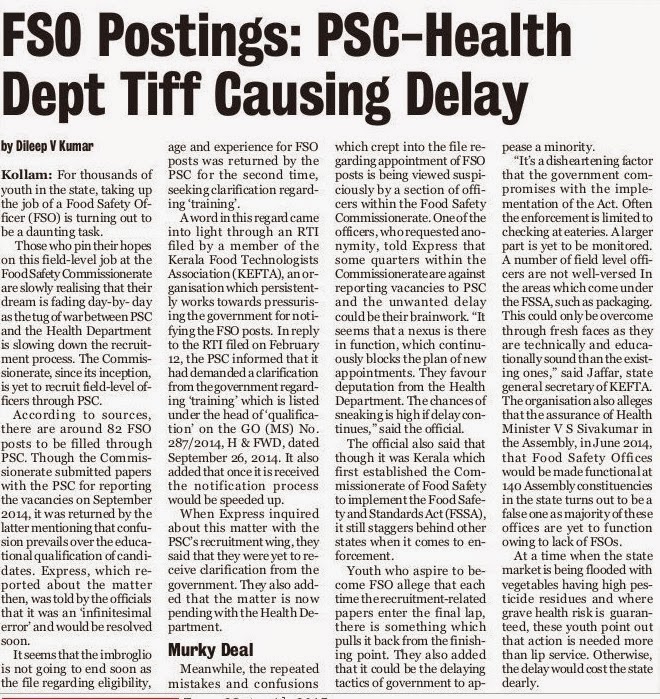
FSO Postings: PSC-Health Dept Tiff Causing Delay

KOLLAM:For thousands of youth in the state, taking up the job of a Food Safety Officer (FSO) is turning out to be a daunting task.
Those who pin their hopes on this field-level job at the Food Safety Commissionerate are slowly realising that their dream is fading day-by- day as the tug of war between PSC and the Health Department is slowing down the recruitment process. The Commissionerate, since its inception, is yet to recruit field-level officers through PSC.
According to sources, there are around 82 FSO posts to be filled through PSC. Though the Commissionerate submitted papers with the PSC for reporting the vacancies on September 2014, it was returned by the latter mentioning that confusion prevails over the educational qualification of candidates. Express, which reported about the matter then, was told by the officials that it was an ‘infinitesimal error’ and would be resolved soon.
It seems that the imbroglio is not going to end soon as the file regarding eligibility, age and experience for FSO posts was returned by the PSC for the second time, seeking clarification regarding ‘training’.
A word in this regard came into light through an RTI filed by a member of the Kerala Food Technologists Association (KEFTA), an organisation which persistently works towards pressurising the government for notifying the FSO posts. In reply to the RTI filed on February 12, the PSC informed that it had demanded a clarification from the government regarding ‘training’ which is listed under the head of ‘qualification’ on the GO (MS) No. 287/2014, H & FWD, dated September 26, 2014. It also added that once it is received the notification process would be speeded up.
When Express inquired about this matter with the PSC’s recruitment wing, they said that they were yet to receive clarification from the government. They also added that the matter is now pending with the Health Department. 
Murky Deal
Meanwhile, the repeated mistakes and confusions which crept into the file regarding appointment of FSO posts is being viewed suspiciously by a section of officers within the Food Safety Commissionerate. One of the officers, who requested anonymity, told Express that some quarters within the Commissionerate are against reporting vacancies to PSC and the unwanted delay could be their brainwork. “It seems that a nexus is there in function, which continuously blocks the plan of new appointments. They favour deputation from the Health Department. The chances of sneaking is high if delay continues,” said the official.
The official also said that though it was Kerala which first established the Commissionerate of Food Safety to implement the Food Safety and Standards Act (FSSA), it still staggers behind other states when it comes to enforcement. Youth who aspire to become FSO allege that each time the recruitment-related papers enter the final lap, there is something which pulls it back from the finishing point. They also added that it could be the delaying tactics of government to appease a minority.
“It’s a disheartening factor that the government compromises with the implementation of the Act. Often the enforcement is limited to checking at eateries. A larger part is yet to be monitored. A number of field level officers are not well-versed In the areas which come under the FSSA, such as packaging.
This could only be overcome through fresh faces as they are technically and educationally sound than the existing ones,” said Jaffar, state general secretary of KEFTA. The organisation also alleges that the assurance of Health Minister V S Sivakumar in the Assembly, in June 2014, that Food Safety Offices would be made functional at 140 Assembly constituencies in the state turns out to be a false one as majority of these offices are yet to function owing to lack of FSOs.
At a time when the state market is being flooded with vegetables having high pesticide residues and where grave health risk is guaranteed, these youth point out that action is needed more than lip service. Otherwise, the delay would cost the state dearly.