Jul 7, 2017

Why people believe the myth of 'plastic rice'

A video which falsely claims to "prove" the existence of fake plastic rice in the food supply
Despite little evidence that it's a widespread problem, rumours of "plastic" rice being sold in Africa and elsewhere persist on social media - driven in particular by viral videos which show bouncing rice balls.
The rumours spread over the last few weeks in Senegal, The Gambia and Ghana - and reached such a pitch that the Ghana Food and Drugs Authority decided to carry out an investigation.
They invited consumers and traders to submit samples of any rice brands they suspected of being made of plastic - and eventually concluded that there was no plastic rice being sold on the Ghanaian market.
Originating in China, rumours on social media have circulated since about 2010 of plastic rice being manufactured and mixed in with the real rice supply in order to trick consumers. The rumours were originally prompted by "fake rice" scandals, although they didn't involve food made entirely out of plastic.
In one case, companies were passing off ordinary but edible rice as premium "Wuchang" grains. Then in 2011, reports emerged that rice was being produced with potatoes and an industrial sticky resin. The rumours were further compounded when a Chinese restaurant association official warned that eating three bowls of "plastic rice" was the equivalent of eating one plastic bag.
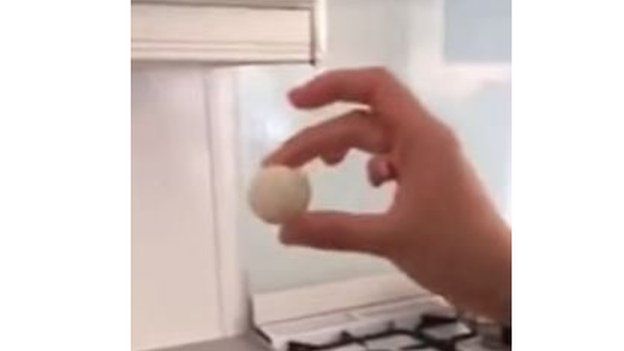
Social media users are making videos fuelling the 'plastic rice' rumours
At no point, however, were there confirmed cases of large amounts of plastic chips being passed off as rice. "Plastic rice" is manufactured for use in shipping boxes, but it's likely that in most cases the cost of the chips would actually be more expensive than real rice.
The story had reached social media in Africa by 2016 when Nigerian customs authorities confiscated 2.5 tonnes of rice. Customs officials initially claimed that the rice was plastic - and were later forced to backtrack when the country's health minister said there was no evidence for the claims. Tests showed that the rice did however contain a high level of bacteria, Nigeria's National Agency For Food and Drugs said.
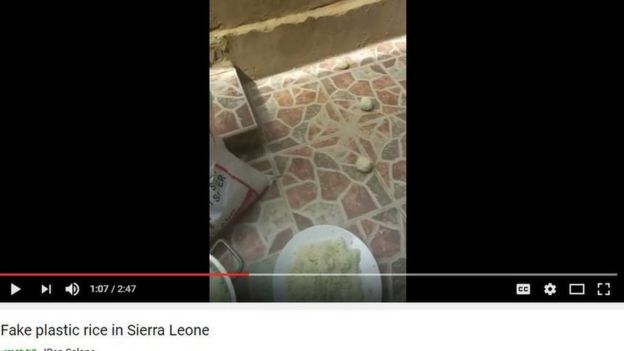
Bouncy rice
But rumours have persisted that plastic is being sold as rice, fuelled by videos which show people bouncing rice balls. Some also purport to show how the rice is made in factories.
Alexander Waugh, director of the Rice Association, a UK-based industry group, says the videos may be authentic - but not because the grains are plastic. Rice - when prepared in the right way - can actually bounce, Waugh told BBC Trending radio.
"The natural characteristics of rice are carbohydrates and proteins and you can do something like that with rice," Waugh says.
It could be that protectionism and a distrust of foreign imports is behind the persistence of the rumours, according to journalist Alexandre Capron of France 24's, The Observers.
Capron has worked extensively to debunk the myths around plastic rice and says some people are deliberately sharing fake videos to encourage consumers to buy more locally grown rice.
"The rumour is more popular in countries which are dependent on imported rice like Ivory Coast or Senegal," he says. "The rumour is so huge that governments are compelled to make statements... as to why there is no plastic rice."
Hassan Arouni, editor of the BBC's Focus on Africa, has looked into the "fake rice" rumours and says he's not sure whether people in West African countries are deliberately targeting food exporting countries such as China. But he does think food safety authorities in West Africa are doing the right thing by addressing the rumours head-on.
"I think that's the way to go and demonstrate to the public this [rumour] is not true," he says. "I think it will reassure people that this is fake news and probably somebody being naughty on the internet."

குளிர்பானம் குடிக்க போறீங்களா கவனம் தேவை

விருதுநகர், விருதுநகர் மற்றும் அதன் சுற்றுவட்டாரப்பகுதிகளில் உள்ள பெட்டிக்கடைகள் உள்ளிட்ட கடைகளில் அனைத்திலும் குளிர்பானங்கள் மற்றும் தண்ணீர்பாட்டில்கள் விற்பனை ஜோராக நடக்கிறது. இதில் பல கடைகளில் போலியான, காலாவதியான குளிர்பானங்கள், தண்ணீர்பாட்டில்கள் விற்பனை செய்யப்படுகிறது என்ற குற்றச்சாட்டு எழுந்துள்ளது.
விருதுநகர் கந்தக பூமி என்பதால் வெயிலின் தாக்கத்தை தணிக்க கடைகளுக்கு செல்லும் விழிப்புணர்வு இல்லாத மக்கள், கடைக்காரர்கள் கொடுக்கும் ஏதாவது ஒரு குளிர்பானத்தை 
குடித்து விட்டு செல்கின்றனர். வாங்கும் போது அது எந்த நிறுவனத்தில் தயாரிக்கப்பட்டது, காலாவதி நாள், அதில் கலந்துள்ள பொருள்கள் குறித்து பார்ப்பதில்லை. அவசரத்தில் கடைக்காரர்கள் கொடுக்கும் குடிநீர் பாட்டில், குளிர்பானங்களை குடித்து விட்டு செல்கின்றனர். 
கூடுதல் விலை
பல கடைகளில் போலி நிறுவனங்கள் தயாரிக்கும் குளிர்பானம், குடிநீர் பாட்டில், மற்றும் காலாவதியான குளிர்பானங்களை இருப்பு வைத்து வியாபாரம் செய்கின்றனர். அதிலும் சில கடைக்காரர்கள் கூடுதல் விலைக்கு விற்பனை செய்வதாகவும் கூறப்படுகிறது.
கிராமம் தான் குறி
விருதுநகரில் எப்போதும் குளிர்பானங்கள் விற்பனை அதிகளவில் இருக்கும். இதை பயன்படுத்தி சிலர் உரிய அனுமதி பெறாமல் போலி குளிர்பானம், குடிநீர் பாட்டில் தயார் செய்து விற்பனை செய்வதை வாடிக்கையாக கொண்டுள்ளனர். 
கடைகளில் குளிர்பானம் தயாரித்து பிளாஸ்டிக் பாக்கெட்டுகளில் அடைத்து விற்பனை செய்கின்றனர். இதுபோன்ற போலியான, தரமில்லாதவைகள் அனைத்தும் கிராமப்புறங்களை குறிவைத்து விற்பனை செய்யப்படுகிறது. அதிலும் பள்ளிகள், கோயில்கள், பொதுமக்கள் அதிகம் கூடும் சந்தை போன்ற இடங்களில் அதிகமாக விற்பனைக்கு வைக்கப்படுகிறது. 
கண்காணிப்பு தேவை
இதனால் குழந்தைகள் உட்பட அனைவருக்கும் வாந்தி, பேதி உள்ளிட்ட உடல் உபாதைகளால் பாதிக்க வாய்ப்புள்ளது. மாவட்ட நிர்வாகம், சுகாதாரத்துறை அதிகாரிகள் இதை கண்டுகொள்வதில்லை. எனவே அவ்வப்போது பெட்டிக்கடைகள் உள்ளிட்ட அனைத்து கடைகளிலும் அதிகாரிகள் கண்காணிக்கவேண்டும் என நுகர்வோர் விழிப்புணர்வாளர்கள் கூறுகின்றனர்.
போலிகள்
மணிகண்டன், விருதுநகர், “பெரும்பாலான பெட்டிக்கடைகளில் பாக்கெட்டுகளில் அடைக்கப்பட்ட குளிர்பானங்கள் விற்கப்படுகிறது. அதை பார்க்கும் போதே போலியானவை என தெரிகிறது. பள்ளி மாணவர்கள் தரமில்லாத பாக்கெட் குளிர்பானங்களையே தேடி வாங்கி குடிக்கின்றனர். 
தொடர்ந்து வாங்கி குடிப்பதால் பல்வேறு வயிற்றுப் பிரச்னைகளுக்கு ஆளாகின்றனர். அதுபோல் பெரும்பாலான கடைகளில் முகவரியில்லாத கம்பெனிகள் தயாரிக்கும் போலியான, காலாவதியான குளிர்பானம், தண்ணீர்பாட்டில் விற்பனை செய்யப்படுகிறது. 
இதனை தடுத்து, ஆரோக்கியமான பொருள் கிடைக்க அரசு அதிகாரிகள் நடவடிக்கை எடுக்கவேண்டும்” என்றார். விருதுநகர், விருதுநகர் மற்றும் அதன் சுற்றுவட்டாரப்பகுதிகளில் உள்ள பெட்டிக்கடைகள் உள்ளிட்ட கடைகளில் அனைத்திலும் குளிர்பானங்கள் மற்றும் தண்ணீர்பாட்டில்கள் விற்பனை ஜோராக நடக்கிறது. இதில் பல கடைகளில் போலியான, காலாவதியான குளிர்பானங்கள், தண்ணீர்பாட்டில்கள் விற்பனை செய்யப்படுகிறது என்ற குற்றச்சாட்டு எழுந்துள்ளது. விருதுநகர் கந்தக பூமி என்பதால் வெயிலின் தாக்கத்தை தணிக்க கடைகளுக்கு செல்லும் விழிப்புணர்வு இல்லாத மக்கள், கடைக்காரர்கள் கொடுக்கும் ஏதாவது ஒரு குளிர்பானத்தை குடித்து விட்டு செல்கின்றனர். வாங்கும் போது அது எந்த நிறுவனத்தில் தயாரிக்கப்பட்டது, காலாவதி நாள், அதில் கலந்துள்ள பொருள்கள் குறித்து பார்ப்பதில்லை. அவசரத்தில் கடைக்காரர்கள் கொடுக்கும் குடிநீர் பாட்டில், குளிர்பானங்களை குடித்து விட்டு செல்கின்றனர். கூடுதல் விலை பல கடைகளில் போலி நிறுவனங்கள் தயாரிக்கும் குளிர்பானம், குடிநீர் பாட்டில், மற்றும் காலாவதியான குளிர்பானங்களை இருப்பு வைத்து வியாபாரம் செய்கின்றனர். அதிலும் சில கடைக்காரர்கள் கூடுதல் விலைக்கு விற்பனை செய்வதாகவும் கூறப்படுகிறது. கிராமம் தான் குறி விருதுநகரில் எப்போதும் குளிர்பானங்கள் விற்பனை அதிகளவில் இருக்கும். இதை பயன்படுத்தி சிலர் உரிய அனுமதி பெறாமல் போலி குளிர்பானம், குடிநீர் பாட்டில் தயார் செய்து விற்பனை செய்வதை வாடிக்கையாக கொண்டுள்ளனர். கடைகளில் குளிர்பானம் தயாரித்து பிளாஸ்டிக் பாக்கெட்டுகளில் அடைத்து விற்பனை செய்கின்றனர். இதுபோன்ற போலியான, தரமில்லாதவைகள் அனைத்தும் கிராமப்புறங்களை குறிவைத்து விற்பனை செய்யப்படுகிறது. அதிலும் பள்ளிகள், கோயில்கள், பொதுமக்கள் அதிகம் கூடும் சந்தை போன்ற இடங்களில் அதிகமாக விற்பனைக்கு வைக்கப்படுகிறது. கண்காணிப்பு தேவை இதனால் குழந்தைகள் உட்பட அனைவருக்கும் வாந்தி, பேதி உள்ளிட்ட உடல் உபாதைகளால் பாதிக்க வாய்ப்புள்ளது. மாவட்ட நிர்வாகம், சுகாதாரத்துறை அதிகாரிகள் இதை கண்டுகொள்வதில்லை. எனவே அவ்வப்போது பெட்டிக்கடைகள் உள்ளிட்ட அனைத்து கடைகளிலும் அதிகாரிகள் கண்காணிக்கவேண்டும் என நுகர்வோர் விழிப்புணர்வாளர்கள் கூறுகின்றனர். போலிகள் மணிகண்டன், விருதுநகர், “பெரும்பாலான பெட்டிக்கடைகளில் பாக்கெட்டுகளில் அடைக்கப்பட்ட குளிர்பானங்கள் விற்கப்படுகிறது. அதை பார்க்கும் போதே போலியானவை என தெரிகிறது. பள்ளி மாணவர்கள் தரமில்லாத பாக்கெட் குளிர்பானங்களையே தேடி வாங்கி குடிக்கின்றனர். தொடர்ந்து வாங்கி குடிப்பதால் பல்வேறு வயிற்றுப் பிரச்னைகளுக்கு ஆளாகின்றனர். அதுபோல் பெரும்பாலான கடைகளில் முகவரியில்லாத கம்பெனிகள் தயாரிக்கும் போலியான, காலாவதியான குளிர்பானம், தண்ணீர்பாட்டில் விற்பனை செய்யப்படுகிறது. இதனை தடுத்து, ஆரோக்கியமான பொருள் கிடைக்க அரசு அதிகாரிகள் நடவடிக்கை எடுக்கவேண்டும்” என்றார்.

சமையல் எண்ணெய் பாக்கெட்களில் 'கொலஸ்ட்ரால் இல்லை' வாசகத்திற்கு தடை

சிவகங்கை: சமையல் எண்ணெய் பாக்கெட்களில் 'கொலஸ்ட்ரால் இல்லை'என்ற வாசகம் எழுதுவதற்கு உணவு பாதுகாப்புத்துறை தடை விதித்துள்ளது.
கடலை, சூரியகாந்தி, தேங்காய், எள் போன்ற தாவரங்களில் தயாரிக்கப்படும் சமையல் எண்ணெய்களில் இயற்கையாகவே 'கொலஸ்ட்ரால்' இல்லை. ஆனால் சில எண்ணெய் 
நிறுவனங்கள் மக்களை கவரும் வகையில் தங்களது தயாரிப்பில் 'கொலஸ்ட்ரால்' இல்லை என வாசகத்தை அச்சிட்டு வருகின்றன. இந்த விளம்பரத்தால் நுகர்வோர் ஏமாற்றம் அடைந்து வருகின்றனர். உணவு பாதுகாப்புச் சட்டப்படி, 'எண்ணெய்யின் இயற்கை குணாதிசயத்தை பாக்கெட்டில் குறிப்பிட தேவையில்லை, செயற்கையாக சேர்க்கப் படும் பொருட்கள் மற்றும் அதனால் ஏற்படும் மாற்றத்தை மட்டும் குறிப்பிட்டால் போதும்,' என கூறப்பட்டுள்ளது.ஆனால் தாவர எண்ணெய்யின் இயற்கை குணாதிசயமான 'கொலஸ்ட்ரால்' இல்லாததை, தங்களது 
தயாரிப்புகளுக்கே உரித்தானது போல் விளம்பரப்படுத்தி சில நிறுவனங்கள் மக்களை ஏமாற்றி வருகின்றன. இதனை தடுக்கும் வகையில் தாவர எண்ணெய் பாக்கெட் களில் 'கொலஸ்ட்ரால் இல்லை' என்ற வாசகம் இருந்தால், அவற்றை பறிமுதல் செய்ய உணவு பாதுகாப்புத்துறை உத்தரவிட்டுள்ளது.
உணவு பாதுகாப்புத்துறை அதிகாரி ஒருவர் கூறியதாவது: விலங்குகளிடம் இருந்து கிடைக்கும் எண்ணெய்களில் மட்டுமே 'கொலஸ்ட்ரால்' இருக்கும். மேலும் தாவர எண்ணெய்களில் செயற்கையால் மேற்கொள்ளப்படும் மாற்றங்களை வேண்டுமானால் குறிப்பிடலாம். இயற்கையிலேயே உள்ள அதன் குணாதிசயத்தை பிரபலப்படுத்தி வியாபாரம் செய்ய கூடாது, என்றார்.சிவகங்கை: சமையல் எண்ணெய் பாக்கெட்களில் 'கொலஸ்ட்ரால் இல்லை'என்ற வாசகம் எழுதுவதற்கு உணவு பாதுகாப்புத்துறை தடை விதித்துள்ளது. கடலை, சூரியகாந்தி, தேங்காய், எள் போன்ற தாவரங்களில் தயாரிக்கப்படும் சமையல் எண்ணெய்களில் இயற்கையாகவே 'கொலஸ்ட்ரால்' இல்லை. ஆனால் சில எண்ணெய் நிறுவனங்கள் மக்களை கவரும் வகையில் தங்களது தயாரிப்பில் 'கொலஸ்ட்ரால்' இல்லை என வாசகத்தை அச்சிட்டு வருகின்றன. இந்த விளம்பரத்தால் நுகர்வோர் ஏமாற்றம் அடைந்து வருகின்றனர். உணவு பாதுகாப்புச் சட்டப்படி, 'எண்ணெய்யின் இயற்கை குணாதிசயத்தை பாக்கெட்டில் குறிப்பிட தேவையில்லை, செயற்கையாக சேர்க்கப் படும் பொருட்கள் மற்றும் அதனால் ஏற்படும் மாற்றத்தை மட்டும் குறிப்பிட்டால் போதும்,' என கூறப்பட்டுள்ளது.ஆனால் தாவர எண்ணெய்யின் இயற்கை குணாதிசயமான 'கொலஸ்ட்ரால்' இல்லாததை, தங்களது தயாரிப்புகளுக்கே உரித்தானது போல் விளம்பரப்படுத்தி சில நிறுவனங்கள் மக்களை ஏமாற்றி வருகின்றன. இதனை தடுக்கும் வகையில் தாவர எண்ணெய் பாக்கெட் களில் 'கொலஸ்ட்ரால் இல்லை' என்ற வாசகம் இருந்தால், அவற்றை பறிமுதல் செய்ய உணவு பாதுகாப்புத்துறை உத்தரவிட்டுள்ளது. உணவு பாதுகாப்புத்துறை அதிகாரி ஒருவர் கூறியதாவது: விலங்குகளிடம் இருந்து கிடைக்கும் எண்ணெய்களில் மட்டுமே 'கொலஸ்ட்ரால்' இருக்கும். மேலும் தாவர எண்ணெய்களில் செயற்கையால் மேற்கொள்ளப்படும் மாற்றங்களை வேண்டுமானால் குறிப்பிடலாம். இயற்கையிலேயே உள்ள அதன் குணாதிசயத்தை பிரபலப்படுத்தி வியாபாரம் செய்ய கூடாது, என்றார்.

Jul 6, 2017

FSSAI - TRANSFORMING THE FOOD SAFETY & NUTRITION LANDSCAPE IN INDIA


DINAKARAN NEWS


DINAKARAN NEWS


GST shadow on world's largest community kitchen


DC impact: Food safety officials raid canteens in bus depot

The food safety department sent a notice to all the bus depots and the Managing Director of MTC, mandating on some factors.
Chennai: After DC exposed the ugly state of canteens for drivers and conductors inside the Metropolitan Transport Corporation (MTC) bus depots, officials from Food Safety and Standards Authority of India (FSSAI) conducted raids following which startling details were revealed, a major one of them being non-procurement of license.
The officials inspected all the bus depots out of which Ayanavaram, Adyar, Vadapalani, Tondiarpet and Kodungaiyur in Chennai district and Thiruvottriyur bus depot in Tiruvallur district were found to be flouting norms blatantly.
“Neither of the canteens at bus depots is registered nor do they have a license. A certificate from FSSAI, which is mandatory to run a canteen, is also missing. We have given a grace period of 15 days, after which all the canteens will be checked again,” said R. Kathiravan, Designated Officer, FSSAI.
The food safety department sent a notice to all the bus depots and the Managing Director of MTC, mandating on some factors – Repainting of walls, provision of an outlet for smoke, cleanliness of the kitchen, fitness certificate, gloves and a cap to the chef and server, drinking water facility with government certificate, disposal of food waste within a day, tiles laid on all the floors and proper maintenance of hygiene. 
In the notice sent to the Tiruvallur bus depot on July 4, provision of Reverse Osmosis (RO) at the canteen was specially mentioned and asked the MD to provide it within 15 days.
The issue started in June this year when the secretary of Nethaji Transport Union, K Anbazhagan’s complaint about poor hygiene at canteens in bus depots, was refused by the superintendent of the Chrompet bus depot. Later, he sent a mail to the FSSAI and three collectors of Chennai, Tiruvallur and Kancheepuram.
“I knew there was something fishy from the beginning. How could the government permit the contractors to take over without a licence? Shortly, I will file a case in the High Court regarding this,” he said. The Managing Director of MTC who was hesitant to comment on the issue said he will try to better the plight of canteens at the earliest.

Fisheries department moots action plan to check quality

KANNUR: Faced with the threat of indiscriminate use of chemical preservatives, the fisheries department is planning to strengthen its vigil and use modern technologies to test fish consignments. Also, testing would be strengthened at checkposts to prevent the use of hazardous chemicals like sodium benzoate to preserve fish when it is brought from other states.
"As of now we don't have a lab to single out chemicals used to preserve fish, a perishable item. We cannot withhold sales till the chemical analysis report is ready. This often becomes a hurdle and our task is left incomplete," said an official with the department.
However, the scientists at the Central Institute of Fisheries Technology (CIFT) in Kochi are in the process of developing a handheld device to test chemical levels in fish. Once this device is made available, checking squads can take it to markets or checkposts to test consignment quality, he said.
Though there is an inspection team (comprising officials from the food safety and fisheries department) in every district, the plan is to strengthen its operations, said department officials.
If a consignment is found to be adulterated with toxic substances, sales can be stopped and if it is imported from other states, it would be sent back after taking samples for further testing. "We had conducted workshops at a few places, including Kozhikode, to gather inputs from officials, boat owners, fishermen and trade union leaders to formulate an action plan," said Satheeshkumar, joint director, fisheries department.
According to officials, the problem before fishermen is that fish is brought directly to the harbour from other states. If there is a stringent measure to curb the sale of fish laced with toxic preservatives, this flooding can be regulated, thus giving better marketing opportunity to local fishermen.
Officials also said there was a plan to introduce permit system for auctioning fish so that middlemen influence can be restricted. The plan is to conduct auction through fishermen cooperative societies so that they would get better earnings.
The permits would be given to those people recommended by the cooperative societies, said officials, adding that proposal was being discussed.

Tobacco products destroyed

The Food Safety Department destroyed gutka and other products containing tobacco and nicotine seized from several shops in the city earlier this week.
During the raids supervised by the Designated Officer for Food Safety and Drug Administration Kalaivani, the banned products worth Rs. 3.5 lakh that were seized from shops were burnt.
The shop owners were warned that they would face action under the Food Safety & Standards Act, 2006, if they were caught selling the banned products henceforth.
District Collector S. Prabakar said in a press release that the public could pass on information about surreptitious sale of the banned products to the office of Food Safety Department over phone: 0424-2223545.
The banned products include gutka, pan masala, zarda and tobacco-based flavoured mouth fresheners. The Central Government issued the ban order last December following a Supreme Court order dated September 23, 2016, banning chewing tobacco products.
According to the Food Safety and Standards (Prohibition and Restrictions on sales) Regulations, 2011, issued by the Food Safety Standards Authority of India (FSSAI), tobacco and nicotine shall not be used as ingredients in any food products.
The order prohibiting manufacture, storage, distribution or sale of gutka and pan masala containing tobacco or nicotine, or any other product marketed separately containing tobacco or nicotine, was issued by the Central Government taking cognisance of the Global Audit Tobacco Survey — India (GATS) 2010, that mortality and morbidity due to consumption of smokeless tobacco was very high in India.
The survey stated that India shares the maximum burden of oral cancer in the world.

Ban on gutkha, panmasala sale

Office of the chief medical officer (CMO) Dimapur has notified all the tobacco and panmasala dealers (wholesale or retail) in Dimapur district to immediately stop distribution and sale of gutkha or panmasala.
In a press release, chief medical officer Dimapur, Dr. K Vikato Kinimi, reminded that in compliance of the Supreme Court order dated September 23, 2016, the food safety commissioner, government of Nagaland had issued a notification dated May 16, 2017 prohibiting distribution and sale of gutkha or panmasala (containing tobacco or nicotine) and any other products marketed separately having nicotine or tobacco in the final products by whatever name called whether packaged or unpackaged or sold as one product or through packaged as separate products sold or distributed in such a manner so as to easily facilitate mixing by the consumers.
In view of this, the CMO Dimapur has informed all the tobacco and panmasala dealers (wholesale or retail) in Dimapur district to immediately adhere to this order.
CMO Dimapur cautioned that non-compliance of the notification would be an offence punishable under section 59 of Food Safety and Standards Act 2006.

Jul 5, 2017

Smoky drink leaves man with hole in stomach


He was rushed to a hospital where the doctors discovered a big opening in the stomach.
A drink at the end of a tiring day turned into a nightmare for a Delhi resident who was left with a 90mm hole in his stomach after gulping down a liquid nitrogen based cocktail.
The victim ordered a few rounds of drinks and some food at a bar in Gurugram but began to feel uncomfortable after consuming it. Assuming that he had acidity, the bartender suggested a tempting cold cocktail with smoke emanating from it. The man gulped it down and was writhing in pain in no time.
He was rushed to a hospital where the doctors discovered a big opening in the stomach.
“For patients with chronic acid problems, we can see perforations of 1-2 mm diameter. For him, it was a 90mm hole. The stomach was open like a book,” Amit Deepta Goswami, a consultant doctor at Columbia Asia Hospital in Gurugram, told DH. 
The damage was caused by liquid nitrogen which was added to the drink to quickly cool it down and make it look attractive.
“While small perforations can be sewed up, it was not possible in this case. Almost 45% of the stomach was removed and the rest was connected to the small intestine,” Goswami said. The cocktail substantially damaged the nearby tissues as well.
The incident occurred in April and the patient is doing fine at the moment. He has since quit alcohol.
Liquid nitrogen has a boiling point of -195.8 degrees Celsius and is used to instantly freeze food and beverages. The colourless liquid is also used to cool computers and in cryogenic medical procedures. When used to freeze beverages, it should only be consumed after the nitrogen has completely evaporated.
Unfortunately, the victim did not wait for the smoke to evaporate. 
Goswami said it was a rare case as the only other case known to him took place in the UK where an 18-year-old girl ended up in a hospital after celebrating her birthday at a bar.
Liquid nitrogen is permitted as an additive in frozen food as per the guidelines of the Food Safety and Standards Authority of India (FSSAI). But when it comes to the use of liquid nitrogen it is a grey area.

Protein levels are rapidly declining in all foods in India

We are also consuming less protein-rich foods. What are the gulfs in our diet?
Large parts of agricultural soil in India are deficient in zinc, boron and iron, and climate change too is affecting plant nutrition levels 
The doctor's words will always ring in your ears: eat more protein-rich foods. But this timeless advice may be hard to implement if the latest report of the National Institute of Nutrition (NIN), Hyderabad, is to be believed. The levels of protein in Indian foods, both vegetarian and non-vegetarian, are declining rapidly. For instance, between 1993-94 and 2011-12, protein levels in beans dropped around 60 per cent; in brown lentil (whole), it went down by 10 per cent; and, in goat meat, it has come down by 5 per cent. 
Protein is a vital macronutrient needed to cope with the wear and tear of the body, in making enzymes and hormones. It is the building block of bones, muscles, cartilage, skin and blood. The deficiency of protein can manifest itself in many ways—sluggishness, slow recovery from injuries and brain fog (lack of focus). If not addressed, this deficiency can lead to nutritional diseases in children like Kwashiorkor and Marasmus.
According to a recent report of the National Sample Survey Office (NSSO), rural households were consuming 56.5 g in 2011-12, down from 60.2g in 1993-94, while urban households were consuming 55.7g, down from 57.2g in 1993-94. In contrast, the national daily intake of protein in Japan was 69.1g in 2015; the figures for USA are even higher.
Aruna Kurpad, head of physiology and nutrition department at St John’s Research Institute, Bengaluru, says that even the amount of protein consumed by most Indians is not of high quality. Even the NSSO data showed that a major share of the total protein intake in both rural and urban India was from cereals, which are not the best source of protein.
Diet diagnosis
Seema Gulati, head, Nutrition Research Group Center for Nutrition & Metabolic Research sheds light. “Our diet is not very meat-intensive. Even those who are non vegetarians, on an average, eat it only on a weekly basis,” she says. NSSO says that egg, fish and meat make up for just seven per cent of protein intake in rural households and nine per cent in urban counterparts.
Shashank Joshi, a medical researcher and diabetologist, offers another explanation: “Proteins, both visible and invisible, are deficient in both urban and rural Indians because we are a cereal-based economy. We eat wheat or rice. We don’t consume as much millets and pulses. Worse, we polish grains and destroy whole grains with modern methods,” he says. He conducted a study in 2014 and found that dietary patterns among Indians tilted towards carbohydrate intake much more than protein. Joshi’s insight is supported by NSSO data. In rural and urban households, cereals account for 58 per cent and 49 per cent of total protein intake respectively. 
While pulses are viewed as the main source of protein in a vegetarian diet, it’s not as simple as eating more pulses. Veena Shatrugna, former deputy director of NIN, says the intake of pulses has gone down with rising prices. “The saddest thing about daal is that it is one of the poorest sources of protein, unless you eat a certain ratio of daal to rice—for instance one to four at every meal,” she adds.
Gulati says the quality of a food source’s protein is determined by the number of amino acids it has. "Protein from animal food products has higher number of amino acids, and therefore, it is better than plant proteins," she says, adding that to get the same kind of protein from plant-based foods, the diversity of food must be widened. However, not everyone can afford meat products and many more do not eat meat. So how can vegetarians improve their protein intake? "Millets are high quality food. It has much more protein, much more iron and micronutrients. Why doesn't the government add it to the Public Distribution System (PDS)?" asks Prasad. “There are other cheap sources of protein. There is chana (gram). It is not very difficult to afford. Soybean is also a good source of protein," says nutritionist and founder of IDK Healthcare, Ishi Khosla. Mixing nutrients from different sources is important to have a balanced diet, she adds. 
Depleting dynamics
There are also external factors for declining levels of protein in food. Experts say intensification of agriculture has impacted soil health. Large parts of agricultural soil in India are deficient in zinc, boron and iron, according to a study by the Indian Institute of Soil Science, Bhopal. Moreover, studies have shown that climate change can affect plant nutrition levels, reducing their protein, zinc and iron content. 
NSSO’s household consumer expenditure on food items provides another insight into protein deficiency. In urban areas, beverages, refreshments and processed foods account for the highest monthly expenditure (Rs 236), while the same position is occupied by cereals (Rs 154) in rural households.
“In a vegetarian diet, different kinds of pulses in different forms like sprouts, daal, must be consumed, and this must be supplemented by nuts and milk products,” adds Gulati. “Expenditure on processed food should be curtailed. That’s a big chunk of the expenses,” says Dipa Sinha, assistant professor of economics at the School of Liberal Studies, Ambedkar University, New Delhi.
She adds that the PDS needs to be robust enough to at least satisfy the cereal requirement of households. The money thus saved can be used to increase the intake of vegetables, fruits, eggs and meat products. Vandana Prasad, national convenor of Public Health Resource Network, a non-profit, quips, "The cost for a packet of Kurkure and an egg is the same, Rs 5." Unless health policymakers come up with long-term measures to improve the protein content in all our foods, we cannot hope for a healthy diet.

Complaints against 130 advertisements uphe

The Consumer Complaints Council (CCC) of ASCI, has upheld complaints against 130 advertisements, including 73 complaints in the Healthcare category and 30 in the Education category covering several private coaching classes.
The advertisements under the Healthcare category include the advertisement of Perfect Point, assuring fat reduction, Vibes Healthcare Ltd, providing treatment for hair re-growth and the advertisements of all India level firm Vardaan Speech & Hear Diagnostic Centre.
Under the Education category, the advertisements of Manya Education Private Limited (GMAT Coaching) and Jamboree Education Pvt. Ltd have been found to be exaggerated and misleading. Similarly, under the Personal care category, the advertisements of Vini Cosmetics Pvt. Ltd (Fogg Roll on Deodorant offering elimination of 96 per cent bacteria) and Godrej’s Cinthol offering a 'buy 3 get 1 free' deal are found to be misleading. Hindustan Unilever’s Pepsodent Germi Check has also come under the ASCI scanner.
In the Food and Beverage category, the advertisements of Adani Wilmar’s Raag Gold Refined Palmolein Oil, which claims Zyada Sehat, Doctor Rice: Sugar Free Rice and Hatsun Agro Product Ltd, Arokya Curd have also found to be false and misleading.
The advertisements of Reliance Communications (fastest 4G network), Airtel (249 unlimited local calls) and Vodafone (Rs.328 + Unlimited Local / STD Calls for 28 days) have also been found to be misleading and exaggerated.
Don't Add Extra to the Ad!
The Advertising Standards Council of India (ASCI), is a self-regulatory organization for the advertising industry to promote, maintain, monitor and uphold fair, sound, ethical and healthy principles and practices of advertising for the protection of interest of consumers and the general public. Established in 1985, the ASCI’s role has been acclaimed by various Government agencies. The Government bodies including The Department of Consumer Affairs (DOCA), the Food Safety and Standards Authority of India (FSSAI) and the Ministry of AYUSH have partnered with ASCI to address all misleading advertisements in their respective sectors.

Food regulator turns down NADA’s request to frame food supplement standards

The National Anti-Doping Agency (NADA) recently approached the Food Safety and Standards Authority of India (FSSAI) with a request to frame standards for these supplements because they were deeply worried about the mushrooming variety of off-the-shelf food supplements and possibility that some of them contain banned performance enhancing substances. After several meetings between both the parties, FSSAI declined the request stating that given the nature of expertise and sports medicine knowledge required to do so is beyond their mandate. NADA officials approached FSSAI over concerns that rapidly increasing gyms in urban and rural areas were pushing some of these supplements and there is no control or monitoring over what they contain. Hence, FSSAI should frame standards.
FSSAI agreed in principle regarding the issue expressed by NADA wherein a section of the authority was keen to go ahead with the exercise, but in the end the authority decided not to. A senior official said though the NADA’s concerns were genuine, there were certain issues that was not in favour of NADA. “The concerns they raised were genuine. Food supplements are sold over the counter and often pushed by gym instructors may contain performance enhancing substances banned for athletes or substances that are just generally harmful for people if used indiscriminately. There may even be prescription drugs that ordinarily cannot be bought over the counter but have an anabolic (body-building) effect on the body.”
After numerous discussions and meetings with NADA, FSSAI concluded that they could not frame standards from NADA’s perspectives and yardsticks. It was beyond their mandate. “We deliberated over the matter, had meetings with NADA and decided that we cannot frame standards from the perspective they want us to. It is beyond our mandate — there is a long list of banned substances, some that are not to be used during competitions but can be used otherwise, and others that can never be used. Then there is also the matter of dosage. So we told them that it is beyond our mandate,” the official added.
Last year, FSSAI had notified standards for health supplements, nutraceuticals, and foods for special dietary use, food for special medical purpose, functional food and novel foods. The regulations stipulated by the FSSAI mentions that “the articles of food with standard nutrient or nutritionally complete formulation shall consist of a composition delivering the desired level of energy, protein, vitamins and minerals, and other essential nutrients required for respective age group, gender and physiological stage in accordance with the guidelines made by the Indian Council of Medical Research.”

Print pre and post GST MRP on goods till Sept.


DINAKARAN NEWS


Gutka and tobacco products worth Rs 3.70 lakh seized in Erode

Erode(TN), Jul 4 (PTI) Nearly Rs 3.70 lakh worth of banned gutka and tobacco products were seized during raids conducted here.
In a press communication, Food Safety and Standard Authority of India today said, a team of officials carried out surprise raids in shops in Kongalamman Koil street and surrounding areas and confiscated Rs 3.70 lakh worth of banned tobacco and gutka products.
All the seized items were taken to Erode Municipal Corporation garbage yard and destroyed, it said.
The shop keepers who were in possession of the same were warned.
No cases were registered, it added.

DINAKARAN NEWS


DINAKARAN NEWS


Jul 4, 2017

Be tough on adulteration

A multi-pronged approach, involving police, medical and health, and agriculture departments, is needed to win the war on adulteration
Food adulteration is no less a crime than an act of terrorism. The perpetrators play havoc with public health and deliberately put the lives of innocent people at grave risk. Such elements must be curbed with an iron hand and given exemplary punishment. Adulteration of food items, including milk, rice and oils, and sale of spurious seeds and fertilizers is an alarming trend that must be checked without any prevarication. Chief Minister K Chandrashekhar Rao’s unambiguous direction to the authorities on curbing adulteration is commendable. While ordering a crackdown against adulteration of food items and sale of spurious seeds and fertilizers, the Chief Minister has rightly highlighted his government’s readiness to amend the existing laws to ensure swift and stringent punishment for those indulging in adulteration. His tough talking on the issue should send right signals across the State. The police must pull up their socks and go after the unscrupulous elements without any mercy. Farmers are suffering huge losses on account of spurious seeds and fertilizers. India’s food system is largely unorganised and highly fragmented with large-scale procurement, distribution and retail sales. The task of regulators becomes very challenging because of insufficient number of laboratories and manpower to test food standards. Since adulteration of food comes under the Concurrent List, the Centre and State governments must work in tandem to maintain safety standards. More teeth need to be added to the Food Safety and Standards Act of 2006 keeping in view the changing technologies.
While making the anti-adulteration provisions more stringent, there is a need for substantial public investments to expand and increase the quality of storage, handling and transportation infrastructure. The private sector should also be encouraged to establish food testing laboratories. This would go a long way in ensuring that the products are within the safety limits. There is a need for Food Safety and Standards Authority of India (FSSAI), an autonomous food regulator, to take up public awareness programmes. A multi-pronged approach, involving police, medical and health, and agriculture departments, needs to be adopted. DNA-based methods can be used extensively to detect food adulterants. Deterrent punishment for food adulterators holds key to curbing this menace. The Law Commission has recommended amendments to the Indian Penal Code to provide harsher punishment in such cases. Currently, sections 272 and 273 of the IPC which deal with ‘Adulteration of food or drink intended for sale’ and ‘Sale of noxious food or drink’ lay down imprisonment up to six months and a fine extending up to Rs 1,000 for both offences. The Commission has recommended life imprisonment and a hefty fine for those convicted of adulterating food items.

Don't drink liquid nitrogen. You'll end up with a hole in your stomach

A 30-year-old man from Delhi, who downed a fancy 'smoking' shot knows better now.
Don’t drink liquid nitrogen. It’s pretty bad for your health. Well, that’s pretty obvious but in case you need proof, just ask this man from Delhi whose stomach now has a hole, thanks to liquid nitrogen.
According to a report in Hindustan Times, two months ago, a 30-year-old who downed a fancy “smoking” shot did not realise that the drink was to be consumed only after the smoke dissipated. In fact, he consumed two.
Just after consuming the drink the man began to experience extreme pain in his stomach accompanied by breathlessness, and had to be immediately rushed to a hospital in Gurgaon.
Upon examining the man, the doctors decided that surgery was necessary and once they opened him up, they realised the extent of the damage caused. According to the report, his stomach “was open like a book”.
The man, who wished to remain anonymous, was quoted by HT saying, “I gulped down the drink, I started feeling very uncomfortable, like how you feel when there is an acid reflux. The bartender passed me another drink and I had it, not thinking too much about the discomfort. However, within seconds, my stomach started swelling and I was in unbearable pain. Breathing was also difficult.”
How did this happen?
The drink that he had consumed was covered with liquid nitrogen. Why? Liquid nitrogen has a boiling point of -196 degrees Celsius. Hence it is used for a variety of things, such as a coolant for computers, in medicine to remove unwanted skin, warts and pre-cancerous cells, and in cryogenics, where scientists study the effect of very cold temperatures on materials. But apart from all the medical and scientific uses, liquid nitrogen has also become a popular gastronomic tool.
Restaurants and bars use liquid nitrogen as a method for instantly freezing food and drinks, or creating and clouds of vapour or fog when exposed to air. Of course, caution should be maintained. When used to freeze drinks, these should only be consumed after the nitrogen has completely evaporated.
According to John Emsley of the Royal Society of Chemistry in England, "If you drank more than a few drops of liquid nitrogen, certainly a teaspoon, it would freeze, and become solid and brittle like glass. Imagine if that happened in the alimentary canal or the stomach. The liquid also quickly picks up heat, boils and becomes a gas, which could cause damage such as perforations or cause a stomach to burst."
While the use of liquid nitrogen is permitted as an additive in frozen food as per the guidelines of the national regulatory body Food Safety and Standards Authority of India (FSSAI), there are no definitive guidelines set for it, especially in terms of safety. 
“There is no clear-cut guideline for it and generally it is considered to be a novel technique, which can be used by food business operators,” said Dr Saurabh Arora of FoodSafetyHelpline.
The aftermath
The patient, when he was admitted, had an abnormally swollen stomach, and his heart rate, blood pressure, and oxygen saturation were well away from optimum conditions. Surgery revealed a huge perforation in the middle and the lower parts of the man’s stomach. Since it was not possible to stitch it back, as the tissue near the tear was too damaged, the doctors removed the damaged portion of the stomach and connected his stomach to the remaining part of the small intestine.
Post the surgery, the patient had to be kept on a ventilator for three days, but thankfully he has since recovered. 
“Consuming liquid nitrogen can cause havoc in a person’s system. By nature, liquid nitrogen expands manifolds and evaporates when left at room temperature. The gas did not have an escape route after the person consumed it and the sphincter closed, this is what led to a perforation in his stomach,” said Dr Amit Deepta Goswami of Columbia Asia Hospital in Gurgaon, where the man was taken to.
Moral of the story: be careful what you put in your mouth. You never know what might happen.

Beware of ‘smoky’ drinks: How safe is liquid nitrogen?

Liquid nitrogen is used to freeze desserts and make fancy cocktails, but a Delhi man ended up with a hole in his stomach after consuming it. Is it really safe?
A nitrogen-chilled drink at a bar in Gurgaon left a Delhi man with a perforated stomach.

It gives your drink a ‘cauldron’ look and your ice-cream an instant magical freeze.
From cold chaats to freeze-dried fruits molecular gastronomy chefs use liquid nitrogen to create such dramatic treats. Not many, however, know that it could be potentially dangerous.
One such nitrogen-chilled cocktail left a Delhi man with a hole in his stomach. He was rushed to a hospital emergency and underwent a major surgery where the damaged parts of his stomach had to be removed and attached to the small intestines.
However, this was not an isolated case. Instances of people ending up in a hospital after consuming liquid nitrogen have been reported from the United Kingdom too. In 2012, an 18-year-old British teenager underwent an emergency gastrectomy after drinking a Jagermeister cocktail.
Here is all you need to know about it:
What is liquid nitrogen?
It is nothing but cooled, liquefied form of nitrogen gas. It is so cold that its boiling point is -195.8 degree Celsius. It can instantly freeze anything that it comes in contact with while evaporating.
Is liquid nitrogen safe?
Liquid nitrogen is often used to instantly freeze foods and is safe when handled properly. “Any food that uses liquid nitrogen should be had after all the gas has completely evaporated,” said Dr Saurabh Arora, foodsafetyhelpline.com, a website which helps people understand the rules and regulations governing food safety. He also heads food testing laboratories in Delhi, Baddi and Bangalore.
“The drink should not be bubbling when a person consumes it, as this indicates that there is still nitrogen gas in it. The white smoke-like vapour, however, is no problem as it forms due to the moisture around after the gas has evaporated and cooled the drink around,” he added.
What happens if you consume liquid nitrogen?
Liquid nitrogen is a colourless liquid and though it is used by chefs to create instant freeze, it cannot be seen as a food item. “Liquid nitrogen is so cold that it can give instant frostbite and when ingested it can damage tissues in the oesophagus and the stomach,” said Dr Mriganka S Sharma, surgeon at Columbia Asia hospital.
It also has a large expansion ratio of 1:694 at 20 degree Celsius. This means that one litre of liquid nitrogen can expand to 694 litres of nitrogen gas at 20 degree Celsius . “As little as one spoon of liquid can expand to more than 600 spoons of gas. Once consumed, the gas does not have an escape route and this can lead to a perforation or a hole in the stomach,” said Dr Amit Deepta Goswami, who treated the Delhi man and a consultant of bariatric and minimal invasive surgery at Columbia Asia Hospital, Gurgaon.
Are there regulations governing the use of liquid nitrogen?
Liquid nitrogen is permitted as an additive in frozen food as per the guidelines of the national regulatory body Food Safety and Standards Authority of India (FSSAI). “However, when it comes to the use of liquid nitrogen it is a gray area. There is no clear-cut guideline for it and generally it is considered to be a novel technique, which can be used by food business operators,” said Dr Arora.

Check adulteration of sago: farmers

Sago unit owners should be included in vigilance committees
A plea to the district administration to take effective steps for checking adulteration in sago manufacturing process was made at the farmers grievances redress day meeting held here on Friday.
M. Asia Mariam, District Collector, presided over the meeting.
K. Sundaram, general secretary of the Tamilaga Vivasayigal Sangam raised this issue and alleged that makka cholam flour is used in the preparation of sago. The government should take effective steps to check this adulteration by setting up vigilance committees in the district.
The farmers representatives and sago unit owners too should be included in the vigilance committees. He also pleaded for awareness meetings to check this illegal practice.
Mr. Sundaram said that the government should issue a GO that sago should be prepared only after peeling the skin from tapioca root. The officials of the Food Safety and Drug Administration Department should conduct surprise checks regularly in these mills and initiate stringent action against the erring mills.
The farmers representatives also pleaded for a survey for identifying the organic farmers in the district and impart specialised training to them, besides extending adequate subsidy linked financial assistance.
Such an initiative will go a long in promoting the interest of organic farmers and also in maintaining sustainability, enhancement of soil fertility and biological diversity and in prohibiting synthetic pesticides and fertilizers, and antibiotics.
Some farmers took exception to the presence of a sand quarry in River Cauvery bed near Mohanur, despite the stiff opposition by the local people and farming community.
The continuance of the quarry will badly affect the farm operation and drinking water sources.
The farmers and other sections of the society have already organised various agitations to express their opposition to this quarry. The government should at once close this quarry, they added.
There is still confusion on the issue of getting permission for the lifting of silt free of cost from the dry beds of water bodies in the district. The farmers are still not aware on whom to approach for submitting their applications and getting permission. They also sought clarification from the authorities whether the farmers were entitled to lift the silt only from their respective villages.
Ms. Asia Mariam said that farmers should submit their application for lifting to the tahsildar through the VAO. The concerned tahsildar will take decision based on prevailing circumstances on according permission for the lifting of silt in the water bodies of other villages.
The animal husbandry department is providing fodder at subsidised rate to all the farmers who have registered for the same. The district is expected about 100 tonnes of dry fodder soon, the Collector added.

Godown sealed

In a joint raid conducted by the Tamil Nadu Food Safety and Drug Administration Department and the corporation, officials found Rs. 5.70 lakh banned pan masala items stocked in godown in Shevapet here. Recently, the police arrested a gang that was involved in intercepting a lorry carrying pan masala and gutka items. 
Though four persons were arrested, the goods cannot be recovered. It is said that the goods were stocked in a godown in Shevapet. Officials raided the godown and found the banned items. Samples were taken and sent for laboratory tests in Chennai. The godown was sealed by the officials.

DINAKARAN NEWS


ரூ.12 லட்சம் மதிப்பிலான பான்மசாலா குட்கா பறிமுதல்

சேலம்: சேலத்தில், 12 லட்சம் ரூபாய் மதிப்பிலான பான்மசாலா குட்கா, பறிமுதல் செய்யப்பட்டது. சேலம் உணவு பாதுகாப்பு நியமன அலுவலர் மாரியப்பன் தலைமையிலான குழுவினர், நேற்று மதியம், 2:00 மணிக்கு, செவ்வாய்பேட்டை, பால்மார்க்கெட், ஜெயந்தி ஏஜென்ஸி குடோனில், சோதனை மேற்கொண்டனர். அப்போது, 400 கிலோ எடைகொண்ட, தடை செய்யப்பட்ட பான் மசாலா குட்கா பதுக்கி வைத்தது தெரிந்தது. அதில், நிக்கோடின் கலந்திருப்பது தெரிந்து, பறிமுதல் செய்து, குடோனுக்கு 'சீல்' வைக்கப்பட்டது. மாரியப்பன் கூறுகையில், ''ஜெயந்தி ஏஜென்ஸி குடோனில், ஏற்கனவே, ஐந்து லட்சம் ரூபாய் மதிப்பிலான பொருட்கள் பறிமுதல் செய்யப்பட்டது. அனைத்தையும் மாதிரி எடுத்து அனுப்பி உள்ளோம். பரிசோதனை முடிவு வந்ததும், வழக்குபதிந்து, மேல் நடவடிக்கை தொடரும்,'' என்றார்.

Jul 3, 2017

DINAKARAN NEWS


DINAKARAN NEWS


DINAKARAN NEWS


FSSAI rejects National Anti-Doping Agency’s request to frame food supplement standards

Concerned about the burgeoning range of off-the-shelf food supplements and the possibility of at least some of them containing banned performance enhancing substances, NADA had recently approached the FSSAI with a request to frame standards for these supplements.
Concerned about the burgeoning range of off-the-shelf food supplements and the possibility of at least some of them containing banned performance enhancing substances, the National Anti-Doping Agency (NADA) had recently approached the Food Safety and Standards Authority of India (FSSAI) with a request to frame standards for these supplements.
But after several meetings between the two, FSSAI declined the request, maintaining that given the nature of expertise and sports medicine knowledge required to do so is beyond their mandate. NADA officials approached FSSAI over concerns that mushrooming gyms not only in urban but also in rural areas were pushing some of these supplements and there is no control or monitoring over what they contain. Hence, FSSAI should frame standards.
Though FSSAI agreed in principle with the concerns expressed by NADA and a section of the authority was keen to go ahead with the exercise, in the end the authority decided not to. A senior official told The Indian Express that though the NADA’s concerns were genuine, there were several other hurdles that eventually made them decide against helping NADA.
“The concerns they raised were genuine. Food supplements that are sold over the counter and often pushed by gym instructors may contain performance enhancing substances banned for athletes or substances that are just generally harmful for people if used indiscriminately. There may even be prescription drugs that ordinarily cannot be bought over the counter but have an anabolic (body-building) effect on the body,” he said.
After much deliberation and several meetings with the NADA, FSSAI concluded that they couldn’t frame standards from NADA’s perspectives and yardsticks. It was beyond their mandate.
“We deliberated over the matter, had two-three meetings with NADA and decided that we cannot frame standards from the perspective they want us to. It is beyond our mandate — there is a long list of banned substances, some that are not to be used during competitions but can be used otherwise, others that can never be used,” the official said, “Then there is also the matter of dosage. So we told them that it is beyond our mandate,” he added.
Incidentally, FSSAI had, last year notified standards for health supplements, nutraceuticals, foods for special dietary use, food for special medical purpose, functional food and novel foods. “The articles of food with standard nutrient or nutritionally complete formulation shall consist of a composition delivering the desired level of energy, protein, vitamins and minerals, and other essential nutrients required for respective age group, gender and physiological stage in accordance with the guidelines made by the Indian Council of Medical Research,” reads the regulations stipulated by the FSSAI.
Ingredient purity is mandated to be in accordance with the FSSAI standards for those categories of food — in cases where standards are not specified, purity criteria generally accepted by the various pharmacopoeias — Indian Pharmacopoeia, Ayurvedic Pharmacopoeia of Indian Medicinal Plants, Indian Council of Medical Research, British Pharmacopoeia, US Pharmacopoeia etc are to be used.

Stale food seized from star hotels

Food items found stored in unhygienic conditions
An inspection team designated by the Director of Health Services seized stale food from five-star and three-star hotels in the city on Saturday.
Major discrepancies were found at Hotel Taj Gateway and Hotel Emerald, while minor offences were detected at Hotel Raviz, Big Bazaar, and MIMS Hospital canteen.
The Gateway and Emerald managements were issued summons, while fine was levied on the others under the Cigarette and Other Tobacco Products Act (COPTA).
The team led by Kozhikode Municipal Corporation health officer R.S. Gopakumar and District Legal Services Authority secretary R.L. Baiju seized 5 kg of cake mixture, 6 kg of ghee rice, and masala mixtures from the kitchen of Hotel Taj Gateway on P.T. Usha Road. Dr. Gopakumar said the cake mixture had fungal coating on it, and that ghee rice and masala were days old. The food items were kept in the refrigerator.
According to the inspection team, the hotels that were surveyed did not follow the rule that dates should be marked on food items while refrigerating them.
“Moreover, food was found stored in unhygienic conditions at Hotel Emerald. Meat and fish were kept together. Some hotels were fined for not keeping the statutory warning against smoking,” it said.
The team also consisted of District Medical Officer Asha Devi, veterinary surgeon Linoop, technical assistant K.T. Mohan, and corporation health inspector Abdul Khader.
Inspections will be conducted at hospitals, government and private offices, schools, and apartment complexes in the city in the coming days.

Kohima Food Safety Officer asks people not to panic for fake eggs

Kohima, Jul 2 (UNI) After the detection of suspected artificial eggs in the state, the Food Safety Officer (FSO) of Kohima Mr Kezha has appealed 
to public not to panic as there was no concrete evidence so far to suggest presence of artificial eggs. 
According to a statement by the FSO that following the complaint, KMC and food safety officials collected the egg sample from the shop and 
sent to a laboratory for test. He said the officials also collected samples from other egg dealers yesterday. 
Kezha also said some eggs suspected to be artificial were broken for inspection, but they were found to be natural eggs. He added that only 
laboratory tests results will determine whether the eggs are natural, artificial, deformed or partially rotten. 
Read more at http://www.uniindia.com/kohima-food-safety-officer-asks-people-not-to-panic-for-fake-eggs/other/news/918132.html#3XcX5FPjxlC520yw.99

Jul 2, 2017

DINAKARAN NEWS


DINAKARAN NEWS


DINAKARAN NEWS


Cooked rice turns red overnight, sample collected for testing


Most schools in city are near smoking hubs


குடோனுக்கு சீல் வைப்பு

தேனி;தேனியில் மாவட்ட உணவு பாதுகாப்பு அலுவலர் சுகுணா, உணவு பாதுகாப்பு அலுவலர்கள் பாண்டியராஜன், மோகன்தாஸ், சுரேஷ்கண்ணன் ஆகியோர் தலைமையிலான குழுவினர் தடை செய்யப்பட்ட பாக்கு உள்ளிட்ட போதை பொருட்கள் விற்பனை குறித்து கடைகளில் ஆய்வு செய்தனர். கடற்கரை நாடார் தெருவில் உள்ள ஒரு குடோனில் பதுக்கி வைக்கப்பட்டிருந்த ரூ. ஒரு லட்சம் மதிப்புள்ள 900 கிலோ புகையிலை உள்ளிட்ட போதைப்பொருட்கள் பறிமுதல் செய்யப்பட்டு, குடோனுக்கு சீல் வைக்கப்பட்டது.

Nagaland: Sale of guthka, pan masala and tobacco products may soon face the heat!


DIMAPUR, July 1, 2017: The Chief Medical Officer, Dimapur has informed tobacco and pan masala dealers (wholesale or retail) in Dimapur district to immediately adhere to the Supreme Court order dated September 23, 2016. The order prohibits distribution and sale of guthka or pan masala (containing tobacco or nicotine) and any other product marketed separately having nicotine or tobacco in the final products by whatever name called, whether packaged or unpackaged, or sold as one product or through packaged as separate products in such a manner so as to easily facilitate mixing by the consumers.
The CMO informed that the Food Safety Commissioner, Government of Nagaland had issued a notification dated May 16, 2017 in compliance of this order. A press release from the CMO, Dimapur cautioned that non compliance of this notification will be an offence punishable under Section 59 of the Food Safety and Standards Act 2006.

FSC prohibits sale of Gutkha/Pan Masala containing tobacco

Dimapur, June 30: Food Safety Commissioner Nagaland has prohibited distribution and sale of Gutkha or Pan Masala (containing tobacco or nicotine) and any other products marketed separately having nicotine or tobacco in the final products by whatever name called whether packed or unpacked or sold as one product or through packed as separate products sold or distributed in such a manner so as to easily facilitate mixing by the consumers.
In view of this, Chief Medical Officer Dimapur has informed all tobacco and pan masala dealers (wholesale or retail) in Dimapur district to immediately adhere to the order, adding non-compliance of the order would be an offence punishable under section 59 of Food Safety and Standards Act 2006.

Plastic eggs among real eggs enter in Kohima market

Detection of suspected artificial eggs or plastic eggs in two places in Kohima town last evening created a sensation among the public and people afraid of buying eggs from the market, either raw and prepared for food. According to reports the artificial eggs were sold in a shop in Chandmari area and Old MLA Hostel Junction of Kohima town yesterday created quite astonish among the people and people gathered to see what an artificial egg. Three Naga youth, who jointly run a roadside snack stall near Old MLA Hostel, reportedly bought eggs, which after being cooked appeared to be "abnormal" with a thin and soft outer shell. They are said to have purchased a carton of eggs from a grocery shop near Mao Market in Chandmari area on Wednesday. 
The youth unsuspectingly boiled the eggs and fried them, preparing for a snack which is a regular demand. However, finding out that the outer layer of the eggs appeared different to what they were used to, they reportedly examined some of the eggs in other crates and found out that uncooked eggs had a rotten odour, while the boiled eggs were odourless and found that they smelt like thermocol when boiled. The detection of plastic egg, the white albumin will not mix up together quickly and fake eggs will make a hollow sound. If you place the egg on the flashlight, you will not be able to see the yolk and the shell will be clearer and the yolk will be deep yellow. 
By chance, you happen to boil it. The yolk will be too hard to break. They reportedly returned the remaining egg from the carton to the retailer immediately, but did not know whom or where to lodge a complaint. When inquired about the matter, the persons manning the grocery store confirmed that a carton of eggs was returned by a customer, but as they were not aware, the crates of eggs are now blended with the others. The Joint Director of Health & Family Welfare, Dr. Kevichusa Medikhrü, who is in charge of the Food Safety Cell and was informed about the artificial eggs, said the matter has been brought to his notice adding that that food safety officers have already been detailed to collect samples of the alleged 'plastic eggs.' 
He informed that the samples would be tested in the State's food testing laboratory, adding that only examination, they would be able to tell whether the eggs really contain traces of plastic/synthetic material or not. Meanwhile, Nagaland Voluntary Consumers' Organisation (NVCO), through its President Kezhokhoto Savi, has demanded a thorough investigation into the matter. In a statement Savi said it is for the concerned authorities to test the products and find out whether they are plastic or real. 
He also expressed deep concern that should the product be found to contain plastic, the health of "our people" will be put at stake as eggs are a main item of food for many people, both old and young. He urged upon the responsible department to take the matter seriously and immediately act on it.

Jul 1, 2017

DINAMALAR NEWS


DINAMALAR NEWS


DINAMALAR NEWS


CMO Dimapur issues caution to tobacco and pan masala traders

DIMAPUR, JUNE 30 (MExN): The Chief Medical Officer, Dimapur today informed tobacco and pan masala dealers (wholesale or retail) in Dimapur district to immediately adhere to the Supreme Court order dated September 23, 2016. The order prohibits distribution and sale of guthka or pan masala (containing tobacco or nicotine) and any other product marketed separately having nicotine or tobacco in the final products by whatever name called, whether packaged or unpackaged, or sold as one product or through packaged as separate products in such a manner so as to easily facilitate mixing by the consumers. The CMO informed that the Food Safety Commissioner, Government of Nagaland had issued a notification dated May 16, 2017 in compliance of this order. A press release from the CMO, Dimapur cautioned that non compliance of this notification will be an offence punishable under Section 59 of the Food Safety and Standards Act 2006.

Centre approves amendments in Legal Metrology (Packaged Commodities) Rules, 2011

The Union Minister for Consumer Affairs, Food and Public Distribution Ram Vilas Paswan approved the amendments in the Legal Metrology (Packaged Commodities) Rules, 2011. The amended rules will come into effect from January 1, 2018.
Aim: Enhancing consumer protection and balancing it with the requirement of ease of doing business.
Salient Features of Amended Rules
  • Goods displayed by the seller on e-commerce platform shall contain declarations required under the Rules like name & Address of the manufacturer, packer and importer, name of the commodity, net content, retail sale price, consumer care complaint, dimention etc.
  • No person shall declare different MRPs (dual MRP) on an identical pre-packaged commodity, unless allowed under any law. This will benefit consumers at large as they are having complaint regarding dual MRP for item depending upon different type of public places like Cinema Hall, Airport, Malls etc.
  • Size of letters and numerals for making declaration is increased, so that consumer can easily read the same.
  • The net quantity checking is made more scientific, with introduction of e-coding.
  • Bar Code/QR Coding is allowed on voluntarily basis.
  • Provisions regarding declarations on Food Products have been harmonized with labelling regulations under the Food Safety & Standards Act, 2006.
  • Medical devices which are declared as drugs, Medical Devices such as stent, valve, orthopaedic implants, syringe, Tools for operations etc. are brought under the Rules. As a result, companies will have to display MRP along with other important declarations.
  • The definition of Institutional Consumer has been changed to prevent any scope for commercial transactions/retail sale of commodities sourced by the institution for their own use.

Background
Use of proper, accurate and standard weights and measures are very important for effective functioning of any economy, as it plays an indispensable role in consumer protection as protection from malpractices of under-weight or under-measurement, is an important function of the Government.
The Legal Metrology (packaged Commodities) Rules, 2011 are framed to regulate the pre-packaged commodities. Under these rules, the pre-packaged commodities have to comply with certain mandatory labelling requirements.

DINAKARAN NEWS


DINAKARAN NEWS


DINAKARAN NEWS


DINAKARAN NEWS


DINAKARAN NEWS