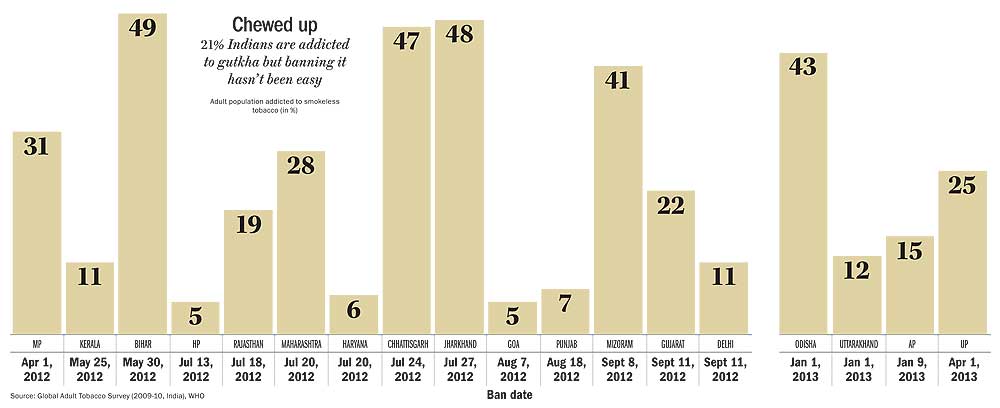
What will happen to gutkha manufacturers as state after state bans all forms of chewing tobacco?
Gaurakh Nath turns back to speak to us, unconcerned that he’s
negotiating an autorickshaw through one of Delhi’s overcrowded roads.
His jaws are working away at chewing and talking, and saliva dribbles
from the side of his mouth as he rather incoherently explains why he’s
not worried about the ban on gutkha in Delhi. He’s been getting through
four or five pouches of pan masala and gutkha in a day for 15 years, and
is determined his habit will continue, even though the Delhi government
banned the sale, manufacture, display and storage of all gutkha
products in September 2012. “I can always find some supply though I may
have to pay more than the actual price,” he says.
Certainly, the ban on gutkha and other forms of chewing tobacco has
been tougher to implement than the state governments anticipated. And
this despite 18 states having imposed blanket bans since April 2012 (two
of them, Odisha and Uttarakhand, kicked off 2013 with the ban). Despite
its image as a cottage industry, gutkha is estimated as a Rs
15,000-20,000 crore business. The Smokeless Tobacco Association, which
represents the gutkha and pan masala industry, claims some 40 million
people will be directly and indirectly affected by the ban. That
includes stakeholders across the packaging and commodities (arecanut,
cardamom, etc.) sides to the business, and
panwallahs, distributors and stockists, apart from those directly employed by gutkha makers.
Those are big numbers and the pain isn’t likely to lessen any time
soon — the ban in Uttar Pradesh will start from April 1; other states
such as Tamil Nadu and Assam are mulling over similar strictures;
Maharashtra and Odisha have, meanwhile, extended the ban to cover even
pan masala.
Why the ban?
In 2011, the Food Safety and Standards Authority of India (FSSAI), a
government watchdog, laid the foundations for the ban with a new rule:
tobacco and nicotine cannot be used as ingredients in any food product.
Based on the suggestion of a national consultation report, this rule was
notified under the Food Safety and Standards Act, 2006, and it defines
‘food’ as anything that is partially processed and can be ingested by
human beings. SN Mohanty, CEO, FSSAI, justifies: “Regulations include
tobacco in the items sold as food because gutkha is partially ingested.”
States can impose annually renewable bans under the regulations.
Why is gutkha such a big deal? GATS (the Global Adult Tobacco Survey)
says 75% of Indian tobacco consumers (260 million of them) use
non-smoking tobacco products such as gutkha, far outnumbering the more
visible smokers. There is, of course, a significant and confusing
vocabulary of similar products: pan masala is gutkha minus the tobacco;
zarda and khaini pack in up to 90% tobacco (sun-dried, with lime); snuff
is simply powdered tobacco sniffed up the nostril.
|
|
|
| Gutkha is a Rs 15,000-20,000 crore industry. 40 million people will be affected by the
ban, says the industry body |
|
|
|
|
|
Gutkha,
hugely popular as a mouth freshener and stimulant in the Indian
subcontinent, is a dry concoction of crushed arecanut (supari), 7-8%
tobacco, catechu (a dry, brown extract from the acacia tree), paraffin,
slaked lime, and sweet or savoury flavourings, but that’s not the least
of it — gutkha is also said to contain 3,095 chemicals, including 28
carcinogenic substances. An Edelweiss sector update says India has the
highest global prevalence of oral cancer and 75,000-80,000 new cases are
reported every year. Tobacco-related illnesses eat up approximately Rs
30,000 crore in both public and private health services — that’s a full
fourth of the country’s entire health spending. Oddly enough, the
government hasn’t directly cited public health reasons for the gutkha
ban. The industry’s response to the ban is equally mixed up and, er,
murky.
Fight or flee
The gutkha industry is highly fragmented. Dozens of regional players
(like Shikhar and Dilbagh in Delhi) dominate the Rs 1-2 per sachet
segment. The national market has only a few big names like Manikchand
(the MD or RMD brand) and Pan Parag’s gutkha variant, which are strong
in the Rs 7-10 per sachet segment. Kanpur and Delhi in the north, and
Ahmedabad, Vadodra, Goa and Pune in the west, are major manufacturing
clusters.
Quite in line with the fragmented nature of the industry, it was a
contradictory chorus that arose when the ban took effect — some say it
will be the death knell, others are blasé and hold the view that this
ban, like the other attempts before it, won’t change anything. “50% of
the industry and its markets have already vanished with ban in 14
states,” despairs Sanjay Dechan, executive director of the Smokeless
Tobacco Association (STA). “After April 1, 80% will have vanished.”
Notably, that’s when UP joins the ban.
|
|
|
|
“The entire banning exercise is aimed at gifting one company the entire market"Sanjay Dechan, Executive director, Smokeless Tobacco Federation |
|
|
|
|
|
The
makers of the Delhi-based Dilbagh, a local brand, are also pessimistic.
“It is pointless to talk to media and state our position,” says Satyam
Bihani, director, Som Fragrances, owner of the brand that comes in
third, after Manikchand and DS. “The government doesn’t hear. Nothing
will change.” Already, the pain is obvious. Pan Bahar’s Sharad Jain
admits, “I have laid off 20-30 workers after the ban.”
Still others are literally fleeing. Partners of Trimurti Fragrances’
Shikhar gutkha have relocated to Mumbai from Delhi. Sarvesh Aggarwal,
who was still listed as a board member in the Shikhar Group’s website at
the time of writing, is cagey about their future plans, “We have
already shifted to Mumbai for good and we will be trying something else
here.” Not everybody has taken such drastic steps, or not yet anyway.
Delhi-based units have moved their facilities to Noida and Kanpur. But
that reprieve will last only for a couple of months more.
Ankur Kumar, proprietor of the Delhi-based Sara Tobacco, who claims
to have advised several tobacco entrepreneurs in setting up their
businesses, does not believe this is a do-or-die situation. “Gutkha
makers have amassed untold wealth over decades — many of them own malls
and other businesses already. It [the ban] should not be a survival
issue for them.”
Then there’s Dharampal Satyapal (DS) Group, the biggest player with
its Rajnigandha brand, which is challenging the government in various
courts. Despite repeated requests, the company declined to comment for
this story but local vendors point out its ingenious way of ensuring
sales continue. The DS Group sells Rajnigandha Pan Masala paired with
sachets of Tulsi Tobacco — pop both into the mouth and, voila, there’s
‘legal’ gutkha. Of course, it’s not the only company offering this
completely legal way of circumventing the ban — many other former gutkha
brands are now available as two separate pouches of pan masala and
chewing tobacco.
New Avenues
Interestingly, many big names in gutkha, like Pan Bahar, originated
in Kanpur before moving to Delhi. Such mobility is possible because
gutkha manufacturing is a simple process — all it needs is 8-10 small
machines and 15-20 workers. HK Paliwal, who does packaging for gutkha
makers in Kanpur, nods at the re-reversal, “Yes, many Delhi-based makers
have either activated their old set-up here, or are using other
people’s platform to produce gutkha.” Paliwal, though, is already
casting about for other business. “The same machines can be used for
packaging small biscuits and
daal-bhujiya packets,” says the canny businessman.
Meanwhile, fragrance makers, like the Kanpur-based Bluebell
Fragrances’ owner Jatin Gupta, are also worried. More than 250 fragrance
makers like him from Kanpur and Kannauj (a small town 80 km away) will
lose 90% of their market from April. Gupta laments, “Everybody is
considering supplying soap and
agarbatti fragrances but it won’t be as big as gutkha for us.”
|
|
|
|
“Why has zarda been spared and gutkha banned when zarda is far more hazardous with almost 90% tobacco?"Bhiku Patel, President, Tobacco Merchants Association |
|
|
|
|
|
Meanwhile,
the mere mention of cigarettes causes heartburn to gutkha makers, whose
lobby issued big advertisements in dailies, calling the ban
unjustified, pointing out that cigarettes contain more tobacco than
gutkha. “The entire banning exercise is aimed at gifting one company the
entire market,” lashes out Dechan, referring to ITC, which controls 85%
of the cigarettes industry in India. The gutkha lobby cites the rise in
ITC’s stock prices over the past six months and analyst reports on the
company recommend that investors buy the stock.
But is this a perfect zero-sum game as the lobby makes it out to be?
No, say analysts. “The low-end cigarette brands might benefit but it
doesn’t start immediately,” says Abneesh Rai, analyst, Edelweiss
Securities. “ITC’s growth has been flattish in the last two quarters.
Cigarettes will gain slightly after some years.” He feels there is still
a big price gap between gutkha and cigarettes, and also that cigarettes
are a far more visible and taboo product. “Women and children who eat
‘gutkha’ may not switch to cigarettes,” says Rai.
Dechan does not hesitate to blame officials in the health ministry
and the FSSAI, who he says serve the cigarette lobby’s interests. “They
keep sending advisories to state governments on banning gutkha, and
threaten them by denying funds under the NHRM [the National Rural Health
Mission, a central scheme implemented by the states] if they fail to
implement the ban,” says a frustrated Dechan.
In Ahmedabad, Bhikubhai Patel has a different question. “Why has
zarda been spared and gutkha banned when zarda is far more hazardous
with almost 90% tobacco?” asks the president of the Gujarat Tobacco
Merchants Association. Patel feels Gujarat farmers, who supply
approximately 90% of the tobacco used in products like gutkha, khaini
and zarda, won’t take such a big hit now because gutkha is only a small
part of the tobacco market. But far-sighted farmers in Anand, Baroda and
Khera aren’t taking any changes — they are already shifting to
alternative crops like banana.
Meanwhile, gutkha makers seem to be counting on the separate sachets
strategy to work. “If some one has a sweet tooth, he has it for life,”
says an official from a big gutkha brand, who does not wish to be named.
Anand Bathija, proprietor of Trident Exports, makers of the Kuber brand
of gutkha and khaini, is not so sure: “Erstwhile gutkha makers will
have to work really hard to make this mix-two-sachets route works as
handsomely as single-sachet gutkha.”
How’s the ban working? Says Sunil Singh, state nodal officer of the
National Tobacco Control Programme in Rajasthan, “So far, we have
conducted inspections at 31,000 places after the ban and destroyed 8
million gutkha sachets. Trucks that were smuggling in the product have
been seized. We have also started a toll-free helpline for people who
want to quit the tobacco habit.”
Other states offer similar positive news. Says Ashish Singhmar,
deputy commissioner of Hamirpur district in Himachal Pradesh, “Open sale
has been checked since the ban. The police and food and health safety
departments have been checking and conducting raids regularly.”
But dig deeper and check with petty officials across most states, and
a different picture emerges. The police in all states is already
overburdened and elections are around the corner — nabbing gutkha
sellers and stopping manufacture is hardly a priority.
STA’s Dechan feels the ban will drive the gutkha industry
underground. He is already almost right. Bhini Prasad, owner of a
cramped corner store in Karol Bagh, does not display the gutkha he
sells, but fishes it out surreptitiously from a rack hidden away inside.
“It comes from UP,” he says sotto voce. “We sell to our special
customers at a Rs 2 premium.”


 ►
►