Dec 25, 2018

Meet the busy bee processing unadulterated honey

He may be a busy bee in an idiomatic expression but in plain terms, he is busy with bees. Donning protective gear, Nazim Nazir could be usually seen engaged in looking after the dozens of square wooden boxes packed with bees.
Since his childhood, Nazim had an outlandish but rather interesting penchant for these teeny-weeny humming creatures and when he turned 20 he took to apiculture and became an entrepreneur within a short span of time.
Nazim, a resident of Samboora, Pampore started with merely two hives and today he owns as many as 150 of them, yielding him at least 1200 kgs of honey.
"First, I had just two hives and I would use the home-grown harvest mainly for domestic purposes," says Nazim.
However, in March 2018, Nazim received a short training course in beekeeping organised by Khadi and Village Industries Commission (KVIC) at Pampore. Following the training, KVIC provided Nazim 10 bee-boxes for free. After some time Nazim says that he was able to extract around 100 kg of honey from the boxes.
"When I sold the harvest in local market It fetched me around sixty thousand rupees," says Nazim.
As the interest of Nazim in the apiculture grew more and more, he began to study about the beekeeping exhaustively.
"I took to the internet and learnt a whole host of things about the beekeeping. I wanted to know well-nigh everything about the bee-keeping" Nazim says.
Now Nazim had expansion plans on his mind and he soon purchased about 50 hives. A little later he added around 100 more boxes to his business.
In the month of May, according to Nazim, he extracted around 1200 kg of honey from all his hives.
"The harvest was above average. I was also overwhelmed by the market response. Even customers visited my home to get the honey," Nazim said.
Soon Nazim focussed on the packaging and started packing the produce into the crystal clear glass jars of different sizes. He also minted his own brand name – Al Nahil.
"I have also applied for registration of my brand with Food Safety and Standards Authority of India (FSSAI)," says Nazim.
As some of the honey-dealer in different areas of Kashmir make a killing by selling the adulterated honey, the honey business in recent years has taken a hit. However, Nazim says that he had thought of a novel idea of regaining the lost confidence of customers.
"As of now, I have a cash-back policy. If you find any kind of adulteration in my product or simply if you are not satisfied, I will return your money" he says, adding that from next year he would sell the honey along with the comb so there would be no room for doubt.
Apart from supplying honey to local markets, Nazim, since June this year, has at least exported 1200 jars of honey outside the state.
I exported it to states like MP, UP and Rajasthan. I received a very good market response from these states," Nazim says. Now he is also toying with the idea of sending honey to outside India.
Barely ten months into the business, Nazim comfortably earns Rs 20,000-25,000 a month and provides employment to two people.

Dec 24, 2018

Festivities round the corner: FSDA starts drive against ‘adulterated’ cakes

Meerut: With Christmas and New Year just around the corner, the Food Safety and Drugs Administration (FSDA) began its drive against “adulterated” cakes, sweets and other items that are sold during the festive time, on Sunday. Four teams with three members each will conduct surprise inspections at shops in rural and urban areas to check adulteration and the sale of stale items in the market.
“Four teams with three members each have been formed. These teams will conduct regular checks by sending suspicious food items to the Lucknow laboratory for testing. In most cases, action will be taken only after the laboratory results confirm adulteration. However, if the team finds any food item that appears to be sub-standard or unsafe, action will be taken accordingly,” said Archana Dheeran, designated food officer, Meerut.
The teams will keep a close eye on milk, milk-made products, cakes, Christmas treats, other sweets and bakery products, Dheeran said.
“The samples of suspicious food items will be sent to Lucknow’s food testing lab to avoid any manipulation at the city-based lab. However, if the food items look too suspicious, they will be sent to the city lab only and an immediate report will be sought. Sample reports from the city lab take only 48 hours and action can be taken soon after,” said Dheeran.
FSDA authorities said that customers can anonymously file complaints related to food adulteration.
If a city resident is apprehensive of a certain food item that he or she has purchased, then they can send it for testing to the food department personally by depositing a fee of Rs 1,000. If found adulterated, a complaint can be filed on the condition of anonymity.

Notices slapped on 1,000 eateries

Thiruvananthapuram: The food safety directorate has cancelled licences of 17 eateries and issued improvement notices to another 1,275 outlets as part of a statewide inspection.
The improvement notices issued by the food safety special squads to improve the conditions in which food was manufactured and distributed.
The inspection was held in four phases in 3,683 eateries across all districts, beginning on December 10. A total of 184 samples suspected to be of sub-standard quality or adulterated were collected and sent to analytical laboratories in Thiruvananthapuram, Ernakulam and Kozhikode. A compounding fee of Rs 27.99 lakh was levied from the eateries that were found to be violating food safety norms.
The special squads formed to curb distribution and sale of adulterated coconut oil seized 18,302 litres of coconut oil banned brands and 2,460 litres of adulterated coconut oil from Thrissur. The squads also seized 50 litres of banned coconut oil brands from Kollam and 15 packets from Alappuzha.
Food safety commissioner had constituted 38 special squads to ensure food safety standards in bakeries, cake/wine production centres, distribution centres of bakery products during Christmas and New year as per the directive of the state government.

Kolkata bakers accused of unhygienic methods, to face regulation this Christmas season

The officials have been inspecting the factories which are involved with baking to check whether the bakeries are maintaining the required hygiene and that notices were being issued to those bakeries at fault to improve their standards.
Nahoum's is one of the oldest and the iconic Jewish bakeries in the city. 
HIGHLIGHTS
The city is known for its age-old bakeries which have been running since the British India
Deputy Mayor Atin Ghosh said they have collected 17 samples of fresh cake and bread loaves from the stores
KMC has instructed the bakeries not to compromise with the quality of the products
With Christmas and the New Year right round the corner, the bakeries in Kolkata are facing the toughest time in recent history even during the best selling season.
Kolkata, which is famous for its traditional Bengali sweets, is also known for its age-old bakeries which have been running since the British ruled over India.
With the upcoming festivities, the Kolkata Municipal Corporation (KMC) has geared up to see that the people of the city don't fall sick.
Recently, the Kolkata Municipal Corporation Health Department inspected some of the city's well-known bakeries including the iconic Flury's and the Kookie Jar.
Deputy Mayor Atin Ghosh said they collected 17 samples of fresh cake and bread loaves from these stores.
He explained that his team of officials has been inspecting the factories which are involved with baking to check whether the bakeries are maintaining the required hygiene and that notices were being issued to those bakeries at fault to improve their standards.
Nahoum's, which is one of the oldest and the iconic Jewish bakeries in the city, received a notice from the officials for the same after they were inspected ahead of the Christmas.
The deputy Mayor said, "They need to follow the law or else a case will be fined against them and they will be jailed too."
"Since then, Nahoum's hygienic condition is much better today," he added.
During the inspection, the officials said, "We visited many cake shops in the city including Nahoum's, Kathleen, and some other cake shops. We found that the cake mixing was being done without any gloves and no hand sanitizer was used before the mixing."
The KMC has instructed the bakeries to not compromise with the quality of the products, to maintain the hygiene, and improve the working condition in the factories.
If they fail to follow the instructions, they will be charged under the Food Safety and Standards Act 2006.
More than 10 lakh people are associated with the business with 4,000 bakeries across the state producing tonnes of cakes during the Christmas season.
Idris Ali, All India Trinamool Congress (TMC) MP and Secretary of Joint Action Committee of West Bengal Bakers Associations said that the industry was going through tough a time and sudden regulations would add to the difficulties.
He said, "Bakery industry is facing difficulties due to GST. We pay 18% GST on cakes and biscuits. The linesmen selling cakes and bakeries bring the revenue in coins in thousands and lakhs. But when we take these coins to the bank, they refuse to take them which is causing us too many difficulties."
Adding that the recent raid has shown that some baker do not follow the baking process and do not maintain the hygiene, he said, "I request the bakery owners to follow the rules strictly and maintain the hygiene."
Talking about maintaining fair prices, Idris Ali said, "These goods and bakeries produced are not just for the rich but also the poor. So, we must take care of the prices and weight of the bakeries we sell. We must not cheat the common people."

Dec 23, 2018

DINAKARAN NEWS


Plastic Free living cheat sheet


2 masala dosas pack all the calories you need in a day


Are baby food makers driving overdiagnosis of cow milk allergy in kids?

NEW DELHI: A recent article in the British Medical Journal (BMJ) has warned that the $50 billion global formula industry could be fanning overdiagnosis of allergy to cow’s milk protein to sell specialist formula. Arguing that specialist formula is not a breast milk substitute, the industry has been aggressively marketing it and using it to forge close ties with healthcare professionals in the UK and globally by sponsoring medical education and research on allergies, the article points out.
This has echoes from the recent controversy in India where the formula industry was accused of trying to circumvent the Infant Milk Substitute (IMS) Act — a law to prevent predatory marketing practices of baby food companies - citing special nutrition needs of babies born with metabolic errors or allergies that might not allow breastfeeding. It had wanted specialist formulas to not be categorized as infant milk substitute (IMS) in an attempt to stay out of the Act.
According to the BMJ article by Chris Van Tulleken of the University College, London, overdiagnosis of the allergy could undermine breastfeeding. Between 2006 and 2016, in the UK, prescriptions of specialist formula milks for infants with cow’s milk protein allergy (CMPA) increased by nearly 500%, while National Health Service (NHS) spending on these products increased by nearly 700% from 8 million pounds to over 60 million annually, noted the article, adding that epidemiological data gave no indication of such a large increase in prevalence of the allergy. This raised the question of industry-driven overdiagnosis through funding and influencing of research, guidelines, medical education and public awareness drives on the allergy.
Referring to how the industry targets framing of treatment guidelines, Bob Boyle, deputy medical director and consultant paediatrician from the Imperial College Healthcare NHS Trust was quoted as stating: “There are many more milk allergy guidelines published than for other food allergies. Many have direct or indirect support from industry, which has a lot to gain from increased specialised formula use.” Many of the symptoms listed in these guidelines are so broad that virtually every infant could be diagnosed as having an allergy, pointed out another practitioner.
In India too, the food safety and standards authority of India (FSSAI) had constituted a steering committee that included the infant and young child nutrition council of India (IYNCI), a front organization for baby food manufacturers with four of the biggest baby food companies - Abbott, Danone, Mead Johnson and Nestle -- as members. The move to exempt food for special medical purposes (FSMP) from the IMS Act came from this steering committee. Though the IYNCI was dropped from the committee following protests by nutrition experts, paediatricians and the breastfeeding promotion network of India (BPNI), the FSSAI pushed ahead with the exemption for FSMPs.
The food regulator also partnered baby food companies to launch an initiative called Diet4Life, a platform used by these companies to sponsor awareness programs for paediatricians, dieticians and parents, ostensibly to educate them about management of inborn errors of metabolism and allergic conditions in children. Under the IMS Act, baby food companies cannot sponsor healthcare providers or market infant milk substitutes. Doctor Arun Gupta of BPNI had pointed out that it was to circumvent these restrictions that the industry was lobbying hard for its products to be taken out of the categorization “infant milk substitute”.
The UK has no law like India’s IMS Act. All it has is the international code of marketing of breast milk substitutes adopted by the WHO in 1981 after egregious marketing practices of these companies were exposed in the 1970s. Though the code includes marketing restrictions and states that companies cannot sponsor educational events or advertise anywhere within the health system, there have been frequent and widely reported allegations of code violations across the world.
The Indian Academy of Paediatrics resolved more than two decades ago that it would “not accept sponsorship in any form from any industry connected directly or indirectly” with products covered by the IMS Act. In contrast, the Royal College of Paediatrics and Child Health accepts funding from Danone and Nestle. The RCPCH website claimed that it only accepted advertising or conference stands providing information about specialist formulas (FSMP), not breast milk substitutes. The British dietetic association with input from the British society of paediatric gastroenterology, hepatology and nutrition and British society for allergy and clinical immunology (BSACI) all accept funding from baby food companies. The British dietetic association has Abbott, Mead Johnson, and Danone Nutricia as strategic partners and Vitaflo (Nestlé) and Friesland Campina (a global formula producer) as key supporters, pointed out the article.
Most healthcare players who take money from baby food companies say their sponsorship relates only to specialist formulas. But Nigel Rollins from the World Health Organization’s department of maternal, newborn, child, and adolescent health confirmed to Tulleken that specialist formulas are unequivocally breast milk substitutes in the eyes of WHO and are thus covered by the code. The belief that specialist formulas are exempt from the code may be enabling manufacturers to justify this network of links with clinicians and institutions to pursue a wider agenda, stated the article.
Many clinicians and patients have also expressed concern on the availability of industry-funded online information promoting non-specific symptoms potentially indicating cow’s milk allergy in exclusively breastfed infants. This is despite evidence showing that though cow’s milk and other food protein can be transferred from mother to infant in breast milk, the quantities transferred are likely to be too small to cause symptoms in most infants. Amy Brown, professor of child public health at Swansea University, said that concerns about breast milk sufficiency or content was one of the main reasons for mothers stopping breastfeeding and the promotion of cow’s milk allergy to the public by industry played to this anxiety.

Punjab bans sale of loose spices and salt

CHANDIGARH: The Punjab commissionerate of food and drug administration has imposed a ban on the sale of loose powdered spices and salt.
Punjab food safety commissioner KS Pannu said on Friday that retailers would have to package and properly label powdered spices and condiments before selling them.
He said all food safety teams had been directed to keep a check on the sale of loose spices and salt in their jurisdiction. Anyone who does not comply with the order, would face action under the Food Safety and Standards Act, he added.
Pannu said spices were important commodities, but their adulteration was common and they were often mixed with artificial colours, starch and chalk powder for increasing their weight and enhancing their appearance. The consumption of adulterated spices could cause a number of diseases, including skin allergies and liver disorders.

Health Dept pitches in to inculcate right eating habits

Food Safety and Standards Authority of India kicks off event
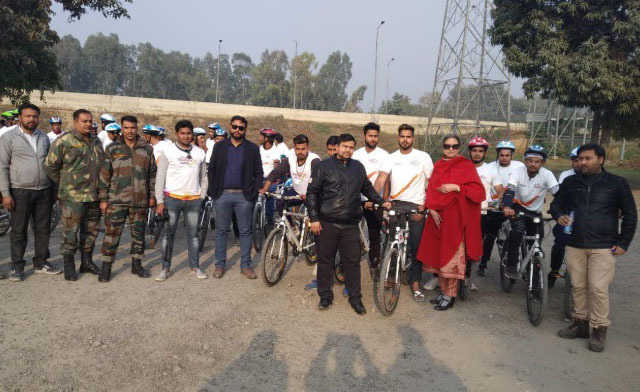
Delegates from the Health Department pedal to create awareness on Saturday. 
Ludhiana, December 22
The Health Department is on a mission to create awareness among masses regarding “Eating less and eating right”.
Under the Swasth Bharat Yatra commenced by the Food Safety and Standards Authority of India, cyclists pedalled from one district to another and spread a message of eat right India.
“Eating healthy is not just about the nutrients in the food. It also includes eating at the right time and eating properly. Meanwhile, eating late at night, hurriedly and inconsistently will have adverse effect on health,” said Dr Andesh Kang, District Health Officer.
On the first day of the three-day event, the team was welcomed at the Community Health Center (CHC), Dehlon. Less sugar, less oil and less salt intake in daily routine and eating fortified food was the message given by delegates.
Yogesh Goyal, Food Safety officer, said Eat right India is built on two broad pillars of eat healthy and eat safe. It aims to enable citizens to improve their health and well being.
Message to general public
Consume less sugar
Consume less salt
Consume less oil
‘Not just about the nutrients’
"Eating healthy is not just about the nutrients in the food. It also includes eating at the right time and eating properly. Meanwhile, eating late at night, hurriedly and inconsistently, will have adverse effect on health." Dr Andesh Kang, District Health Officer
‘Aim to improve citizen's health, well-being’
"Eat right India is built on two broad pillars of eat healthy and eat safe. It aims at enabling citizens to improve their health and well-being." Yogesh Goyal, Food Safety Officer

Dec 22, 2018

Advise social media platforms to put in place system for tracking fake messages: FSSAI to MeitY

Food Safety and Standards Authority of India has requested the ministry to "sensitise" social media platforms on the large-scale implications of such false propaganda, RS Prasad said.
Food safety regulator FSSAI has requested the IT ministry to ensure social media platforms put in place a mechanism to track fake messages with regard to safety and quality of food products, Parliament was informed.
In a written reply to Rajya Sabha, Electronics and IT Minister Ravi Shankar Prasad said FSSAI, in a November 27 letter, expressed concern over circulation of false and malicious videos on various social media platforms regarding the safety and quality of food available in the country.
Food Safety and Standards Authority of India (FSSAI) has requested the ministry to "sensitise" social media platforms on the large-scale implications of such false propaganda, Prasad said.
The regulator has also asked the ministry to advise social media platforms to put in place a system for tracking of messages so that such mischievous perpetrators could be brought to book and penal action can be initiated against them, he added.
Prasad said the government has taken several steps to target such fake videos and messages to take action against people for circulating such false content.
The minister said the government has already issued a notice to messaging platform WhatsApp in July this year on spread of fake news through its platform. WhatsApp, in its response, has conveyed a number of steps that it has taken to address the issue of fake news.
The government has been asking the Facebook-owned company to put in place a mechanism to curb fake messages on its platform, that incited mob fury earlier this year. More than a dozen people were killed across India this year in mob lynchings, fuelled by rumours circulated on WhatsApp.The rumours ranged from suspicion of stealing children to victims being believed to be killing cows. Riots were instigated by people forwarding and misinterpreting videos on WhatsApp.

Punjab food safety commissioner orders check on sale of open/loose spices, salt

The Food and Drug Administration commissioner of Punjab Friday directed food safety teams to check the sale of open/loose powdered spices, condiments and salt across the state.
"Under the provisions of Food Safety & Standards (Prohibition & Restrictions on Sales) Regulation, 2006, no person can sell powdered spices and condiments except 'under packed condition'," Food Safety Commissioner K S Pannu said in an official statement here.
According to the regulation, condiments and spices can be sold only if they are properly packaged and labelled.
"Therefore, all teams have been directed to be vigilant and to ensure that open and loose spices, condiments and salt are not sold in their respective areas of jurisdiction and to take action under the Food Safety & Standards Act against the defaulters," Pannu said.
He said it was not uncommon for ground spices to be adulterated with artificial colours, starch, chalk powder, etc., in order to increase their weight and enhance their appearance.
"The consumption of adulterated spices can cause a number of diseases, including skin allergies, liver disorders, etc. So, food safety teams have been directed to check the sale of unpackaged salt, spices and condiments," Pannu added.

Staple Food Fortification consultation organised

The scaling up staple food fortification conclave was very engaging consultation conducted in partnership with CII-GAIIN-FFRC-FSSAI– SBY. Fortification has proven to be an effective mechanism for tackling malnutrition.
Welcome and Opening Remarks were given by Rajesh Khare, Chairman, Madhya Pradesh State Council & CEO, Evonne Industries Pvt Ltd. He highlighted that ‘Industry is cognizant of the fact that fortification is a good mechanism to tackle malnutrition’.
Talking about Staple Food Fortification: Enriching Foods, Enriching Lives Arijit Chakrabarty, Senior Project Manager, GAIN – Global Alliance for Improved Nutrition said, It is a relieving fact that today in India around 90 per cent of population uses iodized salt. But in earlier times it was not the case, that’s why there were more malnourished people at that time then present.
It is finding from a study that out of all the malnourished people of the world, India’s share is 35%. The reason for this is the food law in micronutrients. Fortification is simple, low cost and no risk so it is very beneficial for health point of view.
Deeksha Bhatt, Coordinator, Food Fortification Resource Centre, Food Safety and Standards Authority of India talked about the role of FSSAI in Creating an enabling environment to initiate and scale-up staple food fortification. FSSAI enables Consumer communication, Regulatory support, Production fortification, establishing and running NABL labs that were instrumental in encouraging 15 States and 13 UT to adopt food fortification. She detailed upon organizing the FSSAI Eat Right Mela in Delhi.

Dec 21, 2018

Ban on import of milk and milk products from China


Ban is on single use plastic


DINAKARAN NEWS


DINAKARAN NEWS


DINAMANI NEWS


DINAKARAN NEWS


DINAKARAN NEWS


DINAKARAN NEWS


Restaurants found serving stale food

Vigilance teams examining the food the chicken used for cooking at a restaurant, in Visakhapatnam on Thursday. 
Vigilance teams collect samples
A team of officials of Vigilance and Enforcement Department and Food Safety Wing of the GVMC registered cases against two restaurants in the city on the charges of serving stale food to the customers and not maintaining hygiene on their premises.
The officials raided the restaurants on Beach Road and in Dabagardens area on Thursday and found that leftover food was being stored in refrigerators and served to the customers the next day. The kitchens were also reeked of poor sanitation, the officials said.
Acting on tip-offs, the three teams of officials led by vigilance SP D. Koteswara Rao conducted the raids. They said that huge quantities of leftover and stale food including biryani, white rice, chicken, fish, prawns and a few other dishes were found to be stored in refrigerators.
Poor sanitation
“Some dishes were found to be stored in freezers for more than three days. We also found rotten vegetables being used for cooking. Freezers and kitchens were badly maintained,” Vigilance & Enforcement Inspector R. Mallikarjuna Rao said.
The teams, he said, collected samples for further analysis and destroyed the stale food.
“Cases have been registered under the Food Safety and Standards (FSS) Act. The raids will continue,” Mr. Koteswara Rao said and asked all the restaurant owners to maitain sanitation.
Vigilance DSP P.M. Naidu, Inspectors N. Srinivasa Rao, B. Narimani, Food Safety Inspector G.V. Apparao took part in the raids.

FSSAI considering 1% as labelling requirement for genetically modified food items

In July, the food regulator had come under severe criticism from the environmental watchdog, Centre for Science and Environment (CSE), after it detected the presence of GM content in nearly three in 10 (32%) packaged food samples that were randomly tested.
The apex food regulator framing guidelines for labelling of genetically modified (GM) food items for manufacture, sale and distribution in India is considering a threshold value of 1% as labelling requirement.
GM food items are those produced from genetically modified organisms or ingredients derived from them. Threshold level for labelling refers to the maximum permissible level of unintentional and technically unavoidable GM content in food that does not call for labelling.
While 5% was initially being considered for declaring the content on the lines of countries such as Japan, Canada, Thailand and Indonesia, the Food Safety and Standards Authority of India is, in a recent development, considering making it 1%, according to sources familiar with the matter. The European Union prescribes a threshold of 0.9%.
“Ideally, it should be 1% but since it is not easy — and very expensive — to quantify a smaller value, there was a suggestion to make it 5%, at least to begin with. However, after a lot of brainstorming, it was decided that 1% should be proposed, and the labs can get equipped for testing gradually,” said a source requesting anonymity.
In July, the food regulator had come under severe criticism from the environmental watchdog, Centre for Science and Environment (CSE), after it detected the presence of GM content in nearly three in 10 (32%) packaged food samples that were randomly tested. The products found to be GM-positive included infant food, edible oil and packaged snacks.
In response, FSSAI released a statement saying it had started work on framing regulations that would lay down procedures for safety assessment and approval of food items. The draft regulations will, after formal approval from FSSAI’s scientific panel, scientific committee and the authority, be notified in the Gazette to elicit comments of various stakeholders. Later, the regulations will be finalised with the approval of the government.

Dec 20, 2018

135 samples of milk products seized

Chandigarh: Continuing with its drive against spurious food products, teams of food and drug administration seized 135 samples of milk and milk products from different parts of Punjab on Wednesday.
The teams collected 135 samples, including of desi ghee, curd, paneer, butter, khoya, lassi, burfi and cream, from various food business operators and forwarded them to the State Food Safety Laboratory in Kharar for analysis.
Food and drug administration commissioner and Tandrust Punjab Mission director K S Pannu said the Punjab government was taking the matter of food adulteration seriously and conducting regular inspections. He said that besides regular inspection of milk and milk products, special campaigns regarding other food items, like fruits, are also being carried out.
Pannu warned of strict action against those found indulging in malpractices. Punishment up to 6 years with a fine of Rs 1 lakh can be imposed on a food business operator whose products are found to be unsafe for human consumption, he said. In case of samples being found sub-standard, a fine of up to Rs 10 lakh can be imposed through a trial at the level of additional deputy commissioner of the district, he added.

Samples of milk, dairy items collected to check for adulteration in Punjab

As many as 135 samples of milk and other dairy products were collected from different places in Punjab by food safety teams as part of a drive against adulteration, officials said Wednesday.
The teams collected samples of 'desi ghee' (clarified butter), dahi (curd), cheese, butter, 'khoya', 'burfi' etc., from various food business operators across the state, they said.
The samples have been sent to the State Food Safety Laboratory in Kharar for analysis, Food and Drug Administration Commissioner K S Pannu said in an official release.
The state government is taking the matter of adulteration of food materials very seriously and regular inspections are being carried out, he added.
"Our mandate is to ensure availability of quality food and compliance with standards laid down by the FSSAI," Pannu said, adding that food business operators have been instructed to maintain strict hygiene and sanitary conditions.
He said besides regular inspection of milk and milk products, special campaigns focusing on food items like fruits, condiments and others were also being conducted.
The commissioner stated that action as per the Food Safety & Standards Act, 2006 would be taken against the food operators whose samples fail the quality test.

Eat Unchecked Fish And Take Care Of Your Health

Health Minister Vishwajit Rane has relaxed safety norms to ‘help’ traditional small fishermen from Maharashtra and Karnataka send fish to Goa. He has compromised on his ‘not negotiable’ stand on safety standards for imported fish. The importer is no more required to bring fish in safe conditions but will be presumed to bring safe fish if he brings it in small vehicles! The requirement is diverted from compliance with safety standards to the size of vehicles used in transportation. Anyone would be allowed to bring fish in small vehicles from areas upto 60 kilometres away from Goa’s borders. All these months Rane had been assuring Goans he would not allow import of fish from other states until importers strictly complied with the Food Safety and Standard Authority of India (FSSAI) regulations. How come he has changed his stance? Are the interests of non-compliant fish importers more important to Rane than the health of the Goan men, women and children?
The flip-flop on the part of Health Minister Rane since the formalin-in-fish issue surfaced has eroded people’s trust in his ministry. His relaxation without establishing a strong monitoring system is going to make people lose whatever trust they have in his ministry about guaranteeing sale of safe fish. He changed his stance on import of fish only a month after he imposed a ban. Nothing has changed since the ban was imposed. The FDA has been doing random routine checks, which are more tokenism than real action for deterrence. The fish traders have won their battle for continuing with their trade without complying with any norms. The real losers in this mock battle between the Health Minister and fish importers were innocent Goan people who wanted nothing more than fish that was not going to harm their health. The Health Minister has given no such guarantee to the Goan people. The message from the relaxation is: Goans can go and eat the fish the traders are bringing and take care of their health!
Perhaps the state government listens to only organized protesters and the invisible lobbyists and wheeler-dealers. The Health Minister had maintained he would not succumb to any pressure and not lift the ban until the traders complied with regulations. But after the fish traders organized a protest a few days ago, their leaders came out full of cheer after meeting the Health Minister. What had passed on between the minister and the traders that was so effective as to make him relax the ban? Perhaps the Goans at large also need to organize protests to demand guarantees from the government to ensure safety standards for imported fish. They have suffered long enough. There is resentment among the people, for whom fish is a staple, and they have expressed their resentment by boycotting fish brought by fish traders. They are not fools not to understand that unsafe fish can be brought in smaller vehicles too. It can be brought in trucks from faraway states like Andhra Pradesh and Odisha and reloaded in smaller vehicles in areas of Maharashtra and Karnataka falling within 60 kms of Goa and brought to Goa without any checks to be sold in Goa’s markets. There are hundreds of examples that big traders have used the cover of ‘small businessmen’ to do their business in order to evade and avoid regulations and strict monitoring. There is a sympathy attached to the word ‘small.’ Fish traders and Health Minister Vishwajit Rane have used the word (small fishermen) to ‘exempt’ them from food safety standards and let them freely become conduits for big sharks!

Until last week Rane was applying his mind to give the charge of checking the quality of fish to Iva Fernandes, who had blown the lid off formalin in fish in July, in order to restore the trust of Goans in safety of fish. Informed sources saw it as punishment to Iva Fernandes as she was being asked to do a job which was supposed to be done by juniors. That showed that the health department and FDA were engaged more in their own games rather than in the serious business of assuring healthy fish to Goans. Rane should have set up a strong checking and monitoring apparatus before relaxing the ban. He has put the cart before the horse. He had promised to set up a state of art fish testing laboratory but there are no signs of it coming up any time soon. The Health Minister should not take Goan people for granted and condemn them to eating unchecked fish. He and the government might have to pay political costs for it.

Temple food and midday meals: need for hygiene protocols

FOOD SAFETY GUIDELINES FOR TEMPLES
Death by food poisoning is back in the news in Karnataka. As of the last report 13 people have died and over 130 people fell ill by consuming the prasad that was served at a temple in Chamarajanagar. This comes just two days after 87 students took ill after finding lizard in their midday meal scheme.
And the chief minister’s answer to this is to issue a circular, by the Religious and Endowments or Muzrai department of Karnataka, which states that all food served in temples, including those to be donated by private individuals, should be tested before being distributed to devotees. What will be tested and how it will be tested is for anyone to guess. It would not be surprising if tests refers to taste.
Neither test nor taste is a solution to the issue primarily because tests take way too long, are very expensive and the infrastructure is not available everywhere. Taste on the other hand is not an indication either, as good taste is not a guarantee of the food being free from contamination. In this case the methodology for contamination was very primitive but that should not lead us to the conclusion that things can be detected by taste.
The only way to avoid such situations from continuously recurring is to have a preventive system. It starts with having a secured premises. The following are the four basic points that need to be addressed:
Food should not be cooked in an open area as it often happens. There should be a closed area designated for the preparation of food and the cleanliness and hygiene of the place must be maintained.
The people cooking the food must be trained on food safety and hygiene and must have gone through the mandated medical tests before handling the food.
Storage and transport of the food must follow the guideline of moving only in closed containers and at the right temperature, following the tenement “hot must be hot and cold must be cold”
Fresh food must be served ideally within two hours (or 4 hours if the temperature is maintained) of preparation. Packaged food including the prasadam must have a date of expiry and non-toxic packaging material must be used.
The FSSAI had issued an order dated 29th January 2018 on the roll out of BHOG (Blissful Hygienic Offering to God) in states and union territories and the state of Karnataka has done absolutely nothing about it. It is time that we implement things that will be effective and capture the best practices across the states rather than just issue more government orders which cannot be enforced.

Dec 19, 2018

DINAMANI NEWS


70 coconut oil brands banned

Commissioner of Food Safety Anand Singh has issued orders banning the manufacture, storage, distribution and sale of 70 brands of coconut oil in the State as these have been found to be “substandard” and adulterated with other cheaper oils.
Food Safety officials said here on Tuesday that while none of the prohibited brands were deemed “unsafe for human consumption”, on laboratory testing, these were found to be “not of intended quality” and a clear violation of the Food Safety and Standards Act, 2006.
Officials said some brands of coconut oil in the market, while meeting quality norms, were found to be violating labelling norms.
“Coconut oil does not naturally contain trans fats, so making claims on the label that a particular brand does not contain trans fat is a way of misleading consumers,” an official pointed out.
Storage and sale of prohibited brands of coconut oil is a crime which invites penal action, the commissioner has warned retail traders.

Over 15k cases registered for violating food safety norms during 2017-18: govt

As many as 24,262 of the total 99,353 samples of food products analysed during 2017-18 were found to be non-conforming to food safety norms, Minister of State for Health Ashwini Choubey told the Rajya Sabha on Tuesday.
The minister said 15,121 cases were registered during the period, in which conviction was ordered in 5,198 cases while penalties were imposed in 7,627 cases.
An amount of around Rs 25.23 crore was imposed as penalty, he said.
In 2016-17, 78,340 food samples were analysed, of which 18,325 were found to be violating the provisions under the Food Safety and Standards (FSS) Act, 2006 and prosecution (civil/criminal) was launched in 13,080 cases, Choubey said.
Of these, conviction was ordered in 1,605 cases and penalties were imposed in 4,757 cases, which amounted to nearly Rs 17.01 crore, he added.
Choubey further said that the enforcement of provisions under the Food Safety and Standards (FSS) Act, 2006 primarily came under the jurisdiction of the state and UT governments.
All food business operators in the country are required to comply with the provisions of the FSS Act.
To keep a check on food adulteration in the country, the state food authorities have been advised to maintain a strict vigil by regularly drawing food samples from all sources like manufacturers, wholesalers and retailers, and taking strict action against the offenders, the minister said.

9.9% Milk Samples Unsafe For Consumption, Says Government

The National Milk Safety and Quality Survey 2018 broadly suggests that milk in India is largely safe, said Minister of State for Health Ashwini Kumar Choubey.
The survey was initiated in May with sample size of around 6,000 samples for analysis 
NEW DELHI: 
A nationwide survey on milk adulteration by the FSSAI found 39 per cent of milk samples to be non-compliant with reference to quality parameters while 9.9 per cent were found to be unsafe for consumption, the government told Parliament on Tuesday.
The National Milk Safety and Quality Survey 2018 broadly suggests that milk in India is largely safe, said Minister of State for Health Ashwini Kumar Choubey.
He said the Food Safety and Standards Authority of India (FSSAI) had initiated the Nationwide Qualitative Screening of milk samples for on-spot qualitative and quantitative analysis of milk samples for quality parameters like fat, solids-not-fat (SNF), added water, protein content and safety parameters including adulterants, antibiotics and pesticide covering around 1,100 towns across the country.
The survey was initiated in May 2018 with a sample size of around 6,000 samples for qualitative analysis and 1,800 samples for quantitative analysis.
The interim report of the National Milk Safety and Quality Survey 2018 was released on November 13.
"As per the interim report, about 39 pc of milk samples were non-compliant with reference to quality parameters (fat, SNF, sugar and maltodextrin) but were without any safety issues. Only 9.9 pc samples were found to be unsafe for consumption.
"Thus, National Milk Safety and Quality Survey, 2018 broadly suggests that milk in India is largely safe," Mr Choubey said.

Non-bailable warrant against FSDA official

Bareilly: In 2003, a designated officer of food safety and drugs administration (FSDA) department official, DR Mishra had lodged a case in additional chief judicial magistrate court of Rampur against a Rudrapur (Uttarakhand) milk vendor refused to give milk sample to his team. Soon, he was transferred to another district but the court kept on sending him summons which ideally should have been sent to his successor in Rampur. Mishra never appeared before the court despite repeated summons due to which the court issued a non-bailable warrant against him.
On Tuesday, Mishra finally surrendered before the Rampur court to record his statements in the matter. “It was the matter of 2003. One of our teams were collecting sample from milk vendors come from Rudrapur to deliver milk in Rampur. When our team had stopped a milk van, the vendor refused to give them sample of the milk. Then we had lodged a case in ACJM court in Rampur. Today, it was the hearing in that matter and I reached court to record my statements,” Mishra said.

Dec 17, 2018

Adulteration, hygiene in focus at Food Safety Hub

Coimbatore: The district food safety department organised ‘Food Safety Hub’ at the corporation swimming pool complex in the city on Sunday.
The hub had several exhibits on hygienic and nutritious food and demonstrations of simple methods to detect adulterated food in homes.
Designated food safety officer B Vijayalalithambigai said the event aims to spread awareness on nutritious and hygienic food to public, mainly school children. “Also, when we conduct the hub at a location, we also inspect whether all the food outlets in the area have acquired lifetime registration with us. If not, we would bring them under the lifetime registration,” she said.
The swimming pool complex was chosen as lot of children visit the place, Vijayalalithambigai said. “We have identified five locations in the city where people come in large numbers: Marudamalai, Brookefileds Mall, VOC Park, Masaniamman Temple in Anaimalai and a famous theme park in Mettuapalayam. We would conduct food safety hubs at those places.”
The hub had a model pushcart to create awareness on how a proper food pushcart should be. Simple methods to detect adulteration in tea, salt, pepper and peas were demonstrated. Anganwadi workers and women from several self-help groups had put up exhibits on traditional foods. A medical camp for food handlers was also held. TNN

City street foods need urgent hygiene check!

Mumbai is known as the hub of street foods; however, the Bombay HC had declared cooking on Mumbai streets illegal twice, which has also not been followed. After a recent revelation by the Maharashtra Food and Drug Administration (FDA) where 74 per cent of Mumbai restaurants are found violating the rules under Food Safety and Standard Act, while there have been no talks on the hygiene at the street food stalls. However, it appears as the FDA and the government might be lagging behind to ensure the hygiene and food safety violations by the street food vendors.
As per the reports, 442 hotels and restaurants were examined by the FDA in Mumbai and out of that, 327 kitchens are reported unhygienic. According to the FDA rules and regulations, all the kitchens from five-star hotels to street vendors should follow the food safety rules. Although in the last month, the FDA announced the life imprisonment to soon be the maximum punishment for food adulterators in the state. Recently, the FDA has issued a notice to all these hotels and restaurant directing them to follow the rules and has warned to close the kitchens if the same were not followed. Nonetheless, it raises a concern for the Mumbaikars considering what measures are being taken to curb the violations of hygiene and food safety!
Shiv Sena MLA Prakash Surve commented, “The street food vendors should be kept under watch, and the watch should be uncorrupt. The BMC doesn’t take any action against them. They should be observed as to what food they are cooking, what water they are using. The administration must increase their manpower and thorough inspection must be done.”
Initially, in 2015, the Bombay High Court directed the Municipal Corporation of Greater Mumbai to evict the hawkers who prepare food on the streets, lanes, and pavements in the city. Later in February this year, the Bombay High Court pulled up the BMC for failing to initiate action against the hawkers and roadside food stalls, which continue to cook and sell food in the open and continue to breach the 2015 orders of the bench. The reason being, the state government had completely failed to implement the Street Vendors Act.
In a conversation with AV, Food Auditor Akshi Kapadia threw light upon the campaigning taking place to train and certify the street food vendors in the city and suburbs. She explained, “Just two or three weeks ago, auditing and training for food vendors have started. Currently, in Mumbai, some of the agencies have started training the street food vendors and certifying them and the campaign has started in Ghatkopar Khau Galli. It will take time but things will eventually turn better.”
She continued saying, “The hawkers are being given a FoSTaC training which is a government certificate for hygiene in different sectors. This was already in the plan and getting executed now. The concern has grown about hygienic food in the customers and as well as the officials. However, not all the vendors will be willingly participating because you know the major concern for them is the money. But it is a positive feedback on the part of the street vendors who have participated.”
As it is well-known that a large part of the Mumbaikars prefers street foods than the restaurant ones! Hence, not only street food but all the FBOs are being targetted. The FSSAI is gearing up for rigorous large-scale inspections to be carried out at FBOs’ premises across the country in order to ensure compliance with the FSS Regulations, 2011. This has been revealed at an event hosted by industry body CII on Thursday. In effect to it, the Maharashtra FDA slapped a notice on December 13 to the renowned Lonavla-based Chikki manufacturer Maganlal Chikki, asking it to stop the production for alleged violation of Food Safety and Standards Act, 2006 (FSSA) at its plants.
Film professional Paroma Bhowmik expressed, “India’s health, hygiene, and sanitation problems are much more omnipresent than it is projected to be. If people are fervently fretting about the hygiene of street food then they should perhaps focus on the extensive rate of food adulteration that is being conducted by some of the biggest industries of the world.”
The issue of hawkers cooking and selling food on the roadside has become unexpectedly prominent. Considering the hygiene issues faced by the street food consumers, Mumbaikars are appealing the government to create awareness for maintaining hygiene and public health.
Argha Ghosh, an Associate content writer by profession spoke to AV and stated, “The basic need is to educate the importance of hygiene to the people who run these street food stalls. They should be given a proper demonstration so that they understand how it can affect the health of the consumers and that the person who is running the stall also falls under the same bracket of ‘consumer’. This could be one way we can ensure street food hygiene. Along with that, the government needs to keep a regular tab on how these shops are running and do regular quality checks.”
Banking professional Sankha Ghosh too shared his thoughts. He expressed, “Across India, there have hardly any uniform hygiene and safety parameter set. So, it’s quite natural that street foods are most unhygienic. The irony is, in a city like Mumbai, there are a large number of people who have their major meals from these joints. Keep apart the other facilities, the basic fooding of these people are highly endangered leading to various diseases. So, the supply of foods needs to be monitored. And, there can be a municipal budget to help these local street vendors to use proper ingredients in food.”

FDA collects samples from posh hotel following complaint

Nagpur: A day after a three-member team of Food and Drug Administration (FDA) raided hotel Radisson Blu following a complaint of worms in food served, the organization will be sending improvement notice to the hotel.
Food safety officer of FDA Abhay Deshpande on Sunday told TOI, “We will be sending an improvement notice to the hotel as our initial findings revealed several irregularities under Food Safety and Standards Act.”
General Manager of hotel Manoj Bali in a message to TOI, maintained it was a routine check by FDA and it had collected food samples from hotel’s kitchen as prescribed. 
According to sources at FDA, some 40 people were at the hotel for a two-day conference organized by a pharmaceutical company. On Saturday, one member of this group having breakfast allegedly found a worm in ‘vada sambar’. However, complaint was made to FDA by members of a social organization. Soon, a three member team of FDA officials reached the hotel at Chhatrapati Square and collected samples from the kitchen.
“We have sent the samples to the laboratory for analysis and reports are likely to come within eight days. Following which we will take next steps. Meanwhile the notice will be served to the hotel due lack of sanitary and health measures,” said Deshpande.

Dec 16, 2018

12 caterers challanged by Food Safety team

JAMMU, Dec 15: Twelve caterers were challaned by Food Safety wing of Drug and Food Control Organization within the Municipal Limits of Jammu.
In view of season of marriage functions, a special drive for checking of caterers in Jammu city was conducted by the team of Food Safety led by Dr Parvesh Kumar, Assistant Commissioner, Food Safety, Jammu.
During the drive, inspections of different caterers at various Banquet halls located in Municipal limits of Jammu of City were conducted. Twelve caterers were inspected during this drive and out of that 11 caterers were challaned under Section 56 of Food Safety and Standard Act (FSSA) 2006 as they were preparing the food under insanitary and unhygienic conditions.
Those challaned were Kashmir Caterer, Som Nath Caterer, VK Caterer at Royal Estate, Toph Sherkhania, Shiv Caterer at Afsar Guest House, Shakti Nagar, Ajay Caterer at Jagat Resort, Shakti Nagar, Pintu Caterer at Eden Garden, Shakti Nagar, Romesh Caterer at Kamala Palace, Roshan Lal Janki Nath Caterer and Sethi Caterer at Tripple-S Banquet Hall ,Akhnoor road, Sandeep Caterer at JK Resort, Arora Caterer at Satyam Resort, Marble Market (Trikuta Nagar), Raju Caterer at Sainik Farm and Vaid Caterer at Aay Vee Resort, Sainik Colony (Jammu).
The Food Safety Officers present in team were Ajay Khajuria, Hans Raj Andotra and Pervaiz Ahmed.

Street food festival aims to change perceptions

Visitors try out street food from across the country at the NASVI's street food festival in the Capital.
Tenth edition promotes idea that street food is not only tasty but hygienic as well: event coordinator
With the motto to change the perception about street food, the 10th edition of the annual street food festival organised by the National Association of Street Vendors of India (NASVI) kick-started in the Capital on Friday.
The event, which is being held at the Indira Gandhi National Centre of Arts from December 14 to December 16, promotes the idea that street food is not only tasty but hygienic as well.
National coordinator of the event, Arbind Singh said, “We began with the idea to promote entrepreneurship amongst these vendors, and change the perception about street food regarding hygiene. Today, when these vendors display their food at this scale, they get recognition.”
“Malls are getting repetitive and street food not only promotes regional flavour, but refreshing and affordable as well,” he added.
The event was held at a greater scale this year with the Food and Safety Standards Authority of India (FSSAI) and the Ministry of Tourism co-organising it. Started with a mere two-three States, it has grown over 26 States and 500 regional cuisines.
The food festival had visitors from all age groups, especially youngsters. There were several vendors who made their debut, while some had participated earlier as well.
The tandoor chai from the capital city of Rajasthan was one of the main attractions. The stall had around 500 guests within few hours of the event.
Apart from the tandoor chai, people gorged on sweets from West Bengal, Litti Chokha from Bihar, chicken from Telangana, and various other stalls.
“The masala is the main ingredient that makes our tea so special, but it’s a secret so we cannot tell you the recipe,” said Sonu Bhargav on the overwhelming response they received for their tandoor chai.
“We have been participating in this festival since 2015, and the response each year is really good. We have learnt the importance of hygiene and how to present our dishes in a more attractive manner,” said Jaikishan, a vendor from Rajasthan.
Keeping up with hygiene aspect, the FSSAI integrated their Eat Right Mela with event. The Eat Right Mela is a part of ‘Swasth Bharat Yatra’ to encourage people to eat healthy, eat safe, and eat fortified. It also promoted companies that are coming up with healthier alternatives. Several officials of FSSAI were present at the event.
“The festival, and the venue are much bigger this year, there are more number of stalls and cuisines,” remarked Tanya, a student who attended the festival last year as well.
The organisers are expecting more visitors on the second and third day.

RMC destroys 238kg inedible bakery items

Rajkot: Intensifying their crackdown on inedible items of bakeries, the health department of Rajkot Municipal Corporation (RMC) destroyed 238kg of cakes, breads, biscuits and chocolates in different bakeries of the city on Saturday. 
Earlier, on Thursday, the RMC had destroyed 312kg of bakery items infested with insects.
The shops that were raided and where bakery items were destroyed were Bake House near Kotecha Chowk (38kg of stale cake base, expired cookies and chocolate compound), Sharda Bakers near Hanuman Madhi Chowk (47kg of expired chocolate balls, gems, toasts and biscuits), Hind Bakery in Bajarangwadi locality (53kg of expired bread and chocolate, Gujarat Bakery in Sanjaynagar on Jamnagar Road (26kg of bread kept in open), JB Bakery in Bajarangwadi (42kg of bread without best before use date) and Jalaram Bakery in Junction Plot (32kg of bread without best before use date). 
“According to the Food Safety and Standard Act 2006, bakers are not supposed to exceed the use of food colour beyond 100 PPM, they are not allowed to use artificial sweetener, tagging is compulsory for them, storing cakes in a prescribed temperature is compulsory for them, they are not allowed to use pieces of fruits in cakes, they are supposed to segregate veg and non-veg cakes and are prohibited from using potassium bromide,” said RMC health official Pankaj Rathod.
The drive against inedible items of bakeries has been intensified, considering the approaching festival of Christmas and New Year, he added.

Dec 15, 2018

Organic food bad for climate, finds study


DINAKARAN NEWS


DINAMANI NEWS


Cook suspected something was amiss


10 die after taking temple ‘prasadam’ in Karnataka temple

Locals present at the temple said the prasadam ran out of stock due to rush and that otherwise, the number of victims could have been higher.
At least 10 people died and over 60 were hospitalised after consuming ‘prasadam’ distributed at the Maramma temple at Sulwadi in Hunsur taluk of Karnataka’s Chamarajanagar district on Friday, in a suspected case of food poisoning.
The district authorities confirmed 10 deaths and feared the toll could increase as some of the patients were critical. Chamarajanagar SP Dharmendra Kumar Meena said 68 people had been hospitalised in Mysuru and Chamarajanagar districts.
The devotees had participated in a few rituals, ahead of their visit to an Om Shakti temple in Tamil Nadu.
They were given a rice preparation as ‘prasadam’ around noon, and a few of them immediately started throwing up. Soon, almost all those who had eaten it were taken ill.

Swiggy, Zomato, others remove 10,500 restaurants for violating food safety law

NEW DELHI: As many as 10,500 restaurants have been de-listed by e-commerce firms like Zomato and Swiggy for not having license or registration under the food safety law, Parliament was told Friday. 
Minister of state for health Ashwini Kumar Choubey said the Food Safety and Standards Authority of India or FSSAI in July directed food e-commerce firms to de-list the the restaurants which don't have registration under the Food Safety and Standards (FSS) Act, 2006. 
"The Food delivery aggregators informed that they have already initiated action against the defaulting partner hotels/restaurants. 
"As per information received, Zomato has delisted 2,500, Swiggy 4,000, Foodpanda 1,800, UberEats 2,000 and foodcloud 200 unlicensed/unregistered FBOs," he said in reply to a question. 
The implementation and enforcement of Food Safety and Standards (FSS) Act, 2006 Rules and Regulations made thereunder, primarily rests with state and UT governments, he said.
Commissioner of Food Safety of all states and UTs have been requested to take necessary action to bring all such FBOs or food business operators under the ambit of FSS Act through registration. 
No one shall commence or carry on any food business without license or registration under the Act, he said.
Choubey stated further regular surveillance, monitoring, inspection and random sampling of food products are carried out by officials to check compliance of the standards and norms.
In case where the food samples are found to be non- conforming, penal action has been initiated, he stated.

Adulterated turmeric found in supermarket chain’s sample

Pune: A sample of turmeric powder drawn from a supermarket chain in the city has been found to be adulterated with rice and maize starch.
Officials of Food and Drug Administration (FDA) had drawn a sample of turmeric powder on November 5 and sent it to the state government-run public health laboratory in Pune for analysis.
Following the analysis, officials raided the premises of the manufacturer in Bhiwandi and seized stock of turmeric powder worth Rs6.5 lakh on Wednesday.
“The manufacturing unit was exclusively providing spices, including turmeric powder, to the supermarket chain which, is famous for selling grocery products at cheap rate,” Suresh Deshmukh, joint commissioner (food), FDA, Pune told TOI.
Deshmukh said that the department would initiate inquiry and investigation into the sale of adulterated food items in the supermarkets. “The adulterants used in turmeric powder are not harmful for human consumption. Hence, it will not be a criminal case. However, adulteration with unharmful substance is also not allowed and prohibited under the Food Safety and Standards Act,” Deshmukh said.
Officials said that they would investigate the complicity of the supermarket in manufacturing and sale of adulterated turmeric powder.“The manufacturer was selling the spices only to the supermarket chain and, hence, it is more likely that that they were hand-in-glove. We will have to investigate it to establish the link,” he added. The government-designated laboratory gave the report on December 1. “Our officials were keeping a close watch to carry out the raid at the manufacturing unit,” Deshmukh said.

350 kg stale meat found in Periyamet

CHENNAI: Officials from the food safety department and city corporation's Royapuram zone destroyed 350 kg of stale veal, meat of calves, seized from nine shops in Periyamet in a raid on Friday. 
"They had stocked up the meat two days ago and were selling it to local food joints. Animals were also slaughtered in the shops we raided. We have booked them for illegal slaughtering and for selling decaying meat," said an official.
Officials said smell from the foul meat is masked using preservatives, additives and is sold cheap to roadside eateries. Two of the nine shops were found running without trade licences, said a corporation official. The seized meat was destroyed and buried inside the corporation's dumpyard at Kodungaiyur. As per the Prevention of Cruelty to Animals (Slaughter House) Rules, 2001, slaughter of cow and calf is banned in Tamil Nadu.

FAILED MILK SAMPLES

Three months on, health officials yet to submit report
Patiala, December 14
More than three months have passed when eight out of the 11 samples of Singla Milk Chilling Centre in Mehon village, near Devigarh, failed the quality test, but the District Health Department is yet to initiate any action against the factory owner. 
District health officer and food safety officer have not submitted the report to the Additional Deputy Commissioner (ADC) to take a decision on the penalties to be imposed on the centre owner against the violations. 
In September, the report had found samples of three mix milk, one paneer, one butter, one desi ghee and one cow desi ghee samples below fixed standard. 
After samples failed the quality test, the Health Department gave one month time period to challenge the report against the Singla Milk Chilling Centre to its owner, which elapsed in October this year. 
All samples were tested at the Government Laboratory, Kharar. As per the Food Safety and Standards Act, 2006, the penalty for substandard food sample extends up to 5 lakh on one item.
When asked about delay in submitting the report, district health officer, Krishan Singh said, “We are waiting for a reply from the centre owner. We had sent him the notice to inform that he could challenge the report. We have not submitted the report, but I have to check the records as I don’t remember what the status of the case is.”
In fact, after the raid, the police investigation revealed that officials of the Health Department were hand in glove with the centre owner and were getting his samples cleared from the government lab in Kharar.
Adulterated food items seized
On August 16, a police team had raided the Singla Milk Chilling Centre. The owner was arrested and the police seized 7,000 litres of adulterated milk, 323 bags of skimmed milk powder, 250 litres of chemicals used in making adulterated milk, 20 quintals of paneer and 12 quintals of ghee, besides refined oil, soda, acid and detergent powder. Subsequently, statewide raids were initiated to keep a check on adulterated food items.

Dec 14, 2018

FSSAI asks food business operators to gear up for rigorous inspection regime

New Delhi, Dec 13 () Food regulator FSSAI will launch "rigorous" inspections on food companies to ensure that best standards are followed as part of its effort to build trust among people about the safety and quality of cooked or packaged products, its CEO Pawan Kumar Agarwal said Thursday.
The Food Safety and Standards Authority of India (FSSAI) will also conduct surveys on many food products being sold in the market to check quality, he said, adding a survey on milk and dairy products has recently been done.
"Our mandate is to ensure availability of safe and wholesome food for human consumption. We have taken initiative in last few years to create demand for such foods. Businesses will make it available only if consumer demands," Agarwal said at a CII conference on Food Safety, Quality and Regulatory summit here.
However, he said an average, Indian citizen is still not confident about safety of packaged or cooked food. "We need to do something to bring trust among people".
Agarwal highlighted various initiatives being taken to create visibility of FSSAI, develop new ecosystem for training/audit of food safety officers, strengthen testing labs and energise state enforcing agencies.
Now, he said the FSSAI would focus on creating a "culture of self-compliances" for food businesses as well as for labs and audit agencies.
"Food businesses now have to be geared up for rigorous inspection regime," Agarwal said, adding that regulator through this inspection would verify whether food companies are complying with standards laid by it.
"We will also conduct surveys and huge surveillance to find out risk. We need to find problem area and make efforts to fix it, then only people's trust can be build," he said. The surveys and surveillance effort would help in generating robust data for the regulator.
Agarwal informed that the government has recently permitted creation of about 800 posts in the authority, but still the strength would be lower than many other countries.Therefore, he said, the FSSAI is making efforts to create network of partnerships with scientific, research and academic institutions to fulfil its mandate.