
Nov 16, 2017


Ahead of CM’s visit, administration tightens noose around Meerut meat shops
Meerut: After a gap of almost three months, the Meerut district administration has again tightened its noose on the city’s meat trade. On Wednesday, Food Safety and Drugs Administration (FSDA) officials led by city magistrate MP Singh raided several meat shops in the Ghantaghar area of the city.
Backed by a heavy police force, FSDA officials sealed four shops for allegedly flouting norms related to hygiene and mandated equipment. Chief food safety officer, FSDA, Sarvesh Mishra told TOI, “The raid was conducted to ensure that all mandatory provisions for licences to run meat shops were being observed. During the raid, four shops selling chicken and other kinds of meat were sealed because they were found flouting these provisions. Owners of all four have been booked under relevant sections of Food Safety & Standards Act, 2006. We even destroyed 20 kg of chicken meat in the process.”
Following an initial crackdown soon after Yogi government in March 2017 took charge in UP, police had eventually adopted a soft approach to enforcing the norms for the meat trade around Eid.
Haji Raees (name changed), who sells buffalo meat said, “The sudden arrival of a huge police force with officials reminded us of the ugly period in April when not only were the shops forcibly shut by the police, but supply of meat had also been curbed after orders from the administration. All this is again happening ahead of the chief minister’s visit on November 18. This indicates that the difficult days are back for us, particularly with the civic body elections about to take place.”
CM Yogi is slated to visit Meerut on Saturday to attend a rally for civic polls.
City superintendent of police Maan Singh Chauhan, however, refuted the charges and said, “The CM’s visit has nothing to do with the raid. All the four shops sealed did not have licences to run their establishments. They were flouting all the norms like not cutting meat in the open. They did not have glass doors, and had flouted other requirements.”
The team also raided a restaurant in the area, Al Kareem. “We found 53 cooking gas cylinders stocked there, and have seized them,” Chauhan added.
City magistrate MP Singh said, “The drive will be conducted every week to ensure there is no flouting of the law.”
Profiteers fined Rs 32000 in Ganderbal
GANDERBAL: The Court of Additional Deputy Commissioner-cum- Adjudicating Officer Syed Shahnawaz Bukhari under the Food Safety Act on Wednesday imposed a fine of Rs 32,000 on a number of traders for violating the Food Safety and Standards Act-2006.
The ADC warned all the stakeholders who are involved with food business to desist such practices in future and directed the concerned authorities to conduct market checking on a daily basis to monitor whether hygienic and quality food is made available to the general public.
FSSAI License is mandatory for the sale of food products, says FSSAI CEO
New Delhi, Nov 15 (KNN) FSSAI is keen to simplify the compliance processes with active industry support and consultation, said Mr. Pawan Kumar Agarwal, CEO, FSSAI FSSAI (Food Safety and Standards Authority of India) while inaugurating FICCI’s food service retail conclave ‘Foodzania 2017’
In his inaugural address he noted that it is mandatory for all food businesses – caterers, manufacturers, companies transporting food items and retail outlets with 25 or more people handling food to have at least one trained ‘food safety supervisor who should be trained under the Food Safety Training and Certification Programme (FoSTaC) and would be responsible for ensuring that food quality is maintained.
Mr. Unnat Varma, Managing Director, Pizza Hut Indian Sub-Continent & Chairperson, FICCI Food Service Retail Taskforce said that the Indian food retail industry has been increasing at a steady pace of over 20 per cent annually because of that the food services industry in the country has witnessed unprecedented growth over the past few years.
Saurabh Kochhar, CEO, Foodpanda & Chairperson, FICCI Food Service Retail Taskforce, said that Foodzania the Indian F&B sector is poised to witness a sea change but various issues like Infrastructure bottlenecks, multiple laws and regulations, skill gap etc. still remains a key concern. He added that F&B sector is one of the more matured industry in India and huge consumer base in India provides numerous opportunities for every player to exist and operate successfully in this sector.
Nov 15, 2017
FSSAI to simplify food safety compliance processes: FSSAI CEO

FSSAI regulates manufacturing, storage, distribution, sale and import of food to promote health and safety of consumers
FSSAI license is mandatory for the sales of food product to ensure the health and safety of the consumers, asserted Pawan Kumar Agarwal, CEO, Food Safety and Standards Authority of India (FSSAI) while inaugurating FICCI’s food service retail conclave ‘Foodzania 2017’ in New Delhi today.
The Food Safety and Standards Act 2006, regulates manufacturing, storage, distribution, sale and import of food to promote health and safety of consumers. It governs people involved in any food business, whether manufacturing or selling and food business operators. These include shops, stalls, hotels, restaurants, airline services and food canteens, places or vehicles where any article of food is sold or manufactured or stored for sale, he added.
In his inaugural address, Agarwal said that FSSAI is keen to further simplify the compliance processes with active industry support and consultation. He, however, added that it is mandatory for all food businesses – caterers, manufacturers, companies transporting food items and retail outlets with 25 or more people handling food to have at least one trained ‘food safety supervisor’. The supervisor should be trained under the Food Safety Training and Certification Programme (FoSTaC), designed by the Food Safety and Standards Authority of India (FSSAI). The supervisors would be responsible for ensuring that food quality is maintained.
Further, FSSAI CEO highlighted the need for the intended engagements from the industry side to protect and ensure the trust of consumers in the food that they intake. He added that display of the food licences in the hotel or restaurant premises is an ideal way to go forward. FSSAI is keen to rate the food business operators (FBO’s) through ‘Hygiene Variety Factors’ and will allocate start ratings to the restaurants and eating places out of six on the basis of certain factors including hygiene awareness, safety processes a among other related factors.
Unnat Varma, Managing Director, Pizza Hut Indian Sub-Continent & Chairperson, FICCI Food Service Retail Taskforce said that in the progressive Indian society, food expenditures hold a lot of prominence, constituting the largest retail consumption category. In fact, the Indian food retail industry is positioned globally as the sixth-largest and has been increasing at a steady pace of over 20 percent annually. Owing to this reason, the food services industry in the country has witnessed unprecedented growth over the past few years, contributing a significant proportion to India’s economic performance.
Saurabh Kochhar, CEO, Foodpanda & Co-Chair, FICCI Food Service Retail Taskforce, said that Foodzania is the initiative by FICCI Food Service Retail Task Force which was formed to address the issues faced by the stakeholders in the sector. The Indian food business sector is poised to witness a sea change. The recent times have seen significant discussions in this sector, which has led to a major reform of allowing FDI in multi-brand retail in India. This is anticipated to bring some game changing impact on the modern retail sector in India and Nation at large.
However, he added, it is not a one stop solution to address the challenges of this huge Industry. Various issues like infrastructure bottlenecks, multiple laws and regulations, skill gap etc. still remain the key concern and we aim to deliberate on these ground realities. We all know that food business sector is one of the more matured industry in India. Huge consumer base in India provides numerous opportunities for every player to exist and operate successfully in this sector. The industry being deeply connected with our day to day lives holds the responsibility of serving their consumers most effectively with best quality and prices.
Further, Government has allowed 100% FDI for trading including through e-commerce, in respect of food products manufactured or produced in India. 100% FDI is already permitted in manufacturing of food products through automatic route. This will provide impetus to the foreign investment in food processing sector, benefit farmers and will create employment opportunities. This has enhanced investment opportunities in India globally and have generated interest among the leading world food retailers for making investment in India. I am confident that this conference will come forward with new ideas that will boost the growth of the F&B sector, at the same time, enhance consumers’ welfare, added Kochhar.
On the occasion, Agarwal with other speakers launched the FICCI-Technopak report ‘Indian Food Services Industry: Engine for Economic Growth & Employment- A Roadmap for Unlocking Growth’, which highlights the overall potential of the food service in India and captures the emerging trends in the industry. It also throws light upon the ease of doing business scenario in the industry. The report recommends key alterations required to stimulate the growth in the food service industry, helping the industry realise its true potential. A concerted and collaborative effort is made to suggest the next steps to address various issues faced by the industry.
FSSAI tightens the noose around eateries without food licence
Food Safety and Standards Authority of India (FSSAI) CEO Pawan Kumar Agarwal said it will first ask states to run a special drive to create awareness among food business operators about the compulsory requirement of licences.
Food safety regulator FSSAI today warned that hotels and restaurants operating without its licence will be sealed and closed if they fail to take permits in the next 3 months.
The rule for licence also applies to those establishments, including religious places, where food is not charged. However, petty manufacturers, retailers and hawkers, among others, are exempt from this.
Food Safety and Standards Authority of India (FSSAI) CEO Pawan Kumar Agarwal said it will first ask states to run a special drive to create awareness among food business operators about the compulsory requirement of licences.
"I am told that 30-40 per cent of our restaurants and hotels do not have FSSAI licences. If this is the law of the land, is it acceptable?" he asked at a FICCIconference on food service retail 'Foodzania 2017' here.
Stating that there is some confusion in businesses on whether the FSSAI licence is mandatory, Agarwal made it clear that it is compulsory for all food businesses and non- compliance is not justified.
"Since there is still some confusion, we are asking state governments to take up a special drive. After the time period for that is over, we are advising them to seal and close all such units across the country if they fail to take FSSAI licences," he said.
FSSAI Enforcement Director, Agarwal said, has been tasked with ensuring 100 per cent licensing of restaurants and hotels in the next three months. He made it clear that there will be "no comprise at all".
Stating that FSSAI licence is needed for food business even if the food is not charged, he said that "even in temples, they are supposed to have FSSAI licences or registration, depending on the size of the business. Therefore, there is no option".
He further said that after taking the licence, food businesses also need to comply with all the regulations such as submission of food safety management plan.
As per the Food Safety and Standards Act, 2006, no person shall commence or carry out any food business except under a licence.
Under the law, food business means any undertaking, whether for profit or not and whether public or private, carrying out activities related to any stage of manufacturing, processing, packaging, storage, transportation, distribution of food, import and includes catering services, sale of food or ingredients.
According to the FSSAI CEO, the regulator will soon make it mandatory for all food businesses to have at least one person as food safety supervisor who has to be trained and certified as per its curriculum.
Agarwal stressed that food operators should display their licence at prominent points on their premises. The display board at any restaurant should also have contact details of customer care as well as food inspector of that location.
The FSSAI is working on developing rating for "hygiene and hygiene plus" and the same will be out soon.The food watchdog has been in operation for the last six years and by now, all hotels and restaurants should have secured the licence, Agarwal added.


பள்ளி அருகே புகையிலை பொருள் விற்க தடை
கோல்கட்டா: 'மேற்கு வங்கத்தில் உள்ள, அனைத்து பள்ளிகள் மற்றும் கல்லுாரிகளுக்கு அருகில், புகையிலை பொருட்கள் விற்பனை செய்தால், அபராதம் விதிக்கப்படும்' என, மாநில கல்வித் துறை எச்சரித்துள்ளது.
மேற்கு வங்கத்தில், முதல்வர் மம்தா பானர்ஜி தலைமையில், திரிணமுல் காங்., ஆட்சி நடக்கிறது. சமீபத்தில், அரசு சாரா அமைப்பு நடத்திய ஆய்வில், பள்ளி, கல்லுாரிகள் மற்றும் கல்வி நிறுவனங்கள் அருகில், பான் பராக், சிகரெட், பீடி போன்ற புகையிலை தயாரிப்பு பொருட்கள் விற்பனை செய்யப்படுவதும், மாணவர்கள் அவற்றை பயன்படுத்துவதும் உறுதியானது.
அறிக்கை : ஆய்வின் அடிப்படையில், அனைத்து பள்ளி, கல்லுாரிகளுக்கும், மாநில கல்வித் துறை அமைச்சர், பார்த்தா சட்டர்ஜி அனுப்பிய அறிக்கை: பொது இடங்களில், புகையிலை பொருட்கள் விற்பனை மற்றும் பயன்பாட்டுக்கு, மத்திய அரசு தடை விதித்துள்ளது. 18 வயதுக்கு உட்பட்டோர், புகையிலை பொருட்களை பயன்படுத்த தடை விதிக்கப்பட்டு உள்ளது.
இந்நிலையில், நகரில் உள்ள பள்ளி, கல்லுாரிகளுக்கு அருகில், புகையிலை பொருட்கள் விற்பனை செய்யப்படுவது தெரிய வந்துள்ளது. இது சட்டத்திற்கு எதிரானது.
அபராதம் : எனவே, மாநிலம் முழுவதும், பள்ளி, கல்லுாரிகள் மற்றும் கல்வி நிறுவன வளாகங்கள் அனைத்திற்கும் அருகில், 100 மீ., சுற்றளவில், புகையிலை தயாரிப்பு பொருட்கள் விற்பனை மற்றும் பயன்பாட்டுக்கு தடை விதிக்க வேண்டும். தடையை மீறுவோருக்கு, 200 ரூபாய் அபராதம் விதிக்க வேண்டும். கல்வி நிறுவனங்களுக்கு அருகில், புகையிலை பொருட்கள் விற்பனை செய்வதை, கல்வி நிறுவனங்கள், கல்வித் துறை ஆய்வாளர்கள் கண்காணிக்க வேண்டும். பள்ளி, கல்லுாரி களில், சிகரெட், பீடி துண்டு கள், புகையிலை கறைகள் போன்றவை இருக்கக் கூடாது. கல்லுாரி கேன்டீன் மற்றும் விடுதிகளில், புகையிலை மற்றும் புகையிலை தயாரிப்புகள் பயன்படுத்த தடை விதிக்க வேண்டும். இவ்வாறு அதில் கூறப்பட்டுள்ளது.

கட்டாயம்! உணவகங்கள், 'லைசென்ஸ்' பெறுவது... உணவின் தரத்தை உறுதிப்படுத்த நடவடிக்கை

நாட்டில் செயல்படும் உணவகங்களை வரன்முறைப்படுத்தவும், மக்களுக்கு தரமான உணவு கிடைப்பதை உறுதி செய்யும் வகையிலும், மத்திய அரசு பல்வேறு அதிரடி நடவடிக்கைகளில் ஈடுபட்டுள்ளது. அதன் ஒரு பகுதியாக, உணவகங்கள், உணவு தயாரிக்கும், விற்பனை செய்யும் நிறுவனங்கள் அனைத்தையும், தேசிய உணவு பாதுகாப்பு மற்றும் தர நிர்ணய ஆணையத்தின் கட்டுப்பாட்டிற்குள் கொண்டு வர திட்டமிடப்பட்டு உள்ளது.
அந்த வகையில், அனைத்து உணவகங்களும், மூன்று மாதங்களுக்குள், லைசென்ஸ் பெறுவது கட்டாயமாக்கப்பட்டு உள்ளது.இது குறித்து, எப்.எஸ்.எஸ்.ஏ.ஐ., தலைமை செயல் அதிகாரி, பவன் குமார் அகர்வால் கூறியதாவது:மற்ற எந்த பொருட்களை விடவும், உணவின் தரத்தை உறுதி செய்வது மிக முக்கியம். தரமற்ற உணவுகளால், மக்களின் உடல் நலம் பாதிக்கப்
படுகிறது.
எனவே, மக்கள் நலன் கருதி, அனைத்து உணவுப் பொருட்களின் தரத்தையும் உறுதி
செய்ய, பல அதிரடி நடவடிக்கைகளை மேற்கொள்ள திட்டமிட்டு உள்ளோம்.அதன் ஒரு பகுதியாக, அனைத்து உணவகங்களிலும் ஆய்வு மேற்கொண்டு, அங்கு தயாரித்து, விற்பனை செய்யப்படும் உணவுப் பொருட்களின் தரத்தை உறுதி செய்து லைசென்ஸ் வழங்கப்படும்.
உணவுப் பொருள் விற்பனையில் ஈடுபட்டுள்ள நிறுவனங்கள், உணவகங்கள் அனைத்தையும் லைசென்ஸ் பெறுவதுகட்டாயம். இதற்காக, மூன்று மாதங்கள் அவகாசம் வழங்கப்படும். குறிப்பிட்ட காலத்திற்குள் லைசென்ஸ் பெறாத நிறுவனங்கள் மீது நடவடிக்கை எடுக்கப்படும். தற்போதைய நிலை யில், நாடு முழுவதும் செயல்படும்உணவகங்களில், 30 - 40 சதவீத உணவகங்கள், உரிய லைசென்ஸ் பெறாமல் இயங்குகின்றன. இவர்கள், உரிய காலத்திற்குள், லைசென்ஸ் பெறுவது கட்டாயம்.
இந்த விதிமுறையில், உணவுப் பொருள் சார்ந்த எவ்வகை நிறுவனத்திற்கும் விலக்களிக்க முடியாது. எனினும், சாலையோர உணவகங்கள், மிகச் சிறிய உணவு விற்பனையகங்களுக்கு விதிவிலக்கு அளிக்கப் படும்.இது குறித்த விழிப்புணர்வை ஏற்படுத்தும் வகையில், மாநில அரசுகள் உரிய நடவடிக்கை எடுக்க அறிவுறுத்தப் படுவர்.இவ்வாறு அவர் கூறினார்.
யாருக்கு லைசென்ஸ்?
உணவகங்கள், உணவுப் பொருள் தயாரிப்பு நிறுவனங்கள், உணவுப் பொருட்களை, 'பேக்கிங்' செய்யும் நிறுவனங்கள், அவற்றை ஓரிடத்திலிருந்து மற்றொரு இடத்திற்கு எடுத்துச் செல்லும் பணியில் ஈடுபட்டுள்ள நிறுவனங்கள், விற்பனைசெய்யும் நிறுவனங்கள், உணவு தயாரிக்க தேவையான மூலப்பொருள் தயாரிப்பு மற்றும் விற்பனை நிறுவனங்கள் உள்ளிட்ட, உணவுப் பொருள் சம்பந்தப்பட்ட அனைத்து நிறுவனங்களும், எப்.எஸ்.எஸ்.ஏ.ஐ.,யிடமிருந்து லைசென்ஸ் பெறுவது கட்டாயமாக்கப்பட்டு உள்ளது.
பிரசாதங்களுக்கும் பொருந்தும்
உணவகங்கள், உணவுப் பொருள் விற்பனை நிறுவனங்கள் மட்டுமின்றி, வழிபாட்டு தலங்களில்
பிரசாதம் தயாரிக்கும் மையங்கள், அன்னதான கூடங்கள் ஆகியவையும், 'லைசென்ஸ்' பெறுவது கட்டாயம். இதில், விற்பனை செய் யப்படும் பிரசாதங்கள் மட்டுமின்றி, இலவச மாக வழங் கப்படும் பிரசாதங்கள் தயாரிக்கவும், லைசென்ஸ் பெற வேண்டும் என,தேசிய உணவு பாதுகாப்பு மற்றும் தர நிர்ணய ஆணையம் தெரிவித்துள்ளது.
வாடிக்கையாளருக்கு, தரமான உணவு, கலப் படம் இல்லாமல், நேர்மையாக தர வேண்டும் என்பதில், மாற்று கருத்து இல்லை. இதற்காக, மத்திய அரசு அறிவிக்கும், விதிகள் வரவேற்கத் தக்கது. அதேசமயம், மற்ற நாடுகளில் உள்ள உணவு பாதுகாப்பு விதிகளை, நம் நாட்டில் அப்படியே அமல்படுத்துவது சிரமம்.
-எம்.ரவி, சென்னை ஓட்டல்கள் சங்க தலைவர்
உணவு பாதுகாப்பு தர ஆணையத்தில் உரிமம் பெறுவதற்கு, பல உரிம கட்டணங்கள் உள்ளன. அதை, ஒரே கட்டணமாக, 500 ரூபாய்க்குள் நிர்ணயிக்க வேண்டும். ஒரு முறை உரிமம் பெற்று விட்டால், மீண்டும் புதுப்பிக்க வலியுறுத்த கூடாது.
-எஸ்.பி.ஜெயபிரகாசம், தலைவர், தமிழ்நாடு உணவு பொருள் வியாபாரிகள் சங்கம்
Nov 14, 2017


Fast food majors adopting ‘double standards’ on antibiotics use: Centre for Science and Environment
Expressing worry over the use of antibiotics in poultry, including chicken, the CSE warned that eating junk food in India involved major health risks for consumers.

A green body today alleged that fast food majors in India were adopting “double standards” by committing themselves to eliminating misuse of antibiotics in meat supply chains in a time-bound manner in the West but not in India.
A green body today alleged that fast food majors in India were adopting “double standards” by committing themselves to eliminating misuse of antibiotics in meat supply chains in a time-bound manner in the West but not in India. The Centre for Science and Environment (CSE) today released an assessment report based on data in public domain and response obtained from
several multinational companies and three Indian firms selling fast food in the country. “Our study shows that these fast food MNCs do not have any India-specific commitments to eliminate misuse of antibiotics in their meat supply chains. “Surprisingly, these global giants have made ambitious, specific and time-bound commitments in the US and other countries to eliminate antibiotic misuse owing to growing pressure from regulators and other stakeholders,” Deputy Director General of the CSE, Chandra Bhushan, told reporters. This is sheer “double standards”, he said.
PTI approached a few fast food majors to obtain their response to the allegation. While reactions from some of them were not immediately available, Jubilant Foodworks, a domestic franchise for the US-based popular chain Domino’s Pizza, said, “We follow global standards and processes, and ensure that the highest standards of quality and food safety and hygiene are maintained across our supply chain.” The company said in a statement that it has a formal policy in place on usage of antibiotics in poultry birds’ health management to guide their sourcing of poultry. Jubilant Foodworks said it has a very clear time-bound action plan in mitigating the risk in the supply chain.
“We have always had a set of standards followed while sourcing poultry for our products, ensuring that our suppliers follow the right farm practices,” it added.
KFC India in a statement said it adheres to all laws and regulations regarding the use of antibiotics. “Furthermore, as part of our strict adherence to robust safety practices and processes, chicken supplied to KFC India is free from any antibiotic residue, as our chicken supplies are subjected to a withdrawal period specific to each medicinal treatment,” the KFC India claimed. The green body also claimed the many MNCs and three popular Indian fast food firms they approached for the study, did not respond to the queries sent to them on the use of antibiotics for inducing growth of food animals.
Expressing worry over the use of antibiotics in poultry, including chicken, the CSE warned that eating junk food in India involved major health risks for consumers. “Fast food is not good for health and on top of that if the meat is sourced from an animal injected with antibiotics for growth promotion (non-therapeutic use), then it’s a double whammy for the consumer,” he said. Head, Food Safety and Toxins programme at CSE, Amit Khurana however, said, a person may or may not get affected after consuming such food.
About the queries sent to companies, he said seven multinational brands and one Indian brand did not respond at all. Most of these food chains sell chicken-based food across the country. “While some others shared their practices of sourcing and testing, they did not specify any timelines by which they planned to eliminate antibiotic misuse”, he said. The CSE recommended that that these fast food companies “must make ambitious, time-bound India-specific commitments to eliminate routine antibiotic use for growth promotion and disease prevention in their supply chains for chicken, fish and other meat”.
Bhushan said these chains must also stop any use of critically important antibiotics, ensure third-party supply chain audits, laboratory testing for antibiotic residues and resistant bacteria, documentation of antibiotic use and commit to making these reports public.
Separate sachets, printed warnings: Rules tilted to beat the ban, chew tobacco
The ban, that came into existence after an SC ruling, is not followed and buying chewable tobacco is as easy as buying toffees.

Sale of tobacco products in the open at court road in Dhanbad.
The death of gutkha baron Rasiklal Manikchand Dhariwal due to oral cancer has brought the man and the disease back into sharp focus.
One of the pioneers of gutkha or chewable tobacco, Dhariwal took the Manikchand empire to soaring heights with an annual turnover of Rs8,000 crore, having struggled in his early years when, as a teenager, he inherited a bidi factory with 20 workers.
The business tycoon’s website boasts what the group considers his achievements. For many others, he was the protagonist who marketed killer pouches that saw a steep rise in the number of cancer deaths.
“Through a patented self-developed process, his tobacco was packed in vacuum sealed pouches and resulted in consistent quality throughout the year. He marketed his product in and around his home town by cycling to places as far as 100km away,” reads the group’s website. “At times he would carry a megaphone around town with his office boy dressed as clown and advertised door to door.”
But as his annual turnover spiked, so did cancer-related deaths.
Ban but no ban
Every year, nearly 85,000 men and 34,000 women get cancer of the oral cavity and pharynx. According to a report of the Union health ministry, at least 90% of these cases are caused by some form of tobacco use, but more than half are caused by use of smokeless tobacco.
The government banned all forms of chewable tobacco products such as khaini, zarda and gutkha in 2013 after a Supreme Court ruling. The ban was implemented under the 2011 Food Safety and Standards Regulation, which states that food products must not contain any substance that is injurious to health, including tobacco and nicotine.
Despite the ban and a subsequent order by the apex court seeking compliance reports, buying chewable tobacco is as easy as buying toffees. Despite 23 states and five Union territories banning it, products continue to be available in the market. Most cigarette shops sell chewing tobacco and paan masala in separate sachets that can be mixed to get the same taste and flavour as gutkha.
NORMS VIOLATED, LIVES PUT AT RISK
◼ The government banned all forms of chewable tobacco products like khaini, zarda and gutkha in 2013 after a Supreme Court ruling.
◼ Despite 23 states and five Union territories banning it, products continue to be available in the market.
◼ Most cigarette shops sell chewing tobacco and paan masala in separate sachets that can be mixed to get the same taste and flavour as gutkha.
◼ Union health secretary and FSSAI sent out advisories to states but implementation continues to be lax.
Hindustan Times reporters had no difficulty in buying banned chewable tobacco that costs only between Rs4 and Rs10. Multiple brands continue to sell the banned item in the heart of India’s capital and within a stone’s throw from the Supreme Court.
Only a year ago, the easy availability of chewable tobacco was brought to the attention of the court by the amicus curiae Gopal Subramanium. The court had then passed another order, asking for the ban to be enforced in letter and spirit.
The Union health secretary and the national food regulator FSSAI (Food Safety and Standards Authority of India) sent out advisories to states to implement the same. However, implementation continues to be lax.
“According to us, all forms of chewable tobacco is banned, whether it is sold separately or in combination with something, it doesn’t matter,” said Pawan Agarwal, CEO, FSSAI.
The Delhi government, too, issued an order stating that storage, distribution and sale of any product containing tobacco should be stopped.
“There has never been a problem in procuring chewing tobacco products. For a period of a month or so, after the Delhi government order, police became strict. But even then, the products were available at a premium at almost every cigarette and paan stall,” said the owner of a kiosk in Delhi’s Connaught Place.
Innovative marketing
Several branded packets of plain chewable tobacco, some with GST numbers printed on them, are available for the asking. The manufacturers have found ingenuous ways of trying to appear that they follow ethical business practice –printing on the sachets warnings such as ‘Do not eat, swallow or use as ingredient in any food (non-edible)’.
“According to the law, tobacco or nicotine is not supposed to be used in food products. Khaini (tobacco with slaked lime) is not meant to be ingested, it is supposed to be spit out,” said Ritesh Jain, who heads the marketing team of the export division of Kamna Industries that produces Kuber Khaini.
Himanshu Hans, who works at Chaini, a brand famous for its khaini, offered the same view. The company’s website claims that it produces a ‘filter tobacco pouch’, which is “less harmful than smoking”.
“When you have khaini, you only take in 1.2% of the nicotine, much less than the 7% from cigarettes. Also, smoking adds tar to the mix. So, khaini is much safer. In fact, the United States has been reducing its duty on smokeless tobacco,” said Jain.
Shikhar, another brand that sells flavoured paan masala and a small pouch of tobacco in the same wholesale package, saving buyers the trouble of buying tobacco separately, defended itself, saying, “Several brands of chewable tobacco are available at every paan kiosk.”
“If ours is not available, the vendor will sell someone else’s product. We do not tell the consumers to use the tobacco, they ask for it,” explained Rajesh Soni, who works in the company’s management team.
Not just the sale; even manufacturing chewable tobacco is illegal.
“Chewable tobacco is banned and the manufacturing is by extension banned because if they can’t sell it, why manufacture?” said Agarwal.
However, there are several tobacco manufacturers in Delhi-NCR as well as neighbouring Uttar Pradesh whose products are readily available. Kanpur is a well-known manufacturing hub with more than 100 brands being produced and then marketed in different states.
“All the factories are working overtime in Kanpur; they always have found a way to bounce back in adversity. The lobby is too strong,” said Chotebhai Naronha, who had campaigned for the ban in view of the rising cases of oral cancer.
The legacy of Dhariwal continues to live on.
Food licence authority revoked, AMC to lose Rs 10 cr yearly
The urban development department on October 24 abolished the Ahmedabad Municipal Corporation's authority to issue food licences to the hotels and restaurants.
The move was come after the policy of Ease of Doing Business, and the department said that the central regulation of the Food Safety and Standards Authority of India (FSSAI) has been in place for more than a decade now.
Because of this, AMC will incur an average loss of Rs10 crore. "We had the authority of issuing food and health licences for AMC limits. Those who want to start an eatery must to have a food licence from us. AMC used to earn Rs10 crore by issuing and renewing licences," said Dr Bhavin Solanki, in-charge medical officer of health.
As per an estimate, there are around two lakh such food units in city. Earlier in 2016, municipal corporations of Vadodara, Surat, Rajkot, Bhavnagar and Jamnagar had unilaterally withdrawn their health licence issuing practice.
However, the civic body can keep checking the licences. "We have to check food samples at eateries to keep a tab on the items.
We will make sure that people are getting healthy, hygienic and standard food," added Dr Solanki.
The civic body randomly collects food samples and sends them for laboratory testing. If the sample fails quality test, the seller gets punished and a fine is levied. Recently, the civic body collected Rs 1 crore in fines.
Students at KU hostel served ‘unhygienic' food

Authorities today seized expired stock of food from Bibi Amina girls’ hostel of Kashmir University which was served to the boarders.
On Monday, a team of officials from drug and food safety organization visited the hostel and found its mess in “unhygienic” conditions. The team said they have taken up the food samples for further investigations.
Assistant commissioner food safety Hilal Ahmad Mir confirmed the development and said “our team visited the hostel building and found the hostel condition unhygienic.”
“We have taken up the samples for further investigation. Our team planned to close the mess, but the decision was changed as the KU people pleaded that the move cause inconvenience to the students,” Mir said.
To mention, the team visited the hostel building after receiving complaints from hostel boarders that they were served unhygienic and expired food.
“We observed it from past months that we were not given hygienic and proper food here. We also took up the matter with authorities but there was no improvement on ground,” a group of hostel boarders said.
Unlike other hostels, the catering of this hostel has been outsourced by the university administration. “The boarders of this hostel are facing problems while as in other hostels the mess and other facilities are regularly monitored by the university administration,” the students said.
“The students of other hostels get their grievances resolved by approaching concerned warden or provost but in our case the officials pass the buck by saying the hostel has been outsourced by administration,” they said.
Meanwhile, Mir said “action will be taken after finalization of the report.”
Meanwhile, the officials in Kashmir University said they will wait for the report of food safety and drug organization. “Once the team will submit its report, appropriate action will follow,” the official said.
Nov 13, 2017
Doctor push for salt content in food labels
CHENNAI: In two weeks, the Food Safety and Standards Authority of India (FSSAI) is planning to put out a draft of the revised food labels, which will include sodium along with other nutritional facts such as carbohydrates, fats, and sugar, FSSAI scientist Anitha Makhijani said at a conference in the city on Friday.
She expected to see smiling faces and hear an applause from senior doctors, scientists and public health experts, who were lobbying for stringent rules that force food manufacturers to reduce salt in their products. But most of them expressed discontent. "It should be salt and not sodium," argued UK-based Dr Graham Macgregor, professor of cardiovascular medicine at the Wolfson Institute of Preventive Medicine. Macgregor has campaigned for regulations for low salt food in countries like the UK, Canada, and Australia.
Until now, FSSAI has said packaged foods can volunteer to display nutritional facts. A few products that list salt usually report it as sodium per 100g. Sodium in food must be multiplied by 2.4 to get the salt in it. "Britain had sodium on food labels more than two decades ago. They changed it to salt because no one knew what they were eating," he said.
Legislations in the UK have been able to bring down average daily salt intake by citizens from 11g to 9g in the past decade. "There is a 40% reduction and most people did not know that their food has lesser salt. But we have seen a 25% reduction in health spending due to high blood pressure and its complications," he said.
At a conference organised by the Sapiens Foundation and scientists from Indian Institute of Technology Madras, experts brainstormed strategies for action against salt with officials of FSSAI, experts from WHO and other international experts. Studies show Indians consume up to 10.98g of salt every day against the WHO recommendation of 5g. High intake of salt can increase blood pressure and cause stroke and diseases of the heart and kidney.
Makhijani said the FSSAI will consider making modifications to the rules. "As of now, declaration of nutritional facts are not mandatory. Rules will have to be amended for that," he said. Chief nephrologist at Sapiens Foundation Dr Rajan Ravichandran said the aim is to reduce salt intake by at least 2g in the next five years. "We want all food products to list the amount of table salt, besides preservatives like sodium bicarbonate. If the product uses above the prescribed level, it should be labelled red and those below should be labelled green," he said.
WHO deputy director Soumya Swaminathan said research on salt will help organisations like the Indian Council of Medical Research push for policies that will help the country bring down the incidence of non-communicable diseases. "It's the need of the hour," she said.
Use of chemicals in preserving fish: HRC directs govt depts to form joint task force
Thiruvananthapuram: The human rights commission has directed food safety, health and fisheries departments to jointly form a task force to check the use of chemicals in the preservation of fish. The commission said that the task force should conduct frequent inspections.
Commission acting chairman P Mohanadas said that the departments must ensure that public gets quality fish.
The commission asked departments to make sure that inspections are carried out in all fish markets and ports in the district and constantly take samples for testing. "Corporations and panchayats have to jointly organize awareness campaigns as a second phase of Operation Sagar Rani, which was conducted in February to check use of chemicals in fish," the commission said. "Hoardings against use of chemicals must be erected in places of sale. Handbooks and notices must be provided against use of chemicals," he said.
The commission was considering the petition of Manu C Mathew, C J Johnson and Ajith against use of chemicals in fish.
When commission sought report from food safety department, it confirmed presence of chemicals in fish. In the inspection during Sagar Rani, food safety department has found use of formalin in ice, which is used to preserve fish. Also sodium benzoate too was found to be used in preservation of fish.
In the inspections conducted along with marine police, the food safety department has taken samples for testing. It found presence of formalin in 15 samples and sodium benzoate in 5 samples.
Sources at the food safety department said that it was difficult to catch the real culprits in such cases. "Mostly, the chemical treatment happens in the auction centres or by wholesale dealers. Only the retail fish vendors will be nabbed," sources said.
"We cannot say use of chemicals in rampant. But use of chemicals is seen mostly when fishermen get good catch. They will keep some for future use after treating with chemicals. They also lack proper preservation methods like use of refrigerator," said food safety officials.
Govt asked to check contamination of fish
Stress on mechanism to test samples
The Kerala State Human Rights Commission has issued directions to the Government to crackdown on the widespread use of chemicals for preservation of fish.
Acting on petitions filed by Manu C. Mathew, C.J. Johnson and Ajith, the commission urged the Government to constitute a task force comprising officials from the departments of Food Safety, Health and Fisheries to carry out periodic inspections at fish markets.
Highlighting the need to keep a constant tab on fish markets at the district, panchayat and taluk levels, acting chairman of the commission P. Mohandas called for a mechanism to collect and test samples at regular intervals.
He stressed the need for a public awareness campaign against the use of chemicals for preservation of fish.
The commission was earlier informed by the Food Safety Commissioner that chemical contamination had been noticed in the fish brought to Kerala from other States.
Ice factories supplying to fish markets were found to be mixing formalin and sodium benzoate was also being used as a preservative.
The department also informed the Commission that inspection of fish markets in coastal areas had been stepped up with the help of the Marine Police.
Observing that the recommendations of the Lok Ayukta to check chemical contamination of fish had not been implemented, the Commission urged the government to take strong steps for the purpose.


சேலத்தில் குட்கா, ஹான்ஸ் விற்பனை இல்லை: போலீஸ் சோதனையால் வியாபாரிகள் முடிவு
சேலம்: சேலத்தில், குட்கா, ஹான்ஸ் விற்பவர்களை போலீசார் கைது செய்து வருவதால், அவற்றை விற்பனை செய்வது இல்லை என, வியாபாரிகள் முடிவு செய்துள்ளனர்.
சேலம் போலீஸ் கமிஷனராக சங்கர், அக்.,11ல் பொறுப்பேற்றது முதல், தடை செய்யப்பட்ட லாட்டரி, கஞ்சா, குட்கா, ஹான்ஸ் ஆகியவற்றின் விற்பனையை முற்றிலும், ஒழிக்க இன்ஸ்பெக்டர்கள், உதவி கமிஷனர்களுக்கு உத்தரவு பிறப்பித்தார். இதையடுத்து, அக்.,20 முதல் நேற்று வரை, 250 வியாபாரிகள் மீது வழக்குபதிவு செய்யப்பட்டுள்ள நிலையில், 50 பேர் கைது செய்யப்பட்டுள்ளனர். அம்மாபேட்டை இன்ஸ்பெக்டர் நாகராஜன், மாணவர்களிடம் குட்கா விற்பனை செய்ததாக, நான்கு பேரை அம்மாபேட்டை இன்ஸ்பெக்டர் நாகராஜன் சிறார் நீதிச் சட்டத்தின் கீழ், ஜாமினில் வெளியே வராதபடி கைது செய்தார். இது, வியாபாரிகள் மத்தியில் பீதியை ஏற்படுத்தியது. இதையடுத்து, போலீஸ் அதிரடியால், சேலம் நகரின் பல இடங்களில் உள்ள சிறிய மளிகை, டீ கடைகளில் குட்கா, ஹான்ஸ் விற்பனை செய்வது இல்லை என்று அறிவிப்பு பலகை வைத்துள்ளனர்.
சேலம் மளிகை வியாபாரிகள் சங்கத் தலைவர் பெரியசாமி கூறியதாவது: போலீசாரின் நடவடிக்கைக்கு, வியாபாரிகள் ஒத்துழைப்பு தர வேண்டும். ஹான்ஸ், குட்கா பொருட்களை விற்பனை செய்ய வேண்டாம். அதையும் மீறி விற்பனை செய்தால், போலீஸ் எடுக்கும் நடவடிக்கையில், சங்கம் தலையிடாது. இவ்வாறு அவர் கூறினார். வியாபாரிகளின் இந்த அறிவிப்பு, போலீஸ் அதிகாரிகள் மத்தியில் வரவேற்பை ஏற்படுத்தி உள்ளது.
Nov 12, 2017


Nov 11, 2017
AFST raises concerns over recent FSSAI proposal
Food safety and Standards Authority of India, FSSAI, has proposed the amendments in qualification of Designated officer, the key post of Food Safety and Standards Act 2006. According to the proposed amendment, a non technical and candidates other than science graduates can also apply for the post.
The Association of Food Scientists and Technologists (AFST) has raised concerns over this proposal. AFST team feels that it will definitely harm the recruitment of Food science /Tech and technical graduate students at all India level, who are qualified technically in food science with chemistry as one of the subjects.
The team also feels that it will influence the implementation of science based Food Safety and Standards Act at all India level if the key post of the Act goes in hands of a non technical person.
AFST has requested everyone to oppose the amendments draft before it becomes a notification by FSSAI.
'The objections regarding amendments in qualification of Designated Officer to FSSAI can be sent on email rakesh.nayal@nic.in before 31.10.2017 for welfare of Food technology students and food science graduates at all India level. Kindly send one email on above email id saying you oppose this proposal and non science base graduate will be against the intent of FSSAI act and put other logical points'.


SC for Following Laws Against Adulteration In J&K With ‘Earnestness’
“We are of the considered opinion that the High Court be requested to pass an appropriate order, if required, so that the law relating to Adulteration and the Food Safety and Standards Act, 2006 is followed with all earnestness.”
New Delhi—The Supreme Court of India has asked Jammu and Kashmir High Court to pass appropriate orders so that the law relating to adulteration and the Food Safety and Standards Act 2006 was followed with all “earnestness.”
Hearing a special leave petition filed by Jammu and Kashmir Traders and Manufacturers Federation,
A division bench of Chief Justice Dipak Misra and Justices A.M. Khanwilkar and Dr. D.Y. Chandrachud said: “we are of the considered opinion that the High Court be requested to pass an appropriate order, if required, so that the law relating to Adulteration and the Food Safety and Standards Act, 2006 is followed with all earnestness.”
The court said that if there was any deviation by anyone, “the High Court can take appropriate notice of the same and pass requisite orders.”
Last year, the high court has time and again stressed that it will not make any ‘compromise’ with the health of the people and will make the system work even if the government forgets its duties.
“There won’t be any compromise with the health of the people. The court is aware of its constitutional obligation and will make the system work even if the government forgets its duties,” the court had said.
“Today it is us, tomorrow it would be our children. Our children would be born deformed because of adulterated food…They (offenders) have become so powerful that the state is unable to proceed against them, money power is now in action,” the court had said while hearing a suo moto Public Interest Litigation.
Jiribam district police seize tobacco products

JIRIBAM | Nov 10
A combined team of police commando and Special Task Force (STF) of Jiribam district police conducted frisking and checking in and around of Jiribam as a preventive and security measures ahead of Sangai Festival.
The frisking was conducting under the supervision of Jiribam SP, Mubi Moirangthem and commanded by additional SP, K. Ajit Kumar Sharma, in which tobacco products were seized from the two different locations.
According to police source, 19 packets of Baba Zarda, 22 packets of S-10 tobacco, 272 packets of V1 tobacco and 220 pieces of Reli tobacco (khaini) were seized on November 9 around 7 pm, from a shop at Kalinagar Pt-II, Jiribam, owned by Haran Das (30), son of Kanai Das of Digli, Jirighat, Cachar.
Moreover, the team also seized 700 packets of Win cigarette from Lakhipur, Jiribam around 11 pm from a person named Md. Abdul Rahim of Lakhipur Manipuri village, Cachar, Assam.
The seized tobacco products will be handed over to the Food Safety Authority after the completion of necessary formalities by the Jiribam police.
AMC collects Rs 1cr in food penalties
70 cases in the past three months under the prevention of food adulteration case
AMC's health department in a press release stated that it has settled 70 cases in the past three months under the prevention of food adulteration case.
"As per Food Safety and Standards Act 2006, our flying squad has been collecting random suspicious food samples and sending them for laboratory tests," said Dr Bhavin Solanki, in-charge medical officer of health, AMC.
"The concerned judicial authority has convicted 70 persons for food adulteration. A total of Rs 1.08 crore has been collected as a fine from them," added Dr Solanki.
Nov 10, 2017

Unlicensed shops thrive on RG Street
Coimbatore: Range Gowda Street, one of the busiest market streets in the city, has been found accommodating the most number of unlicensed commercial establishments selling edible commodities.
Of the 450 shops on the street located near Town Hall in South Coimbatore, less than 30 have the mandatory food business licenses, according to government records.
Due to this, the district food safety department is planning to launch a special campaign this week to increase the licence registration rate.
Licence was made mandatory for all food business concerns by the Food Safety and Standards Authority of India in 2011. Though August 2011 was set as the initial deadline for commercial establishments to adhere to the norm, it was extended several times in the last six years.
According to recent government data, of the 8,500 food outlets in Coimbatore district, only about 3,000 have obtained food business licenses from the food safety department. The rest continue to operate without licenses. This included 400 odd shops on RG Street, which sell perishable items like foodgrains, chocolates, fruits and grocery.
"Even though there has been an increase in the number of manufacturers approaching us for licences of late, many wholesale and retail sellers were still not aware about the importance of obtaining the licence," a district food safety department official said.
Subsequently, the authorities started to study the reason for the low registration rate and found that traders faced several difficulties in applying for the licenses. The application procedure was made online in 2013.Open Free Demat A/C Online - Zero Account Opening ChargesMotilal Oswal
R Murali, a trader on RG Street, said that though there was an option to send the required documents by registered post, some of the forms (Form B) to be attached with the application form are available only online. "It takes at least half-an-hour to scan and upload other documents such as identity proofs, besides paying the requisite fee to the treasury," he told TOI.
Inspired by the considerable success recorded by Salem in this aspect, the Coimbatore district food safety and drug control department is planning to launch special food business license registration camps across the city from this week. "We have decided to launch it in RG Street, where most of the traders are not even aware that they can not run their shops without a license," said a senior official of the department.
The official also said that they have already held talks with local associations, banks and treasury and that the only challenge was to set up strong network connectivity so that there was no interruption in the application process.
The authorities were optimistic that the figures would cross the 5,000 mark by the end of this year as similar camps would be conducted in different areas across the city in the coming weeks based on the results of the first camp.


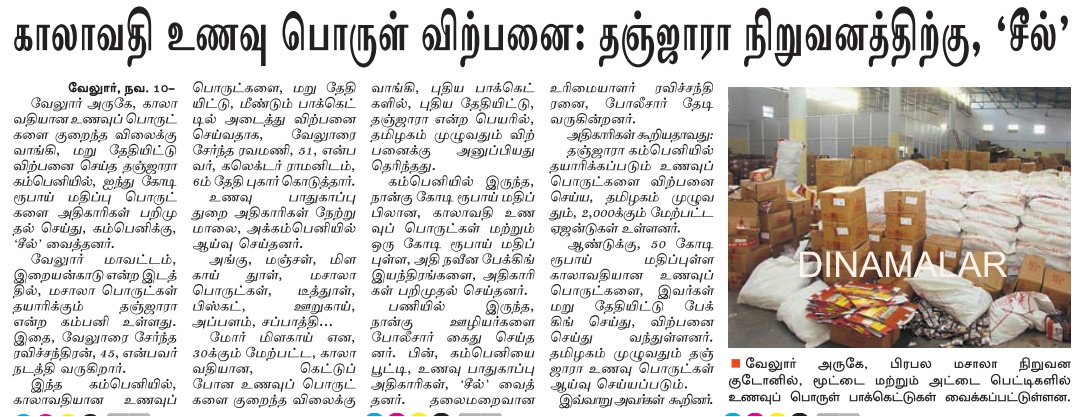
வேலூர் அருகே காலாவதியான ரூ.4 கோடி உணவு பொருட்கள் சிக்கின-நிறுவனத்துக்கு ‘சீல்’

வேலூர் அருகே பிரபல நிறுவனத்தின் வினியோகஸ்தர் காலாவதியான உணவு பொருட்களுக்கு புதிய தேதியிட்டு கடைகளுக்கு வினியோகம் செய்தது கண்டுபிடிக்கப்பட்டது. அங்கு ரூ.4 கோடி மதிப்புள்ள பொருட்களை பறிமுதல் செய்த அதிகாரிகள் அந்த நிறுவனத்துக்கும் ‘சீல்’ வைத்து நடவடிக்கை எடுத்தனர்.
வேலூர்,
வேலூர் சங்கரன்பாளையத்தை சேர்ந்தவர் ரவமணி. இவருக்கு சொந்தமான குடோன் போன்ற பெரிய கட்டிடம் ஒன்று வேலூரை அடுத்த செதுவாலை அருகே சென்னை- பெங்களூரு தேசிய நெடுஞ்சாலையில் உள்ளது. இந்த கட்டிடத்தை ரவிச்சந்திரன் என்பவர் வாடகைக்கு எடுத்துள்ளார். இங்கிருந்து அவர் ‘தஞ்சாரா’ நிறுவனத்தின் தயாரிப்புகளான சமையல் மசாலா பொருட்கள், காபி பவுடர், அரிசி மாவு, கோதுமை மாவு, ரவை, ஊறுகாய், அப்பளம், குலோப்ஜாமூன், உப்பு, குழந்தைகளுக்கான லேஸ் தின்பண்டங்கள் உள்பட 100-க்கும் மேற்பட்ட பொருட்களை வேலூர் மாவட்டம் மட்டுமின்றி தமிழ்நாட்டின் பல்வேறு பகுதிகளில் உள்ள கடைகளுக்கு வினியோகம் செய்துவந்தார்.
இந்த நிலையில் கடந்த சில மாதங்களாக ரவிச்சந்திரன் வாடகை கொடுக்கவில்லை என்று கூறப்படுகிறது. இதனால் கட்டிடத்தின் உரிமையாளருக்கும், ரவிச்சந்திரனுக்கும் இடையே பிரச்சினை ஏற்பட்டுள்ளது. இதனை தொடர்ந்து கட்டிட உரிமையாளர் ரவமணி தனது கட்டிடத்திற்கு சென்று பார்த்துள்ளார். அப்போது அங்குநடக்கும் தொழில்மீது அவருக்கு சந்தேகம் ஏற்பட்டுள்ளது.
இதனால் அவர் “தனக்கு வாடகை பாக்கி தராதது உள்பட அங்கு சட்டத்துக்கு புறம்பாக ஏதோ நடப்பதாக தெரிகிறது. எனவே சம்பவ இடத்தை பார்வையிட்டு நடவடிக்கை எடுக்கவேண்டும்” என்று கூறி கலெக்டரிடம் மனுகொடுத்துள்ளார். அதைத்தொடர்ந்து அந்த கட்டிடத்தில் உள்ள உணவு பொருட்களை சோதனை செய்ய உணவு பாதுகாப்புத்துறை அதிகாரிகளுக்கு கலெக்டர் ராமன் உத்தரவிட்டார்.
இதனையடுத்து நேற்று மாலை வேலூர் மாவட்ட உணவு பாதுகாப்பு நியமன அலுவலர் வெங்கடேசன் தலைமையில், உணவு பாதுகாப்பு அலுவலர்கள் கவுரிசுந்தர், கொளஞ்சி மற்றும் அதிகாரிகள் அங்கு சென்றுள்ளனர். அவர்கள் தங்களுடன் போலீசாரையும் அழைத்து சென்றுள்ளனர். அதிகாரிகள் வருவதை பார்த்ததும் அங்கு வேலை செய்துகொண்டிருந்தவர்களில் சிலர் தப்பி ஓடிவிட்டனர். 4 பேர் மட்டும் இருந்தனர். அவர்களை அதிகாரிகள் பிடித்துக்கொண்டனர்.
பின்னர் அந்த கட்டிடத்துக்குள் சென்று பார்த்தபோது கட்டிடத்தின் தரைத்தளம் மற்றும் முதல் தளம் முழுவதும் ‘தஞ்சாரா’ நிறுவனத்தின் தயாரிப்பு பொருட்கள் அட்டைப்பெட்டிகள், சாக்கு மூட்டைகளில் இருந்தன. அவைகளை பிரித்து அதில் இருந்த பொருட்களை ஆய்வுசெய்தபோது அனைத்து பொருட்களும் காலாவதியானது என்பது தெரியவந்தது.
அதைத்தொடர்ந்து பிடிபட்ட 4 பேரிடமும் விசாரணை நடத்தப்பட்டது. விசாரணையில் அந்த பொருட்களின் பாக்கெட்டுகளில் உள்ள காலாவதியான தேதியை ரசாயனம் மூலம் அழித்துவிட்டு, மிஷின் மூலம் புதிய தேதி அச்சிட்டும், புழு, வண்டுகள் இருக்கும் பொருட்களின் பாக்கெட்டுகளை பிரித்து அதில் இருக்கும் பொருட்களை மிஷின் ஜல்லடைமூலம் சலித்து மீண்டும் அதை பாக்கெட்டுகளில் அடைத்து, அதில் புதிய தேதி அச்சிட்டு கடைகளுக்கு வினியோகம் செய்தது தெரியவந்தது. இது கடந்தசில ஆண்டுகளாக நடைபெற்றுவருவதாக கூறப்படுகிறது. இதற்காக அங்கு எந்திரங்கள் நிறுவப்பட்டு பெரிய தொழிற்சாலை போன்று இயங்கி வந்துள்ளது.
இதுகுறித்து கலெக்டர் ராமன், போலீஸ் சூப்பிரண்டு பகலவன் ஆகியோருக்கு அதிகாரிகள் தகவல் தெரிவித்தனர். அதைத்தொடர்ந்து வேலூர் உதவி கலெக்டர் செல்வராஜ், ஆம்பூர் துணைபோலீஸ் சூப்பிரண்டு தனராஜன் சம்பவ இடத்திற்கு சென்று அந்த நிறுவனத்தை பார்வையிட்டனர். அங்கிருக்கும் பொருட்களின் மொத்த மதிப்பு ரூ.4 கோடி இருக்கும் என்று அதிகாரிகள் தெரிவித்தனர். மேலும் அந்த கட்டிடத்திற்கு ‘சீல்’ வைக்கப்பட்டது.
இதுகுறித்து உணவுபாதுகாப்பு அலுவலர் கவுரிசுந்தர் பள்ளிகொண்டா போலீசில் புகார்செய்தார். அதில் தஞ்சாரா நிறுவனத்தின் தயாரிப்புகளை ரவிச்சந்திரன் விற்று வந்தார். அந்த நிறுவனத்தின் காலாவதியான உணவுப்பொருட்களின் பாக்கெட்டில் தேதியை ரசாயனம் மூலம் அழித்து விட்டு புதிய தேதியை நவீன எந்திரம் மூலம் அச்சடித்து வினியோகித்து வந்துள்ளார்’ என தெரிவித்துள்ளனர். அதன்பேரில் போலீசார் வழக்குப்பதிவு செய்து பிடிபட்ட 4 பேரிடமும் விசாரணை நடத்தி வருகின்றனர். இந்த தொழிற்சாலையை நடத்திவந்த ரவிச்சந்திரன் தலைமறைவாகி விட்டார். அவரை போலீசார் தேடிவருகிறார்கள்.
குட்கா விற்றால் கடை உரிமம் ரத்து: உணவு பாதுகாப்பு அலுவலர் தகவல்
சேலம்: 'குட்கா விற்றால், கடை உரிமம் ரத்து செய்யப்படும்' என, மாவட்ட உணவு பாதுகாப்பு துறை அலுவலர் மாரியப்பன் தெரிவித்துள்ளார்.
இதுகுறித்து, அவர் கூறியதாவது: புகையிலை நிறுவனங்கள், பான்மசாலா, நிகோடினை தனித்தனி பாக்கெட்டாக விற்கின்றன. இதை வாங்கும் மக்கள், இரண்டையும் கலந்து பயன்படுத்துகின்றனர். அவற்றை, தனித்தனியாக விற்றாலும், கடை உரிமம் ரத்து செய்யப்படும். ஏப்., 1 முதல், இதுவரை, மாவட்டத்தில், 37 லட்சம் ரூபாய் மதிப்பில், 2,500 கிலோ புகையிலை பறிமுதல் செய்யப்பட்டுள்ளது. இரு கடைகளின் உரிமம் ரத்து செய்யப்பட்டுள்ளது. இவ்வாறு அவர் கூறினார்.
Nov 9, 2017
Mark dairy products with ‘non-veg’ brown dot: PETA to FSSAI

No animal cruelty: PETA members promote veganism in New Delhi.
Animal rights organisation asks for food packaging and labelling regulations to be suitably amended
Mumbai: In a bid to make choosing packaged food easier for vegans, the People for Ethical Treatment of Animals (PETA) has requested the Food Safety and Standards Authority of India (FSSAI) to amend regulations to introduce the brown dot for milk and milk products. At present, vegetarian products are marked with a green dot, while non-vegetarian ones display a brown dot on their packaging.
Dr. Manilal Valliyate, CEO, PETA has written to FSSAI chief P.K. Agarwal, outlining reasons for the request. His letter said the production of dairy foods commonly involves violence, such as eventual slaughter, separating calves from their mothers, and other forms of cruelty. It said India’s beef industry exists because of the dairy industry. “Ethical vegetarians who want to refrain from supporting the beef industry and cruelty to animals are being duped, because they commonly believe that a ‘green dot’ designates products not involving animal suffering or the slaughter of cattle.”
Urging for the Food Safety and Standards (Packaging and Labelling) Regulations 2011 to be amended to introduce the brown dot in packaging, PETA said cattle aren’t raised solely for beef, so the dairy industry is the primary supplier of cattle to the beef industry, especially for export.
Dr. Valliyate also said since all dairy products are derived from animals, the amount of cholesterol in them is high and could lead to heart diseases. “It’s important to differentiate animal and plant-based products,” he said, adding 75% of the global population, including three out of four Indians, can’t digest dairy products properly.
It is mandatory for food manufacturers to indicate if the food item contains non-vegetarian ingredients. Some products, like carbonated water and milk, are exempt from this provision, so these markings are not required on these products.
FSSAI launches logo for organic food products
NEW DELHI, NOVEMBER 8:
The Food Safety and Standards Authority of India has launched an “Indian Organic Integrity Data Base”, to help consumers verify the authenticity of organic food.‘Jaivik Bharat’
It has also introduced a common logo for “organic foods” with the tagline ‘Jaivik Bharat’.
The portal has been jointly developed by the FSSAI in collaboration with the Agricultural and Processed Food Products Export Development Authority (APEDA) and Participatory Guarantee System for India (PGS-India) of the Ministry of Agriculture and Farmers Welfare.
FSSAI said that through this portal, consumers can access information about the producer, the certification system and the availability of certified organic products
“The unified logo is an identity mark to distinguish organic products from non-organic ones, supported with the tagline “Jaivik Bharat” at the bottom, for easy identification of Organic Food from India. Effectively intertwining elements of the environment, the logo communicates adherence to the National Organic Standards,” an official statement added.
The regulator had introduced the umbrella regulation for Organic foods earlier this year.
1,400 food adulteration cases settled in Gujarat
AHMEDABAD, NOVEMBER 8:
The Gujarat Food and Drug Control Authority (FDCA) has said it settled 1,400 long-pending cases under the Prevention of Food Adulteration Act (PFA) in a single day through special courts.
“The Food Safety and Standards Authority of India (FSSAI) had issued an advisory to all State Food Safety Commissioners to hasten the disposal of the cases. Nearly a year ago, there was a Supreme Court judgement on the matter. But no state had acted, except Gujarat,” HG Koshia, Commissioner, Gujarat FDCA, at the inauguration of the 8th edition of Pharmac India 2017 here.
“On October 9, we had a special sitting and we settled 1,400 cases. This is a first in the country,” he added.
He added that faster disposal resulted in nearly ₹1.25 crore being added to government coffers by way of penalties. Of the 4,800 old PFA cases in Gujarat, 3,881 were found to be trivial mistakes after analysis.
According to Koshia, the pharma manufacturers in Gujarat have improved on quality parameters. Compared to a national failure ratio of 2.3 per cent currently (which was 12 per cent a few years ago) Gujarat has a failure ratio of 1.8 per cent.
Deepnath Roy Chowdhury, National President, Indian Drug Manufacturers’ Association (IDMA), pointed to some regulatory challenges arising in the current market scenario.
“Apart from pricing regulations and regulatory changes, if a company wants to launch products, it has to be checked if it is within the parameters of a certified formulation of the Central Drugs Standard Control Organisation,” he said..
Subscribe to:
Posts (Atom)