Nov 19, 2016

இனி 'இன்ஸ்பெக்டர் ராஜ்ஜியம்' இருக்காது; ஓட்டலுக்கு ஒரு மேற்பார்வை அதிகாரி

புதுடில்லி : ஓட்டல், ரெஸ்டாரென்ட் உள்ளிட்ட உணவகங்களில், மக்களுக்கு பாதுகாப்பான உணவு வழங்கப்படுகிறதா என்பதை கண்காணிக்க, உணவு பாதுகாப்பு மேற்பார்வை அதிகாரியை நியமிக்கும் விதிமுறையை, மத்திய அரசு, விரைவில் அமல்படுத்த உள்ளது.டில்லியில், 'பிக்கி' அமைப்பின் 'உணவு சேவையில், சில்லரை விற்பனை' குறித்த கருத்தரங்கம் நடைபெற்றது. இதில், இந்திய உணவு பாதுகாப்பு மற்றும் தர ஆணையமான - எப்.எஸ்.எஸ்.ஏ.ஐ.,யின் தலைமை செயல் அதிகாரி, பவன் அகர்வால் பங்கேற்று பேசியதாவது: மக்களுக்கு பாதுகாப்பான, தரமான உணவு கிடைப்பதை, எப்.எஸ்.எஸ்.ஏ.ஐ., உறுதி செய்கிறது. ஓட்டல், ரெஸ்டாரென்ட் உட்பட, உணவு சேவை துறையில் உள்ள, அனைத்து நிறுவனங்களும், மக்களுக்கு பாதுகாப்பான, தரமான உணவுப் பொருட்களை வழங்க வேண்டும்.
அதற்கான விதிமுறைகள் மற்றும் கட்டுப்பாடுகளை, எப்.எஸ்.எஸ்.ஏ.ஐ., வகுத்துள்ளது.அதனடிப்படையில், உணவு சேவை துறையின் செயல்பாடுகளை, பல்வேறு அரசு அமைப்புகள், கவனித்து வருகின்றன. உணவு சேவை துறை, பலதரப்பட்ட அரசு அமைப்புகளின் கீழ் இருப்பதால், நடைமுறை சிக்கல்களை சந்திப்பதாக, இத்துறையினர் கவலை தெரிவித்து உள்ளனர்.இதையடுத்து, எப்.எஸ்.எஸ்.ஏ.ஐ., விதிமுறைகள் மற்றும் கட்டுப்பாடுகள், மறு ஆய்வு செய்யப்பட்டு வருகின்றன. மக்களுக்கு பாதுகாப்பான, தரமான உணவு கிடைக்கவும், அதே சமயம், உணவு சேவை துறையின் வளர்ச்சியை கருத்தில் கொண்டும், பல்வேறு திட்டங்களை உருவாக்குவதற்கான பணிகள் நடைபெற்று வருகின்றன.இது தொடர்பாக, மாநில அரசு அமைப்புகளுடன் ஆலோசனை நடத்தி வருகிறோம். உணவு சேவை துறையில், அதிகாரிகளின், 'இன்ஸ்பெக்டர் ராஜ்ஜியம்' இருக்கக் கூடாது.
அதே சமயம், மக்களுக்கு பாதுகாப்பான உணவு கிடைக்க வேண்டும் என்பதில், எவ்வித சமரசத்திற்கு இடமின்றி, உறுதியாக உள்ளோம். மாநிலங்களில், உணவு பாதுகாப்பு ஆய்வாளர்கள் எண்ணிக்கை குறைவாக உள்ளது. இதை உயர்த்தும் நோக்கில், சோதனை அடிப்படையில், கோவாவில், 1,000 பேருக்கு, உணவு பாதுகாப்பு மேற்பார்வை பயிற்சி அளிக்கப்பட்டு வருகிறது. அடுத்த சில மாதங்களில், இத்திட்டத்தை நாடு முழுவதும் விரிவுபடுத்த முடிவு செய்துள்ளோம்.
அனைத்து ஓட்டல்கள், ரெஸ்டாரென்ட்டுகள் ஆகியவை, உணவு பாதுகாப்பு மேற்பார்வையாளர் ஒருவரை, கண்டிப்பாக நியமிக்க வேண்டும். இது குறித்த அறிவிப்பு, விரைவில் வெளியாகும். பாதுகாப்பான உணவு குறித்து, சாலையோர உணவகங்களுக்கு விழிப்புணர்வை ஏற்படுத்த வேண்டும். இவ்வாறு அவர் கூறினார்.

DINAMANI NEWS


ஆயில் மில்லுக்கு சீல் வைப்பு

விழுப் பு ரம், நவ. 19:
நொய்அரி சியை சேர்த்து அரைத்து கடலை எண் ணெய் யில் கலப் ப டம் செய்த விழுப் பு ரம் ஆயில் மில் லுக்கு அதி கா ரி கள் சீல் வைத் த னர்.
விழுப் பு ரம் நக ரம் மற் றும் அதனை சுற் றி யுள்ள பகு தி க ளில் செயல் பட்டு வரும் சில ஆயில் மில் க ளில் கலப் ப டம் செய் யப் ப டு வ தாக மாவட்ட ஆட் சி ய ருக்கு புகார் கள் வந் தன. இதை ய டுத்து உரிய ஆய்வு மேற் கொள்ள மாவட்ட உணவு பாது காப்பு துறை யி ன ருக்கு ஆட் சி யர் சுப் ர ம ணி யன் உத் த ர விட் டார். இதை தொடர்ந்து விழுப் பு ரம் மாவட்ட உணவு பாது காப்பு நிய மன அலு வ லர் வர லட் சுமி தலை மை யில் ஊழி யர் கள் சங் க ர லிங் கம், சம ரே சன், கதி ர வன் ஆகி யோர் விழுப் பு ரம் அடுத் துள்ள மகா ரா ஜ பு ரம் தாம ரைக் கு ளம் பகு தி யில் செயல் ப டும் நிலக் க டலை எண் ணெய் தயா ரிக் கும் ஆயில் மில் லில் நேற்று சோதனை நடத் தி னர்.
அப் போது அங்கு எண் ணெய் தயா ரிக்க பயன் ப டுத் தப் ப டும் கட லை கள் அனைத் தும் தர மற் றவை என தெரி ய வந் தது. கட லை க ளு டன் நொய் அரி சி களை சேர்த்து அரைத்து கலப் ப டம் செய் த தும் கண் டு பி டிக் கப் பட் டது.
விசா ர ணை யில், விழுப் பு ரத்தை சேர்ந்த கரி முல் லா கான் என் ப வர், இந்த மில்லை குத் த கைக்கு எடுத்து நடத்தி வந் த தும், கடந்த 5 ஆண் டு க ளுக்கு மேலாக கலப் பட ஆயில் தயா ரிக் கப் பட் டுள் ள தும் தெரிய வந் தது.
இதை ய டுத்து அங்கு வைக் கப் பட்ட 175 மூட்டை கடலை மற் றும் 100 மூட்டை நொய் அரிசி ஆகி ய வற்றை பறி மு தல் செய்த அதி கா ரி கள், பரி சோ த னைக் காக கிண்டி ஆய் வ கத் திற்கு அனுப்பி வைத் த னர். இவற் றின் மதிப்பு ரூ. 10 லட் ச மா கும். பின் னர் கலப் பட ஆயில் தயா ரித்த மில்லை பூட்டி அதி கா ரி கள் சீல் வைத் த னர்.

64 குடிநீர் நிறுவனங்கள் மூடல் :ஊ குடிக்க தகுதியற்றது என 'திடுக்'

தமிழகத்தில், 64 நிறுவனங்களின் குடிநீர், 'குடிப்பதற்கு உகந்ததல்ல' என, பரிசோதனை முடிவில் தெரிய வந்ததை அடுத்து, அந்நிறுவனங்கள் மூடப்பட்டு உள்ளன. தமிழகத்தில் விற்பனை செய்யப்படும், பாட்டில் மற்றும் கேன் குடிநீரின் தரம் குறித்து, தொடர் புகார்கள் எழுந்தன. பசுமை தீர்ப்பாயம், குடிநீர் மாதிரிகளை சேகரித்து, பரிசோதனை செய்ய உத்தரவிட்டது. இதன்படி, இரு மாதங்களுக்கு முன், மாநிலம் முழுவதும் உள்ள, குடிநீர் தயாரிப்பு நிறுவனங்களில், குடிநீர் மாதிரிகளை சேகரித்து, பரிசோதனைக்கு அனுப்பி வைத்தனர். இதன் முடிவுகள், நேற்று வந்தன. இதன்படி, சென்னை, திருவள்ளூர், காஞ்சிபுரம், கோவை, மதுரை மாவட்டங்களில் உள்ள, 64 நிறுவனங்களுக்கு, குடிநீர் தயாரிப்பை நிறுத்த, 'நோட்டீஸ்' வழங்கப்பட்டு, வழக்கு பதிவு செய்யப்பட்டு உள்ளதாக, அதிகாரிகள் தெரிவித்து உள்ளனர்.
கோவை உணவு பாதுகாப்பு துறை அலுவலர், விஜய் கூறியதாவது: கோவை மாவட்டத்தில், 10 நிறுவனங்களின் குடிநீர் மாதிரிகள் சோதனைக்கு அனுப்பப்பட்டன. இதில், ஏழு நிறுவனங்களின் மாதிரிகள், குடிக்கத் தகுந்ததல்ல என, முடிவுகள் வந்துள்ளன. இந்நிறுவனங்களுக்கு, 'நோட்டீஸ்' வழங்கி, வழக்கு பதிவு செய்யப்பட்டு உள்ளது. அவர்கள், நிறுவனங்களை மூடியுள்ளனர். இதே போல், தமிழகம் முழுவதும், 64 நிறுவனங்களுக்கு, 'நோட்டீஸ்' வழங்கப்பட்டு உள்ளது. இது குறித்து, கோர்ட்டில் வழக்கு நடத்தப்படும். இவ்வாறு அவர் கூறினார்.

மாவட் டத் தில் தரமற்ற குடிநீர் விற்பனை 7 நிறுவனங்களுக்கு ‘சீல்’

கோவை, நவ. 19:
கோவை மாவட் டத் தில் அன் னூர், இருட் டுப் பள் ளம், பேரூர், செல் வ பு ரம், ஈச் ச னாரி, கண பதி, சர வ ணம் பட்டி உள் ளிட்ட பல் வேறு பகு தி க ளில் 74 குடி நீர் விற் பனை நிறு வ னங் கள் உள் ளன. இந் நி று வ னங் கள் மூலம் கோவை, திருப் பூர் மாவட் டங் க ளில் உள்ள கல்வி நிறு வ னங் கள், கம் பெ னி கள், வீடு கள், கடை க ளுக்கு குடி நீர் கேன், குடி நீர் பாட் டில் சப்ளை செய் யப் ப டு கி றது.
இந்த குடி நீர் பாட் டில் க ளின் தரம் மற் றும் விற் பனை தொடர் பாக உணவு பாது காப்பு துறை அதி கா ரி கள் ஆய்வு நடத் தி னர். 10 நிறு வ னங் க ளி டம் இருந்து ‘மாதிரி குடி நீர்’ எடுத்து ஆய் வுக்கு அனுப் பி னர்.
ஆய் வின் முடி வில் 7 நிறு வ னங் க ளில் தர மற்ற குடி நீர் தயா ரித்து விற் கப் ப டு வது உறு தி செய் யப் பட் டது. இதை ய டுத்து, அந்த 7 நிறு வ னங் க ளுக் கும் விளக்க நோட் டீஸ் அனுப் பி னர். ஆனால், அந்த நிறு வ னங் க ளி டம் இருந்து முறை யாக பதில் வர வில்லை. இதை ய டுத்து, 7 நிறு வ னங் க ளுக் கும் உணவு பாது காப்பு துறை அதி கா ரி கள் நேற்று ‘சீல்’ வைத் த னர்.

FSSAI launches Food Fortification Resource Centre

The FSSAI on Thursday launched a Food Fortification Resource Centre (FFRC) to provide technical support advocacy and expertise in all aspects of food fortification during a special meeting, which was attended by Bill Gates.
In the meeting, the founder of Microsoft and trustee of Bill and Melinda Gates Foundation, Gates, extended his support to Indian government's new initiatives to curb the problem of malnutrition in the country.
"I am encouraged by the government's new initiatives to advance India's nutrition goals. In particular, I congratulate FSSAI on the launch of the Food Safety and Standards (Fortification of Foods) Regulation (2016) and continued improvement on salt iodisation," Bill Gates was quoted as saying in a statement issued by the FSSAI.
The meeting was also attended by secretaries of eight different ministries, including Health, Woman and Child Development and Human Resources and Development, along with members of Tata Trust at the headquarters of Food, Safety and Standards of Authority of India (FSSAI).
An online portal of FCTC was also launched during the meeting, which would function as a knowledge dissemination and interaction platform across stakeholders.
An alarming 70 per cent of Indian population consumes less that 50 per cent of the recommended daily allowance (RDA) of micronutrients.
Over a quarter of the world's vitamin A deficient pre-school children are in India. About 70 per cent of the schoolchildren and over 50 per cent of women suffer from anaemia caused by iron deficiency in the country.
According to FSSAI, the standards and logo for fortified foods that were released in October already has become a rallying point for large-scale food fortification.
Several states are already in the advanced stages of adopting fortified foods in government programmes.

22 milk samples collected for quality check

GUWAHATI: The ongoing special drive in response to the direction of the Food Safety and Standards Authority of India(FSSAI) to check the quality of milk consumed by the people, has so far garnered 22 samples from both the organized and unorganized sectors.
The state-run milk cooperative societies and milkmen or vendors were the key areas for the collection drive, which was launched on November 11. The samples will be analysed in Delhi. In the coming days, food safety officers will collect more samples from milk producers and retailers.
Last week, a state-level steering committee for monitoring and evaluating the National Milk Survey was constituted. The survey is part of a nationwide effort to monitor and evaluate the quality of milk consumed by the people. Over 1,500 samples will be collected from different cities to check the quality.
On November 4, the first meeting of the steering committee was held as per the FSSAI instructions and it was decided that a survey of the milk sold in the city would be conducted. Various complaints from consumers about the quality of the milk sold to them had necessitated this study on the quality. "We want to know if the quality of milk sold in the city is good and if there is any adulteration. The samples have been sent and the results will be out soon," said an official.
While a section of consumers get their requirements of milk and milk-based products like cottage cheese from private shops, others prefer to get them from those who keep cows or milk cooperatives. Diluting milk with water to increase the quantity is a regular practice. Other forms of adulteration include mixing of detergents which can be very harmful for health. Starch and skimmed milk powderare also added.

Nov 18, 2016

Keen on HYGIENE!


உடையார்பாளையத்தில் தடை செய்யப்பட்ட புகையிலை, காலாவதியான உணவு பொருட்கள் பறிமுதல்அதிகாரிகள் அதிரடி

ஜெயங் கொண் டம், நவ.18:
உடை யார் பா ளை யம் பேரூ ராட் சி யில் உணவு பாது காப் புத் துறை ஆய் வில் ரூ.33 ஆயி ரம் மதிப் பி லான தடை செய் யப் பட்ட புகை யிலை பொருட் கள் மற் றும் காலா வ தி யான உணவு பொருட் கள் பறி மு தல் செய் யப் பட்டு அழிக் கப் பட் டன.
அரி ய லூர் மாவட் டம், உடை யார் பா ளை யம் பேரூ ராட்சி பகு தி யில் உள்ள பஸ் ஸ்டாண்ட், கடை வீ தி க ளில் உள்ள உண வ கங் கள், டீக் க டை கள், மளிகை கடை கள், பேக் கரி மற் றும் இனிப் ப கங் கள் போன்ற பொருள் விற் பனை செய் யும் கடை க ளில் உணவு பாது காப் புத் துறை யி னர் ஆய்வு மேற் கொண் ட னர். இந்த ஆய் வில் தமி ழக அர சால் தடை செய் யப் பட்ட பான் ம சாலா, குட்கா மற் றும் காலா வ தி யான குளிர் பா னங் கள், பிஸ் கட், உணவு பொருட் கள், மிட் டாய் கள் மற் றும் பிளாஸ் டிக் பைகள் பறி மு தல் செய் யப் பட் டன.
இந்த ஆய் வின் போது மாவட்ட உணவு பாது காப்பு அலு வ லர் கள் சிவக் கு மார், சசிக் கு மார், வெற் றி வேல் மற் றும் பேரூ ராட்சி செயல் அலு வ லர் பால மு ரு கன் ஆகி யோர் முன் னி லை யில் பணி யா ளர் களை கொண்டு பறி மு தல் செய் யப் பட்ட காலா வ தி யான உணவு பொருட் கள் அழிக் கப் பட் டது. மேலும் இப் ப கு தி யில் இது போன்ற ஆய் வு கள் தொடர்ந்து நடை பெ றும் என வும் தெரி விக் கப் பட் டது.

சாதா உப்பை அயோடின் கலந்த உப்பு என விற்றால் கடும் நடவடிக்கை கலெக்டர் எச்சரிக்கை

நாகை, நவ. 18:
சாதா உப்பை அயோ டின் கலந்த உப்பு என விற் றால் கடும் நட வ டிக்கை எடுக் கப் ப டும் என்று நாகை கலெக் டர் பழ னிச் சாமி எச் ச ரிக்கை விடுத் துள் ளார்.
இது பற்றி அவர் விடுத் துள்ள செய் திக் கு றிப்பு: ஆரோக் கி ய மான வாழ்க் கைக்கு அயோ டின் சத்து அவ சி யம். அயோ டின் சத்து பற் றாக் கு றை யால் அறி வுத் தி றன் குறை பாடு, மூளை வளர்ச்சி இல் லாமை, கரு கலை தல், ஊன முற்ற குழந்தை இறந்து பிறப் பது, முன் கழுத்து கழலை போன்ற குறை பா டு கள் ஏற் ப டு கி றது. உணவு பாது காப்பு மற் றும் தர நிர் ணய சட் டத் தின் படி உண விற் காக உற் பத்தி செய் யப் ப டும் உப் பில் 30 பி.பி.எம். அள விற்கு அயோ டின் இருக்க வேண் டும்.
ஒரு சில உப்பு உற் பத் தி யா ளர் கள் மற் றும் விற் ப னை யா ளர் கள் உணவு பாது காப்பு சட் டத் தில் இருந்து தப் பித்து கொள் வ தற் காக, போலி முக வ ரி யிட்ட உப்பு பாக் கெட் டு களை விற் ப னைக்கு விடு வ தை யும், பதப் ப டுத் தும் உப யோ கம் என குறிப் பிட்டு, சாதா உப்பை உண விற் காக விற் பனை செய் வ தும் நடக் கி றது. உண விற் காக விற் பனை செய் யப் ப டும் உப் பில் கட் டா யம் அயோ டின் கலந் து தான் விற் பனை செய்ய வேண் டும். ஒரு கிலோ, அரை கிலோ வடி வில் தயா ரிக் கப் ப டும் உப்பு பாக் கெட் டு கள் அனைத் தும் உண விற் கான உப் பாக மட் டுமே கணக் கில் எடுத் து கொள் ளப் பட்டு, சட்ட நட வ டிக்கை மேற் கொள் ள வும் உணவு பாது காப் புத் துறை மற் றும் தொழி லா ளர் துறை அலு வ லர் க ளுக்கு உத் த ர வி டப் பட் டுள் ளது.
மேலும் உப்பு வியா பா ரி கள் அனை வ ரும் நுகர் வோர் நலன் கருதி அயோ டின் உப்பு வணி கத் தில் மட் டுமே ஈடு பட வேண் டும். சாதா உப்பை அயோ டின் கலந்த உப்பு என ஏமாற்று வணி கத் தில் ஈடு பட் டாலோ அல் லது பதப் ப டுத் தும் உப்பை ஒரு கிலோ வடி வில் விற் பனை செய் தாலோ சட் டப் படி நட வ டிக்கை எடுக் கப் ப டும். இவ் வாறு கலெக் டர் தெரி வித் துள் ளார்.

Fortified food products: Cost, logistics major hurdles for use in govt schemes, says Pawan Kumar Agarwal

Key central ministries, depts present in meeting on ‘large-scale food fortification’.
While various central government ministries and state governments are eager to use fortified food products in their programs such as mid-day meal schemes, they are facing two major problems currently that are supply side logistics and additional cost burden, said Pawan Kumar Agarwal, chief executive officer, Food Safety & Standards Authority of India (FSSAI), on Thursday.
Fortification means deliberately increasing the content of essential micronutrients such as iron, Vitamin A, Vitamin D, Iodine, etc, in a food product so as to improve its nutritional quality with minimal risk to health.
With Bill Gates as a special guest, a major meeting on “large-scale food fortification” was held at the FSSAI headquarters in Delhi on Thursday. Secretaries of eight key central ministries and departments – Ministry of Health and Family Welfare, Ministry of Women and Child Development, Department of Food and Public Distribution, Ministry of Human Resource Development, Ministry of Food Processing Industries, Department of Biotechnology, Department of Health Research (Indian Council for Medical Research), and Department of Animal Husbandry, Dairying and Fisheries – were present in the meeting.
“The eight ministries and departments, and their secretaries, are all enthusiastic about it and want to adopt the fortification standards into their programs. However, most of them are facing two problems: first is supply side logistics and second is the additional costs. Both of these issues are interrelated. It is a chicken and egg situation,” Agarwal said.
On October 16, the FSSAI operationalised draft guidelines on fortification of five products — rice, salt, wheat flour, milk and edible oil. These guidelines, which were put in public domain on September 4 to invite comments and suggestions, set the minimum levels of micronutrients which should be added to these five products in order to be called ‘fortified’. FSSAI will issue the final guidelines soon as the 60-day time period for receiving public comments is already over.
“Different departments (and ministries) have done their own estimates for their own programs. We do not want to dispute those estimates, but their estimates are huge. For example, the estimates of Ministry of Women and Child Development (WCD) to procure fortified rice are huge… Their estimates mean the ballpark figure, which they have calculated and shared with us in a meeting a month ago for programs such as ICDS (Integrated Child Development Services) scheme, were too high according to my sense,” Agarwal said.
Agarwal gave an example of price difference which was observed in fortified salt procurement programme recently in Rajasthan and Tamil Nadu. “When Rajasthan is putting out a tender for fortified salts, they get it for approximately Rs 12. However, Tamil Nadu government got the fortified salt for Rs 7. As you can see there is a huge difference in price due to demand and logistics,” he said.

Authorities raid kiosks near GMC

Panaji: Raids conducted in the vicinity of the Goa Medical College and Hospital (GMC), Bambolim, recently unearthed a huge consignment of cigarettes, beedis and tobacco being sold at kiosks outside the state’s premier healthcare institute.
The Cigarette and Other Tobacco Products Act (COTPA) prohibits the sale of tobacco products within a radius of 100 yards of any educational institution.
The raids were conducted by the Tiswadi taluka enforcement squad for COTPA, 2003. Inspections were carried out by joint mamlatdars, FDA officers and GOACANmembers in the presence of police personnel. Three cases under Section 6 of the Act and 10 under Section 4 were booked. Fines of 2,600 were collected, while 500 pouches of scented tobacco and a large number of Indian and foreign cigarette packs without proper pictorial warnings were seized.
Of the 14 kiosks that were inspected, five were found to be unlicenced.
A total of 48 sandwiches and 10 burgers were confiscated by food safety officers as they were found to be lacking proper, labelled declarations.

Arabian chicken dishes under lens in Kerala

Food Safety awaits results of samples from 35 eateries to take action
Shawarma being prepared in a hotel. 
KOZHIKODE: After complaints of unhygienic shawarma, tandoori and alfaham chicken sold at some of the food joints here, Food Safety and Standards Authority of India officials are closely monitoring shops selling these Arabian delicacies. They are awaiting results of samples taken from 35 eateries to take action. “It was few days’ back we fined Rs 1 lakh on a bakery for using old and tainted meat in Arabian dishes including shawarma,” said food safety assistant commissioner Sankaran Unni.
“The samples we collected the other day from this bakery were not fit for consumption. We have received complaints from the public that some eateries in the city are discreetly providing this." Despite having strict norms, food joints do not adhere to standards of safety and hygiene. “They prepare food and keep it in open areas, open to dust along the roadside. Though the sale of shawarma is not banned entirely, only those eateries which follow strict sanitation and food safety guidelines are allowed to sell it,” he said.

Human rights panel gets food safety audit report

KOCHI: The food safety department handed over a report to the Human Rights Commission on food adulteration on Tuesday. Over a two-year period, the food safety department had collected around 4,927 samples of which around 650 were found to be adulterated or substandard for consumption.
The reports and data regarding the same was handed over to the Human Rights Commission by the secretary of the food safety department at the behest of the commission following a complaint from human rights activist in Kochi.
Over 15 cooking oil brands, which were found to be adulterated, were banned. The report states that necessary legal actions had been taken against guilty parties. The report seeks to form a special squad to conduct regular raids at hotels, bakeries, juice stalls and thattukadas to ensure food safety .
The procedures for upgrading the analytical labs, under the food safety commissioner, to national standard and attaining accreditation are in the final stages of completion. As soon as the labs are fully equipped to national standards, analytical laboratories in the state would be able to independently analyse the samples collected in and around the jurisdiction of the department.

FSSAI to release packaged food fortification norms in 2 months

In talks with industry bodies and players
NEW DELHI, NOVEMBER 17: 
In a bid to promote large-scale food fortification in the country, the Food Safety and Standards Authority of India (FSSAI) is working on standards for packaged food such a biscuits, curd, bread, which are likely to be released in the next two months.
The regulator had last month released the standards for staples such as milk, rice, oil, salt, wheat flour along with the logo, which companies can use in their labelling to indicate fortification.
“We are consulting with various industry bodies and industry players and working on for setting up standards for packaged food. It is a wide industry. We are in the process of understanding how fortification is defined internationally,” said Pawan Agarwal, CEO, FSSAI. He said the regulator is likely to come out with these standards in the next two months.
Resource centre opened
The FSSAI launched its Food Fortification Resource Centre (FFRC) in the presence of Bill Gates, along with secretaries of eight key Central ministries and other development partners.
The centre will provide technical support, advocacy and expertise on the supply side for industry players and demand side for consumers.
An online portal for FFRC was also launched. Tata Trusts and Bill and Melinda Gates Foundation have committed their support to the food fortification initiatives.
Under FFRC, the food regulator, in partnership with development partners like Tata Trusts and Bill and Melinda Gates Foundation will look at taking up demonstration projects to understand the costs and impact of fortified food in smaller regions, added Agarwal.
Joint awareness campaign
FSSAI is also looking to partner with industry players to create a joint campaign to create awareness about fortified food among consumers.
The CEO recently held meetings industry at Goa, Chandigarh, Bengaluru and Mumbai.
“Already the industry is very enthused and looking to come out with fortified products, which will be key to tackle malnutrition due to lack of micronutrients,” he added.
While Mother Dairy is the first company to launch fortified token milk, other companies such as Cargill, Tata Global Beverages, Future Group have also expressed their intentions to bring fortified products.
Agarwal said setting up standards and providing resources through FFRC is expected to help encourage industry players to bring in changes in food processing to be able to make fortified foods.
The Centre and its various departments as well as State governments are mulling to make fortification mandatory for procuring food staples and products for various public programmes such as mid-day meals.
“It’s an apt time for promoting large-scale fortification especially in staples. We are hoping that steps such as setting of standards and launching the logo will help encourage companies to come out with fortified foods as well as make consumers aware about the benefits. We are hoping these steps will help develop and encourage a supply side ecosystem and logistics, for suppliers and companies to come out with fortified food,” Agarwal added.
Meanwhile, FSSAI is also working out on standards for packaged spring water.

Food tech companies keen on fortification, says FSSAI

NEW DELHI: The Food Safety and Standards Authority of India (FSSAI) on Thursday said that companies like Cargil, Future Group and Tata Global Beverages have shown interest in launching fortified food items to fight malnutrition.
Fortification means deliberately increasing the content of essential micronutrients in food to improve its quality.
FSSAI, which has released standards for fortification of milk, salt, edible oil, wheat flour and rice as well as logo to be used by the food companies, is now making draft standards for packaged food items and the same will be released in the next two months. The standards have been set for fortification of salt with iodine and iron; of vegetable oil and milk with Vitamin A and D; wheat flour and rice with iron, folic acid, zinc, Vitamin B12, and other micronutrients.
Speaking on the steps taken to promote food fortification, FSSAI CEO Pankaj Kumar Agarwal said a special meeting on large scale food fortification was held in the presence of Bill Gates, Co-chair and Trustee of the Bill and Melinda Gates Foundation, and eight secretaries from various ministries, including health, food, HRD, food processing and women and child development.
The Gates Foundation and the Tata Trusts have jointly committed their support to this programme, Agarwal said, adding that a new website was launched on Thursday.
“I am encouraged by the government’s new initiatives to advance India’s nutrition goals... The foundation is committed to working with the government and other partners to help scale nutrition interventions that advance India’s nutrition goals,” Gates was quoted as saying in an FSSAI release.
Stating that the Ministry of Women and Child Development is considering making food fortification mandatory, Agarwal said this would “accelerate the process” but should be done in a phased manner with different timeline for each products. However, he emphasised that supply side needs to be strengthened, otherwise it would be difficult to enforce.
“Mother Dairy is fortifying its token milk. They are the first to use logo. While Cargill will launch its fortified edible oil, Tata Beverages has shown interest in fortified tea,” he said.
Having said that several states are at advanced stages of adopting fortified foods in government programmes, Agarwal said that the Future group will soon set up a food park near Bengaluru city and is also “very keen on fortification.”

Surprise inspection by FSO team, large quantity of contraband seized


Port Blair, Nov 17: As part of surprise inspection by a team of Food Safety officials constituted exclusively to search contraband products made surprise visits to various parts of Municipal area to check the sale of tobacco and/or nicotine products.
The inspection team led by Shri. Mammen Abraham, Designated Officer, Shri. A. Khalid, Shri. Tahseen Ali, Shri. R.V. Murugaraj and Shri. S.S. Santhosh, Food Safety Officers alongwith Shri. S. Rajendran and Shri. Ravi Kumar, Helpers attached to Food Safety Unit, South Andaman searched upon on certain Food Business Operators(FBOs) on clear vigilance inputs received on 16/11/2016.
It is learnt that the FBOs are selling contraband products illegally on exorbitant prices to select customers. The raiding team have seized large quantities of contraband products from the FBOs viz. S/Shri. Ashraf, M/s Majestic Pan Shop & Cool Drink, Aberdeen Bazar, A.M. Murugan, M/s Murugan Pan Shop, Bathu Basthi, P. Selvaraj, M/s Selvaraj Pan Shop, Garacharama, K. Ishaq, M/s Ishaq Pan Shop beside Majestic Pan Shop, Aberdeen Bazar and M. Devendar Rao, M/s Ananda Pan Shop C/o Ananda Restaurant, Aberdeen Bazar and legal proceeding have already been initiated under relevant Rules and Regulations under Food Safety & Standards Act’2006. The market value of the seized items are worth Rs.4000/- approximately.
The Food Business Operator(FBO) have violated by keeping the banned tobacco products in their custody under Food Safety Act’2006. The FBOs are being compounded u/s 26(2)(iv), 26(3) and 27(2)(e) which is punishable u/s 55 and 58 of FSS Act’2006.
Further all the food business operators are hereby once again warned not to stock, sale or distribute contraband products under ban throughout the A&N Islands and if seized/recovered from their possession action deemed fit under Rules shall be initiated under FSS Act.

Nov 17, 2016

Operationalisation of FSS (Fortification of Foods) Regulations, 2016 implemented from 16.10.2016


Bill Gates met delegation led by FSSAI and discussed the agenda of Large Scale #FoodFortification in India.


Flavours and Colours


Use by date
India’s food safety authority has not been sure-footed on the matter of issuing standards for fortified foods.
On Monday, the Food and Safety Authority of India (FSSAI) announced that it is working on fortification standards for packaged food products such as cereals and biscuits. Fortification means bolstering the nutritional content of a food product by increasing essential micronutrients such as minerals and vitamins. The FSSAI has also issued draft guidelines for five fortified products — rice, wheat, salt, flour, milk and edible oil. For a country long beset by the lack of food safety standards, the new guidelines are a significant first step. However, the food safety authority has not been very surefooted about fortified foods. On the one hand, it is contemplating operationalising the guidelines for rice, wheat, salt, milk and edible oil, even before issuing a final notification. On the other hand, the agency has not specified a deadline for setting standards for packaged foods.
Such vacillation is unfortunate given that there is a growing body of opinion certifying the salience of fortified foods to combat malnutrition. In fact, the first documented evidence of food fortification was in the early 1900s in the US when vitamin B3 was added to coarsely ground corn — the staple of the poor in the country — to help combat the rise of pellagra, a disease caused by the deficiency of this vitamin. In Britain, after the First World War, the government ordered vitamins A and D to be added to margarine because butter had become a scarce commodity in the country. In India, food fortification began in the early 1960s when iodine was added to salt to combat goiter. But while the UK and the US and many other countries have stringent standards on food fortification, India has been slow to get its act together.
The FSSAI’s indecisiveness is especially troubling in view of the government’s recent emphasis on fortified food. In fact on October 16, the Minister of State for Health and Family Welfare Anupriya Patel announced that fortified food would be a key element in the government’s fight against malnutrition. Programmes such as the Mid-Day Meal Scheme, Integrated Child Development Scheme and the Public Distribution System would be mandated to buy and distribute fortified food, she had said. In a country where the unorganised sector plays a significant role in production, processing and packaging of food products, stringent standards are an elementary first step. It is unfortunate that the FSSAI has not been pro-active on the matter.

Going for frozen food? Here's what you need to know

Frozen snacks come as a saviour when it comes to pleasing the palate, but quality and safety are some of the things one should keep in mind while purchasing them, says an expert.
Chef Tushar from McCain Foods India has listed some of the reasons one can opt for frozen food:
Quality: Frozen produce is picked at the peak of its nutrition and flash frozen to maintain the flavours and nutrients. Flash freezing locks in all the product's goodness. 
Cost-effective: Frozen foods stay fresh for longer because the freezing process suspends enzyme activity that causes the food to rot. Depending on the type of food, you can store it for several months without losing quality, but always check for longevity of your purchase. 
Convenience: Manufacturers have refined preparation, storage and reheating techniques to create flavourful, gourmet-quality meals and entrees. Frozen meals also expose people to foods they might not otherwise eat, such as ethnic foods with long preparation times, or specialty foods that may be too expensive to obtain fresh.
Safety: Freezing suspends microbial and fungal activity in the food. As long as the food remains frozen, it is safe. Frozen ready-to-cook food can be prepared within the hygiene of the house. Add to it your own special touch. 
Reduce wastage: Frozen food helps reduce food waste as you use only what you need -- which means it's good for your pocket and the environment.

FSSAI to set up food safety standards review panel

FSSAI will also strengthen capacity building and training of food safety labs and master trainers in food safety standards, who can further train the stakeholders in the food value chain.
MUMBAI: The Food Safety and Standards Authority of India (FSSAI) today said it is in the process of setting up a food safety standards review panel to identify gaps in the existing standards for safe and nutritious food against international standards. 
"FSSAI has formulated a three-pronged strategy for ensuring safe and nutritious food for the 1.3 billion people in India. We are in the process of setting up a food safety standards review panel to identify gaps in existing standards for safe and nutritious food against international standards," FSSAI CEO Pawan Kumar Agarwal said here. 
"FSSAI will also look at ensuring that these food safety standards are complied by stakeholders in the food business through third party auditing and food inspections," he added. 
Inspections will become a norm as far as food safety is concerned, Agarwal said while speaking at a seminar 'Surakshit Khadya Abhiyan', a national mission on safe and nutritious food initiated by Confederation of Indian Industry (CII) and Food & Agriculture Centre of Excellence (FACE). 
FSSAI will also strengthen capacity building and training of food safety labs and master trainers in food safety standards, who can further train the stakeholders in the food value chain. 
"Also, awareness will be create amongst consumers about food safety and nutritious foods, be it at home, schools, colleges, work place, street food, social and cultural centres," Agarwal said. 
Agarwal expressed optimism that India as a nation can address the food safety issues "if we create a brand and work on it whole-heartedly in a collective manner". 
Advocating a mass movement on food safety and nutritious food for all, he said, "For this, we have to build the right eco system in food safety." 
He also said that awareness should be created about fortified foods amongst consumers. 
"FSSAI has set up standards in fortified foods also. Hence, to ensure nutritious food for all, fortified foods have to be encouraged in production and demand," he said.

CMC launches crackdown on stale food

CUTTACK: Cuttack Municipal Corporation (CMC) has launched crackdown on stalls selling stale food items in the Baliyatra fair.
To ensure that revelers are served with good quality food in the fair, special squads of CMC on Wednesday conducted surprise raids on 182 food stalls in the fairgrounds and destroyed over 160kg of stale food. Besides, for the first time CMC also collected fine of over Rs 1000 from the stall owners, who were found selling stale food items. "Our aim behind collecting fine from food stall owners is to instill fear in their minds so that they will not sale stale or unhygienic food to the revelers," said CMC commissioner, Gyana Das.
Lip smacking food items like thunka puri, dahi bara alu dum, chilly chop, Mathura cake, chaat and kebabs are major attraction of the fair and some hot favorite among the revelers. Lakhs of people throng to the fair specially to relish the mouthwatering food stuff. "It is our top priority to ensure that hygiene and good quality food is served to people in the fair. Lakhs of people congregate every day in the week long fair and any leniency may lead to outbreak of gastrointestinal diseases," said a CMC officer. Along with stale food, the civic body is also targeting the stall owners who are using polythene packets in the fair. Use of polythene is completely banned in the fair. However, the directive has little impact on the fair ground.
CMC officials claimed that despite repeated warnings some food joints are using stale and low quality ingredients in the food. CMC will initiate strict action against the repeated offenders. "Now, we are collecting nominal fine but from repeated offenders we will collect more amount," said a CMC officer.
Over 600 kiosks are selling mouth watering food items in the fairground during the eight day long Baliyatra. The CMC will intensify the raids and each and every stall will be checked thoroughly. The civic body has launched crackdown on sale of water pouches in the fair ground.
Revelers have also welcomed the move. "It is a good initiative and the raids should be conducted properly during the fair," said Samir Ranjan Das, a reveler.

Nov 16, 2016

India’s on-going battle with poverty tugs along the grave issue of hunger and malnutrition as well. With the inaugural launch of National Fortification Summit, FSSAI has chalked out a plan of Scaling up #Foodfortification from just #policy to action with set of guidelines for the fortification of food that includes RICE, WHEAT FLOUR, MILK,SALT & EDIBLE OIL


FDA launches two apps for consumer benefit

PANAJI: The FDA on Monday launched two consumer apps related to food quality and prices of medicines. Food Safety Voice App allows the consumers to voice their concerns, know their rights and track food operators in a particular area. Whether it is packaged food or food served in an establishment, consumers are now empowered to know about the operators and get information on food safety. They can rate a food establishment.
The app for Android smartphone users has built-in functionalities to locate the consumer’s geographical location and they can forward any food-related issues witnessed along with the captured pictures.
Medicine Sahi Daam APP provides the consumer with the facility to check the prices of drugs as notified by the National Pharmaceutical Pricing Authority (NPPA) vis-à-vis the prices charged by the chemist. Any instance of overcharge detected can be immediately reported to the FDA alongwith the copy of the cash memo for further action by the state regulatory authorities.
The above two apps can be downloaded on any smart phone and through it consumers can file their complaints or grievances relating to quality of prepared food or even pre-packaged food articles and medicines.
The apps were launched by the FDA during a consumer workshop attended by 51 representatives from various consumer clubs including GOACAN, representatives from the Department of Civil Supplies and Consumer Affairs and students from the Goa College of Home Science.

சேலத்தில் 4 உப்பு குடோன்களுக்கு சீல் கிலோ ₹130க்கு விற்பனை எதிரொலி வதந்தி பரப்பினால் கடும் நடவடிக்கை

சேலம், நவ.16:சேலத்தில் உப் புக்கு தட் டுப் பாடு என வதந்தி கிளம்பி கிலோ 130க்கு விற் பனை செய் யப் பட் ட தை ய டுத்து , அதிக விலைக்கு விற் பனை செய்த 4 உப்பு குடோன் க ளுக்கு அதி கா ரி கள் சீல் வைத் த னர்.
தமி ழ கத் தில் உப் புக்கு பெரும் தட் டுப் பாடு ஏற் பட் டி ருப் ப தா க வும், உப் பின் விலை பல மடங்கு உய ரும் என் றும், இன் னும் ஓரிரு நாளில் உப்பு அறவே கிடைக் காது என் றும் சேலம், நாமக் கல் மாவட் டத் தில் நேற்று மதி யம் தக வல் பர வி யது. இதை உண் மை யென நம்பி, சேலம், நாமக் கல், தர் ம புரி, கிருஷ் ண கிரி மாவட் டங் க ளில் உள்ள மளிகை கடை க ளில் மக் கள் திரண்டு, மூட்டை மூட் டை யாக உப்பு பாக் கெட் டு களை வாங் கிச் சென் ற னர். கல் உப்பு ஒரு பாக் கெட் கிலோ ₹130க்கு விற் கப் பட் டது.
சேலம் செவ் வாய் பேட் டை யில் உள்ள மொத்த வியா பார உப்பு குடோன் க ளில் அதிக விலைக்கு உப்பு மூட் டை களை வியா பா ரி க ளும், பொது மக் க ளும் வாங் கிச் சென் ற னர். அங்கு போலீ சார் சென்று, குேடான் களை மூடச் செய் த னர். உப்பு தட் டுப் பாடு என வதந் தி களை பரப் பி னால் கடும் நட வ டிக்கை எடுக் கப் ப டும் என கலெக் டர் சம் பத் எச் ச ரிக்கை விடுத் தார்.
இதை ய டுத்து நேற்று காலை, கலெக் டர் சம் பத் தலை மை யில் மாவட்ட வழங் கல் அதி காரி ராம துரை முரு கன், கூட் டு ற வுத் துறை இணை பதி வா ளர் ராஜேந் திர பிர சாத் உள் ளிட் டோர் மளிகை கடை க ளில் ஆய்வு செய் த னர். அஸ் தம் பட்டி, முள் ளு வாடி கேட் பகு தி க ளில் மளிகை மற் றும் டிபார்ட் மென்ட் ஸ்டோர் க ளில் அதிக விலைக்கு உப்பு விற் கப் ப டு கி றதா என சோத னை யிட் ட னர்.
இத னி டையே செவ் வாய் பேட் டை யில் தனி யா ருக்கு சொந்த 3 குடோ னும், லீ பஜா ரில் ஒரு குடோ னும் என மொத் தம் நான்கு குடோன் க ளுக்கு சீல் வைக் கப் பட் டது. 4 இடங் க ளி லும் 7 டன் உப்பு பதுக்கி வைத் தி ருந் தது கண் டு பி டிக் கப் பட் டுள் ளது. இது தொடர் பாக கலெக் டர் சம் பத் நிரு பர் க ளி டம் கூறி ய தா வது:
சேலம் மாவட் டத் தில் உப்பு தட் டுப் பாடு ஏதும் கிடை யாது. குறிப் பாக மாவட் டம் முழு வ தும் உள்ள 1,541 நியாய விலைக் க டை க ளி லும் போதிய அளவு உப்பு இருப் பில் உள் ளது. இந்த உப் பின் விலை ஒரு கிலோ ₹8 மட் டுமே. மாவட்ட கூட் டு றவு பண் டக சாலை க ளில் 60 டன் உப்பு இருப் பில் உள் ளது. உப்பு தட் டுப் பாடு வதந் தியை பரப் பு வோர் மீது நட வ டிக்கை எடுக் க வும், அதிக விலைக்கு விற் பனை செய் வோரை கண் ட றி ய வும் மாவட்ட வழங் கல் துறை, உணவு பாது காப்பு துறையை சார்ந்த சிறப்பு குழுக் கள் அமைக் கப் பட் டுள் ளன. இது வரை 4 குடோன் க ளுக்கு சீல் வைக் கப் பட் டுள் ளது. மேலும், மாவட் டம் முழு வ தும் தாலுகா அள வில் குழுக் கள் அமைக் கப் பட்டு ஆய்வு மேற் கொள் ளப் ப டு கி றது. நிர் ண யிக் கப் பட்ட விலையை விட அதிக விலைக்கு உப்பு விற் பனை செய் வது, உப்பு தட் டுப் பாடு என்ற பொய் யான வதந் தி களை பரப் பு வது, உப்பு பதுக் கு வது போன் றவை தெரி ய வந் த தால் உணவு பாது காப்பு சட் டத் தின் கீழ் கடும் நட வ டிக்கை எடுக் கப் ப டும். இது கு றித்த புகார் களை அந் தந்த பகுதி தாசில் தார் க ளி டம் மக் கள் தெரி விக் க லாம். இவ் வாறு கலெக் டர் சம் பத் கூறி னார்.
சேந் த மங் க லம்:
நாமக் கல் மாவட் டம் சேந் த மங் க லம் அருகே புதன் சந்தை செயல் பட்டு வரு கி றது. வழக் க மாக புதன் சந் தை யில் விற் ப னைக்கு பிறகு, அங் குள்ள திறந் த வெ ளி யில் உப்பு மூட் டை களை வியா பா ரி கள் அடுக்கி வைத்து விட்டு செல் வது வழக் கம். உப்பு தட் டுப் பாடு வதந்தி கார ண மாக, அங்கு அடுக்கி வைக் கப் பட் டி ருந்த 10க்கும் மேற் பட்ட உப்பு மூட் டை களை, நேற்று முன் தி னம் இரவு மர்ம நபர் கள் திரு டிச் சென் ற னர். இது குறித்த புகா ரின் பேரில், போலீ சார் மற் றும் உணவு பாது காப்பு துறை அதி கா ரி கள் விசா ரிக் கின் ற னர்.

DINAMALAR NEWS


INDIAN EXPRESS NEWS


Godowns sealed for selling salt at higher price

Traders preventing officials from sealing the godown at Shevapet in Salem on Tuesday where salt was sold at exorbitant price.

Adequate stock of salt available, says district administration
The district administration has said that 60 tonne of salt were available in the district cooperative warehouses and asked the people not to panic. Collector V. Sampath has also warned action against rumour mongers. He also warned traders selling the sale at exorbitant price. Rumours spread on Monday that salt would not be available from Tuesday forcing people to purchase salt in huge quantities. The price of salt in the city and in rural areas went up to Rs. 80 per kg while the actual price was Rs. 10. People thronged shops till late evening. Traders used the opportunity to sell salt at very higher prices as many shops went out of stock. Later in the evening, the Collector asked the people not to panic and said that sufficient stock of salt were available.
On Tuesday, the Collector inspected departmental stores at Hasthampatti and Mulvadi Gate and found sufficient stock of salt in the shops.
Speaking to reporters, he said that salt were available through 1,541 public distribution shops and were sold at Rs. 8 only. He said that 60 tonne of salt were available in the warehouses apart from salt available in shops. Following the spread of rumours on Monday, a team comprising officials from Civil Supplies Department and Tamil Nadu Food Safety and Drug Administration Department inspected godowns at Shevapet and sealed three godowns where salt was sold at higher price.

Hotel owner held guilty of food sale without licence

CHANDIGARH: A local court has held owner of Hotel City Plaza, Sector 7C, guilty of selling food without licence and sentenced him to undergo imprisonment till rising of the court and to pay fine of Rs 10,000 for the offence.The orders were issued by the court Of Chief Judicial Magistrate Akshdeep Mahajan. Accused Sham Sunder was booked for offence under sections 26(2) (iii), 31(1) of the Food Safety and Standards Act 2006, punishable under Section 63 of the Act, and his bail application was accepted.
Additional public prosecutor (APP) for the complainant contended that the premises of accused was inspected on August 17, 2015 and at that time, it was found that accused had been preparing and selling cooked food articles like pulses vegetables, Chapatti without having food licence for public sale.
Accused denied allegations and alleged false implication. Accused was given opportunity to lead evidence in defence however no evidence was led by the accused. APP contended that mere flaw in investigation should not form the basis for acquittal of the accused, and efforts should be made by the court to see that criminal justice was salvaged despite such defects in investigation. On the other hand, defence counsel contended that no joint raid as alleged was ever conducted and the accused has been falsely implicated in this case. As per the prosecution version, raiding team comprised officials of various departments i.e. Estate Office, fire and other departments.
Upon inspection, Bharat Kanojia FSO, food safety officer, inspected the business premises and he was challaned for selling food articles for human consumption without having a food licence.
A plea has been taken on behalf of convict that he is sole bread earner of his family and is not a previous convict, therefore, lenient view may kindly be taken. After hearing arguments the judgment read, "The convict is sentenced to undergo imprisonment till rising of the court and to pay fine of Rs 10,000 for offence punishable under Section 63 of the Act. On default of payment of fine, convict shall undergo imprisonment for seven days."

COMPLAINT FILED AGAINST THE FAMOUS TIRUPATI LADDOO FOR UNHYGIENIC PREPARATION METHOD

The famous Laddu offered as prasadam in Tirupati is now being questioned for unhygienic preparation method.The FSSAI (Food Safety and Standards Authority of India) has asked the commissioner of...
The famous Laddu offered as prasadam in Tirupati is now being questioned for unhygienic preparation method.The FSSAI (Food Safety and Standards Authority of India) has asked the commissioner of Food safety to look into the certification and alleged violation of food safety norms by TTD in making of laddoos. This was followed by a petition filed by an activist who said he found nuts, bolts, key chain and Pan Parag in the laddoo. The laddoo will now be tested for quality and certification and other norms as specified by Food safety and standards act, 2006. This has created a sense of shock in many followers and worshippers as these tasty prasadams are a part of the Tirupati’s identity.
The licence act says only servants dressed in clean clothes can make or serve the laddoo. Murthy, who made the complaint, witnessed the process of making the laddoos in Tirupati.
‘The act states that such articles when exposed for sale, shall be kept in clean vessels or plates made of glass or metal covered with enamel or tin lining, placed in glass cases provided, if necessary, with a fly proof wire gauge at the top for ventilation and that no such articles shall be touched by hand and clean spoons or other accessories shall be used for serving them. But nothing of this is being practiced,” was the complaint registered by Murthy.
Tirupati laddoos are available in three types- Asthanam Laddu, Kalyanotsavam Laddu and Proktham Laddu. 200 people work together to get the laddoo prepared for the devotees and these people are a part of the Tirupati temple board. The Tirupati laddoo is one of the most sought sweets and it got its patent in the year 2009. These laddoos are made in large number, made of pure ghee but the complaint shows clearly that it is unsafe for consumption. The sweet goes through unhygienic processing method besides deficiencies at several stages including manufacture, storage, distribution and sale.

Nov 15, 2016

MAALAI MALAR NEWS


TAMIL MURUASU NEWS


Standardising: Packaged food products likely to get fortification norms soon

The FSSAI has already issued draft guidelines for five products — rice, salt, wheat flour, milk and edible oil.
The Food Safety & Standards Authority of India (FSSAI) is likely to come up with fortification standards for packaged food products such as cereals and biscuits. Fortification means deliberately increasing the content of essential micronutrients such as iron, Vitamin A, Vitamin D, Iodine, etc, in a food product so as to improve its nutritional quality with minimal risk to health.
“We are discussing with the industry to bring fortification norms for processed (packaged) food products. It is more of an afterthought. We do not have much clarity on it as of now,” said an FSSAI official on the condition of anonymity.
The FSSAI has already issued draft guidelines for five products — rice, salt, wheat flour, milk and edible oil. These guidelines, which were put in public domain on September 4 to invite comments and suggestions, set the minimum levels of micronutrients which should be added to these five products in order to be called ‘fortified’. FSSAI will issue the final guidelines for them once the 60-day time period for receiving public comments is over.
“If a company starts a category of biscuits which is called ‘fortified biscuits’, it is good for the general population only. In America, there is a focus of fortification in packaged food products which are consumed for breakfast, such as cereals. But our approach to fortification in packaged foods is going to be a little different than what we have done till date for five products,” the official added.
The FSSAI is expecting that the fortification of food products, which are consumed in the government programs, will be done within a year. “However, as the food industry is huge and largely unorganised, they will take a much longer time to fortify their food products,” the official said.
On October 16, Anupriya Patel, Minister of State for Health and Family Welfare, launched the logo for “fortified food product”. “Fortification requires neither changes in existing food patterns, habits nor individual compliance. It is socio-culturally acceptable and does not alter the characteristics of the food. It can be introduced quickly and can produce nutritional benefits for populations in a short period of time. It is safe and cost effective, especially if advantage is taken of the existing technology and delivery platforms,” she had said.
Pawan Kumar Agarwal, chief executive officer, Food Safety & Standards Authority of India (FSSAI), has earlier stated that if someone is using the “fortified food product” logo, and if they are not fortifying it as per the prescribed standards, then that company would be subjected to same penalty as for manufacturing unsafe or adulterated products.

DINAMALAR NEWS


DINAMALAR NEWS


நெருங்கும் திருவிழா சீசன் பழநியில் திடீர் உணவுக்கடைகள் கண்காணிக்கப்படுமா?

பழநி, நவ. 15:
திரு விழா சீசன் நெருங் கு வ தால் பழ நி யில் முளைக் கும் திடீர் உண வுக் க டை களை கண் கா ணிக்க வேண் டு மென பக் தர் கள் கோரிக்கை விடுத் துள் ள னர்.
பழநி கோயி லில் கார்த் திகை மாதம் துவங்கி சித் திரை மாதம் வரை ஐயப்ப பக் தர் கள் வருகை, தைப் பூ சம், பங் குனி உத் தி ரம், கோடை விடு முறை தினங் கள் என 6 மாத காலத் திற்கு பக் தர் கள் கூட் டம் அதி க ளவு இருக் கும். இவர் க ளி டம் விற் பனை செய் வ தற் காக அடி வா ரம் பகு தி யில் ஏரா ள மான அள வில் பொம் மைக் க டை கள் மற் றும் தற் கா லிக உணவு கடை கள் ஏற் ப டுத் தப் ப டும்.
குறிப் பாக உண வுக் க டை க ளில் பக் தர் க ளுக்கு வழங் கப் ப டும் தட் டுக் க ளில் பிளாஸ் டிக் பேப் பர் வைத்து உண வு கள் வழங் கப் ப டு கி றது. சூடான உணவு பொருட் க ளால் பேப் பர் உருகி நோய் ஏற் ப டுத் தும் அபா யம் உள் ளது.
இவ் வாறு உணவு வழங் கு வது தடை செய் யப் பட் டி ருந் தும் அடி வா ரப் பகு தி க ளில் பிளாஸ்டி பேப் பர் க ளின் பயன் பாடு ஆண் டு தோ றும் தங்கு தடை யின்றி நடை பெ று வது வழக் க மாகி விட் டது. எச் சில் தட் டு களை முறை யாக கழு வா மால் அப் ப டியே மற் ற வர் க ளுக்கு வழங் கப் ப டு கி றது.
பக் தர் கள் சாப் பிட்டு விட்டு அந்த இடத் தி லேயே கைக ழு வு வ தா லும், எச் சில் இலை களை அதே இடத் தில் போட்டு விடு கின் ற னர்.
இதனை சாப் பி டு வ தற் காக அநேக இடங் க ளில் மாடு, ஆடு, நாய் உள் ளிட்ட விலங் கி னங் கள் சுற் றித் தி ரி வ தால் போக் கு வ ரத்து பாதிப் பும் அதி க ள வில் ஏற் ப டு கி றது.
மேலும் துர் நாற் றம் ஏற் பட்டு நோய் அபா ய மும் ஏற் ப டு கி றது. இது த விர, இட்லி போன் றவை வெண் மை யாக இருப் ப தற் கும், இல கு வாக இருப் ப தற் கும் வேதிப் பொ ருட் கள் கலப் ப தா லும் பக் தர் க ளுக்கு பின் வி ளை வு கள் ஏற் ப டு கி றது. எனவே நக ராட்சி நிர் வா கம் உணவு பொருட் க ளின் தரக் கு றை பா டு களை கண் ட றிந்து உரிய நட வ டிக்கை எடுக்க கண் கா ணிப்பு பணியை தீவி ரப் ப டுத்த வேண் டு மென பக் தர் கள் கோரிக்கை விடுத் துள் ள னர்.

Nov 14, 2016

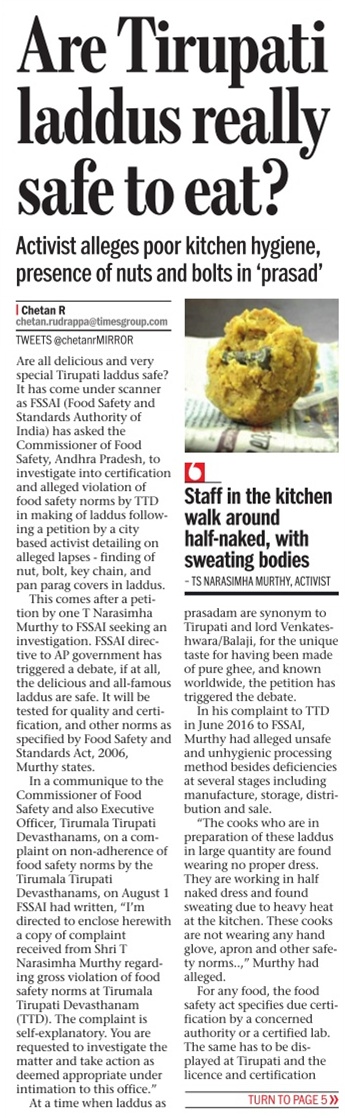
ARE TIRUPATI LADDUS REALLY SAFE TO EAT?


Activist alleges poor kitchen hygiene, presence of nuts and bolts in ‘prasad’
Are all delicious and very special Tirupati laddus safe? It has come under scanner as FSSAI (Food Safety and Standards Authority of India) has asked the Commissioner of Food Safety, Andhra Pradesh, to investigate into certification and alleged violation of food safety norms by TTD in making of laddus following a petition by a city based activist detailing on alleged lapses - finding of nut, bolt, key chain, and pan parag covers in laddus.
This comes after a petition by one T Narasimha Murthy to FSSAI seeking an investigation. FSSAI directive to AP government has triggered a debate, if at all, the delicious and all-famous laddus are safe. It will be tested for quality and certification, and other norms as specified by Food Safety and Standards Act, 2006, Murthy states.
In a communique to the Commissioner of Food Safety and also Executive Officer, Tirumala Tirupati Devasthanams, on a complaint on non-adherence of food safety norms by the Tirumala Tirupati Devasthanams, on August 1 FSSAI had written, “I’m directed to enclose herewith a copy of complaint received from Shri T Narasimha Murthy regarding gross violation of food safety norms at Tirumala Tirupati Devasthanam (TTD). The complaint is self-explanatory. You are requested to investigate the matter and take action as deemed appropriate under intimation to this office.”
At a time when laddus as prasadam are synonym to Tirupati and lord Venkates­h­wara/Balaji, for the unique taste for having been made of pure ghee, and known worldwide, the petition has triggered the debate. 
In his complaint to TTD in June 2016 to FSSAI, Murthy had alleged unsafe and unhygienic processing method besides deficiencies at several stages including manufacture, storage, distribution and sale.
“The cooks who are in preparation of these laddus in large quantity are found wearing no proper dress. They are working in half naked dress and found sweating due to heavy heat at the kitchen. These cooks are not wearing any hand glove, apron and other safety norms..,” Murthy had alleged.
For any food, the food safety act specifies due certification by a concerned authority or a certified lab. The same has to be displayed at Tirupati and the licence and certification renewed every year has to be put on display. But nothing couldn’t be found, alleged Murthy.
“It is noticed that the place of manufacture of food ie, laddu is not upto the standards prescribed under the Food Safety and Standards Act, 2006. The actual preparation method and employees status can be accesses by the authority at the link – https://www.youtube.com/watch?v= pEdGx23PD. TTD has also not displayed the licence at its premises, not complied with mandatory issuing of bills to devotees,” Murthy’s petition details.
Following this, FSSAI had sought investigation and action. Narasimha Murthy had sought information on the investigation. However, nothing has come yet. A communique to him from the joint food controller, AP in September has said that they had not received any reply had from executive director, TTD over FSSAI directive to commissioner for food safety and his directive inturn to TTD seeking their say. Following which Murthy has again moved FSSAI over inaction stating that the commissioner’s office had not initiated any action except calling for report last month. He has also filed first appeal in the case on October 26.
They have to get licence to sell it in Tirupati, and special licence to do it in Bengaluru and New Delhi too, but nothing is done, Murthy alleged.
“On every sale, they have to give bill. It should have quantity, quality, ingredients, date of manufacture and date of expiry. However, these bills have nothing of it. The food safety act gives exemption for push carts and petty shops temporary stall holder or tiny food business operator. But Tirupati is not so. Not providing information on certification even after two months only show they have none,” Murthy added.
Now an investigation will bring facts of Tirupati laddus – more on if they adhere to food act norms.
Experts feel failing to adhere to the norms specified under the food act including selling without licence may prove costly to those selling or dealing with food products.
“If any person or those in business other than those exempted manufactures, sells, stores or distributes or imports any article of food without licence can be punished with six months imprisonment for a term which may extend to six months and fine that can extend to five lakh,” Dharaneesh an advocate told Bangalore Mirror.
Murthy who had visited Tirupati to witness the process in person before lodging his complaint added, “The act states that such articles when exposed for sale, shall be kept in clean vessels or plates made of glass or metal covered with enamel or tin lining, placed in glass cases provided, if necessary, with a fly proof wire guage at the top for ventilation and that no such articles shall be touched by hand and clean spoons or other accessories shall be used for serving them. But nothing of this is being practiced.”
Other specifications
The act also mandates that licence shall allow only servants, who are dressed in clean clothes, and that the licences shall purforth with report to the health officer on any case of dangerous, infectious or contagious disease occurring on the premises. The employer and employee should satisfy health requirements including certification of those in business - not infected with any disease and certification on free from infections/diseases if infected, and health compliance as specified in the act. But none of them are existing there, Murthy alleged. Several efforts to reach TTD executive officer over the charges went in vain as none responded.
The laddus
The Tirupati laddus has more than a 300-year-old history, and are believed to date back to early 18th century. Known for its unique taste, as prasadam offered to devotees visiting Tirupati, these laddus are now registered as Geographical Indications under the GI Act. Mainly three types – Asthanam Laddu (prepared for festivals), Kalyanotsavam Laddu (prepared during kalyanotsavam), Proktham laddu (distributed to devotees every day) are known for its unique taste made of pure ghee and offered to lord Balaji first as naivedyam. The prasadam’s first existence date back to times of Pallavas who offered prasadam to deities and then Devaraya II offered naivedyam to deity and remaining food was distributed to devotees. Prasadam, which was called Tiruppongam then was called Avasaram later during Vijaynagar rulers tims, and then sold as sweet boondi by Madras government before it took shape in 1940 as laddu with growing demand for prasadam ever since time immemorial. Laddu is offered with vadai, which are a hit as Srivari Prasadam at Tirupati.

Limit for iron particles in tea increased to 250 mg/kg: FSSAI

The continuous presence of iron filings in tea has raised safety concerns and there have been many demands to fix an upper limit
Food safety regulator FSSAI has raised the upper limit for iron particles in tea powder to 250 mg per kg from the existing 150 mg, with effect from current month.
Iron fillings enter tea due to wear and tear of the processing machinery. The continuous presence of iron filings in tea has raised safety concerns and there have been many demands to fix an upper limit.
In a circular, Food Safety and Standards Authority of India(FSSAI) said: "The revised limit of iron filings in tea up to level of 250 mg per kg has been approved by the Scientific Committee."
These standards of iron filings in tea have been made operational with effect from this month. They will supersede the earlier limit operationalised on April 22, 2016, it said.
The limit has been raised after taking into consideration the comments and suggestions received from various stakeholders, it added.
FSSAI had recently conducted a large-scale laboratory analysis of tea powder for determining the limit on iron filling.
The tea leaves are dried in a sieve fitted with mesh and leaves are cut using iron rollers. Factories use huge magnets to remove iron fillings from tea powder.
Tea production in India, the world's second largest tea producer after China, stood at 795.89 million kg during April-September period of this fiscal, while 101.04 million kg of tea was exported in the same period.
The country had produced 1,233 million kg in the entire 2015-16 fiscal, of which 232.92 million kg was exported.

Gold, silver leaves

Machines can make the varakh industry a clean, hygienic and well-managed sector
The varakh industry is huge in India, with over 300 tonnes of silver leaves used in paan, chawanprash, tobacco products, ayurvedic medicines and mithais

Nov 13, 2016- For years and years the Indian government put off the decision to make varakh, any leaf composed of pure metals, typically silver and gold, by machine on the grounds that no machines were available. Finally, this year a historic decision has been taken and the Food Safety and Standards Authority of India (FSSAI) has clearly notified that no varakh can be made except by machine.
The person responsible for this change (apart from me) is Surendra Karnavat, a diamond jeweller in America. He and his wife were members of the Rajasthan Association of America and came to India in Vasundhara Raje’s first term as Chief Minister, lured by the promise that they would get all the help required to start a machine-based varakh industry. He was given none of the promised assistance and could only start in a very small way. However, he did not give up hope and started by supplying to only a few shops in his own area. I heard of him, and met him, while campaigning to make varakh in a vegetarian way. Then, when the FSSAI started to take the matter seriously, he came was called to show them how it could be done properly.
The varakh industry is huge in India, with over 300 tonnes of silver leaves used in paan, chawanprash, tobacco products, ayurvedic medicines, mithais and temples. It is used in Germany on food (the food number is E 175) and in France on photo frames. In Japan it is everywhere—interiors, tea, instruments, frescos, temples. The whole of Southeast Asia uses varakh, to pay homage to Lord Buddha. It is used on chocolates, cocktails and liquors—German Goldwasser and the Swiss Goldschlager are examples—soups, salads, ice creams, coffees. Now, gold leaf has become a part of anti-ageing creams, facepacks and foundations. The use of the gilded leaf is endless.
Gold leaf has been used for jewellery, for art decorations, picture frames and gilded art. We have used it in our glass paintings. But we don’t export it, because we make it in a dirty—and now illegal—manner. The 300 tonnes of silver used in India means: one kilo of silver has 225 gaddis (bundles) and one gaddi is 150 sheets of silver varakh that means, 6.75 crore gaddis every year. The world market asks for 300kg of goldvarakh every day.
Silver in abattoirs
Till now, the varakh makers are in slaughterhouses. They are all a sect of Muslims called Pannigars. They select cattle by feeling their intestines while they are alive, and then having them cut and extracting the intestines while they are hot. These intestines are made into pouches, and silver is beaten in between them till it is thin enough to be sold. This method is filthy and certainly not pure silver. When you eat it, you place yourself at risk.
The second method that is used by most mithai sellers—who will pretend that they are getting the varakh from vegetarian sources and also what the president of the mithai association claimed to me)—is to beat the silver between plastic sheets. However, this is also a filthy meat-based method, as the plastic is coated with animal fat for lubrication and is also then covered with leather. The varakh that emerges is not only unhygienic but also unfit for eating.
Karnavat has replaced leather or animal fat with a specially engineered paper, which is translucent and smooth. This paper is fed into a machine and the process of making varakh is completely mechanised, without coming into contact with the sweaty human hand. The leaf has a thickness of 0.18 microns in silver and 0.1 microns in gold, making it of international standards even for gold fillings and ayurvedic medicines. The machine has taken 15 years to develop and meets the guidelines of the US Food and Drug Administration.
The right way
He is one of the very few people in the world who has the knowledge of producing varakh paper (also known as interleaf paper or carbon coated paper). He wants to help low cost machines to be produced and installed, and train unskilled labourers—perhaps even the same people who have
been sitting for years at slaughterhouses and taking out the intestines of freshly killed buffaloes and cows. He believes there is scope for at least 2 lakh people to be employed, and that this is the only way for the varakh industry to become a clean, hygienic well- managed and organised sector, instead of being a filthy unorganised secretive sector that operates in the shadows of butcheries. This could also be a major employment area for women, as gold and silver leaf have to be transferred from interleaf paper to tissue paper, and this delicate exchange can be best handled by a woman. Gold and silver leaf can be major exports from India as well.
Karnavat was invited by the Chinese government to establish a unit and train their people. He refused because he wants to make India the silver/gold leaf hub of the world. This seems to me to be an excellent potential industry and, now that Mudra loans are available to small businessmen, this should be taken advantage of. In fact, if you are a large mithai maker, you should establish your own ancillary varakh leaf factory.
To join the animal welfare movement contact gandhim@nic.in, www.peopleforanimalsindia.org