Jun 19, 2019

Only 4 food inspectors in Greater Hyderabad

HIGHLIGHTS The Greater Hyderabad Municipal Corporation (GHMC) seems to have neglected the health of the citizens of the city, as they have only four food inspectors as opposed to a required strength of 30. 
Hyderabad: The Greater Hyderabad Municipal Corporation (GHMC) seems to have neglected the health of the citizens of the city, as they have only four food inspectors as opposed to a required strength of 30.
There are around 30 circles in the city and one food inspector should be appointed for each circle to keep tab on quality of food provided by food joints, roadside pushcarts, food vendors and hotels, according to the officials of the GHMC.
For the huge city population and more number of food joints, roadside pushcart vendors and hotels, the GHMC has only four food inspectors, including two Gazette food inspectors, one food inspector and an assistant food inspector in Food Safety Department to look after the quality of the food provided at the hotels and food joints.
There were seven to eight food inspectors when it was Municipal Corporation of Hyderabad (MCH) and then the staff has been reduced every year, and now it has reached four, said an official at GHMC.
The responsibility of the food inspectors is to ensure that all registered restaurants and eateries abide by the acceptable standards of health and hygiene. Some 26 food inspector posts are lying vacant since a few years and either state government or civic body is showing interest to fill up the vacancies that play a vital role in maintaining the health of the common man.
Even though the 26 posts are sanctioned a few years ago, the recruitment has not been done till date, as it is pending at the government level, said a GHMC official. This shows that the Food Safety Department has been neglected in the GHMC.
The food inspectors at Food Safety Department conduct raids on regular basis on hotels and restaurants to check the food quality and cleanliness maintaining in the kitchens of the hotels along with medical department staff, due to lack of adequate food inspectors in GHMC.
Speaking to the Hans India, Sudarshan Reddy, a food inspector said, "We are trying to fill the vacant posts, and we have written a letter requesting the government to fill the vacancies in the Food Safety Department. We are waiting for the reply from the government." It is very difficult to ensure hygiene and safety in all hotels across the city with less staff, the official admits.

Food safety is highest priority of my govt: Goa health minister

PANAJI: Health minister Vishwajit Rane said Nationalist Congress Party (NCP) MLA Churchill Alemao is trying to create panic among people asking them not to eat fish till August 15. On Monday, Alemao urged people to refrain from consuming fish during fishing ban period due to formalin scare.
Urging people to ignore Alemao’s appeal, Rane said, “There is nothing to worry and fish available in the markets of Goa is safe for consumption. Food safety is the highest priority of my government. A monitoring system has been put in place. The government is very serious on the issue. It knows what is to be done.”
Talking about measures taken, he said random checks are conducted and samples collected for testing. A whole protocol has been laid down. It is mandated that fish has to be transported in insulated vehicles. The vehicles with inadequate documents but transporting fish are not to be allowed to enter the state, he said.
“Chief minister Pramod Sawant, deputy chief minister Vijai Sardesai and I, had a joint meeting to discuss this issue,” he said reacting to NCP's MLA's appeal.

Three food outlets shut temporarily after raids

‘Subhojanam’ to provide training to those handling food
The city Corporation conducted raids across 52 restaurants and catering centres on Tuesday, closing down three of them temporarily for preparing food in unhygienic conditions.
Following the raid, Mayor V.K. Prashant also announced the launch of the civic body’s ‘Subhojanam’ project to provide mandatory training to those handling food in the city’s restaurants.
The raid was conducted by four special squads in different parts of the city. Misban hotel at Sreekaryam, Ammu catering service in Attipra, and one more catering service without a name were temporarily closed down to improve their working environment.
According to Corporation health officials, there was no issue with the quality of the food served here.
Notices served
In addition, notices were served on 47 more restaurants and catering services for not having proper system for segregated disposal of waste.
The Corporation had recently published an approved list of 19 firms that have been licensed to collect biodegradable waste from restaurants in the city.
The restaurant owners were asked to enter into a contract with these firms.
Identity cards
On completion of a week-long training as part of Subhojanam project, participants will be provided with identity cards.
Once all the phases of the training are completed, the civic body will make it mandatory that only those holding these identity cards can handle food in restaurants, bakeries, tea stalls, and catering units.
The training will be provided by experts from the industry, along with health inspectors of the Corporation. The training modules will be prepared in July.
In August
The training process is expected to begin by August. Those interested in working in the sector will also be provided training.
The Corporation is also mulling the inclusion of basic training in Malayalam language with the help of the literacy mission to migrant workers who make up a majority of workers in the restaurant industry.

Mizoram has taken many steps to ensure food safety: Minister

The Mizoram government has taken several steps to check the standard of food under the provisions of the Food Safety and Standards Act, 2006 and FoodSafety and Standards Rules and Regulations 2011, Health Minister Dr R Lalthangliana informed the state Assembly Tuesday.
Replying to questions from Dr Vanlaltanpuia of the ruling Mizo National Front (MNF), Lalthangliana said that inspection of hotels and restaurants and sampling of some food products have been conducted by the food administration officials.
Most of the food samples were sent to State Public Health Laboratory in Guwahati, he said.
A food testing laboratory is being set up at Zemabawk locality in Aizawl where equipment and machinery purchased by the state commerce and industries department have been already installed, he said.
He said that the new laboratory would be commissioned after the equipment are handed over to the health department.

Jun 18, 2019

Organic nutrients in soil dip with fertiliser overuse


FSSAI to bring in new labelling norms for gluten-free products

The regulator to address cross-contamination issues and remove ‘low gluten’ provision
The Food Safety and Standards Authority of India (FSSAI) plans to introduce new labelling norms for gluten-free claims on products as well as address the issue of cross-contamination of such products with gluten- containing products during manufacturing.
In a guidance note for manufacturers and consumers on gluten-free foods, FSSAI said that it is in the process of adding labelling provisions for addressing the issues of cross contamination.
Advisory on declaration
Advising food manufacturers to avoid such cross contamination, it said that when a gluten-free product is manufactured in a plant where gluten-containing products are also manufactured, it should be declared on the label. It should read, “Processed in a plant where gluten containing products are manufactured”.
The regulator reiterated that only foods that contain 20 mg gluten/kg or less can be labelled as gluten-free, as per its current standards.
“FSSAI is also in the process of removing the provisions relating to the standard of “Food specially processed to reduce gluten content to a level 20-100 mg/kg”…. and ‘Low Gluten and warning for low gluten’ from its regulations,” it added.
The regulator has said that packaged food manufacturers should establish separate storage and preparation areas for gluten-free and gluten-containing ingredients. It said that they “should have separate production areas and equipment with controlled air-low between the two production areas,” to reduce the potential for air-borne flour dust contamination.
The regulators said that hotels and restaurants are advised to keep gluten-free options at their outlets.
The FSSAI said that consumers should be aware when seeking gluten-free options that “wheat-free” foods may contain grain such as rye and barley.
It has advised consumers to check the label when buying gluten-free products and look for certification mark, ingredients , allergen warning among others.

Serious concerns over Bt brinjal


There is no evidence that genetically modified brinjal will benefit farmers
A month ago, Bt brinjal genetically modified (GM) to resist the brinjal fruit and shoot borer (an insect), was found growing illegally in Haryana. This was a different Bt brinjal from the one developed by the Indian company, Mahyco, in which Monsanto has a 26% stake. Mahyco’s Bt brinjal has been under a moratorium since 2010. Even as the government clamped down on the illegal GM crop, some farmer groups have demanded the release of Mahyco’s Bt brinjal and other GM crops in the regulatory pipeline. It is true that the moratorium was imposed by the then Environment Minister Jairam Ramesh, despite being cleared by the Genetic Engineering Appraisal Committee (GEAC), the apex regulatory body for GM crops. But is Bt brinjal actually ready for release?
The impacts
Before imposing the moratorium, Mr. Ramesh had sought comments from a range of experts and concerned groups on environmental impacts and implications for consumers and farmers. Despite demands from activists and social scientists, the Ministry of Agriculture has not offered evidence that Bt brinjal will benefit farmers. Ironically, the National Institute of Agricultural Economics and Policy Research anticipates that if Bt brinjal performs as Mahyco proposes, brinjal output will increase and retail prices will fall, benefiting consumers far more than farmers. The report ignores the scenario that companies might charge premium prices for Bt brinjal seeds, in which case farmers may not benefit at all.
On biosafety issues, scientific opinion is divided down the middle. While some scientists such as Deepak Pental of Delhi University were in favour of releasing Bt brinjal, others such as the late Pushpa Bhargava, entomologist David Andow of the U.S., and the then Vice-Chancellors of the Acharya N.G. Ranga Agricultural University and the Dr. Y.S.R. Horticultural University highlighted crucial deficiencies in the characterisation of Bt brinjal, and in the environmental impacts assessment. The ecologist, Madhav Gadgil, warned of contamination of India’s diverse brinjal varieties. Biodiversity is critical for nutrition and sustainability, and the government’s own task force on biotechnology (2004) had recommended that no GM crop be allowed in biodiversity-rich areas.
Further, a majority of the technical expert committee appointed by the Supreme Court (in the public interest litigations over GM crops), recommended a ban on genetically modifying those crops for which India is a centre of origin or diversity. Brinjal happens to be such a crop.
Nutrition issues
In terms of nutrition, there seem to be some significant differences between Bt and ordinary brinjal. Many health researchers and professionals, and scientists such as immunologist David Schubert of the Salk Institute, U.S. and Suman Sahai of Gene Campaign have argued that Bt brinjal poses risks to human health. M.S. Swaminathan and V.M. Katoch, then the Director General of the Indian Council of Medical Research, asked for long-term (chronic) toxicity studies, before taking any decision on Bt brinjal. Further, they asked that these be conducted independently, instead of relying exclusively on Mahyco for data.
Bt brinjal found no support from State governments. Kerala and Uttarakhand asked for a ban on GM crops. States with substantial brinjal cultivation, i.e. West Bengal, Odisha, Bihar opposed the release pending rigorous, extensive testing. As did Chhattisgarh, Tamil Nadu, Karnataka, Madhya Pradesh, and undivided Andhra Pradesh. These States were ruled by parties across the political spectrum. In 2012 and 2017, respectively, the Parliamentary Standing Committee on Agriculture and the Committee on Science & Technology, Environment and Forests assessed the GM controversy. Both committees expressed grave concerns about lapses in the regulatory system. In fact, the Committee on Agriculture was so alarmed by the irregularities in the assessment of Bt brinjal, that it recommended “a thorough probe by a team of eminent independent scientists and environmentalists”, which never happened. Further, both committees endorsed labelling GM foods to protect a consumer’s right to know. However, since retailing is largely unorganised, enforcing truthful labelling is a logistical nightmare, and the Ministry of Agriculture believes it is impractical. The Food Safety and Standards Authority of India has only recently begun putting labelling rules into place.
No scientific consensus
In sum, there is a moratorium on Bt brinjal because there is no scientific consensus on its safety and efficacy, and because the States and Parliament have profound misgivings about the regulatory system. In recent years, pests have developed resistance to Bt cotton, forcing farmers to spray lethal pesticides. This led to over 50 deaths by pesticide-poisoning in Vidarbha in 2017. A GM-based strategy of pest control is unsustainable, all the more so since farmers, already pressed for land, ignore the government’s recommendation to plant refuge crops.
We cannot wish all these concerns away simply because some farmers want to try Bt brinjal, or farmers in Bangladesh have been cultivating Bt brinjal since 2013. Farmers do not and cannot assess long-term impacts on ecology and health, which needs more rigorous and sensitive studies than those conducted so far. Yet, in the nine years since the moratorium, there has hardly been any progress toward addressing these issues. If anything, the problem of sustainable, remunerative farming has become more acute, and alternative strategies such as organic and zero budget natural farming, which do not allow GM seeds, are gaining ground.
At the very least, the government must detail the steps it has taken since 2010 to address the scientific lacunae, clarify precisely how Bt brinjal will benefit farmers, put the infrastructure to ensure labelling into place, and demonstrate how Bt brinjal fits in with sustainable farming and biodiversity conservation. As things stand, Bt brinjal runs counter to the framework for agricultural development and farmers’ well-being devised by parliamentary panels and the government’s own task forces and expert committees.
Aniket Aga teaches environmental studies at Ashoka University and is writing a book on the science and politics of GM food crops in India. E-mail: aniket.aga.2016@gmail.com

Jun 16, 2019

Food safety registration, licence a must: Officials

Coimbatore: Food safety officials and district collector K Rajamani on Saturday reiterated the need for all restaurants, hotels, catering companies, anganwadis, bottling companies, food kiosks and street food stalls to get either a food safety licence or a food safety registration.
They also told eateries that the use of single use plastic for serving and packaging food won’t be permitted and urged all the stakeholders to cover large water cans, instead of exposing it to the sunlight.
“Establishments that are yet to have licence or registration must approach the food safety department, know all the rules, conform to the rules and apply for either food safety licence or food safety registration based on the type of business they do,” said an official.
The officials said all the water bottling plants should have a Bureau of Indian Standards (BIS) certification and apply for licences. “Large plastic cans that they use to fill water for the sales should be cleaned and dried regularly. When transporting these cans to an establishment or for door-to-door delivery, they should be covered and not exposed to the sun,” the official said.
Adulteration of tea with colouring agents, which has been a major problem in both Nilgiris and Coimbatore, is banned, they said. “If establishments are found using adulterated tea, which is obviously less expensive, cases will be registered against the owners and the product will be seized.”

Jun 15, 2019

Cup to lip, the sip of tea is at risk


DINAKARAN NEWS


White meat or red, both equally bad for you


Violaters of Plastic ban will be penalised from Monday


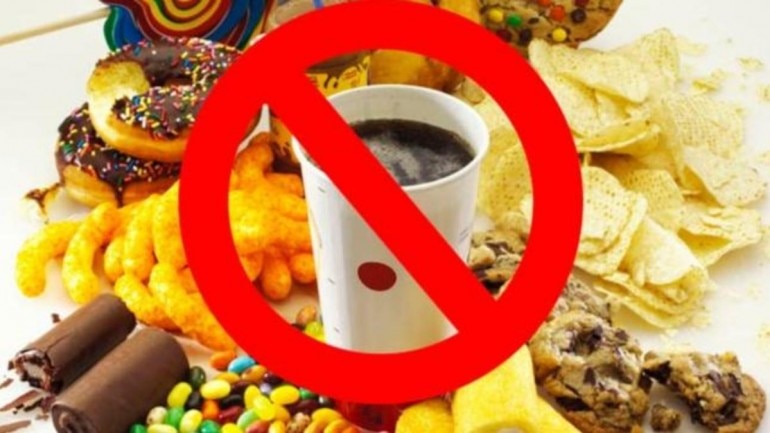
Ban junk food advertisements in and around school premises: FSSAI

In March 2015, the Delhi High Court had directed the food regulator to come out with regulations to promote healthy food for school children.
Ban junk food advertisements in and around school premises: FSSAI

FSSAI has proposed banning advertisements of unhealthy food in and around school premises in an attempt to promote safe and wholesome food among school children, its CEO Pawan Kumar Agarwal said Thursday.
The Food Safety and Standards Authority of India (FSSAI) has prepared a draft regulation on availability of safe, wholesome and nutritious food in schools and the same has been sent to the health ministry for approval, he added.
Here's what CEO Pawan Kumar Agarwal said:
"We have proposed to put a curb on advertisements and promotion of food that is not healthy in school premises and 50 metres surroundings," Agarwal told PTI on the sidelines of an Assocham conference on school healthcare.
In March 2015, the Delhi High Court had directed the food regulator to come out with regulations to promote healthy food for school children.
"About three years ago, the High Court had asked us to come out with regulation on healthy diets for school children. We have been struggling to put that regulation together. Because if you have to make a law, it has to be implemented," Agarwal said while addressing the conference.
In the draft regulation, FSSAI has defined healthy diet based on some parameters.
Need for healthy diet:
"How do you define healthy diet? That is at the heart of that regulation. We cannot say that because it (food product) is coming from MNCs it is unhealthy, some of the Indian food can also be unhealthy. Therefore we have to have a matrix that defines healthy food fairly and objectively," Agarwal added.
"We have come out with a draft regulation that will be in place," he said.
Last year, FSSAI had put this draft regulation in public domain for comments. It proposed restrictions on the sale of junk food including noodles, chips, carbonated drinks and confectionery in and around schools.
While bringing this draft, FSSAI had said the objective was to restrict/limit the consumption and availability of most common HFSS food (junk food) like chips, sugar sweetened carbonated and non-carbonated beverages, ready-to-eat noodles, pizzas, burgers and confectionery.
6 out of 10 diseases are diet related:
Addressing the conference, Agarwal emphasised on maintaining healthy diet, saying that 6 out of 10 diseases are diet related. "If we have safe and healthy food and keep ourselves fit, most of the disease may not come," he added.
Agarwal highlighted the initiatives taken by FSSAI in the last few years to promote safe, nutritious and wholesome food in schools, but stressed on taking this campaign to national level.

Jun 14, 2019

DINAMALAR NEWS


DINAKARAN NEWS


Unhygienic food handling gives rise to illnesses


Food Safety and Standards Authority of India proposes ban on junk food ads in and around schools

HIGHLIGHTS
FSSAI has proposed banning advertisements of unhealthy food in and around school premises in an attempt to promote safe and wholesome food among school children, its CEO Pawan Kumar Agarwal said Thursday.

New Delhi: FSSAI has proposed banning advertisements of unhealthy food in and around school premises in an attempt to promote safe and wholesome food among school children, its CEO Pawan Kumar Agarwal said Thursday.
The Food Safety and Standards Authority of India (FSSAI) has prepared a draft regulation on availability of safe, wholesome and nutritious food in schools and the same has been sent to the health ministry for approval, he added.
"We have proposed to put a curb on advertisements and promotion of food that is not healthy in school premises and 50 metres surroundings," Agarwal told PTI on the sidelines of an Assocham conference on school healthcare. In March 2015, the Delhi High Court had directed the food regulator to come out with regulations to promote healthy food for school children. "About three years ago, the High Court had asked us to come out with regulation on healthy diets for school children.
We have been struggling to put that regulation together. Because if you have to make a law, it has to be implemented," Agarwal said while addressing the conference. In the draft regulation, FSSAI has defined healthy diet based on some parameters. "How do you define healthy diet? That is at the heart of that regulation.
We cannot say that because it (food product) is coming from MNCs it is unhealthy, some of the Indian food can also be unhealthy. Therefore we have to have a matrix that defines healthy food fairly and objectively," Agarwal said. "We have come out with a draft regulation that will be in place," he added. Last year, FSSAI had put this draft regulation in public domain for comments.
It proposed restrictions on the sale of junk food including noodles, chips, carbonated drinks and confectionery in and around schools. While bringing this draft, FSSAI had said the objective was to restrict/limit the consumption and availability of most common HFSS food (junk food) like chips, sugar sweetened carbonated and non-carbonated beverages, ready-to-eat noodles, pizzas, burgers and confectionery.
Addressing the conference, Agarwal emphasised on maintaining healthy diet, saying that 6 out of 10 diseases are diet related. "If we have safe and healthy food and keep ourselves fit, most of the disease may not come," he added. Agarwal highlighted the initiatives taken by FSSAI in the last few years to promote safe, nutritious and wholesome food in schools, but stressed on taking this campaign to national level.

Draft regulation for safe, wholesome, nutritious food for school children to be put in place

The initiatives taken by the Food Safety and Standards Authority of India (FSSAI) in the school space from point of view of inculcating right eating habits have not reached national scale so far, its Chief Executive Officer (CEO) Pawan Kumar Agarwal said at an ASSOCHAM event in New Delhi. 
"There has been good participation from Delhi schools, Tamil Nadu officers were taking interest, so it saw a good participation but it is not really a pan-India phenomenon," said Agarwal inaugurating an ASSOCHAM National Symposium on School Healthcare.
Recalling meeting of health minister with FSSAI officials on the occasion of World Food Safety Day to get a sense of what the organisation has been doing in the space of promoting healthy eating habits, Agarwal said, "He was quite impressed but obviously he also realised that these initiatives, however are extremely thoughtful but the challenge is to make it a truly mass movement."
It will not become a mass movement unless we integrate food in our school systems, he said. "Not merely confining to health and wellness ambassadors and coordinators, it has to be the whole of school which has to be involved in this exercise of getting the school children to eat the right stuff," he added.
Seeking cooperation of education industry he added that there is lot more that needs to be done. "We are still in some sense in mode of consolidation to bring all these elements together and see how we can move forward and take up a national movement around eat right in the schools.
Agarwal also said that FSSAI has come out with draft regulations on healthy diets for school children which will also be in place. "About three years a High Court had asked us to come out with regulations on healthy diets for school children, and we have been struggling to put that regulation together because if we make a law it has to be implemented."
He added, "How do you define 'healthy diets,' that is at the heart of that regulation, we had to have a metrics that defines healthy foods, fairly objectively, now we have come out with draft regulations and that will also be put in place."
Agarwal also informed that in the draft regulation for safe, wholesome and nutritious food for school children, FSSAI has proposed to impose curbs on advertising, promotion and endorsement of food products that are not healthy in school premises and within 50-meter radius of school, while earlier it was only about availability in school canteens.

Curbs sought on advertising of junk food near schools

The Food Safety and Standards Authority of India (FSSAI) is looking to put curbs on advertisement or promotion of unhealthy food not only inside school premises but also in the vicinity of schools.
With such a move, the regulator aims to promote wholesome and nutritious food and restrict the consumption of high sugar, salt and fat products in and around school premises where children are without parental supervision. This is part of the draft Food Safety and Standards (Safe and Wholesome Food for School Children) Regulations.
Speaking at an Assocham event, Pawan Agarwal, CEO, FSSAI, said the food safety regulator has proposed to impose curbs on advertising, promotion and endorsement of unhealthy food products in school premises as well as within 50-metre radius of school surroundings.
The regulator first began looking at this issue in 2015, after Delhi High Court had directed it to come out with regulations to promote healthy food for school children. In that year, it had also released draft guidelines on this issue.
The food safety authority aims to define healthy diets based on certain metrics. “How do you define healthy diet? That is at the heart of that regulation. Therefore we have to have a matrix that defines healthy food fairly and objectively,” he stated.
In the draft guidelines released earlier, the regulator had identified chips, sugar-sweetened carbonated and non-carbonated beverages, samosa, French fries, pizzas among others as HFSS foods.
Under the aegis of a self-regulatory global alliance, several key international packaged food companies already voluntary do not advertise their food products to children below the age of 12 years and in primary schools.

Jun 13, 2019

60 meat in 2040 may come from lab process


5 grams of microplastic consumed weekly


Gurgaon to get Haryana’s first clean street food market

Come August, Gurgaon will be home to the first clean street food market in the state. The Food Safety and Standards Authority of India (FSSAI) has partnered with Gurgaon’s local administration to set this market up in Sector 38. The market, to be built like an open-air food court, will have about a hundred vendors wearing identical uniforms and name tags. The whole market will be cleaned and the vendors will also be trained in how to deal with the customers in a polite and friendly manner. All vendors will wear gloves and the way the food is prepared will be monitored by the FSSAI.
The agency says they will ensure the market is up to the standards of safety and hygiene laid down by them. KK Sharma, the nodal officer for the project, tells us, “We have completed the survey and pre-audit for the market and even trained a hundred vendors in public dealing. We had selected two places for the markets- one opposite Medanta in Sector 38 and the other in Sushant Lok but due to non-cooperation from the traders in Sushant Lok, we are only going ahead with the one in Sector 38 for now.” Interestingly, the Gurgaon city administration had earmarked this market in Sector 38 as a model street food zone in 2015 but the project never took off. This clean street food zone is expected to be operational in two months. The authorities will then start looking for another location as well.

Food Safety Deptt declares snack Fun Fine Puff ‘unsafe’


Food Safety Department declared snacks “Fun Fine Puff” Brand Name “Parul Fun Fine Puff” “unsafe and misbranded,” under the provisions of Food Safety & Standards Act, 2006 Rules and Regulation, 2011.
The department issued the notice after they lifted the sample of the snacks Batch No: 696, which was declared by their laboratory as “Unsafe and Misbranded”.
The department has advised the public in general and the Stake Holders in particular in their own interest to discontinue use / stop sale and supply of above food product.

Over 50 people fall ill after consuming food at religious event

Aurangabad: In a suspected case of food poisoning in Beed, several people, including men, women, and children experienced uneasiness in the wee hours of Wednesday after consuming contaminated food on Tuesday night. The affected people were attending a religious event organised in Govindnagar, Dhanora road of Beed city.
Around 50 people have been admitted to Beed district hospital. “We are coordinating with the FDA as well as medical authorities so that an appropriate action is initiated in this incident. We are also trying to ascertain if the incident is a result of carelessness or it is case of sabotage,” Beed superintendent of police G Sreedhar told TOI.
A detailed report of the incident has been sought from the area police station. Besides, the special branch has been directed to collect more details of the incident.
A family residing in the locality had organised a ‘Jagran Gondhal’, a religious event that is typically organised post-marriage. A goat sacrificed for the event was cooked and served as prasad along with bhakri, rice, and a vegetable dish. Almost half an hour after consuming the food at around 11.30 pm, the guests started feeling uneasy. Minutes later, they felt nauseous and suffered from diarrhoea.
Sensing trouble, they were rushed to the hospital. Doctors who attended them said that the condition of some patients had worsened due to serious loss of fluid. However, they were on their way to recovery by morning and are currently kept under observation.
On learning about the incident, senior officials from the Food & Drug Administration (FDA) rushed to the spot and collected food samples which have been sent for chemical analysis at Aurangabad.
When contacted, FDA’s food safety officer Rushikesh Marewar said, “Following the SOP, we have collected the samples of mutton gravy, Bajra bhakris, rice as well as a brinjal dish that were part of the menu at the event.”
Sources from FDA said that considering the gravity of the issue, the authorities at the lab have been requested for getting the food samples tested on priority. “Based on the findings, a call about further action against the organisers and hosts of the event would be taken,” a senior FDA officer said.

Jun 12, 2019

DINAKARAN NEWS


DINAKARAN NEWS


Dutch Vegetable seed developer wins world food prize


Food safety dept bans blended oil for false label

Kochi: Food safety department has banned the manufacture and sale of a brand of blended edible oil, made by mixing palmolein and coconut oil in the ratio of 80: 20, but marketed as coconut oil. A statement from assistant commissioner of food safety said the product Coco Ross blended edible vegetable oil manufactured by Pan Biz Corporation based in Pattimattam was being fraudulently marketed as coconut oil. 
As per Food Safety and Standards Authority of India ( regulations, every package containing an admixture of edible oils shall carry the following label declaration immediately below its brand name: Blended edible vegetable oil. The font size of the label declaration shall not be less than 5mm. The font size should not be less than 10mm if the edible oil package is more than 1 litre.
Though the product was a blend of two vegetable oils, the product was allegedly being sold at the price of coconut oil by the manufacturers.

50% packaged water spurious, no record of source, RTI query reveals

Activists believe this supply comes from exploiting groundwater and that prevalence of unlicensed bottling plants indicates how rampant the water mafia is in the city.
Activists believe this supply comes from exploiting groundwater and that prevalence of unlicensed bottling plants indicates how rampant the water mafia is in the city. 

Of the 15 packaged drinking water samples tested by the food safety department (FSD) in the city between 2016 and 2018, seven were found to be misbranded, shows data shared by the Food Safety Officer, Gurugram. But none was found to be unsafe for drinking, officials said, adding that all bottling plants found to be selling spurious drinking water during that time were sealed.
This information, received in response to an RTI query filed by city-based activist Aseem Takyar in April this year, also revealed that the department has no record of the supply for the illegal or unlicenced bottling plants that are responsible for the sale of spurious water.
Activists believe this supply comes from exploiting groundwater and that prevalence of unlicensed bottling plants indicates how rampant the water mafia is in the city.
Stating that the issue with packaged drinking water is one of market regulation and that it does not necessarily pose a health risk for consumers, Gurugram food safety officer KK Sharma said, his department carries out inspections and testing of packaged drinking water upon receiving complaints or tip-offs about unlicenced bottling plants.
This involves checking the product’s compliance with the FSS Packaging and Safety Regulations, 2011, and the FSS Food Products and Additives Regulations, 2011, both formulated by the Food Safety Standards Authority of India (FSSAI).
“The last time we had a case of unsafe drinking water being sold by an unlicenced bottling plant was back in 2013, or 2014. Strict action was taken against the violators at that time,” Sharma said.
Another food safety analyst, on the condition of anonymity, said that the samples tested between 2016 and 2018 against FSSAI rules were found to be fit for human consumption.
Sharma explained that a ‘misbranded’ sample is one that violates labelling and packaging rules.
“These samples are spurious from a regulatory point of view, in contravention of the FSS Packaging and Safety Regulations of 2011. Mostly, we find products which do not bear the FSSAI logo, or mandatory instructions such as ‘crush bottle after use’,” he said. In other cases, bottles may not contain a ‘best before’ date, the manufacturing address might be missing or illegible, or the product might not bear the words ‘packaged drinking water’ as required under the FSSAI rules. “What some violators also do is sell bottles under the brand of ‘natural mineral water’, which is an official term,” said the anonymous food safety analyst.
An ‘unsafe’ drinking sample, on the other hand, is one which does not conform to the FSS Food Products and Additives Regulations of 2011, which prescribe safety standards for proprietary food products in India.
“If we find that there is a high quantity of a particular element which makes the product a health risk, we immediately seal the plant and attempt to recall products from the market,” Sharma added.
While the FSD maintains that such rampant circumvention of FSSAI rules is not a ‘public health risk’, activists said it sets a poor precedent for enforcement of food safety norms, which is in itself a health risk.
“The prevalence of unlicensed bottling plants, as revealed by the FSD, shows how rampant the water mafia is. The food safety department might not have detected unsafe water in the last two years, but with such loose regulation, one cannot guarantee that all packaged drinking water in the city is safe for consumption,” local activist Takyar said.

Mobile food testing lab flagged off

Vehicle will tour various parts of Cuddalore district till June 29
A mobile food testing van of the Food Safety and Standards Authority of India (FSSAI) has started touring the district from Monday. District Collector V. Anbuselvan flagged off the Food Safety on Wheels at the Collectorate complex here.
An official said the van was procured by the government from the Centre to strengthen the food testing system.
The van has a state-of-the-art lab, fully equipped to conduct tests for common adulterants in milk, water, edible oils and other items.
The vehicle will tour various parts of Cuddalore district till June 29, an official said. The mobile lab will also be able to collect samples and generate instant reports of the analysis while on the field.
People can send their complaints on adulteration to the Food Safety Commissioner through WhatsApp at 94440 42322.
The complaints received will be forwarded to the respective districts for further action, the official added.

Jun 11, 2019

DINAKARAN NEWS


DINAMANI NEWS


FSSAI - PRESS RELEASE


Multiplex samosa-supplier gets closure notice from FDA, Pune

Officials found that the establishment was not following norms prescribed by the Food Safety and Standards Authority of India
Food and drug administration (FDA), Pune, issued a closure notice to MK Enterprises at Kharalwadi, on Saturday.

Food and drug administration (FDA), Pune, issued a closure notice to MK Enterprises at Kharalwadi, on Saturday.
MK Enterprises supplies samosas to Inox, PVR, and E-Square multiplexes in Pimpri-Chinchwad.
Officials found that the establishment was not following norms prescribed by the Food Safety and Standards Authority of India (FSSAI).
Suresh Deshmukh, joint commissioner FDA, Pune, said, “In the surprise raid conducted by the department, it was found that MK Enterprises was using oil for more than three times for the preparation of samosas.”
“Such samosas were sold at Inox, PVR, E-Square multiplexes in Pimpri-Chinchwad,” added Deshmukh.
“MK Enterprises failed to maintain proper hygiene and cleanliness in the kitchen. Our officers found there were no proper health records of employees working in the kitchen,” he said.

Think twice before nibbling on that exotic street delicacy

Unsafe water and ice found being used at cool drink stalls; most people seem oblivious of risks of eating cut fruits and vegetables kept in unhygienic conditions
The sun is about to set over the Kozhikode beach on a weekend day, and there is a steady stream of visitors strolling on the sandy shores.
“Shall we try a glass of ice urathiyathu?” a young woman asks her husband.
“Oh no, I don’t want to fall sick,” pat came the reply as she was led swiftly away from the mobile cool drink stall.
The crowd around the street vendor, however, kept growing. Standing next to the stall, K. Rajesh, who works for a private firm in the city, is dipping a spoon in the glass containing ice urathiyathu, a drink made of crushed ice, vegetables and fruits, topped with peanuts. “Here you get both sweet and spicy varieties,” he says recommending the drink.
“But don’t you care about the water quality?” “Well, not very sure, but it tastes good,” he says.
Local street foods such as ice urathiyathu are hot favourites with young people here despite the possible health risks from the use of contaminated water or ice blocks. People also blink at the health risks of eating slices of salted cut fruits and vegetables available at wayside stalls.
T.K. Prakasan, health inspector (project in-charge) of the Kozhikode Municipal Corporation, points out that many street vendors are found using ice blocks bought from cold storages that preserve fish for long. The ice may contain formaldehyde which will cause serious health issues if it enters human body. The water being used to make fruit juices is not usually filtered either.
Many hotels and restaurants in the city too are found using contaminated water. A number of jaundice cases were reported from among those who used water from the canteen of a well-known hospital in the city recently. The corporation authorities got the canteen closed after it was found that unhygienic water was being used there. The District Medical Officer has already issued alert against jaundice. Another possible threat is cholera.
The corporation is now insisting that hotels and restaurants check on the quality of water they use on their own and produce certificates along with applications for fresh licences.
People have been advised against eating cut fruits or vegetables kept in unhygienic surroundings.
K.V. Baburaj, chairman of the Standing Committee on Health, said the Health section of the corporation would continue raids on restaurants and food joints in the coming days to ward off the possible threat of disease outbreaks during monsoon.
In many places in the city, the Kerala Water Authority’s drinking water pipes are laid next to drainages.
There is a possibility of drinking water getting mixed with sewage. “Recently, coliform bacteria was found in water samples collected from a hotel at Palayam where drainage and drinking water pipe run next to each other. All such hotels have been asked to install water filters,” Mr. Prakasan said. Restaurants using open well water should ensure that water quality is checked every six months at the Centre for Water Resource Development and Management, KWA lab, or the Regional Public Health Laboratory. If water is sourced through tankers, the hotel or restaurant owner should produce a certificate proving its quality.
The Health authorities are also keeping a watch on ‘fuljar soda’, a carbonated drink, now a sensation among youngsters.
A few days ago, they raided a food joint on the beach where the drink was found being prepared in unhygienic conditions. “We have informed the Food Safety Department that the soda and ice being used at the joint were unhygienic,” Mr. Prakasan added.
The food stuff you may find on the street may look exotic, but ensure that it is healthy too.

Food wrapped in newspapers a deadly cocktail of chemicals

What FSSAI’s new regulation says
The new regulation of the FSSAI prohibits the use of newspaper and recycled plastic for wrapping, storing, transporting or dispensing food items and products. This new regulation will come into force from July 1.
Ludhiana, June 9
Eating out may prove to be costly in terms of health if you happen to consume the food that is wrapped in old newspapers. Printing ink contains harmful pigments, additives and toxic chemicals.
Some eateries serve hot, oil-dripping puri/ chana on old newspapers that are used as plates. Bhel-puri, kulcha-chana are wrapped and packed in newspapers. In small hotels, newspapers serve as kitchen napkins and are used as absorbents. This is despite the warnings by the Food Safety and Standards Authority of India (FSSAI) about the ‘slow-poisoning’ by cancer-causing agents lurking in newspaper ink.
According to the FSSAI, the presence of chemical contaminants and pathogenic micro-organisms in used newspaper pose potential risk to human health. The sick and the elderly and also the people with compromised immune systems are at a greater risk of developing health complications, if exposed to food packed in such material.
Consumers, meanwhile, continue to be blissfully unaware that they are consuming a deadly cocktail of chemicals and additives along with the food they eat with relish.
“On Sundays, we go out for eating. Usually, we prefer puri-chana that is freshly prepared. The eating joint we visit uses newspaper as plate to serve the puri-chana. Even in case of sandwiches, newspaper is used as packaging material,” said Achla, a city resident. She said she and her family were not aware that the practice of using newspaper as packaging material was harmful.
“We did not know that newspaper ink, if consumed through food, is carcinogenic. In fact, at home also, we use newspapers to pack oily food, little realising that it could be a health hazard,” she said.

Jun 10, 2019

DINAKARAN NEWS


Concerns arise over quality of tanker water in Chennai

CHENNAI: Lack of uniform policy to check the quality of water that is supplied by the private water tankers has left residents with no choice but to consume contaminated water.
Private water tanker companies are tapping water from unidentified and abandoned sources compromising on quality. In the Keerapakkam stone quarry, a 22-year old murdered body of a man found four months ago. Now, private tankers are pumping water from the same quarry and supplying to households. Even from a quarry near Thiruporur, a body was fished out in January and tankers pump water from there too.
As per rules, the legal responsibility to check the quality of water lies with Metrowater and they act only if there are complaints. The local bodies and food safety department, under the Public Health Act, support Metrowater by checking water contamination regularly. In March, Greater Chennai Corporation had picked up 621 samples and found 36 unfit for consumption.
“The problem is that they check for quality only when we complain,” said S Gopi, secretary of Subramania Nagar Civic and Welfare Association in Kodambakkam. He added, “We are worried about the quality and don’t use tanker supply for drinking or cooking purposes. We use this only for washing and bathing. Also, the situation is so bad that we somehow adjust as we don’t want to irk the private water supply companies.” Metrowater and public works departments formed a committee in October 2018 to regulate private water tankers.
“A draft report has been submitted to the chief secretary and we await corrections after which it will be passed in the assembly. These norms will ensure water is drawn only from permitted locations, treated before supply, rules for the permit and other details. A team would be formed to monitor the implementation,” said a senior metro water official. 
Gopalakrishnan V, a civic activist, said, “Many gated communities treat the water in their RO plants before use. And other residents have no choice but to boil before use. Also, tanker owners won’t tell us where they pumped the water from and say they cannot give any certification on the quality of water,” he said.
The officials at the public works department, under whom the lakes and quarries come, were unavailable for comments. Some quarries also belong to industries and revenue department. Concerns arise over quality of tanker water.

Thriving street food business throws up new challenges

PUDUCHERRY, 07/06/2019: ( For UT Matter ) There is a growing concern among residents as well as health authorities about the mushrooming of wayside food vendors without any valid registration and food safety measures. Photo: T.Singaravelou | Photo Credit: T.Singaravelou
Reuse of edible oil and reckless dumping of solid waste pose a health hazard; penalties levied by municipal officials on vendors have so far proved ineffective
The booming business of street food is causing concern among the health authorities in the Union Territory. Illegal small roadside eateries have proliferated on almost all roads in the city.
Call it the trickle effect of tourism or changing food habits of residents, good patronage is drawing more people into the business. Of late, barbecue too has found a place on the streets.
As business multiplies, health authorities are concerned about hygiene and the added pressure on the solid waste management system in the town and suburban places.
“It is a livelihood issue for a large number of poor people. So, no authority will curb the business interest of a street vendor. But at the same time, it is the responsibility of health authorities to ensure that the food sold in these eateries is as per standards. We can see even people cooking food close to storm water drains,” says Kumar, a resident of Lawspet.
The food vendors hold a different view on the hygiene. “How many of you people have seen the way food is cooked in a hotel? At least, we cook the food in front of the customers. If we sell contaminated or adulterated food we will be the losers,” said Mubarak, a resident of Bussy Street.
Health risk
I. Danaraju, food safety officer, urban area, said the department was aware of the growing number of vendors cooking food on the streets. “It is not correct to say that the food cooked by vendors is unhygienic and those in the hotels is hygienic. But one worry is that the food prepared in an open street where there is high vehicular movement brings with it health concerns. Also, the re-use of oil is a concern, including in middle level hotels,” he said.
Ravichandran, food safety officer, rural area, said recently they received a specific complaint from residents of Kirumampakkam about food being prepared on top of a drain. The department had to intervene to make the owner take corrective steps, he added.
From the point of view of safety, an awareness programme was held for the vendors at the Street Food Festival organised by the Local Administration Department.
Mr. Danaraju said the need of the hour was to make these entrepreneurs get registered and sensitise them to the food safety aspect. “Now, none of them have valid identity cards. We can’t penalise them if something goes wrong,” he added.
He stressed the need for a coordinated effort by the food cell, municipality and police to check the quality of food being sold in all eateries, including those sold by vendors. The Food Safety wing did not have sufficient manpower to enforce the rules. It would need the support of the municipality and the police, he added.
For the municipal authorities, street food kiosks pose a challenge as they generate large quantum of solid waste. Even after being given strict instructions to place bins for customers to dispose plates and food waste, many owners did not comply with the rule. “We have started imposing fine. On an average, fines were imposed on around 1,000 people a month. The fine amount ranges from ₹30 to ₹500,” said R. Kathiresan, health inspector, Puducherry Municipality.
Commenting on the growing number of food vendors, Pratha Kumar Shetty, professor in the department of food science and technology in Pondicherry University, said: “It is known that these roadside eateries are low on safety and hygiene, selling food of very low or unsure quality. However, this does not deter the consumers from flocking them for breakfast, lunch or dinner. Especially, quality of oil and repeated and unscientific ways of using oils makes these foods bad for health.”
Concurring with his views, K. Peter Prasanth Kumar, professor, department of paediatrics, Pondicherry Institute of Medical Sciences, said the traditional processing methods were not used in the preparation, inappropriate holding temperature and poor personal hygiene of food handlers were the main concerns.
The food was not protected from flies and dust. Infections are not uncommon.
Though most of the illnesses caused by contaminated food are self limiting and treatable (acute gastroenteritis), there are instances that can become life threatening. Lack of running water or potable water makes food safety conditions at these locations untenable.
“Street food is here to stay. Vendors should be given some basic training and certification on how to prepare and store them safely. The need of the hour is to understand the operations of our street vendors and develop infrastructure needed to maintain quality,” he said. Stressing the need for maintaining a balanced approach, Prof. Shetty said: “A balance needs to be struck between the health of the consumers and employment of the persons owing the business.”
It is a herculean task to strictly enforce the high standards in this sector. The only way forward was to give regular training and orientation to these establishments and slowly bring them on a kind of formal or semi formal framework through pragmatic simple registration process by the local administration giving training and awareness. There have been efforts in different places by designating them formally as street food zones.
Bangkok in Thailand is one of the best examples of implementing the clean street food programme. “Today, they boast one of the scientifically managed street food cultures in the world. This has improved their tourism by changing the public and world’s perception of street foods,” said Mr. Shetty.
Town vending panels
Municipal Commissioner Arjun Ramakrishna said a town vending committee would be formed soon to identify vending zones where the food vendors could be relocated. The municipality would provide them with all necessary infrastructure, he added.

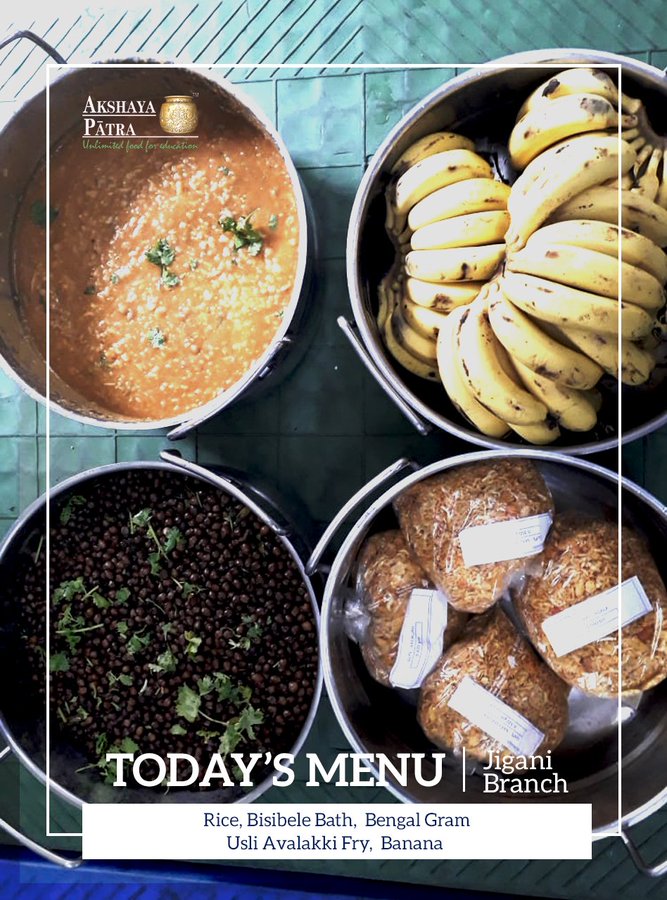
Akshaya Patra midday meal row: Is food without onion and garlic not nutritious?

Akshaya Patra is an organisation which is feeding over 1.76 million children daily in India in order to promote education and eradicating hunger.

The midday meal scheme is often credited for drawing children to schools and also for cut in dropouts, but it has had its share of controversies. The latest row to hit the programme surrounds Akshaya Patra, a charitable organisation run by the International Society for Krishna Consciousness (ISKCON), otherwise known as the Hare Krishna movement.
Akshaya Patra claims that it serves 'wholesome' school lunch to over 1.76 million children in 15,024 schools across 12 states in India.
Accusation
It found itself in the midst of a controversy after an article in a national daily claimed that school-children in Karnataka were not happy with the food provided by the organisation as it lacked garlic and onion.
The criticism
Following this, many people bashed Akshaya Patra for forcing its own food preference on the children, while others raised questions about nutrition. Some even claimed that food was being wasted as the children were not eating the meals served by Akshaya Patra.
"The size of a programme doesn't prove that it's working. Children are not eating enough food because onions and garlic play a major part in Indian food. Due to this, there is large amount of wastage of food," claimed Twitter user Sunil Revathi.
Akshaya Patra's answer
However, the claim was countered by TV Mohandas Pai, who is on the board of the trustee of Akshaya Patra.
"You are lying: any data you have to make this statement?" Pai shot back.
Some supporters of the organisation pointed out that food without onion and garlic could be quite nutritious and since it is a charitable organisation, it should reserve the right to decide what it serves as long as it does not violate the norms for midday meals laid down by the government.
Akshaya Patra said that it follows all the norms laid down by the Ministry of Human Resource Development.
"We have regular quality audits, food safety audits etc. We have given our blood, sweat, tears and personal monies for our children: we follow norms of MHRD; for this selfless service over 20 years we are being abused!," Pai said.
"We also have 17 ISO 22000: 2005 certified kitchens, which are testaments to our priority of protecting the health of children," the official handle of the organisation tweeted on Friday.
Hot, nutritious meals like this are made fresh daily.
Donate $20 and feed a child for an entire school year. 
After the controversy, many social media users came forward to offer donations to the organisation.
The call for more donation to the organisation was given by author Anand Ranganathan.
"The only way bigoted, illogical, anti-science, Hinduphobic vested interests can be silenced, is when you put your money where your mouth is. Please donate to @AkshayaPatra. And do reply with a confirmation that you have done so. Very grateful. Thanks," he said in a tweet on Friday while giving a link to the donation page of the organization.
The support
While Ranganathan did not reveal the exact amount of money collected after his call, he did mention that the organisation received 510 donation in just 11 hours and the average donation size was Rs 3,800 - which amounts to Rs 19.38 lakh - in addition to Rs 2 lakh in one single donation.
"Just crossed 510 donations in 11 hours. Average donation size now Rs 3,800 excluding the one single donation of Rs 2 lacs. Please keep them coming. Thank you so much everyone, but above all, thank you @AkshayaPatra. You are an inspiration. And the pride of India," Ranganathan said.

Food Safety Day in Kohima

KOHIMA: Under the theme “Food Safety, Everyone’s Business”, the Food Safety Day was celebrated for the first time in Kohima on June 7. Speaking on the occasion, Minister of H&FW, S Pangnyu Phom said, “We are observing the first-ever Food Safety Day in Nagaland along with the rest of the country. Food is one of the essentials of life. 
The paramount requirement for the nation is the availability of safe food in sufficient amount but equally important is the fact that the food we eat, must be free from contamination or adulteration so that the consumption does not cause any ill effects on health.” 
In his keynote address, Principal Secretary-cum-Commissioner, Food Safety Commission. H&FW Department, Himato Zhimomi said that food safety is everybody’s business and it is very important, particularly for the young, because they are the most vulnerable group in the society, stated a DIPR release.

Jun 9, 2019

DINAMANI NEWS


DINAKARAN NEWS


Preventing Cardiac Ailments in Kids


Fact of the matter


FSSAI Develops First State Food Safety Index to Measure States’ Performance on Five Parameters of Food Safety

The first-ever World Food Safety Day, declared by the United Nations General Assembly in December 2018, was kicked-off by Hon’ble Union Minister, Dr. Harsh Vardhan and Minister of State, Shri Ashwini Kumar Choubey, Ministry of Health and Family Welfare at the Food Safety and Standards Authority of India (FSSAI) by recognizing the remarkable efforts of States, Food Businesses and individuals in promoting food safety. The theme for this day was ‘Food Safety, everyone’s business’. Since food touches the lives of everyone, everywhere, a wide cross section of stakeholders ranging from professionals to Government food safety officials, Development Partners, food business operators gathered together to collectively take a pledge to promote food safety for all 130- crore citizens of the country. 
The Prime Minister, in his message recognized that “Food safety is of prime importance for the well-being and health of our nation as well as its people, particularly women and children. The Government is focused on implementing the latest and best standards of food safety in the country.”
In an effort to galvanize states to work towards ensuring safe food for citizens, FSSAI has developed the first State Food Safety Index (SFSI) to measure the performance of States on five parameters of food safety. The Hon’ble Union Minister felicitated seven leading States/UTs based on the ranking for the year 2018-2019for their impressive performance. These were Chandigarh, Goa, Gujarat, Kerala, Madhya Pradesh, Maharashtra and Tamil Nadu. The categories included Human Resources and Institutional Arrangements, Compliance, Food Testing- Infrastructure and Surveillance, Training and Capacity Building and Consumer Empowerment. States such as Bihar, Delhi, Jammu and Kashmir, Punjab and Uttar Pradesh followed close behind. 
Following the certification of several ‘Clean Street Food Hubs’ in several cities based on third-party audits and training of street food vendors, now Golden Temple Street, Amritsar has been also recognized as a ‘Clean Street Food Hub’. 
To recognize efforts at the community level to promote food safety, FSSAI has also declared seven campuses such as those of universities, schools, colleges/institutes, workplaces, defence/paramilitary establishments, hospitals and jailsas ‘Eat Right Campus’. Based on a five star-rating by compliance to a set of well-defined benchmarks on food safety and hygiene, food waste management, healthy diets, promotion of local/seasonal food and awareness generation, the following campuses were recognized for their exemplary standards-IIT Gandhinagar, IIT Roorkie, LBSNAA, Mussourie, Unilever and Wipro, Bengaluru, HCL Noida and Genpact, Gurugram. 
FSSAI has instituted the ‘Eat Right Awards’ to recognize the contribution of food companies and individuals to empower citizens to choose safe and healthy food options, which would help improve their health and well-being. The Expert Selection Committee, shortlisted 13 awards out of a total of 123 applications in five categories, namely, Food Products, Food Services, Organized Retail, Innovative Solutions, Safe Food including Testing, and Community outreach and Engagement. Out of a total of 83 applications, 14 awards were given for individual contribution made by young chefs, professionals and media influencers. 
An innovative solution to take food safety to schools, called the ‘Food Safety Magic Box’ was launched. This do-it-yourself food testing kit comprises a manual and equipment to check for food adulterants, which schoolchildren can use in their classroom laboratories. This kit is also useful for frontline health workers. Twenty kits were distributed to Primary Health Centres and Government schools in Delhi with the support of the Delhi Food Safety Department. 
Another new-age, hand-held battery operated device called ‘Raman 1.0’ from Oak Analytics, India was also launched. This device performs rapid detection (in less than 1 minute) of economically driven adulteration in edible oils, fats and ghee. The equipment tests more than 250 samples per battery charge, collects and stores data on the cloud using a smart device. This is the first of 19 such equipment and methods that have been provisionally approved by FSSAI for strengthening the food testing infrastructure in the country. 
To commemorate 150 years of the Mahatma’s 150th birth anniversary, FSSAI had launched the ‘Swasth Bharat Yatra’ on 16th October 2018, World Food Day to spread the message of ‘Eat Right India’. This pan-India cyclothon, the world’s largest for a public health cause, culminated in New Delhi on 27th January 2019. In over 100 days, more than 21,000 volunteer cyclists and 10 lakh participants covered over 20,000 kms, reached over 2100 places and touched the lives of 2.5 crore people, creating awareness on safe & healthy diets. 
A commemorative volume to capture the journey and impact of this yatra was also released by the Hon’ble Minister as a tribute to all the stakeholders who contributed to make this movement a huge success. Further, the promo of a 10-part series on the yatra, shot as a food travelogue showcasing key messages of the ‘Eat Right India’ movement was also released. This series is being telecast on Living Foodz Channel every Saturday and Sunday at 9:30 pm since May 25th and is being telecast from 1st June onwards on Zee Business Channel, at 5:30pm every weekend. 
Gandhiji was the inspiration for the Swasth Bharat Yatra thanks to his non-violent ‘Satyagraha’ to mobilise people for a common goal. His philosophy on food and health is relevant even today. He advocated a simple, whole-foods, plant-based diet, regular fasting and physical exercise for health benefits. To symbolize the ongoing journey towards good health, a statue of ‘Gandhiji on a Bicycle’, the first of its kind, was also unveiled by the Hon’ble Ministers. 
A unique endeavour to mobilize people across the country for safe and healthy food by leveraging the local network and chapters of professional associations such as IDA, NSI, IMA etc., called Network of Professionals in Food and Nutrition (NetProFaN) has been created. A manifesto for NetProFaN was released, encompassing the vision, key objectives, thematic areas of action, activities to be carried out at the ground level and guidelines for functioning. 
The manifesto also outlines a matrix for earning points to get recognition for efforts at the chapter and individual levels. To support these efforts as well as to make knowledge on safe and healthy diets accessible to people at large, FSSAI’s online Web-resource Library was also launched. This library hosts informative and interesting videos on topics such as food adulteration, eating a balanced diet, fortified foods etc. This can be accessed at www.fssai.gov.in/videolibrary
Speaking on the occasion, Chief Guest, Hon’ble Union Minister for Health & Family Welfare, Dr. Harsh Vardhan remarked, “I appeal to all people to adopt Gandhiji’s messages of eating less, safe, healthy, simply, locally and sustainably by reducing food waste and sharing surplus food. I request you all to take this pledge in your own local communities to take this message forward. While FSSAI has done great work, it needs to be used optimally and turned into a Jan Andolan. If we can get India to vote, we can get India to Eat Right.” 
Hon’ble Minister of State, Shri Ashwani Kumar Choubey congratulated FSSAI and quoted scriptures, “Clean food will result in a clean body, mind and thoughts and deeds. For this people’s awareness about safe and healthy food and participation is critical to make an impact on society.” 
The Secretary, Health, Mrs. Preeti Sudan, congratulating FSSAI on accomplishing so much with limited resources and manpower, said “The online resource material, training modules and Eat Right Toolkit have actualized my vision to enable our ASHAs and Anganwadi Workers, the generals in the field to take the message of safe and healthy diets to each and every family at the village level.” 
The Chairperson, FSSAI, commented, “The real tribute to the Mahatma lies in ensuring that safe food becomes the right of every individual and not a privilege of a few.” 
The CEO, FSSAI pointed out, “FSSAI is a very different kind of organization compared to food regulators across the world. First, we have brought food safety and nutrition together in the national health agenda. Second, we focus on consumer empowerment. Third, we work through partnerships and convergence.” 
Thus, with a series of useful resources and initiatives for people and incentivizing safe food practices through multiple recognition systems at the state, city, community, organizational and individual levels, FSSAI has raised the bar for food safety in the country and strives to achieve more as we progress further.

Students sensitized on healthy food habits on Food Safety Day

Madurai: Food safety officials from Madurai district sensitized school students on the best eating practices on Friday, the first World Food Safety Day after the united nations general assembly has decided to observe it on June 7 last year.
With the rise of eating fast food and packaged food habits amongst children, the programme aimed at urging them to get rid of unhealthy food habits, the officials said. Besides students, teachers were educated about healthy substitutes and were asked to sensitise the students. Food safety officials led by designated officer Dr M Somasundaram took part.
Instruction on healthy and unhealthy foods were put on display in the programme where students were introduced to healthy substitutes to packaged foods. At the end of programme, children took pledge against eating unhealthy food.
“Both the health minister and health secretary have zero-tolerance for adulteration and banned additives like coloursin food items,” Somasundaram said.
He said they insisted students not to fall prey to colourful food as they can cause various health problems. A model snack box, consisting traditional food was handed to each student.