
May 13, 2019

Fight against trans-fatty acids

Hyderabad: There is a sense of urgency and a concerted effort has been launched by national and international government agencies and organisations in the field of public health to limit consumption of Trans-Fatty Acids (TFA) in our daily diet in the next few years.
The seriousness with which World Health Organisation (WHO) and Indian food regulatory agencies, including Food Safety and Standards Authority of India (FSSAI) are targeting food with trans-fat is understandable, given the direct link of TFA to cardiovascular ailments and deaths.
In India, trans-fatty acids are commonly known as Vanaspati, which is directly linked to causing heart diseases. In fact, according to WHO, every year TFA on an average causes an estimated 5 lakh deaths globally. In the first week of May, the WHO achieved a major feat when it convinced International Food and Beverage Alliance (IFBA) to work for elimination of industrially produced TFA from food supply chain by 2023. Last year the FSSAI has launched a campaign to eliminate use of Vanaspati in India by 2022 through active engagement with industries.
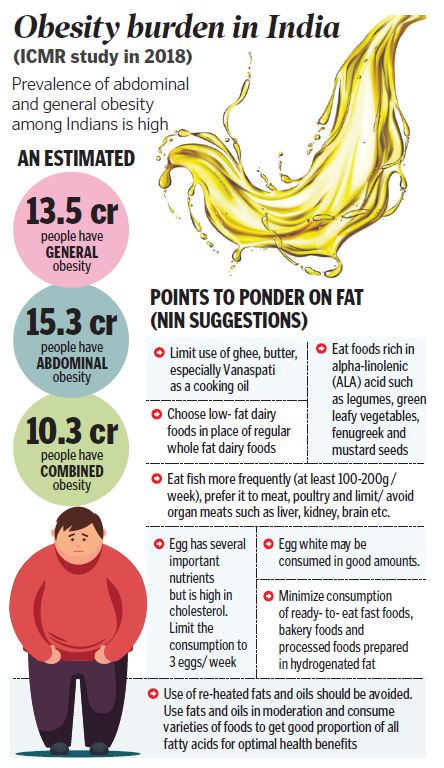
So why Vanaspati is bad for us?
Vanaspati or Trans-fatty acids (TFA) are not natural and are prepared through an industrial process known as hydrogenation, which in simple terms is hardening or solidifying vegetable oils. TFA also occurs naturally but at very lower quantities in meat and dairy products from cattle, sheep, goats, and camels.
In India, Vanaspati is still used as a substitute for ghee in cooking and the preparation of bakery products, sweets and snack foods. These oils are most frequently found in baked and fried foods, prepared or pre-packaged snacks and food, and cooking oils and spreads.
Initially developed as a replacement for animal fats such as butter, TFA are now increasingly utilised by industries because they provide longer shelf life to oils and food products. Moreover, TFA are far cheaper than animal fats and also change the texture and taste of food.
Industrially produced TFA were first introduced into the food supply in the late 19th and early 20th centuries with the invention of partially hydrogenated oils. Partially hydrogenated oils became more popular in the 1950s-1970s. However, by the late 20th century, an extensive body of evidence had accumulated from various studies on the negative metabolic effects of TFA as well as on the relationship between TFA intake and coronary heart disease.
TFA and its impact on health:
In the last few years, a series of international and national research papers have directly linked TFA to coronary heart diseases (CHD). According to Hyderabad-based National Institute of Nutrition (NIN), the daily intake of TFA should not exceed 1 per cent of energy intake.
Doctors and researchers have also found that TFA causes a rise in LDL Cholesterol levels (Bad cholesterol) and lowers good Cholesterol (HDL). It also increases risk of developing heart disease and stroke and is associated with a higher risk of causing type 2 Diabetes.
According to the WHO, ‘replacement of TFA with unsaturated fatty acids decreases the risk of CHD, in part, by ameliorating the negative effects of TFA on blood lipids. In addition, there are indications that TFA may increase inflammation and endothelial dysfunction’.
How much TFA is good?
WHO recommends that total TFA intake be limited to less than 1 per cent of total energy intake, which translates to less than 2.2 grams per day in a typical 2,000 calorie diet and elimination of industrially-produced TFA from the food supply is critical to achieving this aim.
By decreasing the risk of CHD events and mortality, it will help reduce premature death from NCDs, one of the health targets of United Nations Sustainable Development Goals.
Elimination of industrially-produced TFA will also contribute to the creation of an enabling food environment which promotes healthy diets and help achieve the global nutrition and diet-related NCD disease targets.
FDA warns mango growers: Ripen them naturally or face action

Food Safety and Standards Authority of India (FSSAI) has permitted ethephon powder to be used to ripen mangoes. Last year, after the mango season FSSAI published it directive on August 16.
Food and Drug Authority (FDA) has warned that mangoes should be ripened naturally or it would take action. Directive after research Merchants throughout the Country still use calcium carbide for ripening mangoes.
This banned chemical causes cancer and has been proved through research. Hence the government takes strict action against merchants who use this banned substance.
Noted the merchants started using ethephon powder but FDA official stock action against its use too. Many samples were taken from Kalamana market and sent for analysis. FSSAI, after the season, directed that ethephon powder could be used and so all merchants are using this powder.
FSSAI claims that mangoes, ripened through this chemical, were nutritious. Mangoes ripen due to ethylene gas Cheap ethephon powder is imported in large quantities from China and South Korea.
A pouch of this powder kept in a box emanates ethylene gas and ripens the fruit faster which can be brought to the market. Earlier, the grass kept in the mango box also used to give out ethylene gas and ripen the fruit.
However this process is time consuming and merchants want to make profits faster. Powder should not touch fruits FSSAI directive stipulates that, ethephon powder should not directly touch the fruit. If it touches, it can cause serious diseases. The pouch has to be kept in the box.
Food Safety and Standards Act, 2006 has prohibited the use of calcium carbide and action is taken against the individual using it under Sec 59 of the Act.4 Kalamana merchants have gas chamber.
Four merchants in Kalmana have gas chambers for ripening mangoes where ethephon powder is used. Construction of the chamber requires large amount of land and money. Hence small merchants do not construct such gas chambers and ripe mangoes inboxes with ethephon powder.
May 11, 2019


NO ADDED SUGARS? THINK AGAIN, WRAPPER MAY BE MISLEADING YOU

What’s in a name? An ‘ose’, say diabetologists, by every one of its names is just as sweet and harmful. And more frightening is that according to a just-published study, most Chennaiites may not be able to tell their sugars apart.
A recent study on ‘Perception of Sugar Content in Food Labels among Supermarket Consumers in Chennai City’ found that 77% of the respondents did not look specifically for sugar content in the food they were buying although a majority were aware of the ill effects of sugar consumption. Only 2% read the contents on the label, the rest were more interested in brand, offers and price. Also, only 29% were aware of terms such as artificial sweeteners and non-caloric sweeteners.
The study, conducted by Department of Conservative Dentistry and Endodontics, Sri Venkateswara Dental College and Hospital and funded by the Indian Council of Medical Research, was published in the Journal of Pierre Fauchard Academy (India Section) this March.
The ‘no added sugars’, ‘no added flavours’, and ‘no added preservatives’ all add up, says Dr Poorni Saravanan, one of the lead authors of the study. “Corn starch, for instance, is a hidden sugar, which many were not aware of,” she says. While the study was originally undertaken with dental caries in mind, says Dr Poorni, it took a more serious turn when the researchers realized people were not aware of the contents of the food they were buying.
Sugar can be listed under 61 different names, but the rule of thumb, says dietician Shiny Chandran, is that anything on the label that ends with an ‘ose’ has sugar. And that means dextrose, lactose, fructose and glucose. “It is best if the sugar content is less than 3% of all the ingredients,” she says. “Cookies, breakfast cereal, Indian-Chinese fusion food, all contain sugars. Everything that is supposedly low fat contain hidden sugars because that’s the only way to enhance taste.”
WHO guidelines recommend adults and children to reduce the daily intake of free sugars to less than 10% of their total energy intake. A further reduction to below 5% or roughly 25 grams (6 teaspoons) per day would provide additional health benefits, say the guidelines.
Dr Vijay Viswanathan of the M V Hospital for Diabetes says most of his patients are also not aware that there are two types of artificial sweeteners – caloric and non-caloric (like stevia). “People assume all sweeteners are good for them. Maltodextrin for instance is a caloric sweetener so those with issues of obesity and fatty liver and diabetes need to be wary. Most diabetic sweets contain the caloric sweetener lactulose and to make it more palatable, fat is added,” he says.
Dr Poorni says the study also threw up a problem that is unique to India. “The contents are listed in English and this is a barrier for most consumers. It has to addressed by the Food Safety and Standards Authority of India,” she says.


May 10, 2019


Banned stapler pins on your tea bags? FDA is waiting for your complaint

Says can't act unless it receives complaints, has no manpower to conduct checks itself. The Food Safety and Standards Authority of India (FSSAI) banned the usage of stapler pins in tea bags and sent a circular saying so in July 2017
A loose staple pin could be consumed and cause serious health issues.
Despite the ban on the use of stapler pins in tea bags in 2017, manufacturers continue to use them widely. Yet, the Maharashtra Food and Drugs Administration (FDA) has no case of any violations. That's because, officials claimed, they haven't received any complaints regarding this and don't have the manpower to conduct inspections at night, when many tea sellers who use such tea bags, go about their business.
No Complaints, Staff Shortage
Speaking to mid-day, Pallavi Darade, FDA commissioner said, "So far, we haven't received any complaint from people regarding it. If we do, then we can certainly look into it."
Another officer said the FDA office is reeling under a staff crunch, because of which they can't even hold regular inspections to find violators. "Most tea sellers who use tea bags do their business at night, so we need to keep an eye on them. But, sadly, we don't have the staff strength to conduct these inspections. Regarding private companies using them, we need to get complaints, which we haven't yet," the officer added.
FSSAI's Ban
The Food Safety and Standards Authority of India (FSSAI) banned the usage of stapler pins in tea bags and sent a circular saying so in July 2017. The use of staple pins in tea bags is a hazard to consumers, since any loose staple pin consumed inadvertently with tea may cause serious health issues. The pins are made of steel coated with zinc but are also known to be made of galvanised iron coated with zinc. "Taking cognisance of the risk to public safety in using staple pins in tea bags by some FBOs, the Food Authority in exercise of the power conferred under Section 16 (5) of FSS Act, 2006, hereby directs the concerned FBOs to discontinue the manufacture, storage, distribution, sale, and import of stapled tea bags by January 1, 2018," reads the circular. The commissioners of Food Safety of all States/UTs were directed to take necessary action to prevent the usage of unsafe packaging material and take up measures for enforcement of this direction from January 1, 2018.
Doctors Caution
Doctors have cautioned consumers that usage of such pins in tea bags can even prove deadly if one gets mixed in the tea and is consumed. "In the past, there have been incidents where people have swallowed stapler pins. As these pins are also made of iron coated by zinc, it may prove harmful to the stomach's internal lining. It may cause bleeding and even poisoning," said Dr Rasheed Sheikh, a general physician.
2017
When the FSSAI banned the use of stapler pins in tea bags
240kg gutka smuggled out via Central stn parcel office

The Chennai police have found that 240kg of banned gutka was smuggled into Chennai from Bengaluru on train number 12658 Bengaluru Mail on Wednesday morning.
Southern Railway has ordered a high-level probe into the lapse.
That the contraband, packed in six bundles, was loaded on a leased parcel van coupled at the front of the train, unloaded on platform 9 of MGR Central station around 5:45am and taken out through the parcel office on a tempo has shocked officials.
The leased parcel vans are given out on contract to private parties who pay railways a fee. Southern Railway has initiated a process to ask the lease holder for an explanation, said an official.
The tempo was on its way towards the Elephant Gate area when police from the C2 Elephant Gate police station intercepted it. After checking CCTV footage, they established the sequence of events.
TOI has already reported on irregularities at the station’s parcel office. Officials said many contraband items pass through the parcel office unchecked. Last week, red sanders was seized from its premises. Also, gutka from the northern states used to be brought to Tamil Nadu on the Hazrat Nizamuddin-Kanyakumari Thirukkural Express. The train, which started from New Delhi, stopped for an additional15 minutes in Madurai where the contraband was unloaded. Three big seizures were made from the parcel vans of the trains.
An official said recently the RPF had flagged how there were many cases of theft, robbery or other malpractices involving leased parcel vans but the Government Railway Police was reluctant to file cases and investigate.
May 9, 2019


Beware! Over 81% juice stalls fail food safety test

The BMC inspected several juice stalls across the city, including the ones at major railway stations like Dadar, Churchgate, Chhatrapati Shivaji Maharaj Terminus (CSMT), Kurla, and Mumbai Central among others.
Next time you are at your nearest juice centre, be aware of the hygiene at the place! Around 486 samples of juice and 300 samples of ice across the city have failed the 'Food Safety and Hygiene' test. This was revealed from the report on the samples collected by the Health Department of the Brihanmumbai Municipal Corporation (BMC) after the viral video of unhygienic preparation of lemon juice at Kurla station in March.
The BMC inspected several juice stalls across the city, including the ones at major railway stations like Dadar, Churchgate, Chhatrapati Shivaji Maharaj Terminus (CSMT), Kurla, and Mumbai Central among others. Last month, BMC had inspected a total of 1,183 stalls (280 selling lemon juice and 303 sugarcane juice stalls) and collected 385 ice samples.
However, the BMC health department has revealed that out of the collected samples from juice stalls, around 486 juice samples and 300 ice samples were found to be unfit for human consumption. In the advent of summer when people drink more juices at public places, the BMC has stepped in and is taking extra precautions by checking juice stalls especially at big stations like Dadar, CSMT, Kurla and Mumbai Central.
“Consumption of such contaminated juices and ice can land people in hospitals. When the lemons are squeezed manually without maintaining proper hygiene standards, there are high chances of contamination. Improper handling of fruit juices and soft drinks enable the growth of fungi and molds in them,” said Dr. Padmaja Keskar, Executive Director of the BMC's Health Department. She cautioned consumers to practice caution while consuming road-side food.
However, last month, the civic body also inspected 195 other stalls violating hygiene and safety norms and had collected 191 food samples from them, of which, only 43 were found fit for consumption.
Following a visual inspection of the stalls, the inspecting officials choose their samples based on the visual appearance of an eatery's hygiene standards. Also, BMC had destroyed 15,645 kgs of ice, around 3,838 kg of fruits not fit for consumption and around 10,000 liters of juice including sugarcane juice after they were found to be adulterated.
Branded water containing harmful microbes openly sold

UDHAMPUR, May 8: In a shocking exposure it has come to fore that packaged drinking water brands by two prominent companies though containing harmful microbes are openly being sold in the market here with none from the authorities concerned to check it.
On 23rd of last month, the Commissionerate of Food Safety, J&K in a 'Food Alert' had issued 'Stop Use Notice' after samples of the Packaged Drinking Water 'Aqua Nice and Mc Dowell's No. 1 Platinum' were lifted by the Empowered Authorities of the Commissionerate under the provisions of Food Safety and Standards Act 2006, Rules and Regulations 2011.
The 'Stop Use Notice' had declared these packaged drinking waters as 'Unsafe and Misbranded' by the Food Analyst at Public Health Laboratory, Jammu
The report had stated that Packaged Drinking Water bottles had no mention about batch number, date of packing, best before, net content etc and the water contained harmful microbes like e-coli and other coli forms.
Still the water is openly available at all outlets like ruler and urban areas and is also being served at marriage halls and other parties. Many prominent persons in the civil society have expressed concerned over the negligent role of law enforcement authorities and health authorities in this regard and have demanded strict action against them.
May 8, 2019


Novel sensor can detect spoilt milk
Scientists have developed a sensor that can 'smell' if milk has gone bad, an advance that could make expiration dates on cartons a thing of the past.
The sensor consists of chemically coated nanoparticles that react to the gas produced by milk and the bacterial growth that indicates spoilage, said Shyam Sablani, professor at Washington State University in the US.
The sensor does not touch the milk directly.
"If it's going bad, most food produces a volatile compound that doesn't smell good. That comes from bacterial growth in the food, most of the time. But you can't smell that until you open the container," Sablani said in a statement.
The sensor detects these volatile gases and changes colour, according to the study published in the journal Food Control.
The next step for the team is developing a way to visually show how long a product has before it spoils. Currently the sensor only shows if milk is ok or spoiled.
Though still early, Sablani envisions working with the food industry to integrate his sensor into a milk bottle's plastic cap so consumers can easily see how much longer the product will stay fresh.
One problem with current expiration dates is they are based on best-case scenarios, researchers said.
"The expiration date on cold or frozen products is only accurate if it has been stored at the correct temperature the entire time," Sablani said.
Temperature abuse, or time a product has spent above refrigerator temperature, is very common, he said. And it can happen during shipment, or if a consumer gets delayed on the way home from the store.
"We'll have to work with the industry to make this work. But we're confident that we can succeed and help improve food safety and shelf life for consumers," Sablani said.
Food Safety Dept Poonch seizes 6000 packets of sub-standard salt
A team of Food Safety Department on Tuesday raided several Anganwadi centers and seized a large quantity of substandard salt in Poonch district of Jammu region.
Reports reaching GNS said that an official team led by Assistant Commissioner Food and Safety Department Tariq Mehmood alongside Inspector Zafar Ahmad Mir raided CDPO office Buffflaiz and Surankote during which six-thousand packets of substandard 'Samzan' salt were seized.
An official said that the raid was carried out in several storehouses in the border district following a specific information over the use of substandard salt in Anganwadi centres.
The official remarked that “It has come to the fore that the said salt with the name 'Samzan' is misbranded and is of substandard nature. The salt was being used for the preparation of various food items in as many as 1372 Anganwadi centres in the district.
The official said that from henceforth all the centres are directed to discontinue the use of the salt with immediate effect while the officials also said that whole of the stock of the salt will be seized throughout the district.”
After falsely claiming FDA approval, IIT-Delhi startup Sanfe falsely claim AYUSH ministry approval
On 8th of March 2019, four IIT-Delhi entrepreneurs launched a product called ‘Sanfe Period Pain Relief Roll-On’ that claimed to help with menstrual pain. The start-up group (Redroom Technology Private Limited) who launched the Sanfe claimed to have an FDA approval, after which an Alt News Science investigation reported it as a false claim. This previous press release with the FDA approval was published without any fact-checking by several news outlets such as The Indian Express, NDTV, The Times of India, The Economic Times, and India Today.
After releasing our 1st investigative report on Sanfe, the co-founder of Redroom, Archit Agarwal sent a copy of the corrigendum published in The Hindu on the 28th of March 2019, accepting that it was a mistake to suggest that Sanfe was FDA approved. However, in the corrigendum, Redroom maintained that the approval was actually from the AYUSH ministry instead. On the phone, Archit Agarwal also maintained that the formula was clinically tested before release, and was safe for use.

We contacted the AYUSH ministry, Haryana’s Dr Satish Khatkar, who approved the formulation to determine the authenticity of the certificate of approval by AYUSH. Additionally, we conducted a literature review on the research of different components of the Sanfe roll-on to determine whether it was safe and effective to use as per the claim.
Claims:
Archit Agarwal clarified that the AYUSH certificate means that Sanfe roll-on is approved by AYUSH
Sanfe, consisting of 100% natural oils, causes no side effects. (as per the packaging)
It targets the source of pain without having to take ‘pain killers’ (as per the packaging)
Fact Check:
The claim of approval from AYUSH
Both, Redroom Technology and co-founder Archit Agarwal, maintained that the certificate of approval was from the AYUSH ministry, Haryana, and not by the FDA, which was a ’mistake’. When we contacted the authority who had signed this certificate at AYUSH, Dr Satish Khatkar suggested that the document was NOT an approval for safety for the products but only a certificate of approval for manufacturing (see the image of its manufacturing licence).

Dr Khatkar from AYUSH, also suggested that the certificate meant those individual components of the product may be effective and safe according to the ancient textbook of Ayurveda, Bhavaprakasha Nighantu (B.P.N), which had not been approved as a combined specific formula that Sanfe roll-on is.
Moreover, the certificate or manufacturing licence is given after a confirmatory test by AYUSH that the product has only the individual components as per the claim of the manufacturer and that no other safety tests are conducted by AYUSH.
Khatkar also suggested that the responsibility of conducting these safety and toxicity tests was upon the manufacturer, in this case, Space Organics, Haryana. In our previous conversation, the owner of Space Organics, Mr Nagpal, had confirmed that it was not financially viable for them to conduct tests for a product that had a higher research cost than its production cost. Hence, no testing was conducted on this product before its release.
After the first Alt News investigative report, Space Organics and Redroom released a document that listed the research on 79 women as per the original claim. This document was not a peer-reviewed published document, did not contain any data, nor it was tested for safety in various conditions. Khatkar suggested that such ‘research’ is likely to be a market survey where a group of women are given the product and later verbally asked to report efficacy. This unsystematic measure of efficacy cannot be considered as clinical research as suggested by the founders of Sanfe.
The claim of a safe and natural composition
As suggested above, the safety certificate from AYUSH is only for individual components in the roll-on and not for the formula as a whole. As per AYUSH, this safety certificate was backed by the ancient Ayurvedic text Bhavaprakasha Nighantu (B.P.N).
Any remedy that affects will, evidently, have unwanted side effects. Hence, the dosage is studied to extract the most desired effect with the maximum tolerable adverse effect. It is false to claim that herbal drugs will be completely free of side effects just because they are ‘natural’. Some of the most potent drugs in medicine have been derived from natural substances which also carry the same adverse effects as any other laboratory synthesized compounds.
The use of medicinal plants and oils as a form of topical pain treatment has been widely studied, where detailed adverse effects have been described (Bakkali et al. 2008). Prolonged use of any of the Sanfe’s ‘natural’ ingredients, standalone or in combination, can lead to strong unwanted adverse reactions.

Sanfe roll-on consists of 6 components, and there is no prescribed method to limited the frequency of its use. Apart from the described oils (see the manufacturing licence), reportedly, lavender, gandhipura (wintergreen), nilgiri (eucalyptus), rosemary and base oil, the strongest active ingredient is an extract of the mint in the crystal form. While the packaging shown in the image below doesn’t mention crystalline Menthol (mint) as one of the ingredients, the Space Organics certificate above does. Since mint in the herbal form does not contain high quantities of this active ingredient, a crystalline form of the compound menthol is used which can act on the cold receptors in the skin to give pain relief. This is a low-cost compound synthetically manufactured in the lab and is not safe or natural, if not used correctly.

Mint essential oil can contain up to 40-90% menthol which is a potent pain killer acting on the cold receptors in the skin. Several topical anesthetics and nasal decongestants such as Vapour-Rubsalso contain menthol.
Additionally, menthol also enhances the penetration of other transdermal drugs, which means that the absorption of other compounds is increased when mixed with menthol. Drug development companies should issue expert advice on consumption of menthol based compounds as it may be toxic and sub-lethal in higher doses starting from 50-500mg per kg of body weight.
The claim of suggesting it as devoid of traditional pain-killers, which target the source of pain.
The Sanfe formulation contains several ‘pain killer’ compounds in the form of essential oils that is equivalent (in specific dosage) to over the counter pain killers. For example, an American patent describes a mixture of wintergreen oil, olive oil and/or eucalyptus oil as a topical pain killer.

Although Sanfe doesn’t directly claim that its composition has no pain killers, it is contended that pain is reduced without having to take pain killers. Using this roll-on is equivalent to a topical application of consuming a ‘pain killer drug’, provided it gets absorbed into the system in the required dosage.
For example, wintergreen oil (8% in Sanfe roll on) contains about 98% of methyl salicylate, a compound closely related to acetylsalicylic acid, or aspirin- which is a class of ‘pain killers’. Also, if used excessively, wintergreen oil can lead to toxicity from ingestion of methyl salicylate compound. This toxicity varies for different age groups and is the most harmful in small children. For example, 5 ml of methyl salicylate is equivalent to 5 aspirin tablets (325 mg each). Various toxicity studies have confirmed that while low dose skin application was safe or can cause mild-acute irritation to the skin, dosage over 7 gm for a 70 kg adult can result in severe neurological disturbances (Chin et al. 2007).
Other ingredients of Sanfe, such as eucalyptus, lavender, and rosemary have shown limited pain-relieving effects, but have known to cause several skin related, systemic problems and other adverse effects similar to an anaphylactic reaction in higher doses (Darben et al. 1998, Pozadski et al. 2012, Ulbricht et al., 2010). Use of rosemary is also dangerous for anaemics and pregnant women.
Lastly, the claim that it penetrates deep into the source of pain is made without understanding the research in pain mechanisms. Pain during menstruation arises deep within the muscles, while this roll-on is applied only on the skin. The muscle and the skin is separated by several other layers of tissue that do not allow deep penetration of topical drugs unless the drug is in systemic circulation through the bloodstream. Hence, the effect of pain relief with Sanfe may be not be attributed through deep absorption through the skin. This claim shows the developers of Sanfe’s meagre understanding of pain emergence during menstruation.
Conclusion
Hence, once again, the founders of Sanfe, used government institutes such as AYUSH to promote drugs without any background research or understanding of menstrual pain.
Sanfe’s founders also claimed a to have an approval certificate which, through our investigation, turned out to be a manufacturing licence from AYUSH.
The Sanfe formulation is packed with several compounds used as pain-killer medications, as well as other compounds that increase the absorption of such pain-killers, which should be evaluated in toxicity and dosage studies before marketing and administration similar to any other drugs.
Thus, under the Drugs and Cosmetics Act, 1940 and Drugs and Cosmetics Rules 1945, it can be considered as attempts to misbranding the product as defined.
The Ministry of AYUSH in a document lists ethical principles to be followed during a clinical trial for Ayurvedic drugs, the launch of the Sanfe product did not seem to follow those guidelines.
References
Chin, R. L., Olson, K. R., & Dempsey, D. (2007). Salicylate toxicity from ingestion and continued dermal absorption. The California Journal of emergency medicine, 8(1), 23–25.
Bakkali, F., Averbeck, S., Averbeck, D., & Idaomar, M. (2008). Biological effects of essential oils–a review. Food and chemical toxicology, 46(2), 446-475.
De Groot, A. C. and Schmidt, E. (2015), Eucalyptus oil and tea tree oil. Contact Dermatitis, 73: 381-386.
Darben, T., Cominos, B., & Lee, C. T. (1998). Topical eucalyptus oil poisoning. Australasian journal of dermatology, 39(4), 265-267.
Posadzki, P., Alotaibi, A., & Ernst, E. (2012). Adverse effects of aromatherapy: a systematic review of case reports and case series. International Journal of Risk & Safety in Medicine, 24(3), 147-161.
Ulbricht, C., Abrams, T. R., Brigham, A., Ceurvels, J., Clubb, J., Curtiss, W., … & Isaac, R. (2010). An evidence-based systematic review of rosemary (Rosmarinus officinalis) by the Natural Standard Research Collaboration. Journal of dietary supplements, 7(4), 351-413.
Drug and Cosmetics Act 1940 and Drugs and Cosmetic Rules 1945 http://www.cdsco.nic.in/writereaddata/Drugs&CosmeticAct.pdf
http://ayush.gov.in/acts-rules-and-notifications/good-clinical-practice-guidelines-clinical-trials-asu-medicine
May 7, 2019


Food poisoning: Mystery yet to be resolved

Since the group, who went to Ramalkalmedu in Idukki, cooked their own food, the police are clueless as to what caused the adulteration.
KOCHI: Mystery surrounds the case of the poisonous substance that claimed the life of a 30-year-old due to food poisoning in Angamaly on Sunday, even as the other 13 of the 30-member group were discharged from the hospital on Monday.
Since the group, who went to Ramalkalmedu in Idukki, cooked their own food, the police are clueless as to what caused the adulteration. Nedumbassery police have registered a case under section 174 (unnatural death) of CrPC and commenced a probe. The deceased was Anilkumar N P, of Nayathod, Angamaly.
“Though the postmortem report suggested that death was due to food poisoning, clarity can only be shed after getting the chemical examination results,” said Nedumbassery SI.
Chemical contamination of fruits allegations are baseless, say Kochi fruit merchants
With Ramadan month here, fruit vendors in the district are aiming at a major spurt in sales.
KOCHI: With Ramadan month here, fruit vendors in the district are aiming at a major spurt in sales. While they anticipate a manifold increase in sales, the merchants are worried about the "negative campaign going on in the social media about widespread chemical contamination of fruits". According to the All Kerala Fruit Merchant's Association, there are many baseless videos and texts doing rounds in online platforms which are threatening the existence of vendors.
"Some allegations are totally unscientific like plastic painting on watermelons and large scale contamination of grapes. There is no measure to curb these campaigning on social media," says P M A Hussain, general secretary, All Kerala Fruit Merchant's Association.
He said the association wanted to address such rumours before the fasting began when the sales would soar. "We too are responsible citizens. We have been ensuring the supply of good fruits to people here for years. In a meeting held in 2006 and 2012 while implementing the Food Safety Act, we had promised to ensure only good quality produce in Kerala. Many times, the Food Safety Department had conducted inspections and collected samples for testing. But, so far, no complaints have been registered against us," says Hussain.
According to Hussain, it is impractical to conduct contamination like the allegations in social media. "How can anyone coat tonnes of grapes and watermelons with plastic. It is humanly impossible. But, people tend to believe what is shown in WhatsApp videos. We want to bring attention to this," says Hussain.
The fruit merchants say they ensure the produces are healthy and devoid of chemical contamination. "We have agents who approach the farmers and middlemen and inspect the farms in Nettoor, Bengaluru and Mysuru markets. We too are responsible for the item we sell. No product will be bought from farms that resort to such tricks," says Dasappan, a vendor at Broadway. The association officials add the change in shape and colour of the fruits are mostly due to climatic changes and has little to do with the fertilisers or insecticides used.
Food safety office to conduct drive against Adulteration
A spurt in the number of fruit and vegetable sales are observed every summer.

KOCHI: A spurt in the number of fruit and vegetable sales are observed every summer. Adulteration, the addition of calcium carbide to fruits to trigger speedy ripening, and pesticide residue in vegetables are not uncommon during this time of the year. To substantiate, graphic images of contaminated fruits and vegetables are doing the rounds on online platforms. Amidst such allegations, the Food Safety Office will be conducting a drive to investigate samples of fruits and vegetables in the district, in accordance with the instructions from the Food Safety Commissionerate.
"The date will be decided upon the meeting convened today. Currently, we plan to collect samples from across the district. The drive will also be implemented in check-posts through which fruits and vegetables are brought in from other states," said Rani Chacko, food safety officer at Assistant Commissioner of Food Safety Office, Tripunithura.
Despite the directive from the Food Safety and Standards Authority of India to prevent the use of calcium carbide and acetylene gas for the artificial ripening of fruits, claims have asserted their usage across the district. "Carbide is widely used to ripen seasonal fruits, especially mangoes. But as it is banned, the permitted ripening agent is ethylene. Last month, a certain species of jackfruit with carbide was found by the police and we fined the dealers. Carbide affects the quality of fruits. Nevertheless, it is extremely difficult to trace carbide as it evaporates post ripening the fruit," said Rani.
Experts from the Pesticide Residue Research and Analytical Laboratory, Kerala Agriculture University, cite vegetables to be more contaminated than fruits. As per their study last November, around 11 per cent of the products labelled to be organic were found with pesticides while farm-based samples were 3.8 per cent. Samples ranging from eco-shops run by the agriculture department to the open market are examined.
"Grapes are the most adulterated. Spices such as red chilli and cardamom are also highly corrupted. Once in every three-four months, the lab test results are updated. Awareness classes are given to farmers to reduce the use of pesticides and chemical fertilisers," said a professor.
Maintaining fridge hygiene for quality food

Food Pi monitors the hygiene level of food items inside a refrigerator and sends notifications to a user's smartphone
Keeping in view food safety concerns, four engineering graduates have developed a device that can monitor the hygiene level of food items kept inside a refrigerator.
Tanmay Baranwal, Ajitesh Dixit, Nitika Rajput and Chandrasena Sai Srikanth who graduated with a BTech degree in Computer Science Engineering from Lovely Professional University (LPU) in 2016, took seven months to develop the device namely 'Food Pi'. After conceptualising the idea in October 2015, the team along with the help of their professor Harshpreet Singh, completed the product in May 2016.
Talking to Education Times, Nitika says, "Keeping stale food items for days inside a refrigerator disrupt the inside environment. However, due to our fast-paced life, we hardly get time to constantly keep a tab on the food items. Hence, we decided to create a device that will keep a check."
Food Pi comes with an app of the same name, which is available on both Android and iOS platforms. Users need to install the device inside the refrigerator and install the app on their smartphones as well. When a food product starts decaying, Food Pi will send notifications to the user's smartphone in the form of a hygiene score as well as graphs. "On a scale of 0-100, the user can learn about the hygiene level of the food items. The graphs will illustrate the current state of food items and if they are close to getting rotten," says Tanmay, who works as a Computer Engineer in Hyderabad.
The device consists of four sensors namely temperature and humidity monitor, volatile organic compound (VOC) sensor, Carbon Monoxide (CO) sensor and Ammonia sensor.
Tanmay says that getting hold of all the sensors and carefully implementing them in the device was one of the major challenges for the team. "VOC sensor is not easily available in India unlike the other three sensors; hence finding it was a big challenge for us."
A Delhi-based agricultural entrepreneur, Nitika says that implementing artificial intelligence (AI) and machine learning (ML) in the device was another challenge. "A refrigerator contains several food items, which means each item releases variable readings. Calibrating these readings and using ML to make the device process all the information, and send notifications to a smartphone was a tough task."
"We began working on Food Pi from third year of college when we were yet to learn AI and ML. Therefore, we had to read and do a lot of research to use our understanding for the development of the device," adds Tanmay.
The product is yet to hit the market. The team had applied for patent in 2016 and are awaiting the same. Currently, they are working to build a custom-built processor so that the cost of the device lessens. "We built the prototype with a pre-developed processor that cost us around Rs 23,000, but a custom-built processor costs Rs 700-800. Hence, with that the cost of the device will go down to Rs 5000-7000, which in turn will make the device affordable to most Indians," says Tanmay, adding that the team aims industrial bases such as cold storages and urban households as their target audience.
Harshpreet Singh says that currently he is working with the team to add more features to the device. "Presently, Food Pi can monitor the hygiene level of food products for several categories such as milk products, green vegetables. We are working to add a feature through which users can be notified about the hygiene level of a particular food item such as cheese, milk, butter, etc. and even packed and unpacked items," he says, adding that he hopes to launch Food Pi within another two to three years.
FSSAI issues new guideline for branding food products
GUWAHATI: The Food Safety and Standards Authority of India (FSSAI) has announced a new regulation prohibiting brands from using words such as ‘Pure’, ‘Natural’, ‘Fresh’ and ‘Authentic’ on their various food products from July 1 next.
As per the new FSSAI mandate, if the brands need to utilize such words, they will either have to take permission or convey a disclaimer about the same. In the event that the brands neglect to do so, the manufacturers will be charged with a fine of Rs.10 lakhs for the infringement.
FSSAI CEO Pawan Kumar Agarwal said in a statement, “We have decided to redefine our role as an organisation that helps align the expectations of key stakeholders, including scientists, testing labs, food businesses, state governments and consumers.”
An official from the Health Department reportedly said that people generally believe what is written on the packaging and seeing such words like ‘real’ or ‘natural’ leads to compulsive buying.
To keep a check on companies randomly using these words, FSSAI has made it mandatory for brands to either take permission before using these words or carry a disclaimer that states- ‘this is only a brand name or trademark and does not represent its true nature’.
Only food items which have been cut, peeled, chilled and trimmed and which has undergone other processing required to make it fit for consumption, can be referred to as ‘Fresh’.
Companies and brands can also use the word ‘Fresh’ if the food items are unprocessed and “all the nutritive values in them are intact”.
The FSSAI statement further stated, “These regulations are aimed at establishing fairness in claims and advertisements of food products and make food businesses accountable for such claims /advertisements so as to protect consumer interests.”
According to the new guidelines, organizations can't go tub-thumping about their products that they have been suggested by restorative professionals or medicinal affiliations.
In the event that they do so, each of the declaration should be substantiated. In this way, whenever anyone goes out to shop, no one will get carried away by the high claims made by the brands of its different food products.
An examination done by two analysts of the Armed Forces Medical College (AFMC) in Pune a year ago on 1,200 Indian food commercials revealed that almost 60% of such promotions are 'deceiving in nature'. The analysis further found that FSSAI principles and codes of the Advertising Standards Council of India are 'tossed out of the window'.
May 6, 2019


Food Safety team organizes awareness camps
JAMMU, May 5: In view of upcoming holy Ramadan month, Food Safety wing of Drug and Food Control Organization today organized two awareness camps for food handlers, one at Gujjar Nagar and the other one at Residency Road, Jammu.
The camps were conducted on the directions of Commissioner, Food Safety, J&K, Vinod Sharma by a Food Safety team led by Dr Parvesh Kumar, Assistant Commissioner, Food Safety, Jammu Municipal Limits. The main motive of organizing the camps was to sensitize the food handlers regarding proper sanitation and cleanliness in their food establishments and to ensure that customers are provided good quality foods.
A large number of food business operators/food handlers of respective areas attended the camps at Gujjar Nagar and Residency Road. They were asked by Food Safety officers to maintain proper sanitation and personal hygiene in their food establishments and follow all the norms of Food Safety and Standards Act (FSSA) 2006.
Addressing the food handlers, Dr Parvesh impressed upon them to prepare food under hygenic conditions and sell good quality food articles to the customers. He advised them to use different chopping boards for fruits, vegetables, meat and poultry and avoid keeping cooked food for longer time.
The Assistant Commissioner stressed upon the food handlers to maintain proper temperature for storing the food articles and keep their lanes and drains neat and clean to avoid cross contamination. He also told them to keep dusbins in their establishments for waste products. He further directed them not to use news papers for packing of food. Dr Parvesh warned them of stringent action if any of them found violating FSSA norms.
The team was comprised of Food Safety Officers (FSOs), Ajay Khajuria and Hans Raj.
Fortified milk to take over state’s dairy market
Thiruvananthapuram: The recent rise in number of vitamin deficiency cases in the state has prompted milk product manufacturers to venture into production of fortified milk.
After Muralya Dairy Products, leading milk product manufacturer Milma launched its first fortified milk product last week. Muralya launched fortified milk on April 8 and the product was received well in city markets. Sasikumar Menon, CEO of Kattakada-based Muralya Dairy Products, said, “Our fortified milk provides required supplementation of vitamin A and D”.
Fortified milk is a value-added variant of milk with increased vitamin A and D content. The product is made as per food safety and standards authority of India (FSSAI) norms.
Deficiency of vitamin A and D leads to rickets and osteoporosis. The Union government has launched a food fortification scheme to take on this issue.
Kerala co-operative milk marketing federation (KCMMF) chairman P A Balan said that the production of the unfortified version will be stopped once the new fortified version reaches across all markets. Balan also said that though the milk is made more nutritious, the price will remain the same. “We give dairy farmers Rs 34 for one litre of milk and the same produced in Tamil Nadu is sourced by private agencies at Rs 22 and sold in Kerala by giving a high commission to agents. Basically Milma agents receive a commission of Rs 1.68 whereas private agents get around Rs 4-5 per litre. This is resulting in an unhealthy competition,” he said.
Milma also announced a home delivery scheme called ‘AMneeds’. Thiruvananthapuram regional milk producers’ union (TRCMPU) chairman Kallada Ramesh said that the AM in AMneeds implies ‘the morning hours’. Our services will be available in the morning contrary to the 24-hour service offered by many food delivery chains. Customers can download the AMneeds app from Playstore and register their orders. Initially, a service charge will be applicable but we will minimize it to the lowest possible amount once the system becomes popular,” he said.
'கப்' காபி டீ! பஸ் ஸ்டாண்ட் கழிவறை நீரில் தயாராகிறது... உறங்குகிறதா உணவு பாதுகாப்பு துறை ?
கோவை : பஸ் ஸ்டாண்ட் அருகே செயல்படும் உணவகங்கள் என்றாலே, இனி கொஞ்சம் யோசித்துதான் சாப்பிட வேண்டும் போலிருக்கிறது. காந்திபுரம் பஸ் ஸ்டாண்ட்களில் செயல்படும் உணவகங்கள், டீ ஸ்டால்களில் சுகாதாரமற்ற முறையில் உணவு தயாரிக்கப்படுவதுடன், அதிக கட்டணமும் வசூலிக்கப்படுவதாக, புகார் எழுந்துள்ளது. காந்திபுரத்தில் மத்திய மற்றும் டவுன் பஸ் ஸ்டாண்ட்கள், அரசு விரைவு போக்குவரத்துக் கழக (எஸ்.இ.டி.சி.,) பஸ் ஸ்டாண்ட் என மூன்று உள்ளன.
இந்த பஸ் ஸ்டாண்ட்களில் இருந்து வெளி மாவட்டங்களுக்கும், வெளி மாநிலங்களுக்கும் நுாற்றுக்கணக்கானோர், தினமும் பயணிப்பதால் கூட்டத்துக்கு பஞ்சம் இருக்காது.இவற்றை சாதகமாக்கிக்கொண்டு, பஸ் ஸ்டாண்ட்களில் செயல்படும் சில உணவகங்களும், டீக்கடைகளும் கட்டண கொள்ளையில் ஈடுபடுவதுடன், சுகாதாரமற்ற முறையில் உணவு வழங்கி வருவதாக புகார் எழுந்துள்ளது.கழிவறை தண்ணீரில்...எஸ்.இ.டி.சி., பஸ் ஸ்டாண்டில் செயல்படும் ஒருசில கடைகள், அங்குள்ள கட்டண கழிவறைக்கு செல்லும் தண்ணீரை, 'சின்டெக்ஸ் டேங்க்' களில் சேமித்து வைத்து பயன்படுத்தி வருவதாக பயணிகள் தெரிவிக்கின்றனர்.
வெளி மாநில பயணிகளிடம் இரவு நேரத்தில், டீ, காபிக்கு, 25 ரூபாய் வரையும், பரோட்டா ஒன்றுக்கு, 40 ரூபாய் வரையும் தங்கள் இஷ்டத்துக்கு உயர்த்தி, கட்டணம் வசூலித்து வருகின்றனர். விலைக்கு ஏற்ற தரமான உணவு கிடைப்பதில்லை என்பதுடன், சுகாதாரமற்ற முறையில் உணவு தயாரிக்கப்படுவதாக புகார் எழுந்துள்ளது. பயணிகள் கூறுகையில், 'இங்குள்ள கடைகளில், விலை பட்டியலை வெளியே வைக்காமல், இஷ்டத்துக்கு கட்டணம் வசூலிக்கின்றனர்.குறிப்பாக, பொது கழிப்பிடத்துக்கு செல்லும் தண்ணீரை சேமித்து வைத்து, சுகாதாரமற்ற முறையில் உணவு தயாரிக்கின்றனர்' என்றனர்.
மாவட்ட உணவு பாதுகாப்பு நியமன அலுவலர் விஜயலலிதாம்பிகையிடம் கேட்டபோது, ''காந்திபுரம் பஸ் ஸ்டாண்ட்களில், ஆய்வு செய்து நடவடிக்கை எடுக்கப்படும்,'' என்றார்.கழிவால் ஆன கிணறு!எஸ்.இ.டி.சி., பஸ் ஸ்டாண்டில் உள்ள பயனற்ற கிணற்றுக்குள், கடைகளில் இருந்து வெளியேற்றப்படும் கழிவுகளும், கெட்டுப்போன உணவுப் பொருட்களும் கொட்டப்படுவது, சுகாதார சீர்கேட்டுக்கு வழிவகுத்துள்ளது.
May 5, 2019

City foodies express concern over growing cases of adulteration
The foodies of the city seemed to be in spin after the food safety department, Kamrup (Metro), on 30th April, served a closure and improvement notice two restaurants in the city after they were found serving food in unhygienic conditions.
Nehars, located at Christian Basti and Emperor China at RG Baruah Road, have been shut down for ten days. The closure and improvement notice was issued by the officials of the department under Section 32 of the Food Safety & Standard Act 2006.
An inspector with the food safety department said that the raid was carried out after a complaint was received by the department regarding both the restaurants maintaining low hygiene standards.

The official who didn’t wish to be named said that the kitchens of these restaurants were found dirty and were below food safety standards. There was no sufficient space for storage and poor ventilation systems. During the inspection, the officials also found the kitchens to be cramped with very less space for movement.
"While inspecting, we saw the floors and walls to be unclean, insects were roaming in the kitchen. Neither there was any net fitted on the windows nor it had a proper drainage system as per the Food Safety Act," said the official.
Further, he stated that the staff of these restaurants was not found to be using proper gear like hand gloves, aprons and headwear. The department officials also found a huge pile of spices which had already crossed its expiration date. "We have served them a notice to close the restaurant and fix everything within 10 days, and if found that the situation is still the same then further course of action will be taken.”
It’s not the first time that the food safety department has carried out such raids in city hotels and restaurants. In July last year the food safety department along with Minister of State for Health, Pijush Hazarika, carried out surprise raids at various hotels and restaurants at Paltan Bazaar where a few hotels namely Hotel Raja, Hotel Green View and Hotel Kamakhya were shut down for three days after they were found operating in unhygienic conditions.
Raids were constantly carried out by the district administration in city since last year. Heavy fines amounting to even Rs 8 lakhs were imposed on traders of the Fancy Bazar area of the city for selling low quality food products. Atleast 82 cases were registered against these business establishments.
During the raid fines were imposed against oil traders who were found selling low quality product to the customers. Fines ranging from Rs 1 lakh to Rs 1.25 lakhs were slapped on them.
Even fruit vendors were fined for ripening bananas and mangoes using carbides and other chemicals. A total of 12.5 quintals of mangoes were seized during the raid.
Apart from all these, many famous and reputed restaurants also came under the scanner because of serving rotten meat and stale food to its customers. The food department collected samples from their kitchens after receiving complaints.
City foodies express concern
Guwahati is a city that likes to eat and eat good food. Many food fanatics have expressed concern over the growing cases of adulteration and unhygienic conditions of the restaurants in the city.
Nabanita Sarma is foodie and a frequent visitor to various food joints and restaurants in the city.
Speaking to G plus Nabanita said that the growing number of cases of restaurants serving food under unhygienic conditions has created a sense of fear among the food lovers and for the people who visit these places to eat. "Most of the time I eat outside at various restaurants because of my work. I am now scared to eat outside because of the news that we are receiving. Everything is getting adulterated - be it fruits, vegetables and other food items. The safety of the consumers is being compromised. Restaurants operating in unhygienic conditions are posing greater health risk for the people who visit those restaurants to eat."
She further said that the government should make its food licensing norms more strict and should frequently check the food items being served at the restaurants.
Anoorag Deka who is also a foodie and frequent restaurant hopper also expressed a similar concern. Deka said that because of the increase in the number food joints and restaurants, the quality of food is being compromised. “Because of the rapid growth of the city and its population, a lot of food joints and restaurants have mushroomed in the area to cater to the growing needs of the people. And the restaurants are starting to compromise on the standard and quality of food that they serve. Quantity has become the key rather than the quality,” said Anoorag.
The growing concern about the quality issue among the general masses will hamper the food industry as many people are apprehensive of eating outside at such restaurants because of quality and hygiene issue.
Moreover, the reputation of such places will not be the same even after the corrections are made.
Government’s credibility questioned as raids yield no improvement in food standards
The health ministry last year constituted a team comprising officials from the health & family welfare department, Food Safety and Standards Authority of India (FSSAI) and the State Public Health Laboratory (SPHL) to conduct surprise raids on various hotels, milk vans, sweet shops and factories. However, the raids were not conducted regularly because of shortage of manpower, said an officer of the FSSAI under the condition of anonymity.
The officer said, “The office does not have adequate manpower. The team constituted by the minister of state for health and family welfare has inducted most of our food inspectors. Frequent raids are conducted throughout the city to collect samples and follow up on those cases only.”
“The regular checking has taken a back seat. Because of such raids, several restaurants are maintaining the hygiene of the food that they serve to the customer, but again there are many who are not maintaining the standards of the food according to the food safety act. Strict action will be taken against the violators in the future surprise checking that will be done by the team,” said the officer.
May 4, 2019

Subscribe to:
Posts (Atom)