Nov 16, 2016

COMPLAINT FILED AGAINST THE FAMOUS TIRUPATI LADDOO FOR UNHYGIENIC PREPARATION METHOD

The famous Laddu offered as prasadam in Tirupati is now being questioned for unhygienic preparation method.The FSSAI (Food Safety and Standards Authority of India) has asked the commissioner of...
The famous Laddu offered as prasadam in Tirupati is now being questioned for unhygienic preparation method.The FSSAI (Food Safety and Standards Authority of India) has asked the commissioner of Food safety to look into the certification and alleged violation of food safety norms by TTD in making of laddoos. This was followed by a petition filed by an activist who said he found nuts, bolts, key chain and Pan Parag in the laddoo. The laddoo will now be tested for quality and certification and other norms as specified by Food safety and standards act, 2006. This has created a sense of shock in many followers and worshippers as these tasty prasadams are a part of the Tirupati’s identity.
The licence act says only servants dressed in clean clothes can make or serve the laddoo. Murthy, who made the complaint, witnessed the process of making the laddoos in Tirupati.
‘The act states that such articles when exposed for sale, shall be kept in clean vessels or plates made of glass or metal covered with enamel or tin lining, placed in glass cases provided, if necessary, with a fly proof wire gauge at the top for ventilation and that no such articles shall be touched by hand and clean spoons or other accessories shall be used for serving them. But nothing of this is being practiced,” was the complaint registered by Murthy.
Tirupati laddoos are available in three types- Asthanam Laddu, Kalyanotsavam Laddu and Proktham Laddu. 200 people work together to get the laddoo prepared for the devotees and these people are a part of the Tirupati temple board. The Tirupati laddoo is one of the most sought sweets and it got its patent in the year 2009. These laddoos are made in large number, made of pure ghee but the complaint shows clearly that it is unsafe for consumption. The sweet goes through unhygienic processing method besides deficiencies at several stages including manufacture, storage, distribution and sale.

Nov 15, 2016

MAALAI MALAR NEWS


TAMIL MURUASU NEWS


Standardising: Packaged food products likely to get fortification norms soon

The FSSAI has already issued draft guidelines for five products — rice, salt, wheat flour, milk and edible oil.
The Food Safety & Standards Authority of India (FSSAI) is likely to come up with fortification standards for packaged food products such as cereals and biscuits. Fortification means deliberately increasing the content of essential micronutrients such as iron, Vitamin A, Vitamin D, Iodine, etc, in a food product so as to improve its nutritional quality with minimal risk to health.
“We are discussing with the industry to bring fortification norms for processed (packaged) food products. It is more of an afterthought. We do not have much clarity on it as of now,” said an FSSAI official on the condition of anonymity.
The FSSAI has already issued draft guidelines for five products — rice, salt, wheat flour, milk and edible oil. These guidelines, which were put in public domain on September 4 to invite comments and suggestions, set the minimum levels of micronutrients which should be added to these five products in order to be called ‘fortified’. FSSAI will issue the final guidelines for them once the 60-day time period for receiving public comments is over.
“If a company starts a category of biscuits which is called ‘fortified biscuits’, it is good for the general population only. In America, there is a focus of fortification in packaged food products which are consumed for breakfast, such as cereals. But our approach to fortification in packaged foods is going to be a little different than what we have done till date for five products,” the official added.
The FSSAI is expecting that the fortification of food products, which are consumed in the government programs, will be done within a year. “However, as the food industry is huge and largely unorganised, they will take a much longer time to fortify their food products,” the official said.
On October 16, Anupriya Patel, Minister of State for Health and Family Welfare, launched the logo for “fortified food product”. “Fortification requires neither changes in existing food patterns, habits nor individual compliance. It is socio-culturally acceptable and does not alter the characteristics of the food. It can be introduced quickly and can produce nutritional benefits for populations in a short period of time. It is safe and cost effective, especially if advantage is taken of the existing technology and delivery platforms,” she had said.
Pawan Kumar Agarwal, chief executive officer, Food Safety & Standards Authority of India (FSSAI), has earlier stated that if someone is using the “fortified food product” logo, and if they are not fortifying it as per the prescribed standards, then that company would be subjected to same penalty as for manufacturing unsafe or adulterated products.

DINAMALAR NEWS


DINAMALAR NEWS


நெருங்கும் திருவிழா சீசன் பழநியில் திடீர் உணவுக்கடைகள் கண்காணிக்கப்படுமா?

பழநி, நவ. 15:
திரு விழா சீசன் நெருங் கு வ தால் பழ நி யில் முளைக் கும் திடீர் உண வுக் க டை களை கண் கா ணிக்க வேண் டு மென பக் தர் கள் கோரிக்கை விடுத் துள் ள னர்.
பழநி கோயி லில் கார்த் திகை மாதம் துவங்கி சித் திரை மாதம் வரை ஐயப்ப பக் தர் கள் வருகை, தைப் பூ சம், பங் குனி உத் தி ரம், கோடை விடு முறை தினங் கள் என 6 மாத காலத் திற்கு பக் தர் கள் கூட் டம் அதி க ளவு இருக் கும். இவர் க ளி டம் விற் பனை செய் வ தற் காக அடி வா ரம் பகு தி யில் ஏரா ள மான அள வில் பொம் மைக் க டை கள் மற் றும் தற் கா லிக உணவு கடை கள் ஏற் ப டுத் தப் ப டும்.
குறிப் பாக உண வுக் க டை க ளில் பக் தர் க ளுக்கு வழங் கப் ப டும் தட் டுக் க ளில் பிளாஸ் டிக் பேப் பர் வைத்து உண வு கள் வழங் கப் ப டு கி றது. சூடான உணவு பொருட் க ளால் பேப் பர் உருகி நோய் ஏற் ப டுத் தும் அபா யம் உள் ளது.
இவ் வாறு உணவு வழங் கு வது தடை செய் யப் பட் டி ருந் தும் அடி வா ரப் பகு தி க ளில் பிளாஸ்டி பேப் பர் க ளின் பயன் பாடு ஆண் டு தோ றும் தங்கு தடை யின்றி நடை பெ று வது வழக் க மாகி விட் டது. எச் சில் தட் டு களை முறை யாக கழு வா மால் அப் ப டியே மற் ற வர் க ளுக்கு வழங் கப் ப டு கி றது.
பக் தர் கள் சாப் பிட்டு விட்டு அந்த இடத் தி லேயே கைக ழு வு வ தா லும், எச் சில் இலை களை அதே இடத் தில் போட்டு விடு கின் ற னர்.
இதனை சாப் பி டு வ தற் காக அநேக இடங் க ளில் மாடு, ஆடு, நாய் உள் ளிட்ட விலங் கி னங் கள் சுற் றித் தி ரி வ தால் போக் கு வ ரத்து பாதிப் பும் அதி க ள வில் ஏற் ப டு கி றது.
மேலும் துர் நாற் றம் ஏற் பட்டு நோய் அபா ய மும் ஏற் ப டு கி றது. இது த விர, இட்லி போன் றவை வெண் மை யாக இருப் ப தற் கும், இல கு வாக இருப் ப தற் கும் வேதிப் பொ ருட் கள் கலப் ப தா லும் பக் தர் க ளுக்கு பின் வி ளை வு கள் ஏற் ப டு கி றது. எனவே நக ராட்சி நிர் வா கம் உணவு பொருட் க ளின் தரக் கு றை பா டு களை கண் ட றிந்து உரிய நட வ டிக்கை எடுக்க கண் கா ணிப்பு பணியை தீவி ரப் ப டுத்த வேண் டு மென பக் தர் கள் கோரிக்கை விடுத் துள் ள னர்.

Nov 14, 2016

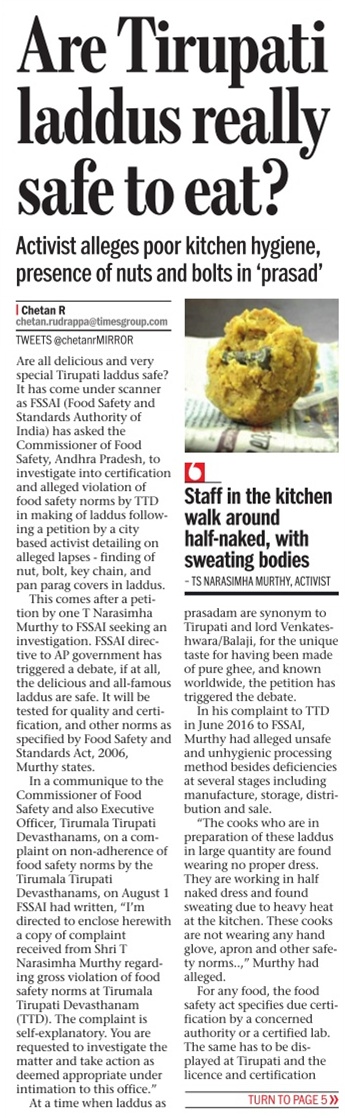
ARE TIRUPATI LADDUS REALLY SAFE TO EAT?


Activist alleges poor kitchen hygiene, presence of nuts and bolts in ‘prasad’
Are all delicious and very special Tirupati laddus safe? It has come under scanner as FSSAI (Food Safety and Standards Authority of India) has asked the Commissioner of Food Safety, Andhra Pradesh, to investigate into certification and alleged violation of food safety norms by TTD in making of laddus following a petition by a city based activist detailing on alleged lapses - finding of nut, bolt, key chain, and pan parag covers in laddus.
This comes after a petition by one T Narasimha Murthy to FSSAI seeking an investigation. FSSAI directive to AP government has triggered a debate, if at all, the delicious and all-famous laddus are safe. It will be tested for quality and certification, and other norms as specified by Food Safety and Standards Act, 2006, Murthy states.
In a communique to the Commissioner of Food Safety and also Executive Officer, Tirumala Tirupati Devasthanams, on a complaint on non-adherence of food safety norms by the Tirumala Tirupati Devasthanams, on August 1 FSSAI had written, “I’m directed to enclose herewith a copy of complaint received from Shri T Narasimha Murthy regarding gross violation of food safety norms at Tirumala Tirupati Devasthanam (TTD). The complaint is self-explanatory. You are requested to investigate the matter and take action as deemed appropriate under intimation to this office.”
At a time when laddus as prasadam are synonym to Tirupati and lord Venkates­h­wara/Balaji, for the unique taste for having been made of pure ghee, and known worldwide, the petition has triggered the debate. 
In his complaint to TTD in June 2016 to FSSAI, Murthy had alleged unsafe and unhygienic processing method besides deficiencies at several stages including manufacture, storage, distribution and sale.
“The cooks who are in preparation of these laddus in large quantity are found wearing no proper dress. They are working in half naked dress and found sweating due to heavy heat at the kitchen. These cooks are not wearing any hand glove, apron and other safety norms..,” Murthy had alleged.
For any food, the food safety act specifies due certification by a concerned authority or a certified lab. The same has to be displayed at Tirupati and the licence and certification renewed every year has to be put on display. But nothing couldn’t be found, alleged Murthy.
“It is noticed that the place of manufacture of food ie, laddu is not upto the standards prescribed under the Food Safety and Standards Act, 2006. The actual preparation method and employees status can be accesses by the authority at the link – https://www.youtube.com/watch?v= pEdGx23PD. TTD has also not displayed the licence at its premises, not complied with mandatory issuing of bills to devotees,” Murthy’s petition details.
Following this, FSSAI had sought investigation and action. Narasimha Murthy had sought information on the investigation. However, nothing has come yet. A communique to him from the joint food controller, AP in September has said that they had not received any reply had from executive director, TTD over FSSAI directive to commissioner for food safety and his directive inturn to TTD seeking their say. Following which Murthy has again moved FSSAI over inaction stating that the commissioner’s office had not initiated any action except calling for report last month. He has also filed first appeal in the case on October 26.
They have to get licence to sell it in Tirupati, and special licence to do it in Bengaluru and New Delhi too, but nothing is done, Murthy alleged.
“On every sale, they have to give bill. It should have quantity, quality, ingredients, date of manufacture and date of expiry. However, these bills have nothing of it. The food safety act gives exemption for push carts and petty shops temporary stall holder or tiny food business operator. But Tirupati is not so. Not providing information on certification even after two months only show they have none,” Murthy added.
Now an investigation will bring facts of Tirupati laddus – more on if they adhere to food act norms.
Experts feel failing to adhere to the norms specified under the food act including selling without licence may prove costly to those selling or dealing with food products.
“If any person or those in business other than those exempted manufactures, sells, stores or distributes or imports any article of food without licence can be punished with six months imprisonment for a term which may extend to six months and fine that can extend to five lakh,” Dharaneesh an advocate told Bangalore Mirror.
Murthy who had visited Tirupati to witness the process in person before lodging his complaint added, “The act states that such articles when exposed for sale, shall be kept in clean vessels or plates made of glass or metal covered with enamel or tin lining, placed in glass cases provided, if necessary, with a fly proof wire guage at the top for ventilation and that no such articles shall be touched by hand and clean spoons or other accessories shall be used for serving them. But nothing of this is being practiced.”
Other specifications
The act also mandates that licence shall allow only servants, who are dressed in clean clothes, and that the licences shall purforth with report to the health officer on any case of dangerous, infectious or contagious disease occurring on the premises. The employer and employee should satisfy health requirements including certification of those in business - not infected with any disease and certification on free from infections/diseases if infected, and health compliance as specified in the act. But none of them are existing there, Murthy alleged. Several efforts to reach TTD executive officer over the charges went in vain as none responded.
The laddus
The Tirupati laddus has more than a 300-year-old history, and are believed to date back to early 18th century. Known for its unique taste, as prasadam offered to devotees visiting Tirupati, these laddus are now registered as Geographical Indications under the GI Act. Mainly three types – Asthanam Laddu (prepared for festivals), Kalyanotsavam Laddu (prepared during kalyanotsavam), Proktham laddu (distributed to devotees every day) are known for its unique taste made of pure ghee and offered to lord Balaji first as naivedyam. The prasadam’s first existence date back to times of Pallavas who offered prasadam to deities and then Devaraya II offered naivedyam to deity and remaining food was distributed to devotees. Prasadam, which was called Tiruppongam then was called Avasaram later during Vijaynagar rulers tims, and then sold as sweet boondi by Madras government before it took shape in 1940 as laddu with growing demand for prasadam ever since time immemorial. Laddu is offered with vadai, which are a hit as Srivari Prasadam at Tirupati.

Limit for iron particles in tea increased to 250 mg/kg: FSSAI

The continuous presence of iron filings in tea has raised safety concerns and there have been many demands to fix an upper limit
Food safety regulator FSSAI has raised the upper limit for iron particles in tea powder to 250 mg per kg from the existing 150 mg, with effect from current month.
Iron fillings enter tea due to wear and tear of the processing machinery. The continuous presence of iron filings in tea has raised safety concerns and there have been many demands to fix an upper limit.
In a circular, Food Safety and Standards Authority of India(FSSAI) said: "The revised limit of iron filings in tea up to level of 250 mg per kg has been approved by the Scientific Committee."
These standards of iron filings in tea have been made operational with effect from this month. They will supersede the earlier limit operationalised on April 22, 2016, it said.
The limit has been raised after taking into consideration the comments and suggestions received from various stakeholders, it added.
FSSAI had recently conducted a large-scale laboratory analysis of tea powder for determining the limit on iron filling.
The tea leaves are dried in a sieve fitted with mesh and leaves are cut using iron rollers. Factories use huge magnets to remove iron fillings from tea powder.
Tea production in India, the world's second largest tea producer after China, stood at 795.89 million kg during April-September period of this fiscal, while 101.04 million kg of tea was exported in the same period.
The country had produced 1,233 million kg in the entire 2015-16 fiscal, of which 232.92 million kg was exported.

Gold, silver leaves

Machines can make the varakh industry a clean, hygienic and well-managed sector
The varakh industry is huge in India, with over 300 tonnes of silver leaves used in paan, chawanprash, tobacco products, ayurvedic medicines and mithais

Nov 13, 2016- For years and years the Indian government put off the decision to make varakh, any leaf composed of pure metals, typically silver and gold, by machine on the grounds that no machines were available. Finally, this year a historic decision has been taken and the Food Safety and Standards Authority of India (FSSAI) has clearly notified that no varakh can be made except by machine.
The person responsible for this change (apart from me) is Surendra Karnavat, a diamond jeweller in America. He and his wife were members of the Rajasthan Association of America and came to India in Vasundhara Raje’s first term as Chief Minister, lured by the promise that they would get all the help required to start a machine-based varakh industry. He was given none of the promised assistance and could only start in a very small way. However, he did not give up hope and started by supplying to only a few shops in his own area. I heard of him, and met him, while campaigning to make varakh in a vegetarian way. Then, when the FSSAI started to take the matter seriously, he came was called to show them how it could be done properly.
The varakh industry is huge in India, with over 300 tonnes of silver leaves used in paan, chawanprash, tobacco products, ayurvedic medicines, mithais and temples. It is used in Germany on food (the food number is E 175) and in France on photo frames. In Japan it is everywhere—interiors, tea, instruments, frescos, temples. The whole of Southeast Asia uses varakh, to pay homage to Lord Buddha. It is used on chocolates, cocktails and liquors—German Goldwasser and the Swiss Goldschlager are examples—soups, salads, ice creams, coffees. Now, gold leaf has become a part of anti-ageing creams, facepacks and foundations. The use of the gilded leaf is endless.
Gold leaf has been used for jewellery, for art decorations, picture frames and gilded art. We have used it in our glass paintings. But we don’t export it, because we make it in a dirty—and now illegal—manner. The 300 tonnes of silver used in India means: one kilo of silver has 225 gaddis (bundles) and one gaddi is 150 sheets of silver varakh that means, 6.75 crore gaddis every year. The world market asks for 300kg of goldvarakh every day.
Silver in abattoirs
Till now, the varakh makers are in slaughterhouses. They are all a sect of Muslims called Pannigars. They select cattle by feeling their intestines while they are alive, and then having them cut and extracting the intestines while they are hot. These intestines are made into pouches, and silver is beaten in between them till it is thin enough to be sold. This method is filthy and certainly not pure silver. When you eat it, you place yourself at risk.
The second method that is used by most mithai sellers—who will pretend that they are getting the varakh from vegetarian sources and also what the president of the mithai association claimed to me)—is to beat the silver between plastic sheets. However, this is also a filthy meat-based method, as the plastic is coated with animal fat for lubrication and is also then covered with leather. The varakh that emerges is not only unhygienic but also unfit for eating.
Karnavat has replaced leather or animal fat with a specially engineered paper, which is translucent and smooth. This paper is fed into a machine and the process of making varakh is completely mechanised, without coming into contact with the sweaty human hand. The leaf has a thickness of 0.18 microns in silver and 0.1 microns in gold, making it of international standards even for gold fillings and ayurvedic medicines. The machine has taken 15 years to develop and meets the guidelines of the US Food and Drug Administration.
The right way
He is one of the very few people in the world who has the knowledge of producing varakh paper (also known as interleaf paper or carbon coated paper). He wants to help low cost machines to be produced and installed, and train unskilled labourers—perhaps even the same people who have
been sitting for years at slaughterhouses and taking out the intestines of freshly killed buffaloes and cows. He believes there is scope for at least 2 lakh people to be employed, and that this is the only way for the varakh industry to become a clean, hygienic well- managed and organised sector, instead of being a filthy unorganised secretive sector that operates in the shadows of butcheries. This could also be a major employment area for women, as gold and silver leaf have to be transferred from interleaf paper to tissue paper, and this delicate exchange can be best handled by a woman. Gold and silver leaf can be major exports from India as well.
Karnavat was invited by the Chinese government to establish a unit and train their people. He refused because he wants to make India the silver/gold leaf hub of the world. This seems to me to be an excellent potential industry and, now that Mudra loans are available to small businessmen, this should be taken advantage of. In fact, if you are a large mithai maker, you should establish your own ancillary varakh leaf factory.
To join the animal welfare movement contact gandhim@nic.in, www.peopleforanimalsindia.org

Nov 13, 2016

Know these side effects of Pappaya!


Govt decides to order testing of edible oils over cancer link


Srinagar, Nov 12: With the reports that edible oils consumed in Jammu and Kashmir, contain cancer links, the government has decided to order state-wide testing of edible oils
One of the senior officials of the State Drug and Food Control Organization told, that raids will be held in all major outlets of edible oils in the state with the aim to identify and punish distributers and manufacturers producing adulterated cooking oil refined from low quality and discarded rapeseeds.
“I want to inform you that concrete steps have already been taken in this regard. We have taken open samples for lab testing from top brands. We will send the samples to referral laboratories in Kolkata and Ghaziabad for precise testing. If any of the brands are found adulterated with harmful and substandard oil, their outlets and industrial units will be immediately sealed,” said the official.
Sources said that most of the top oil brands available in the market are under scrutiny.
It is to mention here that in the recent past ,edible oils in Jammu and Kashmir were found containing recycled oils and oils extracted from discarded rapeseeds, which contain highly toxic carcinogenic substance including ‘dropsin’ and ‘aflatoxin.’
Sources said that apart from edible oils markets are flooded with the milk and milk products containing chemicals such as detergents—the trend that experts say is creating a health catastrophe.
The Indian Council of Medical Research (ICMR), in one of its reports, said detergents are a cause of food poisoning and gastro-intestinal complications. Other common additives to milk impair the functioning of various organs of the body, cause heart problems and cancer, it said.
It is to mention here that Jammu and Kashmir High Court had directed the Government to provide full particulars of outside companies supplying food items to Jammu and Kashmir.
“Commissioner Food Safety shall provide full information and particulars of those food manufacturers, suppliers, persons, companies who originate from outside the state and supply food items to Jammu and Kashmir,” a division bench of Justices Muzaffar Hussain Attar had said in its order.
The court had expressed displeasure over non implementation of Food Safety and Standards Act. “Money power has taken control of everything now. Few people have made empire out of food adulteration, they want quick buck and for it they can go (stoop) to any extent,” the court had observed. 

Harmful germs in country chicken

Experts blame indiscriminate use of antibiotics for problem.
A report published this month by researchers from the UoH, led by Dr. Niyaz Ahmed, found multiple drug resistant Helicobacter pullorum (H.pullorum) bacteria in samples of broiler chicken and free range chicken from the city. 100 samples were taken from various markets and areas across Hyderabad. 

Hyderabad: Country chicken or natu kodi, as it is popularly called in Telugu, is often looked at as a healthy alternative to broiler chicken. However, thanks to growing contamination, even natu kodi is having drug resistant bacteria.
A report published this month by researchers from the UoH, led by Dr. Niyaz Ahmed, found multiple drug resistant Helicobacter pullorum (H.pullorum) bacteria in samples of broiler chicken and free range chicken from the city. 100 samples were taken from various markets and areas across Hyderabad.
Dr Ahmed, a teacher of the biotechnology and bioinformatics department, UoH, is now serving as senior director at the International Centre for Diarrheal Disease Research in Dhaka.
The H.pullorum bacteria isolated from chicken samples by researchers was found to be resistant to four major classes of antibiotics, viz. fluoroquinolones, cephalo-sporins, sulfonamides and macrolides.
H.pullorum is a zoonotic bacterium, which means that it can be transmitted from animals to humans. This happens frequently through poultry birds.
H.pullorum is already known to be carrying a toxin that can interfere with the cell cycle causing damage to the DNA, leading to cancer.
The presence of multiple drug resistant bacteria in broiler and free range chicken points towards two major issues — indiscriminate use of antibiotics by humans on animals and unsanitary conditions in cities.
While broiler chickens are given high doses of antibiotics directly, free range chicken pick up antibiotic residues from the environment as they live in unsanitary human habitations and are exposed to human and animal waste containing antibiotic residues or resistant micro-organisms.
Dr Ahmed said, “With the risk of zoonosis and its ability to spread antimicrobial resistance, H.pullorum could be emerging a food borne human pathogen that needs to be deciphered at the genomic and molecular levels.”
He added, “There is no harm to public health as long as the chicken is cooked properly. It is better to avoid liver and intestines as H.pullorum is found mainly in these organs.”
No law yet to regulate antibiotic use in poultry
Indiscriminate use of antibiotics in poultry birds is a serious concern in the country, yet there is no legislation by the government to regulate the trend.
As of now, there are only two advisories by the Food Safety and Standards Authority of India (FSSAI), released in June and December 2014, which restrict the use of antibiotics in feed and feed supplements.
Apart from this, the FSSAI has also advised that any antibiotic use on animals must be carried out under veterinary supervision.
Last year, the Food Safety and Standards Authority of India released draft rules in which the two advisories were made mandatory. However, there has been no change since and the rules continue to be in the draft stage.
Amit Khurana, programme manager with food safety and toxins division, Centre for Science and Environment, said: “Antibiotics have therapeutic and non-therapeutic uses in the poultry industry. While the therapeutic use is required for the healthcare of the birds, non-therapeutic use is where antibiotics are used as growth enhancers in chicken. It is a known fact that a major use of antibiotics in poultry industry is for non-therapeutic purpose, which needs to be curbed but there exists no rule against it till now.”
Dr Niyaz Ahmed, a teacher at the biotechnology and bioinformatics department, University of Hyderabad, who published a study recently regarding the finding of multiple drug resistant bacteria in chicken samples across the city, said, "Poultry farm owners should stop adding antibiotics to feed. Also, feed manufacturers should not use antibiotics as additives in feed formulae. There should be some regulation on feed composition."
Telangana is one of the top producers of poultry products in India. The monthly poultry output from Telangana is around 4 crore kg of chicken and 90 crore eggs.
The recently published Sample Registration System Baseline Survey 2014 data by Census of India said Telangana has the maximum non-vegetarians in the country, with 98.8 per cent of men and 98.6 per cent of women in the state being confirmed, frequent non-vegetarians.

Nov 12, 2016

DINAKARAN NEWS


DINAMALAR NEWS


Government wants ban on smokeless tobacco

The monograph is India’s first comprehensive report on the impact of smokeless tobacco consumption in the country and a set of recommendations considering the situation in India.
There may soon be a complete ban on all forms of smokeless tobacco in India such as pan masala and flavoured chewing tobacco following the already existing ban on gutkha.
Ministry of Health & Family Welfare on Friday released a monograph on ‘Smokeless Tobacco and Public Health in India’ at ongoing 7th session of the Conference of the Parties to the WHO Framework Convention on Tobacco Control (FCTC) that revealed a clear policy recommendation to enforce a countrywide ban on production, supply and distribution of all packaged smokeless tobacco products.
The monograph is India’s first comprehensive report on the impact of smokeless tobacco consumption in the country and a set of recommendations considering the situation in India. “India is the first country to prohibit the sale, storage and manufacturing of gutkha across all states. However, stronger measures are required for effective implementation of the law. We are also considering the key recommendations of this report,” Amal Pusp, Director, tobacco control, Ministry of Health & Family Welfare said. Available evidence suggests that India shares the maximum burden of oral cancer in the world which is directly associated with the smokeless tobacco products. Doctors claim that almost 90 per cent of these oral cancers are linked to tobacco use.
“The sale of pan masala and areca nut, which are strongly associated with smokeless tobacco use, should be banned because of their carcinogenicity and the increasing prevalence of oral pre-cancerous and cancerous conditions attributable to these substances, especially among youth,” the Health Ministry report said.
“Pan masala and flavoured chewing tobacco are currently being sold separately to circumvent law and this should be strictly prohibited. Strict orders from Food Safety and Standards Authority of India (FSSAI) and court should restrict sale in this form. Policies should be implemented to prevent the sale of tobacco products in places that also sell basic food items or medicines,” it said.
Besides gutkha, 11 states, including Delhi, have over a period of time banned flavoured chewing tobacco, and three states — Maharashtra, Bihar and Himachal Pradesh — have banned flavoured areca nut too. For the smokeless tobacco products that are currently not banned, the subsequent recommendations apply, Health Ministry officials said.
The Ministry has also observed a trend of consumption of smokeless tobacco products among Indian women. Currently, 70 million women age 15 and older use smokeless tobacco products. The relative risk of oral cancer among women using smokeless tobacco products is eight times higher than that for men, and the relative risk of cardiovascular disease among women using such products is 2–4 times higher than in men.

Food safety, viability issues taken up at Gadvasu symposium

LUDHIANA: Various technical sessions were conducted on Friday during the ongoing international symposium and 7th conference of the Indian Meat Science Association at Guru Angad Dev Veterinary and Animal Sciences University(GADVASU).
Dr S T Joo from the Republic of Korea underlined food safety issues related with different cooking techniques. He said cooking time and temperature should be selected with eating quality parameters and killing of pathogens. Experts unanimously agreed on the need to stop rampant slaughter of animals in lanes and bylanes of the city immediately.
They said animal welfare should be considered and Food Safety and Standards Authority of India (FSSAI) regulations should be followed in letter and spirit while transporting animals.
Besides effective utilization of slaughter house byproducts, participants also underlined the need to reduce environmental pollution. Dr R K Dhaliwal, director, student welfare, PAU advocated extension services for awareness, training and development of entrepreneurship in animal husbandry. Dhaliwal also suggested collaborative extension programmes between Punjab Agricultural University and GADVASU.
Professor Lee, a scientist from the University of Konkuk, Republic of Korea presented various methods of low-cost preservation techniques to reduce losses occurring during transportation and storage of livestock produce.
Dr Manish Kumar Chatli, organising secretary said valuable products can be developed from animal husbandry waste, such as biodegradable films, Bone Morphogenic Proteins (BMP) and collagen sheets, among others. He said BMP increases the rate of healing of fractures by 40% to 50%. Collagen sheets, he said, are being used in plastic surgery.
According to him, this would help young researchers interact with subject experts and set new ideas about priority research areas. National Research Centre (Meat) signed an MoU with GADVASU, which will open up new avenues for research and entrepreneurs exchange, sharing of knowledge and facilities. National Research Centre (Meat) welcomed research students from different universities to undertake research in the ongoing projects.

As you show, so shall you reap

How much can a celeb be held responsible for misleading ads?
Pierce Brosnan endorsing Pan Bahar
Pierce Brosnan created ripples last month when he appeared as an ambassador for an Indian paan masala brand. Further, he left everyone flummoxed when he admitted to not knowing what he was being the face of. The former Bond went ahead to express shock at how the brand had allegedly misled him. While the two are yet to clear the tangle, the government on its part is ensuring that consumers are not at the receiving end of an ambassador’s ignorance. On Wednesday, a Group of Ministers (GoM) made a proposal stating that celebrities could face a fine of Rs 10 lakhs, and a year’s ban on advertising any such products. For a subsequent “offence”, the celebrity could be fined a whopping Rs 50 lakh, and a three-year ban for supporting “unrealistic” claims. The proposal is yet to be cleared by the Union cabinet.
The advertising industry, however, isn’t gung-ho about the idea. Arun Iyer, chief creative officer at Lowe Lintas, asserts that it isn’t justified to discriminate against public figures if the brand isn’t fulfilling its promise. He says, “I find the proposal vague in its current form. How do you define ‘misleading’? How is the celebrity supposed to know the technicalities of the brand he/she is endorsing and do his/ her own research on the product? For instance, what would Madhuri Dixit know about the packet of noodles containing lead more than the permissible limits?”
Madhuri Dixit and Amitabh Bachchan were in the line of fire too last year, when the Food Safety and Standards Authority of India (FSSAI) had banned the popular two-minute Maggi noodles. In April this year, M.S. Dhoni was forced to discontinue his services as a brand ambassador for realty firm after residents of the housing project asked him to dissociate himself from the brand. Filmmaker and ad man Vinil Matthew believes it isn’t fair to make the brand and the ambassador pay the same price. “If the claims made by the brand doesn’t stand true, then the brand shouldn’t be allowed to advertise in the first place. If paan masala is being advertised, you can’t blame the actor for spreading cancer. Celebrities shouldn’t be made the scapegoat, simply because they are easy targets,” he says referring to Brosnan’s campaign.
Speaking of celebrities, the last few days have had pictures of Prime Minister Narendra Modi splashed across ads of e-wallets. While it isn’t ‘endorsing’ in the traditional sense, it does associate itself with the PM, effectively the most powerful man in the country. “Tomorrow if I have a problem with either of these services, can I sue the Prime Minister given that he is the brand ambassador?” questions M.S. Gopal, creative director at Tailor.
There is a silver lining, however. As Amer Jaleel, chairman and chief creative officer at Mullen Lintas points out, “If the bill comes into force, agencies will be under pressure to ensure that the approvals are clean. The bigger and larger issue here is to target the companies/brands making false claims.”
But if the proposal must come into effect, it may need a little sharpening on the edges, suggests Sujoy Roy, senior creative director at Ogilvy and Mather. “Celebrities form an integral part of the brand and if such a bill comes into play, they might become wary of advertising certain brands. Celebrities may even increase their fees due to the risks involved. The bill needs to be sharpened to state terms on which kind of products can be endorsed. After all, what may be unrealistic for me, may not be unrealistic for the brand.”

Nov 11, 2016

FSSAI operationalises new standards for caffeinated beverages

New Delhi, Nov 10 (PTI) Food safety regulator FSSAI has operationalised standards for caffeinated beverages and allowed use of blue tint in plastic container of five litre and above for packaging of mineral water. Food Safety and Standards Authority (FSSAI) had sought public comments on the issue way back in 2013. But the same was reviewed and approved in May 2016. 
In a fresh circular, the FSSAI has said the finalised standards for caffeinated beverages and use of blue tint in plastic container of five litre and above for packaging of mineral water have been operationalised from November 4 till the issuance of final notification. 
As per the new standards, water used in preparation of caffeinated beverages should conform to the standards of packaged drinking water. It should contain not less than 145 mg per liter and not more than 300 mg per litre total caffeine from whatever sources. 
A declaration consumer not more than 500 ml per day should be made on the label that represents the per day quantity, the FSSAI said. Vitamins namely thiamine, riboflavin, niacin, vitamin B12 may be added at one recommended daily allowance level. 
That apart, the FSSAI has allowed use of blue tint in plastic container of five liter and above of poly carbonate and poly ethylene terephthalate (PET) used for packaging mineral water.

FSSAI Invited to Speak at the 3rd Annual '''Food Quality & Safety Congress 2016'

MUMBAI, 
Food safety is one of the serious public health concerns in India as the challenge of feeding a large, geographically dispersed population is immense. Similarly, testing and analytical capacity among India's official food safety monitoring units is inadequate to manage a supply chain system that feeds such a large population.
In recent years, food scandals have plagued India like never before, bringing the FSSAI (Food Safety and Standards Authority of India) at the forefront of its regulatory framework and policies governing the food sector.
Launched and conceptualized by Inventicon Business Intelligence Pvt Ltd, the 3rd Annual Food Quality & Safety Congress India, will be conducted on 14th and 15th December at Vivanta by Taj - Dwarka, New Delhi, is the only dedicated conference bringing regulators, F&B manufacturers with analytical services and testing companies together to discuss best practices in aligning food quality and safety systems with FSSAI's changes and instrumentation standards.
Featuring F&B quality and safety industry leaders, this conference will examine strategies in implementing quality and food safety systems. Delegates will learn how to fast-track an analytical set-up, enhance nutrition quality and comply with the latest food regulations to mitigate risk exposure.
The summit has gained the stature of one of the biggest platforms for food professionals to convene, network and discuss the latest trends, policies and regulatory framework. 
In its 3rd year, it has received an overwhelming response and has been attended by over 250+ decision makers and influencers from the industry.
To give the delegates a hands-on experience, this year, a site visit to SCIEX facility has also been included. The objective would be to help delegates understand and see live, the most critical tool/solution that is being used globally in the food testing and analysis workflow. Western countries are all hooked to it and the government is serious about implementing the same in India; this shall be demonstrated in action and how it can benefit regulators/industry executives alike.
Some of the participating companies this year are Unilever, Godfrey Philips, Marico, Yakult Danone, E&Y, Quality Council of India, McDonald's India, Bisleri and Patanjali among various others.
Take away from the summit:
Delegates will gain a comprehensive understanding on the latest cost-effective analytical techniques, best practice strategies for overcoming quality issues, practical solutions to real-life safety challenges and ensure their firm is positioned to comply with latest regulatory guidelines.
The lead partner for this conference is SCIEX - SCIEX is an operating company of Danaher and is a global leader focused on the research, design, manufacture and marketing of state-of-the-art solutions for mass spectrometry products.
Other key partners include - Duke Thomson's, BUCHI, Bio-Rad Laboratories, Inc., ThermoFisher, Minitab|QSutra, ITC Labs, Doctors' Analytical Laboratories and Envirocare Labs Pvt Ltd.
About Inventicon Business Intelligence Pvt Ltd: 
Inventicon Business Intelligence is the result of a decade-long effort by the founders in the space of business information. We develop sector-focused informational conferences and training workshops. Our conferences revolve around current scenarios and opportunities in the global market place and provide timely opportunities for solution providers to meet their target market and for end users to take back key learnings and experiences. Our events act as a point of convergence for senior industry professionals who strive for innovation, strategy and commercial drive. Delegates can expect to hear from industry's best practitioners, get in direct contact with regulators and stimulate high level discussions with peers.
In true sense, we aspire to disseminate critical business intelligence to the rapidly growing corporate and institutional world in the country and not limited to a specific sector.
Related Links:
For more information on the topics, speakers and the agenda, kindly visit: http://mergers-acquisitionsindia.com/Download-Brochure.aspx
To download the Post Show Report of the previous editions, please visit: http://www.foodquality-safetyindia.com/
Inventicon's corporate website: http://inventiconasia.com

Nov 9, 2016

சத்துணவு அமைப்பாளர்களுக்கு உணவு பாதுகாப்பு விழிப்புணர்வு கூட்டம்

நாகை, நவ. 9:
நாகை வட் டார வளர்ச்சி அலு வ ல கத் தில் சத் து ணவு அமைப் பா ளர் க ளுக்கு உணவு பாது காப்பு மற் றும் தர நிர் ணய சட் டம் 2006 குறித்த விழிப் பு ணர்வு கூட் டம் வட் டார வளர்ச்சி அலு வ லர் சந் தா னம் தலை மை யில் நேற்று நடந் தது. நாகை நக ராட்சி உணவு பாது காப்பு அலு வ லர் அன் ப ழ கன் பேசி ய தா வது:
சத் து ணவு மையங் க ளில் சமைக் கும் இடம், குழந் தை க ளுக்கு உணவு பரி மா றும் இடத்தை சுகா தா ர மாக பரா ம ரிக்க வேண் டும். சமை யத்த உணவு உள்ள பாத் தி ரங் களை மூடி வைக்க வேண் டும். சமை ய லர் மற் றும் உத வி யா ளர் கள் தன் சுத் தத்தை பரா ம ரிக்க வேண் டும். உண வுப் பொ ருள் இருப்பு வைக் கும் அறை யில் பூச் சி கள், எலி மற் றும் ஈரம் அண் டாத வகை யில் பரா ம ரிக்க வேண் டும். சமைத்து முடித் த வு டன் சுத் த மான கண் ணாடி பாட் டி லில் மாதிரி உணவை எடுத்து வைக்க வேண் டும். மேலும் உணவு பாது காப்பு துறை யி ட மி ருந்து பதிவு சான் றி தழ் பெற வேண் டும் என் றார். உணவு பாது காப்பு அலு வ லர் மகா ரா ஜன், வட் டார வளர்ச்சி அலு வ லக பொது மேலா ளர் கஸ் தூரி, சத் து ணவு மேலா ளர் முரு கன் பங் கேற் ற னர்.

25 catering inspectors to ensure quality food

Patna: Railways has deployed about 25 catering inspectors in mail and express trains originating from different stations under Danapur division to ensure supply of hygienic and quality meals to passengers on running trains.
According to Danapur DRM R K Jha, these catering inspectors also check whether the meals served to passengers are at the prescribed rate fixed by the Railway Board or not. Passengers used to complain about inflated rates charged from them for meals/breakfast/tea and coffee served by the catering staff on duty, he said, adding that the catering inspectors would also ensure that the waste food materials are disposed of properly to maintain cleanliness inside the coaches.
According to a board official, railways has launched a centralized catering monitoring cell (CCMC) in New Delhi to keep a tab on the quality of food served to passengers on running trains in each zone. A toll-free number, 1800 111 321, has been released for registering complaints, if any, he said.
According to an ECR official, catering monitoring cell has already been set up at the ECR’s zonal and divisional level to keep a tab on the quality of food supplied to passengers on each train originating or passing from the stations of the five ECR divisions, he said.
Railways has introduced a defined ‘quality assurance programme’ under which passengers are to give feedback about the quality of meals served to them on trains. An interactive voice recording system (IVRS) has also been introduced in a few trains to record passengers’ opinion about the food quality served to them, a board official said.
According to sources, more than 200 cases were detected about substandard food served to passengers on running trains. Railways imposed fine on the agencies/contractors concerned in about 50 cases. It has worked out a comprehensive programme to introduce AC pantry cars in most of the zones on the pattern of Rajdhani Express to improve food quality. AC pantry cars will also help railways to preserve cooked or uncooked food materials in a proper way, sources said, adding that railways has already decided to do away with cooking on gas cylinders in pantry cars.
Meanwhile, railways has also made arrangements for supply of food/breakfast to passengers travelling by special trains. This step has been taken following complaints from passengers that they are not served meals on the special trains running from different stations under the ECR to clear post-Chhath passenger rush, sources said.

4 hospitalised in Kozhikode, tainted shawarma a major issue for Kerala food safety officials

Some officials say it’s not a lack of rules, but rigorous implementation that falls short.
With four people hospitalised two with food poisoning, tainted shawarma is again in the public glare in Kozhikode. 
The four customers told officials that they had eaten shawarma rolls from a bakery near the Kozhikode Medical College on Saturday, and were admitted to the hospital on Sunday. 
After locals protested in front of Ojin bakery, the store was closed down by the officials.
“We have sent food samples for testing, following which necessary action will be taken against the bakery. For now, we have served a notice for the bakery to be shut temporarily, pending investigation. We found stale meat and also found that the mayonnaise that is used for preparing the shawarma was not stored at a low temperature, which makes it highly vulnerable for contamination,” said Sankaran Unni, Assistant Commissioner of the Food Safety Standards Authority of India (Kozhikode). 
Shawarma stalls are generally set up as extensions of eateries, with the shawarma grill placed outside the premises, by the roadside. Officials say that an eatery does not need a specific license for a shawarma stall. 
“A bakery is supposed to get an additional license to run a shawarma stall under the category of prepared foods. But while applying for the license, they needn’t specify what the item prepared will be, which means there are no specific rules pertaining to the running of a shawarma stall in particular,” Sankaran Unni said.
Ashraffuddhien, Joint Commissioner (Enforcement), said that clamping down on sub-standard Shawarma stalls has been a priority in Thiruvananthapuram and in Kochi for the last few years. In 2012, a 21-year-old man had died after consuming shawarma from an eatery in Thiruvananthapuram, throwing up a new challenge for officials. 
“At the time there were more than 200 Shawarma stalls in Thiruvananthapuram city. Apart from not maintaining hygiene, we found that many stalls mixed rotten meat with fresh meat, so that they can sell off the rotten meat. In the last four years, we have been regularly conducting inspections,” Ashraffudhien said. 
After the 21-year-old’s death, which sent shockwaves across the state, the food safety department made it mandatory for all shawarma stalls to be enclosed within a glass compartment. 
“The burner emits heat of at least 300 degree Celsius which will make the entire room hot. That is why the burner is always placed outside the eatery. But unlike foreign countries where pollution is less, the situation in Kerala is different. There is pollution from vehicles and the dust in the air, which is sure to contaminate any food prepared in an open space. It is then that we made glass compartments mandatory, to protect the burners from outside contamination,” Ashraffuddhien said. 
He added that after quality standards began to be monitored and enforced more strictly, the number of shawarma stalls in the city dropped to around 125 mainly due to the inability of others to maintain quality standards. 
“After we fined eateries for lack of hygiene or using bad meat, they would follow the rules for a few months, but would begin to compromise on quality after the initial enthusiasm. Eatery owners complain that they are not able to meet the quality standards with the price they sell the food item for. It is when the eatery gets crowded that they pass off old meat. Some eateries have also closed down for the lack of employees to run the place,” he added. 
Sankaran Unni points out that though most Shawarma stalls in Kozhikode follow the guideline to set up glass compartments, it is often the quality of the meat and not necessarily the technique of preparation that is problematic. 
“They marinate the meat for more than four hours before actually cooking it. So when we go on inspections, we know that the meat is four hours old. But this meat often turns out to be days’ old when tested,” he said. 
Ashraffudhien says that it is not the lack of stringent rules but the gap in implementing them, that makes their job challenging. 
“Guidelines and regulations are laid down according to the food safety act, on how an eatery should be maintained. But it is the implementation stage that is problematic. Though we work to ensure hygiene and good practices at eateries, there is hardly any mechanism to check the quality of meat at the source, at slaughter houses,” he said.

Nov 8, 2016

இதையெல்லாம் ஃபிரிட்ஜில் வைக்காதீங்க!

ஆரம்பத்தில் மருந்தையும் சமைக்காத உணவையும் குளிர்ப்படுத்தி, பாதுகாத்து நீண்ட நாட்களுக்குப் பயன்படுத்தக் கண்டுபிடிக்கப்பட்டதுதான் ஃபிரிட்ஜ். இன்று நம் வீட்டில் பழைய சாதம், குழம்பு, காய்கறிகள் முதல் சாக்லேட், பீட்சா வரை பல பொருட்களைச் சுமந்துகொண்டிருக்கிறது. ஃபிரிட்ஜில் என்னென்ன பொருட்களை வைக்கலாம், எவ்வளவு நாள் வைத்திருக்கலாம், எவற்றையெல்லாம் வைக்கக் கூடாது போன்ற அடிப்படை விஷயங்கள், இன்று பல இல்லத்தரசிகளுக்குத் தெரிவதில்லை. அப்படி ஃபிரிட்ஜில் வைத்த உணவுகளைச் சாப்பிடுவதால் உடலுக்கு ஏற்படும் பாதிப்புகள் பற்றித் தெரியாமலேயே, தினமும் நாம் அவற்றை சாப்பிட்டுக்கொண்டிருக்கிறோம். உடனே பாதிப்பு ஏற்படுத்தாவிட்டாலும், நாளடைவில் இந்த உணவுகள் வயிற்று உபாதைகளுக்கு வழிவகுத்துவிடும்.
ஃபிரிட்ஜில் வைக்கக் கூடாத பொருட்கள் எவை எவை... ஏன் வைக்கக் கூடாது... எந்தெந்தப் பொருட்களை சேர்த்து வைக்கக் கூடாது போன்ற விவரங்கள் இங்கே...

சூடான பொருட்கள்
சூடான உணவுகளை ஃபிரிட்ஜில் வைக்கக் கூடாது. இதனால் அந்தச் சூடு, ஃபிரிட்ஜ்ஜின் உட்பகுதி முழுக்கப் பரவி, மற்ற உணவுகள் கெட்டுப்போக வழிவகுக்கும். காய்ச்சிய பாலை ஃபிரிட்ஜில் வைக்கக் கூடாது. இதனால் பால் கெட்டுவிடக் கூடும். ஃபிரிட்ஜில் வைத்த பாக்கெட் பாலை உடனே சூடுபடுத்தக் கூடாது. எடுத்து, சாதாரண நிலைக்கு அது வந்த பிறகுதான் சூடுபடுத்த வேண்டும்.
இறைச்சி
கோழி, ஆட்டு இறைச்சி போன்றவற்றில் பாக்டீரியா வளர்ச்சி அதிகமாக இருக்கும். அது மற்ற உணவுகளுக்கும் எளிதில் பரவக்கூடும் என்பதால், இவற்றை ஃப்ரிட்ஜில் வைப்பதைத் தவிர்க்க வேண்டும். இறைச்சிக்கு என தனி அறைகள் கொண்ட ஃப்ரிட்ஜ் வந்துவிட்டன. அவற்றில் அசைவ உணவுகளை வைக்கலாம்.
பழங்கள்
பழங்களை நறுக்கிய பிறகு ஃபிரிட்ஜில் வைக்கக் கூடாது. இது உடல்நலத்துக்கு கேடு விளைவிக்கும். கிருமிகளின் தாக்கம் அதிகம் ஏற்பட வாய்ப்பிருக்கிறது. அதற்குப் பதிலாக முழுப் பழங்களை வைத்து, தேவையானபோது நறுக்கி, சாப்பிடலாம்.

வெங்காயம்
வெங்காயத்தை ஃபிரிட்ஜில் வைத்தால் ஒரு வகையான துர்நாற்றம் ஏற்படும். அத்துடன் ஃபோலிக் ஆசிட், குவர்சிட்டின் சத்துக்கள் குறைந்துவிடும். வெங்காயத்தை வெளியே வைத்திருந்தாலே போதும்.
கெட்ச்சப் / சாஸ்
கெட்ச்சப், சாஸ் போன்றவற்றை ஃபிரிட்ஜில் வைக்கவேண்டிய அவசியமே இல்லை. அவை, விரைவில் கெட்டுப்போகும் தன்மையற்ற உணவுகள்.
ஊறுகாய்
ஓர் உணவுப் பொருளை நீண்ட நாட்களுக்கு வைத்திருக்கும்போது, அதில் பாக்டீரியாவின் வளர்ச்சி அதிகரிக்கும். ஊறுகாய்களை நீர் படாமல் மட்டும் பாதுகாத்து வைத்தால் போதுமானது. இவற்றை பிரிஜ்ஜில் வைப்பதால் கெட்டுப்போய் ஃபங்கஸ் உருவாகும்.
தேன்
தேன், பல வருடங்கள் ஆனாலும் கெட்டுப்போகாத இயற்கை உணவு. தேனை ஃபிரிட்ஜில் வைப்பதனால் அடர்த்தியாகி அதன் இயற்கைத் தன்மையை இழந்துவிடும். வெளியில் வைப்பதுதான் நல்லது.
பூண்டு
ஃபிரிட்ஜில் பூண்டை வைத்தால் அதன் சுவை குறைந்துவிடும்; விரைவில் கெட்டியாகிவிடும். பூண்டை காகிதப் பையில் போட்டு, நீர்படாத இடத்தில் வைத்தாலே போதும்.
பிரெட்
பிரெட்டை ஃபிரிட்ஜில் வைத்திருந்தால் சீக்கிரமாகக் காய்ந்துவிடும். மாறாக, காற்றுப் புகாத பைகளில் வைத்துப் பாதுகாப்பதே போதுமானது.
டீ, காபி
சிலர் டீ, காபி போன்ற பானங்களை ஃபிரிட்ஜில் வைத்துவிடுவார்கள். வேண்டியபோதெல்லாம் எடுத்து சுடவைத்துக் குடிப்பார்கள். இது காபியின் சுவையைக் குறைத்துவிடும். சில நேரங்களில் அதிலுள்ள காஃபைன் விஷத்தன்மை அடையவும் வாய்ப்புள்ளது.
தர்பூசணி, முலாம்பழம்
தர்பூசணி, முலாம்பழம் உள்ளிட்ட நீர்ச்சத்து அதிமுள்ள பழங்களை வெளியில் வைத்தாலே போதுமானது. ஒருவேளை நறுக்கிவிட்டால், ஓரிரு நாட்கள் மட்டும் ஃபிரிட்ஜில் வைத்திருந்து சாப்பிடலாம். அதற்கு மேல் அவை நீர்த்தன்மையை இழந்துவிடும்.
ஜாம்
ஜாம் தயாரிக்க்கப்படும்போதே பலவிதமான பதப்படுத்தும் முறைகளைத் தாண்டித்தான் கடைகளுக்கு வருகிறது. எனவே, சீக்கிரம் கெட்டுப் போகாது. அதை ஃபிரிட்ஜில் வைக்க அவசியமே இல்லை.
கறிவேப்பிலை, கொத்தமல்லி
கறிவேப்பிலை, கொத்தமல்லி ஃபிரிட்ஜில் வைப்பதால், விரைவில் வாடிவிடும்; சத்துக்களை இழந்துவிடும். இதற்கு மாற்றாக ஒரு பாத்திரத்தில் தண்ணீர் ஊற்றி, அதில் இந்த உணவுகளை வைக்கலாம். இதனால் அவை சீக்கிரம் வாடாமல் இருக்கும்.
மருந்துகள்
ஃபிரிட்ஜில் வைத்தே பயன்படுத்த வேண்டிய மருந்துகளான, இன்சுலின் வைப்பதற்கு என ஃபிரிட்ஜில் ஓர் இடத்தை ஒதுக்கிக்கொள்ள வேண்டும். இவற்றின் அருகில் உணவுப் பொருட்கள், பூக்களை வைக்கக் கூடாது. மருந்துகளுக்குப் பக்கத்தில் மீன், இறைச்சி உள்ளிட்ட அசைவ உணவை வைக்கக் கூடாது. இதனால் மருந்தில், வேதியியல் மாற்றங்கள் ஏற்பட்டு அவற்றின் தன்மை மாற வாய்ப்புள்ளது.
உருளைக்கிழங்கு
ஃபிரிட்ஜில் உருளைக்கிழங்குகளை வைப்பதால், அதன் சுவை குறைந்துவிடும். உடலுக்கு ஒவ்வாமையை ஏற்படுத்தலாம். இதற்கு மாறாக காகிதப் பைகளில் உருளைக்கிழங்குகளை வைக்கலாம். பிளாஸ்டிக் பைகளில் வைப்பதை முற்றிலுமாக தவிரக்கவும். இது விரைவாக காய்கறிகளை அழுகிப்போகச் செய்துவிடும்.

75% of Diwali sweets, food samples found adulterated

DEHRADUN: Before you gulp down that mouth-watering gulab jamun this Diwali, read this. A survey by Dehradun-based Society of Pollution and Environmental Conservation Scientists (SPECS) has found that many sweet shops in the city are selling adulterated food items.
Adulteration in food items usually shoots up during the festive season when people make a beeline for these products. In its survey, SPECS collected samples from sweet shops at Hanuman Chowk, Saharanpur Chowk, Patel Nagar, Majra, Clement Town, Karanpur, Dharampur, Krishan Nagar, Jakhan etc for a three-day period starting from October 24.
Of the 218 samples collected, 163 had some level of adulteration.
Talking to TOI, Brij Sharma, secretary SPECS said, "Of the 218 samples we tested, 163 samples were found adulterated. All samples of mustard oil and roli (vermilion) were found to be adulterated."
Around 70% of the samples of paneer, gulab jamun & milk cake were adulterated with soyabean flour and starch. Samples of mustard oil were found adulterated with metanil yellow (non-permitted food colour) and lead chromate (a compound that emits toxic chromium fumes upon heating).
Samples of raj bhog, pethas and laddoos were also found adulterated with metanil yellow. Samples of turmeric and chilly powder were found mixed with lead chromate and Sudan dye respectively. Coriander powder was found mixed with dust.
Half of the bakery products were found adulterated with substandard flour and low grade fat.
"Urea, detergent, refined oil, dry milk and starch was found in milk samples. In two samples, formalin (a preservative) was also found. Drinking such adulterated milk can lead to stomach disorder, liver-kidney problems, nutrient deficiency, skin diseases and hair loss," Sharma.
He added that mustard oil can be replaced with sesame oil while roli can be replaced with turmeric.

Kerala: Food safety officials find shawarma villain

Six people who consumed it from a nearby eatery got admitted to the Medical College Hospital here on Monday
Food Safety authorities started massive raids in the district following it.
KOZHIKODE: The focus is back on the usage of the rotten low-quality meat in shawarmas after six people who consumed it from a nearby eatery got admitted to the Medical College Hospital here on Monday. Food Safety authorities started massive raids in the district following it. They say there are more than 120 shawarma stalls here. They inspected a few of them where meat was seen kept in unhygienic conditions.
Food Safety Standards Authority of India assistant commissioner Sankaran Unni said the bakery unit near the MCH alone used to sell nearly 300 shawarmas a day. "We have found rotten meat there. Similar is the condition with other stalls here. Arabian cuisine is much in demand in Kozhikode and shawarma is the favourite,” he said. "People try every trick to meet the high demand, and they stuff the shawarma with rotten meat mixed with fresh one. When asked about the rotten meat stocked there, the employees revealed the truth.”
“Last month, two migrant labourers were taken into custody by Kuttiady police on suspicion of keeping rotten meat with ingredients of shawarma for nearby eateries," he said. They destroyed the seized food. They would send samples to the state's food safety commissioner. If the products lack the required quality, he said, the owner can be penalised or even imprisoned.

Nov 7, 2016

DINAMANI NEWS


Unclean toilets attached to kitchens:SCB hotels jeopardising health

 
HYDERABAD: The next time you step into your favourite restaurant make sure it meets basic hygiene standards. In the last 20 days, the Secunderabad Cantonment Board sealed several eateries in the area for not following food safety norms, with unclean kitchens seriously jeopardising customers' health.
In an example of how serious the situation is, one of the most famous restaurants in Tadbund was sealed by authorities because an unclean toilet was found adjacent to kitchen. What was more shocking was that there wasn't even a partition separating the two areas. With no exhaust, the kitchen was stinking. On raiding the unit, authorities found waste material strewn all around and walls covered with oily soot. Although the eatery has been serving food for long, officials cracked the whip only last week.
In fact, over a dozen eateries in the Secunderabad Cantonment have been going about their business without bothering to obtain trade licences leave alone food safety certificates.
The owner of a hotel in New Bowenpally allowed 23 workers to live out of a small room attached to the kitchen-cum-storeroom. Neither the kitchen nor the staff room had any ventilation. Most of the workers were migrants. The hotel's trade licence lapsed last year and the owner did not renew it.
According to food safety norms, food joints should have a separate dining hall, kitchen, storeroom, washing place for utensils and parking facility. They must also have good ventilation, clean shelves, well maintained drainage systems. The staff should also follow basic hygiene measures such as wearing aprons and head caps.
"During the initial inspections we warn managements to improve conditions. If they do not fall in line, we seal them after a fortnight. We will renew licences only if the managements take remedial measures. The fine ranges from Rs 5,000 to Rs 1 lakh," SCB sanitation superintendent M Devender told TOI.
According to SCB records, there are 500 food establishments in the area. "We found, during our recent inspections, that none of the hotels followed rules and regulations stipulated in the Cantonment Act. Over 90 per cent of the owners did not follow food safety norms," an official said.
Admitting that they were not conducting periodic checks, a sanitary official, meanwhile, said, "Earlier we used to do surprise checks once in a month. This time we are conducting the raids after a gap of five years."
Speaking about the matter, S Janakirama Rao, a resident of Bowenpally, said, "Officials should conduct surprise checks regularly. Hotel managements are more concerned about their profits. They do not care for the health of the customers."
Customers' at risk
With food being prepared in unclean environments, people are susceptible to contracting diseases. Some of the major diseases they are at risk at:
Gastroenteritis (E. coli)
Cholera (V. cholerae)
Food poisoning (Shigella and Salmonella)
Typhoid (Salmonella typhi)
Hepatitis A (HAV)

Sample reports of sweets not disclosed by Health Department

Ludhiana: Before festive season, health department has taken many samples from different sweets shops but so far no reports have been out by the department. The festive season had gone but still no reports have been revealed by the department.
Many checking drive were organized in which samples from many sweetmeat shops were collected and were sent for testing. Surprisingly even after so many weeks the health department officials have failed to announce the report of these samples.
Irregularity in their working of health department has exposed them properly as no reports have been released the officials which shows the officials are hand in gloves of sweet shops.
From adulterated ‘Khoya’ to the silver layer used on sweets by the sweetmeat shop owners, every kind of irregularities are going on openly in the city while the health department was sitting on its hands.
Residents now say that health department was not ready to hold raids at major sweetmeat shops due to their personal interest.
According to the sources in health department, they have taken more than 60 samples from different sweets shops in past 30 days but reports are not being revealed.
Methods to check purity
Put a drop of iodine liquid on khoya. If a blue layer is formed, it indicates the presence of starch in khoya.
Rub the silver leaf layer on sweets with two fingers if it becomes powder then it is original. If after rubbing it forms a wick then it could be aluminum foil which is dangerous for health.
Food Safety and Standard Act
According to food safety and standard act, cases of less adulteration and labelling matters come in the categories of “substandard” and “misbranded”.
While the use of synthetic and major adulterated products, including harmful chemicals, insects in food, come under “unsafe” category.

Curry leaf found laced with deadly pesticides: PJTSAU

The researchers took 120 samples for tests and found that 71 samples had more than one pesticide.
22 commonly used pesticides found in the curry leaf samples apart from residues of some rarely used pesticides as well.
Hyderabad: Researchers from the All India Network Project on Pesticide Residues, at Prof. Jayashankar Telangana State Agricultural University (PJTSAU), have found residues of a wide range of pesticides on curry leaf, commonly known as karepak, in samples of the vegetables brought from various markets in Hyderabad.
The researchers took 120 samples for tests and found that 71 samples had more than one pesticide. They found residues of 22 commonly used pesticides in the curry leaf samples apart from residues of some rarely used pesticides as well.
However, they could not comment if the pesticide residues were at dangerous levels or tolerable as the maximum residue Limit for pesticides in curry leaf has not been prescribed by the Food Safety and Standards Authority of India.
Curry leaf is a common ingredient in kitchens, especially in South Indian homes.
Dr Shashi Bhushan Vemuri, former head of the AINP on Pesticide Residues said, “While prescribing pesticide residue standards will not help common folk directly, it will at least help in making people aware if the curry leaf they are consuming is safe or not whenever a study is done. We have done research on curry leaf and found pesticide residues, but we cannot say if it is safe or unsafe.”
He added, “Curry leaf is exported to various countries and many consignments were rejected by some countries as they found large quantities of pesticides in them. An MRL for curry leaf will also ensure that the standard for exports is maintained and is not affected due to indiscriminate usage of pesticides.”
MRLs have been set by FSSAI for only a handful of vegetables which are exported by India to other countries which include soybean, onion, okra, green chilly and ginger.
The pesticide Profenophos and Triazophos were found in many samples of curry leaf but there is no maximum residue limit set by FSSAI for either pesticide for any vegetable.

Flavor of certification on choris pav and street food

It is going to be the winning combination of great taste and hygiene in street food soon, if the ambitious Serve Safe Food @ Street Food initiative takes-off, 
Food vendors in Goa are at the receiving end of a makeover. An ambitious food safety and hygiene training-cum-certification programme is underway to ensure clean food to customers. It is a pilot project under the Serve Safe Food @ Street Food initiative of the Food Safety and Standards Authority of India (FSSAI). 
Under the initiative street food vendors are due for a transformation. They will be trained to maintain sanitation in cooking and serving. Proof of training (as per norms) will be a certificate issued by the Food and Drug Administration department. Vendors will also present themselves to customers sleekly. Clad in clean tees, cap and apron they will be matching restaurants in smartness.
All in it is going to be the perfect fusion for street food lovers. Residents get to tuck into their favorite choris pav and ras omlete without worrying over the aftermaths. The certificate displayed on the food cart will be the evidence of quality for the customer. It is an ambitious programme with the purpose of raising the level of street food vendors. The taste of street food is unquestionable yummy but efforts now are in improving quality so that the food can be had by all and business increases.
Over the years, street food in Goa is got amazing in range. From juices to milkshakes and shawarmas to cutlet bread there is wide variety to suit all taste. The food street at Miramar-Dona Paula road where there are about 25-30 vendors is an example of the diversity in choice. Vendor Ram Gopal Singh, ragda- patties cart owner, says that most of the cart owners on the road are following rules of hygiene. Singh is wearing an apron and gloves.
The gloves are disposable and the water served to customers is branded, he says. But a query on the cleanliness of the water used for washing brings an unsatisfactory reply. Singh says that the water is fresh and got from home. The area has no running water source from the municipality and so Singh like other cart owners has to depend on stored water.
Check around Panjim city reveals that several of the popular street food vendors follow basic rules of hygiene. The Ravi Ras Omelet, at the end of 18th June Road is highly popular in clientele. Proprietor Ravi is in apron, cap and gloves. His three helpers are similarly attired. Chat with several food vendors reveals that most are willing to follow hygiene rules.
The problem is in the unsanitary road conditions. “Garbage in this area has not been lifted since days,” says Sushil Naik, vendor of cutlet pav near National Theatre. Naik claims that vendors who do brisk business maintain a certain level of cleanliness because they want to satisfy customers but the problem is in small cart owners who flout all rules.
According to Salim Veljee, director, FDA, there are 500 registered street food vendors in Goa who are FDA licensed, while 150 vendors are unlicensed. “Food vendors who have not got clearance from the panchayat or the municipality are not registered by us,” he says. The problem of unlicensed operators is not because of the inclination of the vendor to flout rules but because of the delay in getting permits from the local body, he says. “The Serve Safe Food @ Street Food initiative is open for all food vendors,” clarifies Veljee.
The programme was launched on November 2 2016 with support of the National Association of Street Vendors of India (NASVI) and Nestle- Goa. At the first instance around 35 vendors arrived for training. The target is training in batches of all vendors with 100 per cent coverage by December end. If the programme is implemented successfully then Goa will be the first state in India to have trained and certified food vendors.
Arbind Singh, national convenor, NASVI, said that street food vendors are businessmen in their own way. There are examples of food vendors who have become big industrialists, he said. He said that Gulshan Kumar, T-Series founder, was a juice vendor once. The latest initiative is an opportunity to change for all food vendors in the state.
Timely collection of garbage, availability of water and absence of harassment from police and municipal workers is the main problem faced by all street food vendors in Goa. These issues need to be addressed along with training and certification to improve the quality of street food in the state.