
Oct 20, 2019


Probe on milk contamination to be ordered
The Food Safety Department will order a detailed enquiry and analysis to find out the extent and cause of contamination of milk in the State. This follows a study by the Food Safety and Standards Authority of India (FSSAI) that found aflatoxin-M1, a contaminant from cattle feed caused by fungus, in 88 of the 562 samples it lifted across Tamil Nadu.
Commissioner, Food Safety, Beela Rajesh said the Department would upscale surveillance and enforcement actions, and would cross-check safety aspects and publish the details in the shortest possible time. “We have also asked Food Safety officials to do a thorough check on all brands, including Aavin. Tamil Nadu is completely compliant on other tested parameters,” she added.
Tamil Nadu topped the list of States with the highest levels of aflatoxin residues, and the problem was more dominant in processed milk rather than raw milk, the FSSAI study said.
Tamil Nadu Milk Producers’ Welfare Association general secretary M.G. Rajendran said: “The Food Safety Department should create awareness among farmers about how the feed should be stored.”
Aavin managing director C. Kamaraj said Aavin’s milk conformed to standards.
Diwali: Food safety officials go into overdrive

Health secretary Beela Rajesh, who is also the commissioner of food safety, has issued orders directing designated food safety officials of all districts to send samples for testing. Samples of oil, ghee, sweets and savouries have to be lifted as per prescribed format and sent to lab for checks, the letters said. In the past two weeks officials have been testing samples and meeting with manufacturers.
“We have asked them (manufacturers) to avoid synthetic colours in sweets and maintain proper hygiene during bulk preparation on their premises. They have been asked to check the labels of ghee and oil used and buy only from trusted sources with proper bills/ invoices,” said food safety deputy director K Vanaja. “Manufacturers have been warned that violation of food safety standards will lead to convictions. We will track the quality of ingredients and will book their suppliers if the raw material is adulterated,” she said.
In September, food inspectors in the city had picked up samples of ghee and butter from manufacturing units in T Nagar and Saidapet along with a red dye. The dye was found to be cancer-causing, oil-soluble colour that is not permitted to be used in food. Samples of butter and ghee picked from these units also failed food safety standards. Government food analysts reported that as much as 50% of fat in the samples tested was not exclusively dairy fat.
Staff in the manufacturing units told officials that the dye, a combination of red powder and mustard oil, was used as it gave the butter texture and odour. These products cost Rs 200 a kg compared to Rs 435 per kg of ghee charged by brands such as Aavin of the state-run milk cooperative. Similarly, some oils meant for lighting lamps in temples are used for cooking as well.
AMC health teams raid snacks sellers, dairies
Ahmedabad: Food safety and hygiene wing of the municipal health department took samples of snacks preparations at 54 locations in the city on Saturday. Apart from this, the special health wing went to four milk dairies for inspections in Naroda GIDC, Dehgam road and found milk based sweets be prepared under unhygienic conditions. In total, Rs 5.3 lakh in fines was collected from these dairies.
Apart from them local provisions stores in the city which have put up extra counters for selling sweets and snacks were also visited by the staff for food samples. In Bapunagar, two cottage units manufacturing and packing food items were inspected for poor hygiene and have been sealed.
In all, the health authorities destroyed some 4,861 kg of raw food material suspected unfit for consumption and some Rs 6.5 lakh was collected in fines.
Uttarakhand govt bans gutka, pan masala for one year
The order was issued by Food Safety Commissioner Nitesh Kumar Jha on Friday.

This decision is taken by the Trivendra Singh Rawat government after seeing the ill effects on the health of people habitual of chewing tobacco and nicotine-based products.
Dehradun: The Uttrakhand government has imposed a total ban on the storage, distribution, manufacture and sale of pan masala and gutka which contains high content if nicotine and tobacco in them.
The order was issued by Food Safety Commissioner Nitesh Kumar Jha on Friday.
The ban comes into effect immediately and has been imposed for a period of one year.
This decision is taken by the Trivendra Singh Rawat government after seeing the ill effects on the health of people habitual of chewing tobacco and nicotine-based products.
The order cites the Food Safety and Standards Act, 2006, which gives power to the state governments to put a ban on any food product for a year in the public interest.
In its notice, the state government has explained the reason for taking such a move stating that Food Safety and Standards Authority of India has prohibited the use of tobacco and nicotine as an ingredient in any product meant for the consumption of the humans but it has been found that pan masala, gutka in the state are being sold under different name which continues to have a high content of both- tobacco and nicotine.
National Milk Sample Safety Quality Survey
News:Food Safety and Standard Authority of India(FSSAI) has released the National Milk Sample Safety Quality Survey.
Facts:
Key takeaways from the survey:
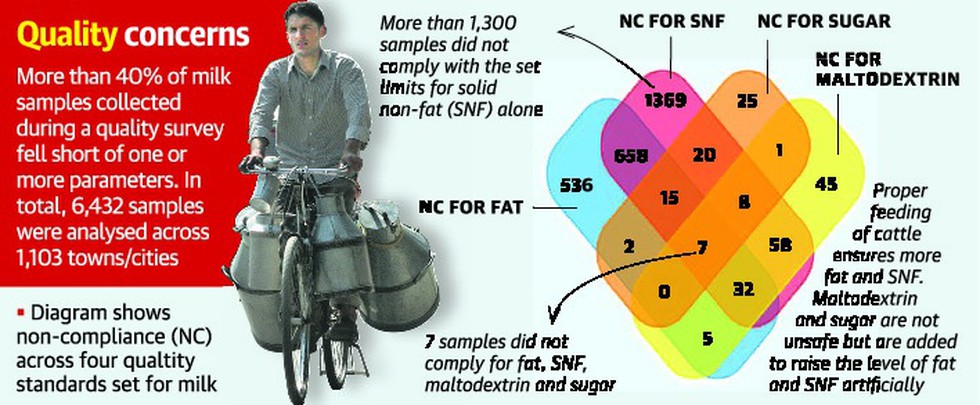
- The survey has found that milk samples from Telangana followed by Madhya Pradesh and Kerala has shown the highest number of cases of adulteration.
- The problem of Aflatoxin-M1 is more dominant in processed milk than that of raw milk.
- Tamil Nadu, Delhi and Kerala were the top states where the Aflatoxin-M1 was found maximum.
- In terms of quality, 7% of the total sample of processed milk did not comply with quality parameters because the presence of contaminants such as fats, Maltodextrin and sugar were above permissible limits.
-
Additional information:
About Aflatoxin-M1:
- Aflatoxins are toxins produced by certain fungi which are generally found in agricultural crops like maize, peanuts, cotton seed and others.They are carcinogenic in nature.
- It comes in the milk through feed and fodder that are currently not regulated in the country.
- There is no proper lab to test this residue in the country.
Testing and sampling Scheme:
- To address the issue of testing,the government is instituting a scheme for testing and sampling for organised dairy players.It will be implemented from January 1,2020,
- The scheme stipulates sampling points during various stages of milk processing, test methods and frequency of sampling.
- Organised players which include dairy co-operatives and private players, will need to have a well-equipped in house lab for testing and also will need to keep records of all tests conducted.
Food Safety and Standards Authority of India (FSSAI):
- Food Safety and Standards Authority of India (FSSAI) is a statutory autonomous body under Food Safety and Standards Act,2006.It comes under the Ministry of Health & Family Welfare.
- FSSAI is responsible for protecting and promoting public health through the regulation and supervision of food safety.
Oct 19, 2019


Oct 18, 2019


Ban on sale of fruits with stickers attached
Food and Drugs administration, Government of Chhattisgarh has made an appeal to all the fruit sellers not to sell the fruits by pasting stickers on it. The people have also been urged not to procure or purchase fruits which have stickers.
Controller, FDA said if any food trader is found to store unsafe food materials, indulge in its distribution or its sale, then under Food Safety and Standards Authority of India (FSSAI) Act 2006, section 59, imprisonment and fine will be imposed by taking necessary legal action.
Office of Controller FDA has intimated the fruits being sold in market mainly apple, mango, orange, guava, banana, sitaphal (custard apple), nashpati (pear) and others are pasted with stickers. The fruit sellers generally claim it to be premium brand or to conceal the damaged part of the fruit. Generally, the stickers carries the traders’ brand, OK tested, best quality or name of the fruit.
It is reported that the stickers have gums which is generally made by chemicals due to which the chemicals damage the fruits. Then, it becomes unfit for human consumption. As per the FSSAI Act standards, the traders and fruit sellers are not allowed to store, distribute or sell such fruits in the market. Even they are not allowed to sell the fruits and vegetables which have started to decay.
Similarly, the sale of fruits covering a layer with wax, mineral oil, colours, ripening the fruits using calcium carbide is also banned.
FSSAI plans to train food safety workers
Govt claims Food Safety Mitras will help reduce hassles for businesses
Union health minister Harsh Vardhan launched the Food Safety and Standards Authority of India's (FSSAI) ‘Food Safety Mitra’ (FSM) scheme on October 16, 2019 — the World Food Day.
The scheme will increase transparency in the food business and reduce hassle, the government claimed, by training individuals to assist food business operators (FBO) with registration and licencing.
‘Mitra’ is the word for ‘friend’ in several Indian languages.
They will have three roles.
A digital mitra will file new applications for licensing or registration, respond to queries and look into suspended licenses or registration.
A trainer mitra will train food safety supervisors and conduct trainings at ‘Eat Right’ campuses certified by the FSSAI.
A hygiene mitra will conduct audits at FBO outlets to check if they are implementing hygiene safety guidelines. Hygiene mitras will also train food safety supervisors and food handlers about safe and hygienic practices to handle food.
FBOs will need to pay the service providers Rs 100-Rs 5,000.
Those keen to be FSMs will need to register on the FSSAI website from November 26, 2019. A graduation in food safety or hygiene will be required.
Selected applicants will be interviewed after an online test. Those successful will be trained by the FSSAI and certified. The certificate will need to be renewed every two years. They will be eligible to assist more than 25 FBOs to comply with the Food Safety and Standards (FSS) Act, 2006.
The government has already selected an initial 15 mitras, whose certificates were awarded on October 16.
The scheme will majorly “focus on small FBOs and food vendors to enable food safety ecosystems at the ground level,” Pawan Aggarwal, chief executive officer of FSSAI, said. He claimed that the initiative will create self-employment opportunities.
“Around 50,000 entrepreneurs are expected to join the scheme. Through services such as licencing registration, hygiene rating and food safety training, we estimate that more than 2,500,000 FBOs will be engaged,” Aggarwal said.
The FSSAI also introduced an initiative to train domestic workers in healthy cooking (eg, using less salt and sugar, not reusing cooking oil, etc) and another to reduce food wastage.
Over 25kg of sweets destroyed during food inspection
Ludhiana: The food safety team of the health department swung into action and carried out intensive checking drives in different markets of the city on Thursday morning, and inspecting several milk producing units. During inspection, the food safety team destroyed more than 25kg of sweet items procured from different sweet shops, along with samples of several milk products, after getting information about their contamination with artificial colours or flavours, which are harmful to health.
District health officer Andesh Kang said, “With the beginning of the festival season across the nation, the consumption of milk products has gone up, forcing the traders into adulteration to increase their daily production. Following the direction of higher authorities, a special team of food safety officials was constituted to carry out raids regularly across food manufacturing units, and take samples to check their purity.”
To ensure the adherence of food items to quality, a food safety team conducted a raid on the premises of two milk producing units on Thursday, and found them violating norms by running in unhygienic conditions, and indulging in adulteration.
Kang added: “After collecting all samples from manufacturing units, we have delivered it to the state food inspection laboratory for further testing. The district health department will now charge the adulterators heavy penalties. We have issued proper guidelines to all city-based vendors that they should avoid the use of newspapers while wrapping food items, and not use their bare hands to collect hard cash and serve food items to customers, to avoid the spread of viruses.”
Oct 17, 2019


FSSAI launches Food Safety Mitra for ease of doing business, job creation
FSSAI has said that the scheme will lead to improved ease of doing business
A Food Safety Mitra is an individual professional certified by FSSAI who assists in compliances related to FSS Act
In a bid to improve the ease of doing business, apex food regulator Food Safety and Standards Authority of India (FSSAI) on Wednesday launched a scheme --Food Safety Mitra (FSM). The scheme will support small and medium scale food businesses in compliance to the food safety laws.
FSSAI has said that the scheme will lead to improved ease of doing business by creating a transparent and organized ecosystem supporting food businesses wherein food businesses will be able to get trained service providers at fair prices - lowering the costs of compliance.
“Apart from strengthening food safety, this scheme would also create new employment opportunities for youth, particularly with food and nutrition background. The FSM would undergo training and certification by FSSAI to do their work and get paid by food businesses for their services," said Pawan Agarwal, Chief Executive Officer, FSSAI.
“FSM opens a new dimension to food safety administration by augmenting government capacity and providing services to food businesses, particularly small and medium food businesses in the area of registration and licensing, training and hygiene rating. Through FSM, FSSAI plans to engage motivated individuals with the food safety ecosystem at ground level," he said.
A Food Safety Mitra is an individual professional certified by FSSAI who assists in compliances related to FSS Act, Rules and regulations with three avatars viz. Digital Mitra, Trainer Mitra and Hygiene Mitra depending upon their respective roles and responsibilities.
The FSSAI has also written to various states to implement the scheme properly. It has asked that in order to kick start the scheme, the assistance of the Network of Professionals of Food and Nutrition in
India chapters of respective States (where ever they exist) may also be taken.
FSSAI has put together an online portal for the same i.e. https: // fssa i.gov.in / mitra / and the registrations on the same for Digital Mitra have begun. A detailed brochure for the Food Safety Mitra scheme containing the structure and fees etc. is attached and is also available at https://fssai.gov.in mitra / doc/ fsrn.pdf.
Food regulator asks sweet manufacturers to ensure quality
At meeting held for confectioners here on Tuesday, the food regulator has stressed them to use minimal colours in sweets.
Calls for adulterant-free, safe confectioneries for Deepavali
The Food Safety and Standards Authority of India (FSSAI) has advised bakery and sweets manufacturers to prepare and stock adulterant-free and safe confectioneries for this Deepavali.
At meeting held for confectioners here on Tuesday, the food regulator has stressed them to use minimal colours in sweets. Samples of sweets made with minimal colours and those made with high concentration of colourants were displayed at the meeting for better understanding.
K. Tamilselvan, Designated Officer of FSSAI, Coimbatore, said that the focus of the meeting was to educate confectioners on good practices to be followed in the manufacturing of sweets from the selection of raw materials to the packing and the storage.
“Confectioners have been advised to use quality raw materials for the manufacture of sweets. They were instructed to maintain at most hygiene in the place of manufacture, personal hygiene of the employees, and follow various rules of the FSSAI in the making, storage and packing of sweets,” he said.
Colouring agents permitted by the FSSAI should be used for manufacturing sweets that require colour. The permitted colours should not be used beyond the prescribed level, not more than 100mg for 1 kg of sweets or 100 PPM (parts per million) of the item. Vanaspati should not be used instead of ghee for ghee-based sweets. Only packaged cooking oil should be used for making sweets. “The confectioners were asked to avoid banned plastic products for packing sweets. The package should have proper label which include FSSAI licence/registration number, the name and address of the manufacturer, dates of manufacture and expiry, price and ingredients. Milk-based products that have short shelf life should be stored separately while stocking”, he added. Employees at the manufacturing units and shops should wear proper clothing and should have hygiene gears like glove, cap and face mask. Newspaper should not be used for storing or packaging purposes.
The WhatsApp helpline of FSSAI can be reached at 94440-42322 to share food safety related grievances.
Food safety teams intensify sampling to check malpractices
Chandigarh: Ahead of Diwali, food safety teams have intensified sampling of food products by daily collecting 100 samples on an average.
To check inter-district and inter-state transit of sub-standard sweets, paneer and khoya, special checkpoints have been set up across the state. Besides sampling, the food safety teams have also launched a drive to sensitise the food business operators (FBOs) about maintaining good manufacturing and hygiene practices.
Tandrust Punjab Mission director Kahan Singh Pannu said a special emphasis is being laid on the quality and quantity of the permissible food grade colours that may be used for the preparation of sweets.
The sweet shop owners have been instructed to avoid synthetic colours in the manufacturing of sweets and maintain proper hygiene during bulk preparation on their premises. They have also been asked to either prepare khoya for their requirement on their own or buy it from trusted sources with proper bills/invoices, said Pannu.
Inspections have led to conviction in six cases and fine to the tune of Rs 1.5 crore imposed in 850 cases on the erring food business operators.
More than 350 awareness camps have been organised to help FBOs improve the hygiene and quality of food products. The FBOs have also been sensitised to abide by the laws mandated under the Food Safety Act and the guidelines of FSSAI. They are also being made aware to procure necessary licence/registration.
In Punjab, there are over one lakh food business operators of which a large number are working without mandatory licence. For encouraging FBOs to apply for licence, the government has already launched an online initiative.
As per the norms, licence is issued to the FBO having an annual turnover above Rs 12 lakh, while registration certificate is mandatory for an FBO with an annual turnover under Rs 12 lakh.
Malls, shops checked by VMC for food safety ahead of Diwali
Vadodara: Teams of the Vadodara Municipal Corporation (VMC) food safety officers checked malls, shops and manufacturing units making delicacies for Diwali festivities. Seven shops were issued notices after conditions there were found unhygienic.
Four teams were formed by the civic body to check establishments making and selling food items like sweets, savouries, bakery products and confectioneries. In all, 49 establishments were checked in the drive that began on Tuesday. These included six malls, 16 bakeries as well as 27 shops in different parts of the city.
The teams collected 48 samples of food items from these places even as 11kg material found unfit for consumption at shops was disposed.
The officials also found the conditions in seven shops and manufacturing units unhygienic and they were issued notices.
Oct 16, 2019


Food safety panel plans to lay healthy diet on students’ table

With childhood obesity and related health problems becoming a burning problem in the state, the Commissionerate of Food Safety has decided to tackle it head on.
THIRUVANANTHAPURAM: With childhood obesity and related health problems becoming a burning problem in the state, the Commissionerate of Food Safety has decided to tackle it head-on. It is planning to implement various strategies to reach out to children, parents and teachers at a much more broader scale.
It has decided to constitute state-level and district-level committees to implement its strategies effectively. “For dietary-based intervention at the school level, we have a project called ‘safe and nutritious food at school’. But it is limited to selected schools. To reach out to a wider audience with the message of taking up nutritious food, new strategies are needed,” said Ratan U Kelkar, Food Safety Commissioner.
“Some of the plans we have in mind include appointing college students, teachers and parents as health and wellness coordinators, engagement of professional bodies and others. Also, we had a couple of meetings with the Civil Supplies Department to procure and distribute only fortified food from the public distribution system,” added Ratan.
To reach out to its targeted group, the Commissionerate is also planning to tie up with Network of Professionals of Food and Nutrition in India (NetPro.FaN), Indian Medical Association, Kerala State IT Mission, National eGovernance Division and others.According to Kelkar, some of the activities being planned at schools include bringing a change in school canteen policy, organizing eat right days, designing healthy plate/lunch boxes and snacks for children and others.
Meanwhile, in a brainstorming session organised by the Commissionerate at Thycaud government guest house, on Tuesday, participants said that school children were at risk of serious long-term health problems, including type 2 diabetes, heart ailments, cholesterol, among others. Some other participants pointed out that authorities concerned should have separate strategies for government and private schools.
“While students of private schools are generally found to be overweight, students of government schools are found to be undernourished. Also, the scope of behavioural change should be explored while imparting diet lessons,” said a participant. In the first-ever Comprehensive National Nutrition Survey India 2016–18, released by the Healthy Ministry in the first week of the month, the state has the fifth highest number of overweight adolescents aged 10–19 years per cent.
Food Safety: Your home kit for spot testing adulteration
Mumbai: The Food Safety and Standards Authority of India plans to develop a special Rapid Analytical Food Testing (RAFT) or spot testing kits which will give the spot results of food if it is adulterated.
“This new testing kit will also reduce the testing load on Food Safety Officers (FSOs) and laboratories by giving test results quickly,” said an FSSAI official.
FSSAI has also invited applications from entrepreneurs under its programme of developing RAFT Kit / Equipment / Method for the purpose of testing food. The apex food regulator has issued guidelines for the same, detailing the pro forma for filing the application.
Senior FSSAI official said while filing the applications the applicants should also produce proper justification for each product category of RAFT kit along with validation certificates. No application for general parameters like pH, density or routine laboratory equipment and accessories and so on will be accepted.
“Applicants should submit separate application for each kit, equipment or method and each application should be accompanied by separate application processing fee,” read notice issued by FSSAI.
Shailesh Adhav, joint commissioner, FDA, Food, said this kit will enable FSOs as well as laboratories to get results quickly and will also help in establishing food safety for the ordinary consumer. This is because results of tests conducted on various categories of food products such as milk and edible oils, among others, will be available readily, which often are time-consuming.
“During festivals, the most common victim of adulteration is khoya or mawa. Because of high demand, people often engage in spurious activities. But with the help of RAFT kit, it can be ascertained very quickly on the spot -- whether the mawa is adulterated or not,” he said.
Sweet makers asked to use only natural colours
As Deepavali nears, the district administration has asked sweet makers not to use artificial colours beyond the permitted level.
With Deepavali a couple of weeks away, preparation of sweets in bulk quantities has just begun. Hence, the district administration has asked the manufacturers and traders to use only natural colours and maintain quality.
The Food Safety and Drug Administration Department conducted an awareness meeting at the Collectorate on Monday in which sweet and savouries makers, bakery owners and other food makers and sellers participated.
Officials explained the ‘good manufacturing practices’ including maintaining hygiene in the kitchens and use of natural colours in the preparation of sweets and savouries to the participants. Also, sweets prepared using permissible and non-permissible levels of artificial colours were kept on display and sweet makers and traders were asked to stick to the norms.
Collector C. Kathiravan, in a press release, said that sweet makers should have obtained temporary licence to manufacture sweets and other items for the festival season, failing which action would be taken against them.
He said the kitchens should be neat and the makers should ensure the place free from mosquitoes, bees and other insects.
Also, workers involved in making the sweets should be clean and only protected drinking water should be used. “Only 100 ppm of permissible colours should be used,” he said and added that packing should not be done in printed sheets or in newspapers.
Mr. Kathiravan said the pack should contain the name and address of the manufacturer, manufactured date and expiry date and asked people not to purchase packs that did not contain such details. He also said that oil once used should not be reused and warned traders against using plastic bags for packing.
Complaints related to poor quality of food items can be taken up with the District Food Safety Authority at WhatsApp number 94440-42322.
Food dept raids various shops
In order to check food quality and correct packaging, officials of Food Safety department conducted raids at various places on Tuesday.
Food safety officer Yogendra Panday during one such raid said it is important for the citizens to make sure that before they pay for any food item it is important to check all the details on the packaging material.
He said, “The consumption and shopping for dry fruits and sweets increases as the Diwali festival gets closer. Taking cognisance of this we are conducting a campaign in the region. On Tuesday we took sampling of dry fruits from Suvidha store at Jogiwala. It was found that the packets of date among the dry fruits are supposed to expire in October 2019. It is our opinion that consumers also need to understand that as they are the ones who pay for the product, they should at least be informed about the state of the product.”
He added, “Consumers should also know about the packaging date of the item, expiry date, about the quality and nutrition value and ingredients. What is happening at most retail stores today is that they are only putting stickers of brands on the packaging, but are not following the packing rules, because of which public is being fooled. This is an important task of food department to enforce packing rules. Citizens too should not only focus on the brand name, but should also ensure the quality of the product inside the packing material.”
Director General (Law and Order) Ashok Kumar has also directed all district officials to support the campaign of food department against food adulteration.
Samples of gift packs taken for test of purity
Bhopal: A team of food safety officials collected samples of gift packs of a multinational confectionary company from the shop of company’s stockist in Shahpura.
The food safety officials also collected five samples of pulses, oil and spices from a popular restaurant in MP Nagar following complaint of adulteration. A person had complained that he had ordered food from the restaurant online and the dal in the food he received had an insect.
The food safety officials had collected eight samples of sweets and namkeen including gift items of a company on Monday as well.
The food safety officials once again appealed to all the traders/manufacturers not to sell adulterated food stuff, stale food or unsafe edibles of any kind or else legal action as provided under Food Safety Act would be initiated against them.
70-kg sweets destroyed
Cracking heavily on sweet shops, in the wake of the festive season, district SBS Nagar Food Safety team collected seven samples, besides getting 70 kg of sweets destroyed.
Manoj Khosla, Assistant Commissioner (Food), said Food Safety Officer Sangeeta Sehdev and he inspected several sweet shops at Banga and Gunachaur and took seven samples of coloured sweets and khoya-based sweets such as pink cham cham, khoya burfi, kalakand, milk cake, rasgulla and gulab jamuns. They destroyed about 70-kg of gulab jamun and pink cham cham as they were unfit for consumption.
Notices were also issued to four shops for not complying with the parameters laid under the Food Safety Act. Sehdev said violators would be dealt with iron hands as per law. Earlier, a special naka was also set up at Banga to check the supply of spurious food items coming from other states/districts. — TNS
Oct 15, 2019


Biodiesel from used cooking oil to fuel a revolution
The Indriyam team with the working model of the plant they developed to convert used cooking oil to biodiesel, in Thiruvananthapuram on Thursday.
Start-up project to generate 250 litres per day
Imagine a local taxi or truck fleet operating on blended biodiesel manufactured in-house from used cooking oil sourced from restaurants, caterers and bakeries in the neighbourhood. That situation may sound too far-fetched but it could become a reality soon, if the pioneering work by a biotechnology start-up here comes to fruition.
Sensing an opportunity in the government’s drive to cut oil imports by turning used cooking oil into biodiesel, the company named Indriyam Biologics has developed a working model that can generate 250 litres of biodiesel per day.
Pilot project
“If things go according to schedule, the pilot project will be launched next month,” says R. Dileepkumar, founder and CEO of the start-up operating from SCTIMST-TIMED, a technology business incubator established by the Sri Chitra Tirunal Institute for Medical Sciences and Technology (SCTIMST) here.
Launched with funding from the Carbon Zero challenge of IIT- Madras, Kerala Startup Mission, Department of Science and Technology, and the SCTIMST, the project involves development of a compact, portable and safe-to-handle processor for localised production of biodiesel from used cooking oil. The company has applied for a design patent on the miniaturised plant that could switch from the chemical to enzyme-based trans-esterification process.
“We hit upon the idea of small-scale production of biodiesel, as most of the big biodiesel plants in the country suffer from poor supply of raw material,” explains Dr. Dileepkumar.
“On the other hand, the reuse of cooking oil poses a health hazard while its disposal pollutes the environment. Conversion to biodiesel addresses both the issues.”
The company hopes to tap big restaurants, caterers and units making banana chips and other fried snacks to ensure the supply of raw material. It is in talks with the Kudumbasree Mission to establish decentralised units.
In August this year, the Central government had announced that State-run oil marketing companies would procure the entire supply of biodiesel produced from used cooking oil for a three-year period. The scheme that seeks to ensure the supply of biodiesel to be blended with normal diesel has been launched in 100 cities across the country.
FSSAI direction
Earlier, the Food Safety and Standards Authority of India (FSSAI ) had stated that from March 3, eateries would not be allowed to reuse cooking oil more than three times. FSSAI has directed all food business operators to dispose of used cooking oil to authorised agencies for conversion to biodiesel.
Take action on panel report seeking ban on sachets, pouches within 3 months, NGT tells govt
NEW DELHI: The National Green Tribunal Monday directed the Centre and other agencies to take action within three months on a report by an expert committee which sought ban on small water bottles, pouches and cups saying these constitute a considerable amount of plastic waste.
A bench headed by NGT Chairperson Justice Adarsh Kumar Goel said that based on the recommendations of the expert committee, "the Ministry of Environment and Forests, Directorate General of Health Services, Food Safety and Standards Authority of India and other agencies concerned shall take action within three months in accordance with law".
The report, submitted recently by the panel, has stated that lighter, portable, and cost-effective nature of single serve "sachets/pouches/bottles" continues to make them an attractive proposition for the low-income consumers as well as young and active millennials.
"Smaller pack sizes/single serve packaging also have brought better quality and premium products affordable to all the sections of the society. But on the other hand it constitutes to the major plastic waste and litter, as their collection is economically non-viable. "Hence, in consultation with Legal Metrology Department the small pack sizes such as small water bottles, pouches, cups which constitute a considerable amount of plastic waste may not be allowed," the panel said.
During its deliberation, the expert committee noted that food and beverages, drugs and cosmetics and textiles are major items of mass consumption that use plastic packaging.
"All municipal bodies must be made responsible for development and setting up of infrastructure for segregation, collection, storage, transportation, processing and disposal of the plastic waste either on its own or by engaging agencies or producers as mentioned in the Plastic Waste Management Rules.
"Citizens, especially the socially engaged ones living in urban areas with wide access to information, have adopted more environmentally conscious consumption habits oriented toward recycling, reusing and composting the waste that derives from their domestic consumption," the report said.
The Expert Committee noted that while regulatory provisions for restrictions on the packaging by use of plastic material are mostly in place, there is lack of coordinated approach and implementation of these provisions is poor.
The tribunal had in May set up an expert committee to probe whether there is a need for further norms to restrict plastic packaging of food products after a plea has sought a ban on it citing health and environment concerns.
The panel comprised representatives of Food Safety and Standards Authority of India, Bureau of Indian Standards, Central Pollution Control Board and Directorate General of Health Services.
NGT was hearing a petition filed by NGO Him Jagriti Uttaranchal Welfare Society seeking ban on the use of plastic bottle and multi-layered/plastic packages /pet bottles.
Use of plastics, including polyethylene terephthalate (PET) bottles and multi-layered packs such as Tetra Packs, has an adverse impact on health and environment, the plea said, adding that it also results in increase in plastic waste.
It had said the notification dated December 24, 2018, issued by the Ministry of Health and Family Welfare under Section 92 of Food Safety and Standards Act, 2006 deals with the issue of packaging mode of food but it ignores Antimony and Di-2-ethylhexyl phthalate (DEHP) in specific migration limits provided for plastic packaging.
Diwali crackdown: FDA to collect samples from all sweet shops
Bhopal: Officials of the Food & Drug Administration (FDA) department will cover all sweets shops to collect samples before Diwali.
Senior food safety officer, Bhopal, D K Verma, said that samples would be collected from all sweets shops before Diwali to ensure that adulterated sweets are not sold for the festival of lights.
On Monday, FDA officials collected seven samples of packed sweets and namkeen from the godown of the super stockist of a company at Govindpura, which sells a variety of packed sweets and namkeen items in the form of gift packs on Diwali.
An FDA team collected samples of rasgulla, gulab jamun, Sonpapdi, Rajbhog and papad from the godown, which would be sent to the laboratory to test their quality. The FDA team also seized 10 packets of amchur, 15 bottles of lime juice and four packets of ajwain, which were beyond their expiry date. The FDA team destroyed all the stuff in the godown that was beyond their expiry date.
An FDA team also raided a sweets manufacturing factory in Govindpura on a tip-off. During the raid, it was revealed that sweets and namkeen in the factory were being manufactured for a sweets shop in Piplani. The team collected five samples of Kaju Katli, Malai Burfi, saltless mathari, gulab jamun and namkeen from the factory for testing.
The FDA also appealed to manufacturers and traders to use quality ingredients to manufacture sweets and namkeen items for sale in the festival season, not to use adulterated or substandard things to prepare sweets or namkeen, not to store stale edible goods, not to sell anything unsafe for human consumption. The officials said that if anyone is caught selling adulterated, impure or substandard edible goods, he would face strict action under the provisions of Food Security Act.
Food Safety Laboratory With FSSAI On The Road To Excellence

GUWAHATI: The road to excellence seems to have been paved for the century-old food testing laboratory (State Public Health Laboratory, Assam or SPHLA) with the FSSAI (Food Safety Standard Authority of India) sanctioning Rs 10 crore to upgrade it so as to enable it to maintain even micro-level food safety standard. The good news is that Rs 7.20 crore of the sanctioned Rs 10 crore has already been released.
Set up by British India in 1920 in Shillong, SPHLA is one of the oldest such laboratories in India. However, in 1973 the laboratory was shifted to the Gauhati Medical College and Hospital (GMCH) from where it was shifted to its present location at Bamunimaidam, Guwahati.
Apart from Assam, four other States – Meghalaya, Mizoram, Arunachal Pradesh and Sikkim – have been depending on this laboratory for maintaining food safety standards. Departments like Customs, NF Railway etc also depend on this laboratory for getting their seizures examined and analysed.
Talking to The Sentinel, a top-level official of the SPHLA said, “In fiscal 2018-19, the FSSAI granted Rs 10 crore for upgrading SPHILA, and Rs 7.20 crore of it has already been released. With the released funds we’re importing three sophisticated machines – LC-MS-MS (Liquid Chromatography Tandem Mass Spectrometry), GS-MS-MS (Gas Chromatography Triple Quadropole Mass Spectrometry) and ICP-MS Inductivity Coupled Plasma Mass Spectrometry – are being imported from Germany and the USA. The installation of such machines will enable us to examine and analyse micro-level pesticides present in food materials.
“Because of the absence of such state-of-the art machines, we’ve not been able to conduct a number of micro-level tests that are mandatory under the Food Safety and Standard Act, 2006. We’re conducting tests of around 1,000 cases annually.”
The official further said that the laboratory is going to get accreditation from the National Accreditation Board for Testing and Calibration Laboratories. Only five of the 77 such government laboratories in the country are accredited ones.
Oct 12, 2019


Subscribe to:
Comments (Atom)