Jul 21, 2019

Guidane note on Millets


Guidance note on Aflatoxins


Baby food to go off menu due to high sugar


Food wing collects seven samples in Kapurthala


Chennai: The number of convictions for misbranding and adulteration of milk has nearly doubled and the penalty collected by the state has gone up by nearly three times (250%) between 2017-18 and 2018-19, according to Union minister of state for health and family welfare Ashwini Kumar Choubey.
Replying to a question from Rameshbhai Lavjibhai Dhaduk of Porbandar on the action taken to check adulteration in milk and to penalise the criminals involved by Food Safety and Standards Authority of India (FSSAI) as per the Supreme Court direction, Choubey said a nationwide qualitative screening of milk samples for on-spot qualitative and quantitative analysis of milk samples was conducted by the Authority. It checked for quality parameters such as fat, solid not fat (SNF), added water, protein content and safety parameters and 13 adulterants, antibiotics, pesticides and aflatoxin M1.
The survey was initiated in May 2018 screened 6,432 samples taken across the country. Analysis showed about 39% of milk samples were non- compliant with reference to quality parameters [fat, Solid not-fat (SNF), sugar and maltodextrin] but were without any safety issues. But 9.9% samples were found to be unsafe for consumption due to presence of harmful contaminants in excess of specified limits coming mainly from poor quality of feed, irresponsible use of antibiotics and poor farm practices, he said. To ensure quality and safe milk, the state food authorities keep a strict vigil by regularly drawing food samples, he said.
In 2017, Tamil Nadu dairy development minister K T Rajenthra Bhalaji accused two private milk companies of adulterating their products with chemicals before selling them. The two brands are using caustic soda and bleaching powder in spoilt milk, convert it to milk powder, he said. The same year, the state wing of FSSAI had lifted 393 samples of which 101 we found to have misbranded or adulterated their product. While seven criminal cases were filed 63 cases were filed in the civil court. The same year, 64 cases ended in conviction and penalty of ₹4.19lakh was levied from 64 cases.
In 2018, however, 847 samples were lifted and 157 were found to have misbranded of adulterated the milk. Three criminal cases and 93 civil cases were filed. This time, however, 97 were convicted and the FSSAI collected ₹14.9 lakh as penalty from 125 cases. “We have been doing spot tests in many shops regularly. Since we have managed to record violations we have been able to win legal cases,” said a senior FSSAI official. The amount collected was second only to Gujarat, which had collected ₹16.2lakh from 80 cases.

Food wing collects seven samples in Kapurthala

Jalandhar, July 19A team of the Health Department carried out a checking drive under Dr Harjot Pal Singh, Assistant Commissioner, Food, and Satnam Singh, Food Safety Officer, Kapurthala under ‘Tandrust Punjab Mission’ today.
The team started inspection at 6.30 am on a complaint basis. A dairy near Subhanpur was checked. However no objectionable material was found on the premises of the dairy, situated at the residence of a villager.The team checked food items and collected samples from other Food Business Operators (FBOs) in Begowal and surrounding areas.
The food wing took seven samples, including two milk, two fruits, one pulses, one confectionary item and one fruit drink.
The team of food wing inspected vehicles carrying food items, especially milk and milk products. During the course of checking, drivers were seen trying to evade the checking by moving vehicles this way or that way.
However, the food wing managed to check many of them. Taking into consideration the ongoing rainy season, the FBOs have been directed to keep and store foodstuffs under clean, dry and hygienic conditions, to protected them from Mold growth, which otherwise deteriorates the food items in rains due to increased moisture content in the air.
The samples have been despatched to the State Food Laboratory, Kharar, and the report of the analysis will be made available to the department at the earliest. Further legal action will be initiated against the offenders as per the report of analysis of the State Food Lab, under the Food Safety and Standards Act 2006 and Rules and Regulations, 2011.
All FBOs were strictly directed to hygiene on the business premises, proper personal hygiene of workers engaged in the unit, especially those directly handling the foodstuffs.


Synthetic Milk plants Raided in Madhya Pradesh, 62 arrested.

The Madhya Pradesh police arrested 62 people for allegedly manufacturing and supplying synthetic milk and other products and distributing them to branded milk outlets in six north Indian states, the PTI reported.
Three synthetic milk units located at Amba in Morena district and Lahar in the Bhind district of the Gwalior-Chambal region were raided by the Special Task Force (STF). They also raided a dozen other locations on Saturday but found the premises locked.
According to Rajesh Bhadoria, the STF Superintendent of Police, around 10,000 litres of spurious milk, over 500 kg of condensed milk and over 200 kg synthetic cottage cheese were seized during the raid. A huge quantity of liquid detergent, refined oil, maltodextrin powder, and other chemicals were also seized.
“As many as 20 tankers and 11 pick-up vans containing spurious milk and other products were seized,” the STF SP said.
30 percent milk was used in combination with refined oil, liquid detergent, white paint, and glucose powder in every liter of spurious milk produced at the three units, The NDTV report said, citing the officials.
How is Synthetic Milk produced?
Synthetic, milk is produced by adding white color water paint, oils, alkali, urea, and detergent, etc. Synthetic milk has a bitter after taste and turns yellowish on heating. The milk when rubbed between the fingers gives a soapy feeling.
The National Milk Quality Survey, 2018
The National Milk Quality Survey, 2018 was carried out by FSSAI to assess the quality of milk. The survey that was conducted in 602 towns collecting 6432 samples revealed that milk in India is largely safe. The Survey had found that 90% of the samples were safe and less than 10% of the samples were non-compliant.
Earlier this month, the Food Safety and Standards Authority of India (FSSAI) launched a scheme for Sampling, Testing & Inspection of milk to strengthen internal controls at the licensed dairy processing establishments. The Scheme that is tentatively planned to be operational by 1st October 2019 elaborates certain quality and safety tests that have to be done by the dairy establishments at regular intervals. This will help the establishments in identifying the cause of any non-compliance, take preventive and corrective action, the FSSAI had stated.

Jul 20, 2019

FSSAI Calls for Colour-coded Labels on Products with High Fat, Sugar Content

Draft regulation has food industry worried; regulations are not scientific enough, say cos
New Delhi:
Makers of chips, soups, biscuits, juices and other packaged foods will soon have to display red colour coding on the front of packets of products that have high levels of fat, sugar or salt content as per the regulator’s new draft of labelling regulations.
The food industry has expressed its concerns over the draft of the proposed changes in labelling rules drawn up by the Food Safety and Standards Authority of India (FSSAI).
“These regulations are not scientific enough neither practical to be implemented,” said Subodh Jindal, president of All India Food Processors’ Association (AIFPA). “The salt, sugar and fat content of packaged food depends on the taste requirement of the consumer and is not manufacturers’ choice,” he said. AIFPA counts Bikanerwala, Tops and Haldiram among its members. Industry insiders claimed that even common food items like milk and fruit juices will fall in the “red category” as the level of fat in milk and sugar in fruit juice is higher than the levels being proposed.
“It is recommended that the authority should instead focus on awareness generation of consumer about balanced diet and suitability of different foods as per one’s lifestyle,” Jindal said. “Most food companies have also given various alternatives to consumers and it is a decision of the consumer to choose a suitable version.”
As per FSSAI’s draft regulations, packaged food companies will also need to declare nutritional information such as calories, saturated fat, trans-fat, added sugar and sodium per serve on the front of the pack.
The draft regulations will be put in public domain this week to invite comments from stakeholders, officials said. It would be implemented in a phased manner over three years.
“The idea behind the new labelling regulations is to enable citizens to know more about the composition of food products, so that they can make informed choices,” said Pawan Kumar Agarwal, chief executive at FSSAI. The regulations are in draft stage and the authority will be open to making changes based on the feedback it receives, he said. The food labels on the front of the pack will also have to declare, per serve percentage contribution to RDA (recommended dietary allowance).

DINAMANI NEWS


What’s in the Food Label

Food label is an important communication tool that provides consumers with information about a product's composition, nutritional profile, and quantity of contents so that they can make product comparisons and selections. Today consumers use food labels to find information such as the ingredient list, expiry date, nutrition, country of origin, serving size and statements about health benefits to help them make their purchasing decisions. Moreover food labelling involves the twin elements of economics and safety. Food standards at present exist almost solely for economic reason, which is to define food in a way that meets the economic expectations of producers and consumers. Likewise, net contents and the name and address of the manufacturer are on the label for economic reasons. The rationale for a statement of ingredients on the label is partly economic, so that the consumer will understand what he is buying, and partly safety, in the event the consumer has a known allergic reaction to an ingredient in that food product. Nutritional information is on the label for economic reasons as to show the value of the food and for health reasons.
Food and Drug Administration Jammu and Kashmir is responsible for ensuring that the food sold in the market is safe, wholesome and properly labelled. This applies to food produced domestically as well as food from foreign countries. The Food Safety & Standards Act 2006 and Food Safety & Standards (Packaging and Labelling) regulations 2011 administer food products under the ambit of Food & Drug Administration headed by Commissioner FDA. Implementation of the Act is practised by 108 Food Safety Officers at the ground level.
Food Safety Officers have important role in promoting awareness among manufacturers, distributors and importers about the proper labelling of the products. This guidance is a summary of the required statements that must appear on food labels under these laws and their regulations. To help minimize legal action and delays, it is recommended that manufacturers and importers become fully educated about the applicable laws and regulations before manufacturing starts or before offering foods for distribution/sale in Jammu & Kashmir State. Food labelling is imperative to food items available on shelves for sale in the market.
Food Safety & Standards (Packaging & Labelling) regulation 2011, provides guidelines for labelling of Food Products. There are three definitions which are important while labelling & Packing of Food Products:
BEST BEFORE DATE: means date which signifies the period during which the food shall remain fully marketable and shall retain any specific qualities for which tacit or express claims have been made.
DATE OF MANUFACTURE: means the date on which the food becomes the product as described.
DATE OF PACKING: means date on which the food is placed in the immediate container in which it is ultimately sold.
The label of the food product is mandated to include following information as provided under Food Safety & Standards Act 2006, regulation 2011, (failing which may incur fine of up to Rs three lakhs).
Name of the Food: Name of the food/product is one of the first FSSAI Guidelines on Labelling the Food Products. As the name suggests, the name of the food product should be in clear format on the packaged product in clear font. The Food Safety and Standards Authority of India (FSSAI) has issued new regulations controlling advertising and label claims for food products, restricting the use of words and phrases such as natural, fresh, original, traditional, authentic, genuine and real. Where the meaning of a trade mark, brand name or fancy name containing adjectives such as “natural”, “fresh”, “pure”, “original”, “traditional”, “authentic”, “genuine”, “real”, etc., appearing in the labeling, presentation or advertising of a food is such that it is likely to mislead consumer as to the nature of the food, in such cases a disclaimer in not less than 3mm size shall be given at appropriate place on the label stating that – “This is only a brand name or trade mark and does not represent its true nature”.
List of Ingredients: List of Ingredients means the elements which have been utilized for making the final food product. The name of the ingredients used in the food product shall be listed in descending order of their composition by weight or volume. It is very necessary that the manufacturer mentions all the ingredients fairly and do not cheat the end-consumer. The manufacturer can land in problem if tends to cheat the consumer.
Nutritional Information: Nutritional Information means the calories derived from fats, saturated fat, trans fat, cholesterol, sodium, carbohydrates, dietary fiber, sugars, protein, vitamin A, vitamin C, calcium, and iron present in the product. The calories are mentioned on all the products labels. However the nutritional information may not be necessary in case of foods such as raw agricultural commodities.
Declaration regarding Vegetarian or Non-Vegetarian: While labelling the food products, the manufacturer should mention on the label whether the product is vegetarian or non-vegetarian. Whether the product is vegetarian or non-vegetarian can easily be known by just looking at the small sign present on the corner of the label. Green Colour indicates the product being vegetarian and Brown Colour indicates that the product is non-vegetarian. Where any article of food contains eggs only as Non-Vegetarian ingredient, manufacturer or packer or seller may give declaration to this effect in addition to the said symbol
Declaration regarding Food Additives: Food additives are substances which are added to food in order to preserve flavour or enhance its taste and appearance. Hence, it is very necessary to give a declaration regarding the additives on the label or the package. Where any colouring matter or preservative is added to food product it shall mention on the label that the product contains added “permitted natural colors” or Product “contains permitted synthetic food colours”. Similarly, if preservatives are added the label shall mention the product contains “Added Preservatives”
Name and Address of the Manufacturer: The name of the manufacturer and place of the manufacturing is usually mentioned on label. The manufacturer has to give complete address of his factory which includes street address, city, state and zip code. Without mentioning any of these, products can be considered fake in the market.
Net Quantity: Net Quantity is also FSSAI Guidelines on Labeling of Food Products. Net Quantity here refers to the weight of the product. The weight of the product and the packaging weight are usually combined together and then mentioned in the Net Quantity.
/Lot No/Batch No: A batch number or code number or lot number is a mark of recognition through which the food can be found in the manufacturing chain and even recognized in the distribution. Therefore, the Code No /Lot No /Batch No should be definitely mentioned by the manufacturer according to FSSAI Guidelines on Labeling of Food Products.
Country of Origin for Imported Food: The country of origin of goods means the nationality of imported goods and even refers to the area where such goods have been grown or have been produced, manufactured or processed. All the imported food items are needed to carry the address of importer
FSSAI Logo & License No: It is mandatory that Food Products carry on its label FSSAI Logo and License No in contrast colour to the background.

FSSAI mulls ‘code red’ for unhealthy food

Nagpur: Soon, packaged food items like chips, soups, biscuits, nankeens, sweets, juices etc will have a ‘red warning’ printed prominently on the packets in case they have high sugar, salt or fat content.
Food Safety and Standards Authority of India (FSSAI) has prepared a draft of Food Safety and Standards (Labelling and Display) Regulations, 2019, in which it has suggested that packaged products will have to display a red colour coding on packs to notify that the food contains high levels of sugar, salt or fat.
As the new rule is still at draft stage, the FSSAI has invited suggestions from people. At present, packaged food products have green triangle code for vegetarian food and brown circle for the non-veg food items. People can visit FSSAI website (https://fssai.gov.in/comments/Bestviewwl.aspx?NOTIFICATION_ID=1088) and register their suggestions to make this draft a law by July 31.
While dietitians and doctors are happy with this move, packaged food industry is not finding it scientific and viable.
“This is a big step towards ensuring food safety. Consumers will understand better about the composition of food products and they can choose their packaged food accordingly. People are health conscious these days, and they will ignore a pack with red warnings,” said Sudhir Deshpande, who retired from FDA as food safety inspector.
Dietitian Meghna Kumre said the display should be prominent enough to attract attention. “At present, manufacturing date, expiry date, and some nutritional values are displayed over the packs but it becomes difficult for consumer to see these at a glance. I hope, the new system should come into force and it will be prominently displayed,” she said.
Paediatrician Dr Preeti Deo told TOI that parents are very aware these days and they will make good use of the coding. “Many children are addicted to wafers, corn puffs, finger snacks which are full of unhealthy ingredients. With red warning printed on the packs, parents will get clear idea of the unhealthiness of these products. I hope, they will avoid packs with more number of red blocks,” she said.
However, manufactures of packaged food are not happy with the proposed rule.
“If we follow the values mentioned in the draft, more than 70% of packaged food available in the market today will be coded red,” said a senior official of a Nagpur-based food processing company who was not willing to be named.
“We decide the salt, sugar and fat content of packaged food as per public taste. It’s more about taste and not health requirements. Even food items like flavoured milk, lassi, and fruit juices will get red warning as levels of fat in milk and sugar in fruit juices are mostly higher than proposed levels for taste enhancements,” he said.
Proposed rule
According to proposed rule, food pack should show name of food (which we see prominently), declaration regarding veg or non-veg (colour coding already exists for this) and per serve contribution of energy, saturated fat, trans fat, added sugar and sodium
For this, a new format has been issued which has 2 parts
Part 1 has declaration of amount of energy, saturated fat, trans fat, added sugar and sodium per serve in five separate blocks
Part 2 has declaration percentage (%) contribution of these ingredients in the pack
The blocks of ingredients for food will be red if:
Value of energy (kcal) from added sugar is more than 10% of the total energy (kcal) provided by 100g or 100ml of the product
Value of energy (kcal) from trans fat is more than 1% of the total energy (kcal) provided by 100g or 100ml of the product
Saturated fat or sodium content provided by 100g or 100ml of the product is more than the threshold values as specified by FSSAI

Nearly third of processed food samples analysed in FY19 were adulterated: Govt

New Delhi, Jul 19 As many as 26,077 samples of processed food were found to be adulterated or misbranded out of the over 94,000 samples analysed during the last fiscal, the government said Friday.
Minister of State for Food Processing Industries Rameswar Teli, in a written reply in the Rajya Sabha, said that 94,288 samples of processed food were analysed in 2018-19.
"Out of this 26,077 samples were found adulterated or misbranded," the minister was quoted as saying in an official statement.
He added that a total of Rs 32.8 crore was raised as penalties last year.
The minister also said the Commissioners of Food Safety of states/UTs are regularly conducting inspections, surveillance and enforcement drives through their officials in food processing units to ensure compliance with laid down standards.
"In cases where samples are found to be non-conforming to the provisions of Food Safety and Standards (FSS) Act, 2006, and rules and regulations made thereunder, penal action has been initiated against the defaulting Food Business Operators (FBOs)...," the minister added.

FSSAI starts drive against unauthorised FBOs

As per the direction issued on July 1 by the Food Safety and Standards Authority of India (FSSAI) officials in the state have started a drive against all the Food Business Operators (FBO) running without permission in the city.
The drive is to address four types of non-compliance which include FBOs that are running in the city without registration certificates which are required to obtain a license, FBOs continuing business with an expired license or running a business without a license, businesses that have obtained fresh license instead of renewing the previous one to avoid penalties and FBOs manufacturing and processing food products which are not endorsed on their food license.
A departmental official said, “We conduct these drives regularly and 20 such FBOs were already found violating the set conditions. Further actions will be taken against them.”
It is pertinent to mention that the FSSAI has only six food inspectors in Dehradun who are assigned to various areas of the city. The limited staff is one of the reasons the department struggles to keep an effective check on all the food business and shops in the city.

Jul 15, 2019

DINAMANI NEWS


Natural food has power to cure lifestyle diseases


TN to track finances, staff in real time


Midday meals left 900 children ill

Food for thought: The HRD Ministry has issued guidelines to all States and UT’s for hygiene in school kitchens. 
The HRD Ministry has received 35 complaints for substandard food since 2016
More than 900 children were reported ill across the country with zero fatalities due to the consumption of mid-day meals in the past three years, according to officials of the Human Resource Development Ministry.
The Ministry had received 35 complaints from 15 States and Union Territories (UTs) regarding substandard food quality in the same period.
“A total number of 930 children were reported ill and none of them died after eating such food in the country in the last three years and current year. The overall responsibility for providing cooked and nutritious midday meals to eligible children lies with State governments,” a senior HRD ministry official said.
The Midday Meal Scheme comes under the HRD Ministry’s Department of School Education and Literacy.
Respective State governments were requested to furnish action-taken reports (ATRs) in the matter, he said.
“As per the reports received, actions such as issuing warning against the official responsible, terminating the contract of NGOs concerned and organisations, initiating criminal proceedings and imposing penalties against the defaulting persons (were taken),” the official said.
The HRD Ministry has also issued guidelines on quality, safety and hygiene in school-level kitchens.
“The guidelines provide instructions on procuring AGMARK quality items for preparation of midday meals, tasting of meals by two or three adult members of the school management committee, including at least one teacher, before serving to children,” the official said.

Say bye to big, fat Delhi weddings: New policy will keep tabs on food wastage, guest list, venue size

The policy which was framed under the directions of the Supreme Court has to be notified this month.
HIGHLIGHTS
  • Policy says surplus food must be distributed to the underprivileged via NGOs
  • Venue operators will have to pay hefty penalties for violations
  • Limit on number of guests as per the size of venue, parking space
The policy drafted by the Delhi government to keep a check on the wastage of food at social functions in the national capital will likely be notified this month.
Sources told The Times of India that the policy which was framed under the directions of the Supreme Court has to be notified this month.
The Delhi government drafted the policy for holding social functions in March, which puts a cap on the number of guests, after the Supreme Court expressed its anguish over wastage of food at the events in the capital.
The Chief Secretary constituted a committee of four officers, including Principal Secretaries of Urban Development and Health, Chief Executive Officer, Delhi Jal Board and Member Secretary, Delhi Pollution Control Committee, to draft the policy.
The draft policy has already been approved by the Supreme Court appointed monitoring committee, the report said.
Surplus food must be distributed to the underprivileged via NGOs
According to the draft policy, all organisers and caterers will have to register themselves with NGOs to manage the surplus and leftover food for distribution among the underprivileged.
"The caterer should make proper arrangements to handover fresh surplus and leftover food to these NGOs," said the Draft 'Policy for Holding Social Functions in Hotels, Motels and Low-Density Residential Area (LDRA) in National Capital Territory of Delhi'.
The owner, organiser, and the caterer must have the necessary permissions including FSSAI license from Delhi's Department of Food Safety, Ministry of Health and Family Welfare to run their kitchens or to sell or serve prepared food for the guest and the consumer.
"They should be registered with some NGO to manage surplus/leftover food by distributing the same among underprivileged. The caterer should make proper arrangements to handover fresh surplus and leftover food to these NGOs.
The food preparation should be according to the ceiling of the number of guests as per prescribed capacity of the motel and LDRA. The number of guests cannot exceed the guest limit approved by the Urban Local Body (ULB) for that function site," it said.
"If the food is surplus due to lower turnout of the guest and resultant less consumption, then it shall be the responsibility of organiser of the social function to remove that food from the social function site, immediately after the completion of the duration of that social function," it says.
The Commissioner Food Safety shall ensure that the above conditions are strictly followed; any violation thereof would invite action from the deployed officers by the Commissioner Food Safety, the draft policy reads.
The rules will be enforced by periodical inspections, which shall be conducted by officers of various state stakeholder agencies.
Venue operators to pay hefty penalties for violations
The maximum number of guests will be the number obtained by dividing the area of the venue by 1.5 sqm or by multiplying total number of cars that can be parked by four, the TOI report said.
"Further, officers of respective ULB will conduct random or complaint-based inspection. The violations would be noted with proofs by the inspecting officers without the disrupting the function. In the event of violation of any of the conditions, the penalty would be imposed against violators under specific act/rules/orders."
Hefty penalties have been laid for operators of the venues, not the host, for violations. Operators will have to pay Rs 5 lakh for first offence, Rs 10 lakh for second and Rs 15 lakh for the third or any subsequent offence.
Restrictions on venue space
"The capacity of the space should be determined by multiplying the total number of car parking available by four or by means the number of persons obtained by dividing the gross floor area of the premises by occupant load factor at 1.5 sqm, whichever is less," says the document.
It said adding that the total number of days on which a social function can be organised are restricted to 120 days in authorized/approved spaces.
The draft also said that motels and LDRA should be constructed as per sanctioned building plan.
"Minimum area of LDRA must be equals or more than 2.5 acres. Only such Motel and LDRA houses should be permitted to hold social functions which have proper access to the road from a main road (60 ft wide or more) and the LDRA should not be located at a road which ends in a dead end," it said.
"Further, in view of Motel Policy of Ministry of Tourism 1995, policy for holding social functions in Farmhouses of Government of NCT of Delhi, Master Plan 2021(MPD 2021), amendments in MPD-2021 notified in 2013, a comprehensive policy was required to be drafted," an official said.
Functions must meet pollution norms
"Accordingly, the committee after consultation with all stakeholders drafted the policy keeping in mind concerns of Environment Pollution (Prevention and Control) Authority (EPCA) and Supreme Court such as stop the use of perennially installed semi-permanent pandals, nuisance of parking on outside road of the venue, safety of guests and general public, stop the misuse of scarce resources like water and stop any kind of pollution or degradation of Environment," the official said.

KFC outlet fined Rs 5,000 for ‘lack of cleanliness in kitchen’

Dehradun: Dehradun Municipal Corporation (DMC) and the state food safety department, in a joint operation on Saturday, conducted a raid on an outlet of fast food chain Kentucky Fried Chicken (KFC) situated at Rajpur Road and imposed a fine of Rs 5,000 for “poor cleanliness in the kitchen and premises.” The food safety department has also collected food samples from the outlet which have been sent to a drug testing laboratory in Rudrapur.
Speaking to TOI, municipal health officer Dr RK Singh said that the raid was undertaken under the leadership of Ramesh Singh, food safety inspector, Dehradun. “The outlet was picked up on a random basis for inspection as part of a routine drive to ensure that cleanliness standards are being followed by eateries in the city. However, we found that the outlet wasn’t disposing food waste properly for which we imposed a fine of Rs 5,000 on them,” he said.
Further course of action against the outlet will be determined on the basis of the sample test results, which are expected to come within two weeks, the official added.
“The outlet’s staff alleged that they get non-vegetarian food items delivered from New Delhi but failed to produce the pay receipts and the licence required for the same,” Dr Singh said.
When queried about the matter, an employee of the outlet who requested not to be identified denied that there were any cleanliness issues. “We often take our customers for a kitchen tour, so how can we let our kitchen remain dirty? It was just a miscommunication that happened. The issue was actually pertaining to the garbage disposal slip that is filled by the DMC’s garbage pick-up workers. Also, we will produce the documents related to the procurement of non-vegetarian food items on Monday. Some of the pay slips were not in our direct possession when the raid took place,” he said.
Last week, the food safety department had also filed a case against three prominent bakeries in the city, in the additional district magistrate court as the food samples collected from the bakeries were found to be substandard.
“We had also conducted raids on some milk dairies in Patel Nagar on Thursday and their food samples, too, were sent to the Rudrapur lab,” Ramesh Singh told TOI.

Rise of food delivery apps and the need to strengthen regulation

In 2018, Maharashtra FDA had raided about 350 food outlets in Mumbai listed on food delivery platforms such as Swiggy, Zomato, Uber Eats and Foodpanda, among others
There are no two thoughts about stringent regulation of food and medicine as both go directly into the body and can cause havoc to a person’s health if their quality and hygiene standards do not meet a certain level.
Indian drug regulation is separate story, which is for a later day. Let's discuss food for now.
In 2018, the Maharashtra Food and Drug Administration (FDA) had raided about 350 food outlets in Mumbai listed on food delivery platforms such as Swiggy, Zomato, Uber Eats and Foodpanda, among others.
The results were shocking as around one-third of them had not registered with the authority.
To be sure, online food delivery platforms have to verify the Food Safety and Standards Authority of India (FSSAI) license of the food outlet listed on their food platform. The presence of so many unregistered food outlets indicate, either it is a case of poor oversight or the outlets are gaming the system.
Even the registered outlets were not any impressive. Around 74 percent of the eateries were found serving food from kitchens with unhygienic conditions.
The water used for cooking was not tested, no pest controls were done, no periodic health check-up reports of people cooking food, poor sanitation, there was lack of cleanliness and ventilation in the kitchens.
It was found that some of the restaurants are cooking food out of makeshift shacks with appalling hygiene.
The problem is not restricted to Mumbai alone. As many as 10,500 restaurants have been de-listed by food delivery platforms, after they were found to be unregistered or unhygienic, according to FSSAI.
Pallavi Darade, Commissioner of Food Safety, FDA Maharashtra at a recent conference said that the consumers are more bothered about the discounts, packaging and delivery time of the food, than important things like where it is made and how it is made.
With more people, especially millennials, are relying on online food delivery applications, it has become increasingly important that we have a robust audit system in place to check the quality and hygiene of the food being served.
There is no doubt that online food delivery companies have given new lease of life to the food industry. There are proliferation of eateries of all sizes. However, we cannot allow operators to play with the lives of the people by cutting corners.
It is unfair to completely blame the online food delivery companies. The government is also responsible. The government must strengthen surveillance and increase the number of food inspectors. For instance, Maharashtra has a shortage of 300 food inspectors. The same would be the case with the rest of the country.The government also needs to curb corruption involved in issuance of licenses or getting off the hook easily when caught. The government can work with online food delivery companies and restaurant bodies to come up with mechanisms to increase surveillance and weed out bad players.

Jul 12, 2019

Food safety is a must while traveling

The WHA estimates that 2 million people die each year from contaminated food or drinking water.
The common risks that travelers can encounter due to food poisoning, ranges from diarrhea to illness caused by harmful bacteria, parasites, viruses and chemical substances.
Your travel plans are set, passport if ready and bags are packed. The enthusiasm to visit your favourite destination could make you forget even the basic things that one needs to remember every time when traveling to a unknown place- food safety being the foremost one.
The WHA estimates that 2 million people die each year from contaminated food or drinking water. The common risks that travelers can encounter due to food poisoning, ranges from diarrhea to illness caused by harmful bacteria, parasites, viruses and chemical substances.
Certain tips that travelers need to know to avoid such problems are:
Research your destination: Anticipate issues and check for food safety, availability of drinking water facility and the most important one, medical care system in the place you are planning to visit.
Carry some nonperishable food items: Even though most of the airports offer healthy and hygienic options it is safe to have some food items in your luggage.
Carry hand sanitizer and disinfectant wipes: These can be used for cleaning your hands and surfaces.
Avoid certain food items: It is advisable to curb the foodie enthusiasm and not opt for raw or undercooked meat, fish, shellfish and eggs as they can be contaminated and could be carriers of deadly bacterias.
Rethink your usual choices: Even though you may typically enjoy certain foods and beverages at home, your safest bet is to avoid some of those favorites during foreign travels especially to remote locations.

Rebranding of banned coconut oil raises concern

Kozhikode: Rebranding of sub-standard coconut oil brands, which were banned by the food safety authority, is giving headache to the food safety authorities in the state. Many banned coconut oil brands are now being sold in the market under new brand names. Adulterated coconut oil reaches the market mainly from Tamil Nadu and other states. Some mills in Palakkad and Malappuram districts also engage in adulteration of coconut oil. 
“Our continuous efforts have succeeded in reducing the presence of sub-standard coconut oil in the market in Kozhikode,” said assistant food safety commissioner P K Eliyamma. All oil mills in Kozhikode, which were engaged in the packing and sale of sub-standard coconut oil, were closed down after detailed inspection, she said.
However, lack of proper mechanism to shut the coconut oil units in neighbouring states is a major concern. Recently, the district food safety officials banned Soorya and Ayilyam brands manufactured by Balakumaran Company as the samples were found to be adulterated. They were found to be the replacements for two oil brands — Soubhagya and Surabhi — belonging to the same company, which were banned earlier.
We not only ban the product but also inspect the manufacturers and close down the mill on detecting adulteration, said P Jithin Raj, food safety inspector, Vadakara circle. “We also seize packed and unpacked oils to avoid rebranding,” he said.
The production of low-quality coconut oil was curbed in the district after a special drive in 2017-18. A number of local oil mills were served closure notice and over a dozen oil brands were banned.
Officials said most coconut oil manufactures from other states do not even have oil mills. They directly mix 20% coconut oil with 80% low-quality edible oil and send it to Kerala, the officials said.
The illegal manufactures mix palm oil, palm kernel oil or coconut testa oil with coconut oil.

46 restaurants served notice

Used oil, stale food seized; eateries told to rectify problems in 7 days
The city Corporation intensified its crackdown on eateries that flouted food safety and hygiene standards by serving notices on 46 restaurants in the State capital on Thursday. Stale food was seized from many eateries during the drive.
Six squads comprising health inspectors and other Corporation employees inspected 59 restaurants in places such as Kamaleswaram, Manacaud, East Fort, Statue, Palayam, Thampanoor, and Karamana. The erring outlets have been instructed to rectify problems within seven days, failing which stringent steps will be initiated.
Large quantities of used oil, stale and expired food products including chicken, beef, fish, eggs, cauliflowers, potatoes, tea powder, biryani, butter, rice, curd, mayonnaise, ice-cream, fruits, porotta and chapatti were confiscated from many eateries. Some restaurants were serving food that were nearly a week old.
Dirty utensils
While they initiated action against most restaurants for their failure to provide health cards for workers, the civic body also penalised the eateries for other violations including the use of dirty utensils, failure to segregate wastes, lack of store room, chimney and facilities for proper ventilation, and unclean water tanks and surroundings.
A few outlets were also pulled up for their tardy upkeep of their interiors and instructed to paint the premises. The accumulation of leachate and food wastes that emanated foul odour within the restaurant compounds was also acted upon.
Plastic bags seized
Large quantities of banned plastic carry bags were also seized from several restaurants during the drive that was led by health supervisors Ajith Kumar, Prakash, and health inspectors Mohanachandran, Anoop Roy, Anil Kumar N.V. and Sujith Sudhakar.
According to Mayor V.K. Prasanth, some restaurants had violated the norms on multiple occasions. The health wing has been directed to cancel the licences of such outlets. He added that all eateries, ranging from ‘thattukadas’ to five-star hotels, will be inspected during the days to come.
The drive is as prelude to the launch of the civic body’s Subhojan project next month. As part of the project, workers of all eateries including hotels, restaurants, catering units, bakeries and wayside outlets in the city will be imparted training and issued identity cards.

2,807 samples of food fail quality test since 2016

10,195 items lifted for checking | 311 convicted on adulteration charge
‘Active measures planned’
The tests on 10,195 samples lifted randomly by the civic authorities had been carried out as per the rules set by the Food Safety and Standards Authority of India. Commissioner, Food Safety, Vinod Sharma said more active measures were planned to curb the menace
A representational picture of a vendor selling fast food in Jammu.
Jammu, July 11
About 2,807 food samples tested in Jammu and Kashmir from 2016 to June this year have failed the quality parameters, raising questions over the standard of food supplied to consumers and leading to the conviction of 311 persons for indulging in adulteration and selling substandard products.
The tests had been carried out as per the rules set by the Food Safety and Standards Authority of India (FSSAI). Both branded and unbranded products were tested. According to government data, of the 10,195 samples lifted randomly by the civic authorities, especially the Drugs and Food Control Organisation (DFCO), J&K, 2,807 samples were found adulterated or not conforming to acceptable standards. The data reveals that during 2016-17, 2,952 samples were collected and analysed. Of them, 1,114 were found adulterated, misbranded or substandard. In 2017-18, 3,643 items were collected and of them, 992 were unsuitable for consumption. From 2018 till June 2019, 3,600 samples were collected. Of them, 701 were found substandard.
The FSSAI has also revealed that cases of food poisoning have come to their notice across the country.
“There are prescribed standards to ensure safe and wholesome food to the consumers through various regulations notified under the Food Safety and Standards Act but these are being violated in J&K,” said a senior administrative official. As per the consumer protection laws, states have to undertake regular monitoring, inspection and sampling of food items to check compliance of the prescribed standards and take penal action when the products are found adulterated, misbranded or are of an inferior quality.
Commissioner, Food Safety, Vinod Sharma said the DFCO regularly monitored and conducted inspections to curb the adulteration of food items. He said more active measures were planned to curb the menace. “As per the procedure, the field staff lift samples and laboratories inspect them. If they are found not conforming to the standards, individuals are challaned. It is up to the courts to decide the quantum of punishment and fine,” said Sharma.

Repeated raids fail to stem usage of food colours

Visakhapatnam: Despite regular raids and warnings, usage of artificial food colouring agents and monosodium glutamate (tasting salt) is rampant at eateries and restaurants in Vizianagaram district. 
Recent raids at eateries by officials of vigilance and enforcement and food safety departments have exposed excessive usage of colouring agents and the chemical in the food. 
“We found tasting salt in over 80% of the eateries and restaurants in Vizianagaram town, Parvathipuram, Saluru and few other areas in the district, where the floating population is high. Tasting salt is not permitted to be used in food as the chemical can cause several health problems like ulcers, and intestine problems, said sub-inspector of vigilance, K Kiran Kumar.
The use of certain artificial colors have been banned under the Food Safety Standards Act of 2006 as they can, in the long run, cause cancer and tumours.
Kumar further revealed that a majority of complaints against use of synethic food colours, which contain chemicals like erythrosine, carmoisine, indigo carmine, brilliant blue FCF and others, are associated with non-vegetarian dishes. Some consumers have also complained that the use of colours has been so high that the colour residue remained in their hands, he added.
“Although we have suggested to restaurateurs to use natural food colours, they have been turning a deaf ear, citing that consumers wouldn’t like if the food is not attractive,” said vigilance inspector Ch B Swami.
The raids also revealed that some restaurants kept stale and leftover food in their freezers to sell them the next day.
Explaining why people brazenly break rules with regard to food safety, food safety and vigilance officials said that as there is no proper punishment laid down for those caught selling stale and dangerous food items.
“Unless the culprits are put behind bars for years, it is difficult to curb food adulteration in restaurants and eateries,” they said.

26% of food samples tested in 3 years found adulterated or substandard

Around 26 percent random food samples analysed during last three years across Jammu and Kashmir were found adulterated and substandard, raising a question mark over the work of authorities responsible for food safety in the state.
Out of the 10,636 samples tested since 2016-17, as many as 2807, that is 26 percent were found to be adulterated or substandard, according to data from union consumer affairs ministry
The food samples were randomly picked up from various markets of J&K for testing compliance with Food Safety and Standards Act. 
In 2016-17, 2952 food samples were analysed, of which 1114 items turned out to be adulterated or substandard. While in the same period, 635 cases were lodged of which only one conviction was recorded.
In 2017-18, the total number of food samples analysed was 3643, of which 992 samples were found violating standards. Authorities in the same period convicted 310 persons, cases registered stood at 921.
LATEST NEWS

For 2018-19, the number of samples found adulterated or substandard stood at 701 out of 4041 samples collected by food safety authorities. However, conviction rate in 698 cases launched was zero.
Food Safety and Standards Authority of India has informed that it has prescribed standards to ensure safe and wholesome food to the consumers through various regulations notified under Food Safety and Standards Act. 
Implementation and enforcement of these regulations primarily lies with state governments.
“Commissioners of Food Safety of different states have been directed from time to time to conduct regular monitoring, inspection and sampling of food items to enforce compliance of the prescribed standards and take penal action in cases,” reads the note of the Union Consumer Affairs Ministry.
Reports that food adulteration is rampant in Jammu and Kashmir, particularly in the Kashmir region have continuously come in as the High Court also felt the need to step in.
In 2016, the High Court took suo-moto cognisance of news reports about food adulteration and rising cancer incidence published in the Greater Kashmir and treated these as Public Interest Litigation under Food Safety and Standard Act 2006.
Food adulteration is not a new phenomenon in Kashmir valley.
But doctors say the occurrence has recently seen a phenomenal increase, which has led to a rise in patients with gastric problems across Kashmir.

Food safety officials raid eateries, take samples

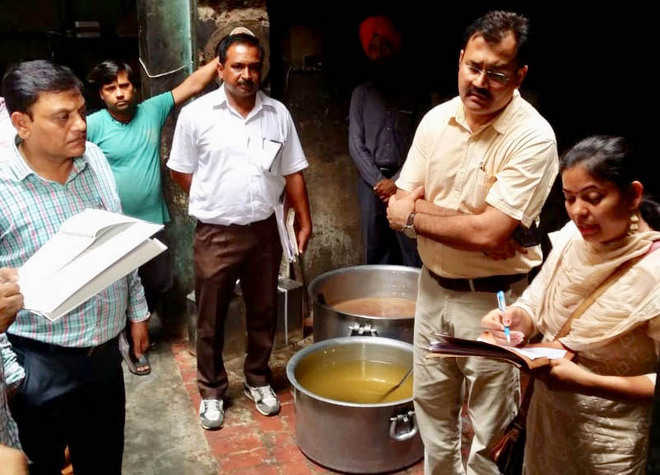
Officials of the MC and the Food Safety Department, Sangrur, led by SDM Vikramjeet Singh Panthey inspect a sweetmeat workshop in Ahmedgarh on Wednesday. 
Mandi Ahmedgarh, July 10
The administration has started checking non-compliance of guidelines of the Food Safety Act and violation of various sections of the Municipal Act regarding maintenance of proper hygienic conditions at various establishments engaged in preparation of food items and catering services at Ahmedgarh and surrounding localities.
Teams of senior functionaries of the Food Safety Department, Sangrur, and the Municipal Council, Ahmedgarh, raided eateries, restaurants and workshops engaged in preparation of sweetmeats of various kinds and took at least five samples for verifying purity and safety of various eatables, including milk products.
Action will be taken against the owners of those establishments who had downed shutters to avoid inspection and sampling on Wednesday.
Investigation revealed that teams of officials of the civic body and the District Food Safety Department had conducted raids at establishments at Gandhi Chowk, Railway Road, Chaura Bazar and Main Bazar localities which are engaged in preparation and supply of eatables, including sweets, ghee, khoya, paneer and other milk products.
Ahmedgarh SDM Vikramjeet Singh Panthey supervised the teams, led by executive officer Chander Parkash and food safety officer Divya Goswami.
Maintaining that the crusade had been launched under the Mission Tandarust Punjab to ensure supply of hygienic and safe food items, SDM Vikramjeet Singh Panthey said action had been initiated against those owners whose goods was suspected to be hazardous for human health. “Besides sealing samples of eatables for checking of purity and safety, we have initiated action against those vendors who were found preparing eatables in unhygienic conditions,” said Panthey, adding that officials had been asked to ensure that periodic medical examination of all workers was done. Panthey asserted that nobody would be allowed to play with health and life of consumers.
Assistant Commissioner, Food Safety Department, Ravinder Garg said legal action would be taken against those whose food samples fail purity test. “Though I am yet to receive a detailed report on today’s raids, we have advised officials concerned to ensure that strict action is taken against those violating the Food Safety Act,” said Garg, maintaining that improvement notices would be issued to those establishments whose performance was found on threshold.

Jul 11, 2019

Only 13% food adulterators convicted

Chennai: Though Tamil Nadu stood second in the country in checking food samples and filing cases for adulteration, its follow-through in the crackdown is not as impressive. Less than 13% of the food adulterators in the state were convicted last year, despite an increase in complaints of food contamination from the public.
Of the 2,384 cases filed over food safety issues in 2018-19, only 300 ended in conviction, shows official data. It also shows that conviction rate for such cases has always been low in the state, except for in 2017-18, when major reforms were introduced by the food safety department. 
Though Rs 5 crore was collected as fines from violators last year, consumer rights activists say the adulterators pay a paltry sum as fine individually.
Activist K Kathirmathiyon said though there are stringent provisions in the Food Safety and Standards Act, adulterations will continue unabated if violators are not punished. “A case is filed only after samples are found adulterated/ misbranded in labs. After that, if an official is unable to get the adulterator convicted, the official should be pulled up and asked to explain why the case didn’t end with conviction,” he said.
When contacted, Tamil Nadu food safety department officials said conviction rate depends largely on the number of samples collected and said they aren’t able to collect as many samples since more than 50% of technical posts are vacant.
A senior official attributed the spike in conviction rate in 2017-2018 to major reforms introduced then. Until 2017, the Food Business Operators (FBOs), field-level officers who collect samples from food outlets, collected only one sample per block. It was increased to nine per block last year.
The official, however, said the figures presented in the Lok Sabha on Tuesday were exaggerated since they are collecting as many samples as possible and a sudden decline in conviction rate was not possible. Data also suggests that many cases are still pending trial. While criminal cases (adulteration) are heard at the district and judicial magistrate (JM) courts, civil cases (misbranding/ mislabelling/ substandard quality) are inquired by the revenue department.

Monitor food processing: HC

Srinagar, July 10: The High Court today said that the authorities entrusted with the job of curbing the food adulteration are not conducting checking and raids to manufacturing of substandard food items and directed for monitoring the production of food items across the State.
The Division Bench of Chief Justice Gita Mittal and Justice Rashid Ali Dar, hearing a Public Interest Litigation against the food adulteration, directed the State Government to take the efficient steps in order to prevent the adulterated food in markets.
After perusal of the latest report filed by the authorities, Court said the report does not show that the respondents have conducted random checks or raids with regard to manufacturing of food items of eatables.
Court directed for filing of an additional affidavit mentioning therein the steps taken by the officials to monitor production of different kinds of food items in the State. Court directed that such affidavit be filed within four weeks.
During the course of proceedings in the matter, the court has been informed that despite repeated orders, the authorities have failed on ground as such a lot has to be done by them to prevent the adulterated food from being sold to general public.
Court on perusal of its previous order said the latest report filed is not in tune with its directions. Court on previous hearing had directed the concerned authorities to constantly check the manufacturing of food items as also ensure complete ban of use of antibiotics in the poultries.
State counsel fairly submitted that the State is under an obligation to ensure the implementation of the provisions of Food Safety and Standards Act 2006 and further added that the State Government shall take all positive steps to ensure the implementation of the provisions of the Act.
Concerned Administrative Departments of the State Government were directed to ensure that the regular inspection of bakers shall be undertaken, and to take samples in order to check the ingredients used by them and not to allow them to sell pastry, cakes and loose biscuits without manufacturing and expiry date.

Kerala: Transfat level high in Vanaspati

Lack of lab facilities hinders food safety.
The surveillance samples of vanaspati/margarine- widely used by eateries and bakeries for preparation of proprietary items especially sweets and deep fried food – collected by the food safety authorities from the open market has high transfat levels.
THIRUVANANTHAPURAM: Kerala has been declared as the model state in terms of the efforts taken to eliminate transfat consumption by Food Safety and Standards Authority of India (FSSAI) however, the food safety authorities here are unable to collect statutory samples or take action because of the lack of lab facilities.
The surveillance samples of vanaspati/margarine- widely used by eateries and bakeries for preparation of proprietary items especially sweets and deep fried food – collected by the food safety authorities from the open market has high transfat levels. Around 11 out of the 44 samples collected from the market has exceeded transfat limits.
An official said that the level of transfat was high in some of the surveillance samples. “There are not many manufacturers in the state. It is learnt that there are only 130 manufacturers across the nation producing vanaspati or margarine. In some of the samples, the tranfat was level was 7 or 8. We have to equip our labs to check statutory samples,” said the official.
The official said that 90 percent of the vanaspati is coming from other states. “We cannot take action as we don’t have the equipment to check the level of transfat in the mobile lab at check posts,” the official added.
As part of its effort to eliminate trans-fat consumption in the state, the commissionerate has constituted a special committee comprising of food safety officers, representatives from the World Health Organis-ation (WHO), World Bank and Vital Strategies, a global public health organisation.
The committee will frame guidelines and help implement the revised standards of percentage of transfat in edible oil, ghee, vanaspati, margarine and bakery shortening by less than 2 % in the state.
It is learnt that many European countries have set the maximum limit for TFA at two percent of the total fat content in oils and fats.
The current permitted level of trans fat is 5 percent in India. The WHO (World Health Organisation) has urged governments across the world to eliminate the use of trans fats from global food supplies by 2023.

Contaminated food


Despite strict protocols, govt study shows 30 per cent of samples have failed the safety test and are adulterated
Just when we thought that food safety was finally an achievable target, what with laws and guidelines becoming more stringent and consumers demanding reassurance of the origin and processing, comes a reality check. According to government data, almost one-third of the food samples tested across the country in 2018-19 was found adulterated or sub-standard, with Uttar Pradesh and Tamil Nadu leading the list where nearly half of the samples failed the test. What is shocking is that failed samples are now 30 per cent of the lot, which was 25 per cent over the last two years. The tests, carried out within the parameters set by the food safety regulator, FSSAI, mean that crackdowns and heightened awareness have meant little. Between 2016-17 and 2018-19, about 8,100 people were convicted for committing food tampering offences and authorities across the states collected nearly Rs 43.65 crore fine from the offenders. Which means that unscrupulous practices of diluting food quality with substitutes and additives continue unabated without fear of falling foul of the law. What it also means is that pesticides and chemicals used in agriculture have had a stubborn effect, affecting both soil and plant health, leading to unwanted spikes in harmful chemicals in food sources. There have been frequent reports of adulterated milk, frighteningly diluted with not just water but starch, groundnut milk and wheat flour. Some reports have also suggested how a majority of Indians would suffer major diseases only because of food contamination. Cooking oils continue to be mixed with low-grade palm oil, cheap edible oils and even cottonseed oil. Some of these are coloured and flavoured to avoid detection of substitutes. Even items of everyday use pose serious health risks, like tea, where used tea leaves are processed and coloured, coffee, which is routinely mixed with tamarind seed, date seed powder and chicory powder and wheat and other foodgrains, into which poisonous fungus is tossed in for volumes. Kitchen essentials like mustard are often mixed with argemone seeds, turmeric with dyes and chilli powder with brick powder.
It’s not that the laws aren’t there but what is pathetically lacking is their uniform implementation and interpretation. Many amendments have been suggested in the Food Safety and Standards (FSS) Act, including life imprisonment and penalty of up to Rs 10 lakh for adulterants. FSSAI has also proposed setting up of state food safety authorities so that this law can be enforced in letter and spirit down to the grassroots. In line with Singapore’s Sale of Food Act, the FSSAI has further proposed that the errant will have to pay fees and other expenses incidental to the analysis of any food, thereby making him/her culpable for reneging on prescribed standards. But as producers, they can hardly be expected to be altruistic or not attempt to bend the rules in collusion with local food inspectors. Besides, often the adulterants escape detection. Therefore, there need to be standardised screening protocols that can be applied for random checks and booking offenders. Food labelling has definitely led to awareness but manufacturers and companies must also be asked to vouch for the authenticity and source of food products and their components. Food is the building block of our national health and human resource and the study should really accelerate efforts to get amended laws passed in Parliament on a priority basis before more damage is done.

How safe is street food in Hyderabad?

Hyderabad and other cities in Telangana have not been able to meet minimum food safety standards
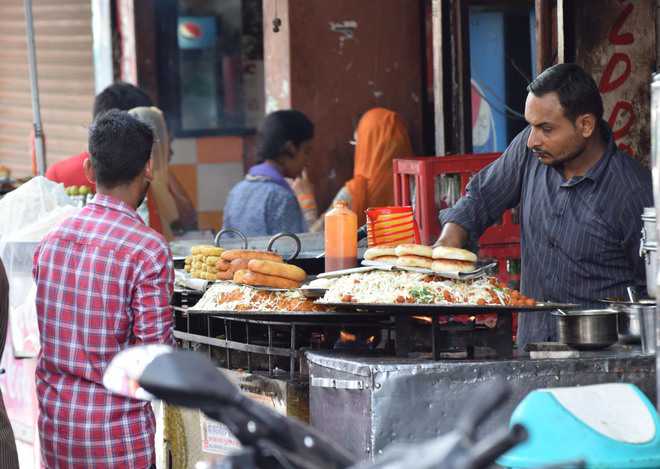
Street food vendors selling samosa, fried chicken and other food items in Hyderabad.
Hyderabad: How safe is the food served by street food vendors in Hyderabad? Does the State’s capital have a proper ecosystem in terms of infrastructure, trained personnel and food testing laboratories to ensure safe food is accessible to public?
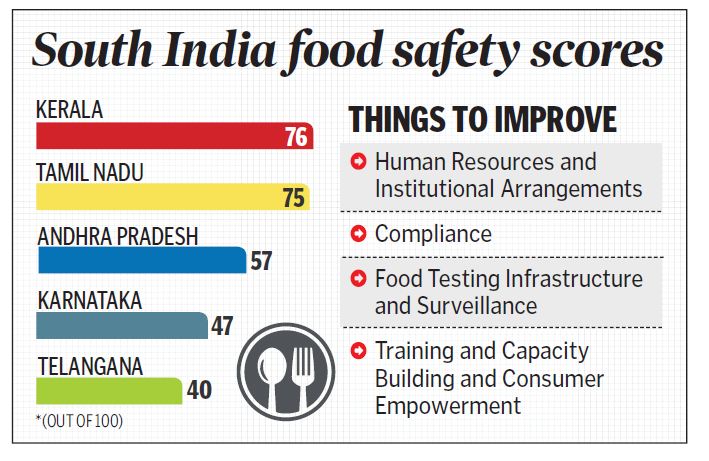
According to the first State Food Safety Index (SFSI) released by the Food and Safety Standard of India (FSAAI) about a month ago, Hyderabad and other cities in the State have not been able to meet the minimum food safety standards and need to do a lot more in the aspect of food safety.
To galvanise States to work towards ensuring safe food for the public, FSSAI had developed State Food Safety Index (SFSI), designed to measure the performance of each State on five parameters of food safety. The parameters based on which each State was judged included Human Resources and Institutional Arrangements, Compliance, Food Testing Infrastructure and Surveillance, Training and Capacity Building and Consumer Empowerment.
Except for Tamil Nadu and Kerala, none of the other South Indian States including TS and AP managed to get a mention in the SFSI rankings. The rankings were based on total scores that each State had secured in the five different parameters. While Goa, Gujarat, Tamil Nadu and Kerala scored over 75 points out of 100, the SFSI score for TS was 40 while AP secured 57 points.
Clean Street Food Hubs needed
To ensure food safety, the food regulator recommended individual States to introduce innovative measures like ‘Clean Street Food Hub’ and ‘Eat Right Campus’ in cities.
Recently, the Golden Temple Street in Amritsar had managed to get recognition as a ‘Clean Street Food Hub’ following certification from third-party audits and a series of training sessions for street food vendors aimed at improving quality and safety of food. Such hubs and clusters where street food is available will be certified by FSSAI once the vendors have met the prescribed parameters to ensure food served is clean and hygienic.
Eat Right Campus
Based on rating on well-defined benchmarks on food safety, and hygiene, food safety management, healthy diets, promotion of local and seasonal food and awareness generation, the food regulator introduced the concept of ‘Eat Right Campus’. Recently, several educational institutions such as IIT Gandhinagar and Roorkie received this tag from FSSAI.