
May 22, 2019


Sweets firm under health dept lens
Jaipur: A sweets and snacks producing firm’s manufacturing unit at MD Road and retail unit at Raja Park were raided by the food safety wing of health department on Tuesday, wherein it was found that they were using tanker water for preparing the edible items. The food safety team also found that the food items were being prepared in unhygienic conditions.
However, the major offence of the firm was that it was functional without procuring any licence from the health department. “The owner was preparing sweets and namkeens (snacks) at the MD Road unit and he was selling it from his outlet at Raja Park. But, when we demanded food licence from him, we found that he did not procure it. For producing and selling food items, one should have food licence. If anyone is doing so without a licence, it is a violation of the Food Safety and Standards Act,” said Dr Sunil Singh, nodal officer, food safety, health department.
They have also served notice to the firm for improvement. The firm has been served with a notice under section 32 of the Food Safety and Standards Act, 2006 for improvement and for not producing food items until it improves and obtains a licence.
Besides, the food safety team also found that the firm was allegedly using sodium hydro sulphite, which is a non-edible item, in preparation of snacks and sweets.
Also, the team found ingredients’ packets such as coriander powder, which were past their expiry dates. The floor of the kitchen was broken and there were spider webs on walls of the kitchen, making it an unhygienic place for preparing food.
May 21, 2019


FSO imposes fine of Rs 2.32 lakh
JAMMU, May 20: Food Safety Organisation (FSO), J&K has imposed fine of Rs 2,32,500 on the violators of different provisions of Food Safety and Standards Act, 2006 Rules and Regulations, 2011 in Srinagar district.
Prosecutions have also been sanctioned against the various Food Business Operators of the State which include M/S Delhi Special Eating Point, Udhampur, M/S Future Retail Ltd., Talab Tillo Jammu, M/S Shubham Goldiee Masala Pvt. Ltd, Kanpur, U.P., M/S Raja Kiryana Retail Shop, Sunderbani Rajouri, M/S Jai Bua Datti Enterprises, Sunderbani Rajouri and M/S Bikanervala Foods Pvt. Ltd., Greater Noida for selling, manufacturing, storing, distributing articles of food which have been declare as unsafe by the various food testing laboratories.
Sell organic produce without certification till 2020, don't use 'Jaivik Bharat logo': FSSAI tells farmers
The Jaivik Bharat logo is an identity mark to distinguish organic products from non-organic ones
Food safety regulator FSSAI has permitted small organic producers, having an annual turnover of over Rs 12 lakh, to sell their produce directly to end consumers without certification till April 2020, but will not be able to use 'Jaivik Bharat logo' on their products, a latest report says.
The Jaivik Bharat logo is an identity mark to distinguish organic products from non-organic ones.
A similar relaxation has been given to 'aggregators' having an annual turnover of Rs 50 lakh. However, the organic food retail firms have to comply with the certification norm.
Under the 2017 organic regulation, sale of organic produce directly to end consumer has been allowed only with the certification of the National Program for Organic Production (NPOP) and Participatory Guarantee System (PGS) India.
In its latest order, the Food Safety and Standards Authority (FSSAI) said the norms were relaxed after it examined several representations regarding challenges faced in the implementation of regulations by organic food business operations including small original producers.
"One of the challenges is that there are a large number of producers and producer organisations in the country who are not certified under any of the two systems of certification. Efforts are currently underway for simplification of PGS-India to make it small producer friendly," it said.
To build confidence in small producers, the regulator has said "...these regulations may be considered as 'enabling regulations' and not be considered for prosecution particulary for small original producers and producer organisations during initial phase of its implementation till April 2020".
The self certification of turnover of small organic producers and aggregators will be considered, the FSSAI said.
However, the state food safety officers have been asked to see if the limits of contaminants and insecticide residue as per the regulations are being followed. They have also been asked to see any misuse of this provision.
May 20, 2019


BIS inspection to be held at KWA’s bottled water plant
Thiruvananthapuram: ‘Thelineer’, the bottled water plant project of the Kerala water authority at Aruvikkara will soon become a reality. Inspection by a team from Bureau of Indian Standards (BIS) will be held on Tuesday.
The certificates of BIS and Food Safety and Standards Authority of India are required for the commissioning of the plant that can generate bottled water of a total capacity of 7,500 litres per day.
KWA has also begun works for production of pet bottles. Tender for this work was delayed due to election model code of conduct.
‘Thelineer’ is expected to be launched in 500ml, 1 litre, 2 litre bottles and 20 litre cans. The rate of 500ml bottle will be Rs 10, while 1 litre bottle will cost Rs 15.
KWA has proposed a revenue sharing model for running the plant. The revenue sharing model, which is waiting to get government nod, aims at giving 12% of the profit to private parties which will operate the plant and market the product. Under this model, the contract will be given in a competitive tender.
The bottled water project in Aruvikkara was originally planned in 2006. KWA amended the Kerala Water Supply and Sewerages Act for the project in 2008.
The administrative sanction for the project was given in October 2013. Due to delay in awarding the project, the CAG report of 2013 had criticized KWA for its laxity to implement an income generating project.
After failing to get bidders, KWA spilt the project into civil, electrical and electronic segments for convenience of tender. The work began in 2015.
May 19, 2019


Milk and milk products topmost unsafe food item in Delhi

Milk and milk products topmost unsafe food item in Delhi
If you are in Delhi, you might want to steer clear of dairy products, for now, that is if you wish to avoid a health risk.
A recent report suggests that milk and milk products sold in Delhi are more likely to be unsafe for consumption, according to the food safety department.
Here are more details about the report.
Details: Out of 2,880 samples, 477 failed quality testing
A report published in Hindustan Times revealed that out of the 2,880 samples, packaged and freshly prepared, that were quality-tested by Delhi's food safety department, 477 failed.
The quality tests were conducted between January 2018-April 2019.
The 477 failed samples comprised 144 substandard samples and 90 that were unsafe.
Most samples failed tests due to misbranding (nutritional information omitted or printed wrong).
Fact: Milk products accounted for 161 of 477 failed tests
161 samples of the 477 failed tests were milk or milk products, the Hindustan Times report revealed. Out of those, 21 products were misbranded. 125 samples were found to be substandard, while 15 other products were marked unsafe for consumption.
Quote: Samples usually fail due to naturally low fat, solids content
"Usually, milk samples fail to meet standards because the fats or solids-not-fat content is less than standards mentioned in the act. Sometimes cows produce milk that is not up to standards," a Delhi health department official told HT.
In 2017, FSSAI reduced the standards for required fats and 'solids-not-fat' quantity to avoid failing samples with naturally low levels as it's not detrimental to health.
Fact: What's the difference between substandard and unsafe?
"A food is considered substandard when the nutritional level is not as per standards," a senior official from Delhi's health department stated. "Misbranded products and substandard products attract fines. But foods that are unsafe can damage health, and the manufacturers are fined and risk imprisonment."
Quote: Here's how you can guarantee you get safe milk
"To guarantee you get safe milk," founder of dairy sector consulting firm, Suruchi Consultants, Kuldeep Sharma suggested, "ensure that the package is intact, check the best before date, and see whether it was kept in a refrigerator in the store."
Sharma also stated that some adulterants, like sugar or glucose, are not harmful, while others, like soda or hydrogen peroxide, can make milk unsafe.
Other survey: FSSAI 2018 survey found 90% milk across India safe
Notably, a survey conducted by the Food Safety and Standards Authority of India (FSSAI) last year found milk across India to be "largely safe, even though quality issues persist."
According to the National Milk Quality Survey, 2018, tested 6,432 samples on a number of parameters and found that a little less than 10% of the samples (638) had contaminants making milk unsafe for consumption.
Fact: 2018 survey spanned 1,100 towns across 29 states, 7 UTs
The 'National Milk Quality Survey, 2018' was conducted in 1,100 towns across 29 states and 7 union territories and 1,100 towns over six months (May-October). However, the survey never specified which part of the country the adulterated samples came from.
Punishment: Punishments for violating food safety regulations
Anyone selling unsafe foods, which haven't caused harm, could face imprisonment for six months with a Rs. 1 lakh fine.
Causing injury extends prison term to six years with a fine of Rs. 5 lakh.
In case of death, the punishment could extend to imprisonment not less than seven years (may extend to life imprisonment) with at least Rs. 10 lakh as fine.
May 18, 2019


2 tonnes of gutka products seized
Trichy: A team from the food safety and drug administration department seized two tonnes of banned gutka products worth Rs 3 lakh from two shops in the city during a surprise raid conducted on Friday.
The team, led by designated officer Dr R Chithra searched the shops in the Big Kammala Street on Friday morning. The officials found five different brands of banned gutka products stashed away in two shops in the street.
According to the shop owners, they brought the banned items from Karnataka by buses, trucks and trains to Trichy and other districts.
The shop owners told the officers that their main trade was to sell the products to retailers and wholesale traders. The owners were also taken to the office of the food safety and drug administration department for inquiry where food safety officers (FSOs) MA Mariappan, A Muthuraja and Stalin Prabhu grilled them.
The officials took samples from the seized items and sent them for testing to the food analysis laboratory.
Action will be initiated against the shop owners once the lab reports come.
Corpn destroys 500kg mangoes ripened by spraying ethylene
Trichy: Despite the warning against spraying ethylene directly on mangoes for ripening, traders in the city continue to break the rule and use the hazardous method of spraying the chemical directly on the fruit. The food safety official seized 500kg of illegally ripened mangoes from the Gandhi market on Thursday.
The food safety and drug administration department has intensified its vigil as the mango season is at its peak. The team led by its designated officer (DO) Dr R Chithra visited the Gandhi market in city on Thursday.
The team found out that the traders spraying ethylene directly on raw mangoes in their godowns in the market. The officials also pointed out the texture of the mangoes that were in direct contact with ethylene.
The major portions of the mangoes were seized from two godowns. The seized mangoes worth Rs 30,000 were destroyed at the dump yard of Trichy City Corporation at Ariyamangalam on Thursday evening.
The food safety and drug administration department had asked the traders to use ethylene gas to ripen the mangoes till last year. But the traders violated the producers and covered the mangoes with ethylene sprayed sheets making the fruit harmful.
As in the case of carbide stones, mangoes having direct contact with ethylene will also cause health hazards. The onus is now on the food safety department to tackle the violation in the use of ethylene for ripening mangoes.
From this year, the department has devised a new method with the help of the agriculture department that a sachet of ethephom can be used for ripening mangoes without touching the fruit. The sachet, dipped in water, should be kept in a box near mangoes for 24 hours for the raw mango to turn into a fruit.
Cooked food stored for next day seized from restaurants
Trichy: Eating-out during weekends remains one of the few options for the city folk to get away from their routines. But, the latest raid by the food safety and drug administration department on a few restaurants in the city exposed the unhygenic conditions prevailed in the eateries and the quality of food there.
As a part of a routine search, the team carried out checks at the restaurants in Cantonment area on Thursday. The quality check at a restaurant in the area unearthed cooked mutton, chicken, rice and parotta stored in a freezer.
“We got information that many non-vegetarian restaurants were using old and stale meat. During our raid, we found cooked food stored in a freezer to be used for the next day. They are preparing fast food items with the meat and supplying it to the customers unmindful of the health hazards,” designated officer (DO) of food safety department Dr S Chithra said.
The search continued in eight shops in the area and the team seized more than 15kg of meat kept in the cold storage. The food safety officials (FSOs) said that they found old meat in all the shops. “Hence, we are advising people to check their food before consuming it,” said Chithra.
Jehangir hosp fined ₹1 L for violating food safety act

The hospital has admitted its mistake and deposited the penalty, says will seek further approval at the earliest
After a patient had found bloody cotton swabs in the soup served to her at Jehangir Hospital, the Food and Drug Administration (FDA) has initiated adjudication process against its canteen and slapped a fine of Rs 1 lakh for violating the Food Safety and Standards Act, 2006, and Food and Safety Standard Regulations, 2011. Earlier, a notice was issued to the canteen after FDA officials visited the facility to inspect after a complaint was lodged. Meanwhile, the hospital has paid the fine and claims that the FDA has marked their kitchens clean and hygienic.
Earlier this month, Mahesh Satpute had complained to the FDA about the cotton swabs incident. Satpute had immediately reported the matter to the senior management, which had allegedly brushed it off. It prompted him to file a complaint with Koregaon Park police station and also convey the matter to the FDA and Pune Municipal Corporation.
Suresh Deshmukh, joint commissioner of FDA, Pune region, said, “Our team visited the hospital canteen facility the next day and inspected the place. We received the complaint from Satpute but we were unable to find any clues or any proof. However, we found other provisions of the food safety acts which were not fulfilled by the facility.”
An improvement notice was issued on the basis of the inspection and an application was filed for adjudication as per the Food and Safety Act, 2006.
Hospital officials agreed that provisions of the food safety norms were violated by them and a penalty of Rs 1 lakh was imposed. “Providing good and healthy food is the responsibility of the canteen operators and they should mandatorily follow it or face action,” added Deshmukh.
The official spokesperson of Jehangir Hospital told Mirror, “FDA has given us a clean chit for the hygiene and cleanliness of the kitchen. However, they have made some other observations. They have levied Rs 1 lakh fine for these issues and we have paid the same to them.
The observations have now been closed and we will be doing the needful by sending photographic records to the FDA so that they can validate our premises as per their norms. We would again like to reiterate that the hospital kitchen is hygienic and clean and there are no compliance issues.”
FDA had inspected the hospital canteen after bloodied cotton swabs were found in a patient’s soup
Thiruvananthapuram: Vigilance report on food safety raids in ten days

According to the statement issued by the Bureau, the food safety authorities are not sending the food samples collected for scrutiny to the labs.
THIRUVANANTHAPURAM: The Vigilance and Anti-Corruption Bureau (VACB) will be submitting a comprehensive report on the irregularities detected in the surprise inspection carried out at various food safety offices across the state within 10 days. IG of VACB H Venkitesh told DC that the Bureau is in the process of preparing a report, which would be submitted to the government very soon.
“A consolidated report with a detailed recommendation for improving the system at the food safety offices would be submitted to the government. A lot of changes need to be brought in to improve the enforcement of the food safety act. Immediate measures should be taken to address the loopholes in the system to ensure transparency,” said Mr Venkitesh.
The squads carried out extensive inspections simultaneously at 42 food safety offices across the state exposing severe anomalies in the enforcement of the Food Safety Act in the state. When asked, the officials of the Kerala Commissionerate of Food Safety refused to comment claiming that they are waiting for the report from VACB.
According to the statement issued by the Bureau, the food safety authorities are not sending the food samples collected for scrutiny to the labs. The complaints coming to the offices are not being properly registered, followed up or officially reported, the press release stated.
The food safety authorities are not doing follow up checks to ensure that the products banned by the food safety authorities are not put up for sale in the market. The officials are imposing minimal fines instead of heavy fines for severe violations. The Bureau also observed that the food safety authorities are not taking action under IPC sessions 272, 273 for food adulteration.
Delhi govt orders special drive to check quality of edible oil, food at eateries
The Delhi government has ordered a special drive for collecting samples of edible oil and prepared food from eateries across the national capital to check quality.
Food safety officers have been directed to carry a device which will help in detection of "good and bad quality" of edible oil.
According to the food safety department's order, the drive, which started on May 15, will continue till the end of this month. The order was issued on May 15.
"All designated officers are hereby directed to conduct special drive in their respective districts w.e.f 15.05.2019 to 31.05.2019 by deploying food safety officers and other staff for lifting samples of (i) edible oil and (ii) prepared food," the department said in its order.
It stated that to operate the device, the officials concerned may take assistance of supporting persons deputed by the Food Safety and Standards Authority of India (FSSAI).
"The special drive will be conducted along with official and routine field work," it added.
Food Safety Deptt declares snack Fun Fine Puff ‘unsafe’
Srinagar
Food Safety Department on Friday declared snacks “Fun Fine Puff” Brand Name “Parul Fun Fine Puff” “unsafe and misbranded,” under the provisions of Food Safety & Standards Act, 2006 Rules and Regulation, 2011.
The department issued the notice after they lifted the sample of the snacks Batch No: 696, which was declared by their laboratory as “Unsafe and Misbranded”.
The department has advised the public in general and the Stake Holders in particular in their own interest to discontinue use / stop sale and supply of above food product.
May 17, 2019


Irregularities found at food safety office

The official added that the food safety office does not have enough vehicles to follow up every complaint.
It is learnt that the authorities haven’t taken any follow-up action on 434 out of the total 680 complaints received till day.
Thiruvananthapuram: Hundreds of complaints received at the district food safety office remain unaddressed raising concerns on the implementation of Food Safety and Standards Act in the state. It is learnt that the authorities haven’t taken any follow-up action on 434 out of the total 680 complaints received till day. Also hundreds of lab reports of the statutory samples collected in connection with various raids and consumer complaints are pending from the Public Analytical Lab.
According to the report from the Vigilance and Anti Corruption Bureau, lab reports on 1,382 statutory samples collected from 2012 onwards are pending. A food safety official said that the lab authorities send reports only if they detect a problem with the food sample. “We take action if the lab result says it is unsafe’. The samples which are safe or not contaminated will not get reported. Hence the number of samples with pending results is showing more in the register,” said the official.
The official added that the food safety office does not have enough vehicles to follow up every complaint.
“We have only two vehicles for carrying out inspection and responding to complaints. It’s impossible to follow up every complaint,” the official added.
Meanwhile, the Vigilance and Anti-Corruption Bureau is planning to submit a report on the inspection to the government within 10 days.
Commissioner Food Safety inspects food establishments in Srinagar City
Srinagar
Commissioner, Food Safety J&K, Vinod Sharma on Thursday inspected various food establishments within Srinagar City to check the quality of food items and sanitary and hygienic conditions of the food establishments.
He was accompanied by Dy. Commissioner, Food Safety, Kashmir, Irfana Ahmad, Designated Officer, District Srinagar, Hilal Ahmad Mir and other concerned officers.
The food establishments inspected include SMHS, Hospital Canteens, Super Speciality Hospital Canteen, GB Panth Hospital Canteen, CH2 Hotel and other Hotels housing Move Employees.
During the inspection, one canteen inside the Super Speciality Hospital SMHS Srinagar was found in unsanitary and unhygienic condition. The catering contractor of the canteen was on-spot fined Rs 10,000.
In addition, the in-patient catering at various hospitals were also checked and the in-charges of the caterings were impressed upon to strictly follow the sanitary and hygienic requirements of Food Safety and Standards Act, 2006 Rules & regulations made thereunder.
A hotel namely CH2, Sonawar was found using the expired (over-dated) ingredients in the preparation of food and using newspapers for wrapping of food items. A fine of Rs30,000/- was imposed on the hotel.
Besides various hotels housing move employees were also inspected to check the hygiene and sanitary conditions of the establishments. The food items being served to the employees were also checked. The catering in-charges of these hotels were also directed to follow the Rules & Regulations prescribed in FSS Act.
Commissioner further directed the officers of the Food Safety Organization to continue checking of quality of eatables on regular basis and also ensure the maintenance of proper hygienic conditions in cooking and serving areas. He directed staff to be more vigilant because of the forthcoming holy festival of Eid-ul-Fitr.
Beware! Mangoes ripened with ethylene powder could harm you
The food safety department allows usage of ethylene gas in very low quantity for ripening mangoes. But the use of ethylene powder is not allowed as it is multiple times stronger than gas.

Kochi: Mangoes are the major attraction in every market during summer seasons. Different varieties of mangoes are arranged in a way to lure buyers. But most of them are found to be less sweet and fragrant.
It was later discovered that raw mangoes are artificially ripened using calcium carbide. Amid the inspection and action against those who use the chemical progressing, the presence of a new chemical ‘ethylene’ has been found.
In an examination jointly conducted by the food safety department authorities and market management committee, over four tons of mango contaminated with ethylene powder was seized from Koyambedu market. The chemical is used to ripen raw mangoes. Koyambedu market is a major source of fruits and vegetables in South India.
The food safety department allows usage of ethylene gas in very low quantity for ripening mangoes. But the use of ethylene powder is not allowed as it is multiple times stronger than gas. The food safety department has warned that continuous use of ethylene will lead to serious health hazards.
May 16, 2019


Food safety dept now allows ethylene method to ripen mangoes
Trichy: After banning the use of carbide stones in artificially ripening mangoes, the food safety and drug administration department is now focussing on using ethylene powder to ripen the fruit. The department has also prepared a standard operating procedure for the traders to use the powder for ripening.
While natural ripening is the undisputed method, several factors such as the time (It will take more than one week for a raw mango to turn fruit naturally) affecting the farmers and traders prompt the enforcing department to find out new ways to help them ripen mangoes quickly and reduce the financial loss. It also wants to stop the traders from using carbide stone, which produces harmful acetylene to induce the ripening process.
Till last year, the food safety and drug administration department had been pressing for using ethylene gas to ripen the mangoes. But the traders had violated the producers to be followed. They covered mangos with ethylene sprayed sheets, which turned the fruit harmful.
Hence, the food and safety officials have devised a new method this year with the help of the agriculture department that a sachet of ethephom can be used for ripening without any direct contact with the fruit. The sachet dipped in water should be kept near mangoes for 24 hours for the raw mangoes to turn fruit. Food safety & drug administration has taken initiative to persuade the traders in Chennai to try the new method. "We educated the traders in the capital to take it up recently. Many of them are following the procedure," said designated officer of Chennai Dr A Ramakrishnan.
Food safety department in Trichy organised an awareness meeting a week ago for the mango traders and sensitized them to go for natural ripening in the first place. The traders were also asked to take up the ethephom sachet technique to ripen the mangoes through ethylene gas.
But, the traders are indifferent towards the new method. T Ravi, a mango wholesale trader at Gandhi Market, said that they are yet to test the new method. "Food safety officers advised us to use ethylene gas to ripen mangoes last year. We used them. Now, they are asking us to use ethylene," he said.
Designated officer, food safety and drug administration department of Trichy Dr R Chithra has warned the traders of severe action if found violating the instructions. "While emphasising on the natural ripening, we also tell them to try the new method. The erring traders will face legal actions," Chithra told ToI.
'Dead lizard' found in food at Haldiram's in Nagpur, FDA cracks whip
The incident took place at the outlet located at Ajani square on Tuesday morning.
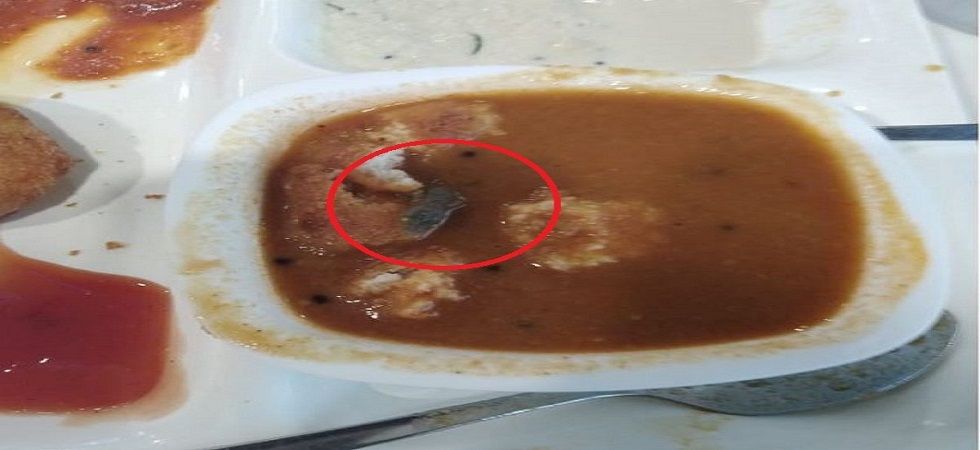
The picture of the dead lizard found in 'vada sambar' went viral on social media.
A man allegedly found a dead lizard in a food item served at the snacks major Haldiram's outlet in Nagpur, a Food and Drugs Administration (FDA) official said on Wednesday. The incident took place at the outlet located at Ajani square on Tuesday morning.
The picture of the dead lizard found in 'vada sambar' went viral on social media."The man and a woman accompanying him, both from Wardha, had ordered vada sambar at the outlet. But while eating, the man found a dead lizard in the food. They brought this to the notice of the outlet's supervisor, who later on threw it away," assistant commissioner of FDA (Nagpur) Milind Deshpande told PTI.
"They were later admitted to a private hospital and discharged on Wednesday," he added.The duo, however, neither spoke to media, not lodged a complaint in this regard."
The FDA was informed about it in the evening, after which we immediately visited the Haldiram's outlet and conducted an inspection. We found certain deficiencies in its kitchen. The windows of the kitchen need to be fitted with nets, which was missing," Deshpande said.
"The FDA has closed the outlet till they complete the compliance as per the Food Safety and Standards (Food business licences and Registration) regulations 2011. They have submitted a compliance report to us. We will inspect the premises and if we find the steps taken are satisfactory, only then we will allow it to reopen," he added.
When contacted, a senior office-bearer of Haldiram's told PTI that they doubted the veracity of consumers' claim.
"But we admitted them to nearby hospital. They were kept under observation for 24 hours and their medical reports were normal. They have been discharged today."We have submitted a compliance report to the FDA," hesaid.

78% can’t detect truth behind ripe mangoes

Private Survey Flags Poor Awareness On Adulteration
Chennai:
Consumer awareness on adulteration in mangoes is rather low, according to a study released by a private survey group on Wednesday.
Of the 13,000 people surveyed, around 78% said they don't know how to identify artificially ripened mangoes.
This information comes against the backdrop of intensified search and raid operations by the state food safety and drug administration department in fruit shops in and around Chennai.
As far as the city is concerned, there are 120 shops in Koyambedu market which sell mangoes. Apart from this, around 70 private retailers sell mangoes on a prominent scale on a regular basis.
Ahead of this year's mango season, authorities had conducted three meetings with these shop owners and held sessions on the dos and don’ts for ripening of fruits.
At the end of these sessions, notices were issued explaining the Standard Operating Procedure (SOP) and consequences they’ll face in case of violations.
“This is to ensure that the shopkeepers don’t claim acquittal on humanitarian basis as was done in the past. So far, we have booked cases against four shops – three in Koyambedu and one in T Nagar – under Sections 50 and 55 of the Food Safety and Standards Act, 2006,” said A Ramakrishnan, designated food safety officer of Chennai district.
The District Revenue Officer is the aggregation officer who will hear these cases, and impose fine of up to ₹4 lakh on each of the violators, he added. “Besides, 8-10% of direct fruit usage will be scanned on a daily basis.”
All four shops were caught red-handed for using ethylene sachets in direct contact with mangoes.
The study, however, pointed out that popular online food retail apps sell mangoes that are ripened using ethylene, claiming that ethylene ripening is permitted by Food Safety and Standards Authority of India (FSSAI).
Rejecting this, TN food safety department authorities said direct contact of ethylene sachets is barred as per the SOP released by FSSAI last December.
Rather, fruit shops are allowed to undertake ethylene ripening only at the rate of one sachet per 10 kg of mangoes. The sachet should be soaked in water and kept inside a small perforated plastic box (one cm area). This box can be placed in an airtight box containing mangoes and should be removed after 24 hours.
An interesting issue this mango season is that no calcium carbide stones were used for artificial ripening processes. These stones cause cancer and neurological problems.


Subscribe to:
Posts (Atom)