Aug 13, 2018

After TOI report on careless bakers in city, Parikshan to organise training on food safety

Visakhapatnam: In an effort to enable those in the food business understand the need to implement hygiene standards during the manufacturing process, a food safety training and certification csourse (FOSTAC) will be organised for the first time in the city by Parikshan, a food formulation consultancy service. This comes after TOI recently reported on how most of the bakeries in the city flout legal metrology rules.
Stating that Parikshan as an organisation has been helping food establishments maintain food safety and hygiene standards across the country, Devika Koneru, head-operations, Andhra Pradesh and Telangana region, said, “Food Safety Supervisors (FSS) will train employees to implement and maintain good hygiene practices. He will also assist operators to conduct in-house supervision, correct irregularities detected and conduct food hygiene and safety training of food handlers in his organisations.”
Adding that every bakery unit should take assistance for labelling from authorised food safety organisations and comply to them, she added, “The course for bakery units will include legal conditions mandated in the law, reasons for food spoilage, experiments on adulteration, packaging and labelling requirement.”
As per the Legal Metrology (Packaged Commodity) Rules 2011, 6 (D), the address of the manufacturer, net quantity of the product, maximum retail price, date of packing, ingredients and use by date should be mentioned on the products. Speaking to TOI, Vikas Pandey, state president, consumer rights organisation (CRO), said, “In a survey that was conducted recently in various areas of the city, it was found out that 93% of the local bakeries do not adhere to the rules regarding the need to mention basic details. Since health of consumers is a matter of serious concern, we will submit our survey results to the district administration and the Legal Metrology department. We will also submit a letter demanding strict action against those who do not abide by the Legal Metrology (Packaged Commodity) Rules 2011.”

Over 16 lakh fine realized from erring business operators

SRINAGAR: The Commissionerate of Food Safety department during last three month have lifted 706 samples of different food articles for analytical purposes out of which 192 has been found not conforming the standards prescribed under Food Safety & standards Act, 2006 and accordingly precautions under different provision of FSS Act have been lodged in the competent courts of law. The violators of the different provisions of the Act have been imposed a fine of Rs. 16,74,400/= so far. With regard to the implementation of Cigarette & Other Tobacco Products Act, 247 people have been found smoking at Public Places and an amount of Rs.16470/= have been imposed as fine on the violators. 
The Commissionerate of food safety has placed seven mobile food testing vans (FOOD SAFETY ON WHEELS) in the state and so far about 359 samples of food have been tested in mobile food testing vans out which 22 have been found of not of standards quality and 39 food safety awareness programs have been conducted with the help of these Mobile Food Testing Vans for awareness of the general public as well as the Food Business Operators. 
The department issued four advisories for the awareness of consumers as well as Food Business Operators. The services of the Mobile Food Testing Vans were utilized during the current Shri Amarnathji Yatra-2018 for ensuring availability of safe and hygienic food to the pilgrims. During the recent yatra period 546 Dhabas, Restaurants and Tea Stalls etc, 546 langers and 157 other Food Business Establishments were inspected and 40 samples of different food articles were lifted for analytical purposes. 
These inspections were conducted via Baltal and Pahalgam Routes. The department conducted Induction Training of Food Safety Officers, two training programmes of all the regulatory officers on implementation of Food Safety Compliance through Regular Inspection and Sampling (FoSCoRIS) at Jammu and Srinagar in collaboration with Food Safety & standards Authority of India. The department has recently conducted Milk Quality Survey throughout the State in collaboration with Food Safety & Standards Authority of India and about 104 milk samples have been dispatched for testing at Gujrat through FASSI notified agency. 
The Food Testing Laboratories at Srinagar have been upgraded with the help of State as well as Central grant. This Commissionerate has different projects like Food Safety Training & Certification (FoSTaC), Food Safety Compliance and Sampling (FoSCoS), Street Food Vendors Training, Hygiene Rating and Responsible Place to Eat in the pipe line for implementation in the coming months. 
The proposal for allocation of the adequate budgetary provisions for strengthening of enforcement mechanism at district and block levels for the implementation of FSS act in letter and spirit in the state. The same has been submitted to the Government and is under active consideration at various levels.


Aug 12, 2018

There is a regulatory vaccum in GM food, says CEO of FSSAI

In a study released in the last week of July, the Centre for Science and Environment (CSE) says it tested 65 food products and found 21 of them testing positive for material from genetically-engineered (GE) plants.
The Food Safety and Standards Act, 2006 specifically authorised FSSAI to come out with regulations.
In a study released in the last week of July, the Centre for Science and Environment (CSE) says it tested 65 food products and found 21 of them testing positive for material from genetically-engineered (GE) plants. Of these, 16 were imported. It has raised an alarm and has called on the Food Safety and Standards Authority of India (FSSAI) to ban such food products, though India releases GE crops for cultivation (only cotton so far) after they are found to be safe for humans, animals and the environment. Vivian Fernandes interviewed the CEO of FSSAI, Pawan Kumar Agarwal. Here is an edited and annotated version:
Is the manufacture, import and sale of food containing genetically-modified (GM) plant material disallowed in India?
There is a regulatory vacuum as far as GM food is concerned. The Food Safety and Standards Act, 2006 specifically authorised FSSAI to come out with regulations. Until 2016, the environment ministry had issued an order under their act (the Environment Protection Act), which kept the provision that we could regulate it, in abeyance. Once that was withdrawn, we started working on how this could be regulated. We have a scientific panel which has met several times and the regulations have been finalised. The threshold above which we have to label (food containing GM material) was part of the labelling regulations. Now that we are coming out with GM regulations, that provision is being taken out and inserted here.
When will the GM regulations be notified?
Very shortly. These will be put up for consultations. They are draft regulations.
Will you insist on labelling of GM food?
That is the proposal. But the draft regulations will have to be first approved by the government.
Why have labelling at all? It is not mandatory In the United States and Canada, for instance.
Different countries have taken different views. The scientific committee and the authority (FSSAI) have taken a view that it must be labelled. Other than the US, several countries have mandatory labelling requirements. Even in the US, it is voluntary. (The US Food and Drug Administration doesn’t require mandatory labelling of food derived from bioengineered plants because it says it isn’t aware that it poses a different or greater safety concern than food developed by traditional plant breeding. The geneticist Deepak Pental of Delhi University says labelling is meant to alert consumers to a health concern. GM crops are approved only when they are not toxic or allergic to humans. Labelling would prejudice the consumer against the product.-Vivian)
A regulatory vacuum means the manufacture, import and sale of GM food is not disallowed?
It is not disallowed. The view of the food authority is, based on scientific evidence across the world, that there is no verifiable health impact of GM food vis-à-vis conventional food on humans. Obviously, if certain (GM) food is to be allowed, it has to be approved by GEAC (Genetic Engineering Appraisal Committee) and then only it will come to us and we will do the risk assessment, just as we do with conventional food before clearing it for consumption.
What is the need for FSSAI to do separate risk assessment, when bioengineered plants have to pass two levels of biosafety trials before being cleared for cultivation?
That is biosafety for growing the crops. They do it for its impact on the environment. We do it for its impact on human health.
Sir, the Biosafety Research Level-I and Level -II trials are meant to ensure that the crops which GEAC recommends for cultivation are not toxic or allergic to humans and animals. Their safety to the environment is also assessed. Will there be a parallel risk assessment by FSSAl, before GM crops are allowed to be cultivated?
For cultivation, the GEAC gives approval. But if any food contains GMOs (genetically-modified organisms) or LMOs (living modified organisms), then their (GEAC) approval will have to be obtained first and then they will have to come to us.
Sir, 96 percent of the cotton grown in India is genetically-modified Bt cotton. Most of our cottonseed oil comes from Bt cottonseed. We have been eating it since 2002 or 2003. In all these years, why did we not test the oil for GM material?
As I said, the FSSAI Act is of 2006. It became operational in 2011. Till 2016, we could not act (for the reasons mentioned earlier). We have now put some regulations. Our current understanding based on scientific evidence is there is no verifiable health risk from GM food. So I don’t think there will be much challenge in terms of it getting approved by FSSAI once it is approved for cultivation in India or abroad. But they have to follow a process because our act requires it. As for labelling, FSSAI wants to make it mandatory, but that depends on whether the government agrees. That also has to go through a consultation process and based on the feedback a final view will be taken.
At what level of GM material will labelling be triggered?
In our labelling regulations, it was 5%, but we have received many representations. We may review it. We will send it to the government within a week or two. (According to a FSSAI press release, Japan, Canada, Thailand and Indonesia allow GMO content up to 5 per cent without labelling. The European Union’s limit is 0.9 per cent. Lower the threshold, higher is the cost demonstrating or verifying compliance – Vivian).
What do you think of the study by the Centre for Science and Environment? Are you convinced about the methodology they have adopted?
CSE’s study is useful. At least some data is available. There are some concerns about the methodology, but something is better than nothing.

DINAKARAN NEWS


DINAMANI NEWS


Organic products demand edging up


‘We want consumers to know what they are eating’

FSSAI’s The Eat Right Movement seeks to push manufacturers and consumers towards healthier choices
The Food Safety and Standards Authority of India (FSSAI) recently started The Eat Right Movement, a nationwide campaign to improve public health and push the food industry to produce healthier choices. Thirty companies, including 18 packaged food companies, have signed various associations with the regulator to bring down salt, sugar and trans fat content in their products. Pawan Agarwal, CEO, FSSAI explains the motivation behind the campaign, and the road ahead.
How did the campaign start?
Last November, we came across a report on disease burden in India, which compared statistics between 1990 and 2016. The incidence of Non-Communicable Diseases (NCD) was extremely high and had been rising steadily over the years. The reason we figured was our unhealthy eating habits. The report got us thinking about measures we can take as regulators. The initiative requires a multi-sectoral approach, and we are trying to make interventions at all levels: regulation, supply and demand.
Can Indians give up on packaged food and beverages?
It’s not easy. It may not happen in a day or a month or even a year, but we have to begin the conversations. As the country’s food authority, we have taken the initiative of talking to all stakeholders and see if we can start the change gradually.
Food companies in Western countries have been told to reduce salt and sugar content. Is it viable?
What we have started in India is similar to initiatives taken in the UK and some Western European countries. However, they have also developed robust monitoring systems to pull up those not adhering to the norms. In the future, we hope to cover the monitoring aspect as well.
Have targets and deadlines been set for reduced salt and sugar content?
We don’t even have a clear picture of the current levels of consumption, so setting targets will be difficult. What we are aiming at is to get food businesses to move in this direction. We are coming up with new labelling regulations and setting a threshold for salt, sugar and trans fat content, beyond which the product can be termed as unhealthy. We want consumers to know what they are eating. There are concerns from the industry on such norms, but we are in the process of fine-tuning them.
How many companies have shown willingness?
Thirty companies have signed various associations with us, including 18 packaged food companies, close to 10 e-commerce players and retailers and some restaurant and hotel associations. ITC, Kellogg’s, Mapro, Marico, Patanjali, Haldiram’s, MTR, Bikanerwala, Britannia, DelMonte, Nestle, Hindustan Unilever Limited are some of the companies who have signed on. The Indian Bakers Federation, Wheat Products Promotion Society, Federation of Biscuit Manufacturers of India, Indian Vanaspati Producers Association are among the bodies that have committed to bring about change.
What are these commitments?
Some have signed general commitments in groups, while some have signed individual ones to reduce the salt, sugar and trans fat content. The commitment documents include pledges like encouraging the use of right choice of fat or oil, reformulating products to reduce fat, sugar and sodium, reducing trans fat content in all foods to less than 0.2% by 2022 in a phased manner.
How will you ensure success?
The success of this initiative depends on consumer demand. Consumers have to consciously and actively move towards a healthy lifestyle, and their demands will automatically push companies to create new, healthy products.

Temples to have food safety registration

‘Prasadams’ or offerings should conform to hygienic standards
Food items (‘prasadams’ or offerings) sold at temples to devotees should conform to the safety and hygienic standards of food safety, the Commissioner of Food Safety has said.
From September 1, temples should follow all regulations under the Food Safety and Standards Act of India 2006 as well as the Food Safety (Licensing and Registration) Rules.
All temples will thus have to secure a licence or registration under the said rules in order to sell ‘prasadam’ through temple counters, the Commissioner said in an official release here.
The authorities concerned should ensure that the storerooms and areas on the premises of temples where the food is cooked should maintain the hygiene standards under Food Safety and Standards Act .
It should also be ensured that the water used for cooking food and served as drinking water is safe. The water should be tested periodically and the certificate on water safety kept for perusal, the Commissioner said.
The safety and hygiene standards should be strictly maintained when in comes to mass feeding and any other food and drinks distributed inside the temple so that there is no possibility of food poisoning episodes.
He said the food safety regulations followed by the two of the biggest temples in the State, Sabarimala temple and Attukal Devi temple and the food safety regulations, licence and registration processes followed in connection with the temple festivals at these temples can be a model for all other temples in the State.

Ban on silver foil use to garnish sweets from Nov

Madurai: The use of silver foil to garnish sweets will be a thing of the past as the food safety officials are planning to enforce a ban on its usage from November this year. As the sweet preparation is expected to begin soon to meet the demand for the Diwali festival, which falls on November 6, it is imperative on part of the bakers to stay away from using silver foil, which is manufactured using animal parts.
Food Safety and Standards (food products standards and food additives) Fifth Amendment regulations 2016, brought in new regulations on the use of silver foils to address various issues prevailing in its production. 
It was widely manufactured by hammering silver placed between sheets of intestine of animals such as cow and buffalo for hours together to get the required thinness.
There were also complaints of adulteration by using aluminium, a heavy metal which can cause health problems, instead of silver. The regulation has addressed it by mandating the weight of silver foil up to 2.8 gram per square metre. Aluminium cannot be beaten as thin as silver.
An official from the department said it may still contain the pieces of the animal, which can cause heath problem. Moreover, it cannot still be called as a vegetarian food. Although advanced methods to prepare the foil using machinery can be done, it is hard to distinguish between the two, he said.
Some of the bakers in the city have given up the usage of silver foils voluntarily. They say that they have done it to maintain the standard and to give the best to the consumers. “We have stopped using silver foils a few years back voluntarily since its production involves animal intestine. We could not able to differentiate the ones produced safely,” said M Jayakumar of Jayaram Bakery said.
The regulation could not be implemented since the Delhi high court had stayed the proceeding, considering the large workforce involved in the job.

Adulterated ghee worth Rs 7.24L seized

Rajkot: The special operations group (SOG) of Rajkot police seized a large cache of adulterated ghee worth Rs 7.24 lakh from a factory behind Ruda Transport Nagar near Sokhada village on Saturday.
“SOG head constables — Manrupgiri Goswami, Jitubha Jhala, Mehul Madhvi and Vijendrasinh Jhala — received a tip-off during patrolling about the adulterated ghee stored at Dhara Fate and Proteins Veg Fat Palmolein and Veg Oil Factory in Jai Jalaram Industrial Estate. Acting on this information, we conducted the raid,” said Rajkot SOG inspector S N Gaddu. 
Police recovered 422 containers of adulterated ghee, worth Rs 6.64 lakh, 150 barrels of adulterated ghee worth Rs 60,000 and raw material to be used for adulteration.
“Food and drugs safety officers — D J Solanki and A B Patel — collected the samples of adulterated ghee for examination. Once the examination report is submitted, we will file the chargesheet and book the accused,” said an SOG official.

Stemming dangers of carbide-ripened fruits

FORCED ripening of fruits meant for human consumption, using dangerous chemical substances, is fast becoming a culture in this part of the world, despite its hazardous implications for health. Experts and institutions have always warned against the practice, with the most recent of such warnings coming from the National Agency for Foods and Drugs Administration and Control. The regulatory agency, in a statement by its Director-General, Moji Adeyeye, took a particular interest in the ingestion of fruits in which calcium carbide has been used to quicken the ripening process.
According to Adeyeye, a professor of Pharmaceutics, Manufacturing Science and Drug Product Evaluation, carbide contains impurities such as arsenic, lead particle and phosphorous. “Consumption of fruits containing these impurities may cause cancer, heart, kidney and liver failure,” she explained. Irritation of the mouth, nose, eye and skin, permanent skin damage, vomiting, difficulty in swallowing, sore throat, shortness of breath and numbness are some of the other health hazards associated with coming in contact with carbide or ingesting any food item ripened using the chemical.
With the growing interest in meals of fresh fruits and vegetables, it is not surprising that diseases such as cancer and internal organ failure are becoming commonplace in Nigeria. Among many prominent Nigerians that have fallen victim to cancer, for instance, was the former DG of NAFDAC, Dora Akunyili. According to figures made available by the Association of Medical Laboratory Scientists of Nigeria, there were over 2 million cases of cancer in the country in 2016, with 100,000 new cases occurring every year. Dapo Campbell, a professor of oncology, said that about 10,000 Nigerians died of cancer yearly, but reports credited to the World Health Organisation put the latest figures at 80,000 cancer deaths per annum.
This is why efforts should not be spared towards ensuring that all foods and drinks taken in the country are properly monitored just as it is done in advanced countries. In Europe, for instance, any food item imported has to meet set standards before the citizens can be allowed to eat it. Little wonder that about 67 food items exported by Nigeria to the European Union countries were banned between 2015 and 2016 for failure to comply with their standards. Conversely, in Nigeria, people eat anything that comes their way, mainly out of ignorance, arising from low levels of awareness.
Ripening is a natural process that takes place in fruits. This process, according to scientists, is aided by ethylene, a hormone released naturally by fruits. It is the process that softens fruits and makes them ready for ingestion. Typically, fruits change colour, texture, taste and, in some cases, emit pleasant aroma when they are ripe. Ripening makes fruits nutritious; and, for the traders, this is a delicate period when as much of the fruits as possible have to be sold or risk them rotting away.
However, not many are ready to wait for the natural ripening process, which is why fruits such as bananas, mangoes and pineapples are sometimes forced to ripen, using artificial or chemical agents such as calcium carbide and ethephon. The motivation is the desire for high turnovers and profits. But due to its hazardous nature, calcium carbide is banned in many countries. In India, for instance, where artificial ripening of fruits is rampant, the chemical has been banned under the Food Safety and Standards Act of 2006. The offence is likened to food poisoning and anyone caught in the act risks spending up to 10 years in jail.
In Nigeria, very little seems to be happening by way of monitoring to spare people a sure death by instalments. While it is important to come up with periodic warnings, as NAFDAC usually does, about an existing danger in consuming some poisonous food, helping to raise awareness amongst members of the public, health and regulatory authorities, however, have a greater responsibility to go beyond just raising the alarm to enforcing compliance with extant laws concerning the quality and standards of ingestible items in the country. Experience has shown that people who benefit from unlawful acts will not readily give it up, unless forced to do so. In this case, the urge for profits is so irresistible that it invariably trumps concerns for human health.
By now, NAFDAC ought to have developed the capacity to monitor fruit sellers, especially those who bulk-buy with intent to resell. Forced ripening of fruits is common in the cities where fruits are hardly planted but are in high demand. NAFDAC should ensure that the habit is discontinued, especially by those who may not even know that what they are doing constitutes a health hazard. It may not be possible to arrest everybody involved but when a few are picked up and prosecuted, it will serve as a deterrent to others.
It is important to help members of the public to identify fruits that have been forced to ripen. Such fruits, it is said, are more attractive and are identified by their uniformity in colour. Fruits ripened by calcium are soft and have very short storage lifespan. They are less tasty compared to those that ripen naturally.
In a place like Dubai, for example, which imports large quantities of fruits, there is a newly-acquired device for the testing of fruits and vegetables to detect the level of insecticides and chemicals to ensure their fitness for human consumption. According to the Dubai Central Lab, the device has the capacity to test 600 samples of fruits a day. “Our current system takes up to 260 kinds. The new device, operated by the latest technology, will offer different kinds of inspection,” said a report quoting Ahmed Amin, the Director of DCL. This is one of the areas that NADFAC should be exploring.

FSSAI To Use Triple E Strategy For Engaging With Educational Institutions

Food Security and Standards Authority of India (FSSAI), India’s apex food regulator, has agreed to use the Triple E strategy for effective engagement with higher educational institutions (HEIs) regarding food safety and applied nutrition. The adoption of this strategy was decided upon during a discussion with the vice-chancellors of various private universities, academicians, the industry and industry associations. This comprehensive engagement framework that uses the three ‘E’s – Engage, Excite, Enable, was another important initiative to contextualize and update the food safety ecosystem in India and to facilitate upcoming food professionals of the future.
A MORE HOLISTIC CONCEPT
The discussion was attended by the joint secretary, ministry of human resource development (MHRD); the president and secretary general, ministry of food processing industries (MoFPI); the deputy director general, Association of Indian Universities (AIU), and representatives from the University Grants Commission (UGC), the National Institute of Food Technology and Entrepreneurship Management (NIFTEM); the Indian Institute of Food Processing Technology (IIFPT); the Confederation of Indian Industry (CII), the Federation of Indian Chambers of Commerce and Industry (FICCI) and the Association of Analytical Communities (AOAC) India.
Ensuring that employable skills are delivered by HEIs was the highlight of the discussion. A more holistic concept of ensuring safe and wholesome food instead of just preventing adulteration and the measures to co-develop and implement an updated curriculum that reflects this shift in thinking were also discussed.
THE NEW CURRICULUM
Practical learning through internships and fellowships, promoting interactive learning through opportunities for students to participate in socially-relevant, advocating merit scholarships for deserving students, along with a programme for faculty training and development were parts of the framework that was decided upon according to the publication.
FSSAI will reportedly explore opportunities for collaboration with MHRD and the Ministry of Youth Affairs and Sports for the further distribution of information. The regulator believes that it will be able to create a future-ready skilled workforce for the future food industry in India with this initiative.

Aug 11, 2018

DINAKARAN NEWS


FSSAI unveils initiative to collect, convert used cooking oil into biofuel

FSSAI wants businesses using more than 100 litres of oil for frying to maintain a stock register and ensure that used cooking oil is handed over to registered collecting agencies 
64 companies in 101 locations will enable collection of used cooking oil
NEW DELHI, AUGUST 10
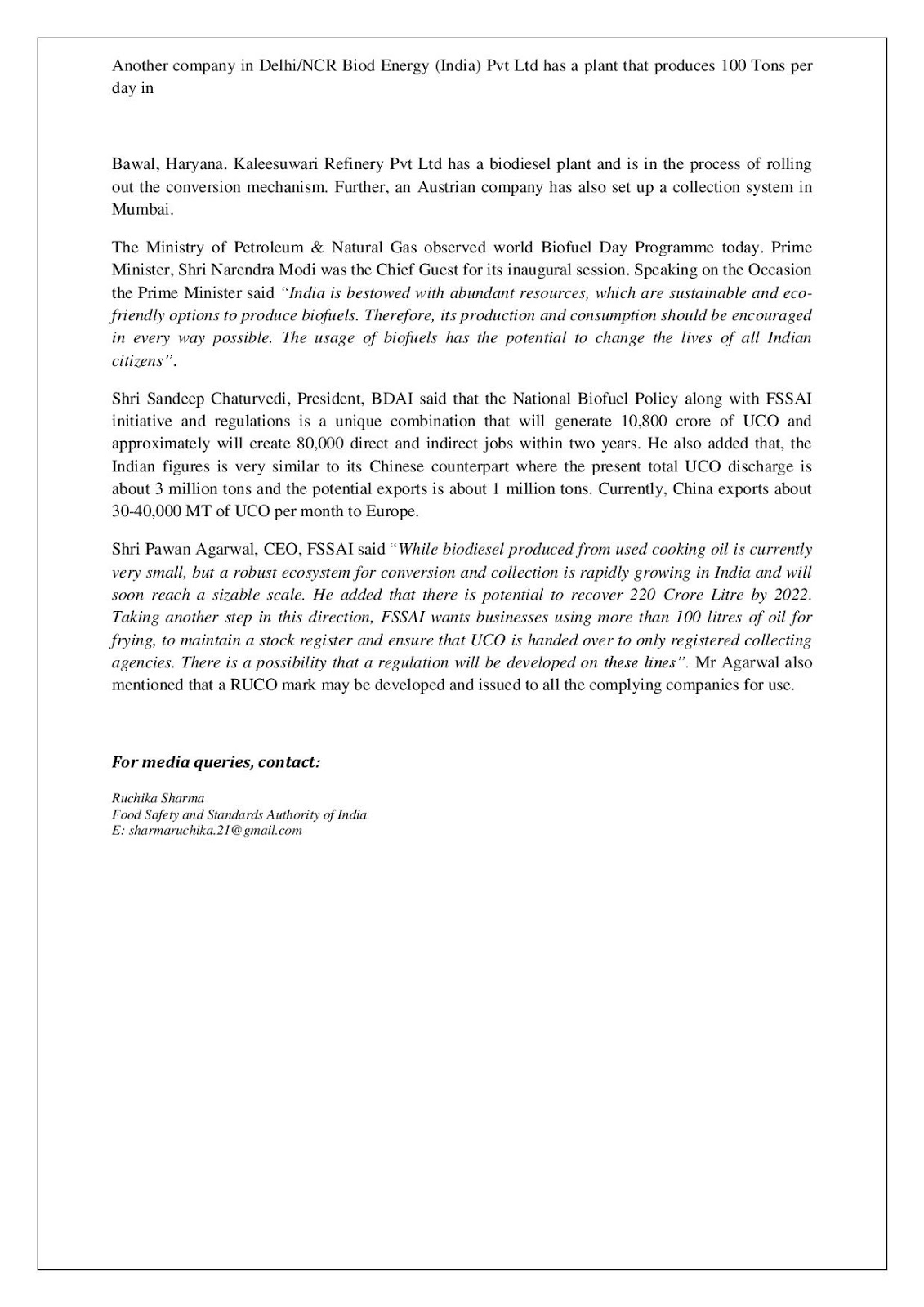
The Food Safety and Standards Authority of India (FSSAI) on Friday launched RUCO (Repurpose Used Cooking Oil), an initiative that will enable collection and conversion of used cooking oil to bio-diesel. The initiative has been launched nearly a month after the food safety regulator notified standards for used cooking oil.
FSSAI may also look at introducing regulations to ensure that companies that use large quantities of cooking oil hand it over to registered collecting agencies to convert it into biofuel.
Under this initiative, 64 companies at 101 locations have been identified to enable collection of used cooking oil. For instance: McDonald’s has already started converting used cooking oil to biodiesel from 100 outlets in Mumbai and Pune.
The regulator believes India has the potential to recover 220 crore litres of used cooking oil for the production of biodiesel by 2022 through a co-ordinated action. In a statement, Pawan Agarwal, CEO, FSSAI, said, “While biodiesel produced from used cooking oil is currently very small, but a robust ecosystem for conversion and collection is rapidly growing in India and will soon reach a sizable scale.”
“FSSAI wants businesses using more than 100 litres of oil for frying, to maintain a stock register and ensure that UCO is handed over to only registered collecting agencies. There is a possibility that a regulation will be developed on these lines,” he added.
According to FSSAI regulations, the maximum permissible limits for Total Polar Compounds (TPC) have been set at 25 per cent, beyond which the cooking oil is unsafe for consumption.
In partnership
FSSAI is also working in partnership with Biodiesel Association of India and the food industry to ensure effective compliance of used cooking oil regulations, the statement added. It is also going to publish guidance documents, tips for consumers and posters in this regard. It is also conducting several awareness campaigns through its e-channels.
“FSSAI has additionally launched a micro-site to monitor the progress of the collection and conversion of used cooking oil into biodiesel,” the statement added.

Food regulator to engage with educational institutes to create skilled workforce

NEW DELHI, AUGUST 10
FSSAI is establishing a comprehensive framework for engagement with higher education institutes on issues concerning food safety and applied nutrition in a bid to create a future-ready skilled workforce in the food processing industry.
As part of this strategy, the regulator has initiated discussions with vice-chancellors of various universities, academicians, industry and industry associations, besides officials of other Ministries.
“Measures to co-develop and implement an updated curriculum that reflects the shift in thinking from merely preventing adulteration to a more holistic concept of ensuring safe and wholesome food have been discussed,” FSSAI said in a statement.
The framework will adopt a comprehensive approach through the introduction of relevant content in course curricula, enhancing practical learning through internships and fellowships, and promoting interactive learning through opportunities for students to participate in socially relevant projects related to food safety and nutrition.
“A triple E-strategy (Engage, Excite, Enable) to engage effectively with Higher Education Institutes was agreed on,” the statement added.

Check quality of drinking water in hotels, FSSAI told

Current law mandates check of ‘packaged drinking water’
New Delhi, dhns: Lawmakers have asked the food safety regulator to carry out periodic inspection of ordinary drinking water being served in hotels, restaurants and other eating joints to ensure that potable water is being served to the customer.
The food safety law currently mandates the Food Safety and Standards Authority of India (FSSAI) to check the quality of only “packaged drinking water” leaving the non-bottled drinking water being served in small and medium-sized restaurants outside the quality net.
The Parliamentary Standing Committee on Health has now directed the FSSAI to undertake timely inspection of the water provided in the food business premises such as eating outlets to ensure that the joints provide clean drinking water to its customers.
In its report submitted in both Houses of the Parliament on Thursday, the panel suggested changing the definition of food to include potable water as well so that food business operators couldn’t take advantage of the loophole in the law.
The committee, headed by Samajwadi Party leader Ramgopal Yadav, also asked the regulator to have a stringent approach on the use of food colour.
“The use of food dyes has to be regulated because time and again, the food dyes have been linked to health problems. Excessive use of colouring matter in food may cause an allergic reaction to some people or hyperactivity in sensitive children,” it said in the report.
The health ministry’s Integrated Disease Surveillance Programme shows food poisoning is one of the commonest outbreaks reported in 2017 apart from the acute diarrhoeal disease. While there were 312 cases of the diarrhoeal diseases out of 1,649 disease outbreaks reported till the third week of December 2017, as many as 242 episodes were due to food poisoning. The incidences diarrhoea and food poisoning are high in places where food is cooked in bulk such as canteens, hotels and wedding venues.
Health ministry officials said food-borne illnesses were a greater health burden comparable to malaria, HIV/AIDS or tuberculosis. The root cause is unsafe, contaminated food and water. Because of poor food safety standards, the government in 2006 brought the Food Safety and Standards Act to replace nearly a dozen existing regulations. The authority was set up two years later and the law became operational from August 2011.
Seven years later, the Parliamentarians recognised there were flaws in the law that need to be corrected, the authority needed to staffed better and testing infrastructure required a boost.

GM Food: “Regulatory Vacuum” But Sale Not “Disallowed” says FSSAI

Pawan Agarwal, the CEO of the Food Safety and Standards Authority of India (FSSAI), admits there is a “regulatory vacuum” governing food containing material from genetically-engineered (GE) plants. He, however, shares that their manufacture, import and sale in India is not “disallowed.”
“The view of the authority is, based on scientific evidence across the world, that there is no verifiable health impact of GM (genetically-modified) food vis-à-via conventional food on humans,” Agarwal told The Quint.
Agarwal made that clarification after the Delhi-based Center for Science and Environment (CSE) published a report at the end of July that of 65 food samples it had examined, 21 had tested positive for GM material and of these, 16 were imported.
Alarm Versus Reality
The CSE report said various brands of imported canola oil, corn kernels, puffs and syrup, tofu, infant feeds and domestic brands of cottonseed oil were found to contain material from GE plants. CSE has raised an alarm, calling their sale without FSSAI approval as “illegal.” CSE’s director-general Sunita Narain was worried about food safety, because “GM food involves taking genes (DNA) from different organisms and inserting them in food crops. There is concern that this ‘foreign’ DNA can lead to risks such as toxicity, allergic reactions, nutritional and unintended impacts.”
The US Food and Drug Administration (FDA) says on its website, that “it is not aware of any information showing that bio engine-ed foods differ from other foods in any meaningful or uniform way, or that, as a class, foods developed by the new techniques present any different or greater safety concern than foods developed by traditional plant breeding.”
US FDA also does not use the term “genetically modified” when referring to food, because technically, it is the plant that is genetically engineered and not the food. It prefers the phrase “food derived from genetically-engineered plants.”
GE crops have to meet a higher standard of proof for the absence of toxins and allergy-causing substances than those obtained through conventional breeding, before they are approved for cultivation.
Regulatory Vacuum in India
India’s Genetic Engineering Appraisal Committee (GEAC) requires these crops to pass two levels of bio- safety trials in confined conditions before they are recommended for mass cultivation. In India only GE cotton has been allowed to be cultivated since 2002.
The cottonseed oil and meal that India produces is derived almost entirely from cotton that has been bioengineered to kill boll worms. But six centres of the Indian Council of Agricultural Research (ICAR) told a parliamentary committee last year that they did find GE cottonseed or oil cake derived from it harming goats, lamb, fish, chicken or cows.
The manufacture, import and sale of food products derived from GE crops are regulated by the Environment Protection Act. But these are no longer under the purview of the environment ministry, its adviser Sujata Arora said, as the powers have been transferred to FSSAI.
Explaining the regulatory vacuum, Agarwal said the law establishing the authority was enacted in 2006. It became operational in 2011 but till 2016, the environment ministry, through an order, kept the FSSAI’s regulatory powers in abeyance. FSSAI’s scientific committee has now made draft regulations for food containing GM material which will have to be approved by the government before the public comments are invited.
The ‘Label’ Issue
B.V. Mehta, director-general of the Solvent Extractors Association of India, an edible oil industry lobby, said it had applied and obtained open-ended permission in 2007 to import GE soybean oil, in place of six-monthly approvals till then.
Though rapeseed oil imported from Canada, United States and Australia is obtained from GE hybrids and sold in India as canola, Indian law does not require it to be labelled as GM.
The language on the labels it insists on is, “Imported Rapeseed ─ low erucic acid oil. Canola oil. (In addition trade name can also be used.)”
Erucic acid is the substance that gives mustard its pungency, which is why consumers in north and eastern Indian prefer Kacchhi Gani or cold-pressed mustard oil. (Rapeseed is related to mustard). In canola, the erucic acid content has to be less than 2 percent, while in mustard it is 48-50 percent. Lower the erucic acid level, higher is the oleic acid content, which makes it good for the heart, like olive oil. Rupinder Pal Singh Kohli, director of the company that sells Jivo, a popular canola oil brand, said FSSAI’s 2018 draft regulations have proposed labeling when GM material in edible oil exceeds 5 percent by weight. He said Jivo is processed at a temperature of 200-240 degrees centigrade before it is bottled and it unlikely that any GE protein fragments would remain in the oil.
Experts Find Lacunae in Methodology
Deepak Pental, geneticist and former vice-chancellor of Delhi University opposed labeling as it would unnecessarily prejudice consumers against food obtained from GE plants. Pental led the team that developed the GE mustard hybrid, DMH-11, which the GEAC recommended last year for cultivation. But it has not received the go-ahead from environment minister Harsh Vardhan.
Pradeep Burma, professor and head of the department of genetics, Delhi University, said the CSE study “lacks rigor in experimental design and analysis.” The methodology it has used ─ Polymerase Chain Reaction (PCR) ─ is extremely sensitive and can pick up minuscule traces of DNA from all kinds of samples, he said. So robust controls should be in place to ensure it does not pick up contaminants. The manual for the test kit used in the CSE investigation recommends three control reactions: negative control, positive control and extraction control. While negative control has been used there is no extraction control, he said.
Burma said most samples in the study have thrown up similar Ct values. This is not possible because different material – Bt cotton leaf, food containing material obtained from GE plants like corn, and oil derived from transgenic crops – will carry different amounts of transgenic DNA. For example, the Ct value of 27.7 for 35S P (a promoter derived from the Cauliflower Mosaic Virus and found in most GE plants) in Hudson brand canola oil and of 28.5 in Bt cotton leaf does not reflect the expected differences. (Ct value is inversely proportional to the DNA/RNA present in a sample).
The yield of DNA from a transgenic plant where all the cells will have genetically engineered DNA is expected to be much higher than in oil where most of the DNA will get degraded and fragmented in the course of processing. In the CSE study the Ct values of the oil sample show more amount of 35SP DNA in comparison to those in Bt cotton leaf samples.
CSE has been asked to comment on Burma’s comments. This story will be updated when we receive them.
(Vivian Fernandes is editor of www.smartindianagriculture.in. This is an opinion piece and the views expressed above are the author’s own. The Quint neither endorses nor is responsible for the same.)

Highway eateries checked for hygiene

Vadodara: Teams of the Vadodara Municipal Corporation (VMC) on Friday cracked down upon highway eateries and ‘dhabas’ located on the national highway and roads connecting it to the city. Officers also visited street food vendors to check if they had started implementing the hygiene tips given to them in a workshop recently.
Food safety officers of the civic body checked nine eateries located near Kapurai Crossroads, Ajwa Crossroads and Golden Crossroads in the city limits. Officials collected nine samples of food items from these eateries. The samples will be tested at the public health laboratory of the VMC.
The drive revealed that six of the nine eateries were not maintaining hygienic standards. The officers issued notices to all the six eateries.
In the evening, teams visited the Kamatibaug, Fatehgunj and other areas of the city to check if street food vendors were following tips given to them during a recent workshop. It came to light that many of them had started using aprons and caps as suggested by the experts. They were also seen trying to ensure that other suggestions were implemented.

Aug 9, 2018

Egg Quality and Safety


Students allege food poisoning


Food regulator may tighten labelling norms for packaged foods

NEW DELHI: With growing consumption of packaged foods and supplements, the central food regulator is now planning to bring claims regulation to keep a stringent check on what companies declare, disclose or claim on labels of their products.
The Food Safety and Standards Authority of India (FSSAI) is working with international agencies like International Alliance of Dietary/Food Supplement Associations to bring in global best practices.
While the regulations will cover all nutrient information claimed by companies, initially it will focus on content such as amount of sugar, salt, fat, vitamins and minerals. It will also look into health supplement categories including claims of food containing probiotics and foods for special dietary use, an official said.
So for instance, if a company claims that a particular product has health benefits or does not contain added salt/sugar, or has therapeutic benefits, then in such cases the proposed regulations will apply and FSSAI may check compliance.
"We are trying to tighten the labelling norms for packaged foods. A number of measures in this direction have been taken. The FSSAI has also come up with some draft regulations, which are being discussed. FSSAI is now also working to bring claim regulations so that companies are accountable for the claims," the official said.
According to the official, the regulator will create a positive list with category of products and then do sampling and testing to see if products on the list comply with the claims made by them.
According to industry estimates, India is among the top five consumers of packaged food in the world and the second largest in Asia, with a sales volume of 34 million tonne. By 2020, it is expected to become the third largest market for packaged food, after China and the United States. The sales volume of packaged food is likely to increase to 47 million tonne, whereas the size of the market is pegged at $65 billion by 2020, from around $40 billion currently.
Apart from packaged foods, the food supplement segment which includes nutraceuticals, foods for special dietary use, foods for special medical purpose, speciality foods containing plants or botanicals, foods containing probiotics, foods containing prebiotics and novel foods are also rapidly growing and is poised to become a $10 billion industry by 2025. As this sector grows, FSSAI is gearing itself to strengthen the regulatory ecosystem through cross-border collaboration and learning from international best practices.
The government feels apart from declaring, the companies should also have accountability about what they claim about their products. The proposed claims regulation is primarily targeted at this. For instance, a mere combination of vitamins and minerals formulated into tablets, capsules or syrup is not food unless vitamins and minerals are added to an article of food based on a food format.

Toxins on our plate

There is a need for better regulation and monitoring to bring toxin-free food to the Indian market.
The quality of food products and their safety are mostly decided at the primary production stage itself which is unregulated.
“The recent scare due to the detection of formalin-laced fish across Goa, Kerala, Assam, Manipur, Nagaland and Meghalaya points to a link between water quality and food safety. Fish traders find it cost-effective to use formalin, a carcinogen, instead of ice to prevent the decomposition of fish during transportation to distant markets. Consumer confidence has been hit hard and fish producers are having a bad time due to the import ban on fish in most of these states,” says Satish Sinha, associate director, Toxics Link, an organisation working for environmental justice and freedom from toxins, at a public lecture held by them on “How safe is our food?” recently in New Delhi.
The country’s lackadaisical attitude towards food safety comes to the fore every time there is an incident like the recent one on the presence of formalin in fish. Antibiotics in poultry, pesticides in vegetables and genetically modified (GM) food are other areas that always have the food inspection authorities in a tight corner.
Genetically modified food continues to be a risk
The release of a recent study by the Centre for Science and Environment (CSE), a research and advocacy body, has sparked a debate around the country on the risks of genetically modifying our food. India, like most countries in the world, has set stringent regulations for approval and labelling of GM food. The ‘foreign’ DNA in the GM food can lead to various health risks such as toxicity, allergic reactions and more. So far, no crop but Bt cotton has been allowed for cultivation in India.
“The study says that though the GM processed food cannot be sold or traded in India without the government approval, it is present illegally on a large scale and also sold, which makes it easy for it to get into our food chain. The study blames India’s health and food regulators for allowing this to happen,” says Kajal Debnath, head (regulatory affairs), Mother Dairy.
“The Food Safety and Standards Authority of India (FSSAI), the apex food regulator has been negligent in regulating the GM food and also in curbing its illegal sales. Its draft regulations on the GM food labelling are weak and impractical to implement,” the study says. It also points out that the FSSAI must set necessary approval processes, make stringent labelling standards, set up laboratories to check for GM foods and take action against those responsible for bringing such foods illegally into the market.
The regulator has limited powers
In India, the FSSAI is responsible for the formulation and enforcement of food safety standards. The Food Safety and Standards Act, 2006 is the primary law that regulates food products and sets the code of conduct for food companies. Around 90 percent of the food products available in the market have reached there after meeting clear FSSAI specifications like the nutritional value, shelf life, expiry date, vegetarian or non-vegetarian stamp and the FSSAI logo with the licence number. The standards given in the Act, however, are confined to manufacturer standards.
Here is the problem. The quality of food products and their safety are mostly decided at the primary production stage itself like say agriculture, which is unregulated. “The FSSAI hands are tied as it does not cover primary production. This means that raw grains, vegetables and fruits that we consume or are used in the production of processed food are outside the purview of the FSSAI,” says Mohammad Amir, the technical officer (Standards Division), FSSAI.
“All aspects regarding proprietary food regulations have been clarified by the FSSAI through a notification in January 2016. The food business operators can consult it to clarify any doubts about the standards, definition, ingredients and additives used, licensing and labelling requirements in proprietary foods,” says Amir.
“The problem about food safety regulation is that it falls in the concurrent list and is under the purview of both the state and the Centre. The food safety compliance by the states has been a weak area in the absence of key infrastructure and capacities to put in place a proper implementation and monitoring mechanism. A regulatory body like the FSSAI which expects self-compliance by the businesses is left with no teeth as a result,” says Ashim Sanyal, the chief operating officer of Consumer VOICE, an international NGO working in the field of consumer awareness and education.
The state’s failure to set up an effective food safety regime and ensure compliance verifications need to be dealt with to bring about consumer confidence on food safety. “The consumer only wants that the claims on the labels, leaflets and advertising related to all types of foods provide correct information on the constituents and the purpose of the food, along with detailed instructions and precautions for use,” says Sanyal.
Water in our food
“The food, before it ends on our plates, goes through a long process and can, at any point during this process, get contaminated. The quality of water has a definite impact on the quality of food,” says Sinha citing the case of a Toxics Link study on the ill effects of the use of wastewater in agriculture and the widespread presence of pesticides in vegetables.
Studies have shown Delhi's fruits and vegetables contain high levels of pesticide residue. 
“The problem is that both groundwater, as well as surface water used in food production, are highly polluted. They are laced with untreated sewage, industrial effluents, agricultural pollutants like pesticides and fertilisers, among others,” he adds. This water has excessive levels of iron, fluoride, salinity, nitrate, and arsenic.
The study reveals that “prolonged consumption of heavy metals (through food) may lead to the disruption of numerous biological and biochemical processes in the human body. Heavy metal accumulation gives rise to a concentration of toxins in the body. While some elements (e.g. arsenic, cadmium, chromium) act as carcinogens, others (e.g. mercury and lead) are associated with developmental abnormalities in children.”
Though strict safety standards are prescribed for water used in the food industry, it is difficult to ensure compliance with the Bureau of Indian Standards specified standards as well as the potable water standards of the FSSAI. The water used in the food processing industry is expected to follow the standards as per IS: 4251. The food industry is required to do additional testing of water quality standards over and above the tests done by local bodies like municipal boards.
A recent study by Arghyam points to the fact that onsite sanitation systems are a source of microbial contamination in groundwater. When wastewater from other sectors like urban sewage water is used in peri-urban agriculture without adequate treatment, it can lead to significant public health risks. For example in Delhi, where despite a ban, farmers have been using the water from the Najafgarh drain that empties into the Yamuna river for irrigation of vegetables. Sewage-based farming is cheap and reliable and farmers resort to it for its high nutrient value which reduces the need for fertilisers. This water is likely to have toxic wastes like pesticides, heavy metals and organic pollutants apart from microbial contaminants. This contaminated water is being used in growing foods, jeopardising the health of consumers. The inability to enforce appropriate safety measures only adds to these woes.
What is the way out?
“To address the issue of food safety, the surveillance and monitoring need to be strengthened by setting up more well-equipped testing laboratories with qualified manpower, equipment, and materials,” says Sanyal.
Food safety display boards by the FSSAI to encourage citizens and food business operators to improve their health and well being. 
An estimated 600 million—almost one in 10 people in the world—fall ill from eating contaminated food and 4,20,000 die every year, as per estimates of the World Health Organisation. “Microbial contamination and foodborne illnesses are on the rise in India and we need better outbreak surveillance and quicker identification of illnesses linked to food. It is important that we effectively implement the existing food safety laws to deal with the problem. It is often difficult for the numerous governmental bodies and ministries to work together in dealing with food safety issues. So better coordination and convergence among the agencies is needed for the effective implementation and monitoring,” says Debnath.
“People need to be made aware of certain steps like washing vegetables thoroughly that they can take to reduce and even remove some forms of contamination. At the same time, farmers have to be taught about good practices in agriculture,” says Debnath. 
“To promote habits of eating right and safe food, the FSSAI has launched a national campaign, The Eat Right Movement with health and wellness centres to integrate its existing initiatives ‘Safe and Nutritious Food’ (SNF) at schools, home and workplace. The toolkit will serve as a supplementary engagement resource to be mainstreamed in the national nutrition and public health programmes,” says Sanyal.

STUNG BY ADULTERATION CHARGE, FOOD SAFETY DEPARTMENT ON RAID SPREE

Wednesday, 08 August 2018 |
Left red-faced by the recent revelation by the Society of Pollution and Environment Conservation (SPEC) of 84.5 percent of the food items available on the Char Dham Yatra and Kanwad Yartra route being adulterated, the food safety department has conducted raids at many shops selling eatables in Rishikesh town on Tuesday. The team led by the food safety officer, Rishikesh, Sanjay Tiwari found unhygienic conditions at many places.
The designated officer Food Safety Dehradun, G C Kandwal said that teams of the department had inspected some roadside eateries at Rishikesh railway station and Char Dham Yatra bus stand. He said that a total of 12 premises were inspected and notices were issued to six shopkeepers. One shopkeeper found selling sweets in unhygienic conditions was served notice and some sweets were destroyed by the team. The team instructed the shopkeepers to keep their premises clean and also to refrain from selling stale food items. Kandwal claimed that the drive would continue till the end of the Kanwad Yatra.
Meanwhile, the association of Uttarakhand Food Inspectors has questioned the credentials of the report published by the SPEC on adulteration. In a letter directed to secretary health and family welfare, the association said that the food inspectors are doing their duty and are keeping a close watch on the food items being sold on the Yatra route and collecting food samples regularly. The association questioned the authenticity of the findings of the SPEC and demanded it to share its finding with the department before it goes public with such reports.

Aug 7, 2018

DINAMALAR NEWS


DINAKARAN NEWS


DINAKARAN NEWS


DINAKARAN NEWS


DINAKARAN NEWS


DINAKARAN NEWS


Banned tobacco items worth Rs 1 lakh seized

Erode: Food safety officials seized Rs 1 lakh worth of banned tobacco and gutka products from a godown here on Monday.
Based on a WhatsApp message, the Tamil Nadu Food Safety and Drug Administration Department officials checked a store at Kongalamman Koil Street and found banned items in the godown behind the shop. 
“Tobacco products weighing about 110kg were seized from Abeswar General Store at Kongalamman Koil Street. The shop was selling them in retail,” said T Kalaivani, designated officer of TNFSDAD, Erode district.
The officials collected samples from the seized products for laboratory tests. The food safety official said action would be initiated against violators.

400kg banned tobacco products seized

Trichy: The city police confiscated about 400kg of banned tobacco products that was being transported in a load van near Gandhi market here on Sunday. Inquiries found that the products were transported from Bengaluru to Trichy and meant for sale in the Gandhi market area. 
Police detained a duo involved in the smuggling. They were identified as Sripal, 42, and Jebaram, 40, natives of Trichy.
Police sources said that a vehicle inspection was under way at Vellamandi Main Road when the Gandhi market police intercepted the load van and inspected the goods stocked in the concealed deck. To their shock, police found the banned products including chewable items stacked in 14 bundles.
Police said the contraband could weigh at least 400kg. “Rs 1 lakh worth contraband mostly chewable tobacco sourced from Bengaluru was seized from the load van,” an investigating officer said.
Meanwhile, an official with the food safety department said, “We have collected four samples from the contraband and have sent for laboratory inspection to identify the nature of seized tobacco products.”
It may be recalled that Thottiyam police personnel and food safety department officials seized Rs 15 lakh worth banned tobacco products from a private godown in Viswas Nagar near Palpannai in June. The food safety department has been conducting frequent inspections in Gandhi market and adjoining localities as there have been a series of tobacco seizure incidents.

Food Safety officials in Vadakara working in decrepit building

The dilapidated office building of the Food Safety Officer in Vadakara. 
Shaky building may collapse any time, fear staff
The circle office of the Food Safety Department in Vadakara, housed in a 30-year-old dilapidated building of the Irrigation Department, is struggling to cope with its increasing work of enforcement and administration, say officials.
The administrative affairss of Vadakara, Kuttiyadi and Nadapuram circles of the department are handled in this shaky building, where five staff members are compelled to work under the situation. Those who visit the office from the Vadakara, Kuttiyadi and Nadapuram regions with various applications too are put to difficulties owing to the poor facilities at the circle office.
An officer attached to the circle office said the building was unfit now to carry out the operations of the department and it might collapse any time. Even renovation would not help to solve the crisis now, he said.
The electrical fittings, pipes, doors and windows are all in a damaged condition. The toilet block is in a poor shape, compelling the staff to look for other facilities. No renovation work has been carried out in the building for over 10 years.
The employees said they were in distress during the rainy season as the roof tiles had been damaged in several areas and rain water leaked in . The wooden ceilings too have been damaged owing to lack of maintenance.

‘Duplicate butter, cheese being used by eating joints’

Vadodara: Team of the Vadodara Municipal Corporation (VMC) on Monday cracked down upon wholesalers dealing in butter, cheese and related products in the city. 
The action was fallout of a representations in the VMC general board that ‘duplicate’ butter and cheese were being used by several street food vendors and even hotels in the city.
Food safety officers of the civic body checked dealers in the Jetalpur Road, Raopura, Khanderao Market and Harni areas of the civic body. They collected eight samples of items branded as cheese, pizza cheese, butter, paneer and fat spread during the drive. These would be tested in the public health laboratory of the civic body to find if there is adulteration.
A major controversy had been raked up after opposition corporator Farid Lakhajiwala alleged in the general board that ‘duplicate’ butter and cheese was being used by eateries in the city.
He had gone to the extent of claiming that mutton tallow was being used to prepare these items and they were available at very cheap rates as compared to pure butter or cheese.
The officials checked both the establishments that were named by Lakhajiwala in his representations. The teams also checked other establishments to verify if the allegations were true.
Lakhajiwala, however, said that the action had been taken a week after he made the representations. He said that this was too late and the dealers may have become alert and taken the adulterated material off the shelves.

Food safety officers seize adulterated spices

Jaipur: Five thousand kilograms of adulterated spices were seized by a team of food safety officers from a manufacturing unit of spices in Laxminarayanpuri of Jhotwara area on Monday. The unit has been sealed. More than 1,500 kg of powdered poha (flattened rice) has also been recovered from the unit owned by one Himmat Singh. “The owner brought powered poha and would then mix it in spices such as turmeric powder, coriander powder and chilli powder,” said an official.
The manufacturing unit was functioning without any licence. “We found that the owner has not procured food licence under Food Safety and Standards Act (FSSA). He was running the unit at a rented accommodation,” the food safety officer said. The officials have also collected samples of spices and sent them to food laboratory for testing. The health department officials alleged that the accused sold adulterated spices to those involved in selling adulterated spices in Gangapur City and Karauli. Officials claimed that they have seized more than 3,300 kg of adulterated spices.

32% of your packaged food products are genetically modified

Gone are the days when you knew where the food you were eating was coming from, what with pretty much everything mass produced and packaged at distant locations, after a series of processes to ensure great shelf life. But with increasing incidences of lifestyle diseases, the average Indian has wisened up, and is trying to pay heed to what he/she should or should not eat. The worrisome part, though, is that while we read the nutrition information on packaged food to determine what could be good for us, what we often ignore or fail to understand is that we may be risking our lives owing to the fact that much of what we consume has been genetically modified. 
A recent study by the Pollution Monitoring Laboratory (PML) at the Centre for Science and Environment (CSE) to understand whether GM foods are available in the Indian market, tested 65 imported and domestically produced processed food samples. Overall, 32% of the food products were GM positive, with a whopping 46% of imported food products also testing positive. About 17% of the samples manufactured in India tested positive, all of which contained cottonseed oil. What’s worse is that of the 20 GM-positive packaged samples (excluding crude cottonseed oil), 13 did not mention use of GM ingredients on their labels. In fact, some brands, including big international names, claimed to have no GM ingredients, but tested positive.
Speaking about this issue, Dr Priyanka Rohatgi, chief clinical dietician, HOD, Department of Nutrition and Dietetics at a city hospital, says, “Though India has resisted GM food production, there have been instances of such food being imported into the country (including corn, baby food and breakfast cereal, which have been introduced without adherence to relevant labeling laws). While a Directorate General of Foreign Trade notification in 2013 addressed the issue of labeling by requiring those importing GM food to explicitly mention it in their labels, in the case of home-manufactured products like edible oil, there are chances of GM cottonseed oil being mixed with other edible oil without any labeling.” 
Elaborating on the health implications, Dr Priyanka says, “There is a strong correlation between the increasing use of herbicides, genetically-modified crop growth and the increase in a multitude of diseases. Studies have shown the sudden increases in the rates of diseases in the mid-1990s coincided with the commercial production of GE crops. Although such crops can resolve the issue of hunger in developing countries, the misuse of the technology can only be tackled by being aware customers. Some of the most negatively impacted food items are corn, soya, canola, aspartame and sugar beets, which should be avoided.”
ALL ABOUT GM FOOD
  • Food produced from genetically modified organisms (GMOs). The Food Safety and Standards Authority of India (FSSAI) has not allowed GM food in India so far.
  • The FSSAI and the Ministry of Health and Family Welfare have not approved any GM food product. However, the CSE study confirms the illegal presence of imported and domestically manufactured GM foods in the Indian market. As per the Legal Metrology (Packaged Commodities) Rules, 2011, every package containing GM food shall bear ‘GM’ at the top of its principal display panel.
  • As per Rule 6(7) of the Legal Metrology (Packaged Commodities) Rules, 2011, every package containing GM foods shall bear at the top of its principal display panel the letters ‘GM’.