
Apr 20, 2018


What Is Healthier: Natural Sugar, Table Sugar Or Artificial Sweeteners?

Take this with a pinch of salt (no pun intended) but the excess of any kind of sugar, natural or otherwise, is very unhealthy. High consumption of sugar (of any kind) will lead to almost the same health problems.
However, a moderate amount of these sugars is where you’ll see the difference of impact. According to some reports, India is one of the largest consumers of sugar. The per capita intake of India is about 20.2 Kg, which is just a few kilos shy of the global average consumption of about 24.8 Kgs. in this article we will throw a light upon which type of sugar should you consume in order to stay healthy and which ones to avoid for the same.
Some Facts About Sugar
Here are few facts about sugar which you should be aware of in order to decide which type is the best for you.
- Sugar is considered a class of carbohydrate
- It is one of the prime sources of energy
- The most popular sources of sugar are:
- Fruits, which contain the sugar component called Glucose.
- Vegetables and honey, which contain the sugar component by the name Fructose.
- Milk products, which contain the sugar component by the name Lactose.
- During digestion, the food when broken down gets converted into molecules of sugar, which after some processing release energy required for the sustenance of vital body functions.
Types Of Sugars And Which One Is Best For You

There are majorly three types of sugar; natural, refined and artificial. Each of these has a different impact on your body and metabolism. Let’s discuss both in detail.
1. Natural Sugar
Natural sugar, as the name suggests is the one which can be found in naturally occurring food sources such as fruits, vegetables, and dairy products. These sugars are more advantageous over artificial sugars because of added nutrients like fibers and proteins.
- Natural sugars are more beneficial from a health perspective as compared to artificial sugars
- Natural sugar sources are low-GI foods.
- Low-GI foods are the ones which take longer for the body to process meaning, you will feel fuller for a longer time.
Some sources of natural sugar are as follows:
Honey
Honey is known for its antibacterial properties and is recommended to be consumed with lukewarm water first thing in the morning to help you lose weight. Honey is an ideal alternative to common table sugar.
Maple Syrup
Maple syrup is derived from the sap of the maple tree. Consumption of maple syrup is encouraged because of its antioxidant properties. Maple syrup is also considered to promote a healthy immune system and improved cardiovascular functionality.
2. Refined Sugar
Refined sugar or more popularly known as table sugar is prepared by processing sucrose extracted from sugar cane and sugar beets. This type of sugar is liberally used in manufacturing sugary treats like candies, donuts, cookies etc. Refined sugar is infamous because of the following reasons:
- Foods containing refined sugar fall in the high-GI category, these foods are digested quickly, leaving you feeling hungry even though you just had something to eat.
- They are also closely related to obesity because in a relatively small amount of food with this type of sugar, one can consume high amounts of calories.
- Refined sugar is the prime culprit for causing diabetes and tooth decay as well.
3. Artificial Sweeteners or Zero-Calorie Sweeteners
Advertised as a healthy replacement for refined sugar, artificial sugar has taken the market by storm. More and more people are switching to artificial sweeteners.
- Extensive studies have been conducted which prove that artificial sweeteners pose no viable threat to health and are safe for consumption by humans.
- Artificial sweeteners have been given the green light by Food Safety and Standards Authority of India (FSSAI) to be used in foods and drinks.
- While deemed healthy by manufacturers, artificial sweeteners have also been reported to make people switch to a more sweetened meal plan, which may not be all the healthy choice of a lifestyle.
Take Home – Difference Between Natural Sugar, Table Sugar Or Artificial Sweeteners
There are pros and cons to all types of sugar but in the end, the main concern isn’t “what you eat” but more like “how much you eat”. Meaning, it doesn’t matter where the sugar comes from, if it is consumed in excess the results will always be equally harmful.
Action against 11 ice factories in city
Presence of coliform bacteria was found to be high in the water samples collected from 11 ice factories operating within the city corporation limits.
As many juice parlours and hotels were found to be using the ice blocks from these plants, District Collector U.V. Jose has recommended action against these units. The water being used by these plants should be decontaminated and sent for laboratory tests. They should be allowed to resume operations only after the Food Safety Department certifies that the water is fit for consumption.
The health section of the city corporation and the district food safety officials had inspected 28 ice factories and collected water samples some time ago. They were sent to the Centre for Water Resources Development and Management (CWRDM) for microbiological analysis.
The corporation Health Officer and the Assistant Commissioner, Food Safety, submitted a report to the district administration incorporating the findings of the report from the CWRDM. The District Collector’s decision is based on this report, which also said that the ice from those plants were not even fit for preserving fish.
‘Verify FSSI, ISI certifications of packaged drinking water online’
Tuticorin: The demand for packaged drinking water has gone up with the soaring mercury levels. At the same time, this has also raised concern over the quality of water sold by the companies. To empower residents to check the quality of water and certifications obtained by their manufacturer, the district administration has asked people to check for Food Safety and Standards Authority of India (FSSAI) and ISI certifications of the companies online.
Drinking water manufacturers should print the licence number issued by FSSAI and ISI number issued by the Bureau of Indian Standards (BIS). This is applicable to 20 litre bubble top cans, five litre, two litre, one litre, 500 ml and 300 ml bottles and the 200 ml water sachets. Collector N Venkatesh said that people can check for the certifications online at https://safewater.fssai.gov.in/CleanWater/home by entering the FSSAI or ISI number.
Apart from knowing the validity and truth of details furnished by the companies, people would also be able to have a look at result of water samples tested from those companies for the last six months and one year, obtained from the periodical tests in National Accreditation Board for Laboratories (NABL) accredited laboratories for chemical and microbiological analysis.
Designated officer for food safety, Tuticorin district, J Thanga Vignesh said there are 40 packaged drinking water manufacturers that have their units in the district. “Two of these units are closed for the last few months as they have not obtained the ISI certification,” he said. The officer added that they collect samples from all packaged water sellers once in every six to eight months.
“Apart from this, we also test samples if we receive specific complaints against a particular unit,” he said and added that this year, tests on samples collected from five manufacturers in the district showed they were not fit for consumption. Results showed that the samples from three units were unsafe due to some problem in the filter. The two others were samples were substandard.
He added that these flaws were rectified and verified by food safety officials. However, they are preparing the chargesheet against these companies because they were selling poor quality water to customers. “The companies would have to deal with it legally,” added the officer. Violations in the details disclosed by companies or water quality can be reported to FSSAI through WhatsApp at 9444042322 or over phone at 0461-2340699.
Food Regulator FSSAI Proposes To Ban Advertisement Of HFSS For Children
Introduction
India's Food regulator, the Food Safety and Standards Authority of India (hereinafter referred to as "FSSAI") has issued a notice on April 11, 2018, wherein it has called for suggestions on the draft Food Safety and Standards (Labelling and Display) Regulations, 2018 (hereinafter referred to as "Draft Regulations")1. The Regulations seek to prescribe the labelling requirements of pre- packaged foods and display of essential information on premises where food is manufactured, processed, served and stored.
Prohibition on advertisement of HFSS food
An important provision of the Draft Regulations is that food products containing high levels of fat, sugar and salt shall not be advertised to children. The Draft Regulations have defined HFSS food or High Fat, Sugar, Salt to be "processed food product which has high levels of total fat or trans-fat or total sugar or salt2, and states that HFSS food products shall not be advertised to children in any form.
Takeaway
Popular and largely consumed foods like chips, cold drinks, etc., contain high fat, sugar and salt. These items comprise of a huge chunk of advertisement in India, and therefore, many advertising companies and companies selling, or manufacturing such foods will be restrained from advertising these products to children. However, the Draft Regulations do not provide any guidelines or enforcement mechanism to ensure ban on such advertising. Moreover, it is not clear as to how advertisements, being available on public forums like television channels, billboards etc., will be prevented from being specifically advertised to children. The question arises whether to adhere to this provision, companies will have to ban all advertisements of HFSS food.
Footnotes
2. Section 2(9) of the Draft Regulations
FDA conducts training for Mid-Day Meal operators

Food and Drug Administration Department(FDA) conducted training for Food Business Operators from the Mid-Day Meal Catering domain and was attended by 31 Self Help Group representatives.
“The objective of the training is the ensure that Food Business Operators are made aware of the provisions of the Food Safety and Standards Act 2006 and are also provided informative tips on hygienic handling of the food, to ensure the availability of Safe and Wholesome food to the consumers,” said FDA Director Jyoti Sardesai.
A Food Safety Supervisors training under the Food Safety Training and Certification (FoStaC) scheme, a flagship program of the Food Safety and Standards Authority of India was conducted by the Directorate of Food and Drugs Administration in collaboration with Vivanta by Taj Panaji and supported by the Confederation of Indian Industries. The training was specifically organised for Food Business Operators from the Mid-Day Meal Catering domain and was attended by 31 Self Help Group representatives. This program for Mid-Day Meal Caterers was inaugurated by Smt Jyoti Sardesai Director FDA and Commissioner Food Safety in the presence of Mr Jaikanth Shroff, General Manager Vivanta by Taj Panaji.
As FSSAI has mandated the requirement of one Food Safety Supervisor per 25 employees trained under the FoStac Scheme, for all the licensed Food Business Operators in the State, this Directorate will continue in organising such programs in association with the various training partners and hence the FBO’s from various sectors are requested to contact the Directorate to get themselves enrolled for this mandatory training. The above requirements has to be complied with within the time span of 2 years.
Earlier in the month of March, a similar program was organised in association with TAJ, for the Mid-Day meal caterers, wherein 30 FBOs were trained and this training held on 17/04/18 was the second training to follow. The training was a blend of classroom session, audio-visuals, group activity Kitchen Visit and was culminated with a written exam. The training was imparted by Quality Manager from Taj Vivanta Dhoroty Pereira and Mr Richard Noronha Designated Officer North Goa of the Food and Drugs Administration.
Apr 19, 2018


Health department collects 16 food samples
LUDHIANA: The district health department conducted raids at various premises in the past two days and collected 16 food samples. An ice-cream factory in Bhamian on Chandigarh Road was also raided where artificial colours and flavours were found. The samples of food items included various items like milk, sauce, curd, packaged drinking water, ice cream and so on. After filling the samples, the officials sent those samples for testing.
On Tuesday, the department started with raiding a sweet shop in Jamalpur on Chandigarh Road and collected the samples of ladoo from there. After this, they conducted a raid at an ice-cream factory in Bhamian area on Chandigarh Road. The health officials claimed that no parameters were being followed by the factory owners and no food management plan was adopted by the owners.
Moreover, the factory was being run in an unhygienic condition and filters were not being used while making ice candies. Pest control system was not there in the factory premises. The health officials also found expired artificial colours and flavours from the factory which were destroyed by the officials later on. Samples of vanilla ice-cream, chocolate ice-cream, strawberry ice-cream and choco bar were collected from there.
The food safety officer Yogesh Kumar said, “In the past two days we collected samples from various places and samples will be tested in the lab. We have served the improvement notice to the owners of the factory which were working under unhygienic conditions.”
Officials seize 150 water cans in two days for violations

Chennai: After reining in manufacturers and retailers for the sale of contaminatedand unlabelled packaged drinking water in the city, the food safety department has now set out to nip the distribution link of the chain.
Over the last two days, food safety officials have planted themselves along stretches in Koyambedu, Red Hills, Mount Road, ECR-OMR, Moolakadai and Velachery that see high movement of vehicles ferrying in water in bubble-top cans from neighbouring Kancheepuram and Tiruvallur districts.
On Wednesday, a four-member team of officials intercepted nine vehicles in Koyambedu and found at least 30 cans that were “soiled and very unhygienic”, and 28 others that carried no labels. While the soiled containers were destroyed immediately, the vehicles carrying containers with no labels were let off with a warning.
On Tuesday morning, officials had stopped around five vehicles on Erukkancheri High Road in Pulianthope after they were found transporting around 350 20-litres cans that were unlabeled. They also found 20 of them were either damaged or not sealed properly. They seized 120 containers and asked the distributors to return to the manufacturers for proper labelling.
Designated food safety officer, Chennai, R Kathiravan said the department had decided to crackdown on the transport of water in unlabeled and soiled containers as they discovered most of the violations are happening the most at the distribution end. “A container should ideally be returned to the manufacturer, where it is labelled and sealed afresh,” said Kathiravan. “But what is happening now is the vendors refill the containers multiple times with untreated water before returning it,” he said. Filling and packaging is often done manually, resulting in water being contaminated with E.Coli, a common bacterial pathogen linked to urinary tract infections and foodborne illnesses.
A can may be refilled only 35 times, but often, in practice, they are overused
Around 90 lakh litres of packaged drinking water is sold in Chennai per day – with sales peaking during summers. Of these, 75 lakh litres are sold in cans. There are around 620 licensed water brands operating through nearly 4,000 dealers in Chennai, Kancheepuram and Tiruvallur. At least 80% of the supply of packaged water comes from units in neighbouring districts.
Apr 18, 2018


Vimta Labs to conduct nationwide milk quality survey
The Food Safety and Standards Authority of India (FSSAI) has announced that Hyderabad-based Vimta Labs has been assigned to conduct this year’s nationwide milk quality surveillance.
The move by the country’s apex food regulator to establish a robust nationwide system to monitor the quality of milk has come at the right time. The Karnataka Food Safety Commissionerate has reported the highest number of cases of adulteration in milk.
While the common adulterants detected in milk are detergents, sugar, salt and urea, these are sold in fake packs bearing the names of major dairy brands, such as Arokya, Thirumala Milk and Adityaa Milk, to con consumers.
FSSAI has stated that it is the best way to ensure optimal utilisation of the Food Safety on Wheels to instill confidence in consumers that food is safe. Also Food Safety on Wheels is a critical component of the food safety ecosystem across the country.
FDA holds training for self-help groups preparing midday meals
Food and Drugs Administration (FDA) held a second training session to the self-help groups (SHG) catering midday meals in the State.
PANJIM: Food and Drugs Administration (FDA) held a second training session to the self-help groups (SHG) catering midday meals in the State. The training was attended by 31 SHG representatives.
“FDA will continue organising such programs in association with training partners and hence food business operators (FBOs) from various sectors are requested to contact the Directorate to enroll for this mandatory training,” FDA officials said.
The requirement of training has to be complied within the time span of two years, FDA said. The training includes audio-visuals, group activity, kitchen visit and culminates with a written exam. The training is imparted by a Quality Manager of a starred hotel and designated officer of North Goa FDA.
“The objective of the training is the ensure that FBOs are made aware of the provisions of the Food Safety and Standards Act 2006 and are also provided informative tips on hygienic handling the food, to ensure the availability of safe and wholesome food,” FDA officer said.
Apr 17, 2018


Andhra Pradesh: Capital food safety lab plans only on paper

VIJAYAWADA: At a time when the number of food adulteration cases in Krishna district, particularly in Vijayawada, is on the rise, proposals of setting up a full-fledged food testing laboratory show no signs of bearing fruit.
When adulteration cases are reported, the Food Safety Department collects samples and sends them to Hyderabad for testing.
Everything from milk to drinking water, fruits to edible oils and meat have been found to be adulterated in the district. Though there are several complaints against food safety authorities, only a few cases are being looked into seriously as there is a shortage of employees in the department.
More importantly, even after conducting raids, officials are unable to take action as a lot of time elapses before they get the results of the tests from Hyderabad. "It is a time consuming process. If we have our own food sample testing lab in the state, we can save a lot of time," a senior official of the Food Safety Department told TNIE.
According to information available with food safety officials, around 401 food samples from Krishna district were tested in 2017. Out of the total samples collected, 55 were found to be unsafe; nine were concluded to be substandard and 41 samples were rip offs of popular brands.
A whopping Rs 3 crore has been collected in the form of fines since 2014 in the district. Around 120 criminal cases were filed against hotels, sweet shops and confectionery manufacturing units in Krishna and 80 persons convicted.
''A proposal was sent to the state government seeking the establishment of a food safety laboratory in Amaravati on the lines of the one in Hyderabad. Around `50 crore is required to upgrade the existing food safety laboratory in Visakhapatnam with necessary infrastructure," said another food safety official on the condition of anonymity.
He added that the government should sanction enough funds for the department to purchase vehicles and improve other infrastructure at the district level and most importantly recruit more people.
For GFX:
*All talk no action
Rs 50 crore
Food Safety and Standards Authority of India (FSSAI) officials submit proposal to govt requestion sanction of Rs 50 crore for enhancing regional laboratory in Visakhapatnam as temporary State Food Laboratory of AP. No headway yet
Proposal to set up facility in Amaravati still pending with finance department
Rs 20 crore sought for infrastructure development, machinery in laboratory
* It's all in the numbers
401 Samples from Krishna district tested
55 found unsafe
9 founds substandard
41 duplicate brands
Rs 3crore collected as fines since 2014 in district
Apr 16, 2018


Color Coding To Help Buyers Differentiate Between Healthy & Unhealthy Foods
Health conscious eaters or people who are looking for foods that are devoid of harmful chemicals and GMO often have a tough time at markets because it’s not exactly easy to distinguish GMO and chemical-free goods from the entire lot. However, a new regulation introduced by India’s apex food safety regulator, Food Safety and Standards Authority of India (FSSAI), may soon change that.
FSSAI has made it compulsory for all food manufacturers to display a red color coding on front-of-the-pack labels borne by packaged food products that are high in fat, sugar or salt levels. Currently food packets – or boxes – carry a general table containing all the nutritional information like calories, total fat, trans-fat, total sugar and salt per serving, but with the new regulation in effect, for products that will contain high levels of fat, salt and sugar, the percentages of dietary energy values will be highlighted in red on the labels. Though a first for India, this is a common practice in many countries.

Additionally, the food safety and standards controller has also suggested that all food products that have 5 percent or more of ingredients that are genetically engineered or modified (GMO) should carry a clear declaration stating the same.
The proposed draft Food Safety and Standards (Labelling and Display) Regulations, 2018 are now in the public domain for suggestions and feedback before they are notified, reports The New Indian Express. What do you think, will this move make selecting foods at markets easier for us or will it have no major effect? Let us know what you think in the comments below.
Unhealthy foods may be colour coded: Food Safety and Standards Authority of India
NEW DELHI: In a move aimed at helping consumers make informed choices, India’s apex food safety regulator has proposed making it mandatory to display red colour coding on front-of-the-pack labels on packaged food products with high fat, sugar or salt levels.
The Food Safety and Standards Authority of India has also proposed that a declaration be made on the label if the food product has five per cent or more of ingredients that are genetically engineered or modified.
The proposed draft Food Safety and Standards (Labelling and Display) Regulations, 2018 are now in the public domain for suggestions and feedback before they are notified.
The regulations say that food company will need to declare nutritional information such as calories, total fat, trans-fat, total sugar and salt per serving on the front of the pack.
However, FSSAI has suggested that in case of packaged food products containing high levels of fat, salt and sugar, the percentages of dietary energy values be highlighted in red colour on the labels.
In some developed countries, colour coding is used to let consumers decide if they want to have potentially unhealthy food.
Apr 13, 2018
Kerala Food Safety Commissonerate warns stern action on sale of bottled water violationg law
THIRUVANANTHAPURAM: Packaged drinking water should not be sold in the state without the relevant food safety licence or BIS certification, the Food Safety Commissonerate said on Thursday. Violations will be dealt with sternly under the Food Safety and Standards Act, 2006, the commissionerate said. The commissionerate has issued the warning following complaints of several brands selling packaged drinking water engaging in the in violation of the law and the provisions of the BIS.
Rule 2.1.2 of the Food Safety and Standards Act makes a food safety licence mandatory for the production of packaged drinking water. The quality of the product is governed by rule 2.10.8 of the Food Safety and Standards (Food Products Standards and Food Additives) Regulation. The Kerala High Court also had ordered stern action against companies engaged in the sale of water in violation of these rules and regulations.
The Food Safety Commissionerate has urged the public to pass on information regarding such violations to the assistant commissioners (Food Safety) in the districts, the food safety mobile vigilance squad or on toll-free number 1800 425 1125.Mobile vigilance squad numbers: Thiruvananthapuram - 8943346195; Ernakulam - 8943346196; Kozhikode - 8943346197
Food safety in the Kerala takes a back seat

The food safety department officials have been on their toes for the last few months because of a spurt in cases related to violation of the food safety rules. With social media also working overtime, officials say that it has become difficult for them to keep up with the pace as they are acutely short of staff.
If it were the Lassi shops in Kochi last month, this week, it was repackaging of food items past their expiry date. Senior officials with the department, who didn’t want to be named, said that they don’t even have half the staff or infrastructure that the excise department enjoys and yet they have a large work portfolio. “Everybody wants to ensure safety of food. It is high time that the government gives us the adequate staff and infrastructure to handle the challenges.”
According to the food safety rules, an assembly constituency should have a food safety officer. However, there is a shortage in many districts. Officials said that in districts which have corporations and municipalities, there is a need for at least two assistant commissioners - one to handle the licences and another for monitoring and surveillance. “We need at least two vehicles - one for the squad and one for department officials. Now there is a Quick Response Team which often hires vehicles when it goes for conducting checks,” a senior official said. There are only three squads in the state - one in each region as of now.
The department gets side-lined as it comes under the health department and is not considered an independent vertical.
“We also have a shortage of testing labs. As of now, there are only three laboratories in the state. Every district should have one lab, so that the samples are checked fast. Speedy disposal of cases is yet another issue as RDO, burdened with revenue complaints, is the appellate authority,” said a senior official.
The Panangad police team headed by sub-inspector Rejin M Thomas has intensified the search for Siva Subrahmanyam, suspected to be the master brain behind this repackaging of food items past their shelf life at a warehouse in Nettoor.
"The well-equipped unit has all modern equipment to repack food items manufactured by major brands. We also suspect they were engaged in manufacturing duplicates of brands with high market demand,” he said.
The police have registered a case against Karwar Alliance Pvt Ltd over the incident. The samples have been sent for detailed lab tests. "We have registered a case against the firm for forgery and cheating,” said Rejin M Thomas, Panangad sub-inspector.
Food inspector Zakkeer Husain said the firm was repacking products with fancy names like choco-vita, malto-vita etc and selling it under the offer ‘buy one, get one free’. “There were also free gifts bundled with the products which are aimed at enticing the customer,” he said.
Step by Step effect: DM asks all school canteens to be inspected
NOIDA: The district magistrate of Gautam Budh Nagar has ordered the inspection of all school canteens in the wake of around 200 students falling ill after having food and water served at Step by Step school.
BN Singh, the DM, said he had instructed the chief medical officer and the basic education officer to ensure canteens and eateries in schools followed guidelines laid down in the Food Safety Standards Act, 2006. Officials have been instructed to check for batch numbers, manufacturing date and nutrition value on packets of spices and edible oil used to cook food for students. “Spices and edible oil should be of good quality and they must be packed tightly. Those cooking the food must wear gloves and ensure the surroundings are clean. The canteen and the school should both preserve food samples for at least 24 hours so they can be examined in case such an incident happens,” Singh said.
Officials from the food and health departments have visited Step by Step twice after the students there took ill. While the first visit last week yielded little other than ajwain and edible oil, the second inspection to collect water samples from the school’s taps on Wednesday was done after the tanks had been cleaned.
Vedpal Singh Pundir, the SHO of Expressway police station, said Step by Step had written to police naming 12 persons who managed the canteen on the campus. Sodexo, the agency that manned the kitchen, said it was yet to get any intimation from the police.
The DM said the teams would often make surprise visits to schools. If items are found to be substandard, a Rs 1 lakh fine would be levied each on the school and the agency manning the kitchen. “There is also a provision for three months’ imprisonment. The schools have been specifically told to ensure food safety standards and cooperate with the administration and police if need be,” Singh said.
CMO Anurag Bhargava said the health department would soon form teams to go on inspections. “We will soon issue an advisory for all schools about food and water served to students. The school management and the canteen operator would be asked to taste the food first before serving it,” he said.
Health dept raids dairy, collects 9 milk samples, destroys 20 kg cream
Ludhiana: The district health department conducted a raid at a dairy on Rahon Road and collected nine milk samples from there on Thursday. The team of health officials also destroyed 20 kgs of unhealthy cream found in the dairy. The department has launched a special drive to check adulteration of food items in the district.
They found 120 kgs of skimmed milk, 16 kgs of palm oil and 2 tins of refined oil from the dairy. Officials filled the samples of skimmed milk, palm oil, cheese, ghee, milk and colouring agent from the dairy for testing. Samples of namkeen and ice cream were also collected from a bakery on Rahon Road.
Meanwhile, a team of health officials collected 23 samples from dairies, grocery shops, restaurants and wholesale traders in Jagraon and Mullanpur. Officials collected milk, cheese, curd, butter, ghee, ice-cream, green chutney, tea, tomato sauce paneer tikka and red chili sauce from a restaurant on GT Road, Jagraon. All the samples collected from various shops and dairies were sent to the state laboratory and the department is expected to receive the report in the next few days.
Food safety officer Yogesh Kumar said they have served a notice to the dairy owner on Rahon Road for not maintaining hygiene at the shop and he has been asked to submit a report for cleanliness certificate within a week.
Apr 12, 2018


Collector warns sellers against adulteration of drinks this summer
Trichy: Collector K Rajamani on Wednesday warned manufactures and shop owners selling fruits, fruit juices and bottled/ packaged drinks of any kind of adulteration in their products this summer.
He asked them to obtain the necessary certificates as per Food, Safety and Standards Act, 2006 from the food safety and drug administration department in Trichy. He also said that before purchasing taste and colour enhancers, they should check its Food Safety and Standards Authority of India (FSSAI) number, expiry date and the manufacturer’s address.
The collector urged them to keep their shops/ stalls in a hygienic manner. He mentioned that the shops/ stalls serving puree and buttermilk should make sure the cup in which they serve is not rusted. He also emphasised juice shops to keep the ice trays clean and not expose fruits to sunlight and store them only in refrigerators.
Rajamani also instructed them to keep the sugar away from water and serve drinks and juice items in stainless steel or glass tumbler.
The collector also came up with a list of advisories for the general public too. He asked people to bring their own vessel to get juice items packed. He also instructed them to not drink sarbath if it is found to be blue in colour. The public were also advised against buying juice served in recycled poor quality plastic cups.
In case of any queries, people could call the district food safety department (0431-2333330) or send their complaint over WhatsApp to the number 94440 42322.
Mango, sugarcane juice outlets checked by VMC
Vadodara: Food safety officers of the Vadodara Municipal Corporation (VMC) continued their crackdown on vendors selling mango or sugarcane juice and other food items consumed widely during summer.
Teams of the civic body checked seven vendors in the Parshuram Bhattha, Akota, Harinagar and Gotri areas of the city. These included three selling mango juice and four selling sugarcane juice.
The teams destroyed 62kg material including 40kg mango juice, two kilogram fruits and 20kg ice. Officials said that these were not found fit for consumption or were in an unhygienic condition. The teams also collected one food sample from these establishments. The sample will be analysed at VMC’s public health laboratory.
Officials added that two vendors did not have food licences and were issued notices in this regard.
VHP threatens stir over meat shops in Haridwar
HARIDWAR: Following a local Vishwa Hindu Parisha (VHP) leader’s self-immolation attempt outside a police station earlier this week in protest against meat shops operating in Jwalapur locality of Haridwar, the saffron organization and Bajrang Dal on Wednesday threatened to launch an agitation in the holy city if shops are not closed immediately.
Haridwar district VHP president, Nitin Gautam, said, “We do not want anything less than closure of all meat shops running without a license. If this is not done, the administration should be prepared to face a backlash.” The administration’s assurance that action will be taken against the shops did not satisfy the Bajarang Dal leaders. They complained that the matter had been brought to the administration’s notice several times, but to no avail.
He added, “Bajrang Dal leaders met the district magistrate, senior superintendent of police and municipal commissioner for action in the matter on Tuesday, but they only assured action and did nothing.”
Referring to a resolution adopted by the then nagar palika parishad (NPP) Haridwar on March 27, 2003 to close the shops, he said that the civic body failed to implement it.
“Subsequent resolutions passed by it also met the same fate,” he said, adding that the nagar nigam had a few years ago decided to shift the shops to Sarai village on the city’s outskirts, but the plan is yet to be executed.
According to sources, while sale of liquor, egg, meat and fish had been prohibited in the holy city since long, a law for it was enacted in 1916 by the NPP which was established in 1868. According to the NPP bylaws, there can be no liquor shop within 7 km of municipal limits. It allowed only four meat shops to be opened at Jwalapur. The VHP has been since decades demanding ban on the shops which number about 150 today, Gautam said.
Haridwar tehsildar, Sunaina Rana, raided the meat market on Wednesday and pasted notices outside the shops warning “a penalty of Rs 1 lakh if the shops are not registered with the food safety department.” Rana told TOI, “Dozens of shops were found operating illegally. They have been given a week’s time to get themselves registered. Otherwise, they will have to face action as per rules.”
Meanwhile, Charanjit Pahwa, the VHP leader who had reportedly suffered around 40% burns is undergoing treatment at the ICU of a Dehradun hospital.
Police have registered a case of attempted suicide against Pahwa and they were trying to identify those who allegedly instigated him for self-immolation.
Apr 11, 2018


Karnataka: Food Safety Commissionerate marred by under-qualified officers

BENGALURU: The Food Safety Commissionerate has requested for an inquiry committee to be set up to check the qualifications of 55 Food Safety Officers. The Food Safety Officer, one per every taluk, has a modest target of sending only five food samples a month to the four food testing labs in the state. Since there are 197 FSOs working, the labs should receive at least 985 food samples, but they aren't receiving them.
"Unless they send samples, there's no proof that they do field work. Also, the recruitment of 210 regular food safety officers is pending with the secretariat since July last year," said Dr Harshvardan B, Deputy Commissioner (squad) of Food Safety. The Food Safety Commissionerate, that comes under the state Health Department, is flooded with officers who aren't qualified to hold these posts. Former health commissioner Subodh Yadav had come to this conclusion after an inquiry before he had left the post. But till today, new recruitments have not been made.
According to the Food Safety and Standards Authority of India Act, Food Safety Officer shall be a full-time officer and shall possess a degree in Food Technology/ Dairy Technology/Biotechnology/Oil Technology/Agricultural Science/Veterinary Sciences/Bio-Chemistry/Microbiology/Masters Degree in Chemistry/degree in medicine or must have successfully completed training as specified by the Food Authority.
In cases where a medical officer of health administration of local area has been performing the function of food inspector, the State government employs them as food inspectors. "There are 210 sanctioned posts, but only 197 are working, out of which 110 are medical doctors. We have no idea about the qualifications that the other 87 hold. They may be office superintendents, block health education officers, entomologists or Class XII passouts. We have requested for setting up an inquiry committee that is pending with the Health Commissioner," Harshvardan said.
Is your honey pure enough? FSSAI to ensure purity with 20 parameter test
As per the information available with Zee Business, the new standards for honey will be released in the month of June 2018. The new standards will have 20 parameters to check the purity of honey. The parameters will also focus on sugar concentrate in the honey and they will be tested as per C4 and C3 norms to know its purity

To ensure purity of honey that reaches the consumers in the market, the Food Safety and Standards Authority of India (FSSAI) has decided to release new standards to test the purity of honey. As per the information available with Zee Business, the new standards for honey will be released in the month of June 2018. The new standards will have 20 parameters to check the purity of honey. The parameters will also focus on sugar concentrate in the honey and they will be tested as per C4 and C3 norms to know its purity.
Pawan Agarwal, the CEO of FSSAI, in an exclusive talk with Zee Business's Suman Agrawal, said, "Sugar and Corn syrups can be used for adulteration of the honey and till date we never had the method to check this adulteration. But, the new standards will have certain provisions to have a check on sugar concentrate in Honey. The standards will be notified as soon as the mechanism of testing method is finalised at our end." He added, "the notification will allow us to have a check on adulteration of honey with the help of sugar and corn syrup."
Earlier on December 14, 2017, the FSSAI issued a draft notification on Food Safety and Standards (Food Product Standard and Food Additives) Amendment Regulation related to standards of Honey, Bee Wax & Royal Jelly, Steviol glycoside along with pulses and other products. These amendments regulations prescribed revised standards for honey and comprehensive standards for all pulses and for all other products, there are new standards. These amendments will ensure purity and quality of these food products.
In addition, BL Saraswat; the executive director at National Bee Board, added, "there was a need to bring new standards to monitor the purity of honey."
The decision to revise the standards was taken in the backdrop of complaints related to adulteration in Honey. Complains are there the honey is being adulterated with sugar, water and sugar syrup. Adulteration of honey with these products makes it difficult to identify the purity of the product. Besides, in past, some reports claimed that China is also sending adulterated honey to India.
About the Existing Standards
The food regulator, FSSAI's existing guidelines mainly focused on the antibiotic, moisture, sucrose, hydroxymethyl furfural instead of adulteration. But the new standards, yet to be released will have guidelines to check the sugar concentration in honey.
KWA’s bottled water plant to be opened in two months
Thiruvananthapuram: After years of delay, the Kerala water authority has reached the final phase of construction of the bottled water plant at Aruvikkara. The test run of the machineries have begun. The KWA is hoping to commission the project within two months.
The KWA began the process to construct the plant in Aruvikkara in 2010. Even after inviting several tenders KWA was not able to get a bidder for the project. The delay has invited serious criticism from the part of CAG in its report in 2013. They CAG has criticized that KWA was a failure in taking up income-generating projects. KWA has invited around six tenders for the project.
The project got a revival two years ago when KWA decided to tender the project as three different components such as civil, electrical and mechanical. It also revised the estimate from Rs 2.2 crore to Rs 10 crore. Now the installation of machineries has completed. KWA officials said that they would soon approach food safety and standard authority and Bureau of Indian Standards for the certification process. “Some works related to electrical connections need to be completed. Currently the test run is progressing on DC generator. After that we are waiting for inspection of electrical inspectorate,” said an official.
The bottled water plant of KWA has a capacity to produce 7,200 litres per day. KWA is planning to release water in 500 ml, 1 litre, 2 litre and 20 litre bottles/cans. KWA is using revere osmosis with UV, dechlorination and filtration to treat the water.
Water resources minister Mathew T Thomas has informed Assembly that the government has not decided on the price of the bottle water. The KWA, which is facing a major cash crunch, is hopeful of the bottling water project, as it one of the few income-generating projects. Currently, KWA has no bottle water project under it. The lone government-owned bottle water project is the ‘Hilly Aqua’ of Kerala Irrigation Infrastructure Development Corporation Limited (KIIDC).
Here's why you should avoid canned foods
Researchers found that canned food contained 100 times the daily dietary allowance of zinc.
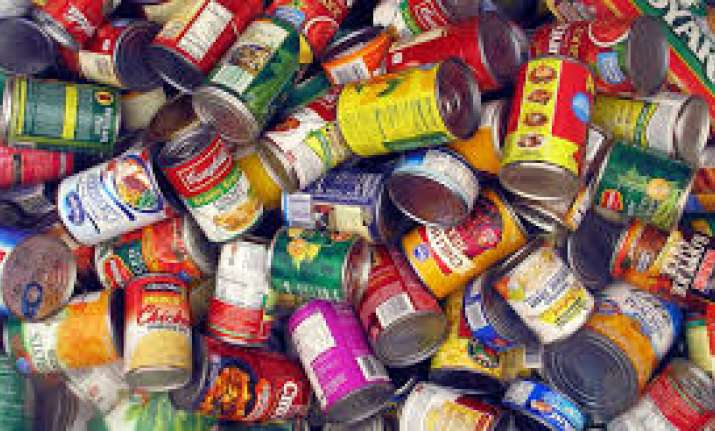
The next time you opt for canned foods such as corn, tuna, asparagus or chicken, think twice. They may contain zinc oxide that can potentially damage your digestive system, warn researchers. The findings showed that nanoparticles of zinc oxide present in the lining of certain canned goods, usually considered good for its antimicrobial properties and preventing staining of sulfur-producing foods, may negatively affect the way in which human digestive tract operates.
"We found that zinc oxide (ZnO) nanoparticles at doses that are relevant to what you might normally eat in a meal or a day can change the way that your intestine absorbs nutrients or your intestinal cell gene and protein expression," said Gretchen Mahler, Associate Professor at the Binghamton University in the New York.
Researchers found that canned food contained 100 times the daily dietary allowance of zinc.
"They tend to settle onto the cells representing the gastrointestinal tract and cause remodelling or loss of the microvilli, which are tiny projections on the surface of the intestinal absorptive cells that help to increase the surface area available for absorption," Mahler added.
This loss of surface area tends to result in a decrease in nutrient absorption.
Some of the nanoparticles also cause pro-inflammatory signaling at high doses, and this can increase the permeability of the intestinal model, the researcher said.
In other words, it can even allow the passage of compounds that are not supposed to pass through into the bloodstream.
The study, published in the journal Food & Function, looked at how many particles might be transferred into the canned food.
"Our model shows that the nanoparticles do have effects on our in vitro model, and that understanding how they affect gut function is an important area of study for consumer safety," Mahler said.
Subscribe to:
Comments (Atom)