Oct 11, 2012

KFC statement on worms found in fried chicken at its outlet in Thiruvananthapuram

New Delhi: Fast food chain Kentucky's Fried Chicken (KFC) has come under scrutiny in Kerala after a family reportedly found worms in their fried chicken. The incident was reported from an outlet in Thiruvananthapuram.
On a complaint, the Food Safety Authority conducted an inspection and found that the outlet didn't maintain adequate sanitation guidelines. Some seized chicken was allegedly as much as five months old. The outlet has been temporarily shut and other KFC outlets are being inspected.
KFC has issued a statement saying it is committed to serving the highest quality products to its customers across each of our restaurants. Following is the statement issued by KFC:
KFC statement on worms found in fried chicken at its outlet in Thiruvananthapuram
We are aware of a recent inspection conducted by the local authorities at our restaurant in Trivandrum. As a responsible brand, we are committed to following international standards and serving the highest quality products to all our customers across each of our restaurants. All KFC chicken is sourced from the state-of-the-art manufacturing facilities which comply to the most stringent food safety standards. These facilities are certified to international quality standards and are audited frequently. Our Chicken is freshly prepared several times a day in the most hygienic conditions in ovens at 250 degrees or fryers at 170 degrees. We are very proud of our quality and welcome consumers to take a tour of the kitchen any time any day. We have a great degree of confidence in our product, as millions of consumers across India do, and will continue to provide complete cooperation to the concerned authorities.

Ghosts of the past came to haunt Kentucky Fried Chicken (KFC) when officials from the food safety department in Kerala raided a Thiruvananthapuram outlet yesterday following complaints of worms in the chicken being served.
KFC's tryst with India began in 1995, when it first set up a base in the country, an outlet in Bangalore. Food safety inspectors soon raided the outlet, finding chicken served to contain 2.8 per cent monosodium glutamate (MSG), said to cause nausea and headaches, retardation and birth defects. The Prevention of Food Adulteration Act sets the ceiling for MSG at one per cent.
With KFC exceeding the MSG limits, its licence was revoked and the outlet had to be closed. The situation was no different in Delhi, when a fly was found in its kitchen and the food safety department under the Madan Lal Khurana-led BJP government in the capital ordered its closure.
Eventually, KFC exited the country following protests by health and animal rights activists, returning only a few years ago to set up shop in India. The food joint, now part of Yum! Restaurants, an American company that operates quick-service restaurants (QSR) such as Taco Bell and Pizza Hut, has 183 outlets in 35 cities. It is the leading player in the QSR space that specialises in chicken in India.

KFC: Worms in served chicken could batter brand

While the Kerala government is raiding KFC outlets as part of its drive to crack down on unhygienic joints, a spokesperson for the company said it was committed to following global standards.
"All KFC chicken is sourced from state-of-the-art manufacturing facilities, which comply with the most stringent food safety standards. These facilities are certified to international quality standards and audited frequently. Our chicken is freshly prepared several times a day in the most hygienic conditions in ovens at 250 degrees or fryers at 170 degrees," the spokesperson said.
But, food experts said the issue of worms being found in chicken was likely to hit the brand hard, as consumers are likely to grow cautious. The company declined to indicate how they proposed to deal with the negative publicity following the controversy.
In the past, Cadbury had launched an extended campaign with brand ambassador Amitabh Bachchan explaining how the firm had strengthened procedures to root out issues of contamination following the detection of worms in its chocolates.
Companies such as Coca-Cola and PepsiCo, meanwhile, lobbied hard to change perceptions following the pesticide-in-cola controversy a few years ago.

After meat, food safety officials hunt for rotting dates


DINAMALAR NEWS


Raid at KFC outlet in Kozhikode

Food and safety officials conducted a raid at the Kozhikode outlet of the Kentucky Fried Chicken (KFC) here on Monday.
The raid came in the aftermath of a worm being found in a chicken piece at a KFC unit in Thiruvananthapuram. Officials took away samples from the restaurant. Restaurant general manger Najeeb said that the way they prepared the chicken made it impossible for a live worm to be found in a piece. “We heat the chicken to a temperature of 260 degree Celsius and it is impossible for a worm to survive at such high temperatures. The incident in Thiruvananthapuram was probably a deliberate attempt by people with vested interests to defame our establishment,” he said.
Food Safety Officer, Mobile Vigilance Squad Kozhikode, C T Anil Kumar said that there was no need of scare as the food product had a shelf life of nine months. “We have taken a chicken sample dated 01/09/12 and further information about the tests will be revealed within  two weeks,” He said.
Meanwhile, KFC customers gave out mixed responses to the incident that happened in the capital. Pradeeksh Vishnudas, a native of West Hill said that the incident came as a shocker. “I will be going to KFC again only if the test results prove that the chicken is safe,” he said.
However not all were pessimistic in their views.
“This news is really disturbing but I do not think that an international brand like KFC will not be careless so as to leave a live worm behind in their chicken,” said Nakul Sudhakar of Palayam.

Oct 10, 2012

Panel gets more time for report on banned pesticides


The Delhi High Court Wednesday granted more time to an experts' committee to submit a report suggesting guidelines to prevent rampant use of banned pesticides in vegetables and fruits.
A division bench of Justice Sanjay Kishan Kaul and Justice Vipin Sanghi was told by counsel Meera Bhatia, appearing for the central government, that the draft report was ready and was with the panel head for consideration.

Bhatia said the report would be filed in the court Nov 2, the next date of hearing.

The court Aug 17 sought a report from the committee for framing a policy for periodic checks to detect pesticide residue in vegetables that pose health hazards.

The court directed the government to constitute the committee after it took suo motu cognizance of a media report alleging use of banned pesticides.

The seven-member committee includes Sandhya Kulshrestha, secretary, central insecticide board and registration committee, and Sarita Bhalla, joint director of the agriculture ministry, as the committee's chairperson.

Other members are Dhir Singh, director of Food Safety and Standards Authority of India, N.K. Sharma, principal scientist in the agriculture ministry, S.M. Bhardwaj, food analyst at Delhi's department of food safety, Vipin Bhatnagar, joint director at plant protection quarantine and storage, and senior advocate V.K. Rao.

NGO Consumer Voice's report found that 35 varieties of vegetables and fruits, picked from Delhi markets and tested for pesticide content, had toxins beyond the permissible limits.

It told the court that vegetables and fruits sold in the city's markets contained poisons capable of causing cancer and harming the nervous system and liver.

The NGO said that the amount of pesticides used by farmers in India was as much as 750 times higher than European standards.

Delhi govt to go strict against food adulteration


Delhi Health Minister A K Walia has instructed the department of food safety to go strict against the food adulteration. Keeping in view last year's incident of adulteration in kutu atta affecting number of persons, the Minister has asked the department to lift samples in ample quantity to enhance level of confidence of consumers as far as quality of the goods including eatables is concerned.
He has taken pro-active measures by taking cognizance of last year's incident and has also instructed the Department Of Food Safety to pull up its socks and get ready to lift maximum number of samples from various markets.
The department has been asked to lift samples of kutu atta, milk, cheese, khoya, ghee, oil and maida and atta from different markets.
Further it has been decided to keep a close eye on the use of colours in sweets during Dussehra and Diwali.
The market associations are being advised to avoid food adulteration. The adulteration in food items will not be tolerated and the adulterators would be booked under the Food Safety & Standards Act. Dr Walia further instructed the department to keep their laboratories in working condition. It is need to acquire all testing material and kits to meet the rush of collected samples. The results must be made available within shortest possible time. The adulterators would be fined and punished at the earliest to discourage any further adulteration in food items in all times to come, a statement said today.

DINAMALAR NEWS


Marketing of vitamins as food supplements: Ministry to amend D&C Rules

The union health ministry will amend Item No. 1 of the Schedule K of the Drugs and Cosmetics Rules (D&C Rules) to control marketing of vitamin preparations as food supplements and also to ensure that the drug substances manufactured for non-medicinal use should be with the permission of the concerned licensing authority under the D&C Rules.

The ministry's decision in this regard stems from the fact that a fairly large number of non-pharmaceutical units have been manufacturing and selling products containing vitamins in quantities which fall either into prophylactic category or therapeutic category as specified under Schedule 'V' of the D&C Rules, 1945, but such products are being indiscriminately licensed under Food Safety and Standards Act, 2006, as dietary supplements / nutritional supplements / nutraceuticals. Many such products carry inserts wherein medicinal claims are also being made.

The issue was discussed by the Drugs Consultative Committee (DCC), which held its 44th meeting on July 20. In the meeting, members raised the issue that many of the vitamin products being manufactured and marketed under licence granted under Food Safety and Standards Act, 2006, contain vitamins in quantities much higher than the daily allowable quantities in gross violation of Section 22(1)(a)(ii) of the FSS Act, 2006, and are according to Schedule 'V' of the Drugs and Cosmetics Rules, 1945.

The Item No. 1 of the Schedule 'K' of the Drugs and Cosmetics Rules, 1945, provides exemption from all provisions of Chapter IV of the Drugs and Cosmetics Act, 1940, and Rules to the drugs falling under Clause [b][i] of Section 3 of the Drugs and Cosmetics Act which are not intended for medicinal use and such products are conspicuously labelled with the words 'NOT FOR MEDICINAL USE.'

The DCC, headed by drugs controller general of India (DCGI), Dr G N Singh, after deliberations agreed for the amendment of Item No. 1 of the Schedule 'K' of the Drugs and Cosmetics Rules, 1945, to ensure that the drug substances manufactured for non-medicinal use should be with the permission of the concerned licensing authority under the D&C Rules.

Branded eateries under food safety department radar


KOCHI: Though food safety officials raided around 300 hotels over the past two months, only one branded outlet was subjected to quality and sanitation checks.

But the scenario changed on Monday after officials sealed a KFC outlet in Thiruvananthapuram after a customer found worms in his dish.

Department officials inspected two outlets of the firm in Kochi - one on Monday, the other on Tuesday. They even collected samples from one outlet and sent it to the regional analytical laboratory for tests. Officials said that further inspections would be conducted after receiving the lab report.

An official said that staff shortage is one reason why they are unable to inspect more branded outlets.

"Most outlets use sophisticated equipment and it takes more time to inspect them and verify quality. We do not have enough officials and it is not possible to check them often. We have only one vehicle for the entire inspection squad," he said, adding that they did not unearth any serious problems at these outlets during previous inspections.

Kerala Hotel and Restaurants Association (KHRA) alleged that officials are not ready to inspect the outlets of prominent brands on the ground that they serve quality food.

However, district food safety officer Ajith Kumar rubbished the allegation and said: "We have inspected many such outlets. In some cases, we also examined their godowns."

And branded outlets are quick to point out that they do not compromise on quality.

"KFC products are sourced from manufacturing facilities that comply with the most stringent food safety standards. These facilities have international quality standards and are audited frequently. Our chicken is freshly prepared several times a day under hygienic conditions," said the company spokesperson in an emailed reply.

An official with Domino's Pizza said that to ensure good food, the quality assurance team has been randomly inspecting company outlets.

KFC outlet in Kerala shut down on worm complaint; could impact sales


An outlet of Kentucky Fried Chicken has been shut down by the Kerala food safety authority after worms were found in a chicken dish.
NEW DELHI: An outlet of Kentucky Fried Chicken in Thiruvananthapuram has been shut down by the Kerala food safety authority after worms were found in a chicken dish even as the American restaurant chain swung to damage control mode.

KFC, owned by Yum Brands, had to down shutters after food safety officials searched the outlet acting on a customer compliant that worms were found in a KFC 'fiery chicken' dish. The authority ordered a temporary closure of the store.

A KFC India spokesman, however, denied the presence of the worm. "All KFC chicken is sourced from the state-of-the-art manufacturing facilities, which comply to stringent food safety standards," he said.

If the row escalates, it could impact KFC's sales at least in the short term in the country.

"If proven, it could be in trouble," Prathish Nair, head of consulting firm Transcend Brand Consulting, said, adding that such a thing, however, would have gone unnoticed in an unorganised restaurant.

"In markets like the US, if such a thing happens, the brands risk getting sued for millions of dollars," he said.

This April, KFC was ordered to pay $8.3 million (about Rs 44 crore) to the family of an Australian girl left severely brain damaged after being poisoned by a chicken meal at a restaurant near Sydney in 2005.

In 2003, a few instances of worm-infested Cadbury chocolates led to its sales plunging. In 2003 and again in 2006, sales of cola firms PepsiCo and Coca-Cola plunged to half, following allegations of pesticide residue in their beverages by NGO Centre for Science & Environment.

KFC, which almost quit India due to protests from health and animal rights activists after its debut in 1995, has been riding on the country's increasing appetite for chicken. Yum! India plans to have 500 KFC outlets by 2015, up from about 160 currently.

Oct 9, 2012

Worms in chicken, KFC outlet in Kerala shut


Food safety officials shut the KFC outlet at MG Road Thiruvananthapuram on Monday evening after a customer found worms in the fried chicken served at the outlet.
When A Shiju, a resident of Palode and his family came to the KFC outlet he was in for a ‘wiggly’ shocker.
“We had ordered fried chicken. As my wife opened the cover to give chicken piece to our 18-month-old baby, we were shocked to see worms creeping inside. When we examined the chicken closely, we found more worms,” he told DC.
When Shiju told KFC staff about worms, the latter immediately promised to give fresh chicken. “I rejected the offer and told them that I will complain to food safety officials. The staff requested us not to complain. But I called up the officials on toll free number. In the meanwhile, two staff members tried to snatch our plate but I resisted the attempt,” Shiju said.
The staff behaved rudely when Shiju refused to budge. They threatened to throw his family out. But, by the time, other customers intervened and prevented them from tampering with the samples, he said.
D. Sivakumar, designated officer of food safety, who led a team to the outlet, said, “Initially one of our officers went there and found the complaint was genuine. Later I led a team and examined the food which was served. We spotted worms.''
The food safety officials collected samples of food products including raw chicken which were packed in April. “They are allowed to keep the raw chicken for longer periods provided it is refrigerated in proper temperature.
They can keep such products in freezer for nine months if the temperature is maintained at 18 degree Celsius,” he said.
He said the raw chicken came to the outlet from Chennai. Subsequently, KFC outlets in Kochi and Koz-hikode were also inspected.
Officials ordered the closure of the outlet till further orders and collected samples of food for laboratory examination.
KFC spokesperson said, “There has been an inspection conducted by the local authorities at our restaurant in Trivandrum.
We are providing full cooperation to the authorities. We are committed to serving the highest quality products to all our customers across all our restaurants.”
Following the incident, the food safety officials inspected KFC outlets in Kochi, Kozhikode and Trivandrum.
Penalties for Offence According to the Food Safety and Standards Act, 2006:
The government of India passed the Food Safety and Standards Act, 2006, to consolidate the laws relating to food and to establish the Food Safety and Standards Authority of India to ensure quality of food and deal with matters relating to it.
Guidelines Acccording to the Act:
1)      Any person, who whether by himself or by any other person on his behalf, manufactures for sale or stores or sells or distributes or imports any article of food for human consumption which is sub-standard, shall be liable to a penalty which may extend to Rs.5 lakh.
2)      Any person whether by himself or by any other person on his behalf manufactures for sale or stores or sells or distributes or imports any article of food for human consumption containing extraneous matter, shall be liable to a penalty which may extend to Rs.1 lakh.
3)      If a food business operator or importer without reasonable ground, fails to comply with the  requirements of this Act (Food Safety and Standards Act, 2006) or the rules or regulations or orders as directed by the Food Safety Officer, he shall be liable to a penalty  which may extend to Rs.2 lakh.

Facilitation counter at ICCI from October 12 onwards

The Indian Chamber of Commerce and Industry (ICCI) will set up a facilitation counter for licensing for its members and constituents on October 12 at chamber premises.
Senior officials from the Food Safety and Standards Authority of India (FSSAI), including G Srinivasan, deputy director, FSSAI Chennai, and consultants will be at the venue to give clarification on licensing procedures and formalities.
For registration and details contact the chamber office before October 10.

Closure notice issued to KFC restaurant

Live worms found in fried chicken served at outlet
Food safety officials issued closure notice to the outlet of the multinational Kentucky Fried Chicken (KFC) at Pulimood in the city on Monday evening following a complaint about live worms inside the chicken served to a family.
Food safety officials said they had received a call on the toll-free line set up for the public to file complaints.
Family’s complaint
“A family which had come to eat at the KFC outlet had called saying that there were live worms in the fried chicken they had been served. They said that they had torn a piece of chicken apart to feed their toddler when they spotted scores of wriggly worms inside the meat. We were sceptical at first about finding live worms inside chicken which had been fried. But it turned out to be true,” a senior food safety official said.
A squad of officials, led by District Designated Food Safety Officer D. Sivakumar, reached the outlet and collected the samples of the incriminating food.
Scuffle
There was a scuffle at the outlet as the media were prevented from going inside the restaurant.
Storage suspect
Officials said the frozen chicken was brought in bulk from Coimbatore by the food chain, but obviously the cold-chain maintenance must have been poor, leading to the spoilage of the meat and worms starting to fester inside.
They said the method of frying adopted – quick frying in extremely hot oil – did not kill the worms as the heat had not penetrated inside.

  • Food safety officials seize samples of incriminating food
  • Say frozen chicken brought in bulk from Coimbatore
  • Formalin found, sale of 3 milk brands banned

    Commissioner asks Tamil Nadu to inspect dairy plants
    The Food Safety Commissioner has banned the sale of three brands of milk brought into the State from Tamil Nadu for a month, after formalin or formaldehyde, a chemical preservative, was detected in the milk samples analysed at the Government Analysts Lab here.
    The Food Safety Commissioner has written to his counterpart in Chennai to immediately inspect the dairy plants concerned and take “punitive action against the offenders as the public health of both States are involved”.
    The milk brands which were found to contain formalin are Heritage-Padmanabha, pasteurised, homogenised, standardised milk from Heritage Food (India) Ltd. in Dindigul district in Tamil Nadu; Jeshma Milk, from Sofia Raja Milk, Vadakkankulam, Tirunelveli; and Maima, from Maima Milk Plant at Arulvaimozhi, Kanyakumari.
    Formalin, a chemical used to preserve tissues for biological and histopathological examinations, is added to milk to retain its freshness and prevent it from spoiling. It is a human carcinogen listed by the International Agency for Research on Cancer.
    The chemical was detected in the milk samples which were collected by the food safety officers from the Kerala-Tamil Nadu border check-posts, as part of an intensive drive by the food safety special squads to ensure the safety of various food items being brought into the State from Tamil Nadu during the festival season.
    Public cautioned
    The Food Safety Commissioner cautioned the public against using other milk products in the same brand names, without testing these properly.
    The Commissioner also issued a directive to all food safety officers to collect samples of cotton candy (also known as Bombay Sweet) from across the State immediately and to send these for analysis, after an inspection conducted on the Shanghumughom beach here revealed that cotton candy was coloured with Rhodamine B, a chemical dye.
    He said prosecution, levying of fine, and other legal measures would be adopted against those who tried to sell banned food items in the State.
    The public should inform the Food Safety Commissioner’s office if they came across any food item with artificial colouring being sold openly.

  • Chemical found during inspection at check-posts
  • Directive to collect samples of cotton candy
  • Manufacturers told to recall products containing lactic acid

    PUNE: The Food and Drugs Administration (FDA) has asked manufacturers and distributors to recall from market confectioneries that contain lactic acid, the use of which is prohibited under the Food Safety and Standards Act, 2006.
    The issue came to the fore after FDA joint commissioner in Aurangabad  found the presence of the prohibited substance (DL lactic acid) in sugar boiled confectionery product 'Kaccha Mango Bite' in Nanded and Aurangabad. FDA officials across the state swung into action after the incident and seized the confectionery at manufacturing plants and from distributors across the state.
    During the first raid conducted at the company's carrying and forwarding agent in Nanded, the FDA officials in Aurangabad seized confectionery worth Rs 4.90 lakh on October 1. A slew of raids and seizures followed soon after across the state.
    "Two months ago, we took samples of the confectionery and sent them to the laboratory for testing. The lab report revealed the presence of DL lactic acid in sugar boiled confectionery," said Chandrashekhar Salunke, joint commissioner (Food), FDA, Aurangabad division.
    Salunke raided a carrying and forwarding agent in Nanded on October 1, followed by another raid on a firm in Aurangabad and Parbhani, where he seized goods worth Rs 4.30 lakh and Rs 49,000 respectively.
    "After I learnt about the use of the banned substance, I informed all FDA joint commissioners, following which a series of raids and seizures ensued across the state," Salunke said.
    Nashik FDA officials confiscated confectionery worth Rs 60 lakh at an Igatpuri-based firm in Nashik district on October 4. The product was being manufactured using lactic acid.
    The FDA sealed the company's godown after impounding raw material, lactic acid stock and stocks of the confectionery product samples of which have been sent to Pune for examination.
    Shashikant Kekare, joint commissioner (food), FDA, Pune, said, "We have seized confectionery worth Rs 91,000 in Pune division. We have asked all distributors of sugar boiled confectioneries to recall products containing DL lactic acid."
    DL lactic acid is an acidulant. Acidulants are additive that give sharp taste to food. According to the Act, DL Lactic acid and L(+) Tartaric acid shall not be added to any food meant for children below 12 months (the lactic acid shall also conform to the specification laid down by the Indian Standards Institution).

    More squads soon to ensure food safety

    KOZHIKODE: Two squads formed by the food safety authorities raided several eateries here on Monday.
    The squads were formed after a plus two student was hospitalized on Saturday with food poisoning after eating shawarma from a restaurant on Railway Station Link Road. The restaurant's licence was cancelled following the incident.
    On a complaint by a city resident, food safety officials raided New Grill restaurant in Thadampatuthazham on Monday, and found that the eatery had flouted guidelines on hygiene. "Since no major violation of food safety norms was found, we issued a correction notice, asking the restaurant to improve its standards," an official said.
    The complaint was received from a person who had consumed a non-vegetarian dish from the restaurant. The man had suffered food poisoning, which was confirmed by the food safety officials.
    The two teams would continue raids on the eateries in the coming days. More squads would be formed to inspect food joints in other parts of the district.
    Food safety inspector C T Anilkumar, who was part of the raiding team, said the food safety commissioner had directed them to act tough on eateries that flout safety norms.
    Meanwhile, health standing committee chairperson of the city corporation Janamma Kunhunni said the civic body was yet to receive a report on Saturday's food poisoning incident.
    "Once the report is received, we will take necessary action," she said.

    HC notice to Centre, state on gutka ban

    PATNA: The Patna high court on Monday directed the Union and state governments to give replies to a writ petition challenging the ban on sale of gutka in Bihar on the ground that when the Union government is levying 60% excise duty on sale of gutka in the entire country, its sale could not be banned in Bihar.
    A single bench of Justice Jayanandan Singh issued directives to the Union cabinet secretary and finance secretary, Food Safety Authority of India (FSAI) and the state government to file counter affidavits to the petition of gutka manufacturer, Rajat Industries Limited, in four weeks.
    The petitioner's counsel, Prabhat Ranjan Dwivedi, submitted that the Union government had taken a policy decision under a central law to impose central excise duty on sale of gutka, declaring this to be a tobacco product under the provision of Cigarette and Other Tobacco Product Act, 2003. In 2012-13, excise duty on sale of gutka has been raised from 45% to 60%. Gutka is the only commodity on which excise duty is levied not on the basis of actual production but on the basis of production capacity, the counsel added.
    Despite these provisions of the Union government, Bihar government had imposed a ban on production, packaging and sale of gutka in the state on the plea that it had done this on the direction of FSAI. The FSAI has declared that gutka is a not a food product. Despite this, the state government has banned the production and sale of gutka under the Food Safety and Standard Act, 2003. On the other hand, the Union government treats gutka as a product containing tobacco under the provision of Cigarette and Other Tobacco Product Act, 2006, the petitioner's counsel added.
    He also submitted that the Indian Constitution does not provide for a situation under which a commodity can be produced legally in one state while its production and sale is banned in another state. This act of the state government affected the petitioner's right to do business anywhere in the country under the same condition, the counsel added.

    Oct 8, 2012

    Does KFC want 13-month-old infants in India to eat its chicken?

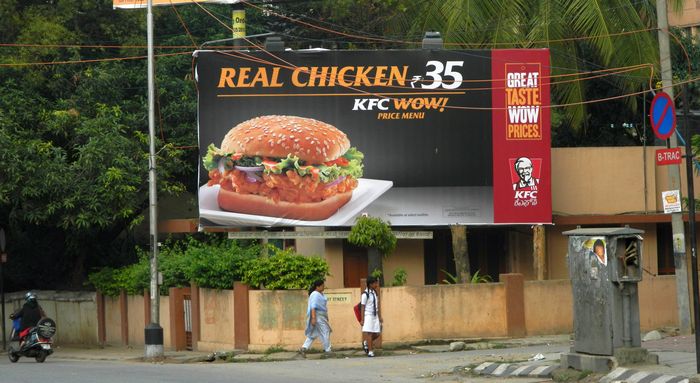
     A schoolgirl walks under the KFC advertisement in Bengaluru (Bangalore). This hoarding is 
    visible to all traffic on one of the city’s major roads, Richmond Road.

    Kentucky Fried Chicken (KFC) in India is advertising a chicken meal that costs 35 rupees (USD 0.67, EUR 0.51). Hoardings such as this one are visible now in all the major metropolitan cities (Mumbai, Bengaluru, Chennai, Hyderabad, Kolkata, Delhi) and KFC has taken outdoor advertising space along major roads in these cities.
    This hoarding advertises “Real chicken” for 35 Indian rupees, “KFC wow! price menu”. In small letters on the lower bottom right of the hoarding the advertisement also says: “Products contain added monosodium glutamate. Not recommended for infants below 12 months”.
    There are two culprits here at work to further the interests of the junk food/fast food industry. One is the Food Safety and Standards Authority of India which is nowhere near as vigilant as it ought to be, especially given its ‘Advisory on Misbranding/ Misleading claims’ which invokes the Food Safety and Standards (FSS) Act, 2006, Rules & Regulations, 2011. This has said: “(2) The various false claims made by the Food Business Operator about food articles and consequent violation, if any, are punishable under the provisions fo FSS Act, 2006; (3) Violations related to food items, seriously jeopardize public health as well lead to unfair gains to Food Business; (4) Misleading advertisement related to food items are imputed with malafide intent on the part of person making the claim and is normally made to misguide a consumer to purchase food item without disclosing the complete details on the advertisement. Companies (Corporate bodies including firm or other association, individual) are also covered u/s 66, FSS Act, 2006.”
    The objectionable disclaimer is in small letters on the lower right edge of the hoarding,
    unnoticeable to passing traffic.
    The other culprit is KFC and its parent company, Yum! Brands, Inc. Just how important is India to Yum! Brands? Consider the statement by the company’s chairman and chief executive officer, David C Novak (available right now on the company website) in which he has mentioned India and its market:
    ” …we have made incredible progress in India, opening 101 new restaurants in 2011. Ten years ago, we were essentially just beginning with KFC in India, and now it’s our second leading country for new unit development. In fact, we’re so excited about our prospects in India, and its impact on the future growth of Yum!, that we’re going to break it out as a separate division for 2012 reporting directly to me. It’s encouraging to see that our new unit progress with KFC in India is very similar to what we saw in China during its first 10 years. Our India team has identified the key elements driving success in China and are adapting these strategies in India to leverage our iconic brands and build concepts with broad appeal.”
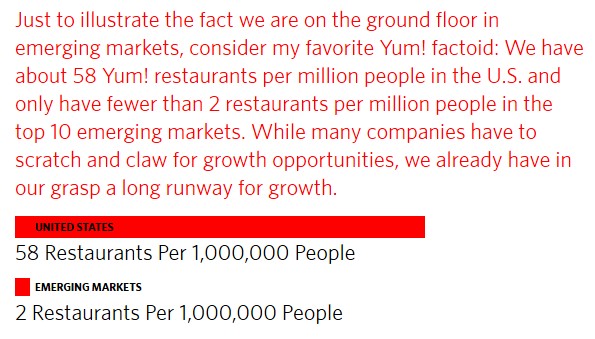
    No thank you. We want 0 such restaurants per 1,000,000 people

    India’s business and financial English-language dailies, since they function as mouthpieces of industry and propaganda sheets for industry and trade associations, and since they function as uncritical endorsers of the current ruling regime’s reckless gallop into ruin, have had only laudatory noises to make about the invasion under way by KFC and similar global junk food peddlers.
    The Economic Times published a gushing interview with Muktesh Pant, CEO of Yum! Restaurants International, which is described as running “the international operations of US quick restaurant chains Kentucky Fried Chicken, Pizza Hut and Taco Bell restaurants”. The newspaper asked: “How is the Indian restaurant market evolving, compared to say China?” and Pant answered: “If you compare the stats of the two countries, the consumer class of 300 million in China has an access to 3,000+ KFCs, while the consumer class of 100 million in India has access to only about 140 KFC outlets. Hence, there is a huge potential for us to leverage our expertise in the untapped market. Our aim is to have 1,000 outlets in India by 2015 and China has helped us provide a blueprint for this rapid growth.”
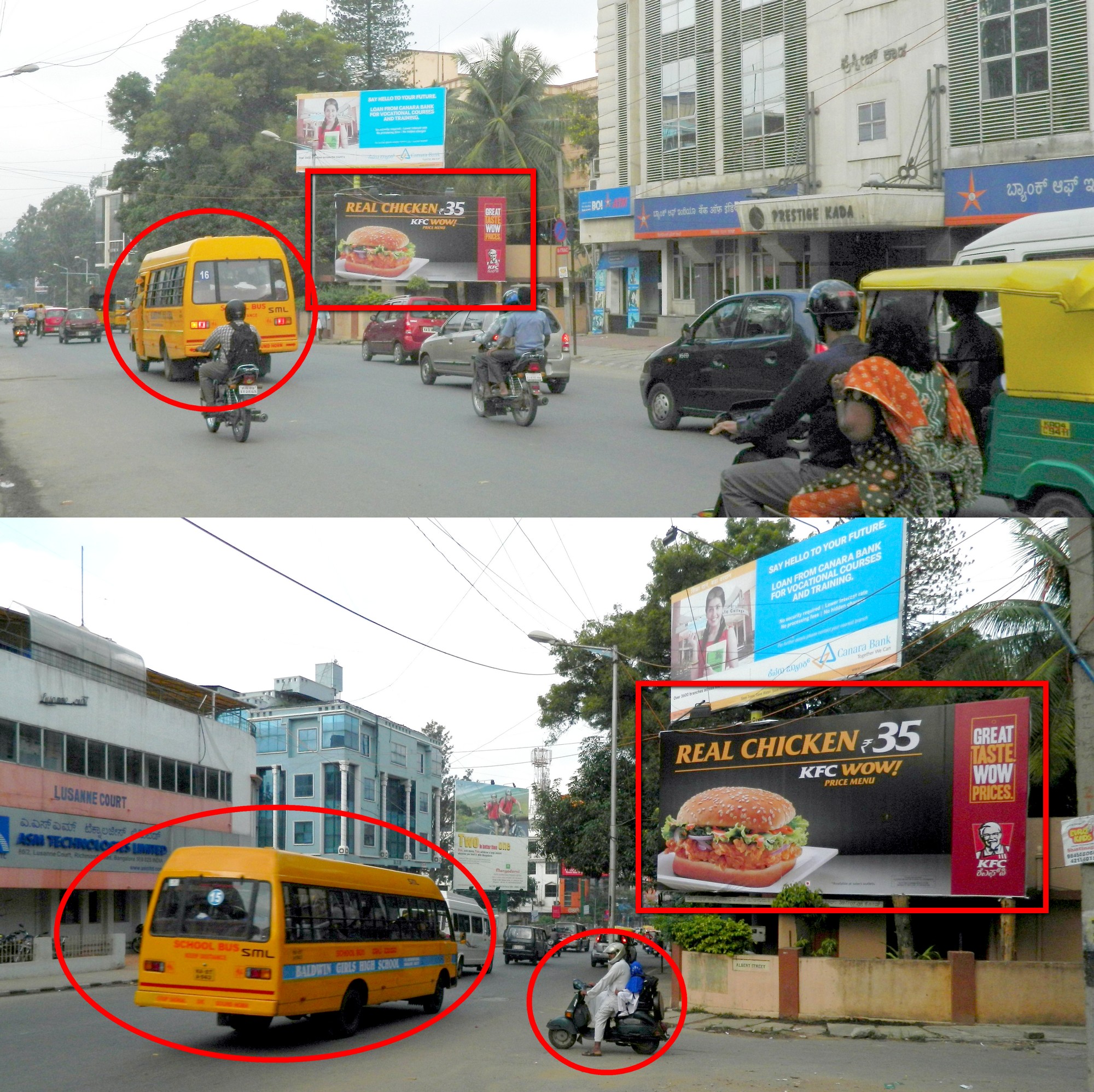
    The influence of KFC on the diet of India’s urban schoolchildren? See the schoolbuses driving past the hoarding.

    The same gushing interview contained answers from Niren Chaudhary, president of Yum! Restaurants India, who was described as “reporting directly to Yum! Brands, Inc, Chairman & CEO David Novak after the world’s largest restaurant company last week made India only the third country after the US and China with a standalone reporting division”. How fabulously exciting for all the 13-month-old infants wetting their diapers in anticipation of their next KFC portion.
    The question was: “Will it translate into faster expansion and more hires?” And Chaudhary’s answer: “Our goal is to double our store base to at least 1,000 stores, employing 50,000 people, in three years. The new structure is a change in reporting relationship and reflects the importance of India as a future growth opportunity.”
    Now we know why the KFC advertisements say what they do (and hide much). This CEO Pant is reported to have studied at the Indian Institute of Technology Kanpur, and if so that particular IIT – and the IITs and IIMs of Bharat – have much to answer for.

    FIR against nine in milk adulteration case

    RANCHI: The scare of milk adulteration has created panic in Jharkhand. Four milk tankers belonging to Sudha Dairy which supplies over 2.5 lakh litres of milk daily to Jamshedpur, Bokaro, Ranchi, Dhanbad and other centres in the state have been seized since 2011 for milk adulteration. The food and adulteration department of the state has also served notices on the brand for selling adulterated milk.
    On Sunday two tankers, each containing 40,000 litres of milk, were seized from Ormanjhi locality by the Crime Investigation Department (CID) and local police after the drivers and helpers of the tankers were found pouring water from a road side hand pump into the milk tanker. As many as 15 Sudha Diary tankers carrying milk come to Ranchi from Bihar everyday.
    K Saryu, officer in-charge of Ormanjhi police station, said: "An FIR has been lodged against nine persons in the milk adulteration case." Saryu said two persons arrested from the spot were mixing water with the milk in the tanker from a hand pump. Jharkhand food controller T P Burnwal said, "A team is carrying out investigations and samples have been sent for tests. Legal action would be taken against Sudha Dairy in case the milk samples are found to be adulterated."
    The food and adulteration department has served notices on Sudha Dairy on previous occasions as well. "We have not received any report of chemical mixing in the milk so far," Burnwal added. It is, however, a challenge for department which has only seven food inspectors to keep a check on adulteration of milk. News of adulteration has shocked parents. "It ia a criminal act since we are totally dependent on the packaged milk," said Geeta Sharma, a mother. S R Mishra, general manager, Sudha Diary (Ranchi) said,
    "A total of 15 milk tankers carry milk from Bihar to various destinations in Jharkhand as the state itself does not produce much milk. For the transport of milk we've hired agencies. We have also received complaints about adulteration by drivers of these tankers."
    Drivers of these tankers have formed a nexus with line hotels located along the state highways.
    "They break the hinge of the tanker cap and drain out the milk. The hinges are not of stainless steel and thus can be easily welded," said a source. To compensate for the loss of milk they pump water from hand pumps which are usually dirty, the source said. In 2011 officials of Sudha Dairy (Ranchi) had conducted raids to check the adulteration of milk. Former Sudha Dairy (Ranchi) general manager A K Singh had raided a place in Ramgarh last year.
    The driver of the tanker, who was found pouring water into the tank containing milk had, however, managed to escape with the tanker. Sudha Dairy (Patna) MD Sudhir Kumar said, "We had cancelled licences of few of the agencies when we received complaints against them." However measures for quality control of the packaging unit in Ranchi ends there since there is no mechanism to check the quality of the milk which arrives here in these tankers. Kumar said a proper mechanism of sealing the tankers was in place at all the milk-collecting units in Bihar.If a packaging unit does not get sealed tankers, they can refuse to accept it," he added. Shakti Singh, physician said milk adulterated with tap water can cause diarrhea, typhoid and other water- borne diseases."If it is contaminated with che cicals, it can also damage to the liver and kidneys," he added.


    1 held for milk adulteration

    MUMBAI: The Kalachowkie police on Sunday arrested a milkman for adulteration. The accused, Satish K Lingeyar (25), will be produced before the court on Monday, the police said.

    The authorities acted after local residents alerted the distributor, Amul. The accused was caught in a joint operation mounted by the distributor and police officials. Empty pouches and packets were also found at Lingeyar's residence on Parel Tank Road.

    DINAMALAR NEWS


    Don't sell 'chutney' and 'jam' in re-used jars, Britons told


    Uk girls
    The growing number of 'chutney' and jam-makers in UK, inspired by model Kate Moss and Kate Middleton, may have to abandon their re-used jars after a warning that they are breaching European health and safety regulations.
    Legal advisers to Britain's Churches have sent out a circular saying that while people can use jars for jam at home or to give to family and friends, they cannot sell them or even give them away as raffle prizes at a public event, the MailOnline reported.
    The circular from the Churches' Legislation Advisory Service is pointedly headed: "Please take note: this looks like a spoof but it's not."
    The advisers say the rules that are being breached are the snappily-titled EC Regulations 1935/2004 and 2023/2006, which prevent containers being re-used unless they are specifically designed for that purpose.
    The Food Standards Agency said that the rules had been introduced because there was a risk of chemicals leaching out of old containers and contaminating food, though it added that it was not aware that re-used jam jars were a safety hazard.
    The agency said it was up to local authority to enforce the regulations, and penalties can reach a maximum of a 5,000 pounds fine, six months' imprisonment, or both.
    The news will alarm the growing number of jam-makers inspired by model Kate Moss, who makes damson jam out of fruit from her Cotswolds estate, and the Duchess of Cambridge, who keeps pots to give away to friends.

    Pesticide in veggies? Home remedies to help


    THIRUVANANTHAPURAM: Agro-scientists working on reducing pesticide residue in vegetables and fruits have come up with simple home remedies for the same.
    It was following a study on the impact of pesticide residue on farm-produce - conducted by the pesticide research and analytical laboratory of the Kerala Agricultural University - finding that a cross-section of leafy vegetables and curry leaves had pesticides beyond permissible limits that the agro scientists of the university tried out various organic methods to remove pesticides.
    "In our study, we found that tamarind water and vinegar were best suited to remove pesticides from vegetables," says Dr Thomas Biju Mathew, department of entomology, who conducted the tests along with a team of scientists. He says they used a majority of pesticides available in the market -- rated red (extreme), yellow (high) and blue (moderate) according to toxicity levels, for the tests.
    "Tamarind water and vinegar were effective in removing the pesticide residue (up to 95%), especially in spinach, curry leaves, chillies, lady's finger, snake gourds and brinjals that were contaminated with heavy doses of pesticides."
    The vegetables need to be dipped in tamarind water (prepared using at least 20 mg of tamarind) for 15 minutes. The curry leaves and chillies should be washed thoroughly before cooking. "Curry leaves and chilles can be dried, kept back in the fridge and used when needed. Bitter guords and beans need to be brushed with a soft bristle brush after dipping in tamarind water and washed once more,'' he says.
    The tests also revealed that basmati rice had higher traces of pesticide when compared to brown rice available in the state. "The pesticide level in samples of rice decreased by 85% once they were washed and cooked." The Central Insecticides Board and Registration Committee had, in August, approved 240 pesticides for use in the country while banning 70. An earlier study by KAU had found that many vegetable samples -- mainly chilly (18 of 48 samples) and curry leaves (47 of 79 samples) -- had traces of pesticides that should not have been used on them.

    Oct 7, 2012

    Shawarma turns villain again

    Aadhil Muhammed undergoing treatment at Udayagiri Multi-Speciality Hospital

    • Aadhil Muhammed undergoing treatment at Udayagiri Multi-Speciality Hospital
    Two months after it first struck, shawarma has turned villain once again. A Plus One student who reportedly consumed shawarma from an eatery on Kozhikode Railway Station Link Road has been admitted to a hospital at Changanassery, in critical condition.
    The licence of the restaurant has been cancelled after seizing stale food items in a raid conducted by the Food and Safety officials.
    According to the Food and Safety officials, a student of Silver Hills High School and native of Kovoor, Aadhil Mohammed, 16, bought shawarma from Hot Buns Arabian Restaurant on his way to Changanassery on Friday, to participate in an interschool basketball tournament. He consumed shawarma during his journey in train at around 7 pm.
    Aadhil was admitted to a private hospital in Changanassery, after he felt uneasiness and started vomiting. Later, it was found that the he was affected by food poison through the shawarma he had consumed.
    Subsequently, Food and Safety officials reached the restaurant and conducted search. Meanwhile, the employees of the eatery allegedly manhandled the officials and mediapersons who arrived at the spot hearing the incident.
    AIYF and Yuvamorcha activists held a protest rally in front of the restaurant and a tense situation prevailed in the area.
    As the protest and raid were on, Kerala Vyapari Vyavasayi Ekopana Samithi asked the shop owners to down the shutters in protest against the raid. Meanwhile, the DYFI activists held a rally urging the owners to open shops.
    They warned that if the shops were not open then, it would not be allowed to open from the next day onwards. Police officials from Town Police station reached the spot. Later, KVVES called off the stir.
    Food and Safety officials said that they had received more than three complaints regarding the food items served in the same restaurant in a period of one month. They also informed that they would file a case against the KVVES members who manhandled them when they were on duty at the restaurant. A 21-year-old Hotel Management graduate Sachin Mathew had died in July owing to food poisoning caused by shawarma. The incident resulted in a temporary ban on shawarma.

    Hotel licence suspended


    KOZHIKODE: The District Food Safety Commissionerate temporarily suspended the licence of a restaurant here when a youth took ill allegedly after eating shawarma from there. Adil Mohammed hailing from Chevayur in the city had eaten shawarma at the ‘Hot Buns’ restaurant on Friday before travelling to Changanassery to participate in a basketball tournament. However, on reaching Changanassery he was taken ill and admitted to a private hospital in a serious condition. Subsequently, the food safety officers conducted a raid at the hotel. But the Vyapari Vyavasayi Ekopana Samithi took out a protest march against the raids and prevented collection of food samples from the hotel.

    “The food safety officers could not collect food samples from the restaurant. So, it cannot be ascertained whether shawarma is the cause of the youth’s illness. But, we found that the restaurant was preparing food in unhygienic conditions. So, the licence has been temporarily suspended as per Section 32 (2) of the Food Safety Act,” said A. Mohammed Rafi, the District Licensing Authority. Rafi said that the authorities had given sufficient warnings to the restaurant owner to improve its hygiene standards after a raid on September 9. A case has also been registered against the leaders of the protest march for obstructing the duty of public officials.

    KAALAI KATHIR NEWS


    Ban sought on sale of gutka, pan masala Symbiosys Technologies CEO serves notice on govt


    Symbiosys Technologies chief executive officer O Naresh Kumar addressing a press conference in Visakhapatnam on Saturday (Photo HANS)

    Visakhapatnam: Chief executive officer (CEO) of Symbiosys Technologies O Naresh Kumar has sent a registered legal notice to the government on why tobacco products, mostly non-smoking gutka and pan masala, should not be banned in view of public health.Addressing a press conference here, Mr Naresh Kumar said pan masala and gutka contained tobacco, which is injurious to health and causes cancer.

    Maharashtra, Madhya Pradesh, Haryana, Bihar, Himachal Pradesh, Rajasthan, Goa and Delhi governments have already banned these products in their States, he said.Mr Naresh Kumar said there were nine lakh deaths in India due to tobacco usage and 90 per cent of them were due to oral cancer as per the reports of the Ministry of Health.

    The Symbiosys Technologies CEO said India has one of the highest rates of oral cancer in the world due to usage of tobacco, according to the World Health Organisation (WHO).He said college and school children were getting addicted to chewing pan masala and gutka as the local authorities were not preventing the sale as per the regulations.

    The Cigarettes and Tobbaco (Prohibition of Advertisements and Regulation of Trade and Commerce, Production Supply and Distribution) Act, 2003, which prevents the sale of tobacco products to people below 18 years of age and sale within 100 yards of any educational institution, is not being implemented in Visakhapatnam and Hyderabad, he said.

    Mr Naresh Kumar said the Food Safety and Standards Act, 2006, and the Prohibition and Restriction on Sale, 2011, effective from August 1, 2011, specified that tobacco and nicotine shall not be used in any food product.

    This was not implemented by the Public Health Department of Greater Visakhapatnam Municipal Corporation (GVMC) or the police, he lamented. “Hence I served a legal notice on the government represented by various officers,” Mr Naresh Kumar said. P Vishnu Kumar Raju was also present at the press conference.

    DINAMALAR NEWS


    Food safety officers of civic bodies to be shifted to Food and Drugs Administration

    NASHIK: Eight food safety officers (FSOs) in civic bodies in the Nashik division are to be merged with the Food and Drugs Administration (FDA) soon. The FDA has sent a proposal to the state to merge eight FSOs from four municipal corporations in the Nashik division with the FDA.

    Earlier, the food and adulteration Act was in force in Maharashtra. The municipal corporations had to implement the law in their jurisdictions, while it was implemented by the FDA beyond municipal limits. The registration and licences were also given by the municipal corporations in their jurisdictions. But after the amendment in food and adulteration Act, the state introduced the new act— the food safety and standard Act, 2006.

    Accordingly, the accountability of implementing the law in the jurisdictions of municipal corporations and municipal councils was entrusted with the FDA. As per the new act, the posts of food inspectors were converted to FSOs. Presently, there are still eight FSOs with municipal corporations in the Nashik division, but they are working for the FDA.

    Speaking to TOI, a senior FDA official said, "There are eight FSOs with four municipal corporations and a municipal council in the Nashik revenue division, but they are working for the FDA. We have sent the proposal to the state for their merger with the FDA. Out of the eight FSOs, two are from NMC, two from Malegaon Municipal Corporation (MMC), one from Manmad Municipal Council, two from Ahmednagar Municipal Corporation (AMC) and one from Jalgaon Municipal Corporation (JMC)."

    He added, "These eight FSOs will be merged with the FDA once we get the state's approval. Nashik divisional office of FDA, includes five districts Nashik, Ahmednagar, Jalgaon, Dhule and Nandurbar. We have around 35 FSOs in Nashik division, including 15 in Nashik district, five in Jalgaon, eight in Ahmednagar district and seven jointly for Dhule and Nadnurbar districts. We are functioning as per the food safety and standard Act, which came into effect from 2011. Different assignments have been given to them and each FSO has been given some specific target of collecting samples and conducting inspections."

    Oct 6, 2012

    Health officials inspect eateries for adulterated food in Salem

    Danger of contamination:Food items kept in the open at a road side eatery near Salem New Bus Stand. -Photo: E. Lakshmi Narayanan
    Danger of contamination:Food items kept in the open at a road side eatery near Salem New Bus Stand. -Photo: E. Lakshmi Narayanan


    Unlicensed shops have become a cause for concern
    Inspection to detect cases of adulteration and expired food items have began in the district after a period of six months.
    This was possible only after petitions filed by hotel owners and various associations against provisions of the Food Safety and Standards Act were vacated by the Madras High Court last week and health officials were allowed to carry out inspection in eateries and take action, if they found violations.
    The Act came into effect throughout the country from August 5, 2011 after the government repealed the Prevention of Food and Adulteration Act 1954 and seven other Acts that were in force.
    The new Act makes licensing and registration of food businesses mandatory. The District Designated Officer has been given powers to check food product standards, packaging, labelling and adulteration in restaurants, eateries, small hotels, bakeries, tea stalls and all small and cottage industries.
    Mushrooming of unlicensed shops and road-side eateries near New Bus Stand, Old Bus Stand, Bose Maidan, Kallankuthu and Kalarampatti selling chicken, meat and fast food items has become a cause for concern as people throng these eateries and consume unhygienic food.
    Though they offer taste, use of non-permitted colours, reuse of cooking oil, poor quality of drinking water, unclean plates and food items kept in the open and exposed to dust pose serious health hazard to the consumers. Such conditions remain unchecked.
    The situation can be evident when the dust and smoke emitted by buses near the bus stand are observed by the non-vegetarians that are kept in the open.
    It was also said that dead chicken from poultry units were used by a few shops and offered at low price in many eateries.
    Digestion problems
    After consumption of such food, some people complain of upset stomach and digestion problems that later may lead to serious problems.
    Yet, the consumers, mostly labourers and middle class people, though aware of the fact, continue to consume the food.
    The situation is worse during monsoon, as the quality of water served causes infectious diseases and adds to the woes.
    A few eateries mushroom in the evening and run till late night near drains where mosquitoes breed and spread diseases.
    These eateries procure contaminated tap water and serve this to their customers. Though doctors warn people to keep away from these tempting food items that cause serious problems, people continue to consume these foods.
    T. Anuradha, District Designated Officer, Tamil Nadu Food Safety and Drug Administration Department, Salem District told The Hindu that initially shop owners were warned of action if they continue adulteration, sell expired food items and use non-permitted colours.
    She added that seven shops were raided in the district, including one tea stall in the city, and adulterated tea powders were seized. Action would be taken as per law, if they continue, she said.

  • District Designated Officer has been given powers to check food product standards
  • Use of non-permitted colours and reuse of cooking oil pose health hazards
  • Still dishing out dirt

    Is your food genetically modified?? check the label


     With effect from January 1, 2013, the government has made it mandatory to mention the sign, “genetically modified” (GM) on every food package that contains it.

    While rolling out the new regulation, Food and Consumer Affairs Minister, KV Thomas, informed the parliament that, there is only a decreased level of awareness about GM foods amongst people in the country; the reason being GM food, which is relatively a new technology, has not been widely experimented. This statement came on the heels of the parliamentary standing committee report on Agriculture, headed by Basudeb Acharya, which also recommended compulsory labeling of all GM products so as to ensure that the consumer is able to make an informed choice.

    With the moratorium on Bt Brinjal issued on February 9, 2010, which is still in force, India at present does not produce any GM food. At the same time, in non-foods category, the government has allowed commercial cultivation of only Bt cotton since 2002. The latest order therefore is expected to essentially affect food importers and the agri-biotech industry in the long run. For instance, Heinz tomato ketchup may need to display “GM”, if the original ingredients included GM tomatoes. The same will be applicable in the case of imported oils like soyabean and canola. Even imported potato chips and tortillas will come under the scanner.

    Referring the move to be arbitrary in nature, Dr Shanthu Shantharam, professor, Iowa State University, Ames, Iowa and former executive director of Association of Biotech Led Enterprises-Agriculture Group (ABLE-AG) stated that, the labeling rule has been made hastily and without a proper discussion or consultation. He goes on to ask an interesting question, “We all know that groundnut and cow's milk is allergic to certain sections of the population, but do they label them in the Indian market?”

    Dr B Mazumdar, vice president, Bejo Sheetal Seeds feels that at the moment it is very difficult to comment anything about the long term implications. “At this present situation it does not make any difference because the fate on agri-biotech still remains undecided,” added Dr Mazumdar.

    Illegal imports
    Right to information (RTI) responses have revealed that no permission has been granted for the import and sale of any GM food in India other than purified soya oil. According to Food Safety and Standards Act, 1986, no person shall manufacture, distribute, sell or expose for sale or dispatch or deliver to any agent or broker for the purpose of sale, any packaged food products (including genetically modified or engineered food or food containing such ingredients) which are not marked and labelled in the manner as specified by the regulations. Genetic Engineering Appraisal Committee (GEAC), which currently regulates the GM food affairs wants some of its regulatory powers to be shared by the Food Safety and Standards Authority of India (FSSAI). But the Authority is still in a nascent stage and the general impression is that, its food lab in Kolkata under the Ministry of Health, is not so well-equipped. Dr Sagari R Ramdas, director, Anthra, while deposing before committee had stated that, “There is no system of labeling in this country. So, we have absolutely no way of assessing if the cotton seed oil is either GM oil or non-GM oil.”

    Civil society activists allege that many Indians may already be eating the controversial corn through a variety of imported products made out of GM corn. The contention is based on the fact that chips made of corn are being imported regularly to India by American manufacturers via dealers in Singapore and Taiwan. They point out that, in 2008, an import consignment of Doritos, a chips brand owned by PepsiCo, was detained by Customs authorities in Mumbai, as it was allegedly found to contain genetically modified ingredients. Following this, the importer penned to the GEAC seeking a “no objection certificate”. The GEAC cleared the consignment based on an undertaking given by the company that the chips did not contain GM corn.

    Greenpeace claims that tests conducted at an independent laboratory on products picked up randomly from a supermarket in the capital revealed Doritos corn chips to contain genetically modified Mon 863 and NK 603 variety corn ingredients. According to Shivani Shah, campaigner, Greenpeace, “There has been no permission granted for the cultivation of GM food crops in the country. But the imported processed foods in all likelihood may contain varying amounts of GM ingredients. There is a Directorate General of Foreign Trade (DGFT) rule to ensure no unapproved GM food enters our markets through import, but unfortunately there is no mechanism to check this at our ports of entry.”

    However, PepsiCo spokesperson had claimed that the chips were produced in Taiwan from locally grown corn suppliers and denied the official import of these chips into the country. Two Delhi-based importers on condition of anonymity told BioSpectrum that they were unaware of the GM issues and mentioned that they have been importing the Doritos chips and Heinz ketchup on regular basis. “The labeling might make consumers skeptical about the products and even might affect the other non GM foods too,” said another importer.

    Will regulation really work?
    Many feel that the current regulation is weak and leaves room for misuse by the food industry. Given that there is no mention of the threshold levels, traceability and liability which are necessary corollaries of a labeling system for GMOs, it is also said that the notification needs to be fleshed out further to ensure that the directed intention meets desired objective.

    Citing labeling as a very contentious issue, Dr Shantharam opined, “It is believed by the industry that it is like posting 'skull and crossed bones' on GM foods as it has been demonized by the anti-GM lobby. It is a trick to castigate the GM food and kill the market for it. Moreover, what counts in is the “truth in labeling”. With the kind of supply chain that operates in India and other developing countries, it is very difficult to maintain a strict segregation from farm to fork. Therefore, whatever is served at the dining table may not be what it says on the label, thereby misleading the consumer.”

    But at the same time, the parliamentary committee report seeks to dispel notions that it might not work in India. It specifically mentions China, which despite being a populous country made labeling of such products mandatory. “The new regulation needs to make it clear that this will not only be applicable to processed foods from within India, but also foods that are imported as well. Labeling also needs to be applicable to oil, which comes from Bt cotton seeds in India as well as soya and corn oil which is imported to the country from countries like the US,” said Basudeb Acharya, chairman, Parliamentary Committee on Agriculture.

    Rajesh Krishnan, campaigner, Greenpeace India, is strongly of the opinion that government must enact a legislation to protect the rights of consumers. “Today, consumers have no rights and no means to know which imported food contains GM. There should be compulsory testing and labeling of GM foods entering the country,” enthused Krishnan.

    With Ferderal Drug Investments (FDI) in retail being seen as a boost for importers, it remains to be seen how effective the new law would be in its checks and balances. Moreover, ensuring that the intended message has reached the consumer will alone not suffice, but the awareness about the GM foods cleared by the overseas regulatory agencies declaring it safe, should also be considered crucial.

    Rahul Koul

    Oct 5, 2012

    HOW TO BUY GOOD MUTTON?


    G.O.Ms.No.362 dt.5.10.12 - ENHANCED D.A


    Food poisoning: 15 nursing students hospitalised

    As many as 15 students of a nursing college run by a private hospital at Killipalam here were hospitalised on Thursday for food poisoning after they reportedly had food from their hostel mess.  The students have been admitted to the same hospital and the condition of at least 10 is said to be slightly serious.
    According to sources, the students had lunch from the mess of the ladies hostel at Uppalam Road on Wednesday. They were later admitted to the same hospital after they complained of vomiting and uneasiness.  The hospital authorities, however, claimed that it was not the food served at the mess but the food brought by a student from her house which caused the illness.
    On being informed about the incident,  Food Safety officials visited the hostel kitchen and collected food samples.

    Ban on tobacco, just for namesake


    The Delhi Government banned manufacturing, distribution, storage and sale of tobacco in the city. However, its implementation is not quite visible in most areas of Delhi.
    The ban was raised on September third week and a special district magistrate has also been appointed for this purpose. However, selling of tobacco and gutka is visible in south Delhi mostly at Okhla and Mehrauli where tobacco is available on whole sale prices.
    After giving a verbal undertaking to the Delhi High Court, the government got the clearance of ban from lieutenant-governor. The health minister assured that a blanket ban will be put on tobacco but it seems all the assurances have turned to be futile.
    In Mehrauli market, Cityplus saw whole sale shops of tobacco selling gutka and pan masala openly. When we enquired that why were they selling these products despite government ban, the shopkeepers said that it is still in demand and they have been selling it for years.
    "We are not retailers; we have raw and pure tobacco, pan masala and other items. We are selling these things to earn money, it is the only source of income for us," said a shopkeeper on condition of anonymity.
    Sources in the health department confirmed that a complete blanket ban on gutka would be implemented by next week. When contacted, health minister A K Walia said, "We are strongly in favour of banning tobacco and all areas and concern departments have been informed. Delhi government is working on this project seriously, whatever product contains tobacco or nicotine will be banned completely in Delhi."
    In several other markets of south Delhi, tobacco products are still visible. Small vendors are selling these items openly. These markets are Kalkaji, Okhla, Malviya Nagar, Mehrauli and Govindpuri. The RWAs and market associations are aware of this and they have even sent letters to the ministry of health, Delhi government.
    Residents of different areas believe that this decision can't hamper sale of tobacco until a strict code of conduct comes in to existence.
    A resident of Malviya Nagar and social activist MK Mishra said, "This order reflects the failure of Delhi Government. They just issued an order but did not bother to check its implementation. At many places one can see pouches of gutka and tobacco in vendor shops. I have sent a written letter to our health minister stated that several vendors and shops are violating the act and there is no check on them."
    In a media report on July 31, in which the Delhi health minister had said the government should ban sale of tobacco products, the bench of high court asked the state to consider the plea as a representation and decide the same in two weeks. The petitioner had claimed that eight states, Madhya Pradesh, Kerala, Haryana, Bihar, Himachal Pradesh, Maharashtra, Rajasthan and Goa  have already banned gutka and its products but Delhi government is still to take any action.
    Under the Food Safety and Standards Act, 2006, the Centre framed a regulation in 2011 empowering the state's Food Safety Commissioner to ban tobacco products. According to the Food Safety and Standards (Prohibition and Restrictions on Sales) Regulations, 2011, gutka and other forms of chewing tobacco products such as zarda, pan masala, gul and bajjar which are toxic and addictive, should be banned from being sold in the state.

    Food Safety Act
    •    Food Safety and Standards Act. 2006 says that violators can be punished with imprisonment up to 7 years or penalty of Rs 10 lakhs or both.
    •    Each district will have special district magistrate to implement and enforce the act.
    •    Area food safety inspectors can visit markets and issue challans to violators.
    •    Apart from sale, production, distribution, promotion, storage and display will be banned in Delhi.