Jun 8, 2020

FHRAI issues reopening guidelines for hotel and restaurants


The Federation of Hotel & Restaurant Associations of India (FHRAI) in association with FSSAI and other key associations have come up with a detailed reopening manual for hotels and restaurants. The comprehensive guidelines highlights generic precautionary measures to be adopted in addition to specific measures to be ensured in hotels and restaurants to prevent spread of COVID-19. It also outlines preventive measures to minimize all possible physical contacts between staff and guests and maintain social distancing. 
Here's a detailed look at the guidelines:
Mandatory golden rules to be followed all the times by fbo’s
  • Physical distancing of at least 6 feet to be followed as far as feasible
  • Thermal screening of guests and visitors before entering the premises
  • Appropriate personal protection gears like face covers/masks, gloves and hand sanitizers etc.shall be made available by hotel to the staff as well as the guests. Staff should additionally wear gloves and take other required precautionary measures.
  • Proper disposal of face covers / masks / gloves left over by guests and/or staff should be ensured.
  • Adequate manpower shall be deployed by hotel management for ensuring social distancing norms.
  • Installation and use of Aarogya Setuapp shall be advised to all.
  • Cleaning and regular disinfection of frequently touched surfaces (door knobs, elevator buttons, hand rails, benches, washroom fixtures, etc.) to be made mandatory in all guest service area and common areas. Deep cleaning of all washrooms shall be ensured at regular intervals.
Covid 19 coordinator or special officer
  • Appoint a special officer nominated from amongst managers who will be responsible for covid19 special response planning and implementation.
  • The officer shall be the reporting person for all covid19 emergencies and capable of having decision making powers to implement things as announced by local authorities based on emerging conditions.
  • The officer shall be supported by operations head, quality control, HR, loss prevention and medical officer connected with the property.
Facilities to face reopening challenge
  • Replace finger touch bio-metric with alternate method
  • Create screening place before time office with temperature monitoring and
  • basic screening for Covid19 symptoms.
  • Setup hand-wash stations at all staff zones like entry, lockers, toilets, cafeteria
  • with soap solution and hand drying facilities, most importantly it shall be sensor
  • based or foot operated.
  • Enough space in kitchen & staff lockers.
  • Spacing plan at pre preparation and production zones.
  • Create 1 Isolation room for every 50 rooms.
Guest handling at front office
  • Sanitise the touch points in car like seat, door knobs, hand rest etc with 70% alcohol.
  • Drivers should be in full uniform with face mask and hand gloves.
  • Before entering hotel, take guest luggage to a separate area. Blow air on the outer surface of luggage and sanitise with 70% alcohol .
  • Avoid direct handling of guest amenities like ID proof, wallets, Mobiles etc.
  • Use sanitised trays to collect them.
  • Sanitise the card machines.
  • Maintain social distancing of at least 1m with the guest.
Kitchen man power planning
  • At any point of time the kitchen shall have only 2 persons for a linear distance of 10ft.
  • The work cycle shall be assessed to fine tune work station occupation and quickly be out of kitchen for the next set of operation to begin.
  • This can be achieved by range critical operations, non range operations and pre preparation operations.
  • Range critical operation is called critical occupation time and accordingly the plan has to be charted out by chef.
Disinfection
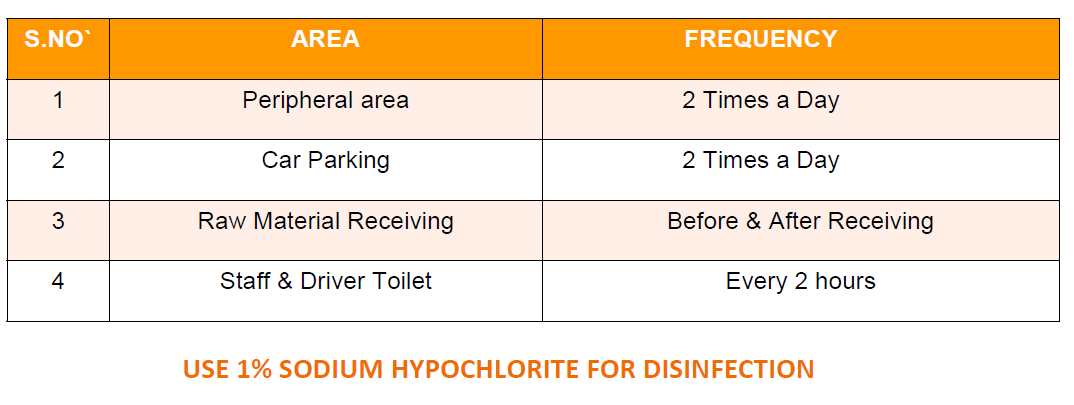
Recommended chemicals
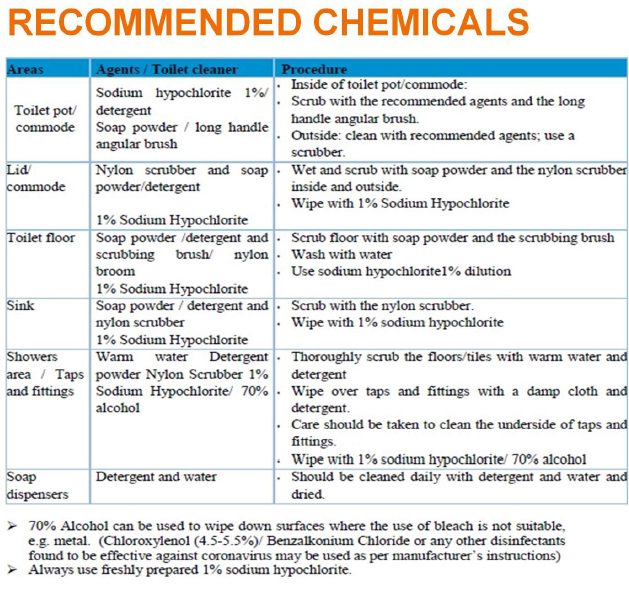
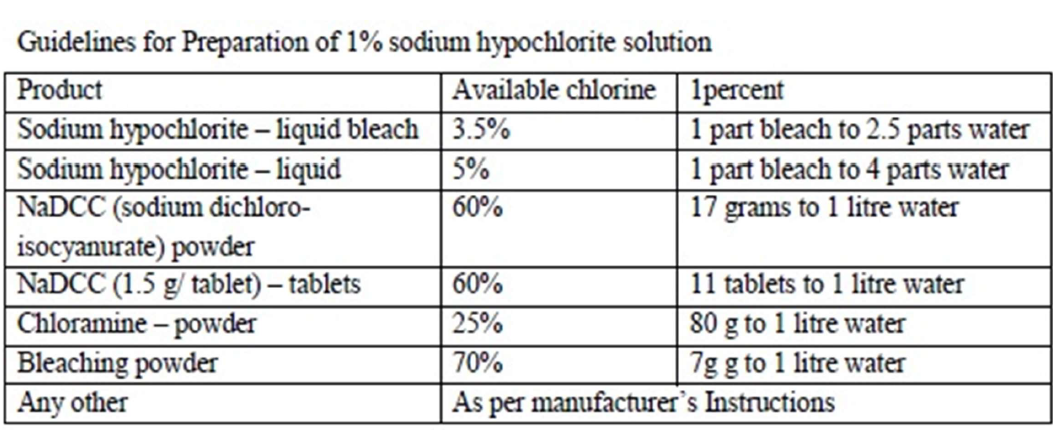
1% sodium hypochlorite solution
Human Resource & high alertness
  • Any person with fever, symptoms of flu should not enter premises
  • During work hours anyone develops symptoms immediately isolate get medical advise and assistance
  • No person assigned to be quarantined or in contact with infected person shall be allowed to come for work
  • Persons resisting for covid 19 procedures or not complying shall be moved out of work
  • A register of monitoring health indicators like fever, cough, running nose , sore throat, short breath be maintained
Material handling
  • Ensure secondary packing does not enter hotel after receiving.
  • If Possible stop primary packing also at store. Transfer it in your own containers or vessels.
  • Daily pre-sanitation of receiving inspection rooms with 1% Sodium hypochlorite.
  • No reverse traffic of materials into kitchen.
  • All items to be handled either with glove or sanitised hand only.
Tips to plan social distancing
  • Minimum distance of one meter from person to person in any direction.
  • Make a plan to schedule staff at each work station.
  • Redefine staff change room rules in terms of resting place, lockers etc so that social distancing is maintained.
  • Realign seats in restaurants and ensure 1 m distance between guests even when they are waiting for takeaway orders .
  • Declare a receiving timetable so that the material receiving area shall have only one supplier at a time.
Guest rooms
  • Remove all amenities like fruit basket, toiletries, snacks etc. and issue it to guest on request.
  • Communicate to guest that amenities will be provided on request.
  • On check out any amenities placed in the rooms shall be discarded.
  • Sanitise TV remotes and high touch points like switches, Chairs, Sofa, Door knobs etc with 70% alcohol.
  • Cover the pillows and mattress with Teflon cover.
  • Sanitise the carpets by spraying 70% alcohol.
Room service
  • Provide Hand Sanitiser at the entry of every room
  • Sanitise food trolleys and food trays before and after every service.
  • DO NOT serve to the guest at rooms. Greet the guest, keep the food and leave the room
  • Assign a trained staff for clearance. No unused packed food served to guest shall be reused.
  • Maintain social distancing of 1m with the guest at all times.
Housekeeping Plan 
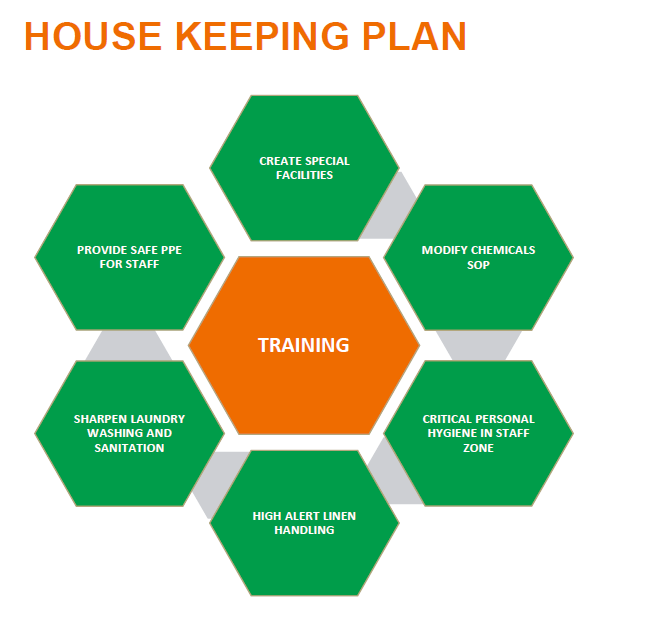
Improved uniforms
  • In addition to the normal uniform the following should be given to the staff:
  • Gloves to operation staff.
  • Individual hand towels.
  • Heavy duty gloves for intense cleaning staff.
  • Provide proper face masks.
  •  Daily new uniform.
  • Full sleeve long coats for kitchen stewarding, staff area cleaning staff
  •  Rubber boots for staff at dish wash, pot wash area.
Linen handling- high alert
  • Housemen should not do bed making or linen handling without face mask, goggles, head cover, gloves, full sleeves long coat up to knee and rubber boots.
  • Removal of guest linen must be left to designated personnel.
  • There should be a closed bin mounted in trolley ensuring this directly put in to laundry.
  • Avoid individual counting by recount make a counting procedure while removing.
  • Give and take any linen through trays or trolleys.
  • Train staff in bed making with gloves and masks.
Sharpen Laundry
  • Create special sanitised place for landing used linen.
  • Segregate clothes through designated person/s using PPE like, full coat, gloves , goggles and face masks.
  • Increase temperature of water to above 75 °C to 90°C for bed linen.
  • Use disinfectant as per govt guidelines or equivalent chemical after verification.
  • Ensure dryers and machine handling parts after every session are sanitised with 70% alcohol based solution.
  • Don’t cough, sneeze or spit directly in to clean linen.
  • Discard any linen from circulation for time being if stains are deep and of human blood or body fluids.
Special points
  • All that guest has touched needs to be disinfected or sanitised.
  • Provide fruit basket or cookies or tea/ coffee maker supplies based on guestrequirements.
  • No reuse of any occupied guest room amenities is allowed hence be guest specific.
  • Concentrate in sanitising phone, door knobs, wash basin and all high touch points like tv remote.
Training
  • Special COVID 19 department based handling training.
  • Training to managers and supervisors on monitoring and reporting on COVID 19 new
  • rules and emergency.
  • Training on personal hygiene with AV’s and posters.
  • Training on social distancing.
  • Training on staff area behaviour, transport and uniform handling specific to COVID 19.
  • Training to focus on motivation due to this stress.
Food services / delivery / takeaways
  • Food Service Area: Thorough cleaning and disinfection after every meal preparation and common touch points such as door knobs, equipment handles, desk, grocery cart handles, etc.
  • Hand wash & sanitation facility: Available to workers, customers especially at the entry
  • Prevention of surface contamination: Use barrier such as tongs, gloves or other utensils to prevent direct hand contact with food, especially for uncooked food.
  • No open display of ready-to-eat foods, should be kept covered in glass displays
  • Visual display of DOs and DONTs
  • Pick-up zones for customers to help maintain social distancing.
  • Prohibition of self service, buffet, mass gathering
  • Disposable items: Use disposable utensils, cutlery, and single use sachet (of salt pepper, sugar, ketchup, etc)
  • E- Payments / E-Wallets: Refrain from handling cash. If handled, wash or sanitise hands. Encourage customers to use e-wallets such as UPI, QR codes, net-banking. In case credit/debit cards are used, the card machine to be sanitized with 70 % alcohol after each use.
  •  Online orders: Encourage customers to place orders online or on telephone, well in advance to reduce the wait time.
Food Delivery: Food Handler
  • Face to be covered with a clean mask or face cover. Hands to be sanitised before food pick up and after delivery.
  • Physical distancing of 1 meter is followed between self and customer.
  • Contact with common touch points such as door bell, handles, etc to be avoided. If unavoidable, hands to be immediately sanitised
  • Contactless delivery methods shall be encouraged.
Food transportation & distribution
  • Train the drivers, loaders and other staff about the COVID-19 infection symptoms and measures for prevention
  • Clean & Sanitize Delivery/transport vehicles regularly. Use vehicle only for food deliveries /distribution.
  • Anyone displaying flu like symptoms to avoid handling / transporting / delivering food.
  • Hand washing material and Sanitizer bottle to be fixed in driver cabin.
  • Face covers to be be worn at all times.
  • Avoid use of public toilets and crowded places during the breaks.
  • If a vehicle enters an area marked as a COVID-19 hotspot, then the vehicle shall be thoroughly cleaned and disinfected before and after use.
  • Maintain relevant records.

World Food Safety Day 2020: Date, theme, significance and quotes

The World Food Safety Day is celebrated every year on June 7 to draw global attention to the health consequences of contaminated food and water. Here are some food safety quotes which you can share with your friends and family.
Human beings are dependent on a few basic needs for living. Food (including water), cloth and shelter are the minimum requirements of a person for a decent standard of life.
Food is a necessity; throughout history, food has acted as a catalyst for societal transformation, development and expansion. But now, food safety is becoming an important issue.
The way in which food is produced, stored, handled and consumed affects the safety of our food. The absence of food safety may harm the health of consumers. Hence, to mark the importance of food safety, the World Food Safety Day is celebrated every year.
Ralph Waldo Emerson once said, "The first wealth is health."
The principles of food safety aim to prevent food from becoming contaminated and causing food poisoning.
The United Nations (UN) has assigned two of its agencies, the Food and Agriculture Organization (FAO) and the World Health Organisation (WHO) to lead efforts in promoting food safety around the world.
When was the first World Food Safety Day celebrated?
In 2018, the United Nations General Assembly declared June 7 as the World Food Safety Day. June 7, 2019, marks the first anniversary of World Food Safety Day and the theme for World Food Safety Day 2019 was 'Food Safety, everyone's business'.
World Food Safety Day 2020: Date
World Food Safety Day is observed on June 7 to draw global attention to the health consequences of contaminated food and water.
"Your diet is a bank account. Good food choices are good investments." -Bethenny Frankel
Today is the second anniversary of World Food Safety Day (WFSD). Through this day, WHO pursues its efforts to mainstream food safety in the public agenda and reduce the burden of food-borne diseases globally.
World Food Safety Day 2020: Theme
According to the World Health Organisation (WHO), under the theme 'Food safety, everyone's business', the action-oriented campaign will promote global food safety awareness and call upon countries and decision-makers, the private sector, civil society, UN organizations and the general public to take action.
Food safety is a shared responsibility in which everybody has a role to play. It is our duty to ensure that the food we consume is safe and will not cause damages to our health.
"Healthy citizens are the greatest asset any country can have." -Winston Churchill
"Food safety is key to achieving several of the Sustainable Development Goals and World Food Safety Day brings it into the spotlight, to help prevent, detect and manage foodborne risks. Safe food contributes to economic prosperity, boosting agriculture, market access, tourism and sustainable development," according to a WHO report.
On this World Food Safety Day, here are some quotes which you can share with your friends, family or on social media pages like Facebook, WhatsApp, Instagram and Twitter with the hashtags #WorldFoodSafetyDay #ZeroHunger to raise the importance of food safety.
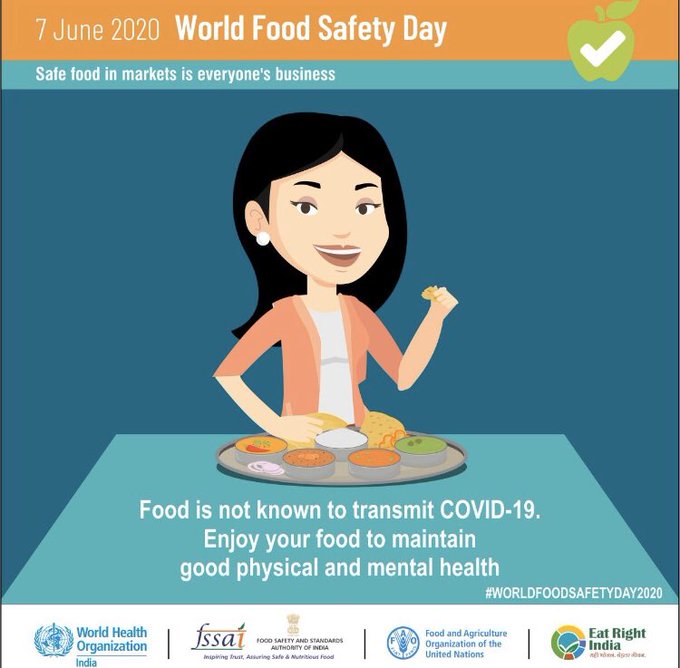
World Food Safety Day 2020 poster (Image source: un.org/en/observances/food-safety-day)
World Food Safety Day quotes
"We're going to do everything possible to make sure that food safety is always paramount, and that we work with the industry as aggressively as we can to make sure that we're paying attention to the food-safety issues." -Mike Johanns
"Sorry, there´s no magic bullet. You gotta eat healthy and live healthy to be healthy and look healthy. End of story." -Morgan Spurlock
"The food that enters the mind must be watched as closely as the food that enters the body." -Pat Buchanan
"Get people back into the kitchen and combat the trend toward processed food and fast food." -Andrew Weil
"Eat breakfast like a king, lunch like a prince, and dinner like a pauper." -Adelle Davis
"Let your food be your medicine, and your medicine be your food." -Hippocrates
"Food safety involves everybody in the food chain." -Mike Johanns
Food t is the third most basic thing for life after air and water. It is the starting point for our energy which keeps us healthy and support well-being. People often take for granted that it is safe, but in an increasingly complex and interconnected chain.
Hence, through the World Food Safety Day, WHO pursues its efforts to mainstream food safety in the public agenda and reduce the burden of foodborne diseases globally.

Jun 7, 2020


World Food Safety Day: WHO Shares 5 Keys To Safer Food

World Food Safety Day: According to WHO, 1 in 10 people fall ill every year from eating contaminated food. Here are five easy ways to practice food safety.
World Food Safety Day: WHO Shares 5 Keys To Safer Food
World Food Safety Day: Practice these five measures for food safety by WHO.
Highlights
  • World Food Safety Day is being celebrated on 7th June
  • WHO has shared a number of guidelines for food safety
  • FSSAI has also assured there is no risk of Covid-19 spread through food
There has been a heightened concern around food safety due to the onset of the Coronavirus epidemic. People are refraining from ordering food from restaurants, and venturing out solely for the purpose of eating. There is an increased preference for eating food that is home-cooked, and seemingly safer. Keeping the epidemic aside, unsafe food in general can cause over 200 diseases as per the WHO. According to the World Health Organisation, 1 in 10 people fall ill every year from eating contaminated food and 4,20,000 die each year as a result across the globe.
In a bid to debunk the myths associated with food safety and to ensure that the food we are eating is safe, the WHO has shared five keys to safer food. These come ahead of World Food Safety Day being celebrated on 7th June, 2020. These are easy guidelines that can be adhered to in these testing times. With these five practices by your side, the safety of your food can be rest assured and you do not have to worry about contracting infections or diseases through your food.

Here Are Five Keys To Safer Food By WHO:

1. Keep Clean
Before we enter the kitchen, it is vital to wash hands and ensure cleanliness and hygiene at all times while cooking.
2. Separate Raw & Cooked Food
It is a good idea to keep raw food in different containers vis-a-vis the cooked ones. This will prevent any risk of contamination for either of the two.
3. Cook thoroughly
Food must be cooked thoroughly and properly before being served, in order to kill any germs and enhance the nutrition too.
4. Keep food at safe temperatures
Different kinds of foods need to be stored differently, location and temperature-wise too. Make sure you follow these practices to ensure safety of food.
5. Use safe water and safe raw materials
The cooking processes should spic and span, as should the raw ingredients and materials. Use safe water and raw materials at all times. Take a look at the full video here:
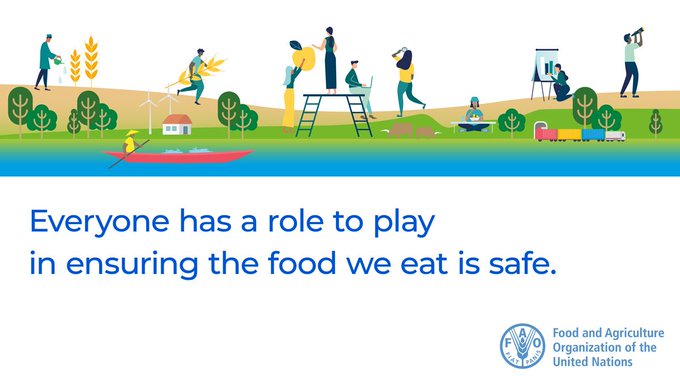
Apart from the guidelines for food safety by WHO, a number of safety measures can be ensured in the process of producing food as well. The Food and Agricultural Organisation (FAO) tweeted about the food safety process, which begins right at the farm and ends with the consumption of the food. It is vital to maintain good standards of food safety at all stages of this process.
As for the major concern surrounding food safety in the Covid-19 times, the Food Safety and Standard Authority India (FSSAI) has issued a clarification. "There is no scientific evidence to indicate the transmission of #COVID19 through food," said the organisation on their Twitter handle.
The clarification comes ahead of the reopening of restaurants on June 8, wherein they will be maintaining the utmost hygiene standards and practices to assure customers. We hope to see more strides in the direction of food safety in future as well!

Is The Food On Your Table Safe To Eat?

On World Food Safety Day, it is important to remember that unsafe food practices claim approximately 4,20,000 lives annually across the world. According to the World Health Organisation, 1 out of 10 people fall ill after consuming contaminated food worldwide each year.
Food is a basic necessity of life, along with clothing and shelter, yet poverty deprives millions of people from accessing clean and hygienic food.
India is blessed with natural resources and abundance of raw materials. However, salubrious food is still a luxury for many Indians. With an abysmally low score of 30.3 on the Global Hunger Index of 2019 - India dropped from 97 out of 118 countries in the Global Health Index in 2016 to 102 out of 117 nations in 2019.
The COVID-19 pandemic has kicked poor people right in their stomachs, leaving them reeling between seasonal hunger and chronic hunger. With the extended lockdown and economic slowdown, their situation seems to be worsening by the day. As days turn into weeks, the growling of their empty stomachs is getting louder, and their despair and desperation has to led to children being forced to scavenge for food or leftovers in garbage dumps.. WHO estimates that nearly 30 % of food borne deaths occurs among children under 5 years of age.
The second World Food Safety Day (WFSD) is being marked today (June 7) after the first event stirred the conscience of the world. Last year, the United Nation General Assembly adopted a resolution to promote food safety everywhere. This year too, it seeks to draw attention and inspire action to help, prevent, detect, and manage food borne risks, contributing to food security, human health, economic prosperity, agriculture, market access, tourism, and sustainable development.
Due to the pandemic, the event -- including discussions, webinars, will be conducted online and promoted on social media with hashtags like 'World Food Safety Day,' and 'WFSD.' 
The objective is to strengthen and ensure food safety for everyone, irrespective of their financial or social status, caste, religion, gender or ethnicity. Food is a fundamental right for all humans, and access to nutritious diet has a direct impact on the growth of every nation.
Safety First
From farm to frying pan, and then to our dining tables, the food we consume comes to us after exposure and contact with different surfaces and hands. This often leads to cross-contamination, where dangerous bacteria gets transferred from a contaminated source to the food. Therefore, care is required at every step till the food reaches the table. A research study found that food borne diseases are expected to rise from 100 million in 2011 to 150-177 million, by 2030. Affluent and urban households are more likely to be affected due to the high consumption of meat and processed food.
As per a 2019 report published in the journal 'Lancet' - India ranks second after China in terms of 'poor diet,' leading to a terrible death toll (1,573,595). The shocking fact is that the 
inadequate and unhealthy diet of poor migrants or laborers is due to their financial constraints, many urban people choose this diet, knowingly and sometimes unknowingly.Blessed are those who get to eat three square meals a day, while millions go to bed hungry and suffer from chronic malnourishment.
The Integrated Disease Surveillance Program of the Indian Ministry of Health & Family Welfare-warns that incidents of food poisoning is becoming increasingly common across the country.
Sharing and Caring -
Food safety is a shared responsibility between governments, producers, and consumers, where everybody plays a key-role in ensuring awareness towards food safety. With the onset of WFSD, WHO calls upon countries to join hands together and reduce the burden globally.
Here are some simple yet effective steps we can take to ensure that the food we eat is safe
1. Cleanliness: A momentary negligence in cleaning can turn infection into a disease. Hence, wash your hands, kitchen countertops, cooking ware, and everything thoroughly. Wash, rub, rinse, and disinfect every single surface, and 70% of the work is done.
2. Separate: Always separate raw meat from other food items, as the bacteria can cross contaminate easily via chopping boards or the cleaning cloth used while handling raw meat.
3. Cooking: Undercooked food is another major cause for food borne illnesses. Therefore, experts recommend that we cook food, especially meat or poultry, thoroughly to avoid any kind of contamination.

Jun 5, 2020

DINAKARAN NEWS


Cloth face masks pose threat to doctors


Food and Drugs deptt seizes 'expired water bottles' in Harwan

Destroys bakery kept in ‘unhygienic conditions’
On the basis of complaint, a team of Food Safety Officers headed by Assistant Commissioner Food Safety, Srinagar seized expired carbonated water bottles at Harwan here.
A statement said huge stock of carbonated water worth Rs 1.75 lakh was seized and the samples were lifted for further necessary action under rules.
Moreover, the statement said, some bakers in the city who have started their business were also inspected and were impressed upon to maintain high standard of hygiene and follow in letter and spirit all COVID19 related guidelines issued by Food Safety and Standards Authority of India.
The statement said bakery items worth Rs 10,000 were destroyed on the spot in Saraibala area which were kept for sale under unhygienic conditions.
Commissioner, Food and Drugs administration, Shakeel-ur-Rehman directed the field officers to keep strict vigil on market to ensure safe and wholesome food to the consumers, said the statement.

COVID-19: How safe are Indian wet markets?

India is a huge market for meats. Apart from usual poultry, bovine and fish, a few protected species are also illegally traded for food in wet markets
Most people did not know the term ‘wet market’ before the novel coronavirus disease (COVID-19) pandemic. The term gained almost universal acknowledgement once it emerged the possible source of the COVID-19 outbreak was the Huanan seafood wholesale market, a wet market in China’s Wuhan.
Close interactions with wild animals caused numerous disease outbreaks in humans even before the emergence of the SARS-CoV-2 virus that causes COVID-19.
Several other strains of the virus — including the Middle East Respiratory Syndrome and Severe acute respiratory syndrome — had zoonotic origins, which means they originated in an animal host before spilling over to human populations.
Other viruses such as Ebola, Nipah, H1N1 (swine flu) all have zoonotic origins.
A wet market usually has multiple open-air stalls spread over a large area that sell vegetables, fruits, meat and fresh seafood. Some slaughter and sell live animals on site, including poultry and fish, while some illegally deal in meat of wild animals as well.
These markets are known as wet markets because water and ice are used to keep food and meat fresh.
India is a huge market for meats. Apart from usual poultry, bovine and fish, a few protected species are also illegally traded for food in wet markets across the country.
The sale of turtle meat is rampant in West Bengal, Bihar, Jharkhand and parts of Uttar Pradesh, according to reports. Wet markets illicitly sell wild meat and other derivatives from porcupine quills to lizard oil to manta rays: All protected species by law.
Consumption of meat per se does not increase the risk of disease transmission. It increases when animals are stressed, stored in small cages and in close contact with humans during the slaughtering process.
The immune system of animals is weakened under duress. Viral pathogens can intermingle and mutate in ways that make them more transmissible between species. The virus can then jump to food handlers or customers through exposure to an animal’s bodily fluids.
Leaders across the world, health experts and international bodies including United Nations have called for a ban on wet markets.
In January 2020 — after the spread of COVID-19 — China closed Huanan market, but re-opened it recently. Closing meat shops indefinitely is not an option.
Meat is an affordable source of nutrition for a large section of people. Strict regulations are needed, however, due to the potential danger of the origin of diseases from wet markets and food habits.
How equipped is India?
The most important legislation is the Food Safety and Standards Act, 2006 (FSSA), that overrides all other food-related laws in operation prior to it. FSSA initiates harmonisation of India’s food regulations according to international standards.
The Food Safety and Standards (Licensing and Registration of Food Business) Regulations, 2011 govern the aspect of license and registration of food businesses, including meat and meat-based products. Under Regulation 2.1, all food business operators in the country are required to be registered. A valid license is needed for any food-related operation and to ensure safety, sanitary and hygienic conditions.
The act has ensured the closure of illegal slaughter houses and butcher shops. Such businesses are now required to obtain proper licenses and follow hygiene-related guidelines laid by Food Safety and Standards Authority of India (FSSAI).
Only goat, sheep, pigs, bovine, poultry and fish are allowed to be slaughtered.
Prevention of Cruelty to Animals (Slaughter House) Rules, 2001 stipulate that a veterinarian must certify the animal is healthy and disease-free before being slaughtered for meat. A number of municipal laws are applicable to meat markets and slaughter houses as well.
No animal may be slaughtered except at a municipal or registered slaughter house, according to section 415 of the Delhi Municipal Corporation Act, 1957.
In localities where a municipal slaughter house exists, it is illegal for animals to be killed anywhere else, according to section 407 of the act. Further, under the Water Pollution Act, it is illegal for slaughter house waste to be discharged into any water resource.
Like many other laws, the implementation of FSSA was found lacking in various aspects. In 2017, the Comptroller and Auditor General of India (CAG) submitted its report on the implementation of the act.
The report found systemic inefficiencies, delays and deficiencies in the framing of several regulations and standards. It was observed licenses were issued on the basis of incomplete documents in more than half of the cases.
It was further noted that most of the state food laboratories entrusted with food testing and certification functions were not only ill-equipped, but also did not possess National Accreditation Board for Testing and Calibration Laboratories accreditation.
To shore up its efforts in 2019, FSSAI mandated a food safety audit for food businesses in six high-risk categories: Dairy products, meat and meat products, fish and fish products, egg and egg products, food for infant nutrition and prepared food (catering).
Third party audits of municipal and other slaughter houses were in progress till now. FSSAI also created a hygiene rating for meat shops. Setting up regional offices and more labs was also proposed.
It is important for existing legislations to be strictly enforced. FSSAI as a nodal agency should be strengthened and better equipped to ensure safe food and food outlets.
Robust measures regarding licensing, sampling and testing need to be put in place. Skilled manpower, with a scientific approach, should be recruited. Penalties for violation of norms should be made stricter. Tighter curbs on illegal wildlife trade are imperative.
Further, there is a need for greater synergy and coordination between concerned ministries, agencies such as FSSAI and civic municipal bodies. State governments must explore and support advanced agricultural technologies to solve food safety (and security) issues.
Alternate meat sources derived from plants and laboratory cultured cell-based meat has already gained traction. This sector is expected to comprise 35 per cent of the global meat market by 2040, according to estimates.
Singer Paul McCartney recently said it was “a little bit medieval eating bats”. He may be right. The Beatles legend famously recorded I wanna hold your hand, making the song a rage in 1963. He did not likely envision social-distancing then. Perhaps it is time to give medieval practices a burial.