Dec 18, 2019

Junk food monster: Communicating diseases

A lab study by the Centre for Science and Environment has found extremely high levels of salt, fat and trans fat in junk foods responsible for obesity and non-communicable diseases like hypertension, diabetes and heart ailments. 
Think before you open the next pack of Haldiram's Classic Nut Crackers or dig into a regular Non Veg Supreme Pizza from Domino’s. Only 35 grams of the scrumptious nut crackers would finish up around 35 per cent of your daily permissible salt intake and 26 per cent of the allowed fat consumption. And four slices of that cheesy pizza would make you consume 99.9 per cent of the day’s allowed salt and 72.8 per cent of fats.
Consumption of these junk foods, that are high in salt, fats and trans fats can have deadly impacts. Doctors say they are an open invitation to non-communicable diseases like diabetes, hypertension, heart ailments and even cancer.
“These diseases are difficult to manage if manifested early in life,” says Ambrish Mithal, head of the endocrinology and diabetes division, Medanta Hospital, Gurugram, Haryana. A 2016 report by the Indian Council of Medical Research (ICMR) shows a worrying trend — disease burden due to unhealthy diet, high blood pressure, high blood sugar, high cholesterol and being overweight has increased from 10 per cent to 25 per cent since 1990. And the victims, many a time, were ill-informed and unsuspecting consumers.
It never bothered Manjeet Singh, an advocate in Delhi, that her 11-year-old son gorged on packaged and fast foods every day. It kept him full and happy, and saved her a lot of time and trouble. Not until the boy started complaining of double vision and headaches. Manjeet was shocked when doctors said he had high blood pressure. “They strictly advised him to reduce weight, not eat junk food and adopt a low-salt diet, else he would be under the risk of cardiac problems and diabetes,” she says. Manjeet could have helped her son had she known, upfront, what was inside those ultra-processed food packs.
The fine print declaring the amount of nutrients is not of much help. “With my vision, I would be spending the entire day buying food if I start reading them,” says Ashok Gulati, a 64-year-old retired professional. It’s impossible for 22-year-old Parvesh Sinha, a departmental store worker who never went to school, to know what he eats.
The Centre for Science and Environment (CSE), a Delhi-based research and advocacy non-profit, had shaken up the country in 2012 when it found high amounts of salt, fat, trans fat and carbohydrate in foods people love to eat. Seven years later, where exactly do we stand?
To understand this, between July and October 2019, CSE’s Environment Monitoring Laboratory again tested their content in 33 popular packaged and fast foods marketed by Indian and multi-national companies and available across the country.
The samples were collected from grocery stores and fast food outlets in Delhi. The lab used internationally accepted testing methods listed by the Association of Official Analytical Chemists (AOAC). Carbohydrate in these foods was tested by the widely used colorimetry method.
The lab results were used to understand how much of each nutrient contributes to the recommended dietary intake for the Indian population. It corelated the results with the serving size or weight of the products to understand the actual intake. The results, to say the least, were shocking.
Chips and namkeens had way more salt and fat than one should consume in a snack. Instant noodles and soups had too much salt.
The analysis was based on the Recommended Dietary Allowance (RDA), derived after reviewing the recommendations of World Health Organization (WHO), National Institute of Nutrition-India, ICMR and the scientific expert groups of the Food Safety and Standards Authority of India (FSSAI).
The RDA for salt was reached at 5g, 60 g fat and 300 g carbohydrate for one person in a day. The trans fat limit was 2.2 g. The calculations were made taking into account the accepted 2,000 kilocalorie that a healthy person requires in a day.
Considering we have three meals in a day and two snacks, our mealtime consumption of these nutrients should not be more than 25 per cent of RDA, and the two main snacks of the day must not add more than 10 per cent of RDA. Now take a look at what the CSE lab tests found. 

Chips and namkeens
What’s advertised by Indian cricket captain Virat Kohli as a healthy and “Smart option for smart snacker” is, in fact, unhealthiest in terms of salt. Of all the chips packets tested, Too Yumm Multigrain Chips had the maximum salt — 1 g in 30 g of chips.
In other words, 30 g of this gives double the day’s allowance of salt from a snack. And even a healthy green vegetable or a leafy salad becomes a source of extra salt. So think again before grabbing on the second snack of the day if you have already munched on Too Yumm Multigrain Chips.
In fact, all the chips tested either had high salt or high fat, or both. Lay’s India’s Magic Masala, Uncle Chipps Spicy Treat and Haldiram’s Chips Pudina Treat exceeded 10 per cent RDA of both salt and fat. One-fifth of the day’s fat RDA gets blown away if one consumes one serve of Haldiram’s Chips Pudina Treat.
Worse, there are chips packets that mention 30 g as the serving size — the amount allowed for consumption — but are not available in that size only. For instance, the Rs 20 pack of Lay’s American Style Cream and Onion that weighs 52 g, mentions 30 g as its serving size.
In effect, it offers more chips than one can consume in one go. So before relaxing on the sofa with a packet of chips, read the fine print and do the mental math to know exactly how many can be enjoyed without getting worried about health.
Haldiram’s Chips Pudina Treat does not even mention the serving size. In fact, it attracts consumers by offering them extra chips. Too Yumm Multigrain Chips gives vague information on the serving size. It says: “Image is a pictorial reference of serving suggestion”. While the picture shows only four-five chips, that's definitely not how much children stop with.
Eating chips frequently results in dental problems, a common ailment otherwise left ignored. “Chips are sticky and remain in the oral cavity for long hours. Soon, they start to ferment resulting in tooth decay and cavities,” says Praveen Chaudhary, senior dentist and head of the department at Jaypee Hospital in Noida, Uttar Pradesh.
CSE’s lab tested four varieties of namkeens. All but one had high salt and fat content, but Haldiram’s Classic Nut Cracker had criminally high salt, exhausting almost 35 per cent of RDA — much higher than one should consume in one full meal. It mentions the 35-g serving size only on its website. Checking this online before tearing the pack open is a difficult proposition.
Haldiram’s Aloo Bhujia exhausts more than 21 per cent of the salt RDA. But there’s no way consumers can know how much salt they consume from these namkeens and chips.
Of the 14 packed foods CSE tested, 10 declare sodium in their products, not salt, which leaves the consumer misinformed. Three don't declare sodium or salt. Only one declares salt. Manjeet, for instance, carefully read the nutritional information of the chips her son regularly munches on, but could not tell how much salt he consumes.
Clearly, food companies are complicating facts. One should consume not more than 2 g sodium in a day, but companies give the information in mg. Now do the mental math one more time. 

Instant noodles and soup 
Akshat, a 13-year-old school student, eats Nestle Maggi Masala instant noodles twice or thrice a week. It’s easily available in his school canteen. But a 70-g pack of this puts 2.6 g salt into our body.
Patanjali, which promotes its Atta Noodles Chatpata with the punchline ‘Jhatpat Banao, Befikr Khao’, contains 2.4 g salt in one pack. Remember, 5 g is all that is allowed through the day.
Ching’s Secret Schezwan goes a step further. It labels less than half the amount of what it actually contains, according to CSE’s lab results.
Similarly, instant soup is popular in winters, but is definitely not a healthy option. Just one serve of Knorr Classic Thick Tomato soup can exhaust over one-fourth of the daily salt limit.
And people love to have it as a starter before meals. So, even a healthy meal afterwards can shoot up your daily salt intake, that too within a short period. As consumers misconstrue these as fresh food for the cooking it involves, the industry makes hay. 
Burgers and fries 
Advertisements affect people’s senses and stimulate responses such as craving to eat. In the long run, this becomes a habit, says Uday Sinha, a professor at the Institute of Human Behaviour & Allied Sciences, Delhi.
In a recent full-page newspaper advertisement, McDonald’s made a disparaging comment on freshly cooked home food. It said: “Stuck with Ghiya-Tori again? Make the 1+1 combo you love.” Even FSSAI called it an irresponsible advertisement as it was against the national efforts to promote the right eating habits, especially among children. Read along to know how healthy McDonald’s combo is. 

Eat one Chicken Maharaja Mac and your daily permissible salt intake is almost over in one go. It has 4.6 g salt, leaving only 10 per cent, or 0.4 g more for the entire day. The fat content is over half the prescribed daily limit for a meal.
A medium McDonald’s fries accounts for almost one-fifth of the daily fat need. The combo has an astounding 103 per cent salt, 72 per cent fat, 13 per cent trans fat and 33 per cent carbohydrate. 
Unsuspecting vegetarians are not any luckier. A vegetarian Cheese Whopper from Burger King will leave you with just over a fourth of the daily salt quota and less than half of that for fat. As its regular fries accounts for almost one-fifth of the daily fat need, adding it to a combo meal, stuffs you with just too much nutrients.
Burger, fries and fried chicken from KFC’s 5-in-1 classic zinger box would give 20 per cent more fat than the day’s quota along with very high levels of salt and trans fat.
“Food companies know that India is a naive market for junk food. A large population is unaware of nutrition and good food. Junk food is being made and sold in a manner that it is addictive,” says Vandana Prasad, a community paediatrician. So think twice before you choose that combo meal over home-cooked food.
Smaller burgers are cheap and attract people. But their contribution to RDA is big. KFC’s Veg Zinger with cheese can exhaust up to three-fourths of the daily salt brink and 45 per cent of the fat limit. Its Chicken Classic Zinger with cheese finishes over 80 per cent of fat and over 60 per cent of salt threshold. Burgers with cheese have more trans fats. 

Pizza, sandwich and wrap 
Pizza is considered a healthy fast food meal option because of the vegetables it comes with, but CSE lab results found it is loaded with salt and fat, and has high levels of trans fat.
It tested vegetarian and non-vegetarian pizzas from Domino’s and Pizza Hut along with one sachet of oregano seasoning it comes with. These were regular or personal pizzas meant to be consumed by one person.
Domino’s Non Veg Supreme has about 5 g salt, while Peppy Paneer cheese burst has only slightly less. So, no more space for salt from any other food, if these pizzas are consumed.
Non-veg Supreme also exhausts about three-fourths of the permissible fat. This also provides high levels of unhealthy trans fat — about one-third of the limit. Pizza Hut’s Chicken Supreme has more salt than one needs for the day.
Even the humble Classic Tomato Margherita from Pizza Hut can add over 50 per cent of the daily salt intake, 25 per cent of fat and about one-fourth of the trans fat limit. Excessive trans fat content in all pizzas that were tested is a cause for concern.
CSE lab tests also examined sandwiches, often perceived as healthy food for the raw vegetables it uses. But the result was disturbing. Salt, fat and trans fat content in sandwiches are as high as in pizzas.
 6-inch Subway Chicken Seekh Kabab sandwich has about 5 g salt, 39 g fat and 0.62 g trans fat. This is not just the amount of salt one can have in an entire day but also adds up to 65 per cent of the recommended fat levels and 28 per cent of trans fats.
Its vegetarian option, the Paneer Tikka sandwich, is not any healthier and exhausts over three-fourths of salt and fat limits, and one-fourth of trans fat limit. McDonald's Big Spicy Paneer Wrap will give you about 4 g of salt and 45 g of fat. 
Facts on trans fats 
Trans fats are deadly. Their intake must be avoided to prevent heart diseases. CSE found that most food companies either do not disclose or give more than the amount they declare.
Haldiram’s Classic Nut Cracker, for instance, had 4.6 times trans fat it claims to have. Fast food companies Domino’s and Subway do not mention trans fats at all on their website.
But all four of their samples that CSE tested had high trans fats. Burger King and KFC mention 0 g, suggesting no trans fats. That's not the case. Trans fats found in two pizza samples of Pizza Hut were higher than what the company declared.
“A diet high in trans fat can increase the risk of heart disease,” says Mithal of Medanta Hospital.
Clearly, companies are not bothered.
(Names of consumers have been changed to protect their identity)
Study by Mrinal Mallik, Arvind Singh Sengar and Rakesh Kumar Sondhiya Analysis by Amit Khurana and Sonal Dhingra

Fast food safe? Take it with pinch of salt

‘Dangerously high’ salt and fat content in samples
Samples of some food products, including chips, snacks and fries, contain amounts of transfat — a type of fat with detrimental health effects and not essential in diet — higher than their labelled values, the CSE also claimed.
Many packaged snacks and fast food products sold across the country have salt and fat levels higher than thresholds proposed by India’s food safety regulator, the non-government Centre for Science and Environment claimed on Tuesday, calling for red warning labels on them.
The CSE, which released its findings of salt and fat content in limited samples of several products, including burgers, French fries and noodles, has also alleged that the Food Safety and Standards Authority of India (FSSAI) has diluted labelling rules to favour the industry.
Samples of some food products, including chips, snacks and fries, contain amounts of transfat — a type of fat with detrimental health effects and not essential in diet — higher than their labelled values, the CSE also claimed.
“We have found dangerously high levels of salt and fat in the samples of packaged and fast food we tested,” Sunita Narain, the CSE’s director-general, said in a media release. “Consumers have a right to know what is contained in the package, but the FSSAI is dragging its feet and has not notified its own draft labelling regulation.”
The analysis, which tested 14 samples of packaged food and 19 samples of fast food, for instance, has found that salt levels in chips ranged from roughly two to five times the FSSAI’s proposed threshold of 0.25g per 100g. Samples of other packaged products tested contained two times to seven times the salt threshold.
Samples of burgers contained up to 1.5 times salt levels while fat levels ranged from 1.1 to 2.4 times the threshold value of 8g per 100g. A paneer tikka sandwich tested had 1.6 times salt and 2.3 times fat thresholds.
The CSE has claimed that the FSSAI, which had released draft regulations for food labelling in July 2018, has since then diluted labelling rules in fresh draft regulations released earlier this year.
The FSSAI did not immediately respond to a query from The Telegraph seeking reactions to the CSE’s claims.
The new draft regulations have replaced salt with sodium, total fat with saturated fat, and total sugar with added sugar. The CSE said salt was easier to understand than sodium, saturated fat addresses only one part of the problem, and added sugar made the threshold weaker.
“We’ve been waiting for the FSSAI to notify the regulations — it’s over 18 months since the 2018 draft,” said Amit Khurana, director for food safety at the CSE. It has also pointed out that the draft regulations do not specify the size and placement of the warning labels.
The CSE has called on the FSSAI to introduce red warning labels in line with “global best practices” on such snacks and fast food products whose salt or fat levels exceed the threshold values.

Fast food putting you at risk of heart attack

New Delhi: Most of the snacks, noodles and fast food items sold in the market contain higher than permissible limit of salt. In some cases, a study conducted by the Centre for Science and Environment showed, the salt content is three to five times the threshold set by the Food Safety and Standards Authority of India.
High salt intake, experts said, is a known cause for high blood pressure, which causes 57% of heart attack and 40% of stroke cases. “A small amount of salt on a daily basis — WHO recommends less than 5 grams per day per person — is essential for nerve and muscle function. But it is seen in India that people consume eight to nine grams of salt daily,” said an expert. 
FSSAI norms — drafted recently, but not notified yet — permit 0.25 gram of sodium per 100 grams of savoury snacks and instant noodles. For soups and fast foods, the threshold of salt is 0.35 gram per 100 grams.
CSE said tests showed one of the popular chips brands had 1 gram of salt content in 30 gram of chips. Among namkeens, one brand had salt content seven times the recommended threshold. Dr Sunita Narain, director of CSE, said they tested salt, fat, transfats and carbohydrates in 33 popular junk foods, which included 14 samples of chips, namkeen, instant noodles and soups and 19 samples of burgers, fries, fried chicken, pizza, sandwich and wraps.
The CSE director general said consumers have a right to know what is contained in the package, but FSSAI has not notified its own draft labelling regulation. Her comment refers to the delay in notifying the draft Food Safety Standards, (Labelling and Display) Regulations, which has been in preparation since 2013.
“The recommended dietary allowance of salt and fat is five grams and 60 grams respectively daily. However, we found that eating one burger sold by major brands exhaust anywhere between 62% to 82% of the recommended salt intake for the day and 82% to 120% of the recommended fat intake,” said Amit Khurana, programme director, food safety and toxins at CSE.
FSSAI said in a statement that it has been taking up the junk food regulations seriously and has already put up the draft notifications in public for comments.

Packaged foods breach safe limits of salt, fat: CSE study

Agency tested salt, fat, trans-fat and carbohydrates in 33 popular ‘junk foods’
An array of packaged snacks and fast foods breach safe limits of salt and fat content, says a laboratory analysis by the Centre for Science and Environment.
The agency tested salt, fat, trans-fat and carbohydrates in 33 popular “junk foods”, which consisted of 14 samples of chips, salted snacks, instant noodles and instant soup, and 19 samples of burgers, fries, fried chicken, pizzas, sandwiches and wraps. The samples were collected from grocery stores and fast food outlets in the city.
Daily ceiling
To calculate how unsafe the foods tested were, the organisation relied on the concept of the Recommended Dietary Allowance (RDA) — a daily ceiling on the amount of salt, fat, carbohydrates and transfats. The RDA is based on scientific consensus and has been agreed upon by expert bodies such as the World Health Organisation, and the National Institute of Nutrition in India. It says that, ideally, no more than 5 gm of salt, 60 gm of fat, 300 gm carbohydrate and 2.2 gm of transfat should be consumed by an adult every day. Further, the RDA from each breakfast, lunch and dinner should be no more than 25%, and that from snacks no more than 10%.
The CSE found that given the size of the servings and the amount of nutrients per 100 gm, a single packet of packaged nuts, soup or noodles ended up having these salts and fats well over the recommended limits. For instance, Haldiram Aloo Bhujia, a popular savoury snack, with a serve size of 231 gm, had the equivalent of 7 gm of salt and 99 gm of total (saturated and unsaturated) fat. A single serving of the Nestle’s Maggi Masala (70 gm) exhausted 50% of the composite RDA for a snack, and a serving of Haldiram’s nut cracker exhausted 35% of the salt RDA and 26% of the fat RDA, the CSE analysis found.
Need to declare
According to the proposed draft Food Safety and Standards (Labelling and Display) Regulations, packaged food companies will need to declare nutritional information such as calories (energy), saturated fat, trans-fat, added sugar and sodium per serve on the front of the pack. The food labels are also required to declare, per serve percentage contribution to RDA on the front of the pack. Though under discussions since 2015 and several drafts — the latest one came out in in July — these rules have yet to become law, and to be operationalised.
‘Red Octagon’
The CSE took the values prescribed in the drafts for their calculations and concluded that all of the popular snacks and fast foods ought to be displaying a ‘Red Octagon’, a warning symbol employed in packaged foods in Chile and Peru. The Red Octagon, which should be printed on the front of the pack, has a number and the name of the food component within that indicates how widely off the RDA a particular ingredient is. Thus a Red “3.1, Salt” on a pack of Lay’s India’s Magic Masala by PepsiCo indicates that the salt it contains is 3.1 times the RDA for snacks.
“What we have seen is that all of the packaged foods of the various brands we tested would be in the red. This is why the powerful food industry is opposing the notification,” said Sunita Narain, director general of CSE, at a press conference. The regulations, as they now stand, don’t apply to fast foods such as burgers and pizzas, even though they were included in the CSE analysis.

Packaged water bottles without expiry dates seized

Trichy: Food safety department staff seized four packaged drinking water cans that were found without expiry date in Pudukottai district on Tuesday.
Al-Hajee Aqua, a Pudukottai-based packaged drinking water company, which was supplying the cans, was booked under food safety and standards Act, 2006, for not registering their vehicle with the food safety department.
Every vehicle used for transporting foods material need to be registered with the food safety department. Officials from the food safety department intercepted the vehicle when they were supplying drinking water in the collector office premises on Tuesday. Designated officer from food safety department, Pudukkottai R Ramesh Babu said that the vehicle was summoned to the food safety office after it was found to be having cans without expiry dates.
“A total of four bubble top can with a capacity of 20liters were found without expiry dates. We have taken legal samples from those cans. A case was booked under section 58 of food safety and standards act, 2006 for registering the vehicle with food safety department,” he said.
Action will be initiated against the company if the water quality was not found within safety standards, he added.

Banned tobacco products, rotten fruits seized

Officials of the Food Safety and Standards Authority of India (FSSAI) conducted surprise checks in shops at Singanallur and seized banned tobacco products, rotten fruits and artificially coloured food products worth around ₹ 1.89 lakh late on Monday.
K. Tamilselvan, Designated Officer of FSSAI in Coimbatore, and food safety officers conducted simultaneous checks in 67 shops.
According to food safety officials, banned tobacco products of 100.5 kg were found in six shops during the raids. Notices were served on the owners of the shops.
The officials said that 16 out of the 67 shops inspected had not obtained the licence or the registration certificate from the food regulator.
Around 120 kg of rotten fruits, artificially coloured food products, expired packaged food products and banned plastic products worth ₹ 74,000 in total were also seized from the shops during the raids.
Warning
FSSAI warned that stringent action would be taken against those selling banned tobacco products in the vicinity of schools and colleges.
Licence and registration certificates of shops that were found selling or stocking banned tobacco products would also be suspended, the officials added.

Crackdown on shops selling unsafe food

Coimbatore: Food safety department officials on Monday seized expired and spoilt food from 16 eateries in the Singanallur bus stand. They also found six shops selling banned tobacco products.
The officials had checked petty shops, bakeries and restaurants located in and around the bus stand following the collector’s order. They seized 100.5kg banned tobacco products, including chewable tobacco, worth Rs 1,15,000 from six shops. 
“We also checked the quality of food sold by the eateries. We checked the use of plastic, artificial colouring agents and whether they were selling or using expired products,” said designated food safety officer K Tamilselvan.
The team found 16 shops flouting food safety norms. “Some shops were found selling chilli chicken that had banned colouring agents. Some were selling rotting fruits, artificially-ripened fruits including banana, spoilt halwa and chips. A few were found using plastic bags and straws,” Tamilselvan said.
The officials issued notices to the shops and warned of cancelling licenses if they repeat the offence.
The district administration will cancel the license of shops found selling tobacco products within 100 yards of educational institutions, sources added.

Awareness programme for food business operators held

‘There are around 6,000 licensed food operators in Madurai’
MADURAI
Food Safety Department organised a programme to create awareness of the Food Safety and Standards Act, 2011, among food business operators (FBOs), here on Tuesday.
M. Somasundaram, Designated Officer for Food Safety, Madurai district, addressed the FBOs on the importance and ways of procuring a licence under the Act. “Currently, there are around 6,000 licensed food operators in the city. Through such programmes we are sensitising them that obtaining licences for their businesses is mandatory under the Act,” he said.
Over 100 FBOs from across various sectors took part in the programme. There was widespread use of used cooking oil by hotels and eateries across the district and this issue had to be addressed, said Mr. Somasundaram. The department had launched an initiative, Repurpose Used Cooking Oil (RUCO), to recover used oil from vendors and the food industry. The department was also paying ₹25 for every litre of used oil. The oil purchased this way will be used for the production of biodiesel,” he said.
He also said that edible oil, which was not packed, was prohibited for sale under the Act. Packing toys or gifts with food products for infants was also not permissible.
“The cold press oil produced in the city has not been meeting the standards prescribed under the Act. So, the manufacturers must collectively petition the Chief Executive Officer in the department for a solution,” he said.
During an interaction with the Designated Officer, the participants discussed their problems. “Most of the FBOs in the district don’t understand the Act and are unconsciously violating the law. These programmes provide a platform to address this issue,’ he said.

Dec 17, 2019

DINAMALAR NEWS


DINAMALAR NEWS


DINAKARAN NEWS


DINAKARAN NEWS


DINAMALAR NEWS


DINAKARAN NEWS


DINAKARAN NEWS


DINAKARAN NEWS


Bengaluru: Central Jail inmates could soon be given safe and hygienic food


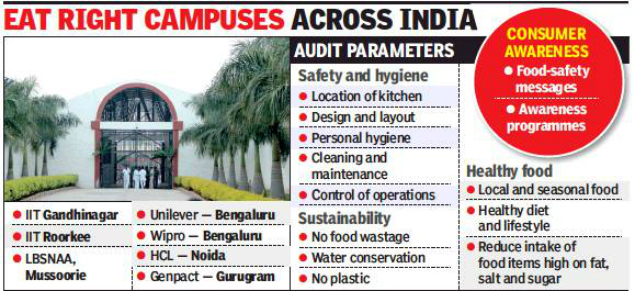
BENGALURU: No excess sugar, salt or oil. Fresh, healthy food with plenty of veggies and sprouts. Central Jail at Parappana Agrahara could soon become an Eat Right campus certified by the Food Safety and Standards Authority of India (FSSAI). 

Eat Right is a training and audit mechanism to ensure food produced and consumed is safe, hygienic, sustainable and healthy. A campus selected under this initiative must meet four parameters (see box) and the same is rated on a five-star mechanism.
If certified, the state's largest jail, which houses several VIP inmates, will be the second prison complex in India to earn the title after Tihar, where the certification process is under way. "FSSAI chairperson Rita Teaotia who recently visited Bengaluru, discussed the Eat Right programme with various stakeholders, including representatives from Central Jail. Jail representatives said it was heartening to note that prisons too were being considered as potential campuses as jail inmates are usually neglected. They said 5,000 inmates from low socio-economic background could benefit from this initiative. Since then, we have been working on the licensing/registration process. We will soon begin training, followed by an audit framework," said Ruchika Sharma, media coordinator, FSSAI. 
We've had an initial round of talks. While the area of food preparation is somewhat streamlined, our challenge is at the consumption level. With the jail having a floating population, there is no proper process to make the inmates aware of healthy eating habits. As most of them are from under-privileged background, they do not understand the importance and value of a balanced and nutritious diet. All these concerns need to be addressed," said Dr Uma M, chief medical officer, central prison, Bengaluru.
According to FSSAI, in May-June 2019, 950 inmates at Tihar jail were trained in these healthy food practices. While the department of food safety, New Delhi, has made it mandatory to deploy a food safety supervisor in its prison complex, it has also proposed to build a food-safety testing laboratory in future. Tihar jail houses 32 kitchens and two manufacturing units which prepare food for almost 40,000 people.

FSSAI intervenes as dispute over denition of ice cream heats up

Kollam: A dispute over the denition of ice cream has risen between two camps of sweet and dessert manufacturers in Kollam district of Kerala. Though the matter was dragged into a court here, the Food Safety and Standards Authority of India (FSSAI) has intervened as it remained unresolved. The central food safety regulator is all set to dene an ice cream and explain what all goes into or doesn't go into its making. 
The feud was triggered after a group of companies demanded that frozen desserts should also be allowed to be labelled as ice creams. However, the rival group is contending that products which are not made by using dairy fat should not put under the ice cream category. 
Ice cream is prepared by using primary ingredients milk or milk solid, sugar, and ice crystals. Dairy fat would be added to these. However, some companies add vegetable fat instead of dairy fat. Their demand is to include desserts that use vegetable oil also in the category of ice cream. However, the companies that make ice cream using dairy fat have objected to this. 
Thus, the FSSAI has intervened to resolve the dispute. An expert committee was formed to dene the ice cream. Though the committee met, its members have sought more time to take a final decision.
As per the norms frozen sweets should have a label, clearly making the dairy fat, vegetable oil and protein products.

Dec 15, 2019

DINAKARAN NEWS


Government waives fee for food adulteration test

  • Food Safety and Standards Authority of India (FSSAI) has authorised credible voluntary consumer organisations (VCOs) to assist consumers in getting such tests done
  • To overcome the problems, the FSSAI has said, testing fees will now be reimbursed, even if the consumer sample does not fail

New Delhi: Doubtful about quality of a food product? You can now get the sample checked in government designated food laboratories free of cost.
The apex food regulator, Food Safety and Standards Authority of India (FSSAI) has authorised credible voluntary consumer organisations (VCOs) to assist consumers in getting such tests done.
Currently, in India food safety law provides for reimbursement of testing fees only if a consumer sample fails. According to the government, this provision has however never been used due to some practical difficulties.
To overcome the problems, the FSSAI has said, testing fees will now be reimbursed, even if the consumer sample does not fail.
The food regulator has authorised 80 VCOs to facilitate the testing process.
The VCOs will create a nationwide network of consumer organisations for food safety and nutrition (NetCOFaN) with the support of FSSAI.
“The tests will be done only through pre-selected consumer organisations and limited numbers. We will try it with a few credible consumer organisations first and then scale it up," Pawan Agarwal, CEO, FSSAI told Mint.
“Consumer organisations will be linked to identified labs and tests will only be done at those labs," he said.
NetCOFaN will initially work in three specific areas, i.e. awareness and training, mobilization of small and petty food businesses for various schemes, and food testing and surveillance.
The network will also use content on food safety and nutrition by FSSAI with their ground level contacts for awareness and training programmes by localizing it.
On-ground presence of VCOs will help reach the messages to local areas across the country. Support of VCOs will also be taken to mobilize small and petty food businesses to participate in hygiene rating, cluster certification and food safety training and certification (FoSTaC) programmes.
VCOs will be provided with ‘Food Safety Magic Box’ that has over 100 simple do-it-yourself tests for common adulterants and a kit for testing in mid-day meal scheme.
“Creation of network would help to build synergies amongst them and is very innovative way of FSSAI in reaching out to the consumers across the country," said Pushpa Girimaji, an expert on consumer issues.
Starting the process, FSSAI has partnered with Delhi-based Consumer Voice to check safety and quality of milk products in Delhi NCR, for which it has collected samples of paneer, khoya and desi ghee and other milk products.
These samples were coded by Consumer Voice and tested in FSSAI’s National Food Laboratory at Ghaziabad. The results of this surveillance would be compiled soon and shared with concerned stakeholders. Preventive and corrective action, if needed, would then be initiated jointly by Consumer Voice and the State food authorities.
Evidence based point system has been put in place to monitor work of VCOs and they would be provided token funding based on of activities to ensure sustainability and continuity.
FSSAI had earlier asked top-200 food companies to appoint nodal persons for consumer grievances. These persons have been trained for effective consumer grievance redressal. FSSAI is now looking at ways of using services of VCOs in effective redressal of consumer grievances.

Now, food quality can be tested in government-designated laboratory free of cost

NEW DELHI: Unsure about quality of your food? You can now get the sample tested in a government-designated food laboratory free of cost.
Food Safety and Standards Authority of India (FSSAI) has authorised voluntary consumer organisations (VCOs) to assist consumers in getting such tests done and also waive the existing fee for it.
At present, the food safety law provides for reimbursement of testing fees only if a consumer sample fails. However, the regulator feels the fees is a factor why consumer hesitate to bring samples for testing.
FSSAI said provisions have now been introduced to reimburse testing fees even if the consumer sample does not fail.
The food regulator has authorised 80 VCOs to facilitate the testing process. These organisations will create a nationwide network of consumer organisations for food safety and nutrition (NetCOFaN) with the support of FSSAI. These consumer organisations will be linked to identified labs and tests will only be done at those labs, the regulator said.
The network will also use content on food safety and nutrition by FSSAI with their ground level contacts for awareness and training programmes by localizing it.
On-ground presence of VCOs will help take messages to local areas across the country. Support of VCOs will also be taken to mobilize small and petty food businesses to participate in hygiene rating, cluster certification and food safety training and certification programmes, FSSAI said.

Dec 14, 2019

DINAKARAN NEWS


DINAMANI NEWS


DINAKARAN NEWS


DINAKARAN NEWS


Food or drug? Government to take a call soon

 
NEW DELHI: Is a multivitamin preparation a drug or just plain old food? And what about pick-me-ups like Revital or supplements like Ferradol? Given the confusing proliferation of products, the government is looking to arrive at an answer by changing the regulatory framework. 
It appears the solution will be broadly along these lines: If the ingredients of a particular product are below that determined as the daily dosage, or 1RDA (Recommended Dietary Allowance), then it will be deemed ‘food’ and regulated by the Food Safety and Standards Act (FSSA), according to people with knowledge of the matter and documents that ET has seen. Anything above that will be a ‘drug’ and regulated under the Drugs and Cosmetics (D&C) Act. 1RDA is defined as the level of nutrients to be consumed daily to meet all the requirements of a healthy individual. At a recent meeting between the Drug Controller General of India (DCGI) and the FSSAI, which administers the FSSA, it was decided that multivitamin preparations containing vitamins in a strength lower than 1RDA would be excluded from the D&C Act. The Act will be amended so that vitamins and minerals below 1RDA for prophylactic purpose are deleted from Schedule V. 
“Prophylactic levels of vitamins and minerals equal to or less than 1 RDA as specified by ICMR, may be regulated under FSSA and its rules,” FSSAI told the DCGI in a November 21letter, asking it to make the necessary amendments in the D&C Act. 
Most companies prefer to position their products as health supplements under the FSSA to avoid the more onerous D&C Act regime, which could also invite price controls. The ambiguity stems from multivitamin preparations being covered by both the D&C Act and by the FSSA. Taking advantage of this overlap, companies had started seeking approval of the Food Safety and Standards Authority of India (FSSAI) to circumvent price controls and tighter regulation. “There is an apparent regulatory overlap of FSSA and D&C Act since multivitamin composition of certain products are, in fact, used for both prevention of diseases as well as providing health benefits,” said a senior government official on condition of anonymity.
For example, Abbott’s product Limcee Plus, which was approved by FSSAI in January 2018 in the health supplement category, costs Rs 60 for a strip of 15 tablets. On the other hand, its chewable vitamin tablet Limcee, on the national list of essential medicines since 2013, costs Rs 14 for a strip of 15 tablets. The company says Limcee Plus contains amino acids and thus doesn’t just target patients who suffer from vitamin C deficiency. 
The DCGI and FSSAI had earlier this year approached the Indian Council of Medical Research (ICMR) to review prophylactic doses mentioned under Schedule V and Schedule K of the D&C Act vis-a-vis the doses prescribed under the FSSA with an intent to avoid confusion. 

VACB finds Food Safety staff-hoteliers nexus

Officers reluctant to register complaints, violations never reach trial stage
The Vigilance and Anti-Corruption Bureau (VACB) on Friday said endemic corruption in the Food Safety wing had brought the State to the brink of a public health crisis.
The agency, which conducted a surprise inspection of Food Safety offices in the State, said that inspectors accepted bribes and rarely sent food samples collected from outlets for chemical examination. They appeared reluctant to register complaints from the public or record them in registers and give acknowledgement receipts to petitioners. Citizens who sought information on action taken on their appeals were turned away harshly.
Director General, VACB, Anil Kanth had ordered the inspections code-named Operation Jeevan after a family was laid low recently consuming stale food from a popular latenight eatery here.
Investigators said that Food Safety inspectors routinely buried damning food safety analysis reports to save favoured hoteliers in exchange of sizeable backhander payments.
In many cases, food safety officials did little to remove banned food products from supermarket shelves.
The agency said corrupt officials ensured that food safety violation never reached the trial stage. They saved the accused by letting them off with minor fines.
Records fudged
Food safety officials who detected persons responsible for food contamination rarely prosecuted them. They fudged records and accepted bribes to protect the offenders.
In many cases, officials laid down a smokescreen by conducting make-believe inspections at predictable places and timings.
They often saved violators by insulating them from criminal prosecution and restored the food permits secretly days after they annulled them publicly.
In Varkala, the VACB found that inspectors had only sent eight out of the 101 stale food samples seized from various outlets for food safety tests.
The office had taken no action on 23 complaints received from tourists about food sold in the tourist resort area.
In Thiruvananthapuram, the VACB found that the Assistant Commissioner, Food Safety, had taken no action on 78 complaints. The situation was the same in food safety offices in other districts.
An investigator said hoteliers paid food safety inspectors to inform them earlier about food safety raids.

FSSAI mulls cattlefeed norms to curb animal food contamination

Animal feed and fodder are turning out to be a major source of contaminant of foods of animal origin - The Hindu
For now, feed/fodder to conform to BIS standards
The Food Safety and Standards Authority of India (FSSAI) is looking at bringing in standards for animal feed so as to curb contaminants, pesticides and heavy metals finding their way into foods of animal origin through feed and fodder.
Till the time these regulations are finalised, the FSSAI has directed that cattlefeed materials must conform to norms set by the Bureau of Indian Standards (BIS).
Six-month breather
“In order to address the issue on an interim basis, it has been decided that commercial feeds/feed materials intended for food producing animals shall comply with the relevant BIS standards and shall not be manufactured, imported, distributed and sold except under the Bureau of Indian Standards certification,” the directive said. Stakeholders have been given six months to comply with the directive, which will come into force in June.
Noting that animal feed and fodder are turning out to be a major source of contaminants of foods of animal origin, it said, “regulatory control to ensure quality and safety of animal feed and silage is urgently needed.”
According to the findings of the National Milk and Quality Survey, 2018, traces of contaminants such as Aflatoxin M1 have been found not just in raw milk supplied by unorganised players but also in processed milk supplied by organised players; feed and fodder are the cuiprit. The food safety authority had said that the presence of Aflatoxin M1 residues beyond permissible limits in processed milk is a serious concern.
In its action plan for safe and quality milk and milk products, the FSSAI believes that “regulatory values or recommendations through legislation can limit animal exposure through feed ingestion against the presence of residues of mycotoxins in animal-derived products.”
The regulator has also said that it will be putting in systemic efforts to improve animal husbandry practices to address safety and quality concerns over milk.
The FSSAI, in collaboration with the Ministry of Animal Husbandry, Dairying and Fisheries along with the National Dairy Development Board, will work towards enhancing awareness on improved animal husbandry and farm practices among small dairy farmers.

FSSAI inks MoU with Nasscom to prevent food wastage

New Delhi, Dec 13 (KNN) Food Safety and Standards Authority of India (FSSAI) has signed a Memorandum of Understanding (MoU) with Nasscom foundation to develop an app and set up a 24×7 helpline number to connect donors with surplus eatables with food distribution organisations.
“India will soon have access to a common help-line and a mobile application ‘Food Donation in India’ to donate food to the needy. FSSAI and NASSCOM Foundation have signed a MoU today to jointly build a technology platform for Food Donation in India,” FSSAI said in a statement.
The platform will also facilitate registration of surplus food distribution organisations, and initially, the network of 81 such organizations across PAN India, known as the Indian Food Sharing Alliance (IFSA) will be a part of this platform, it said. The solution, FSSAI said, will provide an easy accessible platform that will cater to different stakeholders like food businesses, hoteliers, caterers, individuals etc and facilitate food donations in any part of the country.
FSSAI CEO Pawan Agarwal said that this would definitely provide a recognition to the organisations involved in surplus food distribution and would help in reducing the wastage of food in the country through food donation.
On the other hand, Ashok Pamidi, CEO, Nasscom Foundation said the collaboration is a significant step in the direction of leveraging tech for solutions and the foundation hopes more such engagements in future.

Visible food safety violations to attract spot fine from now on

Visible violations by Food Business Operators (FBOs) are expected to see a decline with the Food Safety and Standards Authority of India (FSSAI) all set to start levying spot fines.
As per a new directive, Designated Officers of the FSSAI in each district can now impose spot fine on FBOs who are found with certain visible violations.
While violation for the first and second time attracts fine, repetition of the same violation for a third time will attract a higher amount of fine and cancellation of the registration certificate issued by the food regulator.
The spot fine is also expected to have an impact on the sale of banned products like gutka as seizure of any such item for a third time will attract cancellation of registration certificate and a spot fine of ₹ 25,000, the highest fine among all violations.
K. Tamilselvan, Designated Officer of FSSAI for Coimbatore, said that the spot fine system was expected to have a deterrent effect on FBOs that repeatedly flouted food safety norms.
“The new directive empowers Designated Officers to levy spot fine when a food is found containing extraneous matter, FBOs failing to comply with directions of food safety officers, unhygienic or unsanitary processing or manufacturing and sale of food items,” he said.
FBOs, who are slapped with a spot fine, will have to pay the amount at the treasury and food safety officers cannot collect the penalty as cash. If the FBOs fail to pay the penalty within the stipulated time, the Designated Officer can suspend the registration certificate of the FBO until the penalty is paid.
According to Dr. Tamilselvan, misbranding, label violations, possession of banned food products and adulteration in certain food items are among the common visible violations found in Coimbatore.
“The spot fine applies to the possession of banned food item like gutka when the seized quantity is less than that of the sample quantity. Sample quantity means the quantity required to lift four separate samples of the same item for laboratory analysis. Now, even if a vendor is found with two or three sachets of different gutka, spot fine can be levied,” he explained.
Stating that levy of spot fine would have a deterrent effect on violators, Coimbatore-based lawyer and consumer rights activist V.P. Sarathi said that the food safety officers should also strictly implement other provisions of the FSSAI Act to bring down other violations by FBOs.
Citing an incident wherein he found worm in a packaged drinking water a year ago, sample of which was subsequently found “unfit for human consumption” in a laboratory analysis, Mr. Sarathi said that the food regulator only served a ‘caution notice’ to the manufacturer.
“Such offences should have seen a logical end of prosecution by the court and heavy fine should have been imposed on the violator,” he opined.
A meat stall owner with whom spoke to said that the spot fine would not affect traders, who sold quality meat to customers, but would help buyers understand those who sold sub-standard items.

Dec 13, 2019

DINAKARAN NEWS


DINAMANI NEWS


GUTKA AND PLASTICS


DINAKARAN NEWS


DINAMANI NEWS


இனிமே பானி பூரி சாப்பிடும் போதெல்லாம் இதுதான் ஞாபகம் வரும்!

காலில் மிதித்து பானி பூரி தயாரித்து, திருச்சி முழுவதும் அதை சப்ளை செய்த நிறுவனத்திற்கு 'சீல்' வைக்கப்பட்டது.

இனிமே பானி பூரி சாப்பிடும் போதெல்லாம் இதுதான் ஞாபகம் வரும்!
திருச்சி சஞ்சீவி நகர் மேல தேவதானம் பகுதியில், வடநாட்டினர் பானி பூரி தயாரிக்கும் நிறுவனம் ஒன்று செயல்பட்டு வருகிறது. இந்த நிறுவனம் அந்தப் பகுதியில் உள்ள ஐந்து வீடுகளை வாடகைக்கு எடுத்து இயங்கி வருகிறது. 
இந்த பானி பூரி நிறுவனத்தை, வடமாநிலத்தைச் சேர்ந்த கமல்சிங், ராஜு ஆகியோர் நடத்தி வந்துள்ளனர். இந்த நிறுவனத்தில், வடமாநிலங்களைச் சேர்ந்த 20 பேர் தங்கி, பானி பூரிகளைத் தயாரிக்க பணியில் அமர்த்தப்பட்டுள்ளனர். 
இந்த நிறுவனம் குறித்து திருச்சி மாவட்ட உணவுப் பாதுகாப்புத் துறைக்குச் சமீப நாட்களாகப் புகார்கள் வந்துள்ளன. அந்த புகாரில், “சுகாதாரமற்ற முறையில், காலில் மிதித்துப் பூரி மாவைத் தயாரிக்கிறார்கள்” எனக் கூறப்பட்டிருந்தது. 
புகாரையடுத்து, இந்த பானிபுரி நிறுவனம் செயல்பட்டு வந்த வீடுகளில், உணவுப் பாதுகாப்புத் துறை அலுவலர்கள் அதிரடி சோதனை நடத்தினர். 

சோதனையின்போது, சுகாதாமின்றி, தரமற்ற முறையில் பானி பூரிகளைத் தயாரித்து வந்தது கண்டுபிடிக்கப்பட்டது. அதேபோல் பானிபூரிகள் தயாரிக்கப்பட்ட இடத்தில், தரைகளில் ஆங்காங்கே ஓட்டைகளும், அதிக எண்ணிக்கையில் எலிகளும் சென்று வந்து கொண்டிருந்தன. மற்றொரு அறையில் அதிகாரிகள் சோதனை செய்யச் சென்றபோது, அங்கு நடந்த நிகழ்வைப் பார்த்து அதிர்ந்து போனர். 
ஆம், ஒரு அறையில் பானிபூரி தயார் செய்ய மாவைச் சிலர் கால்களால் மிதித்துத் தயாரித்து வந்தனர். இதைப் பார்த்த அதிகாரிகள் அதிர்ச்சியடைந்தனர். அதேபோல் அந்த இடம் சுகாதாரமற்ற முறையிலிருந்ததாகவும் கூறப்படுகிறது. இதனால் அந்த நிறுவனத்திற்கு உணவுப் பாதுகாப்புத் துறை அதிகாரிகள் சீல் வைத்தனர். 
இதற்கிடையில், திருச்சியில் உள்ள 90 சதவீத பானிபூரி கடைகளுக்கு இந்த நிறுவனத்தில் கால்களால் தயாரிக்கப்படும் பானிபூரிதான் செல்கிறது என்பது தெரியவந்துள்ளது.

Unsafe food: FSSAI urges crackdown

FSSAI is working to sharply reduce the quantity of unsafe food in India to ensure consumers can consume a healthy and safe diet.
Sounding concerns about the prevalence of unsafe food in the country, the Food Safety and Standards Authority of India (FSSAI) is seeking a sharp reduction. 
FSSAI chairman Pawan Kumar Aggarwal, speaking at a Confederation of Indian Industry (CII) event, drew attention to “very low” public confidence in Indian foodstuffs. Aggarwal drew attention to a survey of one lakh samples of food, which found 3.7 percent of the foodstuffs to be unsafe. He called on the industry to reduce this percentage to one percent or less in the next four years. In addition to the 3.7 percent of samples which were unsafe, fifteen percent were non-standard and nine percent was improperly branded. 
Acknowledging food safety to be a concern, Aggarwal nonetheless expressed concern that effecting reductions in the quantities of non-standard, improperly branded and unsafe food was achievable with proper surveillance, enforcement and review of food standards, and monitoring of pollutants such as antibiotics, heavy metals, and pesticides in the country’s produce. He also highlighted the disparity between the survey’s findings and media and public perception. 
“It [the lack of confidence] is partially due to perception but there is some amount of reality,” he explained. “Obviously we have to communicate well with the citizen so that gap between reality and perception is reduced. We need to take concrete actions to address this issue.” Of the targets to reduce unsafe foodstuffs, Aggarwal said “the level of 3.7 percent is low when compared to media reports of sixty to seventy percent. In [the] next four years, can we bring unsafe food level to less than one percent or negligible level…non-standard food to five percent and mis-branded food to two percent?”
There is indeed a clear need to reduce the quantity of unsafe food in India. It was reported last year that, of the 1,649 infectious disease outbreaks reported until December 3rd, 2017, food poisoning was responsible for 242, the second highest number behind acute diarrhoeal disease. Food poisoning is on the rise too, the number of instances of food poisoning outbreaks increasing from just fifty in 2007 to 242 a decade later – almost a fivefold increase. Such instances have repeatedly proven to be lethal. 
Earlier this year, it was reported that the FSSAI would be taking major steps towards ensuring food safety in India through the appointment of inspectors. “The FSSAI has trained about 1.7 lakh food safety supervisors for capacity building under the Food Safety Training and Certification initiative. They will ask people and food vendors to comply with the food safety norms, including the hygiene aspect,” commented Union Health Minister Dr Harsh Vardhan. “We not only have to provide [the] right food, but also ensure that there is strict implementation of laws and the compliance of standards to assure that citizens have safe and wholesome food.” The FSSAI’s encouragement of the removal of unsafe food from the market is another encouraging step.

Food delivery apps in hot water over hygiene, quality

Officials from Institute of Preventive Medicine say that more than 50 per cent of plaints are about food ordered via online delivery apps.

HYDERABAD: Almost half of the food safety and quality-related complaints being received by food safety officials in the city are related to food ordered online, through the delivery applications. Food safety officials say that applications like Swiggy or Zomato need to strengthen their mechanism in ensuring that only quality food is delivered to their customers. Officials from the Institute of Preventive Medicine, which also houses the Telangana FSSAI office, say that more than 50 per cent of the complaints from the city are about food ordered via online delivery applications.
While action is usually taken directly against the restaurant if inquiry by GHMC reveals discrepancies, officials claim that the fault lies with the delivery service too who are bound to check and monitor the restaurants themselves. Moreover, many of the penalised restaurants continue to be listed on the food delivery applications.
Speaking to Express, Dr K Shankar, director of the Institute of Preventive Medicine said, “Every month we get 15-20 complaints from the consumers, out of which 8-10 are screen shots of their online orders through applications.”
Another senior official on condition of anonymity said, “We cannot take any direct action against the food delivery apps. But they are also supposed to have proper monitoring mechanism of the restaurants that they list. Moreover, the conditions in which these food delivery apps deliver the food also is very unhygienic. The heat insulated bags are not washed, cleaned or disinfected for days together.”
He further said “None of the restaurants that are penalised are also delisted from these delivery service apps.” As per official information, the State has a sanctioned strength of 58 Food Safety Officers but presently has only five officers.
At the district level, of sanctioned 12 District Food Safety Designated Officers, there are only nine though there is a need to increase the numbers as districts have increased to 33.

CM lays stress on food safety

‘Conduct regular inspection of food items’
Chief Minister Pinarayi Vijayan has stressed the need for a fool proof mechanism to ensure food safety by carrying out periodic inspections.
Addressing the annual meeting of District Collectors and heads of departments here on Thursday, he said it was important to conduct regular inspection of fish, meat, vegetables and cooking oil sold through various outlets in the State.
He directed officials to carry out inspections of wayside eateries and big hotels on a regular basis to prevent the sale of contaminated food items. The meeting decided to implement the plastic ban in the State from January 1.
An intensive participatory campaign would be organised across the State on January 25 to remove plastic and other waste from the sides of national highways and other roads. The campaign would enlist the support of voluntary workers, NSS, NCC, Green Corps and the general public.
The meeting decided to launch the second phase of the Care Kerala housing scheme taken up by the Cooperation Department. The Chief Minister would inaugurate the project in Thrissur in January next year. Officials said 2,000 houses would be completed by December and handed over to beneficiaries.
The meeting reviewed the progress of various projects implemented by the departments of Agriculture, Ports, Culture, Environment, Education, Health, Home, Housing, Industries, Local Self-Government and Sports and Youth Affairs.
Ministers E.P. Jayarajan, A.C. Moideen, Ramachandran Kadannappally, C. Raveendranath, K.T. Jaleel, K.K. Shailaja and Kadakampally Surendran, Vice Chairman of Planning Board V.K. Ramachandran, Chief Secretary Tom Jose and heads of various departments participated.

Shop owners asked to avoid spilling hot oil on pedestrians

FSSAI has instructed hotels and snacks stalls on State Bank Road in Coimbatore to keep frying pans covered to avoid spilling of hot oil on pedestrians.

The Food Safety and Standards Authority of India (FSSAI) has instructed those who run eateries and snacks stalls on either side of State Bank road, near railway station, to keep the large kadais (cast iron vessel) covered to avoid spilling of hot oil on pedestrians who walk along the pathway.
K. Tamilselvan, Designated Officer of FSSAI for Coimbatore, and his team inspected the shops and issued the instructions a few days ago. They asked the shop owners to cover the large caste iron kadais, that are kept close to the footpath, to avoid spilling of hot oil on pedestrians or keep the vessels away from pedestrian pathway.
According to people, who frequent the bus stop in front of the railway station, there were several incidents wherein pedestrians had hot oil splash from such eateries when the cook shakes the strainer or puts items like rolled dough for poori into the kadai.
“During inspections, the kadais used for deep frying were found kept in the open, close to the pathway, except in one restaurant. We instructed owners of the eateries to keep them covered with glass or metal cabin so that the oil is not splashed on pedestrians while frying. They could also keep the kadai away from the pathway,” said Dr. Tamilselvan.
He said that the shops would be inspected again without notice and action would be taken against owners who fail to obey the instructions.
Last month, The Hindu had reported on the encroachments along the pathways and oil splash from open kadais. The Coimbatore District Railways and Airways’ Passenger Welfare Association had also petitioned the Coimbatore Corporation to remove encroachments by 60-odd shops.

Dec 12, 2019

FSSAI sets safety standards for goat milk


Places of worship cold to taking food safety licence for offerings

Sri Padmanabhaswamy, Guruvayur, Sabarimala temples take registration; majority of other Hindu shrines, churches and mosques ignore the FSSAI directive
KOCHI: The Food Safety and Standards Authority of India’s (FSSAI) directive to the churches, mosques and temples in the state to take food safety licence or registration to distribute ‘prasadam’ and offerings has received a lukewarm response. Though the state food safety department which started implementing the ‘Blissful Hygienic Offering to God’ (Bhog) campaign a year ago, only 1,652 PoWs (places of worship) have taken the registration from the department.
As per the rough estimate prepared by the department, over 15,000 worship centres in the state serve food to the devotees as ‘prasadam’. “The Bhog drive is an initiative by FSSAI to encourage places of worship to adopt and maintain food safety and hygiene as well as convey food safety messages through such places to the people to follow as responsible citizens. Though we have approached religious heads to bring the PoWs under the Food Safety and Standards Act, they are reluctant to take the registration. Most of them didn’t want to come under the radar of the food safety department,” said an official.
As per the information sourced from the department, only religious centres in Ernakulam and Thiruvananthapuram have taken the move positively. Of the 1,652 centres that registered, Ernakulam district received registration of nearly 200 and Thiruvananthapuram 320 centres. The major worship centres such as Sri Padmanabhaswamy, Guruvayur and Sabarimala temples have taken the registration.
“Since we can’t initiate any penal action against the authorities, the implementation can be done only through the regular campaign. There are some religious organisations like Malankara Mar Thoma Syrian Church which have positively received the move. The Mar Thoma Church has taken the registration for all its churches. We are working hard to implement Bhog in all PoWS,” said Alex K.Isaac, Assistant Commissioner of Food Safety, Thiruvananthapuram.
Meanwhile, the Food Safety Commissioner has directed all district collectors to convene a meeting of the representatives of all worship centres to make them aware of the rules. “We will convene a meeting of the stakeholders on February 5 to discuss the implementation of Bhog. The authorities can take the registration at the meeting,” said Ernakulam Collector S Suhas.
The FSSAI introduced the project after 13 people died and 130 others fell ill after consuming ‘prasadam’ from a temple in Karnataka.
Dr Rathan U Kelkar, Commissioner of Food Safety, was unavailable for comments.


Stay up to d

FSSAI asks industry to reduce level of unsafe food to less than 1 pc over next 4 yrs

New Delhi, Dec 11 () Stating that the public perception about food overall in the country is very low, Food Safety and Standards Authority (FSSAI) Chairman Pawan Kumar Aggarwal asked the industry to bring drown the level of 'unsafe food' to less than one per cent or negligible level in the next four years.
Addressing a CII event, Aggarwal shared a four-point vision and noted that the first aim is to bring down significantly the level of unsafe, non-standard and mis-branded food in the country.
Citing a survey of one lakh samples of food conducted by enforcement officers over last years, he said 3.7 per cent of food was found to be unsafe, 15 per cent was non-standard food and 9 per cent was mis-branded food.
"The sampling was done in an area where safety was a concern. The level of 3.7 per cent is low when compared to media reports of 60-70 per cent. In next four years, can we bring unsafe food level to less than one per cent or negligible level, while non-standard food to 5 per cent and mis-branded food to 2 per cent?" he said expressing confidence of achieving these targets.
This can be achieved through higher levels of surveillance, improved and targeted enforcement, review of food standards (in particular composition and vertical standards), regular monitoring of pesticides, anti-biotic residues and heavy metals besides building capacity of primary producers, he said.
Stating that there is "very low" public confidence in the food overall, the FSSAI chief said, "it is partially due to perception but there is some amount of reality. Obviously we have to communicate well with the citizen so that gap between reality and perception is reduced. We need to take concrete actions to address this issue."
He further said the second goal is to raise hygiene levels in processing and preparation of food across the supply chain.
Talking about promoting healthier and sustainable diet, Aggarwal said the third goal is to ensure that over two-third food is healthy and develop right eating culture in the country.
There is a need to review standards with health and sustainability lens, promote use of logos and symbols (like organic, trans-fat free and wholegrain) besides enhancing enforcement of claims and advertising regulations to ensure food is healthy, he said.
He also emphasised on the need to transform school environment, promote eat right campus, eat right districts and eat right cities through participatory movement.
According to FSSAI chief, the fourth goal is to build a robust institution ad ecosystem through partnerships and networks to deliver above three goals."We are building a high trust culture which is simple, fair and transparent. We have recently introduced performance management culture in FSSAI," he added. 

Govt doctors to be trained in detecting adulterated food

Coimbatore: The food safety department is all set to train government doctors in detecting food adulteration with a rapid test, using easily available items.
The move comes close on the heels of health minister Dr C Vijayabaskar’s recent announcement in the assembly that every primary health centre would be trained in detecting adulterated food products by way of DART (detection of adulteration using rapid tests). 
Now, the food safety department will conduct a training programme for around 50 doctors on rapid tests available for food items such as milk, ghee, oil, spices, sugar and fruits, at the public health office here on Thursday.
Designated food safety officer K Tamilselvan said there were many simple methods to detect water adulteration in milk. “Just put two small drops of milk on a polished slanting surface. If it is unadulterated milk, the droplet will be thick and flow down the surface very slowly. If it has water, it will flow down fast and when it falls won’t retain the colour of milk.”
He said saffron too was prone to adulteration with colouring agents and maize. “When pure saffron is put in water, its colour won’t run and spread. In adulterated saffron, the colour will run and turn the liquid into red. If bent, original saffron will not break at all while fake saffron could break.”
According to the food safety officer unadulterated asafoetida would catch fire if that were to be exposed to flames for a while.
While doctors will undergo the training on Thursday, they are expected to pass on the knowledge to paramedical staff and village health nurses in the primary health centres by December-end. “Once all the staff members are trained, they will have to set up a DART demonstration corner in the health centre on all special days like antenatal check-up days, review days and vaccination days, to help public, especially in rural areas, detect adulterated food products,” Tamilselvan said.

Don’t buy fish mixed in sand; Food Safety dept issues warning

Punalur: The food safety department has issued a warning to people not to buy fish that is smeared in sand. It also alerted people to be careful as this is done to fool the people misleading it to be it to be a new variety of fish.
The alert was issued at the awareness campaign conducted as part of the Model Food Safety Panchayat project. The traders fool the people saying that these fishes are caught fresh from the sea.
The sand found on the open shores are taken and spread over the fishes. These sand infected with germs get into the fish bodies and spread to humans, says the authorities.
Preserving fish should be done only with ice. A kilo of fish can be preserved using the same amount of ice. The fishes must not be dumped inside ice box. Pure water must be used to make ice. These huge blocks of ice must not be dragged on floors and vessels made of bamboo must not be used to handle fishes.
How to identify good fish 
  • The gills of the fishes are shaped in a definite design and are dark red in colour
  • Fishes will have bright bulging eyes 
  • Look for firm, shiny fish
  • Sniff the fish and it must not have a strong, fishy odour
  • When you touch the fish, the flesh of the fish must bounce back
  • The skin surface must be tight and scales tightly attached. Avoid fishes with loose skins
Rampant in TVM 
The smearing of sand over fishes is rampant in Thiruvananthapuram district. Now these kind of fishes are also seen in Kollam. These kind of spoilt fishes were seized from Anchal a few months back. Awareness campaign and inspections at fish markets have been intensified, says T S Vinodkumar, Food Safety Officer, Punalur.

Dec 5, 2019

DINAMANI NEWS


DINAKARAN NEWS


UP: Inquiry ordered after dead rat found in midday meal

8 students, teacher spot rodent, fall ill
At least eight students and a teacher from a UP school complained of uneasiness and had to be taken to a hospital after a dead rat was found in the midday meal in a UP school on Tuesday.
Additional District Magistrate Amit Kumar Singh said that the small rodent was scooped out of a container of yellow urad daal at the Janata Inter-College – a government-aided institute - in Mustafabad Panchenda village. Luckily, no one had eaten till then.
The meal, meant for students of Class VI, VII and VIII, was supplied by NGO Janklyan Samiti of Hapur. An FIR has been lodged against the organisation.
An inquiry has been ordered and strict action will be taken against those found guilty of negligence, Singh said.
The students and the teacher complained of vomiting after they saw the rat in the daal.
Recently, the UP government has been in the news for all the wrong reasons thanks to its midday meal scheme.
Last week, a video showed that a litre of milk was allegedly diluted with a bucket of water so that 81 children could be served during their midday meal at a government school in Sonbhadra district, following which a teacher was suspended.
Two months ago, a similar video emerged from Siyur Primary School in Mirzapur district showing a woman distributing rotis and another giving salt to the children.
The National Human Rights Commission (NHRC) had taken note of the Mirzapur incident and sent a notice to the Uttar Pradesh chief secretary following which two teachers were suspended. The commission had also sought a detailed report about the status of the midday meal scheme across the state within four weeks. PTI
The rat was scooped out from the bottom of a daal container

Mumbai Central gets India's first 'Eat Right Station', 4-star rating by FSSAI

  • As part of efforts to help passengers make a healthy and right food choice, the Indian Railways launched the 'Eat Right Station
  • 'Eat Right India' is built on two broad pillars—Eat Healthy and Eat Safe
MUMBAI : The Mumbai Central Terminus of the Western Railway has been certified as India's first "Eat Right Station" with a 4-Star rating awarded by the FSSAI.
The honour came on the basis of compliance of food safety and hygiene, availability of healthy diet, food handling at preparation, trans-shipment and retail/serving points, food waste management, promotion of local and seasonal foods and creating awareness on food safety and a healthy diet, said Western Railway chief spokesperson Ravinder Bhakar, here on Tuesday.
"The Western Railway, food quality regulator FSSAI, and Indian Railways Catering Tourism Corporation trained food handlers, both in canteens and base kitchens, inspected catering establishments at the station, certified and rated the standards of food," Bhakar said.
As part of efforts to help passengers make a healthy and right food choice, the Indian Railways launched the 'Eat Right Station' as part of the 'Eat Right India' initiative of the FSSAIstarted in 2018.
It focused on improving the health and well-being of the people by ensuring they ate healthy, with the FSSAI making suitable interventions on both the demand side and supply side, besides related aspects, said Bhakar.
'Eat Right India' built on two broad pillars -- Eat Healthy and Eat Safe -- aimed to engage, excite and enable people enhance their health and wellbeing, he added.