Oct 22, 2019

CAUSE OF CONCERN HALF THE MILK SOLD IN CHENNAI IS SUBSTANDARD

Aflatoxin, Known To Cause Cancer, Found In 5% Samples; Docs Worried
Nearly 60% of the milk samples lifted from Chennai and its peripheries tested as part of the National Milk Safety and Quality Survey, 2018, were found “noncompliant”, but a bigger worry was that nearly one in 20 samples had a cancercausing ingredient aflatoxin M1.
A report of the survey was released by the Food Safety and Standards Authority of India on Friday. The report deals with safety and quality of milk tested between May 2018 and October 2018 across all states and UTs. More than 6,432 samples, including 551 from 30 districts in Tamil Nadu, were tested.
“As per the report, 51% of the milk samples in TN were marked as noncompliant compared to 41% of all-India standards. Nearly 88 samples from the state tested positive for aflatoxin,” said state food safety deputy director Dr K Vanaja.
Food safety analysts said poorly maintained cattle sheds where fodder is not frequently replaced or kept dry can cause growth of fungus. “The food gets contaminated with aflatoxin. It is passed on to the milk as well,” said a senior government food analyst. “Pasteurization and sterilization of milk have little effect on aflatoxin M1 thus as waste product it remains in milk,” she said.
Among the 44 samples from Chennai, two tested positive for the carcinogen (above 0.5micrograms/kg) and 26 others were deemed non-compliant. In the surrounding areas, one out of four samples each in Puzhuthivakkam and Maraimalainagar were found to have aflatoxin.
“It is one of the commonest causes of liver cancer. When ingested, it gets concentrated in the liver and triggers growth of cancer cells,” said surgical gastroenterologist Dr R Surendran of MIOT Hospital. “We no longer test for aflatoxin in liver biopsies, but it now looks like it is time to get this done at least as evidence for a policy,” he said.
The executive summary of the report says this is the first time that presence of aflatoxin M1 in milk has been assessed in India. “Aflatoxin M1 comes in the milk through feed and fodder, which are currently not regulated in the country,” the report said. Medical literature has several published data linking aflatoxin to low birth weight and stunted growth in children.
Besides aflatoxin, doctors say presence of antibiotics in milk is a cause of concern. “Repeated use of antibiotic can make even some of the powerful, last-resort drugs redundant. With more and more superbugs, resistance to antibiotic can be one of the biggest public health hazards,” said infectious disease expert Dr Abdul Ghaffur, who is also the technical advisory member, of the national antibiotic policy.
State health secretary Beela Rajesh, who is also the commissioner of food safety, said the government is now planning a larger study to identify hotspots. “The survey has district-wise data but as of now we don’t know the name of brands or where the contaminated milk was picked from,” she said. District food safety officials will pick samples from more than 140 manufacturing units across the state. “We will be systematically screening milk provided by cooperative societies and vendors as well. It will be on our priority list now,” she said.


Oct 21, 2019

DINAKARAN NEWS


DINAMANI NEWS


DINAMANI NEWS


DINAKARAN NEWS


DINAKARAN NEWS


DINAKARAN NEWS


DINAMANI NEWS


DINAMANI NEWS


DINAKARAN NEWS


DINAMALAR NEWS


DINAKARAN NEWS


DINAKARAN NEWS


DINAKARAN NEWS


DINAKARAN NEWS


DINAKARAN NEWS


DINAKARAN NEWS


DINAKARAN NEWS


Telling Numbers: 93% milk samples found safe, 41% had quality issues

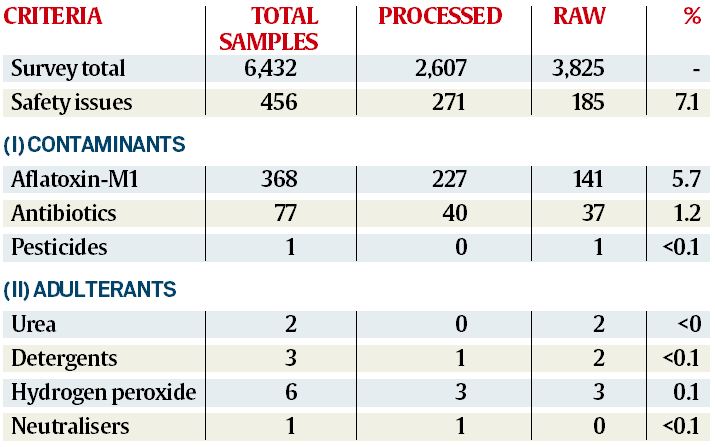
Among the samples found unsafe, 12 were adulterated (6 with hydrogen peroxide, 3 with detergents, 2 with urea, 1 with neutralisers). Nine of the samples were taken from Telangana, two from Madhya Pradesh and one from Kerala.
Overall, above 93% of the milk samples (5,976 of 6,432) were found safe for human consumption.
On Friday, the Food Safety and Standards Authority of India (FSSAI) released the National Milk Safety and Quality Survey 2018. It recorded data from 6,432 samples of milk, out of which 40.5% were processed samples and 59.5% were raw milk samples, taken from towns with populations of 50,000-plus. The samples were analysed for fat and SNF (solids not fat), 13 adulterants and three contaminants.
Overall, above 93% of the samples (5,976 of 6,432) were found safe for human consumption. However, about 41% of the samples, though safe, fell short of one quality parameter or another.
Among the samples found unsafe, 12 were adulterated (6 with hydrogen peroxide, 3 with detergents, 2 with urea, 1 with neutralisers). Nine of the samples were taken from Telangana, two from Madhya Pradesh and one from Kerala.
Percentages are based on the total 6,432 samples in the survey. The sum of individual failures will not add up to 456 because some samples failed on more than one parameter. (Source: National Milk Safety and Quality Survey 2018, FSSAI)
In 368 samples, the survey found residues of aflatoxin M1 (a type of mycotoxin that can cause disease and death) beyond permissible levels. This was the first time milk in India was tested for aflatoxin M1, which comes into contact with milk through feed and fodder, not regulated in the country at present. States with the highest levels of residues of this contaminant were Tamil Nadu (88 of 551 samples), followed by Delhi (38 of 262) and Kerala (37 of 187). Most of the residues were found in processed milk.
Out of 77 samples found to be non-compliant for antibiotics, most were taken from Madhya Pradesh (23), followed by Maharashtra (9) and Uttar Pradesh (8).

Pesticides a major component of Hyderabad’s staple, reveals FSSAI report


HYDERABAD: A report published by the Food Safety and Standards Authority of India (FSSAI) has revealed that essential edibles such as vegetables, fruits, grains and spices sold in outlets across Telangana and Andhra Pradesh are laced with pesticides. In most cases, the items are said to contain pesticides which are not approved. 
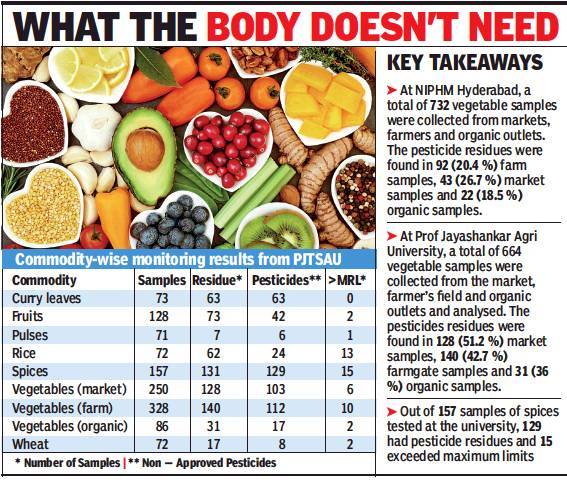
The report ‘Moniotring of Pesticide Residues at National level’, released on October 16, reveals that 40 per cent of samples collected in Hyderabad had pesticide residue with 2.5 per cent samples even exceeding the maximum limit. Curry leaves, spices and vegetables were revealed to be the worst when compared to prescribed standards with pesticides in them deemed to have been at a high level. The tests were carried out in two institutes in Hyderabad.
At National Institute of Plant Health Management Hyderabad, a total of 1,411 samples which includes vegetables, fruits, milk, pulses, rice, wheat, red chilli powder, curry leaves and surface water were tested. The samples were collected from Rajahmundry, Hyderabad, Sangareddy, Shadnagar, Tirupathi, Vijaywada, Visakhapatnam and Kurnool. In the analysis, researchers detected pesticide residues in 30 per cent of samples and one per cent of the samples exceeded the FSSAI’s maximum residual limits (MRL).
Interestingly, pesticide residues were also found in organic samples apart from samples collected from farms and markets. The most commonly detected pesticides were acephate, acetamiprid, azoxystrobin, carbendazim, imidacloprid and tebuconazole. Residues of difenoconazole in fruit samples, carbendazim and imidacloprid in rice samples and pyriproxyfen in red chilli powder samples exceeded the FSSAI’s MRL. Also found in samples were non approved pesticides like acephate.
At the Professor Jayashankar Telangana State Agricultural University around 1,297 samples of various food commodities were collected and analysed. The samples were collected from Hyderabad, Kurnool, Kothapet, Mehidipatnam, Vijayawada, Karimnagar, Rajendranagar, Warangal and Tirupati. Residues were detected in 652 samples which is around 50 per cent of the total. Around 4 per cent of samples including vegetables, fruits, grains and spices were found exceeding FSSAI MRL.
“In spice samples, cardamom samples were found to have residues of quinalphos and cumin samples residues azoxystrobin and thiamethoxam, which exceeded FSSAI MRL,’ the report said .

Table salt faces severe competition from Himalayan pink, sea and rock salt


Pristine white, flowing table salt is getting dropped in favour of coarse variants. Here's why.
A year ago, Rupal Shah, 51, made a change to her monthly grocery list. The Khar resident replaced iodised table salt, a staple in most Indian homes, with Himalayan rock salt. One of the triggers for the switch was that husband Nihaal, who has a family history of high blood pressure, showed the first signs of the disease during a check-up. Shah, who heads management at Fort art gallery, Chemould Prescott Road, and is visiting faculty at Rizvi College of Architecture, says that her parents had made the switch from iodised table salt seven years ago, and she saw the drop in their blood pressure levels. A year down the line, Nihaal's BP is in the healthy range.
Earlier this year, 91-year-old Mumbai-based businessman Shiv Shankar Gupta forced several of us to ask, is the salt you are eating right for you? He hit headlines for his claim that salt produced by top firms has high levels of potassium ferrocyanide. The chemical, says Gupta, is harmful. While Gupta did not wish to speak to mid-day for this article, he made available the literature he has researched and written, including reports from American West Analytical Laboratories in the US, where he sent samples of commonly used table salt including Tata and Sambhar, for testing. The reports state that the levels of potassium ferrocyanide are higher than stated "reporting limits", except in the case of Hindustan pink salt, Puro Healthy Salt and Tata Salt Rock Salt.
Himalayan pink salt powder
Potassium ferrocyanide is an anti-caking agent that gives refined salt the free-flowing quality that we now take for granted. However, it does not decompose into cyanide in the body, as some believe, and is considered non-toxic. Various studies have shown that the human body doesn't absorb potassium ferrocyanides. In rats, the lethal dosage was pegged at 6,400 milligram per kilogram. A study published in the European Food Safety Journal in 2018, titled: Re-evaluation of sodium ferrocyanide (E 535), potassium ferrocyanide (E 536) and calcium ferrocyanide (E 538) as food additives, states that a daily intake of 0.03 mg/kg of body weight is acceptable.
However, at toxic levels, it causes irritation of the gastrointestinal tract, causing symptoms such as cramping, diarrhea, nausea, and vomiting. Potassium ferrocyanide is also known to negatively affect the respiratory system. Maria Jenita, a consultant at Chennai Testing Private Ltd., a lab that is consulted by firms wishing to check levels of potassium ferrocyanide for nutritional labelling and ingredient testing, says, "Everyone won't react [to high levels of potassium ferrocyanide]. However, those who are weak in certain nutrients, will be affected, even if levels are small." When asked if these effects will show immediately, Jenita says, "No, the effects are long term. People may develop allergies or hormone-related diseases or auto-immune disorders."
Himalayan rock salt granules
Unlike most of us, Goa-based Dr Reyna Sequeira knows how the salt that we consume is made. The associate professor of sociology at the Government College of Arts, Science and Commerce, in 2013 authored a book titled As Dear as Salt: The Story of Neglect and Decay in a Traditional Occupation in Goa.
Sequeira says, her fascination with how salt is made began when she would drive past saltpans on her way to Goa University. When time came to work on her MA dissertation, she pitched the idea of understanding the lives of saltmakers. For a year, she worked with them, understanding the conditions they operated in and how salt is made. Two decades later, when she had to work on a PhD thesis, she decided to revisit the friends she had stayed in touch with over the years.
Sendha namak
"The water in salt pan lands is boiling hot. When you dip your feet in them you get sores. The government is not paying heed to the working conditions unlike farmland, since salt making is considered as an industry i.e salt is prepared from sea water and the direct rays of the sun, salt pan workers have no right to ownership, because it was decreed that one is just taking a product that's already available on the land," says Sequeira over the phone from Benaulim.
On the process of making salt, Sequeira adds that sea water is first let into one bed of land, cleaned and then let into a second bed and then a third. When the water drains overnight, crystals are formed. This is sea salt that we consume. Sequeira who has visited saltpan lands in Mumbai, Mira Road and Gujarat, says that companies pick up this salt and send it to factories where it undergoes a refining process, which also includes fortifying it with iodine.
Rupal and Nihaal Shah switched from table salt to Himalayan rock salt, and say Nihaal's blood pressure is now within healthy range. Pic/Shadab Khan
The idea of iodising salt, Sequeira calls "hogwash". "If the government wanted to give us iodine, why not just make it mandatory for people to take a dose in the morning and evening?" she asks. Juhu-based dietician and Reebok certified fitness expert, Sheela B Tanna, agrees. At her home, table salt has been missing for 20 years. She uses rock salt, sea salt or Himalayan pink. "Most people think alternatives are expensive, but that's because they see packets in supermarkets instead of buying it by the kilo at the kirana store." She made the switch when she felt that using a healthier salt could improve health in a polluted city. "Pink salt provides electrolytes to the body. A small pinch can help with muscle cramps and soreness," she adds. With two children — 20 and 22 years old — she wasn't worried about iodine deficiency. "You can get iodine from other dietary sources, such as fish and dairy products, cereal, chapati and rice."
Diabetologist Pradeep Gadge, says it is only those who already have an iodine deficiency who need to consume it via supplements. However, iodine deficiency is no longer common, thanks in most part due to the salt idodisation policy implemented several decades ago by the government. "Iodine deficiency happens in hilly terrain where due to the constant rain, iodine is not retained in the soil. Therefore, the local produce will be iodine-deficient." He clarifies that hypothyroidism does not mean iodine deficiency. It's an auto-immune thyroid problem caused due to lifestyle, endocrine disruptors in our diet, pollution, stress and inadequate sleeping hours.
Professor Reyna Sequeira, who has researched saltpans in Mumbai and Gujarat, argues against the salt needs iodizing theory
Are other salts a viable option? Sendha namak, or sindhav namak is salt mined from the Himalayas in Pakistan, while sea salt comes from the saltpan lands. While Himalayan pink salt is available in the market in both granular and powdered form, sea salt is usually seen only in the granular form and is easily available at the kiranawala. Gadge says that he often prescribes sendha namak to diabetic patients.
Because it is granular, patients often end up using lesser amounts, which improves markers such as blood pressure. He adds that not just with iodine, salt is also fortified with iron and in some areas—for example in Gujarat where Filariasis or elephants foot is common—with deethyl carbazine, a known drug. Yet, if you have none of these diseases or deficiencies, can you consume a more organic salt? Yes, says Gadge.
Fitness instructor Sheela B Tanna hasn't used table salt for 20 years. She says a pinch of pink salt, packed with electrolytes, can help with muscle soreness. Pic/Ashish Raje
Sequeira who has been consuming locally-made salt and gifts packs to friends traveling abroad as organic salt is in demand there, says, there's more research to prove that sea salt can be healthy. She quotes a study titled Bacteria from Salt Pans: A Potential Resource of Antibacterial Metabolites by Tonima Kamat and Savita Kerkar, Department of Biotechnology, Goa University, Taleigao Plateau, published in 2011. The study states: Our results indicate that salt pan bacteria from Batim and Ribandar have an interesting antibiotic producing profile and hence can be looked upon as potential resource of antibacterial metabolites. Very few reports are available on the antimicrobial potential of the cultures isolated from Indian salt pans."
0.03 mg of potassium ferrocyanide that's safe per kg of body weight
Iodine Is Essential Micronutrient Required By Body: Tata Salt Spokesperson
"Iodine is another essential micronutrient that is required in a small quantity by the body, every single day. As part of the Government of India's efforts to address the issue of micronutrient deficiency in the country and tackle Iodine Deficiency Disorder (IDD), Tata Salt has partnered with the government in this initiative from the year 1983, and played a pivotal role in the battle against iodine deficiency. The recent allegations made against the purity and health benefits of Tata Salt are totally false and misleading and being made by vested interests. India is one among many countries including the United States of America, European Union, Australia and New Zealand that have allowed the use of PFC in salt. The level allowed by the Food Safety and Standards Authority of India (FSSAI), an independent statutory authority, under Ministry of Health & Family Welfare, Govt. of India, is the lowest among these jurisdictions (10 mg per kg)."

650kg mawa seized from passenger vehicles

Indore: District food and drug administration officials on Sunday raided premises of travel operators and seized mawa in large quantity on suspicion of adulteration. 
A total of 650kg of mawa was seized. Of it, 350kg was seized from premises of a private bus operator and 300kg from an auto-rickshaw. 
District food safety officer Manish Swami said that they formed two teams and conducted surprise inspection in Pipliyahana and Teen Imli areas on basis of a tip-off.
“The seized mawa was transported from Ahmedabad and Kota to Indore. It was to be sold in market ahead of Diwali. The information mentioned on each packet states use of palm oil, sugar and milk powder in making of the product, which looks like mawa,” Swami told TOI. 
He said that two persons - Jitendra Garg and Shubham - have claimed ownership of seized product. “The mawa has been seized on suspicion of being adulterated. It was being transported in a passenger vehicle violating Food Safety and Standards Act,” he said.
Officials said that samples were sent for testing of adulteration. “Any kind of adulteration in seized product would lead to legal action,” they said

Oct 20, 2019

DINAMALAR NEWS


DINAKARAN NEWS


DINAKARAN NEWS


DINAKARAN NEWS


Probe on milk contamination to be ordered

The Food Safety Department will order a detailed enquiry and analysis to find out the extent and cause of contamination of milk in the State. This follows a study by the Food Safety and Standards Authority of India (FSSAI) that found aflatoxin-M1, a contaminant from cattle feed caused by fungus, in 88 of the 562 samples it lifted across Tamil Nadu.
Commissioner, Food Safety, Beela Rajesh said the Department would upscale surveillance and enforcement actions, and would cross-check safety aspects and publish the details in the shortest possible time. “We have also asked Food Safety officials to do a thorough check on all brands, including Aavin. Tamil Nadu is completely compliant on other tested parameters,” she added.
Tamil Nadu topped the list of States with the highest levels of aflatoxin residues, and the problem was more dominant in processed milk rather than raw milk, the FSSAI study said.
Tamil Nadu Milk Producers’ Welfare Association general secretary M.G. Rajendran said: “The Food Safety Department should create awareness among farmers about how the feed should be stored.”
Aavin managing director C. Kamaraj said Aavin’s milk conformed to standards.

Diwali: Food safety officials go into overdrive

Chennai: Food safety teams are lifting daily samples of sweets and savouries from manufacturing units, storehouses and stores to assess quality of ingredients, manufacturing practices, storage and labelling of finished products, officials said. The food safety department has also launched a drive to sensitise food business operators about hygienic practices.
Health secretary Beela Rajesh, who is also the commissioner of food safety, has issued orders directing designated food safety officials of all districts to send samples for testing. Samples of oil, ghee, sweets and savouries have to be lifted as per prescribed format and sent to lab for checks, the letters said. In the past two weeks officials have been testing samples and meeting with manufacturers.
“We have asked them (manufacturers) to avoid synthetic colours in sweets and maintain proper hygiene during bulk preparation on their premises. They have been asked to check the labels of ghee and oil used and buy only from trusted sources with proper bills/ invoices,” said food safety deputy director K Vanaja. “Manufacturers have been warned that violation of food safety standards will lead to convictions. We will track the quality of ingredients and will book their suppliers if the raw material is adulterated,” she said.
In September, food inspectors in the city had picked up samples of ghee and butter from manufacturing units in T Nagar and Saidapet along with a red dye. The dye was found to be cancer-causing, oil-soluble colour that is not permitted to be used in food. Samples of butter and ghee picked from these units also failed food safety standards. Government food analysts reported that as much as 50% of fat in the samples tested was not exclusively dairy fat.
Staff in the manufacturing units told officials that the dye, a combination of red powder and mustard oil, was used as it gave the butter texture and odour. These products cost Rs 200 a kg compared to Rs 435 per kg of ghee charged by brands such as Aavin of the state-run milk cooperative. Similarly, some oils meant for lighting lamps in temples are used for cooking as well.

AMC health teams raid snacks sellers, dairies

Ahmedabad: Food safety and hygiene wing of the municipal health department took samples of snacks preparations at 54 locations in the city on Saturday. Apart from this, the special health wing went to four milk dairies for inspections in Naroda GIDC, Dehgam road and found milk based sweets be prepared under unhygienic conditions. In total, Rs 5.3 lakh in fines was collected from these dairies. 
Apart from them local provisions stores in the city which have put up extra counters for selling sweets and snacks were also visited by the staff for food samples. In Bapunagar, two cottage units manufacturing and packing food items were inspected for poor hygiene and have been sealed. 
In all, the health authorities destroyed some 4,861 kg of raw food material suspected unfit for consumption and some Rs 6.5 lakh was collected in fines.

Uttarakhand govt bans gutka, pan masala for one year

The order was issued by Food Safety Commissioner Nitesh Kumar Jha on Friday.
This decision is taken by the Trivendra Singh Rawat government after seeing the ill effects on the health of people habitual of chewing tobacco and nicotine-based products.
Dehradun: The Uttrakhand government has imposed a total ban on the storage, distribution, manufacture and sale of pan masala and gutka which contains high content if nicotine and tobacco in them.
The order was issued by Food Safety Commissioner Nitesh Kumar Jha on Friday.
The ban comes into effect immediately and has been imposed for a period of one year.
This decision is taken by the Trivendra Singh Rawat government after seeing the ill effects on the health of people habitual of chewing tobacco and nicotine-based products.
The order cites the Food Safety and Standards Act, 2006, which gives power to the state governments to put a ban on any food product for a year in the public interest.
In its notice, the state government has explained the reason for taking such a move stating that Food Safety and Standards Authority of India has prohibited the use of tobacco and nicotine as an ingredient in any product meant for the consumption of the humans but it has been found that pan masala, gutka in the state are being sold under different name which continues to have a high content of both- tobacco and nicotine.

National Milk Sample Safety Quality Survey

News:Food Safety and Standard Authority of India(FSSAI) has released the National Milk Sample Safety Quality Survey.
Facts:
Key takeaways from the survey:
  • The survey has found that milk samples from Telangana followed by Madhya Pradesh and Kerala has shown the highest number of cases of adulteration.
  • The problem of Aflatoxin-M1 is more dominant in processed milk than that of raw milk. 
  • Tamil Nadu, Delhi and Kerala were the top states where the Aflatoxin-M1 was found maximum.
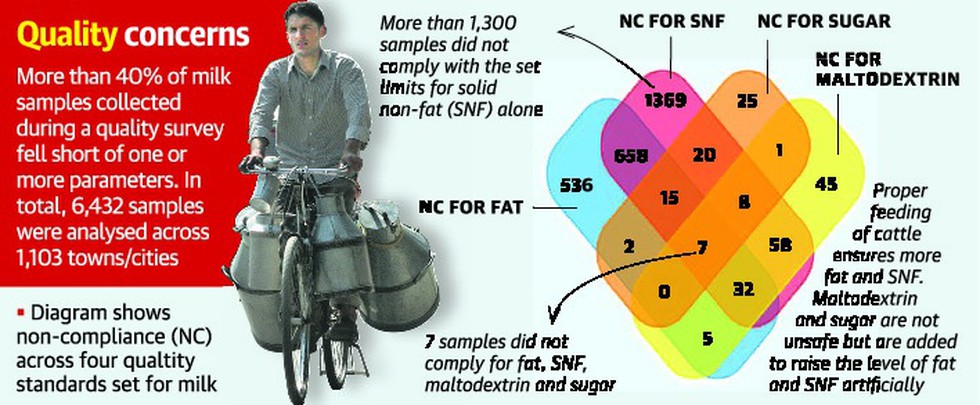
  • In terms of quality, 7% of the total sample of processed milk did not comply with quality parameters because the presence of contaminants such as fats, Maltodextrin and sugar were above permissible limits.
  •  
Additional information:
About Aflatoxin-M1:
  • Aflatoxins are toxins produced by certain fungi which are generally found in agricultural crops like maize, peanuts, cotton seed and others.They are carcinogenic in nature.
  • It comes in the milk through feed and fodder that are currently not regulated in the country. 
  • There is no proper lab to test this residue in the country.
Testing and sampling Scheme:
  • To address the issue of testing,the government is instituting a scheme for testing and sampling for organised dairy players.It will be implemented from January 1,2020,
  • The scheme stipulates sampling points during various stages of milk processing, test methods and frequency of sampling. 
  • Organised players which include dairy co-operatives and private players, will need to have a well-equipped in house lab for testing and also will need to keep records of all tests conducted.
Food Safety and Standards Authority of India (FSSAI):
  • Food Safety and Standards Authority of India (FSSAI) is a statutory autonomous body under Food Safety and Standards Act,2006.It comes under the Ministry of Health & Family Welfare.
  • FSSAI is responsible for protecting and promoting public health through the regulation and supervision of food safety.