
Jul 20, 2017


Dengue prevention drive in hotels, restaurants

An official from FSSAI checking water stored at a hotel in the city on Wednesday.
FSSAI officials check whether storage of water is done in proper manner
Food Safety and Standards Authority of India (FSSAI) has swung into action to back the efforts by the Health Department to combat dengue.
FSSAI officials have started inspecting restaurants and small hotels to ensure that storage of water is done in proper manner.
Officials are also checking to ensure contaminated water is not used for cooking and drinking purposes.
“Based on directions from superiors, food safety officers are conducting inspections at hotels, mainly to ensure safe storage of water. Other than aiding mosquito breeding, contaminated water can cause for other illnesses,” said O.L.S. Vijay, Designated Officer, FSSAI, Coimbatore.
Hotels have been asked to not to store water for longer days as it may lead to contamination. During visits, hoteliers have been instructed to store the water in containers covering them with a fitting lid.
“Hoteliers have been asked to clean underground water storage tanks at frequent intervals. Use of bleaching powder is advised for cleaning. They are also instructed not to serve water stored for more than three days for drinking and cooking purposes,” said Dr. Vijay.
Food safety officers are also checking whether storage systems are turning breeding grounds for mosquitoes.
As part of increasing awareness among public, food safety officials are also pasting posters in hotels on safe storage of water and prevention of mosquito breeding.
ANIMAL WELFARE BOARD ASKS COPS TO ACT AGAINST TEMPLE SLAUGHTER

With temples scattered across Pune district, action against animal slaughter has been hard to eradicate completely
City officer has written to PMC, police chief and others, decrying open sacrifices, especially during religious festivals
Pune-based animal welfare board officer Meher Mathrani has written to various administrative bodies in the city, including the police commissioner, the Pune Municipal Corporation (PMC) commissioner, chief secretary of Maharashtra, the Food Safety and Standards Authority of India (FSSAI), the Animal Husbandry department and Federation of Indian Animal Protection Organisations (FIAPO) to take action against temples engaging in public slaughter of animals for religious purposes. The letter highlighted how animal sacrifice flouts several norms, including Slaughter House Rules, 2001 and the Prevention of Cruelty Act, 1960.
The open sacrifice right before the month of Shravan also has temples where people cook the meat within the premises and distribute among devotees. This, according to the letter, goes disregarded by the police. It also spoke of how the meat goes unchecked by vets and is still consumed by humans. The letter requested authorities to hand out memos to people to sensitise them to these issues.
“Sacrifice affects children who are continuously exposed to cruelty to animals. It is visually extremely disturbing and desensitises the child, who subsequently grows up to be a desensitised adult. With all the strife we see on a daily basis, we must encourage compassion and sensitivity. It is the duty of government agencies to enforce laws, rather than leave it to NGOs and activists who face a lot of danger when trying to stop such sacrifices. We cannot be a smart city if we ignore these issues,” said Mathrani, animal welfare officer (h) and head, Action for Animals against Cruelty and Trauma (AaCT), India.
Responding to her plea, assistant police commissioner (special branch) Ravindra Rasal, said, “We always ensure that police stations around the vicinity educate temple authorities to not engage in public slaughter of animals. The slaughter should take place only at a registered slaughterhouse. If we get complaints, we will act against the temple or the group, but it is not possible to keep a check on all temples. Also, this becomes a sensitive matter since it pertains to religion.”
Speaking to Mirror, animal rights activist Manoj Oswal said, “The process of banning slaughter cannot happen at the spur of the moment. One cannot suddenly ask devotees to stop a practice that has been going on for long. Since it involves religious sentiment, even police intervention becomes difficult. This will require prior planning and a threelayered process. First, we speak to the temple trustees and explain the religious importance of banning slaughter. Without their cooperation, we will not be able to proceed. Once we convince them, we speak to local authorities like the police who create a detailed plan. This would include a geographical map of which temples within their jurisdiction practice public slaughter. The court orders are presented to them and we try to convince them legally. The final stage includes the process of spreading awareness among the public. Pune district is a difficult place - temples are sporadically distributed and mass slaughter does not occur. This is why we have not been able to stop them completely.”
On Monday, a police complaint was filed at Vimantal police station against a temple opposite Symbiosis institute, which had kept a goat to be slaughtered for sacrifice the next day. The temple caretakers said that it was unfair to target only them and get the police involved.
Police claim ambiguity on ban of gutka, fail to act on seizure
Trichy: An 'ambiguity' over the ban on chewable tobacco kept the police in a state of confusion and inaction despite seizing a vehicle with a consignment of the stuff on Wednesday afternoon. The question which baffled them was: Was gutka and chewable tobacco banned across the state or merely within 100 metres of educational institutions and hospitals ?
It was a usual vehicle check by the cops near Uyyakondan Thirumalai on Vayaloor road which led to the seizure of 1.2 tonnes of banned chewable tobacco from a minivan around noon. The vehicle was intercepted by the police as it was found carrying the chewable tobacco product in 30 bags, each weighing 40 kgs, from a godown in Kavalkaranpatti on the outskirts of Trichy to the city.
The vehicle and its driver were brought to the government hospital police station. Enquiries with the driver revealed that it was being brought for supply to shops in the city. It may be pointed out that the state government had passed a GO on May 23 including chewable tobacco in the list of banned tobacco products. Unfortunately, the police were unaware of this government order that banned the sale of the stuff that they seized. There was confusion as to whether it was banned across the state or merely within 100 metres of educational institutions and hospitals. As a consequence, the police were even reluctant to show the tobacco to the mediapersons citing possible legal consequences. They summoned the owner of the godown and the vehicle.
"We are seeking legal opinion to further proceed in the case because we need to make it clear that we have the authority to take action in the case," said sub-inspector of police, S Gopal. However, food safety and drug administration department which has been entrusted with powers to seize such products and prosecute the carriers was clear that all chewable tobacco products are in Tamil Nadu.
"There is no doubt that chewable tobacco is banned in Tamil Nadu. The police can take action if they have seized them. In case of receiving information, we have the authority to destroy them and take legal action on the person who possessed them," designated officer (DO), food safety, Trichy Dr R Senthilkumar told TOI. However, both the police officials as well as food safety officers in the food safety department expressed their inability to act on such violations due to the unclear instructions from their higher officials about the list of banned tobacco products. The police remained mute spectators on the seizure till evening.
The draft laws for organic foods, if cleared, will adversely affect small farmers
The Food Safety and Standards Authority of India’s new certification regulation is going to hinder the growth of the sector. Instead of targeting small farmers, why not make laws that require mandatory labelling of foods grown with pesticides, chemicals or GMO etc?

If a small farmer has to get a National Programme for Organic Production certification, which is what the Draft Food and Standards (Organic Food) Regulations, 2017, is proposing, it will make her product expensive and so uncompetitive
The Food Safety and Standards Authority of India (FSSAI) recently announced the Draft Food and Standards (Organic Food) Regulations, 2017, aimed at curbing sale of fake organic products. This regulation will require products sold in the market as “organic” to be certified by either the National Programme for Organic Production (NPOP) of the commerce and industry ministry, or the Participatory Guarantee Scheme (PGS) of the agriculture ministry.
The NPOP was designed for the export market and involves third-party companies, which verify organic status, while in PGS, a collective of farmers guarantee that everyone in the group is practicing organic farming. The draft, however, exempts ‘unprocessed’ organic food sold directly by farmers or farmer organisations to consumers.
On the face of it, this looks like an excellent regulation, with a promise of protecting consumers’ rights. But an analysis shows that it cannot curb sales of fake organic products, and it might do more harm than good to the organic farming movement in India.
The demand for a regulation on organics itself is suspect, as it is led by the Crop Care Federation of India (CCFI), which represents pesticide companies. In December 2014, CCFI released a report, prepared by the Indian Agricultural Research Institute (IARI), on pesticides in organic vegetables from Delhi. Interestingly, IARI has not made this report public.
The institute tested 150 vegetable samples from one organic store in Delhi and found traces in 50; in 10 of these, the levels were above the maximum residue limit (MRL). The store identified a certified farm in Sonipat as the source of the vegetables. The farm was certified by one of the largest NPOP certifiers.
To begin with, sampling from one store from one city is scientifically untenable. Second, finding small traces of pesticides in organic vegetables is not surprising because pesticides are present in water and air, and will find their way into a produce even if the farmer is practicing organic farming. This is why many countries prescribe a tolerance limit for presence of pesticides in organic products. Third, the 10 samples in which levels exceeded the MRL were sourced from a certified farm – which means certification cannot be an answer to the problem.
Let us accept that fake organic products do exist. But the scale is difficult to ascertain till we have a pan-India study on it. Second, a fake organic product is not a safety concern; it is an issue of ‘misbranding’ or ‘misleading advertisement’. Fake products can be as safe or unsafe as any other products sold in markets. So the question is: Is certification required to tackle misbranding?
The FSSAI has a definition of and penalty for misbranding of food and misleading advertisements. The penalty for misbranding is up to Rs 3 lakh and for misleading advertisement, up to Rs 10 lakh. The food safety act does not specify that to prevent misbranding or misleading advertisement, a product has to have a certification. Why, then, are organic products being singled out?
To understand how this new regulation impact farmers, one must examine the certification itself. First, both NPOP and PGS are process-based certification systems. Their main concern is processes and practices of farming and food-processing, not testing food for pesticide residues. The former (NPOP) being more expensive than PGS, is preferred by big farmers, companies and exporters.
Under NPOP, only the produce of a NPOP-certified farm can be processed by a NPOP-certified processor and sold as ‘organic’. The NPOP processor cannot take fresh produce from a PGS farmer, process it and sell it as ‘organic’.
Under PGS, only the food processed by the PGS group of farmers can be labelled as ‘organic’. The problem: PGS groups, run by small farmers, are not capable of processing organic produce. They sell their produce to other processors for value addition.
The draft regulation will make it difficult for small farmers, who are either PGS certified or non-certified, to sell their produce for value addition. They will be forced to sell fresh produce directly to consumers or get NPOP certification.
If a small farmer gets NPOP certification, it makes his product more expensive and so uncompetitive. If he sells only fresh produce, his value addition is low. So the draft regulation will dissuade small farmers from doing organic farming.
The Indian organic farming movement is witnessing a revival, largely led by small farmers. Consumer numbers are on the rise. This has happened without any support from the government. In fact, in 2017-18, the outlay on organic farming is a mere Rs 350 crore; in comparison, the annual subsidy for chemical fertilisers is over Rs 70,000 crore.
But the FSSAI’s regulation is going to hinder its growth. Instead of targeting organic food, why not make laws that require mandatory labelling of foods grown with pesticides, chemicals or GMO etc?
If the FSSAI is so anxious about fake organic products, it should set standards and use its ‘misbranding’ provision to penalise them. Like it does for every other food product.
Jul 19, 2017


Expired oil, green gram stock seized; report confirms sub-standard quality

Expired oil and green gram stocked at godowns for dispatching to PDS shops being seized in Kalaburagi on Tuesday.
Flouting norms, the Food and Civil Supplies Department has stocked vegetable oil and green gram past the expiry dates for supplying to Public Distribution Shops in the district under the Anna Bhagya Scheme.
Speaking with The Hindu on Tuesday, District Food Safety Officer R.S. Biradar said that based on a complaint both the Department godowns on the outskirts of the city has been raided and the expired stocks were seized in the first week of July. The matter had been reported to the Deputy Commissioner Ujjwalkumar Ghosh. He directed the concerned authorities to immediately stop the distribution of expired stocks from last week.
Around 70,000 expired vegetable oil packets and around 525 kg of green grams with expired dates were seized. Mr. Biradar said the manufactured date mentioned on a few oil packets was December 2016 and on others it was February 2017, valid for four months from the date of packing.
Meanwhile, the Divisional Food Laboratory in its report had recorded the oil as sub-standard as the acid value of tested oil is 1.02%. As per the Food Safety and Standards Authority (FSSAI) the acid value should be less than 0.5%, Mr. Biradar added.
Similarly, the samples of green gram stocked in godowns were also recorded as sub-standard. The grains contain 6.97% weevilled grain and 1.86% foreign matter, and do not conform to the standards.
Vijayanand Diggikar, Assistant Director for Food and Civil Supplies, speaking to The Hindu over the phone said that though the products were expired and lab reports clearly confirmed the samples of vegetable oil and green gram were sub-standard, the samples would be sent to the Food Laboratory in Hyderabad for tests.
Based on the lab reports, senior officials would take a further decision.
No specific case of plastic rice, sugar, eggs detected: Govt
NEW DELHI, JULY 18:
Allaying consumer fears and belying media reports, the government on Tuesday informed Parliament that no specific case of presence of plastic rice, sugar and eggs had been detected in the country.
C R Chaudhary, the Minister of State for Consumer Affairs, told the Lok Sabha in a written reply that the government was aware of reports of rice and sugar being made of plastic.
“The matter has been taken up with the State governments of Kerala and Gujarat on the basis of International Food Safety Authorities Network (INFOSAN) alert. The concerned State governments have confirmed that no incidence of plastic rice has been reported in the respective States,” he informed the House.
The Minister said random sampling and testing of food products, including rice and sugar, was done by the officials of Food Safety Departments of respective States/UTs to check compliance of the standards laid down under the Food Safety and Standards Act, 2006, Rules and Regulations.
“No specific case of presence of plastic rice and sugar has been detected in the country,” he said, adding that under the provisions of the Consumer Protection Act, 1986, one can approach consumer fora for redressal in case of defective products and deficiency in service.
In reply to another question, Sudershan Bhagat, the Minister of State for Agriculture, said that reports of plastic eggs had come to the notice of Food Safety and Standards Authority of India (FSSAI) through various platforms.
“Consequently, FSSAI has asked Commissioners of Food Safety of all States / Union Territories to ensure that there is no production / distribution of fake/artificial eggs and urged them to take up strict enforcement activities,’ adding that “no specific instance of presence of fake eggs in any part of the country has been received.”
Seven months since FSSAI advisory, Karnataka yet to ban newspaper food packaging
BENGALURU: Foods contaminated by newspaper ink raise serious health concerns since printing ink, besides containing chemical contaminants, may have pathogenic microorganisms. Kerala Food Safety Commissioner prohibited the use of newspapers for packing food last week. Karnataka is yet to wake up though.
This comes seven months after the Food Safety Standards Authority of India (FSSAI) issued a circular to food safety commissioners of all states and union territories to initiate a campaign for creating awareness amongst all stakeholders to discourage the use of newspapers for packing, serving and storing of food items.
Dr Shivappa, Joint Director, Food Safety, said, “We had issued a circular to all designated officers to create awareness about this but are unable to find the circular. It hasn’t been uploaded on our website either.”
Kerala Food Safety Commissioner in his notification dated July 11 pointed out that wrapping food in printed paper would cause chemical and microbiological contamination of food. “This practice is equal to slow poisoning,” the order observes. The FSSAI in December last year had advised to ban newspaper packaging that can lead to cancer.
The order was issued as per Section 30(2)(a) of the Food Safety and Standards Act, 2006, which enables the commissioner to prohibit in the interest of public health, the manufacture, storage, distribution or sale of any article of food, either in the whole of the state or any area, not exceeding one year.
Shivappa said that other alternatives available are ceramic plates, areca, steel plates, banana leaves and thick polythene paper. “Ceramic plates are not cost effective and steel plates need to be washed. Banana leaf is easily available and cost effective too. Plastic is banned so it cannot be used. Another alternative is recovering additional cost from customers,” he said.
Dr Harshvardan B, Deputy Commissioner (Squad), Food Safety, said that though designated officers in districts had been told to disallow wrapping of bajji and bonda in newspapers during monthly meetings no notification had been issued yet.
Unless a notification is issued, it is not legally binding, it will merely remain a circular, said K Srinivasa Gowda, Joint Commissioner, Food Safety. Karnataka Food Safety Commissioner Subodh Yadav said that a similar notification will be issued soon.
What FSSAI says
“Indians are being slowly poisoned due to newspapers being widely used as food packaging material by small hotels, vendors and also in homes in lieu of absorbent paper. The ink contains multiple bioactive materials. Printing ink may also contain harmful colours, pigments, binders, additives, and preservatives. They may be contaminated with metallic contaminants, mineral oils and harmful chemicals like phthalates which can cause digestive problems and also lead to severe toxicity. Older people, teenagers, children and people with compromised vital organs and immune systems are at a greater risk of acquiring cancer-related health complications, if they are exposed to food packed in such material. Newspapers should not be used to wrap, cover and serve food or to absorb excess oil from fried food.”

உணவுத்துறை அதிகாரிகள் ஆய்வுக்கு பின் அன்னதானம் :ஸ்ரீவி.,யில் கலந்தாய்வு கூட்டத்தில் ஆர்.டி.ஓ., வலியுறுத்தல்
ஸ்ரீவில்லிபுத்துார்;''ஆண்டாள்கோயில் ஆடிப்பூர தோரோட்டத்தில் அன்னதானம், நீர், மோர் போன்றவை உணவுத்துறை அதிகாரிகள் ஆய்வு செய்த பின் தான் வழங்கவேண்டும்'' என அனைத்து அரசுத்துறை அதிகாரிகள் கலந்தாய்வு கூட்டத்தில் முத்துக்குமரன் டி.ஆர்.ஓ., பேசினார். ஸ்ரீவில்லிபுத்துார் தனியார் திருமண மண்டபத்தில் நடந்த கூட்டத்திற்கு தக்கார் ரவிச்சந்திரன் தலைமை வகித்தார். அறநிலையத்துறை உதவி ஆணையர் ஹரிஹரன் முன்னிலை வகித்தார். செயல் அலுவலர் ராமராஜா வரவேற்றார். மாவட்ட வருவாய் அலுவலர் முத்துகுமரன் பேசியதாவது: தேரோட்ட தினத்தன்று பல்வேறு பொதுஅமைப்புகளால் வழங்கப்படும் அன்னதானம்,தண்ணீர், மோர், நீர் ஆகாரங்களை உணவுத்துறை அதிகாரிகள் ஆய்வு செய்த பின்னர் தான் வழங்க அனுமதிக்கப்படும். கோயில் பாதுகாப்பில் ஈடுபடும் போலீசார், என்.எஸ்.எஸ். மாணவர்கள் சுழற்சி முறையில் பணியாற்றவேண்டும். தேரில் ஒரு அர்ச்சகர் உட்பட 15 பேர் மட்டுமே அனுமதிக்கப்படுவர். ராஜபாளையம், ஸ்ரீவில்லிபுத்துார் தீயணைப்பு வாகனங்களை மட்டுமே பயன்படுத்தவேண்டும். சிவகாசி, சாத்துார், வெம்பகோட்டை, விருதுநகர் ஊர்களை சேர்ந்த தீயணைப்பு வாகனங்களை அழைக்கவேண்டாம். கோயிலை சுற்றியுள்ள பகுதிகளில் பக்தர்களுக்கு தேவையான கழிப்பறை, தண்ணீர் வசதிகளை நகராட்சி செய்யவேண்டும். சிறப்பு பஸ்களை அரசுபோக்குவரத்து கழகம் இயக்கவேண்டும்.
பொதுநல அமைப்புகள் மாடவீதிகள், ரதவீதிகளில் தண்ணீர் பந்தல்கள் அமைக்ககூடாது. பஸ் ஸ்டாண்ட் மற்றும் போக்குவரத்திற்கு இடையூறு இல்லாத பகுதிகளில் தண்ணீர் வழங்கலாம். நான்கு ரத வீதிகளில் கட்டட பொருட்கள் ரோட்டில் கொட்டக்கூடாது. பொதுமக்கள் நலனை பாதுகாப்பதில் எவ்வித சமரசத்திற்கு இடமின்றி போலீஸ், வருவாய், நகராட்சி துறைகள் செயல்படவேண்டும். ரதவீதிகளில் போடப்படும் இரும்பு பிளேட்டுகள் தேர் கடந்தவுடன் உடனுக்குடன் அப்புறப்படுத்த வேண்டும். புதுபட்டி விலக்கிலிருந்து மம்சாபுரம் வரையுள்ள ரோடு தற்காலிகமாக சீரமைக்கப்படும். தினமும் அனைத்து அரசுத்துறைகளும் இணைந்து ரத வீதிகளில் கண்காணித்து, தேவையான முன்னெச்சரிக்கை நடவடிக்கைகள் மேற்கொள்ளவேண்டும், என்றார்.
சிவகாசி சப்-கலெக்டர் சங்கரநாராயணன், தாசில்தார் சரஸ்வதி, சங்கரேஸ்வரன் டி.எஸ்.பி., டவுன் இன்ஸ்பெக்டர் மகேஸ்குமார், நகராட்சி ஆணையாளர் முகமதுமுகைதீன், தீயணைப்பு அலுவலர் பழனிசாமி, அரசு மருத்துவர் காளிராஜ், புலவர் பாலகிருஷ்ணன், ராம்கோ நிறுவன அலுவலர்கள் மற்றும் பல்வேறு அரசுத்துறை அதிகாரிகள் பங்கேற்றனர். கண்காணிப்பாளர் வெள்ளைச்சாமி நன்றி கூறினார்.
Jul 18, 2017


Unhealthy practice unnoticed

What is strange is that the people, too, complacent about health hazards such a practice is posing. It is carcinogenic. It means that it may cause cancer in the long-run. Despite the warnings by the Food Safety and Standard Authorities of India (FSSAI), stalls continue the practice because old newspapers are available in plenty at low price.
Most of the small eateries and roadside food stalls across the city have been using old newspaper sheets to parcel the food continue for a long time now. Santosh (32), a worker at an eatery at Maredpally said it is the easiest and the most convenient way to wrap the food. “The person, who makes the parcels, cuts out all the newspaper pages first early in the morning. It is so convenient. As far as I remember this has been the practice for long,” he said.
Paper bags, which are costlier when compared to these newspaper sheets are being used even by sweet shops and other fast food chains. Ganesh (28), who runs a small Jalebi stall near Uppal, said old newspapers are cheap and easily available when compared to paper bags.
It hardly makes much of a difference to his everyday profits. “I get newspapers for free sometimes but buying paper bags can add another Rs 2 to5 per piece to my daily budget eating into the profit,” he said. Kanishka Das (40), a resident of Banjara Hills, said he buys a bunch of paper bags of different sizes once in a month to avoid wrapping the food items in newspaper sheets after he came to know the health hazard the latter posed.
“Once polythene covers proved hazardous to the nature, paper was considered the next best thing. But the moment I came to know how bad it can be to use a newspaper sheets, I started buying my own stock of paper shopping bags of different sizes for different weights and carry them every time I go for shopping”, he said.
HC told food testing labs do not have mandatory accreditation with central panel

The Food Safety and Standards Authority of India (FSSAI) on Monday told the High Court that the two food testing labs in the state are not accredited with the National Accreditation Board for Testing and Calibration Laboratories (NABL), which is mandatory.
Counsel for the FSSAI Mehmood Paracha told a division bench of Chief Justice Baddar Durrez Ahmad and Justice Ali Muhammad Magrey that the two food testing labs-- Public Health Lab, Patoli and Jammu and Public Health Lab, Dalgate--are not accredited with the NABL.
“Unless the labs are accredited they have no meaning as per the section 43 of the Food Safety and Standards Act,” Paracha told the court.
The court directed the government to get the accreditation certificate from the board within two months.
Earlier, an expert two-member panel from the FSSAI had informed the High Court that the state’s food testing labs were not functioning properly.
Both the labs, it had said, were not carrying out any tests for contaminants such pesticide residues, heavy metals, veterinary drug residues, crop contaminants and naturally occurring toxic substances.
As soon as the matter came up for the hearing today, Amicus Curie and senior advocate Bashir Ahmad Bashir pleaded that the Food Safety and Standard Act needs to be implemented strictly to avoid food adulteration in the state.
The Amicus suggested that the food testing labs should be set up in all districts for speedy analysis of food samples.
Regarding the appointment of an independent food commissioner, the commissioner secretary health and medical education told the court that a proposal in this regard has been submitted to the government.
“The proposal stands submitted to the finance department which has to clear it,” he said.
Following the submission, the court asked the finance department to clear the proposal within two weeks and forward it to the concerned for necessary action.
While the requirement of food safety officers and public analysts and their appointment cropped up today again before the bench, Additional Advocate General MI Dar assured the court that the staff will be provided to the food safety department on priority.
The court directed the government to ensure the two food testing labs are fully equipped within two weeks.
While the court was earlier informed that 76 food safety officers (FSOs) were in place out of the 106 sanctioned posts, it directed for filling up of the vacant 36 posts.
The court also said that food analyst post be also filled up immediately. The court was, however, informed that 36 posts of FSOs have been referred to the Services Selection Board.
HC grants week’s time to appoint FSC
Asks authorities to upgrade food testing laboratories
Srinagar, July 17: The State High Court today directed Finance Department to clear proposal for the appointment of Food Safety Commissioner within a week.
The direction by the division bench of Chief Justice Badar Durez Ahmad and Justice Ali Mohammad Magrey followed submission by Commissioner Secretary Health Department, who was present in the court.
On being asked by the court why the appointment FSC has not been made, the Commissioner Secretary submitted that the proposal for creation of post has been sent to Finance Department and after approval, it would be placed before the state cabinet.
Subsequently, the court directed the Finance Department to conclude the exercise with one week. "Till the full time (FSC0 is made, Commissioner Secretary shall have the additional charge of the post," the court said.
Last week, the court had pulled up government for not putting in place FSC and had directed commissioner secretary to be personally present before to inform it about the steps taken to appoint the FSC.
The direction had followed perusal of a report by Food Safety and Standards Authority of India (FSSAI), highlighting deficiencies in food testing laboratories, both at Srinagar and Jammu.
Subsequently, the court directed the concerned authorities to upgrade the laboratories by NABL so that prosecution can be launched against the violators.
Pertinently, as per the FSSAI report, both the laboratories are currently equipped with minor equipment, which are in working condition. These include electronic balance, muffle furnace, butyro-refractometer and tintometer etc.
"Both labs do not carry out any tests for contaminant such pesticide residues, heavy metals, veterinary drug residues, crop contaminants and naturally occurring toxic substances," the report said.
Currently, the report said, both the labs neither have in place state-of-the -art equipment necessary for pesticide, heavy metals and drug residues etc nor competent and trained manpower to operate the equipment. A major limiting factor towards fulfilling the requirements of testing of food samples is the non-availability of sophisticated instruments, the report said.
Giving their food the +F edge

Healthy smiles Children at the Government English Medium School in Nashik’s Mundegaon village get food, including fortified rotis from a centralised kitchen that is run under a bilateral agreement between the Maharashtra Government and Tata Trusts
A public-private partnership might finally fortify India against malnutrition. Preeti Mehra writes
Daurali Devi lives in one of Delhi's unauthorised colonies. She has no idea what the +F symbol stands for, but lately the 65-year-old has started looking for it on the milk sachet that she buys. Her grandchild's paediatrician has told Devi that milk embossed with the sign has “zyada takat” (more strength) and it’s good for her three-year-old grandson who suffered from low-weight since birth.
Her grandson is part of the 25 per cent of the Delhi’s population that suffers from malnutrition. Addressing the problem, Delhi late last year joined the effort to fortify common foods with micro-nutrients when milk caterer, Mother Dairy took the lead by adding Vitamin A and D to all its poly packs. Daurali's family, which was earlier buying unpackaged milk from Mother Dairy, was among the hundreds that shifted to the sachet on advice from a medical practitioner.
Not just Delhi, malnutrition continues to ail a significant percentage of India’s population. For instance, the National Family Health Survey of March 2017 shows that over a quarter of children under the age of five are stunted (low height for age) in all of India’s major state capitals, except in Kochi and Hyderabad.
The 2016 Global Hunger Index ranked India 97th out of 118 countries behind Nepal, Sri Lanka, Bangladesh. It was positioned 80 out of 104 countries the previous year.`
Given the seriousness of the issue, a renewed attempt is being made to address malnutrition through food fortification. While till a few months ago, there was talk of a food fortification policy being worked out, the Government is now moving forward through FSSAI (Food Safety and Standards Authority of India).
Nearly 40 companies have come forward to lend their hand and are fortifying their products, following the +F formula. Some are fortifying their product for the pan-India market, while others are targeting specific States.
“Food fortification is nothing new. Everyone agrees it needs to be done and wants to do it. But it doesn’t get done,” says Pawan Kumar Agarwal, Chief Executive Officer at FSSAI. “All it requires is aligning a few things for the industry to start fortifying and the consumer to start accepting. It’s like the chicken and egg story, which comes first,” adds Agarwal, who is pro-actively pushing for a greater embrace by states and food companiesTesting the waters
Delhi is one of the recent states to join the fight against malnutrition. Some of its peers, including Rajasthan and Madhya Pradesh have taken the lead in adding nutrients to staple foods such as wheat flour and oil through a pilot project initiated by the Global Alliance for Improved Nutrition (GAIN). The international organisation was launched in 2002, at the United Nation's Special Session on Children to tackle human suffering caused by malnutrition.
The two States were chosen due to their high burden of malnutrition. According to the National Family Health Survey-3 (NFHS 3), in Madhya Pradesh 25 per cent population under five years suffers from stunting, 30 per cent in the same group from wasting, 29 per cent from anaemia, 21 per cent newborns have low birth weight and 27 per cent of reproductive age women have chronic energy deficiency.
Rajasthan's indicators are also as poor. GAIN looked at consumption patterns of both the States and found that wheat, milk and oil were consumed in the largest volumes. They then interacted with large industries packaging the commodities and nudged them to fortify their products.
Typically, oil was enhanced with Vitamin A and Vitamin D, while wheat flour was fortified with iron, folic acid, Vitamin A, B12, B 3, B1, B 2, B 6 and zinc. While voluntary fortification through commercial channels were selected in both the States, in Rajasthan distribution of fortified foods was also carried out through key government schemes like the public distribution system (PDS), the school mid-day meals (MDM) and the Integrated Child Development Services (ICDS) that caters to children under six years, and to pregnant and lactating mothers.
Since 2002,several States have chosen to use government programmes for distribution of fortified staple foods and some are still in the process of building their strategy. For instance, fortified oil is being routed through the PDS in Himachal Pradesh, Karnataka and Gujarat, Rajasthan and parts of Haryana; it is being used for MDM in Madhya Pradesh, Punjab, Himachal Pradesh, Rajasthan and one district of Haryana; and for ICDS meals in Rajasthan and parts of Haryana.
Similarly, fortified wheat flour has made inroads through PDS into West Bengal and Andaman & Nicobar Islands. While a pilot project for enhanced wheat flour is underway in Maharshtra's Navi Mumbai, a roll out is under consideration by the Kerala and Haryana government. Fortifying of rice is still at a nascent stage and only some parts of Odisha, Karnataka and Haryana are using the fortified product for school mid-day meals. The crucial question in all efforts to introduce fortified staples is public acceptance of the product and willingness to pay marginally more for it.Standards for staples
From the Government’s end, the food fortification project is being taken forward by the FSSAI. Apart from Tata Trusts and GAIN, it is working with other development partners including the Bill and Melinda Gates Foundation, The Clinton Health Access Initiative, Inc., The Coalition for Food and Nutrition Security, India, Iodine Global Network, UNICEF and World Food Programme.
FSSAI of course also co-ordinates with the concerned Central ministries to make the roll out smoother.
And this year the food safety organisation has taken several leaps to make things actually happen on the ground. To begin with, the FSSAI has formulated the +F symbol that denotes that a product has been fortified correctly — the same symbol that Daurali Devi looked for when she bought her milk sachet.
Along with this, FSSAI has put in place standards for fortification of five staples commodities — wheat flour, milk, oil, rice and salt. To converge all efforts at increasing the nutritive content of the Indian diet it established Food Fortification Resource Centre (FFRC) at its headquarters in Delhi in November last year. This is now functioning as a nodal agency for food fortification in the country.
For now, food fortification remains a voluntary exercise to be undertaken by the relevant industry as well as the States. However, for it to be implemented effectively at any level it needs multi-stakeholder engagement. “We are a rallying point on fortification and are involved in facilitating and providing all the stakeholders technical support,” explains Smita Mankad, head of FFRC who says that the last six months has been an effort in bringing all the players to the table.Identify the food vehicle
So, how is food fortification done? Dr Rajan Sankar, Programme Director, Nutrition at Tata Trusts, says that the first step is to identify commonly eaten foods in a region. Those foods then “can act as vehicles for one or more micro-nutrients and lend themselves to centralised processing on an economical scale.”
This is because when fortification is done on foods that are in the everyday diet of large populations, it does not require people to change their dietary and food patterns, so are easily accepted. “It can be dovetailed into existing food production and distribution systems,” explains Dr Sankar who has implemented several fortification programmes.
And that is exactly how it is being rolled out. On the one hand, the food industry is being made aware of the need to fortify all its packaged food. On the other hand, State Governments are being sensitised on how crucial it is to distribute fortified food through public channels.
The trend seems to be catching on. For instance, in April this year, Tamil Nadu inaugurated a salt refinery to manufacture double fortified salt (DFS), which will be channelled through the PDS, the mid-day meal scheme, anganwadis and primary health centres.
Tata Trusts is helping the State Government implement the project. DFS has also been a choice of other States like Uttar Pradesh, Tripura, Karnataka, Haryana and Madhya Pradesh.
It may be recalled that ahead of the 2017 Assembly elections, then Uttar Pradesh Chief Minister, Akhilesh Yadav, launched double fortified 'Swadeshi' salt for marginalised communities.Industry on board
Agarwal and Mankad say that the private sector has reacted quite positively to fortifying its products.
In wheat flour, brands such as Aashirwad, Golden Harvest, Risshta, Energetic, Vitamin Plus, Kumar Chakki Atta and Harmony Chakki Fresh have chosen to fortify. Some States such as West Bengal, Andaman & Nicobar Islands are also supplying fortified wheat through their public distribution system. Milk is being fortified by a large number of players now. Mother Dairy started with Delhi but has taken its initiative pan India. So has Kwality Limited, which also sells milk apart from ice creams.
The milk cooperatives in Haryana, Punjab, West Assam, Jharkhand, Rajasthan, and Creamline Diary in Tamil Nadu have followed suit. Oil has had as many as 11 companies joining in including the much advertised, top of the pile brands like Fortune, Saffola, Ruchi Gold, Sweekar, and Nature Fresh.
What makes it easier to convince private players to come on board is the fact that cost has never been the main deterrent to fortification. According to FSSAI, the price to fortify food is minuscule. It costs as much as ₹30 to ₹100 per metric tonne which works out to just about 3 to 10 paisa per kg of food, depending on the type and number of micro-nutrients that are being added and the staple food that has been chosen to be fortified.
It needs just eight paise to fortify a litre of oil, eight paise for a kilogram of wheat flour. Around 30 – 40 paise for a kilogram of rice and ₹2-3 for a kg of DFS.
“The challenge is not the cost, it’s convincing companies and consumers on the merits of fortification. When the demand comes from the consumer, more industry players will fall in line,” explains Agarwal.
This is the chicken and egg story that he has been trying to tackle. “Nudge both demand and supply, bring stakeholders to the table, connect industry to premix suppliers, offer technical training and expand consumer awareness.” The result should soon be out for all to see.
Jul 17, 2017


READY-TO-EAT SPROUTS UNHEALTHY, REVEALS STUDY

Undercooked meat is unhealthy, so are the ready-to-eat sprouts which is widely sold in the retail market or supermarkets and by vegetable vendors on the roadside.
A study published in the latest edition of the Current Science has found that both undercooked meat and moong daal sprouts are potential sources of food-borne infections.
The researchers had picked a total of 14 chicken meat and 13 ready-to-eat (RTE) sprouted mung bean samples from different retail poultry shops and local street vendors respectively from Mumbai.
After detailed analysis of the samples, the researchers found that pathogens belonging to various bacteria were present in chicken meat and sprouts.
Common food-borne and opportunistic pathogens like Campylobacter, C. perfringens, Streptococcus, Shewanella, Pseudomonas, Aeromonas hydrophila, Staphylococcus, E. coli, Acinetobacter, Enterobacter, Klebsiella were detected and 18 per cent of the genera were common to both food types, said the research team.
The researchers were Onkar A Naik and Archana Rath from Department of Biotechnology, University of Mumbai, and Jayant R. Bandekar and Devashish Rath from Food Technology Division and Molecular Biology Division of the Bhabha Atomic Research Centre, Trombay, Mumbai.
High microbial load was observed in both chicken meat and sprouts samples. In a tropical country like India, warm and humid conditions facilitate rapid proliferation of bacteria in food. Moreover, undercooked food and unhygienic handling practices also contribute to high bacterial load in food samples, the researchers noted.Doctors have attributed poor microbiological quality of the sprouts to unhygienic sprout production and retailing practices.
“If sprouted hygienically, they are safe and healthy. In retail markets where hygiene issues like washing of hand and water quality are not ensured, they become unsafe. Hence, while purchasing them one must ensure that best practices are being maintained,” said Dr Umesh Kapil, from Department of Gastroenterology and Human Nutrition Unit, AIIMS in Delhi.
Though there are no guidelines in India, the US FDA and the Centers for Disease Control and Prevention advises that children, the elderly, pregnant women and people with weakened immune systems should avoid eating raw sprouts of all kinds, including alfalfa, clover, radish and mung bean sprouts. Sprouts can be “cooked thoroughly to reduce the risk of illness.
Over the past 16 years, there have been at least 30 reported illness outbreaks associated with raw or lightly cooked sprouts abroad. Mike Doyle, director of the Center for Food Safety at the University of Georgia has been quoted as saying “I consider sprouts to be among the most risky foods sold at retail”.
Diarrhea, fever and abdominal cramps are common symptoms that occur 12 to 72 hours after infection.
Roadside eateries pay no attention to hygiene

Parotta being prepared on a roadside shop Tiruchi.
GST forces many poor people to opt for them
K. Ravichandran (47) of Aruppukottai just needs Rs. 40 to have a non-vegetarian unlimited meal on a roadside eatery on V. O. Chidambaram road near the Central Bus Stand in Tiruchi. On Sunday, while he was being served a curry, a layer of dust kicked up by a swirling wind fell on his plate. A layer of dust also covered the omelettes and parottas being made by the food stall owner. But neither he nor Ravichandran bothered much about the dust and Ravichandran continued to enjoy his lunch, as the owner went on cooking.
Ravichandran was not a lone customer having lunch at the roadside eatery. Similar was the scene at most of the roadside push cart eateries at Central Bus Stand. At least 50 customers were seen eating at different stalls on VOC road. Most of them were having lunch as they waited for buses to various destinations.
Some of them were drivers and conductors of State owned transport corporation buses and private buses.
They get one parotta at Rs. 10 and kuska and varieties of rice at just Rs. 20 per plate. One plate of mutton biriyani was being sold at Rs. 70.
“Most of the restaurants charge Rs. 100 for a vegetarian meal. In addition, I have to pay Rs. 10 to Rs. 18 to the government on Goods and Service Tax. I cannot afford it. Hence I prefer to eat at a roadside eatery,” says Ravichandran.
Surprisingly many are aware that most of the food stall owners pay little attention to ensure hygienic environment and hygienic methods of food preparation.
“We know well that we eat food items prepared in a poor hygienic condition. But, we can afford only to eat at roadside eateries,” says a woman, a Thiruverumbur bound passenger from Erode, who was having lunch at a roadside eatery.
A owner of a roadside eatery said that he was giving top priority for hygienic preparation of foods but the windy season was making the job difficult.
Sounding an alert on possible outbreak of diarrhoea and cholera, M. A. Aleem, former Vice Principal, K. A. P. Viswanatham Medical College, said that most of the roadside eateries were transacting business in an unhealthy and unhygienic environment. The windy season would make the food quality worse. It was important for the health officials to ensure good environment surrounding eateries.
While acknowledging that roadside eateries have come to stay in the city, Dr. Aleem further said that the Tiruchi Corporation, Public Health and Food Safety officials should conduct an awareness programme for all owners, cooks and other employees of these eateries.
Development of food testing laboratory mechanism will boost the food processing sector in India
Quality and Food Safety have become competitive edge in the global market for the enterprises producing and marketing foods products. For a successful food processing sector in the country, various aspect of Total Quality Management (TQM) such as quality control, quality system and quality assurance should function in a horizontal fashion for total success. The quality infrastructure is must to produce the world class processed food products in India. The Indian food products face the tough competition from global companies which produces high quality standard food products. To overcome this situation and to produce global quality food products in India then a Quality and Food Safety system has to be implemented to meet the global quality standard.

Laboratory testing is an important process, which relies on scientific analysis to identify problems with food products
For quality check and testing, Food Testing Laboratory plays very important role. Western countries have put a strong food testing laboratory system to check and maintain the high quality food products. India too is following the same system to produce the world class quality products. Ministry of Food Processing Industries (MoFPI) has been working rigorously to upgrade Food Testing Laboratory infrastructure in India. The main objective of this upgradation is to provide a safe nutritious diet in order to maintain health other aspects in today’s world. The Ministry of Food Processing Industries is upgrading the food testing laboratories which would benefit all stakeholders including domestic industry (Domestic and exports), entrepreneurs, small and medium enterprises.
Laboratory testing is an important process, which relies on scientific analysis to identify problems with food products. It provides analytical data on the quality of a product or production process. The objective of quality control is to identify impurities in the food material, or contamination after a product is produced and before it is placed on the market. Additionally, laboratory testing is important for the research and development of new products, including, for example, the choice of ingredients or components, the design of food processing, shelf-life studies and sensory evaluation of products.
The Ministry of Food Processing Industries is keen to build the food processing sector in India. It is focusing high on building infrastructure, maintain standard quality and providing all the assistance to propel the growth of the industry. To bring the world class technology and provide international platform, The Ministry of Food Processing Industries is organizing World Food India from November 3-5, 2017 in New Delhi. World Food India intends to establish global linkages and facilitate foreign investment in India’s food retail market that services the needs and rising aspirations of the country’s 1.3 billion consumers.
World Food India aims to provide opportunities for both investment and trade in the food processing sector for leading Indian and international companies. Encompassing the entire food spectrum from production to consumption, World Food India is looking at creating a better sourcing environment, thereby enabling higher returns for farmers, creating employment, and fostering entrepreneurship.
Jul 16, 2017
UP's crackdown on slaughterhouses: Butchers, farmers and traders suffer as big businesses gain
Kanpur/Lucknow (Uttar Pradesh): Mohammad Shafiq took solace from the large grain container placed in a corner of the room.

“This will last six to nine months. At least we won’t starve now,” he said.
The 52-year-old, who lives with his family in a small hutment in a graveyard in Kanpur’s Idgah Colony, used to procure meat from the nearby government slaughterhouse and sell it by the roadside.
In March 2017, the newly-elected Bharatiya Janata Party(BJP) government in Uttar Pradesh (UP) ordered action against slaughterhouses and meat-sellers operating without valid licences and violating environmental and health rules.
Across the state, numerous shops and slaughterhouses, including government-run abattoirs, were sealed, leading to severe shortage of meat and affecting the livelihoods of thousands like Shafiq who made a living by using common government abattoirs for a small fee. Essentially, failure of municipal administrations to upgrade these facilities had destroyed the vast unorganised meat industry, and hundreds of thousands of ancillary jobs.
For a while, Shafiq went back to his ancestral village with his wife and kids. There, he worked as a farm-hand even though his left hand does not function properly. “It was wheat harvesting season. I had never done that work before but with my kids’ support, I managed somehow and got 500kg grain in return,” he told IndiaSpend on a muggy June evening.
Now back in Kanpur, Shafiq hawks churan (tangy powder), tamarind and jamun around town. “Earlier my elder son used to do this work, but he suffers from night blindness. I thought I can put in more hours than him. He has now taken to buying and selling scrap. I make Rs 200-250 a day while he manages between Rs 75-125,” Shafiq said.

Mohammad Shafiq sells churan (tangy powder) in Kanpur, central Uttar Pradesh. Till three months ago, he used to sell meat that he bought from a government abattoir in Kanpur and earned a profit of Rs 500 every day within three hours. With the closure of the slaughter house, Shafiq now hawks his wares till evening and makes Rs 200-250.
From meat-selling, Shafiq used to earn Rs 400-500 within three hours. “The meat, fresh from the slaughterhouse, would sell quickly. We don’t have refrigeration, so I would only buy as much as I could sell easily. Any leftovers, the family would use,” he said.
‘Illegal’ slaughterhouses: Past governments ignored issue
The Prevention and Control of Pollution (Uniform Consent Procedure) Rules of 1999 list slaughterhouses under the ‘red’ heavily-polluting category with potential to adversely impact public health.
In UP, as in the rest of the country, a range of agencies regulate slaughterhouses. Foremost among these is the state-level pollution regulator, the Uttar Pradesh Pollution Control Board (UPPCB), which gives permission (“no-objection certificate”) for setting up a slaughterhouse after getting a go-ahead from the top district administrator, the District Magistrate (DM). The DM conducts a site inspection to assess compliance with various parameters, including law and order, before granting permission. Once a slaughterhouse is set up, the UPPCB monitors its functioning to ensure pollution control measures are in place.
If the facility is for export, approval is also required from the Agricultural and Processed Food Products Export Development Authority (APEDA). Slaughterhouses must also follow the Prevention of Cruelty to Animals (Slaughter House) Rules, 2001, as well as obtain a license from the Food Safety and Standards Authority of India (FSSAI) to ensure all animal-derived food is healthy.
Many slaughterhouses have been accused of violating norms, and the National Green Tribunal (NGT) is hearing a string of petitions seeking their upgradation or closure. In May 2015, hearing one such petition, the NGT ordered all slaughterhouses running without requisite permits in UP to be shut.
When the new BJP government assumed office in UP in March this year, it began to take action on the NGT order.
Both private and government-run slaughterhouses were shut, having failed to upgrade despite the 2015 NGT order, a previous Supreme Court order and reminders by the UPPCB.
In this partial list of 129 industrial units failing to install anti-pollution devices in 2015, 44 were slaughterhouses, 39 of which were run by municipal bodies and nagar panchayats while another was run by the Lucknow Cantonment Board. All four of capital city Lucknow’s slaughterhouses were found not to have proper treatment facilities.
According to the Uttar Pradesh Municipal Corporation Act, 1959, the construction and maintenance of public markets and slaughterhouses is an obligatory duty of the local corporation. The Allahabad High Court upheld this in an ongoing case regarding operation of slaughterhouses.
An amount of Rs 12.5 crore was sanctioned on 3 January, 2017, for the modernisation of the slaughterhouse at Lucknow’s Moti Jheel, but the project got stuck when the model code of conduct for assembly elections came into force the very next day.
A similar situation prevails in other cities and towns except Agra, where the municipal corporation runs a modern abattoir.
“The responsibility of previous governments is greater than the current government. They failed to modernise the slaughterhouses for a very long time preparing the ground for the present crisis,” said Irfan Ahmad, the vice-president of the Jamiat-ul-Quresh, an organisation of slaughterhouse owners and meat and beef suppliers in Kanpur.
A comparison of the earnings and expenditures of the Lucknow and Agra municipal corporations shows how the state capital lost precious revenue by failing to modernise its slaughterhouse.
The Agra Municipal Corporation earned Rs 4.26 crore in 2014-15 from leasing out its modern slaughterhouse to a private contractor. The contractor uses the facility for export purposes and also allows individual butchers to use it for a fee of Rs 385 per buffalo. The Lucknow Municipal Corporation, in contrast, was able to charge Rs 10 as fee for slaughtering of goat/sheep and Rs 25 for buffalo, making Rs 25.33 lakh in all. Spending Rs 44.87 lakh on staff salaries, it reported a loss of over Rs 19 lakh.
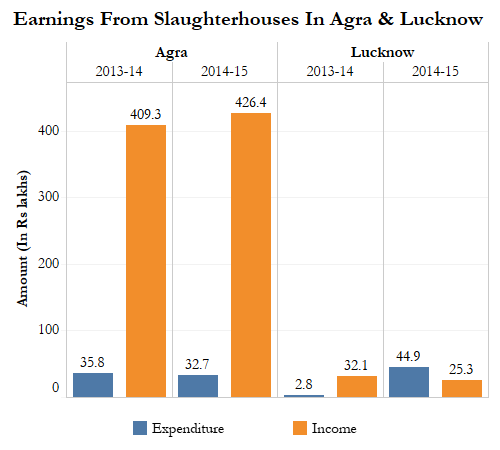
Source: Budget documents of Lucknow and Agra municipal corporations
A crackdown with wide reverberations
UP, India’s top meat producer in 2012-13, has felt the reverberations far and wide.
Of the 77 APEDA-approved slaughterhouses in India, 44 are in UP. In addition to these, municipal corporations and nagar panchayats (city councils) run numerous abattoirs to meet the domestic meat requirement.
UP has a famous, long-standing non-vegetarian culinary tradition, and as per the 2011-12 consumer expenditure survey of the National Sample Survey Organisation (NSSO), an average UP household reported consuming 0.17 kg of buffalo meat every month, as against the all-India average of 0.10 kg.
Some 30.6 percent of UP households reported they consumed non-vegetarian food, while 7.95 percent households reported they consumed beef or buffalo meat. The all-India average was 4.5 percent.
Beef And Buffalo Meat Consumption
Quantity (Per 30 days) Incidence (Per 1,000 households)
Uttar Pradesh 0.17 kg 7.95
All India 0.1 kg 4.5
While India registered a 3.33 percent decline in livestock population during 2007-12, UP saw a 14 percent growth, indicating the economy’s dependence on livestock and allied businesses, IndiaSpendreported on 29 March, 2017.
NOTE: *Including meat processing plants
Livelihoods lost
Kanpur’s Bakar Mandi slaughterhouse, from where Shafiq used to buy meat, was one of many government facilities which had not been modernised despite repeated reminders from the UPPCB.
Butchers would pay a small fee (Rs 25 for buffalo, Rs 10 for goat) to use the facility at night and the meat would be put on sale around the city by early morning.
“I support modernisation, but the government should have made an alternative arrangement before closing it down. A gradual phase-out would have helped everyone,” Shafiq said.
Danish Qureshi, 25, of Rampur town was similarly rendered jobless. He now drives a rented e-rickshaw for hire, although he considers meat-selling his family business. “My father had a licence issued by the Municipal Corporation 45 years back. I used to get it renewed every year,” he said, “Why didn’t anybody tell us we were doing business illegally?”
His bigger complaint is that the government is not helping butchers secure bank loans to upgrade their shops, a prerequisite to get FSSAI licenses. “Most of us have little by way of savings,” he said, adding, “Those with money have renovated their shops, but they form just one per cent of the butcher community in Rampur.”
Farmers, associated trades take a hit
At the Sunday cattle market in Tirwa village, about 15 km from Kannauj city in central UP, very few transactions were taking place as farmers were not getting the price they were quoting.
This was largely due to enforcement of the NGT order. The more recent central government ban on sale of cattle for slaughter in cattle markets–currently on hold following a Supreme Court order–is yet to be implemented on the ground.
“Last year it was notebandi, and this year it is meat bandi that has reduced demand,” said Arjun Singh, a farmer from Achanakapur village. He was seeking Rs 50,000 for a young female buffalo, but was getting offers of Rs 32,000.
Since the slaughterhouse crackdown, farmers are unable to fetch good prices even for milch cattle because buyers are worried they will be unable to resell.
“What if a buffalo is unable to breed? No other farmer would touch it. Should we keep spending on its fodder or sell it to a slaughterhouse? Why can’t the government understand this simple logic?” asked a farmer at a cattle market in Chaubepur village near Kanpur.
Brajal Kumar Dwivedi, a young farmer from Jaisinghpura village, wanted to sell a mother-calf buffalo pair for Rs 90,000. He was getting offers of up to Rs 70,000. “I bought it last year for Rs 80,000 from Sakipur mandi, had it fed and impregnated, and am still unable to get the price I paid,” he said. Engaged to be married, Dwivedi needed money for his wedding but said he would wait a few weeks for prices to stabilise, and would sell milk to the local dairy until then.

Brajal Kumar Dwivedi of Jaisinghpura village in Kannauj district of central Uttar Pradesh wanted to sell a mother-calf buffalo pair for Rs 90,000, but he did not get offers beyond Rs 70,000. He bought the buffalo last year for Rs 80,000, fed it, had it impregnated but cannot get the right price, as demand falls. Engaged to be married, Dwivedi hoped to raise money for his wedding. He has now decided to wait for a few weeks, hoping that prices stabilise.
Jaddunath Singh of Kithwa village was not so lucky–he had to sell a buffalo at a Rs 11,000 loss because he needed money for the treatment of his hospitalised father-in-law.
Those providing ancillary services are also affected. Rajendra Singh, who lets out vehicles to transport animals, was staring at another dull day. “Most farmers are taking their animals back on the vehicles they came on. Only a buyer would hire a vehicle here, but not many deals have come through. This has been the case for the last three months,” he said.
The Pechbagh hide market in Kanpur, the largest in India for buffalo skin, has also seen trade decline over the last couple of years–particularly since the 2015 mob lynching of a Muslim man, Mohammad Akhlaq, and his son, who were suspected of stealing and slaughtering a stolen cow calf, in Dadri in eastern UP.
“Fear of cow vigilantes who beat up transporters even if they are transporting only buffalo skins has scared away suppliers,” said Akhtar Hussein Akhtar, a godown owner at Pechbagh and an office-bearer of the local Hide Merchants’ Association.
Akhtar explained that large, mechanised slaughterhouses sell hides directly to big tanneries, and only those engaged in skinning dead animals sell to merchants in Pechbagh. “[Earlier] most of the supply came from government abattoirs while weekly supply from villages filled the gap.
Now whatever raw material we are getting is from villages and that too of animals who die of natural causes, not slaughtered ones,” he said, adding that supply has gone down from 10,000 hides per month to 500. “We have also reduced our employee strength from eight workers to just one now,” he said.
According to the Hide Merchants’ Association, around 40,000 people are directly engaged in this trade. Membership of the association has reduced by half in the last few years as many have turned their godowns into garment shops.
Big businesses benefit
According to the All India Meat and Livestock Exporters’ Association, UP’s meat industry employs nearly 2.5 million people. But there’s a stark difference between the formal market consisting mostly of wealthy exporters and the informal community of butchers, meat suppliers and those trading in animal byproducts. While the former own mechanised, well-equipped slaughterhouses that usually have the requisite permits, the informal market is dependent on government-run abattoirs, most of which have now been shut down for failing to comply with rules.
The crackdown has therefore skewed the market in favor of big companies, which have thus far been engaged in export of buffalo meat. “Big companies are making tidy profits as the cattle market has tanked due to no demand from butchers. On the other hand, shortage of meat in the market has caused its price to increase. So, the companies can buy animals at a low price and sell meat at a premium,” Dharmendra Malik, general secretary of the UP branch of the Bharatiya Kisan Union (BKU), told IndiaSpend.
To combat the meat shortage, the Kanpur DM arranged a meeting of meat-sellers and private companies operating from Unnao, a leather and chemicals hub 15 km from Kanpur. “We are granting no-objection certificates for meat shops to operate on the condition that they source meat from these companies,” Dr AK Singh, the veterinary officer at Kanpur Municipal Corporation, told IndiaSpend.
Similar arrangements have been made in other cities, including Bareilly, Moradabad, Aligarh and Muzaffarnagar. The price of buffalo meat has gone up from Rs 150 per kg before the clampdown to Rs 200 now.
Businesses are happy to tap the market not open to them earlier. “People are not very keen on the frozen meat we supply as they are used to getting raw and fresh meat from the city abattoirs. But that option is not available now. We are currently supplying 3-4 tonnes of buffalo meat per day to Kanpur and hope to scale it up to 30-35 tonnes,” Abhishek Arora, owner of AOV Exports Limited, told IndiaSpend.
Butchers, however, are unhappy at being compelled to buy from large companies. “Around a fourth of our earnings come from selling of waste material from slaughter. Entering into an agreement with the company means to let go of this profit. We would rather close down than hand over our business to the companies,” said Shahabuddin Qureshi, the general secretary of Qureshi Foundation, an association of butchers and meat-sellers in Lucknow.
A way forward?
Many said an ideal solution would be to set up an alternative slaughtering site away from habitation until the government abattoirs are modernised. “When an animal is slaughtered, around 20 people get work. There are the meat sellers, those who trade in animal skin, those selling bones and hooves, and then there are people who process the fat for sale to soap factories,” said Ahmad of Jamiat-ul-Quresh. “Now the meat sellers with licenced shops are the only ones able to do some business. All others have been rendered jobless.”
Meanwhile, illegal slaughter continues in Lucknow, clandestinely and at a smaller scale. “The animal waste which was earlier generated at one place and picked up by the municipal corporation, is now polluting densely populated areas without any proper disposal,” Qureshi asked. “What purpose has been solved with the closure of the government-run abattoirs?”
As workers struggle to reorganise their lives after the mass closure of slaughterhouses, the failure of past and present governments to organise a trade that employed hundreds of thousands is largely overlooked.
“The clampdown was much needed in view of the health and environment concerns associated with ill-equipped slaughterhouses,” said Kamna Pandey, former member of the Animal Welfare Board of India, based in Lucknow, “In fact, I don’t agree with the argument that the action needed to be in phases. But the government should have also been proactive in constructing modern slaughterhouses to avoid public loss.”
Paper wrappers on food banned in Kerala


Thiruvananthapuram: The food safety commissioner has issued an order prohibiting the use of newspapers and other printed material for wrapping, packing and serving food for a period of one year. The order was issued as per Section 30(1) of the Food Safety and Standards Act,2006 which gave the commissioner the power to prohibit the storage, distribution or sale of food articles that are unsafe.
Food safety commissioner Navjot Khosa, in an order pointed out that a risk analysis has found that this would cause chemical and microbiological contamination of food articles. This made the food unsafe and injurious to the health. The consumers are thereby being slowly poisoned, the order pointed out.
The order pointed out the Section 18(1) (a) of the Act endeavoured to achieve an appropriate level of protection of human life and health and the protection of consumer’s interest, including fair practices in all kinds of food trade with reference to food safety standards and practices. Further, the Section 29(3) the authorities should maintain a system of control and other activities as appropriate to the circumstances, including public communication on food safety and risk, food safety surveillance and other monitoring activities covering all stages of food business, said the order.
Food adulterators, drug peddlers under watch: Mahesh Bhagwat
Rachakonda Police Commissioner promises to eradicate organised crime in the city
Rachakonda Police Commissioner Mahesh Bhagwat vowed to eradicate organised crime in the city. Construction of a new Rachakonda Commissionerate will start at a 10-acre plot located near VM Home in Saroornagar, once the State government issues the order.
The Rachakonda top cop had won a rare honour from the US State Department in June 2017. He was awarded the title ‘Real Hero’ for his 13-year-long work against labour and human trafficking. While talking to media personnel at Meet the Press programme organised at the Hyderabad Press Club, Mr. Bhagawat said the police will bring to book all offenders, even those high rungs, who indulge in organised crimes including food adulteration, human trafficking and gambling.
Emphasising on women’s safety, Mr. Bhagwat said in addition to instilling confidence among women by addressing their complaints through SHE teams, Rachakonda police has also roped in 144 girl students from 74 colleges as representatives of ‘She for Her’ programme. The police trained students would help their peers studying in colleges.
As part of the crackdown against prostitution rackets operating in the city, 45 brothels were closed down and 155 women were rescued. “Operation of brothels has almost come to an end in Rachakonda and house owners are now collecting details of tenants before renting them the property,” he said. The Rachakonda CP also spoke about security arrangements to be made at Yadagirigutta temple and the construction of Commissionerate headquarters building. Mr. Bhagwat said all the vehicles going to Yadagirigutta temple will be scanned.
In the wake of arrests of drug peddlers in Hyderabad, parents had made representation to him, the Commissioner said. “Recently some worried parents wanted the police to keep a watch at their children’s school surroundings for drug peddlers. They were worried because their children woke up late each morning. I advise the parents to not worry unnecessarily. Parents have to spend time with the children and keep a watch on their Internet browsing, cell phone usage and TV viewing habits. Rachakonda police are also keeping a watch on suspects,” Mr. Bhagwat said. The commissioner of police said the ganja peddlers are bringing the contraband from Odisha and Andhra Pradesh to Hyderabad to transport it to other parts of the country.
“We have made proposals to evoke PD Act against food adulterators, sellers of spurious seeds and drug peddlers,” the CP said. People can contact Rachakonda police to inform about crime at 9490617111. Since rural areas fall under Rachakonda Commissionerate, which is the biggest in the country, his officers have been organising awareness programmes to stop child marriages and crime related to superstitions and black magic.
Subscribe to:
Posts (Atom)