Jul 18, 2017

Giving their food the +F edge

Healthy smiles Children at the Government English Medium School in Nashik’s Mundegaon village get food, including fortified rotis from a centralised kitchen that is run under a bilateral agreement between the Maharashtra Government and Tata Trusts
A public-private partnership might finally fortify India against malnutrition. Preeti Mehra writes
Daurali Devi lives in one of Delhi's unauthorised colonies. She has no idea what the +F symbol stands for, but lately the 65-year-old has started looking for it on the milk sachet that she buys. Her grandchild's paediatrician has told Devi that milk embossed with the sign has “zyada takat” (more strength) and it’s good for her three-year-old grandson who suffered from low-weight since birth.
Her grandson is part of the 25 per cent of the Delhi’s population that suffers from malnutrition. Addressing the problem, Delhi late last year joined the effort to fortify common foods with micro-nutrients when milk caterer, Mother Dairy took the lead by adding Vitamin A and D to all its poly packs. Daurali's family, which was earlier buying unpackaged milk from Mother Dairy, was among the hundreds that shifted to the sachet on advice from a medical practitioner.
Not just Delhi, malnutrition continues to ail a significant percentage of India’s population. For instance, the National Family Health Survey of March 2017 shows that over a quarter of children under the age of five are stunted (low height for age) in all of India’s major state capitals, except in Kochi and Hyderabad.
The 2016 Global Hunger Index ranked India 97th out of 118 countries behind Nepal, Sri Lanka, Bangladesh. It was positioned 80 out of 104 countries the previous year.`
Given the seriousness of the issue, a renewed attempt is being made to address malnutrition through food fortification. While till a few months ago, there was talk of a food fortification policy being worked out, the Government is now moving forward through FSSAI (Food Safety and Standards Authority of India).
Nearly 40 companies have come forward to lend their hand and are fortifying their products, following the +F formula. Some are fortifying their product for the pan-India market, while others are targeting specific States.
“Food fortification is nothing new. Everyone agrees it needs to be done and wants to do it. But it doesn’t get done,” says Pawan Kumar Agarwal, Chief Executive Officer at FSSAI. “All it requires is aligning a few things for the industry to start fortifying and the consumer to start accepting. It’s like the chicken and egg story, which comes first,” adds Agarwal, who is pro-actively pushing for a greater embrace by states and food companiesTesting the waters
Delhi is one of the recent states to join the fight against malnutrition. Some of its peers, including Rajasthan and Madhya Pradesh have taken the lead in adding nutrients to staple foods such as wheat flour and oil through a pilot project initiated by the Global Alliance for Improved Nutrition (GAIN). The international organisation was launched in 2002, at the United Nation's Special Session on Children to tackle human suffering caused by malnutrition.
The two States were chosen due to their high burden of malnutrition. According to the National Family Health Survey-3 (NFHS 3), in Madhya Pradesh 25 per cent population under five years suffers from stunting, 30 per cent in the same group from wasting, 29 per cent from anaemia, 21 per cent newborns have low birth weight and 27 per cent of reproductive age women have chronic energy deficiency.
Rajasthan's indicators are also as poor. GAIN looked at consumption patterns of both the States and found that wheat, milk and oil were consumed in the largest volumes. They then interacted with large industries packaging the commodities and nudged them to fortify their products.
Typically, oil was enhanced with Vitamin A and Vitamin D, while wheat flour was fortified with iron, folic acid, Vitamin A, B12, B 3, B1, B 2, B 6 and zinc. While voluntary fortification through commercial channels were selected in both the States, in Rajasthan distribution of fortified foods was also carried out through key government schemes like the public distribution system (PDS), the school mid-day meals (MDM) and the Integrated Child Development Services (ICDS) that caters to children under six years, and to pregnant and lactating mothers.
Since 2002,several States have chosen to use government programmes for distribution of fortified staple foods and some are still in the process of building their strategy. For instance, fortified oil is being routed through the PDS in Himachal Pradesh, Karnataka and Gujarat, Rajasthan and parts of Haryana; it is being used for MDM in Madhya Pradesh, Punjab, Himachal Pradesh, Rajasthan and one district of Haryana; and for ICDS meals in Rajasthan and parts of Haryana.
Similarly, fortified wheat flour has made inroads through PDS into West Bengal and Andaman & Nicobar Islands. While a pilot project for enhanced wheat flour is underway in Maharshtra's Navi Mumbai, a roll out is under consideration by the Kerala and Haryana government. Fortifying of rice is still at a nascent stage and only some parts of Odisha, Karnataka and Haryana are using the fortified product for school mid-day meals. The crucial question in all efforts to introduce fortified staples is public acceptance of the product and willingness to pay marginally more for it.Standards for staples
From the Government’s end, the food fortification project is being taken forward by the FSSAI. Apart from Tata Trusts and GAIN, it is working with other development partners including the Bill and Melinda Gates Foundation, The Clinton Health Access Initiative, Inc., The Coalition for Food and Nutrition Security, India, Iodine Global Network, UNICEF and World Food Programme.
FSSAI of course also co-ordinates with the concerned Central ministries to make the roll out smoother.
And this year the food safety organisation has taken several leaps to make things actually happen on the ground. To begin with, the FSSAI has formulated the +F symbol that denotes that a product has been fortified correctly — the same symbol that Daurali Devi looked for when she bought her milk sachet.
Along with this, FSSAI has put in place standards for fortification of five staples commodities — wheat flour, milk, oil, rice and salt. To converge all efforts at increasing the nutritive content of the Indian diet it established Food Fortification Resource Centre (FFRC) at its headquarters in Delhi in November last year. This is now functioning as a nodal agency for food fortification in the country.
For now, food fortification remains a voluntary exercise to be undertaken by the relevant industry as well as the States. However, for it to be implemented effectively at any level it needs multi-stakeholder engagement. “We are a rallying point on fortification and are involved in facilitating and providing all the stakeholders technical support,” explains Smita Mankad, head of FFRC who says that the last six months has been an effort in bringing all the players to the table.Identify the food vehicle
So, how is food fortification done? Dr Rajan Sankar, Programme Director, Nutrition at Tata Trusts, says that the first step is to identify commonly eaten foods in a region. Those foods then “can act as vehicles for one or more micro-nutrients and lend themselves to centralised processing on an economical scale.”
This is because when fortification is done on foods that are in the everyday diet of large populations, it does not require people to change their dietary and food patterns, so are easily accepted. “It can be dovetailed into existing food production and distribution systems,” explains Dr Sankar who has implemented several fortification programmes.
And that is exactly how it is being rolled out. On the one hand, the food industry is being made aware of the need to fortify all its packaged food. On the other hand, State Governments are being sensitised on how crucial it is to distribute fortified food through public channels.
The trend seems to be catching on. For instance, in April this year, Tamil Nadu inaugurated a salt refinery to manufacture double fortified salt (DFS), which will be channelled through the PDS, the mid-day meal scheme, anganwadis and primary health centres.
Tata Trusts is helping the State Government implement the project. DFS has also been a choice of other States like Uttar Pradesh, Tripura, Karnataka, Haryana and Madhya Pradesh.
It may be recalled that ahead of the 2017 Assembly elections, then Uttar Pradesh Chief Minister, Akhilesh Yadav, launched double fortified 'Swadeshi' salt for marginalised communities.Industry on board
Agarwal and Mankad say that the private sector has reacted quite positively to fortifying its products.
In wheat flour, brands such as Aashirwad, Golden Harvest, Risshta, Energetic, Vitamin Plus, Kumar Chakki Atta and Harmony Chakki Fresh have chosen to fortify. Some States such as West Bengal, Andaman & Nicobar Islands are also supplying fortified wheat through their public distribution system. Milk is being fortified by a large number of players now. Mother Dairy started with Delhi but has taken its initiative pan India. So has Kwality Limited, which also sells milk apart from ice creams.
The milk cooperatives in Haryana, Punjab, West Assam, Jharkhand, Rajasthan, and Creamline Diary in Tamil Nadu have followed suit. Oil has had as many as 11 companies joining in including the much advertised, top of the pile brands like Fortune, Saffola, Ruchi Gold, Sweekar, and Nature Fresh.
What makes it easier to convince private players to come on board is the fact that cost has never been the main deterrent to fortification. According to FSSAI, the price to fortify food is minuscule. It costs as much as ₹30 to ₹100 per metric tonne which works out to just about 3 to 10 paisa per kg of food, depending on the type and number of micro-nutrients that are being added and the staple food that has been chosen to be fortified.
It needs just eight paise to fortify a litre of oil, eight paise for a kilogram of wheat flour. Around 30 – 40 paise for a kilogram of rice and ₹2-3 for a kg of DFS.
“The challenge is not the cost, it’s convincing companies and consumers on the merits of fortification. When the demand comes from the consumer, more industry players will fall in line,” explains Agarwal.
This is the chicken and egg story that he has been trying to tackle. “Nudge both demand and supply, bring stakeholders to the table, connect industry to premix suppliers, offer technical training and expand consumer awareness.” The result should soon be out for all to see.

Jul 17, 2017

DINAKARAN NEWS


DINAKARAN NEWS


DINAKARAN NEWS


READY-TO-EAT SPROUTS UNHEALTHY, REVEALS STUDY

Undercooked meat is unhealthy, so are the ready-to-eat sprouts which is widely sold in the retail market or supermarkets and by vegetable vendors on the roadside.
A study published in the latest edition of the Current Science has found that both undercooked meat and moong daal sprouts are potential sources of food-borne infections.
The researchers had picked a total of 14 chicken meat and 13 ready-to-eat (RTE) sprouted mung bean samples from different retail poultry shops and local street vendors respectively from Mumbai.
After detailed analysis of the samples, the researchers found that pathogens belonging to various bacteria were present in chicken meat and sprouts.
Common food-borne and opportunistic pathogens like Campylobacter, C. perfringens, Streptococcus, Shewanella, Pseudomonas, Aeromonas hydrophila, Staphylococcus, E. coli, Acinetobacter, Enterobacter, Klebsiella were detected and 18 per cent of the genera were common to both food types, said the research team.
The researchers were Onkar A Naik and Archana Rath from Department of Biotechnology, University of Mumbai, and Jayant R. Bandekar and Devashish Rath from Food Technology Division and Molecular Biology Division of the Bhabha Atomic Research Centre, Trombay, Mumbai.
High microbial load was observed in both chicken meat and sprouts samples. In a tropical country like India, warm and humid conditions facilitate rapid proliferation of bacteria in food. Moreover, undercooked food and unhygienic handling practices also contribute to high bacterial load in food samples, the researchers noted.Doctors have attributed poor microbiological quality of the sprouts to unhygienic sprout production and retailing practices.
“If sprouted hygienically, they are safe and healthy. In retail markets where hygiene issues like washing of hand and water quality are not ensured, they become unsafe. Hence, while purchasing them one must ensure that best practices are being maintained,” said Dr Umesh Kapil, from Department of Gastroenterology and Human Nutrition Unit, AIIMS in Delhi.
Though there are no guidelines in India, the US FDA and the Centers for Disease Control and Prevention advises that children, the elderly, pregnant women and people with weakened immune systems should avoid eating raw sprouts of all kinds, including alfalfa, clover, radish and mung bean sprouts. Sprouts can be “cooked thoroughly to reduce the risk of illness.
Over the past 16 years, there have been at least 30 reported illness outbreaks associated with raw or lightly cooked sprouts abroad. Mike Doyle, director of the Center for Food Safety at the University of Georgia has been quoted as saying “I consider sprouts to be among the most risky foods sold at retail”.
Diarrhea, fever and abdominal cramps are common symptoms that occur 12 to 72 hours after infection.

Roadside eateries pay no attention to hygiene

Parotta being prepared on a roadside shop Tiruchi.
GST forces many poor people to opt for them
K. Ravichandran (47) of Aruppukottai just needs Rs. 40 to have a non-vegetarian unlimited meal on a roadside eatery on V. O. Chidambaram road near the Central Bus Stand in Tiruchi. On Sunday, while he was being served a curry, a layer of dust kicked up by a swirling wind fell on his plate. A layer of dust also covered the omelettes and parottas being made by the food stall owner. But neither he nor Ravichandran bothered much about the dust and Ravichandran continued to enjoy his lunch, as the owner went on cooking.
Ravichandran was not a lone customer having lunch at the roadside eatery. Similar was the scene at most of the roadside push cart eateries at Central Bus Stand. At least 50 customers were seen eating at different stalls on VOC road. Most of them were having lunch as they waited for buses to various destinations.
Some of them were drivers and conductors of State owned transport corporation buses and private buses.
They get one parotta at Rs. 10 and kuska and varieties of rice at just Rs. 20 per plate. One plate of mutton biriyani was being sold at Rs. 70.
“Most of the restaurants charge Rs. 100 for a vegetarian meal. In addition, I have to pay Rs. 10 to Rs. 18 to the government on Goods and Service Tax. I cannot afford it. Hence I prefer to eat at a roadside eatery,” says Ravichandran.
Surprisingly many are aware that most of the food stall owners pay little attention to ensure hygienic environment and hygienic methods of food preparation.
“We know well that we eat food items prepared in a poor hygienic condition. But, we can afford only to eat at roadside eateries,” says a woman, a Thiruverumbur bound passenger from Erode, who was having lunch at a roadside eatery.
A owner of a roadside eatery said that he was giving top priority for hygienic preparation of foods but the windy season was making the job difficult.
Sounding an alert on possible outbreak of diarrhoea and cholera, M. A. Aleem, former Vice Principal, K. A. P. Viswanatham Medical College, said that most of the roadside eateries were transacting business in an unhealthy and unhygienic environment. The windy season would make the food quality worse. It was important for the health officials to ensure good environment surrounding eateries.
While acknowledging that roadside eateries have come to stay in the city, Dr. Aleem further said that the Tiruchi Corporation, Public Health and Food Safety officials should conduct an awareness programme for all owners, cooks and other employees of these eateries.

Development of food testing laboratory mechanism will boost the food processing sector in India

Quality and Food Safety have become competitive edge in the global market for the enterprises producing and marketing foods products. For a successful food processing sector in the country, various aspect of Total Quality Management (TQM) such as quality control, quality system and quality assurance should function in a horizontal fashion for total success. The quality infrastructure is must to produce the world class processed food products in India. The Indian food products face the tough competition from global companies which produces high quality standard food products. To overcome this situation and to produce global quality food products in India then a Quality and Food Safety system has to be implemented to meet the global quality standard.
Laboratory testing is an important process, which relies on scientific analysis to identify problems with food products
For quality check and testing, Food Testing Laboratory plays very important role. Western countries have put a strong food testing laboratory system to check and maintain the high quality food products. India too is following the same system to produce the world class quality products. Ministry of Food Processing Industries (MoFPI) has been working rigorously to upgrade Food Testing Laboratory infrastructure in India. The main objective of this upgradation is to provide a safe nutritious diet in order to maintain health other aspects in today’s world. The Ministry of Food Processing Industries is upgrading the food testing laboratories which would benefit all stakeholders including domestic industry (Domestic and exports), entrepreneurs, small and medium enterprises.
Laboratory testing is an important process, which relies on scientific analysis to identify problems with food products. It provides analytical data on the quality of a product or production process. The objective of quality control is to identify impurities in the food material, or contamination after a product is produced and before it is placed on the market. Additionally, laboratory testing is important for the research and development of new products, including, for example, the choice of ingredients or components, the design of food processing, shelf-life studies and sensory evaluation of products.
The Ministry of Food Processing Industries is keen to build the food processing sector in India. It is focusing high on building infrastructure, maintain standard quality and providing all the assistance to propel the growth of the industry. To bring the world class technology and provide international platform, The Ministry of Food Processing Industries is organizing World Food India from November 3-5, 2017 in New Delhi. World Food India intends to establish global linkages and facilitate foreign investment in India’s food retail market that services the needs and rising aspirations of the country’s 1.3 billion consumers.
World Food India aims to provide opportunities for both investment and trade in the food processing sector for leading Indian and international companies. Encompassing the entire food spectrum from production to consumption, World Food India is looking at creating a better sourcing environment, thereby enabling higher returns for farmers, creating employment, and fostering entrepreneurship.

Jul 16, 2017

UP's crackdown on slaughterhouses: Butchers, farmers and traders suffer as big businesses gain

Kanpur/Lucknow (Uttar Pradesh): Mohammad Shafiq took solace from the large grain container placed in a corner of the room.
“This will last six to nine months. At least we won’t starve now,” he said.
The 52-year-old, who lives with his family in a small hutment in a graveyard in Kanpur’s Idgah Colony, used to procure meat from the nearby government slaughterhouse and sell it by the roadside.
In March 2017, the newly-elected Bharatiya Janata Party(BJP) government in Uttar Pradesh (UP) ordered action against slaughterhouses and meat-sellers operating without valid licences and violating environmental and health rules.
Across the state, numerous shops and slaughterhouses, including government-run abattoirs, were sealed, leading to severe shortage of meat and affecting the livelihoods of thousands like Shafiq who made a living by using common government abattoirs for a small fee. Essentially, failure of municipal administrations to upgrade these facilities had destroyed the vast unorganised meat industry, and hundreds of thousands of ancillary jobs.
For a while, Shafiq went back to his ancestral village with his wife and kids. There, he worked as a farm-hand even though his left hand does not function properly. “It was wheat harvesting season. I had never done that work before but with my kids’ support, I managed somehow and got 500kg grain in return,” he told IndiaSpend on a muggy June evening.
Now back in Kanpur, Shafiq hawks churan (tangy powder), tamarind and jamun around town. “Earlier my elder son used to do this work, but he suffers from night blindness. I thought I can put in more hours than him. He has now taken to buying and selling scrap. I make Rs 200-250 a day while he manages between Rs 75-125,” Shafiq said.
Mohammad Shafiq sells churan (tangy powder) in Kanpur, central Uttar Pradesh. Till three months ago, he used to sell meat that he bought from a government abattoir in Kanpur and earned a profit of Rs 500 every day within three hours. With the closure of the slaughter house, Shafiq now hawks his wares till evening and makes Rs 200-250.
From meat-selling, Shafiq used to earn Rs 400-500 within three hours. “The meat, fresh from the slaughterhouse, would sell quickly. We don’t have refrigeration, so I would only buy as much as I could sell easily. Any leftovers, the family would use,” he said.
‘Illegal’ slaughterhouses: Past governments ignored issue
The Prevention and Control of Pollution (Uniform Consent Procedure) Rules of 1999 list slaughterhouses under the ‘red’ heavily-polluting category with potential to adversely impact public health.
In UP, as in the rest of the country, a range of agencies regulate slaughterhouses. Foremost among these is the state-level pollution regulator, the Uttar Pradesh Pollution Control Board (UPPCB), which gives permission (“no-objection certificate”) for setting up a slaughterhouse after getting a go-ahead from the top district administrator, the District Magistrate (DM). The DM conducts a site inspection to assess compliance with various parameters, including law and order, before granting permission. Once a slaughterhouse is set up, the UPPCB monitors its functioning to ensure pollution control measures are in place.
If the facility is for export, approval is also required from the Agricultural and Processed Food Products Export Development Authority (APEDA). Slaughterhouses must also follow the Prevention of Cruelty to Animals (Slaughter House) Rules, 2001, as well as obtain a license from the Food Safety and Standards Authority of India (FSSAI) to ensure all animal-derived food is healthy.
Many slaughterhouses have been accused of violating norms, and the National Green Tribunal (NGT) is hearing a string of petitions seeking their upgradation or closure. In May 2015, hearing one such petition, the NGT ordered all slaughterhouses running without requisite permits in UP to be shut.
When the new BJP government assumed office in UP in March this year, it began to take action on the NGT order.
Both private and government-run slaughterhouses were shut, having failed to upgrade despite the 2015 NGT order, a previous Supreme Court order and reminders by the UPPCB.
In this partial list of 129 industrial units failing to install anti-pollution devices in 2015, 44 were slaughterhouses, 39 of which were run by municipal bodies and nagar panchayats while another was run by the Lucknow Cantonment Board. All four of capital city Lucknow’s slaughterhouses were found not to have proper treatment facilities.
According to the Uttar Pradesh Municipal Corporation Act, 1959, the construction and maintenance of public markets and slaughterhouses is an obligatory duty of the local corporation. The Allahabad High Court upheld this in an ongoing case regarding operation of slaughterhouses.
An amount of Rs 12.5 crore was sanctioned on 3 January, 2017, for the modernisation of the slaughterhouse at Lucknow’s Moti Jheel, but the project got stuck when the model code of conduct for assembly elections came into force the very next day.
A similar situation prevails in other cities and towns except Agra, where the municipal corporation runs a modern abattoir.
“The responsibility of previous governments is greater than the current government. They failed to modernise the slaughterhouses for a very long time preparing the ground for the present crisis,” said Irfan Ahmad, the vice-president of the Jamiat-ul-Quresh, an organisation of slaughterhouse owners and meat and beef suppliers in Kanpur.
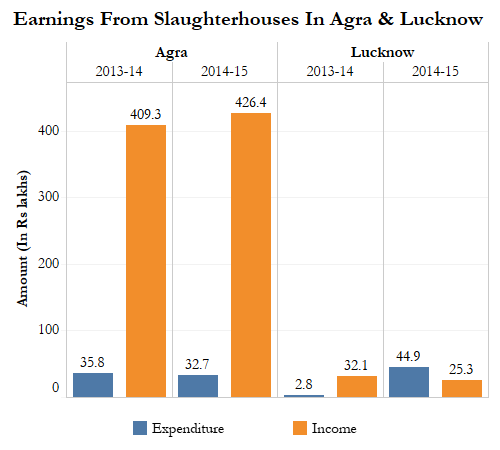
A comparison of the earnings and expenditures of the Lucknow and Agra municipal corporations shows how the state capital lost precious revenue by failing to modernise its slaughterhouse.
The Agra Municipal Corporation earned Rs 4.26 crore in 2014-15 from leasing out its modern slaughterhouse to a private contractor. The contractor uses the facility for export purposes and also allows individual butchers to use it for a fee of Rs 385 per buffalo. The Lucknow Municipal Corporation, in contrast, was able to charge Rs 10 as fee for slaughtering of goat/sheep and Rs 25 for buffalo, making Rs 25.33 lakh in all. Spending Rs 44.87 lakh on staff salaries, it reported a loss of over Rs 19 lakh.

Source: Budget documents of Lucknow and Agra municipal corporations
A crackdown with wide reverberations
UP, India’s top meat producer in 2012-13, has felt the reverberations far and wide.
Of the 77 APEDA-approved slaughterhouses in India, 44 are in UP. In addition to these, municipal corporations and nagar panchayats (city councils) run numerous abattoirs to meet the domestic meat requirement.
UP has a famous, long-standing non-vegetarian culinary tradition, and as per the 2011-12 consumer expenditure survey of the National Sample Survey Organisation (NSSO), an average UP household reported consuming 0.17 kg of buffalo meat every month, as against the all-India average of 0.10 kg.
Some 30.6 percent of UP households reported they consumed non-vegetarian food, while 7.95 percent households reported they consumed beef or buffalo meat. The all-India average was 4.5 percent.
Beef And Buffalo Meat Consumption
Quantity (Per 30 days) Incidence (Per 1,000 households)
Uttar Pradesh 0.17 kg 7.95
All India 0.1 kg 4.5
While India registered a 3.33 percent decline in livestock population during 2007-12, UP saw a 14 percent growth, indicating the economy’s dependence on livestock and allied businesses, IndiaSpendreported on 29 March, 2017.
NOTE: *Including meat processing plants
Livelihoods lost
Kanpur’s Bakar Mandi slaughterhouse, from where Shafiq used to buy meat, was one of many government facilities which had not been modernised despite repeated reminders from the UPPCB.
Butchers would pay a small fee (Rs 25 for buffalo, Rs 10 for goat) to use the facility at night and the meat would be put on sale around the city by early morning.
“I support modernisation, but the government should have made an alternative arrangement before closing it down. A gradual phase-out would have helped everyone,” Shafiq said.
Danish Qureshi, 25, of Rampur town was similarly rendered jobless. He now drives a rented e-rickshaw for hire, although he considers meat-selling his family business. “My father had a licence issued by the Municipal Corporation 45 years back. I used to get it renewed every year,” he said, “Why didn’t anybody tell us we were doing business illegally?”
His bigger complaint is that the government is not helping butchers secure bank loans to upgrade their shops, a prerequisite to get FSSAI licenses. “Most of us have little by way of savings,” he said, adding, “Those with money have renovated their shops, but they form just one per cent of the butcher community in Rampur.”
Farmers, associated trades take a hit
At the Sunday cattle market in Tirwa village, about 15 km from Kannauj city in central UP, very few transactions were taking place as farmers were not getting the price they were quoting.
This was largely due to enforcement of the NGT order. The more recent central government ban on sale of cattle for slaughter in cattle markets–currently on hold following a Supreme Court order–is yet to be implemented on the ground.
“Last year it was notebandi, and this year it is meat bandi that has reduced demand,” said Arjun Singh, a farmer from Achanakapur village. He was seeking Rs 50,000 for a young female buffalo, but was getting offers of Rs 32,000.
Since the slaughterhouse crackdown, farmers are unable to fetch good prices even for milch cattle because buyers are worried they will be unable to resell.
“What if a buffalo is unable to breed? No other farmer would touch it. Should we keep spending on its fodder or sell it to a slaughterhouse? Why can’t the government understand this simple logic?” asked a farmer at a cattle market in Chaubepur village near Kanpur.
Brajal Kumar Dwivedi, a young farmer from Jaisinghpura village, wanted to sell a mother-calf buffalo pair for Rs 90,000. He was getting offers of up to Rs 70,000. “I bought it last year for Rs 80,000 from Sakipur mandi, had it fed and impregnated, and am still unable to get the price I paid,” he said. Engaged to be married, Dwivedi needed money for his wedding but said he would wait a few weeks for prices to stabilise, and would sell milk to the local dairy until then.
Brajal Kumar Dwivedi of Jaisinghpura village in Kannauj district of central Uttar Pradesh wanted to sell a mother-calf buffalo pair for Rs 90,000, but he did not get offers beyond Rs 70,000. He bought the buffalo last year for Rs 80,000, fed it, had it impregnated but cannot get the right price, as demand falls. Engaged to be married, Dwivedi hoped to raise money for his wedding. He has now decided to wait for a few weeks, hoping that prices stabilise.
Jaddunath Singh of Kithwa village was not so lucky–he had to sell a buffalo at a Rs 11,000 loss because he needed money for the treatment of his hospitalised father-in-law.
Those providing ancillary services are also affected. Rajendra Singh, who lets out vehicles to transport animals, was staring at another dull day. “Most farmers are taking their animals back on the vehicles they came on. Only a buyer would hire a vehicle here, but not many deals have come through. This has been the case for the last three months,” he said.
The Pechbagh hide market in Kanpur, the largest in India for buffalo skin, has also seen trade decline over the last couple of years–particularly since the 2015 mob lynching of a Muslim man, Mohammad Akhlaq, and his son, who were suspected of stealing and slaughtering a stolen cow calf, in Dadri in eastern UP.
“Fear of cow vigilantes who beat up transporters even if they are transporting only buffalo skins has scared away suppliers,” said Akhtar Hussein Akhtar, a godown owner at Pechbagh and an office-bearer of the local Hide Merchants’ Association.
Akhtar explained that large, mechanised slaughterhouses sell hides directly to big tanneries, and only those engaged in skinning dead animals sell to merchants in Pechbagh. “[Earlier] most of the supply came from government abattoirs while weekly supply from villages filled the gap.
Now whatever raw material we are getting is from villages and that too of animals who die of natural causes, not slaughtered ones,” he said, adding that supply has gone down from 10,000 hides per month to 500. “We have also reduced our employee strength from eight workers to just one now,” he said.
According to the Hide Merchants’ Association, around 40,000 people are directly engaged in this trade. Membership of the association has reduced by half in the last few years as many have turned their godowns into garment shops.
Big businesses benefit
According to the All India Meat and Livestock Exporters’ Association, UP’s meat industry employs nearly 2.5 million people. But there’s a stark difference between the formal market consisting mostly of wealthy exporters and the informal community of butchers, meat suppliers and those trading in animal byproducts. While the former own mechanised, well-equipped slaughterhouses that usually have the requisite permits, the informal market is dependent on government-run abattoirs, most of which have now been shut down for failing to comply with rules.
The crackdown has therefore skewed the market in favor of big companies, which have thus far been engaged in export of buffalo meat. “Big companies are making tidy profits as the cattle market has tanked due to no demand from butchers. On the other hand, shortage of meat in the market has caused its price to increase. So, the companies can buy animals at a low price and sell meat at a premium,” Dharmendra Malik, general secretary of the UP branch of the Bharatiya Kisan Union (BKU), told IndiaSpend.
To combat the meat shortage, the Kanpur DM arranged a meeting of meat-sellers and private companies operating from Unnao, a leather and chemicals hub 15 km from Kanpur. “We are granting no-objection certificates for meat shops to operate on the condition that they source meat from these companies,” Dr AK Singh, the veterinary officer at Kanpur Municipal Corporation, told IndiaSpend.
Similar arrangements have been made in other cities, including Bareilly, Moradabad, Aligarh and Muzaffarnagar. The price of buffalo meat has gone up from Rs 150 per kg before the clampdown to Rs 200 now.
Businesses are happy to tap the market not open to them earlier. “People are not very keen on the frozen meat we supply as they are used to getting raw and fresh meat from the city abattoirs. But that option is not available now. We are currently supplying 3-4 tonnes of buffalo meat per day to Kanpur and hope to scale it up to 30-35 tonnes,” Abhishek Arora, owner of AOV Exports Limited, told IndiaSpend.
Butchers, however, are unhappy at being compelled to buy from large companies. “Around a fourth of our earnings come from selling of waste material from slaughter. Entering into an agreement with the company means to let go of this profit. We would rather close down than hand over our business to the companies,” said Shahabuddin Qureshi, the general secretary of Qureshi Foundation, an association of butchers and meat-sellers in Lucknow.
A way forward?
Many said an ideal solution would be to set up an alternative slaughtering site away from habitation until the government abattoirs are modernised. “When an animal is slaughtered, around 20 people get work. There are the meat sellers, those who trade in animal skin, those selling bones and hooves, and then there are people who process the fat for sale to soap factories,” said Ahmad of Jamiat-ul-Quresh. “Now the meat sellers with licenced shops are the only ones able to do some business. All others have been rendered jobless.”
Meanwhile, illegal slaughter continues in Lucknow, clandestinely and at a smaller scale. “The animal waste which was earlier generated at one place and picked up by the municipal corporation, is now polluting densely populated areas without any proper disposal,” Qureshi asked. “What purpose has been solved with the closure of the government-run abattoirs?”
As workers struggle to reorganise their lives after the mass closure of slaughterhouses, the failure of past and present governments to organise a trade that employed hundreds of thousands is largely overlooked.
“The clampdown was much needed in view of the health and environment concerns associated with ill-equipped slaughterhouses,” said Kamna Pandey, former member of the Animal Welfare Board of India, based in Lucknow, “In fact, I don’t agree with the argument that the action needed to be in phases. But the government should have also been proactive in constructing modern slaughterhouses to avoid public loss.”

Paper wrappers on food banned in Kerala

The order was issued as per Section 30(1) of the Food Safety and Standards Act, 2006.
Thiruvananthapuram: The food safety commissioner has issued an order prohibiting the use of newspapers and other printed material for wrapping, packing and serving food for a period of one year. The order was issued as per Section 30(1) of the Food Safety and Standards Act,2006 which gave the commissioner the power to prohibit the storage, distribution or sale of food articles that are unsafe.
Food safety commissioner Navjot Khosa, in an order pointed out that a risk analysis has found that this would cause chemical and microbiological contamination of food articles. This made the food unsafe and injurious to the health. The consumers are thereby being slowly poisoned, the order pointed out.
The order pointed out the Section 18(1) (a) of the Act endeavoured to achieve an appropriate level of protection of human life and health and the protection of consumer’s interest, including fair practices in all kinds of food trade with reference to food safety standards and practices. Further, the Section 29(3) the authorities should maintain a system of control and other activities as appropriate to the circumstances, including public communication on food safety and risk, food safety surveillance and other monitoring activities covering all stages of food business, said the order.

Food adulterators, drug peddlers under watch: Mahesh Bhagwat

Rachakonda Police Commissioner promises to eradicate organised crime in the city
Rachakonda Police Commissioner Mahesh Bhagwat vowed to eradicate organised crime in the city. Construction of a new Rachakonda Commissionerate will start at a 10-acre plot located near VM Home in Saroornagar, once the State government issues the order.
The Rachakonda top cop had won a rare honour from the US State Department in June 2017. He was awarded the title ‘Real Hero’ for his 13-year-long work against labour and human trafficking. While talking to media personnel at Meet the Press programme organised at the Hyderabad Press Club, Mr. Bhagawat said the police will bring to book all offenders, even those high rungs, who indulge in organised crimes including food adulteration, human trafficking and gambling.
Emphasising on women’s safety, Mr. Bhagwat said in addition to instilling confidence among women by addressing their complaints through SHE teams, Rachakonda police has also roped in 144 girl students from 74 colleges as representatives of ‘She for Her’ programme. The police trained students would help their peers studying in colleges.
As part of the crackdown against prostitution rackets operating in the city, 45 brothels were closed down and 155 women were rescued. “Operation of brothels has almost come to an end in Rachakonda and house owners are now collecting details of tenants before renting them the property,” he said. The Rachakonda CP also spoke about security arrangements to be made at Yadagirigutta temple and the construction of Commissionerate headquarters building. Mr. Bhagwat said all the vehicles going to Yadagirigutta temple will be scanned.
In the wake of arrests of drug peddlers in Hyderabad, parents had made representation to him, the Commissioner said. “Recently some worried parents wanted the police to keep a watch at their children’s school surroundings for drug peddlers. They were worried because their children woke up late each morning. I advise the parents to not worry unnecessarily. Parents have to spend time with the children and keep a watch on their Internet browsing, cell phone usage and TV viewing habits. Rachakonda police are also keeping a watch on suspects,” Mr. Bhagwat said. The commissioner of police said the ganja peddlers are bringing the contraband from Odisha and Andhra Pradesh to Hyderabad to transport it to other parts of the country.
“We have made proposals to evoke PD Act against food adulterators, sellers of spurious seeds and drug peddlers,” the CP said. People can contact Rachakonda police to inform about crime at 9490617111. Since rural areas fall under Rachakonda Commissionerate, which is the biggest in the country, his officers have been organising awareness programmes to stop child marriages and crime related to superstitions and black magic.

Jul 15, 2017

காற்றில் பறக்கும் இறைச்சிக் கடைகளுக்கான விதிமுறைகள்: சுகாதாரமாற்ற நிலையில் சாக்கடைகளுக்கும், சாலை ஓரங்களிலும் விற்கப்படும் இறைச்சிகள்

ஞாயிற்றுக்கிழமை வந்தததும் பெரும்பாலான வீடுகளில் மாமிச உணவின் மசாலா பலரை சுண்டியிழுக்கும். காலையில் ஒவ்வொரு பகுதியிலும் சாலையோரத்தில் இருசக்கர வாகனங்கள் அணிவகுத்து நிற்கும்.
நகர் புறமாக இருந்தாலும்,கிராமப் புறமாக இருந்தாலும் சாக்கடை அருகிலும், குப்பைகள் அருகிலும்தான் மாமிசக் கடைகள் அமைக்கப்பட்டு, அங்கு திறந்த வெளியில் ஆடு,மாடு, கோழி மற்றும் பன்றி இறைச்சிக் கடைகள் வியாபித்திருப்பதையும், பெரும்பாலானவர்கள் அங்கு தான் இறைச்சிகளை வாங்குவதற்கு நீண்ட நேரம் காத்திருப்பதையும் காணலாம்.
இறைச்சி கடைகளுக்கான விதிமுறைகள் என்ன? கடையின் தரை மற்றும் சுவர்கள், எளிதில் சுத்தம் செய்யப்படும் வகையில் இருக்க வேண்டும். கழிவுகளை சேகரிக்க, மூடியுடன் கூடிய குப்பை தொட்டி,கழிவு நீரை வெளியேற்ற, முறையான இணைப்பு அமைத்திருக்கவேண்டும். ஈ, பூச்சி தொல்லை ஏதும் ஏற்படாத வகையில், கடையில் கம்பி வலையுடன் கதவுகள்,பணியாட்களுக்கு தொற்று நோய் ஏதும் இல்லை என்ற மருத்துவ சான்று பெற்றிருக்க வேண்டும்.
ஆடுகளை அனைவரின் பார்வை படும்படி அறுக்கக் கூடாது. எலும்புகள் மற்றும் கழிவுகள், தோல்கள் ஆகியவற்றை உடனுக்குடன் அப்புறப்படுத்த வேண்டும். துருப்பிடித்த கத்திகளை பயன்படுத்தக் கூடாது. இறைச்சியை கழுவ சுத்தமான தண்ணீர் பயன்படுத்த வேண்டும். வெட்டப்படும் ஆடுகள் சுகாதாரமானவை என சான்றிதழ் பெற வேண்டும். மாநகராட்சி இறைச்சி கூடத்தில் வெட்டப்பட்ட, இறைச்சியையே விற்க வேண்டும்.இறைச்சியை கூடத்திலிருந்து எடுத்துச் செல்ல, மூடியுடன் கூடிய அலுமினியப் பெட்டிகளை பயன்படுத்த வேண்டும்.
மாறாக திறந்த நிலையில், சைக்கிள் அல்லது வேறு வண்டிகளை பயன்படுத்தக் கூடாது. பொதுமக்கள் கூடும் இடங்களில் இறைச்சிக் கடைகள் இருக்கக்கூடாது. 50 மீட்டர் தள்ளியே அமைந்திருக்க வேண்டும். அதை போல் வழிபாட்டு தலங்களில் இருந்து 100 மீட்டர் தூரம் தள்ளியிருக்க வேண்டும்.
மேற்கண்ட இந்த விதிமுறைகள் பின்பற்றப்படவில்லை என்றால் முதற்கட்டமாக நோட்டீஸ் அளிக்கப்படும். மீண்டும் அந்த தவறை தொடர்ந்தால் லைசென்ஸ் கேன்சல் செய்யப்பட்டு கடை மூடப்படும் போன்றவை இறைச்சிக் கடைகள் நடத்தப்படுவதற்கான விதிமுறைகள்.
ஆனால் நடைமுறையில் இருப்பது என்ன? இறைச்சிக் கடைகள் எவ்வாறு செயல்படுகிறது? சாலையோரங்கள், சுகாதாரமற்ற பகுதிகளில் கால்நடைகளை கொன்று வெட்டி விற்பனை செய்கின்றன.
பாதுகாப்பான இறைச்சியை எப்படிப் பார்த்து வாங்குவது குறித்தும், அதற்கான விதிமுறைகள் குறித்தும் விழுப்புரம் மாவட்ட உணவுப் பாதுகாப்பு அலுவலர் வரலட்சுமியிடம் கேட்டபோது, ''ஆறு விஷயங்களைக் கவனிக்க வேண்டியது அவசியம். நீங்கள் செல்லும் இறைச்சிக் கடை தினந்தோறும் திறக்கக் கூடியதா? அந்தக் கடைக்கு அரசு உரிமம் உள்ளதா? கடையில் சுத்தமான சூழல் உள்ளதா? இறைச்சி பக்கத்தில் நிற்கும்போது மொஞ்சை (கவுச்சி) வாடை அடிக்கக் கூடாது.
இறைச்சி நிறம் மிகவும் சிவப்பாகவோ, மிக அதிகம் வெளுத்துப்போயோ இருக்கக் கூடாது. இறைச்சி இளஞ்சிவப்பு நிறத்தில் இருக்க வேண்டும். கறியைத் தொட்டுப் பார்த்தால் ஜில் என இருக்கக் கூடாது. அப்படி 'ஜில்’ என இருந்தால் அது குளிர்பதனப் பெட்டியில் வைத்த முந்தைய நாள் இறைச்சியாக இருக்கலாம். இவற்றைக் கவனித்து வாங்கவேண்டும்
மேலும் விழுப்புரம் மாவட்ட ஆட்சியரின் உத்தரவின் பேரில். திறந்தவெளியில் நடத்தப்படும் இறைச்சிக் கடைகள் மீது நடவடிக்கை எடுத்துள்ளோம். மேலும் இறைச்சிக் கடைகள் நடத்துவோருக்கு விழிப்புணர்வு ஏற்படுத்தும் வகையில் பயிற்சியை மேற்கொள்ள உள்ளோம். மாவட்டத்தில் சுகாதாரமான, பாதுகாப்பான இறைச்சிகள் விற்பனையை உறுதி செய்யும் வகையில் மாவட்டத்தில் உள்ள உணவு பாதுகாப்பு மேலாளர்களுக்கு அறிவுறுத்தியுள்ளோம்" என்றார்.
இறைச்சியை உண்ணும்போது நம்மை நாமே பாதுகாத்துக் கொள்வது குறித்து பொதுநலன் அறுவை சிகிச்சை நிபுணர் சரவணனிடம் கேட்டபோது, ''பொதுவாக, ஆடு மாடு உடலில் கிளாடீரியம், ஸ்டப்லா காகஸ், எக்கினோ காகஸ், ஈகோலி, ஆஸ்காரிஸ் போன்ற ஏராளமான நுண்ணுயிரிகள் இருக்கின்றன. ஆடு மாடு இறந்ததும் இவை அதிக அளவில் பல்கிப் பெருகி அதைச் சிதைக்க ஆரம்பிக்கின்றன.
இதனால், இறைச்சி அழுக ஆரம்பிக்கிறது. மேலும், பூஞ்சைத் தொற்றும் ஏற்படலாம். எனவே கால்நடைகளை வெட்டிய அடுத்த சில மணிநேரங்களில் சமைத்து உண்பது நல்லது. ஆட்டுத்தொட்டியில் வெட்டப்படும் இறைச்சியை நான்கு மணி நேரத்துக்குள் பயன்படுத்த வேண்டும். அதற்கு மேல் பதப்படுத்தாமல் வைத்திருந்தால், இறைச்சி அழுகத் துவங்கிவிடும். இறைச்சியை குளிர்பதனப் பெட்டிகளில் மைனஸ் 15 முதல் 18 டிகிரி செல்ஷியஸ் அளவுக்கு ஒரு வாரம் வரை வைத்துப் பயன்படுத்தலாம்.
கெட்டுப்போன இறைச்சியில் உள்ள கிருமிகள் மனித உடலுக்குள் செல்லும்போது, ரத்தக் குழாய்கள் வழியே சென்று மூளையைப் பாதிக்கும். ஹைடாடிட் என்ற ஒட்டுண்ணியானது கல்லீரலுக்குச் சென்று அங்கு கட்டியை உருவாக்கும். நுரையீரலை அடையும் கிருமிகள் சுவாசப் பிரச்சினை, இடைவிடாத இருமல், சளி போன்றவற்றை ஏற்படுத்தக் கூடும். தசைகளில் தங்கும் கிருமிகள் தீராத வலியை ஏற்படுத்தும். இதுதவிர, வாந்தி பேதி போன்றவையும் ஏற்படலாம். ஈக்கள் மொய்க்கும் இறைச்சியை வாங்கி உண்ணும் போது காலரா போன்ற நோய்கள் ஏற்படலாம்" என்றார்.

Food safety department bans use of newspaper for wrapping food items

THIRUVANANTHAPURAM: Food safety department has come up with an order that will make all wayside eateries change the way they serve food. In a latest order, Food safety commissioner Navjot Khosa has imposed a one-year ban on using newspapers and other printed material for wrapping, packing and serving of food.
The Food safety and standard authority had in December last year issued an advisory to food safety commissioners in all states to restrict use of newspaper as food packaging material. The advisory was issued after conducting a risk analysis study.
The Food safety department has invoked section 18 (1)(a), section 26(2)(i), section 29(3), section 30(2)(d) and section 30(1) of the food safety and standards act to impose a ban on use of newspapers or other printed materials for storage, distribution or sale of food.

Ban on wrapping food in newspaper

According to the FSSAI, chemicals in printing ink contain harmful colours, pigments, additives and preservatives.S. Gopakumar 
Regulator warns of slow poisoning of consumers
The folksy newspaper cone, used to pack hot roasted peanuts, channa chaat or such wayside snacks, may soon be passe.
Citing health hazards, the Commissioner of Food Safety has issued an order prohibiting storage, distribution and sale of food articles packed in printed material including newspapers. The order issued on Tuesday says such wrapping could cause slow poisoning due to chemical and microbiological contamination. The restriction is for a year.
The Commissioner’s ban order is based on an advisory issued by the Food Safety and Standards Authority of India (FSSAI) last December about the health hazards posed by cancer-causing agents in printing ink. The advisory restricted the use of newspapers and other printed materials for packing of food, saying that its consumption is injurious to health, even if the food is cooked hygienically.
Risk analysis
Indians are being slowly poisoned due to newspapers being widely used as food packaging material.
According to the FSSAI, the chemicals in printing ink contain harmful colours, pigments, additives and preservatives. A risk analysis by the food regulator has found that the presence of chemical contaminants and pathogenic micro-organisms in used newspaper poses potential risk to human health. Older people, children and people with compromised vital organs and immune systems are at a greater risk of acquiring cancer-related complications if they are exposed to food packed in such material.

DB directs Health Secy to appear in person

JAMMU, July 14: In a suo-moto PIL, Division Bench of State High Court comprising Chief Justice Badar Durrez Ahmed and Justice Ali Mohammad Magrey today directed Commissioner-Secretary, Health to remain present in the court on the next date of hearing to explain as to why no steps have been taken for creation of post of Commissioner Food Safety and for appointing a person to that post in spite of clear directions given in previous order.
When the PIL was taken-up for hearing, Division Bench impleaded Food Safety and Standards Authority of India (FSSAI) as respondent. The DB also took on record report of Dr Lalitha R Gowda and Shailender Kumar dated July 3, 2017 submitted on behalf of FSSAI.
After going through the report, Division Bench observed, “there are various deficiencies which need to be addressed immediately. The State shall provide adequate answers to the deficiencies pointed out in the report before the next date of hearing”.
“One of the major concerns in PIL is that there is no Commissioner of Food Safety, which is the requirement under Section 30 of the Food Safety and Standard Act, 2006”, the DB said and directed Commissioner-Secretary, Health, to remain present in the court on the next date of hearing to explain as to why no steps have been taken for creation of post of Commissioner, Food Safety and for appointing a person to that post in spite of clear directions given in previous order.

12 Chapters of FSSA, 2006 that every Food Business must know

8 laws were consolidated to form the FSSA, 2006 – Food Safety and Standards Act came in as a solution to the rising chaos in the divided food industry. For its growth and uniformity in the standards, this step was necessary. Thus in August 2006, after this revolutionary step, the formation of the apex food monitoring and governing authority called Food Safety and Standards Authority of India (FSSAI) was seen by the country.
More than a decade later, Indian Food Industry still abides by the FSSA 2006. Many modifications, changes and additions in the amendments later and still occur with the changing conditions of the food market.
But what is FSSA, 2006? What makes the FSSA 2006? What are the different topics that are covered in this extensive government document? How did it aid in the formation of Food Safety Standards Rules, 2011?
Let’s understand in-depth – Food Safety Standards Act, 2006.
We shall consider each chapter and briefly understand its components.
1. Chapter 1 – Preliminary: It defines the technical terms, the authority of the Gazette and the exceptions that need to be included in terms of excluded states.
2. Chapter 2 – Establishment of Food Safety and Standards Authority of India: It speaks about The Chair, The Committee, the powers of the Authority, Terms, and Removal, as well as the functions of all the Panels thus formed.
3. Chapter 3 – General Principles of Food Safety: This chapter focuses on the principles of food safety that should be followed by the Government, the agencies, and the Food Authority, with respect to enhancing the food safety in the country. These include the generic steps that can aid in safety, developing/creating amendments as required, considerations that should be looked into and exclusions in terms of occupations, not under the Act.
4. Chapter 4 – General Provisions as to Articles of Food: This chapter speaks in depth about the different food articles, processing aids, and their use in accordance with the Act. These also include the different additives, contaminants, toxins, metals, Genetically Modified Foods, etc. Added in this chapter, is a provision for Packaging and Labeling of food products, certain definitions, and restrictions related to advertisements and unfair trade processes.
5. Chapter 5 – Provisions relating to Import: A small part is dedicated to rules to be followed whilst importing any food product in the country.
6. Chapter 6 – Special Responsibilities as to Food Safety: It describes the duties of any core Food Business Operator and those indirectly related to the business. It speaks about the practices and rules one should follow and the precautions that should be taken. It also highlights, individually, the responsibilities of each stakeholder in the Food Industry (Manufacturers, Retailers, Distributors) as well as the Recall Process that should be followed in case of non-compliance found.
7. Chapter 7 – Enforcement of the Act: It is an extensive chapter that speaks about invoking the Act and the Authorities that are entrusted with the responsibility of exercising the procedure specified in the Act. It explains in depth
– The duties and powers of The Commissioner of Food Safety and personnel under it,
– the mandated license, and registration of the food business,
– issuing improvement notices to the non-complying Food Business owners,
– issuing prohibition orders,
– information on food poisoning cases in the area, and
– Legal powers of prosecution and investigation
8. Chapter 8 – Analysis of Food: This section covers the importance of NABL Accredited and FSSAI Notified Laboratories with respect to testing of Food products. It mentions about the powers vested in the Food Authority for framing regulations in case of notifying an organisation for conducting Audits, appointing Food Analysts, duties of a food safety officer, rules for sampling and analysis of the product picked from the market, analysis of the imported food items and the entire process that should be followed by concerned authorities.
9. Chapter 9 – Offences and Penalties: An important aspect of regulations and law, offences, and penalties have to be carefully, but effectively dealt with. This chapter specifies under what conditions is the Food Business owner liable to be brought under the scanner. It mentions the penalties for selling sub-standard or poor quality food product, showing misleading advertisements, food containing extraneous matter, unhygienic or unsanitary processing, adulteration, unsafe food manufacture or distribution and such related offences, including the death of any customer.
10. Chapter 10 – Adjudication and Food Safety Appellate Tribunal: It mentions the appointment, duties, and role of the appointed officer under the situation of an offence. It also highlights the powers of the compounding officer(s) and the process once the suspected FBO is proved to have committed the offence.
It then gives us a gist of the hearing process for the offence committed and the establishment of the Food Safety Appellate Tribunal. It bifurcates the laws and the authorities of the civil jurisdiction and the Tribunal in the case of a food safety non-compliance. We can also see the mention of the special courts in the case of immediate proceedings needed, along with other aspects like appeal, time period and so on.
11. Chapter 11 – Finance, Accounts, Audits, and Reports: This speaks about the budget, audits and the annual report as structured by the Food Authority.
12. Chapter 12 – Miscellaneous: It mentions the authority of the State and Central Government, Transfer orders, penalties’ recoveries, etc. A special mention of Milk and Milk Products Order, 1992 is made here as well. More such aspects are finally explained which marks the end of the chapters.
The zones of the country are then mentioned in Sections, followed by the 8 Laws which when consolidated, for FSSA, 2006.
The Food Law has given way to many regulations and since it’s inception, many amendments and inclusions are made for enhancing the food standards. It laid the foundation of streamlined food standards in the country to be followed and improvised in the future.

Eggs pass Manipur fitness test- Sale drops in Imphal markets after rumours on social media

Manipur food safety officials with the collected egg samples in Imphal. 
Imphal, July 13: The Manipur health department's food safety wing today cleared the eggs suspected to have contained plastic and collected at random from Imphal city market over the past few days.
After posts on social media about alleged plastic eggs entering Indian market, including Manipur, were widely circulated, the food safety wing of the state health department collected 20 egg samples from the city wholesalers.
State food analyst Ch. Sanajaoba Meitei said necessary tests had been conducted on the samples and the eggs were found normal with no evidence of the alleged plastic in the tested ones.
The samples were brought to the state food testing laboratory on July 6, where physical, chemical and structural tests were conducted.
"With the news of the sale of plastic or artificial eggs in the market doing the rounds on social media, officials of the food safety wing of Imphal West collected samples from egg wholesalers of Ngari Gulli of Imphal city. Most of the eggs were brought from Andhra Pradesh," an official source said.
The tests were also conducted after reports that a family in Imphal found one egg among seven, bought from the local market last month, did not match the colour of the other six when fried after boiling.
The family told a local daily that when the suspicious looking egg was burnt with a candle, it smelt like plastic.
"The state food testing lab is currently conducting several tests and there are no signs of any plastic rice or eggs," state food safety consultant Dr S. Bimalkumari said.
Several cases of adulteration of edible items were detected in Manipur in the recent past.
Three persons were fined Rs 1,50,000, Rs 10,000 and Rs 5000 earlier this month for adulterating edible oil. The three were pulled up following a complaint to the food safety officials after 20 people fell ill during a community feast in Bishnupur.
Official sources said three city fruit sellers were also arrested for using a chemical as a banana ripening agent last month. The three were granted bail. Police seized some adulterated bananas and the unknown chemical that was used is being verified.
Sale of eggs dropped in the Imphal markets after rumours swirled about the presence of plastic in eggs. "I used to sell about 500 eggs daily before the rumour of plastic eggs spread. Now the sale has dropped to nearly half after all this talk about plastic eggs," Raju Yadav, a grocery shop owner in Imphal city, said.
Official sources said chief minister N. Biren Singh has directed the food safety wing of the health department to be on strict vigil to check the sale of adulterated food items.

DINAKARAN NEWS


DINAKARAN NEWS


Jul 14, 2017

TAMIL MURASU NEWS


DINAMALAR NEWS


TAMIL MURASU NEWS


DINAMANI NEWS


DINAKARAN NEWS


Adulterated food: Andhra Pradesh third, no Telangana data

Food safety authorities have filed criminal and civil cases pertaining to the adulteration of 870 samples.
Hyderabad: After Gujarat and Madhya Pradesh, Andhra Pradesh has reported the highest number of incidents of adulteration of food items. According to Food Safety and Standards Authority of India around 20 per cent of the 4,860 samples received and analysed in AP in 2015-16 were found to be adulterated. Food safety authorities have filed criminal and civil cases pertaining to the adulteration of 870 samples.
Ironically, authorities could secure conviction only in three cases of adulteration, showing the negligence of investigation by the food safety officials. FSSAI officials said AP officials has booked 194 criminal cases and 347 civil cases against food safety violators. “Around Rs 52.15 lakh has been collected as fine in Andhra Pradesh,” an FSSAI official said. Asked about Telangana state, he said no information had been received. Several food sellers are yet to be registered in Telangana state.
In AP food safety authorities issued licences to 31,384 establishments and registered 32,902 food sellers and distributors. In Telangana state, the number is almost half. Only 15,347 have been issued licenses and 12,694 establishments were registered according to the FSSAI officials. Both the states have formed steering committees and tribunals to deal with cases under the FSSAI Act from appointing food safety commissioners, adjudicating officers, designated officers and food safety officers.

Telangana govt to check calcium carbide levels in fruits, vegetables


​Hyderabad: The city administration is planning to provide mini kits to monitor the calcium carbide levels in fruits and vegetables. The food inspectors with the help of the kit can test the produce on the spot and can avoid sending samples for laboratory testing. The authorities initiated a plan of action to request the Central government for the kits.
Hyderabad District Joint Collector M Prashanthi has been appointed the Chairman of the committee. The committee comprises of Police, Transport, Agriculture and Marketing Departments. The food laboratories usually take three-fourteen days to check the produce. The long wait keeps the officials from taking any action. The kit is a simple method based on bio-functionalised nano- metal composite which can detect artificial ripening by calcium carbide.
M Prashanthi said, “Only the plan of action has been formulated and we need to order the kits. The kits for spot inspection of fruits and vegetables will be a simple and fast process for the inspectors. The food safety department will be provided with the kits to monitor calcium carbide levels in fruit and vegetables.”
Greater Hyderabad Municipal Corporation (GHMC) Food Inspector K Balaji Raju said that with the use of the mini kits it will be easy and simple to check for calcium carbide levels as soon the produce enters the markets. The method will help punish the guilty and to create awareness at the earliest.

Punjab govt announces Rs 5 crore for modernisation of food safety department

Chandigarh, Jul 13 (PTI) The Punjab Government today announced Rs five crore for modernisation of the food safety department and also launched its first mobile testing lab facility to check adulterated food products in the state.
"By ensuring the supply of nutritious and unadulterated food products, many deadly diseases such as cancer, Hepatitis and gastric disorders could be curbed," Punjab Health and Family Welfare Minister Brahm Mohindra said in a statement.
The state government has also decided to organise capability building programme-cum-special training for assistant food commissioners, food safety officers and designated officers of the health department to provide them with relevant and practical insights into food safety standards, and related legal provisions under the Food Safety Standards and Regulations Act 2006 and 2011.
Mohindra said the state government will also recruit 20 food safety officers for the smooth functioning of food safety branch.
He said the drive has already been intensified in the state with "zero tolerance" against adulteration of food articles.
He said 1,458 samples of food items were found unsafe and adulterated in the state during 2016, and alleged in the past 10 years, the quality of food had deteriorated

Why the new food mantra today is ‘Ayurveda Diet’

There’s a reason why nature wants us to eat mangoes and watermelons, apart from the humble trio of tinda, karela and lauki in summer.
You are as good as what you eat. It was Ayurveda that first popularised this theory, which is why the Indian science of dietetics is held up with respect around the world. It is time, in fact, to consider the "Ayurveda Diet" as the worthy replacement of the Mediterranean Diet, which doctors around the world have been propagating for the past three decades.
The "Ayurveda Diet", which is in urgent need of codification by the medical community working in tandem with chefs and home cooks, and regulatory bodies such as the Food Safety and Standards Authority of India (FSSAI), is based on the principle of balance and portion control, and you don’t have to be a vegetarian to practise it.
Moreover, as we become increasingly conscious about the carbon footprint of the food we eat, we can go back to Ayurveda for inspiration — generations of Indian vaids and hakims had taught us to eat seasonal and buy local, which has now become a sexy concept because the West is going ga-ga over farm-to-fork and zero-mile diets.
There’s a reason why nature wants us to eat mangoes and watermelons, apart from the humble trio of tinda, karela and lauki in summer. As long as we respected nature’s wishes, without succumbing to the lure of Washington apples, New Zealand kiwis and aloo-gobhi through the year, we enjoyed good health despite being exposed to an array of infectious diseases.
It’s not surprising that the world has finally hailed the virtues of the humble moringa (drumsticks; sajina), or cow’s milk ghee, or millets (bajra and ragi, in the Indian context, which are high in protein and fibres), which are the new ‘super foods’. Our Ayurvedic gurus were drawing on centuries of wisdom when they celebrated these and other gifts of nature.

These thoughts came to my mind deep down south at the Kairali-The Ayurvedic Healing Village in Palakkad, Kerala, where I had gone to attend a chefs’ retreat anchored by Gita Ramesh, co-owner of that swath of paradise and author of the definitive Ayurvedic Cookbook, published by Roli Books, and attended by Manjit Gill, India’s most distinguished chef, Abhijit Saha, one of the earliest proponents of Progressive Indian cuisine who divides his time between Singapore and Bengaluru, Arun Kumar TR, who is the new face of south Indian food, and television chef and Mexican cuisine specialist, Vikas Sethi.
I asked Gita Ramesh, who has a degree in Ayurveda and is married into a family of distinguished vaids, to summarise the dietetic principles of Ayurveda and she said, “Eat everything that is in season, but in moderation.”
Ayurveda is also not against non-vegetarian diets, as is commonly believed, but during treatment, you have to turn vegetarian, which is not very hard to do if your meals have all the right ingredients in the right proportions, so that the medicines prescribed can be absolved easily by your body. Hence the idea of "Healing Recipes", which was the central thought behind the retreat.
Ramesh reminded that the foundational belief of Ayurveda is that each person has a unique constitution, which is why the ancient science categorises us into three types based on body characteristics (doshas) — vata (must stay away from potatoes and chickpeas); pitha (endowed with a high power of digestion); and kapha (go slow on cold food because of sluggish digestion).
The head of the Ayurvedic hospital at the village, of course, pointed out that each one of us is a sum of at least two doshas, understanding which is the first step of any Ayurvedic treatment protocol. Ayurveda also propagated what is believed to be a modern idea — preventive care, or swastha — and its notion of shodana, or treatment, targets not only the outward signs of a disease, but also its internal causes.
One can write reams on this wisdom, but before anything else, we need to take up the challenge Ramesh posed to the visiting chefs. Good food practices must be made to travel, she said. In Kerala, for instance, a newborn baby is fed ragi porridge after three months. Isn’t that a much healthier alternative to an industrially produced baby cereal?

Is Your 'Ice Cream' Made From Milk Or Vegetable Oil?

Hailing from Mumbai, I ate a ton of ice cream every summer. It was a tasty way to beat the heat. After I started foodnetindia, however, I realised that a lot of what I ate back then might not have been ice cream, but rather, frozen dessert. Not a big deal, right? Wrong! Because frozen desserts may contain trans fats!
The Food Safety Standards Authority of India (FSSAI) defines an ice cream, kulfi or softy ice-cream as a concoction obtained by freezing a mix of milk and/or other products derived from milk, with or without the addition of sweetening agents, fruits, fruit products, and eggs, among other things. It defines frozen dessert as a product obtained by freezing a pasteurized mix prepared with milk fat and/or vegetable oils. It may also contain fat, milk protein, vegetable protein and sweetening agents.
The use of edible vegetable oil is permitted in frozen desserts, but not in ice cream.
The key difference between the two is the fact that the use of edible vegetable oil is permitted in frozen desserts, but not in ice cream. It is therefore entirely possible to conclude that according to the FSSAI definition, ice cream is a sub-set of frozen dessert and is subject to more stringent standards. It is also possible that the 'and/or' in the definition of frozen desserts is a typographical error. However, for the purposes of this article, the assumption is that frozen dessert contains vegetable oil or fats of vegetable origin (which is generally the case), and I consider that as an issue of concern for consumers because some vegetable fats are sources of toxic trans-fats.
The consumption of trans-fats is one of the biggest safety issues in the packaged food industry. Manufacturers label trans fats in their products as 'edible vegetable fat, 'partially hydrogenated vegetable oil,' 'vegetable shortening,' 'vanaspati ghee,' and 'margarine'. The consumption of trans-fats is associated with several lifestyle diseases, and I've written about the trans-fats problem in an earlier article as well.
Manufacturers label trans fats in their products as 'edible vegetable fat,' 'partially hydrogenated vegetable oil,' 'vegetable shortening,' 'vanaspati ghee,' and 'margarine'.
Why do they use vegetable oil instead of dairy fat? When asked by NDTV, Mr. Sapan Sharma, GM, Hindustan Unilever Limited, said, "Vegetable fat is more advantageous than dairy fat. Vegetable fats are not a direct cholesterol source. Palm oil or derivatives like mid fractions are healthier. Also, vegetable fat is amenable to making ice cream. Palm oil is very versatile, and helps give frozen dessert its smooth and creamy texture at -15 degrees." However, he did add that HUL does not use partially hydrogenated vegetable oil. Kwality Walls, which is an HUL brand, has even published an article in which it explains why vegetable oil is used, and clarifies that their products don't have hydrogenated fat. They even got an order from the Bombay High Court against Amul, restraining Amul from telecasting an advertisement depicting the difference between ice-cream and frozen desserts, and said that it actually amounted to slander of goods. The contention was that the advertisement was trying to mislead consumers by stating that frozen desserts sold in India contained Vanaspati.
HUL even got an order from the Bombay High Court against Amul, restraining Amul from telecasting an advertisement depicting the difference between ice-cream and frozen desserts.
While I appreciate the fact the HUL and Kwality Walls have taken the trouble to clarify that their products don't contain trans-fats, there may be other frozen dessert manufacturers whose products may actually contain trans-fat. So, considering that ice-cream is one of the most popular packaged food items in this country, I think that the food labelling laws need to be changed to ensure that consumers can easily identify whether a product is an ice-cream or a frozen dessert, and if they still choose to buy a frozen dessert (I wouldn't), then the law should ensure that the vegetable oil used is specified.
The law may or may not change, and even if it does, it will take time. So if you want to be absolutely certain that your sweet treat is safe, take the trouble to read the packaging. Trust me, it is worth it.

Minister calls for thrust on food safety

Minister for Agriculture V.S. Sunil Kumar has stressed the need to ensure food safety while striving to achieve food security.
Speaking after inaugurating a function at the College of Agriculture, Vellayani, to honour the winners of the awards instituted by the Kerala Agricultural University, he told researchers to aim higher. VC P. Rajendran presided. Dean A. Anil Kumar, Associate Director K. Umamaheswaran, Kalliyur grama panchayat president R. Jayalakshmi, block panchayat member J.Girija, and panchayat member Pravinakumari spoke. While Himaparvathi and Deepa R. Chandran won the best student award, P. Aparna and Allen Thomas received the best teacher award.
The prize for the best department went to the Soil Science and Agricultural Chemistry department. The awards have been instituted in memory of former professor N.P. Kumari Sushama.

FSDA brings food in kanwar camps under scanner

Meerut: To keep an eye on the food being prepared at the camps, hotels and dhabas in the city for kanwar yatra, the Food Safety and Drugs Administration (FSDA) has brought the food being served to the devotees under the scanner.
Concerned about the food being prepared and served to the pilgrims, the FSDA authorities have issued a set of guidelines to the kanwar camp owners and divided the district into 15 zones so as to keep a tab on the food quality being served.
“A huge number of kanwariyas will be passing through the city till Shivratri on July 21. Various city-based NGOs and religious groups have set up camps and temporary food stalls in the city to provide food to the kanwariyas. Considering the huge number of people who will be eating this food, we are keeping a scanner on the food being prepared at these camps,” said Archana Deeran, designated food officer, FSDA, Meerut district.
“The district has been divided into 15 zones and duties of various food safety officers finalised for each zone. They will keep a check on the food being sold.
“Also, instructions have been given to send the rate list of food items being sold at these food outlets and also to ensure that only branded spices are used for preparation of food,” said Sarvesh Mishra, chief food safety officer.
The samples will be sent to the food testing laboratory in Lucknow and their results will arrive in a month’s period. The samples will be sent to the state capital to avoid any tampering at the lab in Meerut.
“We have also issued instructions to the kanwar camp owners to ensure that no guideline is flouted and no stale food is provided at this time, especially because the speed of food deterioration increases in monsoon season,” said Deeran.
Meanwhile, the authorities of drug administration, a wing of FSDA, have set up a 24-hour service van, which will remain on wheels and will provide free medicines to the kanwariyas.