Jun 16, 2017


Jun 15, 2017
We are not thelas: Food trucks do brisk business but face licence wrangles
According to civic authorities, these food trucks are illegal as they do not have a hawker’s licence to cook and sell food on the roadside

There are nearly 50 food trucks in the city.
THE trend of food trucks, which have on-board kitchens and serve various kind of cuisine, is picking up pace in Pune, especially in the bustling suburban areas of the city. While there are almost 50 food trucks in the city, all of them face a major issue. According to civic authorities, these food trucks are illegal as they do not have a hawker’s licence to cook and sell food on the roadside. The owners, however, say that the problem is the absence of a legal framework for ‘restaurants on wheels’, which are different from roadside food stalls.
Originally an American concept, it has spread to cities such as Delhi, Mumbai, Ahmedabad and Bengaluru; the capital and Ahmedabad now have dedicated parks for food trucks. Food trucks in Pune serve cuisine ranging from Asian to Continental, Mediterranean to American, and dishes ranging from sandwiches and salads to kebabs and tacos. These trucks are now a common sight in areas like Vimannagar, Aundh, Baner and Koregaon Park.
Mohit Nakra, a lawyer-turned-food-truck-owner, and one of the first persons to venture into the business in Pune, said, “We must understand that these food trucks are different from roadside thelas. Most of the food truck owners are trained in culinary skills and there is no doubt that the food we serve is hygienic. But unfortunately, the authorities have not been able to grasp this concept and treat these food trucks like a thela”. “Most of the food truck owners have permits, such as those from the Food Safety and
Standards Authority of India, the Food and Drug Administration and the Shop Act. But as the food trucks are parked on the side of the road, we have to get a hawker’s licence, which none of us have. The new licenses have not been issued and the process has a lot of red tape,” he added.
Sandhya Garage, deputy commissioner (encroachment), Pune Municipal Corporation, said, “None of these food trucks have the necessary permit for cooking and selling food on the roadside… we have taken action and will continue to do so. So, if they are operating on the side of the road, they are doing so illegally.”
Vikram Dabholkar, another food truck owner, said, “The solution… is to form a dedicated park for food trucks. Our group has already surveyed private land in Vimannagar area… but we have to work on the economics of it… in a food truck park, people will be able to choose from an array of options and we will be able to resolve the legal issue as well.”
6 Food Safety Inspectors submit fake marks cards to get promotion, complaint lodged
The Karnataka State Open University Examinations Chancellor has lodged a police complaint with the Jayalakshmipura police station, Mysuru, against 6 persons who faked marks cards of post graduate degree, with an intention of getting promotion as Food Safety Inspectors with the Health and Family Welfare Department.
Sharanappa, Satish, Ramesh Reddy of Gangavathi, Kashi M Vali of Sandur, Shivayogappa of Malla B village, Surapur taluk, Yadgir district, and Mallanna S of Shiravala village, Shahapur taluk, Yadgir, working as Food Safety Inspectors at the Health and Family Welfare Department were found to have submitted fake marks cards of post graduate degree to avail promotion.
Applications were called for the posts of 87 Food safety Inspectors on 28.8.2016 from the Karnataka State Food Safety Commissioner's officer. MSc Chemistry was mandatory to apply.
The 6 who were working as food assistance at the Health and Family Welfare Department decided to apply and managed to get fake marks cards from Open University. Incidentally, they did get the posts.
The fraud came to light only when the department referred all marks cards to respective universities. The Examinations Chancellor of Open University decided to lodge a police complaint against the 6.
Shivappa, Joint Director, Food Safety Cell, Health Department has said that action will be initiated against them.
Food samples collected by FSDA fail test
BAREILLY: Samples of edible oil and a namkeen collected by food safety & drugs administration (FSDA) from three different places in February were found to be substandard. Officials said that the food items have been seized and license of the accused traders would be cancelled.
Bareilly FSDA designated officer Mamta Kumari told TOI, "We had conducted raids in February across the district during the festive season of Holi. We collected over two dozen samples from various sources in the district to send them to laboratory. The reports of those samples have started coming now. On Wednesday, we got reports of samples of bran oil, palm oil and namkeen. Oil samples were collected from Rithora block, while namkeen sample from Bhabhora area. In lab reports all three samples are said to be substandard and highly injurious to health."
The FSDA official said that in edible oil synthetic colour and acid was found, similarly in namkeen non-edible colour was mixed.
"Lab reports say that sample contain non permitted synthetic yellow colour which is highly harmful for consumption. We will file a case against the accused traders in the court of additional city magistrate. We have already sealed the premises and now their licences will be cancelled. The edible oil was produced in huge quantity nearly 2,000 to 3,000 litres per day to dispatch in the other district also. Similarly, namkeen was dispatched in the local market, especially in the rural area," Kumari added.
Food safety department conducts raid on Inox
Vijayawada: The department of legal metrology and food safety department have jointly conducted a raid on Inox Multiplex at Gandhi Nagar in the city and collected the details of the price list and quantity being sold to the customers. Every day, hundreds of movie goers purchase different types of soft drinks and packed and unpacked food items.
Highlights:
- Collect food samples for the lab
- Water bottle sold at excess price compared to other places
The officials noticed less quantity soft drink sold to customersThe raid was conducted on Wednesday following complaints lodged against the canteen for the selling the soft drinks and food items at an excess price. The food safety department had collected the samples of samosa to test the quality in the lab. Assistant food controller N Poornachandra Rao told The Hans India that that the raid was conducted following the complaint lodged against the canteen for selling the food items at excess price and giving less quantity to the consumers. He said some samples of unpacked food items were collected to test the quality in the lab.
Legal metrology department had noticed that less quantity of soft drinks sold to the customers even after collecting high price. Common people are worried over the exorbitant prices being collected for the food items like popcorn, samosa and other food items. The legal metrology officials said that the canteen had violated the norms and details would be produced before the District Collector for taking action for violating the norms.
Poornachandra Rao said that notices would be served on some soft drink companies why they are selling the same quantity of drinks with same packing and ingredients at different prices. For example, there is a huge variation of price for the 200 ml soft drink sold in Inox and outside the shops.
He questioned why these companies print different prices on the soft drink bottles for the same quality and quantity product. He said if the food products being sold proved to be sub-standard action will be taken as per the law.
Officials find irregularities in multiplex’s cafeteria
Case registered for not mentioning quantity of soft drinks
Officials of Legal Metrology and Food Safety departments who raided a multiplex in the city on Wednesday found several irregularities in terms of quantity and quality of the food sold in the cafeterias.
Zonal Food Safety Officer G. Purnachandra Rao and Assistant Commissioner of Legal Metrology Nageswara Rao jointly raided the cafeterias in the INOX Gandhi Nagar multiplex following complaints against the poor quality of snacks and exorbitant prices.
Mr. Purnachandra Rao said they found that the cafeteria failed to keep a record of details of sourcing of unpackaged food items like samosa and popcorn.
Also, metrology officials found that the multiplex was selling unpackaged food items for exorbitant prices without mentioning the quantity being offered.
“We found that a cup of soft drink is sold for Rs. 150. But the quantity of the same is not mentioned anywhere. This is in violation of the rules and we have booked a case against the management,” said Mr. Nageswara Rao.
Food safety officials collected samples of a pulpy orange fruit drink which has unidentified red coloured flakes in it. “We have sent the sample for laboratory tests and will take necessary action depending on the test result,” Mr. Purnachandra Rao said.
Temple prasadham to be standardised across State

Ensuring uniformity:Temples have been asked to ensure the prices of prasadham items are not exorbitant.
Size and quantity will be the same; quality will also receive focus
The Hindu Religious and Charitable Endowments (HR and CE) Department has advised temples to ensure uniformity in the size and quantity of prasadham sold on their premises. They have also asked for quality be given top priority.
Some 250 major temples in the State sell such various items, including murukku, thattai , laddu and appam . The concept is to make these items in the temple’smadapalli (kitchen) and symbolically offer them to the gods as neivedhya and then sell them to the public. “Earlier, they used to be distributed free of cost. Nowadays, the free distribution continues, but temples are also sellingprasadham as it brings revenue,” explained a retired HR and CE official.
The directive comes as the fasli year (accounting year of temples from July 1-June 30) comes to an end and contracts for such eatables are given or renewed. “We have given training to contractors who prepare and sell these items and told them and temple authorities to ensure prices are not exorbitant,” M. Veera Shanmuga Moni, Commissioner HR and CE, said.
Nominal increase
The standardisation may lead to a nominal increase in cost. “That would perhaps be a rupee or two. As far as quality is concerned, respective temple administrations are constantly on the watch and there have been instances of tenders being cancelled half way and temples themselves taking up sales. At the Meenakshi Amman in Madurai and at the Arunachaleswarar temple in Tiruvannamalai, prasadham is made and sold by the temple managements themselves,” he added.
However, the prasadham is not certified by the Food Safety and Standards Authority of India (FSSAIl) . K. Mukundan, a resident of West Mambalam, said that such standardisation is a must . “Even small SHGs get FSSAI certification for eatables made by them. Why should temples be left out?” he asked.
Cooking oil samples tested
Action will be taken if found adulterated, say food safety officials
The Food Safety Department awaits results of eight samples of cooking oil an inspection team had taken for testing from traders and manufacturers during a recent raid in the district.
Raids were conducted reportedly based on complaints that sesame oil and groundnut oil were being adulterated with cheap cooking oils by a section of unscrupulous traders.
There have been instances in the past when such tests had indicated adulteration of sesame oil and groundnut oil with sunflower oil and palm oil, official sources said.
Some manufacturers and traders add chemicals for deodorising, colouring and also flavouring, the sources said.
Samples were taken from units undertaking mechanised production as well as those following traditional pressing method.
In the event of determining adulteration of the premium products with much cheaper palm oil and cottonseed oil, the manufacturers and traders concerned would face legal action, it is learnt.
Used as a flavour enhancer and as an ingredient to foods to impart health benefits, sesame oil is generally priced at a premium to other edible vegetables.
Practitioners of both Western medicine and the Indian system of Ayurveda recognise significant health benefits in gingelly oil as it has properties of lowering blood pressure and cholesterol, aids in weight reduction, and is a source of antioxidants, a gastroenterologist said.
But, getting sesame oil that is preferred by health-conscious customers in natural form is not easy, a trader acknowledged, explaining that manufacturers can price the product competitively only by compromising on its purity.
Special teams formed
Food safety officials have formed special teams to monitor the alleged sales of “plastic rice” in the district.
The teams have inspected 78 establishments, including rice mandi, retail outlets, department stores, and godowns. Two samples lifted from shops tested in laboratory at Guindy showed that they were edible rice.
Those who want to make complaints to the Food Safety Department can use the watsapp number 94440 42322, or 04343-230102.
Get license before selling edible goods
Application forms available online too
The district administration has asked food business operators to register themselves with the Tamil Nadu Food Safety and Drug Administration Department and obtain a license, failing which action will be taken against them.
Mandatory
District Collector M. Asia Mariam said that Food Safety and Standards Authority of India (FSSAI) have made it mandatory under the Food Safety and Standards Act, 2006 for them to obtain license. There are 16,897 government and private food business operators in the district of which only 8,369 had registered themselves, and just 1,441 had obtained license.
Food business operators include food manufacturers, stockiest, transporters, tea shops, bakeries, roadside eateries, meat sellers, fruit and vegetable sellers, hotels, canteens in educational institutions, marriage halls, people who sell flour, provision shops, distributors, sago manufacturers, jaggery and sugar manufacturers, oil producers and sellers, private milk storage companies, flour mills, persons involved in export and import, cold storage units, wholesale distributors, manufacturers of beverages and other food business.
Online forms are available atwww.fssai.gov.in.
Those whose license had expired should renew it.
The Collector said that of the 152 samples taken by the department from food business operators till date, 138 were found to be sub-standard.
A fine of Rs. 12.84 lakh was collected from them and cases were pending against 14 traders in court.


Jun 14, 2017
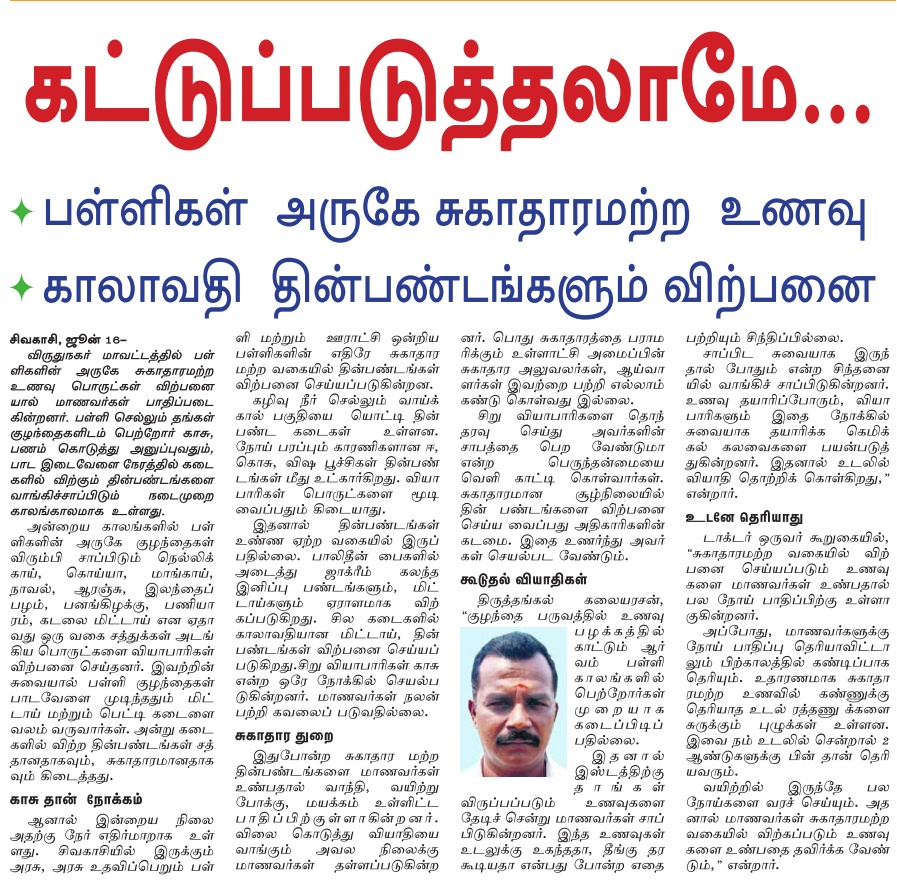
பிளாஸ்டிக் அரிசி விவகாரம்: 13 இடங்களில் அரிசி மாதிரி எடுத்து சோதனை
ராஜபாளையம்,
விருதுநகர் மாவட்டத்தில் 13 இடங்களில் அரிசி எடுத்து சோதனைக்கு அனுப்பப்பட்டுள்ளது.
விழிப்புணர்வு கூட்டம்
ராஜபாளையம் அருகே தளவாய்புரம், செட்டியார்பட்டி உள்ளிட்ட பகுதிகளில் 50–க்கும் மேற்பட்ட அரிசி அரவை ஆலைகள் இயங்கி வருகின்றன. ஆலைகளுக்கு முறையான அனுமதி பெற வேண்டியதன் அவசியம், சுகாதாரமான முறையில் அரிசியை தயார்படுத்தும் முறைகள் குறித்து விளக்கிட உணவு பாதுகாப்பு மற்றும் மருந்து நிர்வாகத்துறை சார்பில் விழிப்புணர்வு கூட்டம் நடைபெற்றது.
செட்டியார்பட்டியில் உள்ள அரிசி ஆலை திருமண மண்டபத்தில் நடந்த கூட்டத்துக்கு அரிசி ஆலை உற்பத்தியாளர் சங்க தலைவர் ஆனந்தன் தலைமை தாங்கினார். செயலாளர் ராமர், பொருளாளர் மாரிமுத்து ஆகியோர் முன்னிலை வகித்தனர். கூட்டத்தில் உணவு பாதுகாப்பு பிரிவின் மாவட்ட நியமன அலுவலர் அனுராதா விளக்கவுரை ஆற்றினார். அவர், உணவு பாதுகாப்பு மற்றும் தரங்கள் சட்டத்தின் கீழ் உணவு உற்பத்தி செய்பவர்கள் மற்றும் அரிசியை உண்பதற்கான பக்குவத்திற்கு தயார் செய்யும் ஆலைகள் உரிமம் பெற வேண்டியதன் கட்டாயம் குறித்து விளக்கினார்.
அரிசியை தயார்படுத்தும் இடங்களை பராமரிக்கும் முறைகள் பற்றியும், தோல் மற்றும் தொற்று வியாதிகள் உடையவர்களை வேலைக்கு நியமிப்பதை தவிர்க்க வேண்டும் எனவும் கூறினார். எந்திரங்களை பராமரிக்கும் விதம் குறித்தும், அரிசியை சுத்தப்படுத்த நச்சுத் தன்மையுடைய கொள்கலன்களை உபயோகிப்பதை தவிர்கக வேண்டும் எனவும் கூறினார். உணவு பாதுகாப்பு அதிகாரிகள் கருப்பையா, சக்திகணேஷ், மாரிமுத்து ஆகியோரும் கூட்டத்தில் பங்கேற்றனர்.
மாதிரி
இதைதொடர்ந்து உணவு பாதுகாப்பு பிரிவின் மாவட்ட நியமனஅலுவலர் அனுராதா நிருபர்களுக்கு பேட்டியளித்தபோது கூறியதாவது:–
பிளாஸ்டிக் அரிசி தொடர்பாக விருதுநகர் மாவட்டம் முழுவதும் சில்லரை மற்றும் மொத்த வியாபார இடங்களில் 100–க்கும் மேற்பட்ட இடங்களில் ஆய்வு மேற்கொண்டு, 13 இடங்களில் மாதிரிகள் சேகரிக்கப்பட்டுள்ளது. மாதிரிகள் உணவு பகுப்பாய்வு கூடத்திற்கு அனுப்பப்பட்டுள்ளது. ஆய்வு அறிக்கையின் அடிப்படையில் அடுத்த கட்ட நடவடிக்கை எடுக்கப்படும். இவ்வாறு அவர் கூறினார்.
பிளாஸ்டிக் அரிசி குறித்து ஆய்வு கருத்தரங்கில் அதிகாரி தகவல்
சேத்துார்;''பிளாஸ்டிக் அரிசி குறித்து மாவட்ட வாரியாக ஆய்வுகள் மேற்கொள்ளப்பட்டு வருவதாக,'' மாவட்ட உணவு பாதுகாப்பு நியமன அதிகாரி அனுராதா கூறினார்.
சேத்துார் அருகே செட்டியார்பட்டியில் தமிழ்நாடு அரசு உணவு பாதுகாப்பு மற்றும் மருந்து நிர்வாகத்துறை சார்பில் உணவு பாதுகாப்பு குறித்த விழிப்புணர்வு கருத்தரங்கம் நடந்தது.
தளவாய்புரம் செட்டியார்பட்டி மற்றும் சுற்றுப்பகுதியில் உள்ள 40க்கு மேற்பட்ட அரிசி ஆலை உரிமையாளர்கள் கலந்து கொண்டனர்.
இதில் பேசிய உணவு பாதுகாப்பு அதிகாரி, '' உணவு பொருட்கள் தயாரிக்கும் இடம், அரிசி ஆலைகள் சுத்தமாக இருக்க வேண்டும். உடல்நலக் கேட்டை ஏற்படுத்தக்கூடிய, உலோக நச்சுத்தன்மை உடைய சாதனங்கள் கொண்டு உணவு தயாரிக்கவோ, சேகரிக்கவோ கூடாது.
பணியாளர்கள் பணியை தொடங்கும் போதும், பணியை முடித்த பின்பும் கைகளை நன்றாக சுத்தம் செய்ய வேண்டும். ஆலை உரிமையாளர்கள் ஆலை உரிமத்தை குறிப்பிட்ட தேதி தவறாமல் புதுப்பிக்க வேண்டும்.
மாவட்டம் வாரியாக அரிசி ஆலைகளில் உணவுதுறை அதிகாரிகள் ஆய்வு செய்து வருகின்றனர்.பிளாஸ்டிக் அரிசி இருக்கும் பட்சத்தில் ஆலை உரிமையாளர்கள் மீது சட்டரீதியான நடவடிக்கை எடுக்கப்படும் ,''என்றார்.
தளவாய்புரம் நெல் அரிசி வியாபாரிகள் சங்க செயலாளர் ராமர், பொருளாளர் மாரிமுத்து ,உணவு பாதுகாப்பு அதிகாரிகள், சக்திகணேஷ், மாரிமுத்து, கருப்பையா கலந்து கொண்டனர். சங்க தலைவர் ஆனந்தன் நன்றி கூறினார்.


Plastic rice rumours cooked up, says govt
Says no case reported from city
Rumours about rice made of plastic being sold in the Capital were “fake news”, the Delhi Food Safety Department said in its reply to a complaint.
Complaint lodged
Environmentalist Vikrant Tongad had lodged a complaint with the Public Grievance Monitoring System (PGMS) of the Delhi government about 10 days ago, asking it to take steps to address the reports of plastic rice flooding the markets.
Mr. Tongad had cited reports in the media as well as information shared through social media that the said plastic rice was being imported from China.
On Tuesday, the reply from the Food Safety Department to Mr. Tongad’s complaint dismissed the reports.
“This is fake news. The Department of Food Safety keeps a strict vigil on the quality of food items. During the past days, 27 samples of rice have been lifted from different markets of Delhi and in no case plastic was found,” the Department replied.
However, Mr. Tongad said the response did not mean that plastic rice was not being sold anywhere in Delhi.
“The inspections should be carried out on a regular basis and on a larger scale. Just because 27 samples were cleared doesn’t mean that there is no plastic rice,” said Mr. Tongad.
Response awaited
He added that he had filed a similar complaint with the Central government’s PGMS, but was yet to receive a response. In his complaint, he asked the Centre whether rice was being imported from China.
A video of children playing with a ball apparently made of plastic rice in Uttarakhand went viral earlier this month.
With Political Help, Lobbies Put Chemicals In Our Diet
BJP must honour its pledge to keep GM food out
Before the power of commercial lobbies, even the BJP government bows. The party’s manifesto took a strong stand against Genetically Modified (GM) foods; ignoring it, the Government’s Genetic Engineering Approval Committee (GEAC) green-lighted genetically engineered mustard in India. GM mustard is known to be more dangerous than GM cotton (which has caused havoc already) and GM brinjal (which was stopped in the nick of time).
Because mustard is used in every household every day in India, its health implications are of special importance to us. GM mustard is an HT (herbicide tolerant) crop. This euphemism means it uses a single herbicide, eventually becoming resistant and necessitating heavy use of chemical herbicide. Such excessive use has been linked to birth defects and childhood cancers. Almost all of Europe has discontinued the GM concept altogether because of health issues.
Why then does India welcome these traps? There are three reasons: The vested interests of politicians, over-enthusiasm of civil servants, and the apparent ease with which watchdogs like GEAC can be compromised. Much of this is facilitated by the world’s most powerful lobbying groups which routinely influence US Government policies. (Barak Obama appointed several Monsanto Executives in his Government’s food and agriculture supervisory bodies).
These lobbies are no less powerful in India. Remember those horrid, heart-wrenching videos of endosulfan victims in Kasargod areas? They are still there — pitiably malformed children and men with bloated body parts. Every time such pathetic pictures of human suffering appeared on television screens, people would ask: Why doesn’t the Government ban endosulfan? And every time Agriculture Minister Sharad Pawar was confronted with the question, he would say: We need to do more tests to know if endosulfan is harmful. How thick can political skins get?
Insensitive politicians are aided and abetted by specialists in the Government’s planning bodies. NITI Ayog has argued in favour of GM mustard on the ground that the GM technology will substantially increase yield. This is a myth as UN statistics prove. Non-GM users have the highest mustard yield — Germany, France, UK, Poland, Czech Republic. Way down in the table are GM users — USA, Canada, Australia. Why did NITI Ayog rely on other self-serving statistics? And why did it ignore social and health issues?
The bigger tragedy is that we cannot be sure of our watchdogs; under pressure, they become promoters rather than preventers of malpractices. India has for long been a victim of this malaise. In 2009, the Food & Safety Standards Authority of India (FSSAI), our only food regulatory body, saw Pepsi and Coca-Cola officials becoming members of panels to judge various technical matters such as sampling methods, additives and flavourings. With a board comprising representatives of the very companies it was supposed to regulate, what safety standards could FSSAI ensure?
Similar manipulations made the GEAC clear GM brinjal in 2009. Monsanto, described by The Guardian of UK as “the world’s most hated company,” infiltrated the GEAC and also gave various research assignments to field researchers and sundry agricultural scientists in the country. The result was that Monsanto-flavoured research reached the GEAC for Mansanto-flavoured decisions. Activist Kavita Kuruganti publicly charged that the Chairman of the Expert Committee appointed to examine the matter was “pressurised by the Agriculture Minister, GEAC and the industry” to clear GM brinjal. We were saved from it only because an alert Minister, Jairam Ramesh, put it safely in Trishanku Swarga.
The lobbyists turned smarter this time. They presented GM mustard as the product of a Delhi University (DU) team’s research. This was followed by another report: The genes that went into the DU mustard were the property of Bayer, a merged part of Monsanto. Three giant corporations including Monsanto-Bayer control both the seeds market and the pesticide market globally. It’s a win-win situation for them and Swadeshi scientists, too, necessarily work as their foot soldiers.
The only thing that can be done about technologies based on chemical pesticides is to eliminate them. Reckless use of pesticides in the cotton region of Punjab ruined a generation of farmers. Their tragedy was dramatised by the “cancer train” that took afflicted farmers daily from Bhatinda Station to Bikaner (where the Acharya Tulsi Cancer Institute was more affordable). Biologist Pushpa Bhargava, appointed by the Supreme Court in 2008 to observe the GEAC’s functioning, was outraged by the manipulations he saw. “Whatever Monsanto said was God’s own word,” he said and warned: “If Bt. Brinjal is released, it will be the single largest disaster in the country.”
Larger still will be the mustard disaster.
Delhi’s food safety department negates rumours of plastic rice
Rumours about plastic rice have been making rounds and spreading like wildfire over the past few days. It all started when customer complained that plastic rice was used to prepare biryani in Hyderabad

Flooded with queries from citizens about ‘plastic rice’ being sold in markets, the Delhi government’s food safety department has negated such rumours after conducting random checks.
“We had collected at least 27 samples – 20 raw samples from the markets and seven cooked rice samples from various hotels and restaurants - from across the city. None proved to be plastic rice. It is fake news,” Mrinalini Darswal commissioner of the state food safety department told HT.
Rumours about plastic rice have been making rounds and spreading like wildfire over the past few days. It all started when customer complained that plastic rice was used to prepare biryani in Hyderabad.
The news not only grabbed media headlines but also became viral on social media as wheat and paddy forms the staple diet of Indians.
“We have been receiving calls from wary customers across Delhi. Such rumours were also spreading across the social media. Earlier this month we received a grievance letter from a person. It was then we decided to go for a random check,” said a food safety officer of the department.
The samples were checked in the food laboratory of the department of food safety. All the samples complied with the specification under regulation no 2.4.6.5 of the Food Products Standards and Food Additives Regulation Act 2011 which defines the standards of rice in India.
“Only four samples were found to be misbranded due to labelling violations and one sample of cooked rice was found to be unsafe as it contained some bacteria,” said Darswal.
Environment right activist Vikrant Tongad who had shot the grievance letter to the food safety department said the panic about plastic rice being imported from China and flooding the markets were making rounds in social media.
“It was unlikely that plastic rice would be imported to India as it costs much more than normal paddy. Secondly India produces enough paddy and doesn’t need to import rice from China. But as news of plastic rice were also surfacing from other countries I decided to inform the food safety department,” said Tongad.
Sources said that the concept of plastic rice first surfaced around seven years back in China. It was popularly known as the Wuchang Rice Scandal. It was said to be made out of sweet potatoes and synthetic resin moulded into the shape of real rice. In 2016 Nigerian authorities claimed to have seized around 2.5 tons of plastic rice.
WHITE REVOLUTION, ADULTERATED
India is the world’s largest milk producer but almost 60 per cent of its milk is contaminated due to supply chain malpractices. While the state is doing its bit to fix the system, a technology for spot analysis is the game-changer
When it comes to milk, India has both, a good and a bad track record. It ranks first in the world in milk production and contributes about 18 per cent to the world’s total milk production. In 2014-15, India produced 146 million tonnes of milk.
However, it is feared that over 60 per cent of the milk is contaminated due to malpractices in the milk supply chain, which includes dilution with unsafe water and mixing of hazardous chemicals. The milk is adulterated with contaminants such as urea, various kinds of salt, detergent, liquid soap, boric acid, caustic soda, and hydrogen peroxide, which have serious health effects. This has been candidly admitted to by the Government of India.
As per the Food Safety and Standards Authority of India, milk adulteration is the “act of deliberately reducing the quality of milk offered for sale to the consumers for profit”. Adulteration can take place during the harvest, growth, storage, transport and even at the distribution stage.
The FSSAI recently conducted a survey in 33 States and found that 68.4 per cent of the 1,791 milk samples it tested, were contaminated. In urban India, nearly 70 per cent of samples were found to be contaminated compared with 31 per cent in rural areas. The survey said that only Goa and Puducherry sold unadulterated milk — or at least the samples taken from these two States were not contaminated.
At the other end of the contamination spectrum were West Bengal, Bihar, Chhattisgarh, Jharkhand, Odisha and Mizoram. Not a single sample tested from these States met the FSSAI norms.
er prominent States fared just a shade better. Around 89 per cent of the samples tested from Gujarat, 83 per cent from Jammu & Kashmir, 81 per cent from Punjab, 76 per cent from Rajasthan, 70 per cent from Delhi and Haryana, and 65 per cent from Maharashtra, failed the test.
Forty eight per cent of the samples from Madhya Pradesh also met a similar fate. States with comparatively better results were Kerala, where only 28 per cent of samples did not conform to FSSAI standards, followed by Karnataka (22 per cent), Tamil Nadu (12 per cent) and Andhra Pradesh (6.7 per cent).
Keeping these grim facts in mind, one must ask: What is the big deal if India is the world’s largest producer of milk, thanks to the White Revolution? Arguably, for a layman, differentiating between contaminated and pure milk is a tall order. Only specific chemical tests can reveal the truth. As mentioned earlier, water is the most common adulterant in milk. It not only reduces the nutritional value of milk but, if itself is unsafe, then it will make the consumer sick.
This only confirms that food adulteration is common in India. And so milk, which is widely consumed by children, isn’t spared. This is shocking, to say the least. What’s particularly worrying is the kind of substances used to adulterate milk. This shows that the trade-off between the risk of getting caught and the reward of huge profits is skewed heavily in favour of the latter.
The Government must focus on raising the risks for adulterators. One way of doing this is by hiking the penalty, including making the crime of food adulteration analogous to attempt to murder in extreme cases. It’s equally important to regularly check food products for adulteration, and ensure speedy trial of those who are suspected of food adulteration.
As the situation is rather serious, the Government is working overtime to address the issue. Union Minister for Science & Technology Harsh Vardhan has recently highlighted a system for detection of milk adulteration and analysis. This has been developed by the Central Electronics Engineering Research Institute, under the Council of Scientific & Industrial Research, in Pilani.
It is expected to tackle a national-level health hazard due to adulteration in milk. The Union Minister has also said that he will be reaching out to his counterpart in the Union Ministry of Health and Family Welfare as well as to the Health Ministers of all State Governments to deploy this technology platform so as to address the problem of milk adulteration in the country. The FSSAI will also be asked to bring in the required regulatory intervention so as to ensure the delivery of quality milk.
The CSIR, of which Harsh Vardhan is the vice president, has done yeoman service in developing this technology which which instantaneously detects the adulterants in any milk sample. It is a low-cost portable system with user-friendly features. It enables detection of contaminants in just 40 to 45 seconds, and costs only 50 paise per sample.
One only hopes that this system will go a long way in breaking the backs of those who are playing with the lives of unsuspecting people.
Food Safety and Standards Enforcement Wing generates Rs 64,68,033 lakh revenue in 7 yrs

IMPHAL, Jun 13 : Food Safety and Standards Enforcement Wing under the supervision of the Directorate of Health Services, Manipur has reportedly generated Rs 64,68,033 lakh revenue in the past 7 years. However, due to lack of manpower and infrastructure, numerous tasks could not be executed efficiently.
Speaking to The Sangai Express, Dr Sarungbam Bimolakumari, Consultant, Food Safety and Standards Enforcement Wing, said that food retailers and cooperators should ensure the food items they supply to the markets for consumption are safe and healthy for people.
“Between 2012 and 2017, Food Safety and Standards Enforcement Wing collected Rs 64,68,033 lakh as license and registration fee, Rs 12,71,000 lakh as penalty and Rs 65,32,500 lakh as food analysis fee. There is one District Designated Officer, 2 to 3 Food Safety Officers and 2 to 3 Office Assistants in 9 districts of the State. There are also some districts with not even a single official,” she informed.
One Tata Sumo vehicle each is provided for Imphal East, Imphal West and Bishnupur districts. The vehicles are utilized to conduct food anti-adulteration drives in stores and hotels and other related works.
She said that as part of the State Government’s 100-day programme, drives were conducted under the supervision of the Food Safety Commissioner in various parts of the State from May 28 and June 12 in which adulterated food items and tobacco products worth Rs 29,76,850 were disposed. There are still 4 rooms filled with seized tobacco and adulterated food items. If anyone is found selling banned food items, the individual can be jailed for 6 months along with upto Rs 5 lakh fine under Food Safety and Standard Act 2006.
“For 2017, budget of just Rs 35 lakh was sanctioned for Food Safety and Enforcement Wing. We have shortage of manpower and infrastructure which has hampered the overall performance. At times, we had to spend money from own pockets to ensure our work gets done,” she said.
One shopkeeper in Kwairamband Keithel said, “Earlier, Zarda Paan per serving used to cost Rs 5 but now it costs Rs 20. Special Paan which was Rs 100 per serving now costs Rs 150-200. Tobacco which comes in round tin now costs Rs 25 and above while Talab costs Rs 15 per sachet. Availability of banned products only allow the suppliers to earn more profit. I also used to sell Paan and tobacco products. Now I sell only Kom Kwa.”
Jun 13, 2017


Ensure FSSA standards in milk, state told
The Madras High Court has directed the Health Secretary, Director of Food Safety and the Commissioner of Milk Development to take steps for effective implementation of Food Safety and Standards Act (FSSA) and file a report pertaining to the sale of adulterated milk by private milk suppliers.
Chennai:
The first Bench comprising Chief Justice Indira Banerjee and Justice M Sundar, before whom another public interest litigation regarding milk adulteration came up for hearing on Monday, also ordered notice to the 12 private milk producers, including Thirumala Milk Products Private Limited, Heritage Foods Private Limited and Hatsun Agro Products Ltd.
The officials, including the private milk producers, have been asked to file their counters by July 24. The petitioner R Karthikeyan of Shanmugapuram in Chennai submitted that as per the provisions of FSSA, 2006, firms selling milk in packets should get themselves registered with the authorities for collecting milk. Moreover, they should also get licence from Food Safety and Standards Authority of India (FSSAI) in respect of the quality of the milk sold.
Noting that the state established milk cooperative society Aavin has a market share of just 20 per cent and the private players have cornered the rest, he said under such circumstances, on May 24, 2017, the Dairy Minister revealed that the milk sold by the private companies contained formaldehyde, a cancer-causing substance.
Pointing out to the Minister’s firm stand and his assurance that samples are being tested in a lab at Mysuru, the petitioner said if adulterated and unsafe milk is permitted to be sold even after the Minister’s categorical assertion, it is against the health and safety of the people. He sought the court to direct the authorities to prevent the production and marketing of unsafe milk and confiscate such product that is being sold.
MTC bus depot canteens in pathetic condition

Bus conductors and drivers allege that they are not provided hygienic food or facilities at MTC bus depot canteens.
Chennai: Tiny room with tables occupied by flies feeding on spilt and dried food, soiled plates and murky drinking water – this is how the canteens for drivers and conductors at Metropolitan Transport Corporation (MTC) bus depots look like.
Canteens at Chrompet, Ennore, Thiruvottriyur, Tondiarpet, KK Nagar, T Nagar, Ambattur, Central depot and majority of them in North Madras are in a bad shape.
“Initially, 600 gram of rice was served for all workers and there was more choice of food. Now, the quantity and quality of rice are not proper as there are no measuring cups and the canteen workers serve according to their wish,” rued K. Anbazhagan, joint secretary, Nethaji Transport Union.
He added that none of the canteens provides glasses and the workers get their own plastic bottle to fill water.
While some depots are equipped with metro water facility, some provide bore water. Reverse Osmosis (RO) systems do not work in bus stops and they literally drink murky and unhealthy water.
Bus drivers also allege that Pallavan House bus depot has all the facilities as all the officials, including managing director have their lunch in the place.
“They only charge one rupee per day for food, but that unhygienic meal and surroundings might cause many diseases which will both take a toll on our health and pockets. Neither does the department give us salaries nor food,” said one of the conductors at the T Nagar bus depot.
When DC questioned an official in T Nagar, he said, about 100 people eat in the depot every day and they clean the room twice. Workers in an inebriated condition, staying in the room at the depot pose a menace during lunch and spill the food.
“Authorities from Food Safety and Standards Authority of India inspected the food on Sunday and did not inform us about anything yet,” he said.
Moreover, an official from MTC said, following numerous complaints from drivers and conductors, they issued a notice to the canteens last week asking them to provide only water can or RO water to the workers. “We will form a committee this week and conduct raids from the coming Monday,” he said.
Checks in rice mills
Amidst persistent rumours over ‘plastic rice,’ especially in the social media, officials of the Food Safety and Standards Authority of India have been conducting checks in rice mills and at the premises of retail and wholesale rice dealers across the district. All the 18 Food Safety Officers in the district were involved in the checks to physically verify the rice stocks at the mills and shops. “We are conducting physical checks as per instructions from our higher authorities over the past few days. However, so far no such rice made of any artificial substance has been detected,” a Food Safety Officer told The Hindu. The checks are essentially seen as a move to allay fears of the public.
Five Food Safety Officers in Tiruchi Corporation limits and one each in the three municipalities and those in the block level were engaged in conducting the checks. He indicated that the checks would continue and complaints, if any, would be attended.
Subscribe to:
Posts (Atom)