Apr 22, 2017

FDA seizes 890kg mangoes artificially ripened with calcium carbide in Ulhasnagar


ULHASNAGAR: Officials of the Food and Drug Administration (FDA) in a joint operation with staff of Ulhasnagar Municipal Corporation on Friday raided five godown at the Ulhasnagar. Out of them, from two they seized 890 kg mangoes that were being artificially ripenedwith calcium carbide. The raid was carried out after FDAofficials received specific Information about five wholesalers engaged in fruits business selling artificially ripened mangoes.
Acting on information, FDA inspector Santosh Vajharkar with the help of UMC Deputy Municipal Commissioner Jameer Lengrekar and his team on Friday afternoon raided five godowns out of which from two godown, namely Meghraj Fruit Merchant at Ulhasnagar 1 and Vasudev Fruit Merchant near vegetable market, found 890 kg mangoes that were artificially ripped with calcium carbide.
The seized mangoes were later taken to dumping ground where it was disposed of by the staff of Ulhasnagar Municipal Corporation. The FDA official said that criminal action against the owner of these godowns is on. He said any person found guilty of using chemicals to ripen fruit can be slapped with a fine of up to Rs 5 lakh.
Talking to TOI, Jameer Lengrekar, deputy municipal commissioner, said, "Out of five godowns, we got ripe mangoes at two godows while at remaining godowns, there were no mangoes". Lengrekar further said, "Such raids will continue to curb the sale of chemically ripened mangoes that may prove dangerous to health.

Exclusive: Clash of science and politics "dangerous" - EU food safety chief

LONDON (Reuters) - Politicians who attack the EU agency that ruled the weedkiller glyphosate probably does not cause cancer are in danger of undermining the effectiveness of a body that is key to keeping Europeans safe, its chief warned.
Bernhard Url, executive director of the European Food Safety Authority (EFSA), said his agency is facing unprecedented criticism after concluding in November 2015 that glyphosate - one of the world's most widely used pesticides and an ingredient in Monsanto's big seller Roundup - was "unlikely to pose a carcinogenic hazard to humans".
Attempts to discredit his agency over its assessment were "unacceptable and short-sighted", he told Reuters in a rare interview, accusing his critics of undermining science to pursue a "political agenda".
"If political actors discredit scientific organisations because they don't like the outcome in one out of 100 cases, they diminish the reputation of an organisation that they as policymakers will need to rely on in future," he said. "From a political perspective it's very unwise".
An international dispute over glyphosate's possible risks to human health has prompted investigations by congressional committees in the United States, and in Europe has forced a delay to a re-licensing decision for Roundup. The EU decision is now due by the end of 2017.
The row erupted after the International Agency for Research on Cancer, a semi-autonomous part of the World Health Organization (WHO), said in March 2015 that glyphosate was "probably carcinogenic".
Many other regulators besides the EFSA have since determined it does not pose a cancer risk, however, including the European Chemical Agency (ECHA), the U.S. Environmental Protection Agency (EPA), and a joint committee of the WHO and the U.N.'s Food and Agriculture Organization (FAO).
Opposition in the European Union has been driven by the European Parliament's Greens-European Free Alliance and by others, including Greenpeace and a group of scientists led by Christopher Portier from the U.S.-based non-governmental organisation, the Environmental Defense Fund.
Greenpeace called the EFSA review a "whitewash" that "defied the world's most authoritative cancer agency in order to please corporations like Monsanto". Portier and more than 90 scientists signed an open letter to European Health Commissioner urging EU authorities to ignore the EFSA's opinion.
The Green alliance asked the EFSA to withdraw its assessment and last month urged European Commission President Jean-Claude Juncker to delay a decision on glyphosate until the dispute has been sorted out. It says the EFSA review was unduly influenced by industry-backed studies.
Members of the European parliament (MEPs) have "serious concerns regarding the influence of industry on some of the studies used in their assessment," Bart Staes, the alliance's food safety spokesperson, told Reuters in an email on Friday.
Several MEPs have asked for all the studies included in the EFSA assessment to be made public, which it says is impossible because doing so would contravene European law protecting corporate intellectual property. The agency has, however, published some 6,000 pages of data and analyses considered in the assessment, according to Url.
"POLITICAL AGENDA"
Url asked why complaints about EFSA's work seemed to emerge only in response to opinions that clashed with a particular "political agenda".
The same political groups protesting now applauded the EFSA when it said in 2013 that pesticides known as neonicotinoids posed a risk to honeybee health, he said.
"Then they said EFSA had done a great and important job and made a big contribution to the protection of public health.
"But when the same system, the same people, using the same methods, produces something that doesn't fit their political agenda - an agenda that could include for example a different way of doing agriculture in Europe, or banning pesticides... they try to discredit the scientific organization."
The EU imposed restrictions on the use of neonicotinoid chemicals - made and sold by various companies including Bayer CropScience and Syngenta - after EFSA pointed to risks for bees, which are crucial for pollinating crops.
Since its foundation 15 years ago EFSA has issued around 8,000 scientific opinions on subjects from food additives such as acacia gum and lecithin, to plastic containers, to livestock illnesses such as African swine fever and lumpy skin disease.
The vast majority of these have gone unchallenged, Url said, and have been used as intended to inform policymakers as they draft legislation on how the benefits and risks of such substances should be managed in foods for European consumers.
Staes maintained his group values "the important role that ESFA plays in contributing towards the health and safety of the European public" and said it and the ECHA should be supported with more funding and better access to publicly-funded studies as "a welcome counter balance to industry driven research".
Asked why he thinks glyphosate has generated such an intense battle, Url said:
"Glyphosate is a very widely used weedkiller; it's linked to Monsanto; Monsanto is linked to genetically modified organisms; so it's about money, obviously, but also about the way agriculture is done in Europe. There are many people who say we shouldn't use large amounts of agrochemicals."
Url said the EU's current system for risk management "works", and as a result, food is generally safe and public health is protected. Undermining its credibility poses risks for public health and for society, he argued.
"If trust in scientific advice is diminished, the likelihood will be higher that ... the decisions taken will not be the best for society," he said.

Rat in pulao: Akshay Patra says not in their food

AHMEDABAD: Following Wednesday's incident of a dead rat being found in vegetable pulao served during mid-day meal at a government-run primary school in Jamla village, Kalol, the district health department instituted a detailed inspection of Akshaya Patra kitchen at Gandhinagar.
In a press release issued on Thursday by Akshaya Patra, it was claimed that the department has expressed satisfaction over the quality and food safety standards maintained by the kitchen and that it found pest control measures meeting standards of the Indian Pest Control Association (IPCA).
The cooking process was conducted in a hygienic centralized kitchen, the statement said. "It is important to note that food is cooked at a temperature of about 95 to 99 degree centigrade and up to 140 degree centigrade while seasoning in a through stirring and inspection process," read the statement.
The visuals shown in the reports clearly indicate that the incident could have not occurred in our kitchens," claimed the statement.
Akshaya Patra claimed that it has received feedback from other school centres related to the same distribution route which clarify that no illness of any kind was encountered after consumption of the food supplied.
It further added that the raw food material is first inspected according to FSSAI standards, all the vessels which carry prepared food - rice cooking cauldrons, dal or sabzi tanks, dal cookers are thoroughly sterilized by boiling water before usage. "Similarly all the knives, cutting boards undergo the same process before use," stated the press release.

Apr 21, 2017

DINAMALAR NEWS


DINAMALAR NEWS


Raid in hotel finds stale mackerel


Wayside soft drink shops under scanner in Kerala

Commissionerate of Food Safety’s special squad to check use of crushed ice in drinks leading to illness.
The special team will focus on hygiene and ingredients being used in preparation of the drinks. They hope the raids on shops will help contain diarrhoea.
Alappuzha: The Commissionerate of Food Safety launched a special squad to ensure safety of soft drink shops on wayside as it can be causative agent of mass diarrhoea in the summer.
K. Anilkumar, joint commissioner of food safety, said that a five-member team led by an assistant commissioner has been created in every district to control mushrooming wayside soft drink shops which use crushed ice, sarbath and lemon for preparing drinks.
With the mercury rising at an alarming rate these days, carts supplying soft drinks have popped up on the wayside, especially on national and state highway.
For some years now, the district medical office (DMO) had banned sale of fruit juice, welcome drinks, lime juice and Kulukki sarbath' prepared in unhygienic surroundings.
“The team will inspect all shops in the concerned districts and focus on hygiene and ingredients used to prepare drinks.
We found many cases of unhygienic ice in north Kerala. We hope to enforce safety standards with the help of raids in such shops. This year no diarrhoea cases have been reported so far,” Mr Kumar said.
For several years now, soft drinks like lime juice and Kulukki sarbath' have been regular in people's menu during summer. Kochi had become a hot bed of such unconventional drinks.
However, Kulukki sarbath maintains its rock star position in the summer season.
For the last couple of years, the medical wing in the district here had opened a 24-hour functioning control room and the district medical officer (DMO) had urged the district administration to ban these drinks in the wake of number of diarrhoea cases went up.
“We are regular customers at soft drink kiosks, but we were unaware of hygiene of ice pieces being used to prepare it. We opt for it because of its heavenly taste and of course its affordability to our wallets,” says Subhash, a student and an ardent fan of lemonades.
“Owing to the constant demand from fans, soft drinks' now come in an array of flavours — mint, pineapple, strawberry and even masala too. The cost remains the same. You will get this for `10 or `20,” he says.
Last year too the health department and commissionerate of food safety had cracked down on illegal kiosks after it was revealed that ice was manufactured using contaminated water.
Ratheesh from Alappuzha says, “Sale of such drinks, which can cause health hazards, should be curbed.
“According to Kerala Municipal Act, these mobile shops have to secure a licence from the corporation/ Municipality.
The authorities have to take stringent steps to crackdown on illegal kiosks which use ice made of contaminated water,” he demanded.
Vijesh, who run a kulukki sarbath kiosk in Alappuzha-Changanassery road, says he was buying ice from plants where he didn't know how they were prepared.
“We have no intention to serve unhygienic drinks. The authorities have to take action against those who prepare ice pieces,” he said.

Sweet manufacturing unit sealed at Barthana

A team of Food Safety Officers today conducted market inspection in various areas of the Srinagar city during which a sweets manufacturing unit was sealed and other food operators were recommended for prosecution.
The team headed by Assistant Commissioner Food Safety Srinagar today visited Maharaja Bazaar, Jawahar Nagar, Qamarwari, Barthana and its adjacent markets in the city and found some food establishments operating in total insanitary conditions. Accordingly, 14 such establishments were recommended for prosecution which included 7 meat selling shops.
“Moreover, one sweets manufacturing unit at Barthana was found operating in unhygienic conditions. It was said that the unit authorities were using rusted and damaged utensils in the preparation of sweets and within its premises harmful non-edible chemicals were also recovered. The unit was sealed for further investigation besides samples were lifted for analytical purpose,” a statement of the Food Safety Standard Department said.

Dead rat found in meal at model school

AHMEDABAD: A dead rat was found on Wednesday in the mid-day meal served at a government-run primary school in Jamla village of Kalol taluka in Gandhinagar district. The tail of the rat was found in the dish of a teacher who had taken the food to taste it for safety.
Mansa MLA Amit Chavda, who rushed to the spot, said according to rules, the food has to be checked first by a teacher.
When the teacher took some food in his dish, he found the tail of a rat in it. "Immediately the entire food cooked was checked and a dead rat was found," Chavda said.
The MLA further said that the food was supplied by Akshay Patra. "One much check the quality of the food supplied. In the past also, there were cases of food poisoning in kotwas. However, the forensic report had then stated that the food poisoning had occurred because of contaminated drinking water," Chavda said.
He claimed that Jamla Adarsh Primary School, where the dead rat was found, was declared a model school by the state government. "There are 242 students in the school," the MLA said.
Rajendra Trivedi, commissioner of mid-day meal scheme, admitted that a dead rat had been found in the food.
"In Jamla village, the teacher spotted the rat in the food before it was served to students," he said.
"The department has asked senior officials to look into the incident and find out if there were complaints from any other school. Akshay Patra was supplying food in the schools of Mansa, Kalol and Gandhinagar taluka and, so far, we have not received any complaint," Trivedi said.
Officials said that as it had received several complaints about the quality of food, it was decided that the food will first be tested by the teacher and only then will it be served to students.

Tips on spotting adulteration in spices

Spices are an integral part of Indian cooking. However, the rate at which the adulteration of spices in the country has risen gives rise to serious health concerns. It is important to be able to tell whether the spices you have purchased have been adulterated, and to understand which sources, if any, are safe.
Food adulteration is slowly becoming an epidemic, affecting human lives on a large scale. The use of colours, chemicals, pesticides, and additives is becoming an acceptable but dangerous practice in India, often done for monetary gain without realising its long term and disastrous impact on the health and future of the country, both economically and ecologically. Food adulteration is no longer restricted to local produce, and has found its way into packaged products as well. The presence of starch in paneer to make it thicker, hydrogenated oils and vanaspati in ghee to lend it that rich yellow colour, and even powdered bricks in chili powder raise questions about the quality of the food that we eat.
Adulteration is dangerous as it degenerates the quality of food, making it sub-standard for human consumption. Among spices, the most commonly adulterated items include coriander, dried ginger powder, dried red chili, cardamom, cumin powder, pickle powder, garam masala, curd chili, chili powder, fennel seeds, Kashmiri chili powder, rasam powder, and curry powder, which contain pesticides exceeding the permitted limits prescribed by the European Union. In India, the agricultural sector uses an overwhelming amount of pesticide, which eventually gets absorbed into the air and later the water, giving rise to a vicious cycle.
Thus, it is becoming imperative that we buy and consume spices that are safe, as adulterated spices can have many adverse effects on our health like nausea, vomiting, and blurred vision. Most often, spices like turmeric powder, chili powder, and other powdered spices have a high percentage of residual pesticides in them. These spices are also known to be adulterated, as they can be easily mixed with food colouring, added starch, coloured saw dust, or even brick powder, cutting costs for the sellers.
Below are some of the simple tests that can be conducted at home to identify the presence of adulteration in spices:
Turmeric powder: Indian cooking is incomplete without the use of turmeric powder. However, a commonly used adulterant here is lead chromate, which gives it a bright yellow tinge and is insoluble in water. To detect the presence of lead chromate, the powder can be mixed with water and placed in a beaker. If adulterated, it will immediately leak colour.
Red chili powder: Red chili powder is the most commonly used spice in any Indian household, and is perhaps also the most adulterated spice. Among the most commonly used adulterants in chili powder are saw dust and brick powder. Add a teaspoon of chili powder to a glass of water and swirl it. Adulterated chili powder will dispel a red swirl of colour.
Powdered spices: Starch, food colours, dust, and even horse dung are some of the commonly used adulterants in powdered spices, and can lead to serious health complications. Immersing powdered spices in water will ensure that the adulterants float on the surface of the water, while the remaining spices settle at the bottom.
Indian food is incomplete without the addition of masala powders and spices, but with this menace of contamination of spices, it can become a health hazard if consumed daily. The best way to avoid consuming spices that are adulterated is to buy them from a trusted source that packages them after being checked by food regulatory boards and carries either an ISI mark or an Agmark stamp.

‘Water sold in bubble top containers has high chlorine level’

Bubble top water containers of 20 litres have once again come under the scanner of FSSAI as a few samples were found not conforming to standards. (Photo for illustrative purpose only).
The level in two samples was more than 300 ppm while permitted level is 2 ppm
Samples of 20 litre bubble top packaged water lifted from Coimbatore were tested ‘not conforming to standards’ in microbiological examinations conducted by Food Safety and Standards Authority of India (FSSAI) recently.
Food safety officials here said that the main deformity found in the samples was high presence of chlorine.
Of the ten samples collected and tested from Coimbatore, two have been found not conforming to standards even after two rounds of examination.
According to FSSAI officials, seven out of the ten samples collected were initially tested positive for inordinate presence of microbiological organisms and chlorine. The seven units were served closure notice. However, three units moved court and obtained permission to improve their standards.
FSSAI later allowed the remaining four units to open their plants and improve their quality.
“Samples were collected for a second time from the three units that approached court. However, two of them did not conform to standards,” said O.L.S. Vijay, designated officer, FSSAI, Coimbatore.
Mr. Vijay said that the chlorine level in the two samples tested in the second time was more than 300 ppm (parts per million) whereas the permitted level is 2 ppm.
According to food safety officials, the main reason for high presence of chlorine in the water was improper filtering during the bottling process. They said that the bottling units often compromised to change the membrane used for filtering raw water.
“The cost of the membrane ranges from Rs. 50,000 to Rs. 1 lakh. Hence bottling units use the membrane for a longer period which affects the filtering process. The membrane need to be changed at frequent intervals based on the volume of water filtered,” said a food safety official.
FSSAI is planning to conduct an education and awareness programme for bottling units selling drinking water in 20 litre bubble top containers.
“There are 74 units bottling and selling drinking water in 20 litre containers. They will be called for an awareness session covering all aspects of the filtration and bottling process,” said Mr. Vijay.

250 litres of oil seized

About 250 litres of edible oil that was not sold in sealed packets were seized by officials of the Tamil Nadu Food Safety and Drug Administration Department here on Thursday.
Based on complaints, a team led by T. Anuradha, District Designated Officer, and food safety officials inspected two oil shops and one grocery shops in Kalarampatti, Karungalpatti and Kondalampatti and found edible oil sold in containers. Officials said that as per the Food Safety and Standards (Prohibition and Restrictions on Sales) Regulations, 2011, edible oil has to be sold in sealed packets. Officials seized the oil and destroyed it. Shopkeepers were asked to sell the oil only in packets.
On Wednesday, the team inspected a godown on Longley Road and found 2,000 kg of green coloured fennel seeds kept in stock for sales. Officials said that non-permitted green colour is used for colouring the seeds which is banned as per the act. Sample was taken and sent to Food Laboratory in Guindy. The gunny bags were sealed in the godown.

DINAKARAN NEWS


DINAKARAN NEWS


DINAKARAN NEWS


DINAMANI NEWS


DINAKARAN NEWS


காலாவதியான உணவு பொருள் குளிர்பானங்கள் அதிரடி பறிமுதல்

விழுப்புரம்: விழுப்புரத்தில் காலாவதியான உணவு பொருட்கள் மற்றும் குளிர்பானங்களை உணவு பாதுகாப்பு அலுவலர்கள் பறிமுதல் செய்தனர்.
விழுப்புரம் பழைய பஸ் நிலையம் மற்றும் புதிய பஸ் நிலையத்தில் உள்ள கடைகளில், மாவட்ட உணவு பாதுகாப்பு நியமன அலுவலர் டாக்டர் வரலட்சுமி தலைமையிலான குழுவினர் ஆய்வு மேற்கொண்டனர்.
இப்பணியில், உணவு பாதுகாப்பு அலுவலர்கள் சங்கரலிங்கம், ரவிக்குமார், சமரேசன், முருகன், ஜெயராஜ் மற்றும் கதிரவன் ஆகியோர் ஈடுபட்டனர்.
ஆய்வில், காலாவதியான 25 கிலோ உணவு பொருட்கள், 70 பாட்டில் குளிர்பானங்கள், 10 கிலோ தடைசெய்யப்பட்ட புகையிலை மற்றும் 5 கிலோ கலப்பட டீ துாள் பறிமுதல் செய்யப்பட்டது. இதையடுத்து காலாவதியான பொருட்களை, அழித்தனர்.

Apr 20, 2017

அனைத்து வணிகர்களும் உணவு பாதுகாப்பு துறையிடம் பதிவுச்சான்று பெற வேண்டும் கலெக்டர் உத்தரவு


திருப்பூர்,
திருப்பூர் மாவட்ட உணவு பாதுகாப்பு துறை செயல்பாடுகள் குறித்து ஆய்வுக்கூட்டம் கலெக்டர் அலுவலகத்தில் நேற்று நடைபெற்றது. கூட்டத்துக்கு கலெக்டர் எஸ்.ஜெயந்தி தலைமை தாங்கினார்.
கூட்டத்தில் அவர் பேசியதாவது:–
கோடை காலமாக இருப்பதால் சுத்திகரிக்கப்பட்ட குடிநீர் பாக்கெட், பாட்டில் மற்றும் கேன்கள் தரமாக உள்ளதா? எனவும் பாக்கெட்டுகளில் தயாரிப்பு முகவரி மற்றும் தேதி ஆகியவற்றை ஆய்வு செய்து அதிகாரிகள் நடவடிக்கை எடுக்க வேண்டும். அனைத்து பழக்கடைகள் மற்றும் குளிர்பான கடைகளில் விற்கப்படும் பழங்கள், குளிர்பானங்கள், குளிர்பானங்களில் பயன்படுத்தப்படும் ஐஸ், மோர், சர்பத் மற்றும் தண்ணீர் தரமாகவும் பாதுகாப்பாகவும் உள்ளதா? என ஆய்வு செய்ய வேண்டும்.
தெருவோர கடைகளில் விற்பனை செய்யப்படும் தேநீர் மற்றும் போண்டா, பஜ்ஜி போன்ற உணவு பண்டங்களின் தரத்தை பரிசோதனை செய்ய வேண்டும். நடைபாதையோரம் விற்கப்படும் கோழி இறைச்சி, மீன் கடைகளை பாதுகாப்பான இடத்தில் வைத்து விற்பனை செய்ய வேண்டும். இறைச்சி கடைகளில் விற்கப்படும் இறைச்சிகள், வதைக்கூடத்தில் கால்நடை டாக்டரின் சான்று பெற்று விற்பனை செய்யப்படுகிறதா? என ஆய்வு செய்ய வேண்டும்.உரிமம்
அரசு மற்றும் அரசு சார்ந்த உணவு வணிக நிறுவனங்களான ரே‌ஷன் கடைகள், உணவு பொருள் சேமிப்பு கிடங்குகள், கூட்டுறவு அங்காடிகள், அம்மா உணவகம் மற்றும் அம்மா மருந்தகங்கள், கோவில் அன்னதான மையங்கள், சமூக நலத்துறையின் கீழ் செயல்படும் அரசு உணவு விடுதிகள், அங்கன்வாடி மையங்கள் மற்றும் பள்ளி சத்துணவு மையங்கள் ஆகியவை உணவு பாதுகாப்பு துறையிடம் உரிமம் மற்றும் பதிவுச்சான்று பெற்றுக்கொள்ள வேண்டும்.
பண்டிகை காலங்கள் மற்றும் கோவில் திருவிழாக்களின்போது இந்து சமய அறநிலையத்துறையை சேர்ந்த செயல் அதிகாரிகள், தெருவோரமாக விற்பனை செய்யும் கடை ஒப்பந்ததாரர்களிடம் கடைகளை ஏலம் விடும்போது உணவு பாதுகாப்பு பற்றிய விழிப்புணர்வை ஏற்படுத்த வேண்டும். மாவட்டத்தில் உள்ள சிறுவணிகர்கள் முதல் அனைத்து உணவு வணிகர்கள் மற்றும் தனியார் மறுவாழ்வு இல்ல காப்பகங்கள் உணவு பாதுகாப்பு துறையிடம் பதிவுச்சான்று மற்றும் உரிமம் பெற்று வணிகம் செய்ய வேண்டும்.
இவ்வாறு கலெக்டர் கூறினார்.
கூட்டத்தில் மாவட்ட உணவு பாதுகாப்பு துறை நியமன அதிகாரி தமிழ்செல்வன் மற்றும் உணவு பாதுகாப்பு துறை அலுவலர்கள் கலந்து கொண்டனர்.

DINAMALAR NEWS


Food safety officials put ‘plastic’ eggs rumour to rest

Samples lifted from different place were tested safe
While the scare created by rumours on ‘plastic’ eggs being sold in the market is yet to settle down, samples lifted and tested by Food Safety and Standards Authority of India (FSSAI) officials here found it to be safe.
FSSAI officials here said that six egg samples lifted from different places and sent for laboratory examination were tested safe with no deformity detected. The samples were tested at Government food safety laboratory in Madurai.
The examination subjected protein, cholesterol, fat, sodium and other nutrients present in the egg samples. The shell of the egg samples were also subjected to examination. “All the samples sent for laboratory examination conformed to standards. No deformity or artificiality was found in the samples,” said O.L.S. Vijay, designated officer of FSSAI in Coimbatore.
Dr. Vijay said that hardening of inner and outer shell membrane of the eggs was dubbed as plastic egg. “The inner shell membrane of the egg, the thin membrane coming in touch with the egg white (albumen), may become harder when it is older than 15 days. Due to this, the hardened inner shell membrane may look like a thin white layer with elasticity when boiled or fried,” said Dr. Vijay.
Similarly, the outer shell membrane lying between inner shell membrane and white outer shell also gets thickened as the egg becomes older.
According to Dr. Vijay, lack of calcium in the feed given to chicken may result in the texture and quality of the outer shell. The shell becomes delicate when there is an acute deficiency of calcium.
While feeds for egg laying chickens in farms used to include varied sources of calcium including calcium powder, crushed corn and dry fish in the olden days, egg producers are learnt to be using calcium solutions nowadays.
Food safety officials said that eggs produced in Namakkal are now stamped with “best use before date” so that buyers use them before the inner shell membrane gets harder. The best use before date stamped is normally 15 days from the date of egg laying.
FSSAI officials here had received two complaints from consumers who alleged that artificial eggs with plastic presence are sold in market. While one complaint was sent by a resident of Saravanampatti in March, the second complaint was from a resident of Masakalipalayam near Singanallur in April.

Regulator to clamp down on adulteration of food sold in loose form

FSSAI also wants FMCG (fast moving consumer goods) companies to introduce smaller pack sizes in small cities, sources told CNBC-TV18.
India's food regulator, Food Safety and Standards Authority of India (FSSAI), is working on stringent measures to curb food adulteration across the country. It is particularly worried about adulteration in food items sold in loose form.
FSSAI also wants FMCG (fast moving consumer goods) companies to introduce smaller pack sizes in small cities, sources told CNBC-TV18. The request for small pack sizes is for products such as spices and edible oil.
The regulator is soon going to launch a food safety awareness drive in the country, which will be rolled out in a phased manner.
It is in talks with companies like Britannia, DS Group and Tetrapak to raise funds for the campaign.
The campaign will begin with the National Capital Region.

Tobacco products seized

Banned tobacco products were seized and a fine of Rs. 23,500 was imposed on nine persons in a joint crackdown launched by Thoothukudi Corporation and Food Safety Department officials here on Wednesday.

Awareness programme conducted for fruit vendors in Chennai

CHENNAI: Anticipating an increase in artificial ripening of fruits as summer peaks, Tamil Nadu's food safety department on Wednesday held an awareness programme for fruits vendors' associations and retailers.
At the event held in the district collectorate here, senior health officials spoke about the ill effects of calcium carbide - the most commonly used chemical for speeding up the ripening process. They warned retailers and middlemen of strict action in the coming days as the department will intensify the drive.
In March, food safety officials seized a total of 4,000kg of artificially ripened fruits from the wholesale market in Koyambedu, including mangoes, sapotta and papaya. They also seized 75kg of calcium carbide stones.
Food safety officials said during the inspection, many of the vendors claimed that they were in the dark about the harmful effects of calcium carbide, known to damage the kidney and liver and cause ulcers and gastric problems.
"The practice is so rampant that many still don't know the dangers of calcium carbide, even if taken in moderate measures," said R Kathiravan, designated officer of the food safety and drug administration department, Chennai district.
Some vendors also resort to burning kerosene stove or incense sticks in closed rooms to quicken the ripening process. Experts say these methods give the mangoes a bright yellow and have a longer shelf life but are dangerous to eat.
Calcium carbide is banned under Section 44A of the Prevention of Food Adulteration Act, but is widely used by fruit merchants. The chemical in solid form is kept wrapped in paper among the fruits. It reacts with water to form acetylene, which catalyses the ripening process.
Food safety officials said if vendors were caught selling artificially ripened fruits, they would be booked under Section 57 of the Food Safety and Standard Act, 2006, which could invite a fine of up to Rs 10 lakh.
The public can also inform the department on shops selling artificially ripened fruits. Phone: 044-23813095 and email dofssache@gmail.com.

Finding rules ‘tough’, meat shop owners in Ghaziabad plan to down shutter permanently

Under the guidelines, the shop owners cannot slaughter birds or animals on the premises and have to maintain regular hygiene, besides making arrangements for procuring meat from licensed slaughterhouses.
A majority of small-scale and marginal owners of meat shops are likely to down shutters permanently as they are finding it tough to comply with the guidelines of the Food Safety and Standards (Licensing and Registration of Food Business), Regulations of 2011.
The district authorities in Ghaziabad had started the process of registering meat shops under the guidelines issued by Food Safety and Standards Authority of India (FSSAI), but shop owners are sceptical of meeting the necessary conditions.
“It has been over a month now since I shut my shop. The entire family is tensed as there is no money flowing in. Students have to start their next academic school session but we have delayed paying their fees and purchasing books due to the fund crunch. Although we have run the shop properly for three decades and have also applied online, the new guidelines have become a barrier for restarting the business,” said Yaad Ilahi Qureshi, a meat shop owner at Raj Nagar.
“Officials say that meat shop cannot be allowed as it is located near a ‘halwai’ shop. We have operated from here for the last three decades and nobody objected to it. Still, officials say that guidelines have to be followed,” he said.
Another shop owner said that a delegation will be going to Lucknow for attending a protest proposed on Thursday.
“Many shop owners renovated their shops, put up tinted glasses, made arrangements for drainage and other facilities but the guidelines are tough to adhere to. Roadside vendors will go out of business and we are also against their operations. But what about those who have been running a shop for years?” said Chand Qureshi, a shop owner.
Under the guidelines, the shop owners cannot slaughter birds or animals on the premises and have to maintain regular hygiene, besides making arrangements for procuring meat from licensed slaughterhouses.
“My shop has been located near a masjid for the last 50 years, but the officials have denied permission, on the basis that it is near a religious place. I also obtained a letter from the Imam of the masjid, that he has no objection, but it did not make a difference. It has been nearly a month since I shut shop. We are uneducated and don’t understand the intricacies of the guidelines,” said Haji Yasin from ‘Meat Vyapar Sangh.’
Shop owners also blamed the corporation for allowing their operations without renewing their licence.
“There is no option left. Some shop owners are thinking of shutting shop permanently while some are trying to relocate their shops elsewhere. However, the major problem that we have no earning as we have stopped the sale of meat,” said Jameel Qureshi, a shop owner.
District magistrate Nidhi Kesarwani said that the “guidelines have to be followed at any cost by the shop owners and there can be no relaxation for any shop owner.”

UP to issue 5,000 food licences, registrations across state

Meerut: To increase the number of legal eateries and food joints, the Uttar Pradesh government has directed the Food Safety and Drugs Administration (FSDA) units to issue as many as 5,000 new food licences and registrations across the state. Meerut alone has a target of issuing 80 new food licences and 200 new registrations. This, interestingly, is a part of 100-day action plan of the newly formed BJP government.
Randheer Singh, designated officer, FSDA, Meerut, said, “At a recent meeting in Lucknow, certain guidelines have been issued to the department to be implemented within 100 days. One of the most important decisions taken at the meeting was to increase the number of registrations and licences for operating food units in the entire state. This order will put food shops and units running without licence or registration under the scanner of the authorities.”
According to the norms, any food outlet with an income of Rs 12 lakh annually needs to get registered by FSDA’s food safety officer. Similarly, any food outlet with an income between Rs 12 lakh and Rs 30 crore needs to get a food licence from the designated officer of their respective district. Food outlets earning over Rs 30 crore per annum must get licences from the Food Safety and Standards Authority of India (FSSAI).
“In Meerut district, we have to issue 80 licences and get 200 registrations done. All this has to be completed in a span of 100 days,” said Randheer Singh.
Meanwhile, the FSDA department will also conduct awareness programmes at public and religious places to make people aware about food licences and the norms of the department, which have to be followed if a shopkeeper is selling any food item.
“Court cases also have to be disposed of in 90 days’ time and delays have to be checked. Also, instructions have been given to keep a check on adulteration of milk, milk products, edible oil and spices,” said Singh.

Meat shops start getting licences in Ghaziabad

GHAZIABAD: The district administration has for the first time started issuing meatshop licences to applicants about a month after the official March 22 crackdown on illegal slaughterhouses and meat shops in Ghaziabad district. On Tuesday, the food safety department of the administration issued three licences to applicants for setting up retail meat shops.
Two of the three licences issued are for setting up shops in Rajnagar District Centre while one is for a shop in Bhopura. About 200 prospective meat shopowners in Ghaziabad have so far filed online applications with the Food Safety & Standards Authority of India (FSSAI) out of which 140 have submitted hard copies of requisite documents.
"The three shops that have been issued licences can sell meat on retail including poultry and fish. However, they have not been provided with the licence to slaughter animals," said A K Jaiswal, food safety officer.
The FSSAI has processed 19 applications and sent them to their respective local municipal bodies for no-objection certificates. However, 16 of these application forms were rejected for not fulfilling certain terms and conditions.
Officials said the rejected application forms will be considered afresh for clearance if the applicants have fulfilled all the terms and conditions.
A set of 17 terms and conditions have been listed by the FSSAI for procuring licences for meat shops. The administration is helping licence-seekers file online application forms through the Jan Sewa Kendras or common services centres.

Misbranded vermicelli operators penalized

Panaji: A penalty of Rs 5,000 each has been imposed on three food business operators for selling misbranded vermicelli.
Adjudicating officer and district magistrate, North Goa, Nila Mohanan, under the provisions of the Food Safety and Standards Act 2006, has imposed the penalty on manufacturing firm Prayag Foods Pvt Ltd, Thane, Maharashtra, for manufacturing 'vermicelli', distributor Shree Ganesh Traders and food business operator Nagesh N Naik of Shree Ganesh Traders, Mollar, Corlim, for selling vermicelli, which was declared to be misbranded by the food analyst of the food and drugs laboratory, Bambolim, under the provisions of the food safety act.

Food safety: 161 hotels raided across State

7,62,000 collected as fines, notice given to 112 hotels, three ordered shut
As many as 161 eateries across the State were raided for food safety and quality by special teams from the office of the Food Safety Commissioner on Wednesday.
A pressnote issued here said fines to the extent of ₹7,62,000 were slapped on select eateries and improvement notices were given to 112 hotels. Three eateries were ordered shut.
In Thiurvananthapuram, 11 hotels were raided and the fine imposed was ₹7,200. Improvement notices were given to nine eateries. In Kollam district, 17 hotels were raided and the fine imposed was ₹85,000. One eatery was ordered shut and improvement notices were served on others.
In Alappuzha, seven hotels were raided and fines to the tune of ₹1,05,000 were imposed and improvement notices were issued to six eateries. In Pathanamthitta, nine eateries were raided and improvement notices were issued to five. The fine levied was ₹32,000. In Kottayam, 10 eateries were raided and ₹70,000 was levied as fine. Improvement notices were issued to six eateries.
In Idukki, raids were held at 13 places and notices issued to 10 eateries. The fine imposed amounts to ₹51,000. In Ernakulam, 15 eateries were raided and a fine of ₹75,000 was imposed. Improvement notice was issued to one eatery. In Thrissur, 15 eateries were raided and notices issued to 10. The fine imposed was ₹65,000.
In Palakkad, 13 hotels were raided and ₹20,000 levied as fine. Seven hotels were issued improvement notices. In Malappuram, 13 eateries were raided and fines of ₹12,000 were imposed. Six eateries were given improvement notices. In Kozhikode, 10 hotels were raided and eight were given improvement notices. A fine of ₹35,000 was levied. In Wayanad, six eateries were raided and a fine of ₹55,000 was imposed. While one outlet was closed, improvement notices were issued to 6.
In Kasaragod, 12 outlets were raided and one eatery was ordered closed. Improvement notices were issued to the others. A fine of ₹54,000 was levied. In Kannur, 10 hotels were raided and fine of ₹31,000 was levied. Nine hotels were given improvement notices.
Quality-related complaints about hotels and eateries can be made at the toll-free number 1800 425 1125, the press note added.

DINAKARAN NEWS


DINAKARAN NEWS


DINAKARAN NEWS


DINAKARAN NEWS


DINAKARAN NEWS


DINAKARAN NEWS


DINAKARAN NEWS


DINAKARAN NEWS


2,000 கிலோ கலப்பட சோம்பு பறிமுதல்

சேலம்: சேலத்தில், 2,000 கிலோ கலப்பட சோம்பு பறிமுதல் செய்யப்பட்டது. சேலம், செவ்வாய்ப்பேட்டை, பால்மார்க்கெட், லாங்லிரோடு பகுதியில் உள்ள மளிகை கடைகளில், கலப்பட பொருட்கள் விற்பதாக, அடிக்கடி புகார் எழுந்தது. இதனால், மாவட்ட உணவு பாதுகாப்பு நியமன அலுவலர் அனுராதா தலைமையில், அலுவலர்கள் நேற்று சோதனை மேற்கொண்டனர். மளிகை கடை, குடோன் என, 20க்கும் மேற்பட்ட இடங்களில், காலை, 10:30 மணி முதல், மதியம், 1:30 மணி வரை சோதனை நடந்தது. அதில், கோபால் என்பவருக்கு சொந்தமான குடோனில், பச்சை சாயம் ஏற்றப்பட்ட, 2,000 கிலோ கலப்பட சோம்பு பதுக்கி வைத்திருந்தது கண்டுபிடித்து, அவற்றை பறிமுதல் செய்தனர்.
அனுராதா கூறுகையில், ''பறிமுதல் செய்த கலப்பட சோம்பின் மதிப்பு, 2.6 லட்சம் ரூபாய். அதன் மாதிரி எடுத்து, பகுப்பாய்வுக்கு அனுப்பப்பட்டு, உரிமையாளர் கோபாலுக்கு நோட்டீஸ் வழங்கி உள்ளோம்,'' என்றார்.

Apr 19, 2017

TAMIL MURASU NEWS


DINAMALAR NEWS


DINAKARAN NEWS


DINAKARAN NEWS


Poultry industry rubbishes rumours of ‘plastic eggs’

“Reports about Chinese eggs coming into the market are false," said the NECC
The National Egg Coordination Committee (NECC) denied reports of sale of plastic eggs in the market during a press conference in the city on Tuesday. Reports have recently surfaced that ‘Chinese’ plastic egg lookalikes were being infiltrated in Indian markets. The poultry industry had also reported a dip in the sales following the speculations.
Prasanna Pedgaonkar, deputy general manager of Venkateshwara Hatcheries, while addressing the media, ruled out the possibility of any such adulteration. “Reports about Chinese eggs coming into the market are false. The Indian poultry industry ensures production of 100 per cent white-shelled eggs, while the eggs which originate from China are 100 per cent brown,” he said. Production of artificial eggs, NECC members added, would be costlier than production of natural eggs and no economic benefit could be derived out of it.
The poultry industry, however, has reported a 10 per cent drop in consumption and sale of eggs in recent days. Pedgaonkar said Maharashtra, on an average, sees consumption of two crore eggs per day, with Pune reporting consumption of around 60 lakh eggs on a daily basis. “The dip in consumption was due to a combination of reasons and the rumours certainly had a part to play,” he added.
On the reports of a change in the texture of eggs, he said that was because of thermal shock due to high temperature. “At the farmgate, the temperatures are over 40 degrees Celsius, while at shops, the temperatures suddenly drops to 20 degrees Celsius. This leads to thermal shock and texture change,” he said. Meanwhile, the same press conference also saw senior officials from the Food and Drugs Administration talking about remote chances of adulteration in eggs.

Fruit ripening powder seized


Three city hotels penalised


Meat in heat: Experts warn of infections


GHMC crackdown on restaurants reveals stale meat, dirty kitchens


Y2K Hotel Sealed, Many More Fined
Continuing its crackdown against hotels following unhealthy practices, the Greater Hyderabad Municipal Corporation (GHMC) on Tuesday sealed the popular Y2K restaurant in Panjagutta and penalised six other eateries for using stale meat and not maintaining hygienic conditions.
The situation got tense at Y2K when the management allegedly got into a heated argument and tried to stop the civic body officials from shutting down the eatery . The police had to be called in to bring the situation under control. The hotel was sealed for using stale meat and running without trade and food licences.
Later in the day , the GHMC officials raided Almas Palace in Jubilee Hills and imposed a fine of `10,000 for an unhygienic kitchen. Similarly , Swagath Grand in Vanasthalipuram was imposed a fine of `10,000 for using stale food. A fine of `5,000 was imposed on Papadams in Vanasthalipuram for similar reasons.
In Secunderabad, the civic body inspected Maharaja Restaurant and Bar, Mount Paradise Bar & Family Restaurant and Sri Siddhi Udupi Tiffin & Restaurant and imposed a fine of `25,000 each for using unstamped meat and unhygienic conditions.
Civic officials said that the hoteliers were risking the health of people for a few thousand rupees. “Some of the hotel officials are aware of the rules and regulations, but still don't follow them to save money ,“ said a senior official from the GHMC health wing.
Lean meat (fish and chicken) or red meat loses its nutritional value if it goes stale, doctors said. “Eating stale meat may lead to diarrhoea and vomiting, which could in turn lead to electrolyte imbalance,“ said Dr Deepa Agarwal, nutritionist at Apollo Hospital.“If stale red meat is consumed for a longer period of time, it may lead to gastric cancer,“ she said.

Eating out? You may be courting diseases


Hyderabad: The next time you plan to dine out with your family or friends, make sure you are not buying diseases.Though contamination of food served in hotels, restaurants and street corner joints is common, what's more worrying is the fact that an unusually very high percentage of food stuff including salads, fruits and juices are laced with a cocktail of deadly bacteria.
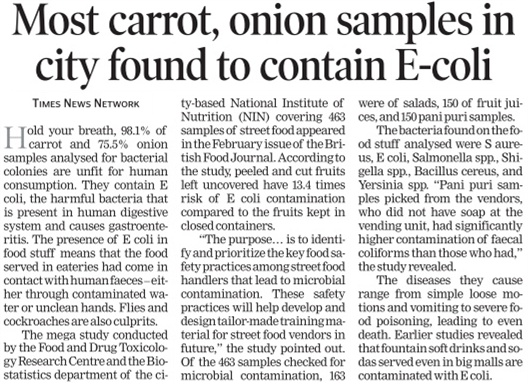
A first of its kind study on the food samples collected from a number of hotels, restaurants and street-side eateries in Hyderabad published in the recent issue of the British Food Journal (BFJ) reveals the major health hazard lurking around those aroma-filled and tasty food served in the city. Hold your breath, 98.1% of carrot and 75.5% onion samples analysed for bacterial i ti colonies are unfit for human t consumption. They contain E le coli, the harmful bacteria that r is present in human digestive c system and causes gastroentec ritis. The presence of E coli in food stuff means that the food f served in eateries had come in fe contact with human faeces ­ eith her through contaminated wac ter or unclean hands. Flies and p cockroaches are also culprits. d The mega study conducted t by the Food and Drug Toxicology Research Centre and the Biostatistics department of the ci ty-based National Institute of Nutrition (NIN) covering 463 samples of street food appeared in the February issue of the British Food Journal. According to the study , peeled and cut fruits left uncovered have 13.4 times risk of E coli contamination compared to the fruits kept in closed containers.
“The purpose... is to identify and prioritize the key food safety practices among street food handlers that lead to microbial contamination. These safety practices will help develop and design tailor-made training material for street food vendors in future,“ the study pointed out.Of the 463 samples checked for microbial contamination, 163 were of salads, 150 of fruit juices, and 150 pani puri samples.
The bacteria found on the food stuff analysed were S aureus, E coli, Salmonella spp., Shigella spp., Bacillus cereus, and Yersinia spp. “Pani puri samples picked from the vendors, who did not have soap at the vending unit, had significantly higher contamination of faecal coliforms than those who had,“ the study revealed.
The diseases they cause range from simple loose motions and vomiting to severe food poisoning, leading to even death. Earlier studies revealed that fountain soft drinks and sodas served even in big malls are contaminated with E coli.

Food safety authorities raid Nunna mango market

VIJAYAWADA: Undeterred by directions from the High Court and multiple raids last year, mango traders are going ahead with artificial, cheaper, faster and harmful methods of ripening. The district unit of the Food Safety and Standards Authority of India(FSSAI) officials raided the largest mango market in the region - Nunna mango market - on Tuesday and recovered ethylene powder sachets left hidden in cartons to ripen the fruit.
The FSSAI officials said that the traders are using Chinese ethylene powder which is re-packaged at Ghaziabad, Uttar Pradesh. "Since there is a ban on calcium carbide, the traders are using ethylene powder indiscriminately without following any scientific method. We don't know how much amount of ethylene gas will be released from the sachet once it is placed among the mangoes. This powder is even more harmful than calcium carbide ," said FSSAI-designated officer for Krishna district and zonal in-charge N Poornachandra Rao, speaking to the media.
When the traders argued that the government itself is allowing ripening of fruits in ethylene chambers, the officials said that no method apart from ethylene chamber is allowed as per FSSAI norms. "We will dig deep into the source of this powder. It is like calcium carbide so we can initiate criminal action," Rao explained.
The official appealed to traders not to use any artificial means to expedite the ripening. "For now, we are letting the traders go. We have collected a few samples to be sent for testing," he added.

Food cooked at unhygienic site destroyed

Chandigarh: A team of food safety officials inspected a bakery making savouries in Shastri Nagar, Manimajra. The team was led by food safety officer Bhaljinder Singh.
The factory was found running in unsanitized and unhygienic conditions and was challaned for the same.
Five quintals of savouries were found unfit for consumption and were destroyed by the officials. Inaddition to this, sweets and confectionery items of approximately four quintals were found to have been prepared in unhygienic conditions.
Some food items stored at a residential premises were also destroyed during the drive.
The drive to check illegal and unhygienic food units in Manimajra was started by SDM (East) Dr Tapasya Raghav.
Raghav said the drive to check unhygienic conditions at food producing outlets will continue.

Eateries raided

A popular Biryani joint and an upmarket eatery were among those fined and seized by the officials of GHMC . On Tuesday, the officials inspected the kitchen of Y2K restaurant at Punjagutta and found that unstamped meat was being used for cooking. It also came to light that the hotel did not have trade or food license required to operate the restaurant. 
When the officials proceeded to seize the restaurant, the staff and the management argued with the officials and prevented them from taking action. The police officials were called in to control the situation after which the hotel was seized. Swagath Grand Hotel in Vanasthalipuram was fined Rs.10,000 for serving stale food to the customers. 
The health and sanitation officials carried out the inspection and found the kitchen in an unhygienic condition. While Papadams in Vanasthalipuram was fined Rs.5,000, Alma’s Kitchen in Jubilee Hills was fined Rs.10,000 for serving stale food and unhygienic maintenance of the kitchen.

Bali flags off 5 fully equipped Mobile Food Testing Labs

Out of these five mobile laboratories, two each will be deployed in Kashmir and Jammu Divisions and one will be deployed in Ladakh region.
In a significant move towards further strengthening the State Food & Drug Control Organization (F&DCO), the government has procured five fully equipped Mobile Food Testing Laboratories (Vans) with a cost of Rs. 31 lakh each. 
Out of these five mobile laboratories, two each will be deployed in Kashmir and Jammu Divisions and one will be deployed in Ladakh region.
Minister for Health & Medical Education, Bali Bhagat dedicated these mobile vans to the D&FCO, here today.
Speaking on the occasion, the minister said that it is endeavor of the government to ensure wholesome food articles to the people of Jammu and Kashmir for which the D&FCO, which is the regulatory authority for checking the menace of adulteration in the food articles, shall be strengthened and equipped with all modern gadgets. 
Congratulating the Controller D&FCO and her staff for having these facilities, the minister said that the mobile labs will help in reaching out to every corner of the state and undertaking spot testing of food articles. 
This will also help in generating greater awareness amongst the consumers about the safe food articles. He called for optimum use of the facilities to achieve the objective of providing quality food products to the consumers.
Maintaining that the D&FCO which has a very special and sensitive role to play, the minister said that the organization is not only representative of the government, but entire society is depending on it, therefore, every functionary must work with utmost responsiveness and honesty to maintain its credibility. 
He called for stepping up the awareness campaign through different mediums to educate the masses about the food safety standards.
Lotika Khajura briefed the minister about the features and benefits of the Mobile Food Testing Labs and said that the facility will help in ensuring stringent regulatory control across the state over food business operators dealing with processing and distribution of food articles in the market for mass consumption. 
She said the topography of Jammu and Kashmir badly required such facility to counter the challenges posed by the adulteration. This will help in restoring the public confidence, transparency and accountability among the empowered functionaries, she said.
Later, the minister also inspected the food and drug labs and interacted with the concerned functionaries.

Real Milk, Real Ice Cream? Amul’s Advertisement Alleged to be Disparaging in Bombay HC

Amul, known for their quirky and contemporary advertising, seem to have found themselves in trouble over this recent advertisement (picture on the left) that compares them to other ‘frozen dessert’ companies. The advertisement claims that while they use ‘real milk’ to make ‘real ice cream’, other ‘frozen dessert’ companies use Vanaspati oil.
As reported by Livemint, Hindustan Unilever Limited (HUL), and Vadilal have taken Gujarat Cooperative Milk Marketing Federation Limited (GCMMF) to Court, claiming that this Amul advertisement by GCMMF constitutes disparagement. Since the only case pending (SL/204/2017) between the two parties that I could find on the Bombay High Court website doesn’t have any orders uploaded, I am relying on news reports for this post. I would very much appreciate it if our readers could direct me to an order passed in this case, if any.
As is relevant to this dispute, the Food Safety and Standards Authority of India (FSSAI) has mandated that ice cream made with vegetable oil is to be labelled a ‘frozen dessert’, while only those products that contain milk fat can be called ‘ice cream’. HUL, the manufacturers of Kwality Walls ice cream, released a statement that called Amul’s advertisement misleading, as it made “factually incorrect statements”, and “created apprehensions” among the consumers of frozen desserts. Further, HUL clarified that Kwality Walls ‘frozen dessert’ products did not contain Vanaspati. The only difference between ice creams and frozen desserts, they pointed out – is that “frozen desserts use vegetable fat instead of dairy fat, which actually makes them healthier as they have lower saturated fat and do not have cholesterol”. Amul reportedly issued another statement, stating that frozen dessert companies were misleading consumers by using low cost ingredients, and that they were attempting to make consumers aware of the difference.
The essence of this controversy is the implication of ‘frozen desserts’ being made with Vanaspati oil, as is being referred to in the advertisement. While HUL accepts that they use vegetable fat, it is the negative implication that the use of the word ‘Vanaspati’ will have on their sales, that is said to constitute disparagement in this present case. While the advertisement in question does not mention Amul’s competitors by name, HUL has reportedly argued that it is not necessary for the name of the brand to be explicitly mentioned for there to be a case of disparagement. A proposal put forward by HUL was that a voiceover (‘vanaspati tel yaani vegetable oil’) be edited into the advertisement to clarify that it was vegetable oil that was being referred to and not Vanaspati. As per these news reports, GCMMF then contended that the onus lies on HUL to prove that consumers will be misled by the words ‘vanaspati tel’ in the advertisement.
Trademark Disparagement
As I had summarised in a post last month, disparagement with regard to trademarks is essentially the dishonest use of a trademark in advertisements. Section 29(8) of the Trademark Act (“Act”) provides for an action of infringement to lie in case an advertisement containing a registered mark: (a) takes unfair advantage of, and is contrary to honest practices in industrial and commercial matters; or (b) is detrimental to its distinctive character; or (c) is against the reputation of the mark. While it will fall to the determination of the Court whether this Section is applicable in the present matter, the focal point of determination is whether the advertisement can be said to have been of a registered mark; and consequentially whether the advertisement attracts any of the three conditions mentioned above.
In Hindustan Unilever Limited v. Reckitt Benckiser India Limited, the Delhi High Court in 2014 held that in order to determine whether a statement disparages or defames, the question must be considered from the viewpoint of the general public, and not with regard to a special class of people. Colgate Palmolive Ltd. v. Hindustan Unilever Ltd. was a 2013 decision of the Delhi High Court inter alia observed that the advertisement had to be viewed as a whole, and not analyzed like the provisions of a statute.
Comparative Advertising
Standards to be determined for a claim of comparative advertising have been widely interpreted by Courts. We have blogged widely on the issue in the past, please read here for our posts. In 2013, The Delhi High Court in Reckitt Benckiser v. Hindustan Lever Limited listed out a few essential principles of the law on disparagement, which Anubha has listed as follows:
A tradesman is entitled to declare his goods to be the best in the world, even though the declaration is untrue.
He can state that his goods are better than his competitors.
He can even compare the advantages of the two goods. He, however, cannot, while saying that his goods are better than his competitor’s, say that his competitor’s goods are bad. If he says so, he really slanders the goods of his competitors and their goods, which is not permissible in law.
If there is no defamation to the goods or the manufacture of such goods no action lies, but if there is such defamation, an action lies for recovery of damages for defamation, then the court is also competent to grant an order of injunction restraining them to perform such acts.
Further, in order to satisfy the test of comparative disparagement, the plaintiff has to establish: (a) A false or misleading statement of fact has been made about his product; (b) That the statement is deceiving or has the potential to deceive the substantial segment of prospective consumer and; (c) The deception is likely to influence consumer’s purchasing decisions. The court noted that the manner in which the same is telecasted is of prime importance, the same should not be in the manner to ridicule or condemn the product of the competitor, resulting in disparagement or disrupting them in the market.
The 2015 case of Havells v. Amritanshu noted that the standard to be applied was “whether a reasonable man would take the claim being made as one made seriously”. Additionally, to see if an advertisement is misleading, two essential elements need to be satisfied: First, that the advertisement must deceive the persons to whom it is addressed or at least, must have the potential to deceive them. Secondly, as a consequence of its deceptive nature, the advertising must be likely to affect the economic behaviour of the public to whom it is addressed, or harm a competitor of the advertiser.
This isn’t the first time this issue has cropped up – HUL had dragged Amul to the Advertising Standard Council of India (ASCI) last year, objecting to the distribution of pamphlets on the same issue, but the ASCI had ruled that Amul’s campaign did not disparage frozen dessert. Keeping in mind the above standards as developed by Courts, HUL and Vadilal will have to prove to the satisfaction of the Court that Amul’s advertisement really is misleading, and that it has the potential to deceive the substantial segment of prospective consumers. We hope that orders in this suit will soon be available on the High Court website, and promise to bring you any further updates in this case!

AAP govt ties up with private labs to improve food quality in Delhi restaurants

New Delhi: To ensure better and frequent monitoring of food served in restaurants and even on streets , Delhi’s food safety department tied up with 18 private labs in the city for picking up samples, testing them and providing a report.
Delhi has only one government lab that would test food samples, resulting in a huge backlog. The private labs that the Delhi government tied up with are NABL accredited, which assures quality.
“It is a force multiplier for the government. With the one lab and limited man-power, it was just not possible for us to cover entire Delhi. Now we will be able to do 20 times as many tests we were previously conducting,” said Dr Mrinalini Darswal, Delhi’s food safety commissioner.
This will also combat the perpetual shortage of staff in the department.
“There are not food safety officers to monitor every food vendor in Delhi. Currently there are 16 officers against 32 sanctioned posts and even that is not enough. Partnering with these labs we would be able to pick up more samples and it is as good as having 19 functioning food safety labs,” said Darswal.
The government tied up with these labs in February and a computerised system of giving the reports was set up.
“The labs get paid R 5,000 per sample for collection and testing, this is the rate fixed by the FSSAI (Food Safety and Standards Authority of India). We have tried this method for some time now, which is why we were able to conduct the emergency inspections of the mid-day meal kitchen efficiently,” said Dr Darswal.
The food safety department started a drive to check all the mid-day meal kitchens on February 20 after nine children fell ill at a Delhi government school after consuming food that had a dead rat in it.
These labs would, however, be authorised to pick up only surveillance samples. “After the reports of the surveillance samples come in, we will be able to pin point 2 or 3 vendors whose samples fail. Our food safety officers can then go to these shops and collect a legal sample, which is a tedious procedure and is time-consuming,” said Darswal.
A ‘legal sample’ is when a specified quantity of a food item, according to the food safety regulations, bearing the same batch number is picked up from a single shop after following due procedure.