
Apr 19, 2017


Poultry industry rubbishes rumours of ‘plastic eggs’

“Reports about Chinese eggs coming into the market are false," said the NECC
The National Egg Coordination Committee (NECC) denied reports of sale of plastic eggs in the market during a press conference in the city on Tuesday. Reports have recently surfaced that ‘Chinese’ plastic egg lookalikes were being infiltrated in Indian markets. The poultry industry had also reported a dip in the sales following the speculations.
Prasanna Pedgaonkar, deputy general manager of Venkateshwara Hatcheries, while addressing the media, ruled out the possibility of any such adulteration. “Reports about Chinese eggs coming into the market are false. The Indian poultry industry ensures production of 100 per cent white-shelled eggs, while the eggs which originate from China are 100 per cent brown,” he said. Production of artificial eggs, NECC members added, would be costlier than production of natural eggs and no economic benefit could be derived out of it.
The poultry industry, however, has reported a 10 per cent drop in consumption and sale of eggs in recent days. Pedgaonkar said Maharashtra, on an average, sees consumption of two crore eggs per day, with Pune reporting consumption of around 60 lakh eggs on a daily basis. “The dip in consumption was due to a combination of reasons and the rumours certainly had a part to play,” he added.
On the reports of a change in the texture of eggs, he said that was because of thermal shock due to high temperature. “At the farmgate, the temperatures are over 40 degrees Celsius, while at shops, the temperatures suddenly drops to 20 degrees Celsius. This leads to thermal shock and texture change,” he said. Meanwhile, the same press conference also saw senior officials from the Food and Drugs Administration talking about remote chances of adulteration in eggs.


GHMC crackdown on restaurants reveals stale meat, dirty kitchens

Continuing its crackdown against hotels following unhealthy practices, the Greater Hyderabad Municipal Corporation (GHMC) on Tuesday sealed the popular Y2K restaurant in Panjagutta and penalised six other eateries for using stale meat and not maintaining hygienic conditions.
The situation got tense at Y2K when the management allegedly got into a heated argument and tried to stop the civic body officials from shutting down the eatery . The police had to be called in to bring the situation under control. The hotel was sealed for using stale meat and running without trade and food licences.
Later in the day , the GHMC officials raided Almas Palace in Jubilee Hills and imposed a fine of `10,000 for an unhygienic kitchen. Similarly , Swagath Grand in Vanasthalipuram was imposed a fine of `10,000 for using stale food. A fine of `5,000 was imposed on Papadams in Vanasthalipuram for similar reasons.
In Secunderabad, the civic body inspected Maharaja Restaurant and Bar, Mount Paradise Bar & Family Restaurant and Sri Siddhi Udupi Tiffin & Restaurant and imposed a fine of `25,000 each for using unstamped meat and unhygienic conditions.
Civic officials said that the hoteliers were risking the health of people for a few thousand rupees. “Some of the hotel officials are aware of the rules and regulations, but still don't follow them to save money ,“ said a senior official from the GHMC health wing.
Lean meat (fish and chicken) or red meat loses its nutritional value if it goes stale, doctors said. “Eating stale meat may lead to diarrhoea and vomiting, which could in turn lead to electrolyte imbalance,“ said Dr Deepa Agarwal, nutritionist at Apollo Hospital.“If stale red meat is consumed for a longer period of time, it may lead to gastric cancer,“ she said.
Eating out? You may be courting diseases

A first of its kind study on the food samples collected from a number of hotels, restaurants and street-side eateries in Hyderabad published in the recent issue of the British Food Journal (BFJ) reveals the major health hazard lurking around those aroma-filled and tasty food served in the city. Hold your breath, 98.1% of carrot and 75.5% onion samples analysed for bacterial i ti colonies are unfit for human t consumption. They contain E le coli, the harmful bacteria that r is present in human digestive c system and causes gastroentec ritis. The presence of E coli in food stuff means that the food f served in eateries had come in fe contact with human faeces eith her through contaminated wac ter or unclean hands. Flies and p cockroaches are also culprits. d The mega study conducted t by the Food and Drug Toxicology Research Centre and the Biostatistics department of the ci ty-based National Institute of Nutrition (NIN) covering 463 samples of street food appeared in the February issue of the British Food Journal. According to the study , peeled and cut fruits left uncovered have 13.4 times risk of E coli contamination compared to the fruits kept in closed containers.
“The purpose... is to identify and prioritize the key food safety practices among street food handlers that lead to microbial contamination. These safety practices will help develop and design tailor-made training material for street food vendors in future,“ the study pointed out.Of the 463 samples checked for microbial contamination, 163 were of salads, 150 of fruit juices, and 150 pani puri samples.
The bacteria found on the food stuff analysed were S aureus, E coli, Salmonella spp., Shigella spp., Bacillus cereus, and Yersinia spp. “Pani puri samples picked from the vendors, who did not have soap at the vending unit, had significantly higher contamination of faecal coliforms than those who had,“ the study revealed.
The diseases they cause range from simple loose motions and vomiting to severe food poisoning, leading to even death. Earlier studies revealed that fountain soft drinks and sodas served even in big malls are contaminated with E coli.
Food safety authorities raid Nunna mango market

The FSSAI officials said that the traders are using Chinese ethylene powder which is re-packaged at Ghaziabad, Uttar Pradesh. "Since there is a ban on calcium carbide, the traders are using ethylene powder indiscriminately without following any scientific method. We don't know how much amount of ethylene gas will be released from the sachet once it is placed among the mangoes. This powder is even more harmful than calcium carbide ," said FSSAI-designated officer for Krishna district and zonal in-charge N Poornachandra Rao, speaking to the media.
When the traders argued that the government itself is allowing ripening of fruits in ethylene chambers, the officials said that no method apart from ethylene chamber is allowed as per FSSAI norms. "We will dig deep into the source of this powder. It is like calcium carbide so we can initiate criminal action," Rao explained.
The official appealed to traders not to use any artificial means to expedite the ripening. "For now, we are letting the traders go. We have collected a few samples to be sent for testing," he added.
Food cooked at unhygienic site destroyed
Chandigarh: A team of food safety officials inspected a bakery making savouries in Shastri Nagar, Manimajra. The team was led by food safety officer Bhaljinder Singh.
The factory was found running in unsanitized and unhygienic conditions and was challaned for the same.
Five quintals of savouries were found unfit for consumption and were destroyed by the officials. Inaddition to this, sweets and confectionery items of approximately four quintals were found to have been prepared in unhygienic conditions.
Some food items stored at a residential premises were also destroyed during the drive.
The drive to check illegal and unhygienic food units in Manimajra was started by SDM (East) Dr Tapasya Raghav.
Raghav said the drive to check unhygienic conditions at food producing outlets will continue.
Eateries raided
A popular Biryani joint and an upmarket eatery were among those fined and seized by the officials of GHMC . On Tuesday, the officials inspected the kitchen of Y2K restaurant at Punjagutta and found that unstamped meat was being used for cooking. It also came to light that the hotel did not have trade or food license required to operate the restaurant.
When the officials proceeded to seize the restaurant, the staff and the management argued with the officials and prevented them from taking action. The police officials were called in to control the situation after which the hotel was seized. Swagath Grand Hotel in Vanasthalipuram was fined Rs.10,000 for serving stale food to the customers.
The health and sanitation officials carried out the inspection and found the kitchen in an unhygienic condition. While Papadams in Vanasthalipuram was fined Rs.5,000, Alma’s Kitchen in Jubilee Hills was fined Rs.10,000 for serving stale food and unhygienic maintenance of the kitchen.
Bali flags off 5 fully equipped Mobile Food Testing Labs
Out of these five mobile laboratories, two each will be deployed in Kashmir and Jammu Divisions and one will be deployed in Ladakh region.

In a significant move towards further strengthening the State Food & Drug Control Organization (F&DCO), the government has procured five fully equipped Mobile Food Testing Laboratories (Vans) with a cost of Rs. 31 lakh each.
Out of these five mobile laboratories, two each will be deployed in Kashmir and Jammu Divisions and one will be deployed in Ladakh region.
Minister for Health & Medical Education, Bali Bhagat dedicated these mobile vans to the D&FCO, here today.
Speaking on the occasion, the minister said that it is endeavor of the government to ensure wholesome food articles to the people of Jammu and Kashmir for which the D&FCO, which is the regulatory authority for checking the menace of adulteration in the food articles, shall be strengthened and equipped with all modern gadgets.
Congratulating the Controller D&FCO and her staff for having these facilities, the minister said that the mobile labs will help in reaching out to every corner of the state and undertaking spot testing of food articles.
This will also help in generating greater awareness amongst the consumers about the safe food articles. He called for optimum use of the facilities to achieve the objective of providing quality food products to the consumers.
Maintaining that the D&FCO which has a very special and sensitive role to play, the minister said that the organization is not only representative of the government, but entire society is depending on it, therefore, every functionary must work with utmost responsiveness and honesty to maintain its credibility.
He called for stepping up the awareness campaign through different mediums to educate the masses about the food safety standards.
Lotika Khajura briefed the minister about the features and benefits of the Mobile Food Testing Labs and said that the facility will help in ensuring stringent regulatory control across the state over food business operators dealing with processing and distribution of food articles in the market for mass consumption.
She said the topography of Jammu and Kashmir badly required such facility to counter the challenges posed by the adulteration. This will help in restoring the public confidence, transparency and accountability among the empowered functionaries, she said.
Later, the minister also inspected the food and drug labs and interacted with the concerned functionaries.
Real Milk, Real Ice Cream? Amul’s Advertisement Alleged to be Disparaging in Bombay HC
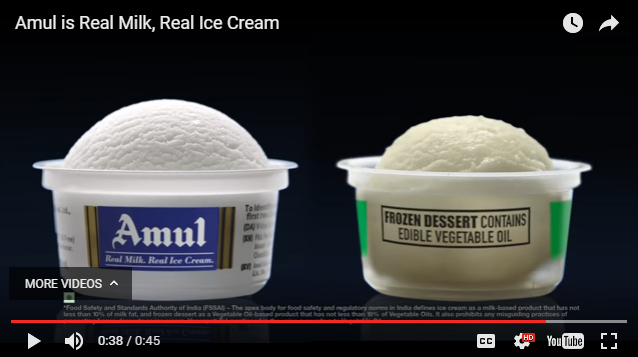
Amul, known for their quirky and contemporary advertising, seem to have found themselves in trouble over this recent advertisement (picture on the left) that compares them to other ‘frozen dessert’ companies. The advertisement claims that while they use ‘real milk’ to make ‘real ice cream’, other ‘frozen dessert’ companies use Vanaspati oil.
As reported by Livemint, Hindustan Unilever Limited (HUL), and Vadilal have taken Gujarat Cooperative Milk Marketing Federation Limited (GCMMF) to Court, claiming that this Amul advertisement by GCMMF constitutes disparagement. Since the only case pending (SL/204/2017) between the two parties that I could find on the Bombay High Court website doesn’t have any orders uploaded, I am relying on news reports for this post. I would very much appreciate it if our readers could direct me to an order passed in this case, if any.
As is relevant to this dispute, the Food Safety and Standards Authority of India (FSSAI) has mandated that ice cream made with vegetable oil is to be labelled a ‘frozen dessert’, while only those products that contain milk fat can be called ‘ice cream’. HUL, the manufacturers of Kwality Walls ice cream, released a statement that called Amul’s advertisement misleading, as it made “factually incorrect statements”, and “created apprehensions” among the consumers of frozen desserts. Further, HUL clarified that Kwality Walls ‘frozen dessert’ products did not contain Vanaspati. The only difference between ice creams and frozen desserts, they pointed out – is that “frozen desserts use vegetable fat instead of dairy fat, which actually makes them healthier as they have lower saturated fat and do not have cholesterol”. Amul reportedly issued another statement, stating that frozen dessert companies were misleading consumers by using low cost ingredients, and that they were attempting to make consumers aware of the difference.
The essence of this controversy is the implication of ‘frozen desserts’ being made with Vanaspati oil, as is being referred to in the advertisement. While HUL accepts that they use vegetable fat, it is the negative implication that the use of the word ‘Vanaspati’ will have on their sales, that is said to constitute disparagement in this present case. While the advertisement in question does not mention Amul’s competitors by name, HUL has reportedly argued that it is not necessary for the name of the brand to be explicitly mentioned for there to be a case of disparagement. A proposal put forward by HUL was that a voiceover (‘vanaspati tel yaani vegetable oil’) be edited into the advertisement to clarify that it was vegetable oil that was being referred to and not Vanaspati. As per these news reports, GCMMF then contended that the onus lies on HUL to prove that consumers will be misled by the words ‘vanaspati tel’ in the advertisement.
Trademark Disparagement
As I had summarised in a post last month, disparagement with regard to trademarks is essentially the dishonest use of a trademark in advertisements. Section 29(8) of the Trademark Act (“Act”) provides for an action of infringement to lie in case an advertisement containing a registered mark: (a) takes unfair advantage of, and is contrary to honest practices in industrial and commercial matters; or (b) is detrimental to its distinctive character; or (c) is against the reputation of the mark. While it will fall to the determination of the Court whether this Section is applicable in the present matter, the focal point of determination is whether the advertisement can be said to have been of a registered mark; and consequentially whether the advertisement attracts any of the three conditions mentioned above.
In Hindustan Unilever Limited v. Reckitt Benckiser India Limited, the Delhi High Court in 2014 held that in order to determine whether a statement disparages or defames, the question must be considered from the viewpoint of the general public, and not with regard to a special class of people. Colgate Palmolive Ltd. v. Hindustan Unilever Ltd. was a 2013 decision of the Delhi High Court inter alia observed that the advertisement had to be viewed as a whole, and not analyzed like the provisions of a statute.
Comparative Advertising
Standards to be determined for a claim of comparative advertising have been widely interpreted by Courts. We have blogged widely on the issue in the past, please read here for our posts. In 2013, The Delhi High Court in Reckitt Benckiser v. Hindustan Lever Limited listed out a few essential principles of the law on disparagement, which Anubha has listed as follows:
A tradesman is entitled to declare his goods to be the best in the world, even though the declaration is untrue.
He can state that his goods are better than his competitors.
He can even compare the advantages of the two goods. He, however, cannot, while saying that his goods are better than his competitor’s, say that his competitor’s goods are bad. If he says so, he really slanders the goods of his competitors and their goods, which is not permissible in law.
If there is no defamation to the goods or the manufacture of such goods no action lies, but if there is such defamation, an action lies for recovery of damages for defamation, then the court is also competent to grant an order of injunction restraining them to perform such acts.
Further, in order to satisfy the test of comparative disparagement, the plaintiff has to establish: (a) A false or misleading statement of fact has been made about his product; (b) That the statement is deceiving or has the potential to deceive the substantial segment of prospective consumer and; (c) The deception is likely to influence consumer’s purchasing decisions. The court noted that the manner in which the same is telecasted is of prime importance, the same should not be in the manner to ridicule or condemn the product of the competitor, resulting in disparagement or disrupting them in the market.
The 2015 case of Havells v. Amritanshu noted that the standard to be applied was “whether a reasonable man would take the claim being made as one made seriously”. Additionally, to see if an advertisement is misleading, two essential elements need to be satisfied: First, that the advertisement must deceive the persons to whom it is addressed or at least, must have the potential to deceive them. Secondly, as a consequence of its deceptive nature, the advertising must be likely to affect the economic behaviour of the public to whom it is addressed, or harm a competitor of the advertiser.
This isn’t the first time this issue has cropped up – HUL had dragged Amul to the Advertising Standard Council of India (ASCI) last year, objecting to the distribution of pamphlets on the same issue, but the ASCI had ruled that Amul’s campaign did not disparage frozen dessert. Keeping in mind the above standards as developed by Courts, HUL and Vadilal will have to prove to the satisfaction of the Court that Amul’s advertisement really is misleading, and that it has the potential to deceive the substantial segment of prospective consumers. We hope that orders in this suit will soon be available on the High Court website, and promise to bring you any further updates in this case!
AAP govt ties up with private labs to improve food quality in Delhi restaurants
New Delhi: To ensure better and frequent monitoring of food served in restaurants and even on streets , Delhi’s food safety department tied up with 18 private labs in the city for picking up samples, testing them and providing a report.
Delhi has only one government lab that would test food samples, resulting in a huge backlog. The private labs that the Delhi government tied up with are NABL accredited, which assures quality.
“It is a force multiplier for the government. With the one lab and limited man-power, it was just not possible for us to cover entire Delhi. Now we will be able to do 20 times as many tests we were previously conducting,” said Dr Mrinalini Darswal, Delhi’s food safety commissioner.
This will also combat the perpetual shortage of staff in the department.
“There are not food safety officers to monitor every food vendor in Delhi. Currently there are 16 officers against 32 sanctioned posts and even that is not enough. Partnering with these labs we would be able to pick up more samples and it is as good as having 19 functioning food safety labs,” said Darswal.
The government tied up with these labs in February and a computerised system of giving the reports was set up.
“The labs get paid R 5,000 per sample for collection and testing, this is the rate fixed by the FSSAI (Food Safety and Standards Authority of India). We have tried this method for some time now, which is why we were able to conduct the emergency inspections of the mid-day meal kitchen efficiently,” said Dr Darswal.
The food safety department started a drive to check all the mid-day meal kitchens on February 20 after nine children fell ill at a Delhi government school after consuming food that had a dead rat in it.
These labs would, however, be authorised to pick up only surveillance samples. “After the reports of the surveillance samples come in, we will be able to pin point 2 or 3 vendors whose samples fail. Our food safety officers can then go to these shops and collect a legal sample, which is a tedious procedure and is time-consuming,” said Darswal.
A ‘legal sample’ is when a specified quantity of a food item, according to the food safety regulations, bearing the same batch number is picked up from a single shop after following due procedure.
Apr 18, 2017


Ensure meat hygiene, says Collector
Three retired veterinary doctors to be deputed in Thoothukudi slaughterhouse
THOOTHUKUDI
To streamline the functioning of the slaughterhouse here and ensure meat hygiene, veterinarians would be deputed, Collector M. Ravikumar told reporters here on Monday.
Three retired veterinary doctors would be deputed in the slaughterhouse in May. Based on complaints from consumers, officials of Food Safety Department conducted raids on meat stalls last week. A total of 800 kg of meat was seized from various parts of the city and destroyed after it was found unfit for consumption on Saturday.
On Sunday, the officials seized and destroyed 150 kg of ‘unfit-for-consumption’ meat. Several meat stalls were not in possession of licence, which was mandatory under the Food Safety and Standards Act (FSSA).
Meat could be stored in refrigerators only for two hours after the slaughtering of animals, but often unsold meat was kept in cold storage for days together and such meat would not be fit for consumption, he said.
The Collector said the Food Safety officials had been instructed to raids meat stalls every week, and if they found meat unfit for consumption, they would seize and destroy it, he said.
9 products of top firms found to be substandard by food regulators, says report
The products include Mirinda, Cerelac Wheat, Saffola Gold, Frooti among others.
The food regulators of Rajasthan, Tamil Nadu, Haryana, and Assam have reportedly found nine products of major companies to be “substandard” after they failed quality tests conducted between April 2016 and January 2017, The Indian Express said on Monday.
The products include Pepsico India Holdings Private Ltd’s Mirinda, Nestle India Ltd’s Cerelac Wheat, Adani Wilmar Ltd’s Fortune oil, Marico India’s Saffola Gold oil, Parle Agro’s Frooti and a cheese spread used by the Subway chain among others, according to information sought under the Right to Information (RTI) Act by the Express.
“The RTI replies show that Herbalife’s energy drink, Murugappa group’s Parry packaged drinking water and Haldiram’s Aloo Bhujia are among the products reported to have failed the quality tests during this period,” the newspaper said.
“In a number of cases, the companies have either questioned the test procedure or have asked for re-analysis of the samples,” it added.
Mirinda
The Express said five reports found Mirinda to be “misbranded, substandard and unsafe”.
According to the newspaper, in a report dated January 12, 2017, Gurgaon’s food safety officer found batches of Mirinda to be “unsafe as well as substandard”. The state food lab of Food and Drug Administration (FDA) of Haryana Haryana also found “Mirinda” to be “misbranded” in 3 probe reports in April, May, and October last year and it found the drink to be “misbranded, substandard and unsafe” in October 2016.
“According to an RTI reply, the lab did not have the information regarding the action taken in last four cases because the matter was ‘not related’ to its ‘office’,” it said.
The food safety officer said the newspaper in an RTI reply that a “letter (has been) sent for permission for prosecution to commissioner of FDA”.
“PepsiCo operates in the state of Haryana through its franchisee. The franchisee has received only one of the reports (18th May 2016) referred to by you and has requested for a reanalysis of the sample mentioned in that report. No other notice referred by you has been received by our franchisee … All products, including Mirinda, comply with the food regulations and are completely safe and hence pulling out Mirinda is unwarranted,” a PepsiCo spokesperson was quoted as saying by the Express.
Cerelac Wheat
Nestle India Ltd’s infant food Cerelac Wheat was found to be substandard by the chief medical and health officer (CMHO) of Rajasthan’s Rajasmand district in a report dated October 14, 2016.
In one RTI reply, the CMHO told the Express that Cerelac failed at the quality parameter of “total protein”.
Asked what action has been taken against the company, the officer’s RTI reply stated: “Anusandhan jaari (Investigation is ongoing).
The company did not respond to requests seeking comment from the newspaper.
Fortune oil
In an RTI reply, the CMHO of Bundi in Rajasthan said that the acid value of Fortune, a refined rice brand oil from Adani Wilmar Ltd, was found to be 0.67, which must not be higher than 0.5, in test results on July 15, 2016.
The officer told the Express that the matter is under investigation when it asked if any action has been taken against the company.
“So far we have not received a notice on Refined Rice Bran Oil from Bundi, CMO. As regards the acid value on Rice Bran Oil, the permitted limit is 0.50, However, due to the faulty procedure (wrong indicator) adopted by many public analysts, the result may show acid value on higher side … There is no question of withdrawing the product from Indian Market as Rice Bran Oil is one of the healthiest oils available in the market and our product meets the standards as provided under the Food Safety and Standards Act, 2006,” an Adani spokesperson told the newspaper.
Saffola Gold oil
A sample of Saffola Gold, blended edible vegetable oil, was picked up on May 9 last year by food safety officer Naresh Kumar Chenjara in the western state’s Sawai Madhopur.
The Expres said the probe results came on May 27, 2016, and said the product was substandard as its acid value was 1.12 instead of the permitted limit of 0.50.
The results also said Saffola Gold does not conform to the prescribed provisions of food safety and standards (Food Products Standards and Food Additive) Regulation, 2011.
“Under Food Safety and Standards Act, 2006, (we are) submitting chargesheets in court against the firms/manufacturers,” Umesh Sharma, CMHO, Sawai Madhopur, told the newspaper in an RTI reply.
Marico Limited did not respond to requests seeking comment.
Processed cheese spread
Similarly, a sample of the processed cheese spread used by Subway Systems Indian Private Ltd picked up by the food safety officer of Faridabad on July 21, 2016, was found to be substandard as it was “misbranded”, according to the newspaper.
The Express said when asked about the action taken, the food safety officer, in an RTI reply, said: “Case pending to launch”. But Subway denied using processed cheese spread.
“We would like to place on record that Subway does not use ‘Processed cheese spread’ as an ingredient in any of its products,” a Subway spokesperson told Hindustan Times in its response on Monday morning.
Frooti
The Express reported Parle Agro’s mango drink, Frooti, was found to be “substandard” as it failed on the “physical” parameter by the state public health laboratory of Assam in 3 probe reports between June 13, July 14 and August 2, 2016.
The samples were manufactured by Padmesh Beverages, which has been given a contract by Parle Agro, at its plant in Satgaon, Guwahati, Assam.
“The action against samples which have been declared substandard by the food analyst to the government of Assam are being taken and are at different stages of adjudication in the court of the adjudicating officers in the district headquarters of the state,” the Food and Drug Administration (FDA) of Assam told the Express in an RTI reply to the Express.
The newspaper said Parle Agro did not respond to requests seeking comment.
Parry packaged water
The food safety wing of Kanchipuram in Tamil Nadu found that the aerobic microbial count in the sample of Parry packaged water was 32 colony forming units (CFU)/ml, which must not be more than 20 CFU/ml, in samples of Parry Enterprises India’s packaged drinking water taken on July 20, 2016.
A microbial limit test checks the presence of microorganisms such as bacteria, yeast, and mold in a sample is exceeding the limit or not.
The Kanchipuram wing stated in an RTI reply that “adjudicating process will be started against the concerned food business operators”.
The Murugappa group company said: “Please note that we are unable to refer to the Probe Report you have referred above, as we have not received this report. However, we were made aware of a test report (which reported the numbers mentioned by you above) by Kings Institute dated 20th July which was an enclosure to a letter from FSSAI dated 29th July 2016, on a matter relating to labelling. We understood that this observation made by the Test house was in itself inaccurate and based on inadequate and perfunctory analysis as per the Act.”
Haldiram aloo bhujia
The newspaper said the state food lab of FDA Haryana found the aloo bhujia produced by Haldiram Foods International Private Ltd in a probe report of July 2016 to be “misbranded” or not compliant with rules in Food Safety and Standards (Packaging and Labeling) Regulations, 2011.
“The state food lab did not comment on the action taken in this probe report and said that the matter is ‘not related to this office’,” it said.
Haldiram did not respond to requests seeking comment.
Fresh energy drink mix
The Express reported that Haryana’s food lab picked up a sample of fresh energy drink mix by Herbalife International India Private Ltd from a shop in Model Town, Sonipat in Haryana and the test results came on May 30, 2015, which stated that the product was found to be “substandard”.
It said the food safety officer of Sonipat said in an RTI reply that a case has been “filed in ADC (Additional Deputy Commissioner) court, Sonipat”.
“With respect to your queries kindly be informed that the matter is sub judice and it would not be appropriate to make any comments at this point of time,” the company told the newspaper.
Food quality in shops: onus on shopkeepers
Following the death of a four-year-old boy due to suspected food poisoning after he reportedly ate jelly candy from a bakery in the city, food safety officials have asked shopkeepers to ensure the quality of food items being sold through their outlets.
“The Food Safety and Standards Act wants shopkeepers to check if the manufacturers have the mandatory food safety licence. The 14-digit licence number should be displayed in the packet, container or bottle in which the food item is stored. It should also have the customer care number and address of the manufacturer,” O. Sankaran Unni, Assistant Commissioner, Food Safety and Standards Authority of India (FSSAI), said on Monday.
He said that most of the food items being sold through bakeries and small shops in the city often don’t meet these standards and buying food from them is unsafe. Government and semi-government organisations, private organisations, street vendors, Kudumbasree units, home-based food manufacturers, mess houses, and canteens in educational institutions are supposed to apply for the licence. It is also illegal to sell curd, milk, edible oil, and masala powder in low-quality plastic covers, according to a directive brought out by the FSSAI.
Meanwhile, Mr. Unni said that it is yet to be confirmed if Yosuf Ali, the four-year-old from Kappad, died after he ate jelly candy. “According to his family members, they had also eaten other food. We are awaiting the post-mortem report and the report from the regional analytical lab to reach a conclusion,” he said. The bakery from where the jelly candy was brought had been asked to produce their food safety licence. The Kasaba police questioned the wholesale dealer from Tirur in Malappuram district from where the sweet was purchased. They are also awaiting the lab report.
It is yet to be confirmed if Yosuf Ali, the four-year-old from Kappad, died after he ate jelly candy.
Street food vendors have poor knowledge of FSSA
Chandigarh:A majority of the street food vendors working at various places in City Beautiful working at the tertiary care hospital have a very poor knowledge of Food Safety and Standards Act (FSSA) guidelines.
This fact has been highlighted in a study conducted by researcher Meenakshi from the School of Public Health, Postgraduate Institute of Medical Education & Research (PGIMER).
The study was conducted on various street food vendors in different sectors of Chandigarh. Around 100 street food vendors from different sectors of Chandigarh, including Sectors 27, 24, 23, 22, 19, 16, 15 and 11 were sampled.
The study highlighted the status of conformance of selected street food vendors of Chandigarh of the Food Safety and Standards Regulation, 2011. The findings showed that about 98 per cent of the vendors never underwent any health checks for communicable diseases.
Only 6 per cent of vendors were trained on the aspects of safety and food handling. While only 8 per cent used hand gloves and zero per cent used head gears. The study findings further highlighted that only 11 per cent of thwe vendors had the licence to sell food.
Recently, the Chandigarh Municipal Corporation did the survey of around 24,000 street vendors and soon they will be getting the licences from the department. The Haryana Nav Yuvak Kala Sangam under the Street Vendors (Protection of Livelihood and Regulation of Street Vending) Act, 2014, conducted the survey.
However, In its first, the Food and Safety Department is also planning to ensure that the city roadside vendors got themselves registered with the UT Food Safety and Standards Department, Chandigarh.
FSSAI develops rapid test kit to detect adulterated milk, oil
New Delhi, April 17 (IANS) The Food Safety and Standards Authority of India (FSSAI) on Monday said that it has developed a rapid test kit to check quality of milk and edible oils.
"We have started developing variety of rapid test kits for variety of products. But the focus is on milk product and edible oil. We are looking for potential investors and entrepreneurs for bulk production," FSSAI Chairman Ashish Bahuguna told media after a meeting of the Central Consumer Protection Council here.
One test kit cannot be used for all products and it poses a challenge, he said.
"We are trying to distinguish between safety and substandard. A product can be substandard without impacting the health," Bahuguna said, noting that milk adulteration was more in North India compared to that in South India.
Since the previous survey to check adulteration threw up surprising results, the government will hold another set of survey in summer when "reportedly mid-term inflation is on peak because production is lower".
After getting the reports, the government will decide a strategy and focus on hotspots.
Union Food and Consumer Affairs Minister Ram Vilas Paswan urged the FSSAI to come up with test kits for Rs 10-12 for customers to use it to check adulteration.
Bahuguna said that a company in West Bengal had manufactured an edible oil vending machine, which can be used for buying small quantity.
Milk adulteration more in North India: FSSAI
The regulator has already developed a testing kit to check the quality of milk.
New Delhi: Milk adulteration is more in north India compared to southern states, food safety regulator FSSAI said today. To address this issue, the regulator has already developed a testing kit to check the quality of milk and is looking for investors for its bulk production.
However, more detailed and focused strategy to tackle the menace of adulteration will be developed after conducting one more survey, it added. "A survey conducted three months ago showed in general that milk adulteration was low in southern India, more in north India," Food Safety and Standards Authority of India (FSSAI) Chairman Ashish Bahuguna told media after a meeting of the Central Consumer Protection Council (CCPC) here.
A survey with a sample size of about 2,500 had "some surprising" results as some states reported no adulteration at all, which "I personally cannot believe", he said. Stating that there is no question on the integrity of the results of the recent survey, Bahuguna said, "But we will conduct another survey to get the accurate picture so that to decide a strategy and focus on hotspots."
He also said, testing kits to check quality of milk has already been developed and the FSSAI is negotiating with investors for mass production and marketing of the kit. The regulator is in the process of developing a testing kit for edible oil as well.
The issue of adulteration was discussed in the CCPC meeting, in which Consumer Affairs Minister Ram Vilas Paswan asked the FSSAI to come up with testing kits which consumers can buy at Rs 15-20.
FSSAI wants edible oil manufacturers to make small packs for rural India
“We are speaking with manufacturers to reduce the package size of edible oil,” Ashish Bahuguna, chairman of FSSAI said.
NEW DELHI: The food regulator wants edible oil manufacturers to bring out their products in smaller packs which daily wagers and rural buyers can afford.
Ashish Bahuguna, chairman of Food Safety and Standards Authority of India (FSSAI), told reporters that the regulator mandates that edible oils be sold in packaged form, but in rural areas these oils are being sold in smaller quantities from opened packs. For people earning their wages on a daily basis, it is difficult to afford oil packages of larger quantities, he said.
"We are speaking with manufacturers to reduce the package size of edible oil," Bahuguna said, adding that his department has also proposed a differential duty on smaller packages.
"We are also requesting the government to see if there could be a differential duty on smaller packages. That, however, seems to be unlikely because the GST regime is trying to push a common duty structure. But nonetheless we have made this proposal to the government."
Apr 17, 2017


RTI: 1,707 abattoirs registered under FSSA; most in Tamil Nadu, Madhya Pradesh, Maharashtra
Uttar Pradesh, in news recently over closure of illegal slaughterhouses, has only 58 which are registered under the Act.
A query under the Right to Information has revealed that only 1,707 slaughterhouses in the country are registered under the Food Safety and Standards Act (FSSA), 2006.
There are no abattoirs registered under the 2006 Act in Arunachal Pradesh, Chandigarh, Dadra and Nagar Haveli, Daman and Diu, Mizoram, Nagaland, Sikkim and Tripura. Further, these states/Union Territories do not have a single slaughterhouse which has a license issued by either the state or the Central authority.
Uttar Pradesh, where the BJP government is clamping down on illegal slaughterhouses, is not in the top three states where the highest number of slaughterhouses registered under FSSA are located.
These top three states are Tamil Nadu, Madhya Pradesh and Maharashtra.
Chandrashekhar Gaud, an RTI activist, obtained this information under RTI from the Food Safety and Standards Authority of India (FSSAI).
“These figures show that there are large number of illegal slaughterhouses in the country,” he said.
FSSAI data showed that Tamil Nadu has the highest number of slaughterhouses registered under the Act (425), followed by Madhya Pradesh (262) and Maharashtra (249).
In other words, 55 per cent of abattoirs registered under FSSA are located in these three states.
Uttar Pradesh, in news recently over closure of illegal slaughterhouses, has only 58 which are registered under the Act.
Meanwhile, People for Ethical Treatment of Animals (PETA) in a press release here has said that there are an estimated 30,000 unlicensed slaughterhouses in the country.
Leather industry has no system in place to ensure that the skins used as raw material are not sourced from illegal slaughterhouses, it said, and appealed for closure of all unlicensed slaughterhouses.
No way out, meat sellers open shops sans licence

LUCKNOW: Several muttonand chicken retail shops in the city were found to be open even after expiry of licences on Sunday. Meat sellers said they had no other option because shops were their only source of livelihood.
Licences of all meat shops in the city had expired on March 31. They had a grace period of 15 days during which licences were to be renewed. However, Lucknow Municiapal Corporation (LMC) refused to renew licences saying they would act only after receiving guidelines from the state government. The 15-day grace period expired on Saturday midnight. As a result, now all the raw meat shops in the city selling meat are 'illegal'.
With no way out, many meat sellers have opted to work without licences. A reality check by TOI found that meat shops were running in Aliganj, Mahanagar, Indiranagar, Chowk, Nakkhas, Maulviganj and Thakurganj. Sellers said they had opened shops to sell stored stocks, hoping that licences will be renewed.
"I opened my shop today to exhaust the stock. I will shut it from Monday," said Halim Quereshi, a meat seller on Victoria Street. A seller in Nishatganj said he needed money for admission of his child and the shop was his only source of income.
Lucknow Bakra-Gosht Vyapar Mandal has said it will organise a protest march on Monday from Shaheed Smarak to Vidhan Bhawan.
Meat sellers are struggling since March 20 when the state government ordered crackdown on unlicensed slaughterhouses and meat retail shops. They approached the high court which asked LMC to submit its action plan on renewal of licences and construction of modern slaughterhouses.
The next hearing is on April 19.
Meat shop prohibition around mosques too: FSDA
BAREILLY: One of the 17 points in the guideline issued by the Uttar Pradeshgovernment to meat sellers mentions that such shops are prohibited within a 50-metre radius of religious places and should be at least 100 metres from the main entrance of these places. Food Safety and Drugs Administration (FSDA) department officials have now clarified that a 'religious place' includes a mosque as well. The restriction is despite the fact that caretakers of mosques have not objected to meat shops in the vicinity.
The designated officer of FSDA for Bareilly, Mamta Kumari, said that as a mosque was also a religious place, following the directions issued by the government no one would be given licence to run a meat shop near any mosque. This rule, she said, would be enforced even if mosque caretakers had given permission to the shops to be run in the area.
"Approximately 1,340 persons have submitted the licence fee at government treasury so far to run meat shops while several hundred are still in queue. Among them around 250 applicants have shops near mosques. All of them have brought no-objection letters from the respective caretakers of the mosques. However, unless the government decides otherwise, these people can't be issued licences," Kumari said.
Members of a social service organisation, Aman Committee, have met FSDA officials seeking relaxation of this rule. They have also said that there were several examples from the city of meat shops running in rooms given on rent by mosques.
Responding to them, FSDA officials clarified that any change in the rule could come only from the government and they were authorized only to execute instructions, not make changes in them.
Qadir Ahmed, member of Aman Committee, said, "It is quite unfair to prohibit one from running a meat shop close to a mosque. Like someone running a dairy shop near a temple, it is not considered objectionable to run a meat shop near a mosque. Moreover, if the locals as well as the caretaker of the mosque don't have any objection to the meat shop, there should be no hurdle to issuing licence to the applicant."
Meanwhile, the FSDA officials also clarified that there was no restriction to transporting meat in bulk for weddings. One can purchase as much meat as required from a slaughterhouse after taking prior permission from the department, officials said.
Soft drink to oil, state food monitors find 9 products of top firms ‘substandard’
In a number of cases, the companies have either questioned the test procedure or have asked for re-analysis of the samples.


The RTI replies show that Herbalife’s energy drink, Murugappa group’s Parry packaged drinking water and Haldiram’s Aloo Bhujia are among the products reported to have failed the quality tests during this period.
THE FOOD regulators of Rajasthan, Tamil Nadu, Haryana and Assam have reportedly found nine products of major companies to be “substandard” after they failed quality tests conducted between April 2016 and January 2017.
According to information accessed by The Indian Express under the Right to Information (RTI) Act, these products include Pepsico’s Mirinda, Nestle’s Cerelac Wheat, Adani’s Fortune oil, Marico India’s Saffola oil, Parle Agro’s Frooti and a cheese spread used by the Subway chain.
The RTI replies show that Herbalife’s energy drink, Murugappa group’s Parry packaged drinking water and Haldiram’s Aloo Bhujia are among the products reported to have failed the quality tests during this period.
In a number of cases, the companies have either questioned the test procedure or have asked for re-analysis of the samples.
* Mirinda, soft drink, Pepsico India Holdings Private Ltd
Five reports found Mirinda to be “substandard”. In the first report dated January 12, 2017, the food safety officer of Gurgaon found batches of Mirinda to be “unsafe as well as substandard”. Asked about the action taken against the company, the officer stated in an RTI reply: “Letter (has been) sent for permission for prosecution to commissioner of FDA (Food and Drug Administration of Haryana).” In three probe reports — April, May and October last year — the state food lab of FDA Haryana found “Mirinda” to be “misbranded”. In the fifth probe report of October 2016, the lab found “Mirinda” to be “misbranded, substandard and unsafe”. According to an RTI reply, the lab did not have the information regarding the action taken in last four cases because the matter was “not related” to its “office”.
A PepsiCo India spokesperson said: “PepsiCo operates in the state of Haryana through its franchisee. The franchisee has received only one of the reports (18th May 2016) referred to by you and have requested for a reanalysis of the sample mentioned in that report. No other notice referred by you has been received by our franchisee… All products, including Mirinda, comply with the food regulations and are completely safe and hence pulling out Mirinda is unwarranted.”
* Cerelac Wheat (Infant Food), Nestle India Ltd
In a report dated October 14, 2016, this product was found to be substandard by Chief Medical and Health Officer (CMHO) of Rajasmand district in Rajasthan. In one RTI reply, the CMHO told The Indian Express that Cerelac failed at the quality parameter of “total protein”. Asked what action has been taken against the company, the officer’s RTI reply stated: “Anusandhan jaari (Investigation is ongoing)”. The company did not respond to requests from The Indian Express seeking comment.
* Fortune, refined rice brand oil, Adani Wilmar Ltd
The test results were received by the CMHO of Bundi at Rajasthan on July 15, 2016. “Acid value (of Fortune oil) was found to be 0.67, which must not be higher than 0.5,” the officer stated in an RTI reply. Asked about action taken against Adani Wilmar, the officer’s RTI reply stated: “Anusandhanrat (Under investigation)”. An Adani spokesperson said: “So far we have not received a notice on Refined Rice Bran Oil from Bundi, CMO. As regards the acid value on Rice Bran Oil, the permitted limit is 0.50, However due to the faulty procedure (wrong indicator) adopted by many public analysts, the result may show acid value on higher side….There is no question of withdrawing the product from Indian Market as Rice Bran Oil is one of the healthiest oils available in the market and our product meets the standards as provided under the Food Safety and Standards Act, 2006.”
* Saffola Gold, blended edible vegetable oil, Marico Ltd
This product sample was picked up on May 9 last year by food safety officer Naresh Kumar Chenjara in Sawai Madhopur, Rajasthan. The probe results came on May 27, 2016, wherein the product was declared substandard as its acid value was 1.12 instead of the permitted limit of 0.50. “The sample of Blended Edible Vegetable Oil (Saffola Gold) Loose bearing code number and serial number H-875 of designated officer cum the CMHO of Sawai Madhopur is substandard as it does not conform to the prescribed provisions of food safety and standards (Food Products Standards and Food Additive) Regulation, 2011,” said the probe report.
In an RTI reply, Umesh Sharma, CMHO, Sawai Madhopur, told the newspaper: “Under Food Safety and Standards Act, 2006, (we are) submitting chargesheets in court against the firms/manufacturers.” Marico Limited did not respond to requests seeking comment.
* Processed cheese spread, Subway Systems Indian Private Ltd
On July 21, 2016, the food safety officer of Faridabad picked up the sample of “processed cheese spread” from “Subway, SCF-78, Sector -15, Faridabad”. The product has been found to be substandard as it was “misbranded”. Asked about the action taken, the food safety officer, in a RTI reply, said: “Case pending to launch”. The company did not respond to requests seeking comment.
* Frooti, mango drink, Parle Agro
In three probe reports — June 13, July 14 and August 2, 2016 — the state public health laboratory of Assam found “Frooti Mango drink” to be “substandard” as it failed on the “physical” parameter. These samples, which were found substandard, were manufactured by Padmesh Beverages at its plant in Satgaon, Guwahati, Assam. Parle Agro has given a contract to Padmesh Beverages for Frooti manufacturing.
The Food and Drug Administration (FDA) of Assam said in an RTI reply: “The action against samples which have been declared substandard by the food analyst to the government of Assam are being taken and are at different stages of adjudication in the court of the adjudicating officers in the district headquarters of the state.” Parle Agro did not respond to requests seeking comment.
* Packaged drinking water, Parry Enterprises India
On July 20, 2016, the food safety wing of Kanchipuram in Tamil Nadu found that the aerobic microbial count in the sample of Parry packaged water was 32 colony forming units (CFU)/ml. As per food safety rules, the maximum limit of aerobic microbial count in packaged water must not be more than 20 CFU/ml. A microbial limit test checks if the presence of microorganisms such as bacteria, yeast and mould in a sample is exceeding the limit or not. Asked about action taken against the company, the Kanchipuram wing stated in an RTI reply that “adjudicating process will be started against the concerned food business operators”.
The Murugappa group company said: “Please note that we are unable to refer to the Probe Report you have referred above, as we have not received this report. However, we were made aware of a test report (which reported the numbers mentioned by you above) by Kings Institute dated 20th July which was an enclosure to a letter from FSSAI dated 29th July, 2016, on a matter relating to labelling. We understood that this observation made by the Test house was in itself inaccurate and based on inadequate and perfunctory analysis as per the Act.”
* Aloo bhujia, Haldiram Foods International Private Ltd
In a probe report of July, 2016, the state food lab of FDA Haryana found “Haldiram Aloo Bhujia” to be “misbranded”. The state food lab did not comment on the action taken in this probe report and said that the matter is “not related to this office”. A product is called “misbranded” when it is not compliant with rules in Food Safety and Standards (Packaging and Labeling) Regulations, 2011. The company did not responded to requests seeking comment.
* Fresh energy drink mix, Herbalife International India Private Ltd
The sample for this product was picked up from a shop in Model Town, Sonipat, Haryana. The test results from the state food lab came on May 30, 2015, which stated that the product was found to be “substandard”. Asked what action was taken against the company, the food safety officer of Sonipat stated in an RTI reply that a case has been “filed in ADC (Additional Deputy Commissioner) court, Sonipat”.
The company stated: “With respect to your queries kindly be informed that the matter is sub judice and it would not be appropriate to make any comments at this point of time.”
Steps against illegal sale of food items
The Food Safety and Standards Authority of India (FSSAI) will soon start legal action against individuals and units who engage in the manufacturing and sale of food items without the mandatory food licence.
FSSAI assistant commissioner O. Sankaran Unni said they would be given time till May 15 to get the licence.
“If they fail to do so, they will be sentenced to six months in prison and fined Rs. 5 lakh,” he added.
Boy’s death: inspection of city bakeries to continue

Police officers at the bakery in mofussil bus stand area in Kozhikode from where the boy had consumed jelly candy.
4-year-old suspected to have died of food poisoning after consuming jelly candy
Food safety officials are planning to continue their inspection of sweets and savouries sold through shops and bakeries in the city throughout the week. This follows the death of a four-year-old boy due to suspected food poisoning on Friday after he consumed jelly candy from a bakery here.
O. Sankaran Unni, Assistant Commissioner, Food Safety and Standards Authority of India (FSSAI), said the bakery in the mofussil bus stand area had been asked to close down. The jelly candy was found to be manufactured by a Coimbatore-based confectionery. “We have sent a report to the district food safety official in Coimbatore. The sale of jelly candy and pudding manufactured by the company has been banned in the district,” he said.
To check if shops in the city are selling the banned food items, the officials inspected some shops in Palayam market and mofussil bus stand on Sunday. “The raids will continue for the whole week,” he said.
The health section of the Kozhikode Corporation too has come out against the sale of such sweets. The corporation is likely to take a decision soon.
Mr. Unni said bakeries and shops wee buying such food items from wholesale shops. “Most of them don’t have any manufacturing date or expiry date. Neither do they carry details about the ingredients,” he added.
Yusef Ali, the four-year-old from Kappad near here, reportedly started vomiting after consuming the jelly candy on Thursday. Though Ali was put under intensive medical care at the Institute of Maternal and Child Health, he did not survive. His mother too was found suffering from similar symptoms and was admitted to the Medical College Hospital, Kozhikode.
Legal action
The FSSAI will soon start legal action against individuals and units who engage in the manufacturing and sale of food items without the mandatory food licence. Mr. Unni said they would be given time till May 15 to get the licence. “If they fail to do so, they will be sentenced to six months in prison and fined ₹5 lakh,” he added.
Apr 16, 2017


2 held, food insp suspended following raids on spurious milk
Two persons were arrested and a Food Inspector was suspended today after a spurious milk manufacturing unit was unearthed by the Food Safety Department officials at Shikarpur town here.
About 2,500 litre of spurious milk, ready to sell, huge quantity of milk powder and other materials used in making spurious milk were also seized by the police during the raid, a senior district administration official said.
"The owner of the unit and his son were arrested and booked under relevant sections of the IPC," District Magistrate A K Singh said, they were carrying on the business for a long time.
500 kg of beef seized, destroyed
Raid to continue to ensure quality
In a joint operation conducted by officials from three departments, over 500 kg beef, which was reportedly not fit for human consumption, was seized and destroyed on Saturday.
Following information that huge quantity of beef had been stored for Easter sale in a shop near Poobalarayarpuram fish market and a few more places, a team of officials from Thoothukudi Corporation, Department of Animal Husbandry and the Department of Food Safety raided the shop on Saturday. “Over 500 kg beef, which is not fit for human consumption, had been stored in the freezer of the shop. Hence, it was seized and destroyed,” the officials said.
They said the Corporation had made it clear that roadside slaughtering of goat, bull and pig would not be allowed as it should be done in the permitted slaughter house in the presence of Corporation officials. The raid will continue in the days to come to ensure quality of meat being sold to the public, particularly during festival seasons,” the officials said.
Sanitary Inspectors Rajasekar, Hari Ganesh, Rajapandian and Kannan, Food Safety Officers V. Sivabalan, T. Ramakrishnan and Shanmugasundaram and veterinarian of Department of Animal Husbandry A. Joseph Raj organized the raid.
Eggs feel like plastic after cooking, sent for testing
CUDDALORE: The residents of Kattumannarkoil in Cuddalore district have expressed apprehension over the sales of `plastic eggs' in their locality. They claimed that a resident identified as Vidhya from Sarvarajanpet near Kattumannarkoil bought eggs from a grocery shop in the village on Friday . When she attempted to make an omelette she noticed that the egg white looked abnormal and resembled plastic.
She brought the issue to the notice of her family members and neighbours. They tested the other eggs and also found that the white material in other eggs too looked like plastic. They alerted the district officials. A team led by district food safety officer Ravi reached the village and collected the egg samples. The officials sent the samples for testing to a government laboratory at Coimbatore.
"It is highly impossible (to manufacture plastic eggs). There is no need for such eggs as there is good supply of eggs in the state. However we have collected samples of the eggs and have sent it for analysis to a government laboratory in Coimbatore," said Ravi.
Eggs containing plastic-like material have been reported in a few places in the state and neighbouring Kerala. However, food safety officials dismissed it as rumours. They said the transparent protein member between the egg shell and egg white might have thickened due to prolonged refrigeration making it look like plastic when cooked.
Are you drinking poison this summer?
Cold drinks in Jammu & Kashmir adulterated, misbranded
Impure samples, convictions highest yet no blanket ban
JAMMU, Apr 15: Beware! You may be at risk. Food Safety and Standards of Authority of India (FSSAI) has placed Jammu and Kashmir among top ten states in the country where highest number of aerated or carbonated cold drinks have been found adulterated and misbranded.
28 percent of total samples analyzed by FSSAI were found adulterated and misbranded. According to the annual public testing laboratory report for the year 2015-16; 1354 samples were received from Jammu and Kashmir. Of these samples, 1215 were analyzed i.e around 89 percent of the samples received by the testing laboratory of FSSAI were tested. 334 samples of the carbonated/aerated cold drinks were found adulterated and misbranded.
This has been revealed by Ministry of Food Processing in its latest data on adulterated aerated/carbonated soft drinks for the year 2015-16. The above data is 27 percent of the total samples sent to the laboratory for testing from Jammu and Kashmir, thus, clearly indicating how bleak the scenario is yet the state government has preferred not putting a blanket ban on the manufacture and sale of cold drinks in the state.
Though the state has launched highest number of convictions in the country yet it has desisted from following several other states in the country which have put a blanket van on the carbonated/aerated cold drinks.
Jammu and Kashmir has launched just 1 criminal case and 335 civil cases against various internationally acclaimed soft drink companies for having violated the norms, manufactured and sold adulterated and misbranded cold drinks across the state but has preferred not to take required steps for ensuring that these companies conform to the norms.
Of 336 cases launched by the state government, convictions have taken place in 225 cases, which is highest in the country. An amount of Rs. 22.15 Lakh was realized as penalty from various companies.
The data puts a question mark on the seriousness of the government in ensuring people do not face health hazards because of the cold drinks which are both adulterated. More serious is the silence of the state government in sharing the details of the companies who are playing with the lives of the commoners. State prefers keeping the details top secret, thus allowing cold drinks manufacturers to play with the lives of the commoners across the state.
Data of J&K being 9th state in the country from where adulterated samples were received increases health risk of the people since a government study had found five different toxins-heavy metals antimony, lead, chromium and cadmium and the compound DEHP or Di(2-ethylhexyl) phthalate-in cold drinks produced by two major multinational companies, PepsiCo and Coca Cola.
The study, commissioned by top Health Ministry body, the Drugs Technical Advisory Board (DTAB), had found that these toxins leached into five cold drink samples picked up for the study - Pepsi, Coca Cola, Mountain Dew, Sprite and 7Up - from the PET (polyethylene terephthalate) bottles they were in. Mountain Dew and 7Up are owned by Pepsico, while Sprite is owned by Coca Cola. Results had further shown that there was significant increase in leaching with rise in room temperature.
Under the DTAB's instructions, the study was conducted by the Kolkata-based All India Institute of Hygiene and Public Health (AIIH&PH), which comes under the Health Ministry. AIIH&PH had picked up four bottles (600 ml size) each of the cold drink brands as samples through the "stratified random sampling method". The institute had then handed over samples to the Kolkata-based National Test House (NTH), which falls under the Ministry of Consumer Affairs, to perform the tests.
While there are no permissible limits for heavy metals in cold drinks, the tests found 0.029 milligrams per litre (mg/L), 0.011 mg/L, 0.002 mg/L, 0.017 mg/L and 0.028 mg/L of antimony, lead, cadmium, chromium and DEHP, respectively, in Pepsi. In Coca Cola, 0.006 mg/L, 0.009 mg/L, 0.011 mg/L, 0.026 mg/L and 0.026 mg/L of the aforesaid heavy metals, respectively, were found. The results were similar for Sprite, Mountain Dew and 7Up.
The leaching of these heavy metals-from PET bottles in which the drinks were packaged-increased with the rise in room temperature. For example, at normal room temperature, the tests found 0.004 mg/L and 0.007 mg/L of lead in 7Up and Sprite, respectively. However, when it was kept at 40 degree Celsius for 10 days, the lead increased to 0.006 mg/L and 0.009 mg/L, respectively. The World Health Organisation (WHO) considers lead and cadmium two of the top ten chemicals of "major public health concern".
According to the WHO, children are particularly vulnerable to harmful effects of lead. "Lead can have serious consequences for the health of children. At high levels of exposure, Lead attacks the brain and central nervous system to cause coma, convulsions and even death. Children who survive severe lead poisoning may be left with mental retardation and behavioural disorders," the WHO has noted.
For cadmium, the WHO said, "Cadmium exerts toxic effects on the kidney, the skeletal system and the respiratory system and is classified as a human carcinogen." Chromium, antimony and DEHP are also known to cause serious side effects on the body.
Kozhikode boy dies of ‘food poisoning’
KOZHIKODE: The department of food safety department on Saturday banned the sale of Cuckoo-brand pudding in the district after a four-year-old boy from Kappad died of suspected food poisoning.
Yusufali, son of Palodayil Basheer and Surabhi, died on Friday night a day after he had consumed jelly-candies and the pudding bought from a bakery at the Moffusil bus stand.
The boy's mother has been undergoing treatment at the Medical College Hospital. They had bought the candy and pudding from Royal Bakery before boarding a bus on Thursday. The child later complained that the candy was bitter, and the mother, after tasting it, threw away the packet, police said. The boy and the mother complained of uneasiness and nausea on Friday morning, and the child was taken to a private hospital in Kappad, before he was referred to the medical college. Police said the boy died while being shifted to the medical college.
Police registered a case of unnatural death, and along with the food safety officials, inspected the bakery from where the candy was purchased. Samples collected would be sent for chemical analysis. Food safety officials said they had sealed the Royal Bakery which sold the candy. "We banned the Cuckoo-brand pudding in the district after it was found that the packet did not mention the manufacturing or expiry dates," O Shankaran Unni, assistant commissioner of the food safety department said.
The city corporation, meanwhile, banned the sale of Tiger Highcount jelly-candies in its area. A team led by corporation health standing committee chairman K V Baburaj also visited the bakery.
Health inspector P Abdhul Khader said both the mother and child had the candies and pudding from the bakery. The food safety department said it was not sure now if food poisoning had caused the boy's death. Police said they were waiting for the postmortem report.
Apr 15, 2017

TTD against allowing food inspectors into its temple kitchen

TTD has been told to obtain a food safety licence for the laddu.
Says it will hurt religious sentiments of devotees
The Tirumala Tirupati Devasthanams (TTD) is totally averse to the idea of allowing food inspectors into its temple kitchen ‘Potu’, which it says is a “pious” place, where the food offered to the presiding deity as ‘Naivedhyam’ is prepared by cooks, particularly those belonging to the Sri Vaishnavite sect.
Of late, the TTD is confronted with the demand to obtain a food safety licence from the Food Safety and Standards Authority of India (FSSAI) to its ‘laddu’ prasadam. The laddu has been defined as food under the Food Safety and Standards Act 2006. It is against this backdrop that the FSSAI, following a RTI application by a Bengaluru-based activist T. Narasimhamurthy, recently directed the Central Licensing Authority in Chennai to inspect the ‘potu’ at Tirumala where the laddus are prepared, and obtain a license to run the kitchen.
But the temple administration seems to be in no mood to yield to the demand, which it says will not only hurt religious sentiments of devotees, but also tantamounts to transgression of the ancient tradition. Outsiders are not allowed to walk into the kitchen of any Sri Vaishnavite temple.
TTD Health officer S. Sermista told The Hindu that the laddus at Tirumala are prepared in strict adherence to the stipulations laid down by the FSSAI. The raw materials are thoroughly tested. The TTD has a state-of-the-art laboratory to check the quality of the raw materials as well as all the prasadams being prepared in the temple kitchen. The quality of laddus and other prasadams are checked thrice before being distributed to the devotees. Utmost importance is being attached to hygiene and upkeep of the surroundings inside the kitchen. Steam is used in the cleaning of the vessels and containers used in the cooking.
The Mysuru-based Central Food Training and Research Institute undertakes periodical check-ups and offers technical advice in addition to the validation of digital instruments as well as their upgradation, Ms. Sermista said.
She said ultimately it is for the management to take a decision whether or not to apply for a license for the laddu. She reiterated that laddu is a prasadam which is also provided at subsidised price and that it cannot be defined as ‘food’.
When her attention was drawn to the materials such as bolts and gutkha covers being found in the laddus, she brushed them aside attributing it to the internal conflict between the two groups of potu workers, who she claimed, indulged in an ugly war of defaming each other.
Subscribe to:
Posts (Atom)