Apr 3, 2017

CRPF mess had no food safety licence

Low-quality fish might have caused food poisoning
Low-quality fish prepared in temporary facilities, having no food safety licensing, could have led to food poisoning at the Central Reserve Police Force (CRPF) Camp at Pallippuram, as per the preliminary assessment of the Food Safety officials. A day after 195 jawans of the CRPF camp were admitted to various hospitals with food poisoning, the CRPF officials have remained tight-lipped and out of the reach of the media, even as an internal inquiry has been ordered.
This incident of food poisoning in a CRPF Recruit Training Centre comes after some BSF and CRPF jawans from different parts of the country posted videos online with complaints regarding food and lack of facilities.
Around 450 jawans from various States arrived in the camp a few days ago for training and have been housed in three barracks. Each of the barracks have separate mess halls. Soon after the dinner at 8.30 p.m. on Saturday, some of the jawans complained of dizziness and stomach pain and a few others vomited. Some of them were taken to the Government Medical College Hospital and the A.J. Hospital in Kazhakuttam. As more people complained of uneasiness, all of those who consumed fish were taken to the medical college.
Denied entry
The Food Safety officials soon arrived at the camp, but they were denied entry.
“We were told by the officials at the gate that they have instructions from the top not to allow anyone inside. Health Minister K.K. Shylaja was visiting the jawans at the Government Medical College Hospital at this time. When we informed her of the incident, she got in touch with the CRPF officials. We were allowed in only after this,” says K. Anilkumar, Joint Commissioner of Food Safety.
According to him, the mess facilities did not have any food safety licensing.
Not permanent
“From what we know, these mess facilities are not for permanent use. It is used only when the batches arrive for training. Any facility that prepares food for a large number of people comes under compulsory licensing. In this case, this is more important because the jawans should be provided the best quality food. This fish used in the curry was found to be fried, indicating that it could be of low quality. It was brought from a market in Mariyanadu, near Kazhakuttam,” he said.
Samples collected
Samples of the fish curry, rice, water, and the oil used for cooking have been collected and sent to the Food Safety Department’s Chief Analytical Lab as well as the Police Department’s lab.
Despite many attempts, the CRPF officials have remained incommunicado. At the Government Medical College Hospital, the media personnel were not allowed inside the wards, to interact with the jawans who were admitted there.
109 return to camp
By evening, 109 of the 111 personnel who were admitted to the medical college hospital returned to the camp, as they were found to have recovered. Two personnel, who have fever and headache, are still admitted there.

Food safety issue ‘neglected’ in India: parliamentary panel

The parliamentary panel emphasizes on the need for ample provisioning of mobile food testing labs
The parliamentary committee on demands for grants for 2017-18 for the Department of Health and Family Welfare expects the department to take appropriate measures to arrest shortfall in utilisation of funds. 
New Delhi: A parliamentary panel has asked the health department to take necessary measures to arrest underutilisation of funds by the country’s food safety regulator FSSAI and ensure strengthening of the food testing system in a time-bound manner.
It said the safety and standardisation of food is a “neglected” area in India and the health department, under which the Food Safety and Standards Authority of India (FSSAI) falls, needs to focuS more on this field. Emphasising the need for ample provisioning of mobile food testing labs, the committee has also recommended that the results of all food items being tested should be advertised in newspapers and social media to make people aware.
The parliamentary committee on demands for grants for 2017-18 for the Department of Health and Family Welfare noted that there has been a “consistent trend” of underutilisation of funds in 2014-15, 2015-16 and 2016-17.
The committee, chaired by Rajya Sabha MP Ram Gopal Yadav, “expects the department to take appropriate measures to arrest shortfall in utilisation of budgetary funds and ensure that the strengthening of food testing systems and laboratories is done in a time-bound manner.” The FSSAI was established in 2006 and the status of safety, regulation, manufacturing, processing, distribution, sale and import of food items for human consumption shows a “dreary” picture in India, the committee said.
Slow progress of developmental activities and initiatives would hamper the quality of work being rendered in the context of safety and standardisation of food items, it noted. Since there are numerous domains under the FSSAI, underutilisation of budgeted funds indicates “negligence” in this area and “poor” financial planning on the part of the authorities concerned, the committee said.
It emphasised the need for ample provisioning of mobile food testing labs which, the committee said, would go a long way in ensuring awareness regarding precautionary measures so that diseases spreading through contaminated and sub-standard food are minimised. It asked the department to set desirable and achievable targets and seek additional funds depending upon the implementation of the scheme at a later stage.

Army to get dressed frozen chicken

CHANDIGARH: All Army personnel will now be provided dressed frozen chicken that will be approved by the Food Safety and Standard Authority of India (FSSAI) as butcheries at all Army stations across the country will be closed shortly. Till now, contractors supplied live chicken to Army units.
Each personnel of the 14 lakh-strong Army will get 170-180 gram chicken per day, which will be supplied from FSSAI-approved centres, Hazard Analysis Critical Control Points and ISO 22000-certified plants only. The Army has so far ordered about 20,000 tonnes of chicken.
The new rule came into effect on April 1. Eight to 10 chicken processing plants will now supply to the Army. The processing plants have been allotted tenders of Army stations by commands on the basis of lowest bids. Frozen chicken was being supplied to 26 Army stations over the past three years under a pilot project. 
“Slaughterhouses run by the Army in cantonments did not have FSSI certification,” an officer said. 
The then defence minister Manohar Parrikar had said in January that directions had been issued to ensure supply of FSSAI-approved frozen chicken i to all units. A few months ago, BSF jawan Tej Bahadur Yadav in a YouTube video had alleged poor-quality food being served to paramilitary troops.

Five more BJP-ruled states follow suit after UP crackdown on illegal slaughterhouses

Just when the crackdown on "illegal" slaughterhouses in Uttar Pradesh was raising doubts about its overall effect on the ecology of Indian exports and the $4.8 billion industry, five more BJP-ruled states have decided to follow suit of the north Indian state that is so far the largest producer of beef in the country.
According to a report in News18, similar clampdown id being reported from Jharkhand, Rajasthan, Uttarakhand, Madhya Pradesh and Haryana, all of which have a BJP-led government at the helm.
According to a report in The Times of India, Jharkhand government too has given the "illegally" operating slaughterhouses in the state an ultimatum, giving them 72 hours to stop their operations or gain proper clearances from the relevant state authorities. The report further states that not one abattoir in Jharkhand had got clearance from the Food Safety and Standards Authority of India (FSSAI), adding that the Ranchi Municipal Corporation has given licences to a few units.
It is noteworthy here, that slaughterhouses are deemed highly polluting industries, and require a range of environmental and food grade clearances before they can operate.
Similar reports came from Rajasthan, where more than 4,000 illegal shops in Jaipur face crackdown by the end of this week, according to Zee News. Meat sellers, however, allege that the government has not renewed or issued any licences since March 2016, calling it a part of larger conspiracy. They also claim that at least 950 of the 4,000 shops currently facing shut down were legal. In Haridwar, Uttarakhand, three meat shops were sealed while 11 were shut in Raipur and one in Indore, News 18 report said.
Besides this, in Gurugram, Haryana, Shiv Sena workers have reportedly arm-twisted meet vendors, including a KFC outlet, into shutting shops in view of Navratri. The party workers also wanted all meat shops to remain shut on every Tuesday claiming that Hindus abstain from meat eating on this day.
Moreover, as another report in India Today states that impressed by the action in UP, Haryana cow protection groups are already urging the state's chief minister to impose a shutdown on the illegal slaughterhouses. This is in addition to the fact that the government has decided not to issue any more fresh licenses to slaughterhouses. This development is especially unsurprising, Haryana is also the state where much brouhaha has emerged around beef and cow slaughter. The state's chief minister had gone all out pitching for domesticating cows, while promising government benefits to people who would breed cows. Haryana is also the state where samples of beef biryani were collected and tested in laboratries to determine whether the meat used was cow meat.
The action in these states come close at the heels of UP chief minister Yogi Adityanath's promise to uproot the illegal meat industry. The BJP had also vowed to shut down all illegal slaughterhouses and place curbs on all mechanical abattoirs in the state.
However, the sudden clampdown — without duly addressing the concerns of over Rs 15,000-crore industry, which employs more than 25 lakh people in the state — had hit the industry hard with experts opining it will cripple certain job-generating industries dependent on the slaughterhouses.
A research by IndiaSpend shows that the crackdown hurting the slaughterhouse ecology will also trigger a domino effect that could impact diverse, rural and urban economic and social systems not just in UP but nationwide. The article pointed out that the slaughterhouse ban will also cripple the meat industry, leather tanneries and livestock industry.
Industry experts are already predicting a price hike after Navratri, as acute meat shortage is likely to threaten Delhi meat industry as it relies heavily on meat purchased from neighbouring states of UP and Punjab.
The ban has caused serious concerns about the meat industry in the state, which according to APEDA, an export regulator for agricultural and processed food products, is the highest producer of meat with 19.1 percent share of the national figure, followed by Andhra Pradesh at 15.2 percent and West Bengal at 10.9 percent.
Now with other states following suite, it can substantially threaten the huge industry which fetches India it's largest share of foreign exports, according to a report in CNN-Money. The report notes that for a country that revers its cows, a substantial increase in red meat export has shot up and it "now earns India more export dollars than basmati rice."
Another report in Quartz points out that not only is India the largest exporter of beef but it has widened its export margin over Brazil, which was the top exporter till 2012. In the entire last fiscal, 2015-16, the exports aggregated Rs 26,684 crore with the main export destinations including Vietnam, Malaysia, Egypt, Indonesia and Saudi Arabia.

Apr 1, 2017

DINAKARAN NEWS


FOOD ADULTERATION: ALLEGED LIFE THREATENING ‘PLASTIC EGGS’ SEIZED FROM MARKET


Kolkata: The Kolkata Police today arrested an egg-seller in the city for allegedly selling artificial plastic eggs.
Mohammed Shamin Ansari, who was detained yesterday by the Kolkata Police Enforcement Branch for allegedly selling plastic eggs, was arrested this morning after questioning, a senior officer of the police said.
Meanwhile, a team from the Kolkata Municipal Corporation, led by Mayor-in-Council (Health) Atin Ghosh, and Kolkata Police Enforcement Branch officials raided various markets in the city today and seized eggs which were later sent to the laboratory for testing.
The KMC team visited the seller in the Muchipara area from whom Ansari had bought eggs.
“One crate of eggs has been seized from the wholesaler who sold the eggs to Ansari. We will also collect samples from other shops in the market and send them to the laboratory for testing,” Ghosh said.
Ansari, the police said, had bought eggs worth Rs 1.15 lakh from the wholesaler.
“As per the Food Safety and Standards Act, food adulteration is a punishable offence. If these eggs are found to be life-threatening, the offenders may face punishment like life imprisonment and a huge fine,” Ghosh said.
Ansari, who was booked on the charges of fraud and criminal conspiracy by the police, was remanded to police custody for four days when produced at a city court.
Complaints of artificial plastic eggs being sold were also received from Canning in South 24-Parganas district following which an enquiry was started, the state police said.

Adulteration in Mustard Oil

Adulteration in Mustard Oil 
Cases of adulteration in food products including edible oil, have come to the notice of the Food Safety and Standards Authority of India (FSSAI). The implementation and enforcement of the Food Safety and Standards Act, 2006, Rules and Regulations thereunder primarily rests with the State/UT Governments. Regular surveillance, monitoring, inspection and random sampling of food products are undertaken by the officials of Food Safety Departments of the respective States/ UTs to check compliance with standards laid down under FSS Act and regulations thereunder. In cases, where food samples are found to be non-conforming, recourse is taken to penal provisions under Chapter IX of the FSS Act.
The FSSAI has developed a Surveillance Plan and shared the same with the State/ UT Governments to ensure safe and wholesome food for consumers. It is an indicative and suggestive Surveillance Plan, with adequate flexibility keeping in view the local conditions and environment. The States conduct surveillance of different food commodities and take legal action wherever there is an infringement of the law. 
The Minister of State (Health and Family Welfare), ShFaggan Singh Kulaste stated this in a written reply in the Lok Sabha here today.

Food safety body to tighten norms for organic products

Any seller of organic food either exclusively or as part of their retail merchandise shall display such food in a manner distinguishable from the display of conventional food so that the consumers are not misled

FSSAI sets labelling and certification norms; violations to attract penalty
NEW DELHI, MARCH 31: 
The Food Safety and Standards Authority of India (FSSAI) has proposed stricter norms for organic food in the country to address the issues of traceability. As part of the the draft regulations, it has proposed that traceability should be established at the producer level for accuracy of organic status claims of the products. The regulator has now sought comments from the stakeholders before it finalises these regulations.Labelling norms
The draft regulations have also specified labelling and certification norms for organic food products so that the full and accurate information on the organic status of the product is conveyed to consumers. “Such product shall carry a certification/quality assurance mark of one of the systems” that certify organic food, it added. The regulator said that any food promoted as organic should comply with the provisions of the National Programme for Organic Production or Participatory Guarantee System for India, besides any other system or standards that it may notify in the future. “Any seller of organic food either exclusively or as part of their retail merchandise shall display such food in a manner distinguishable from the ... conventional food so that the consumers are not misled,” the draft regulations stated.Penal provisions
The regulator has also said that non-compliance of these regulations will attract penal provisions and is liable for action as a false, misleading or deceptive claim.
“The Food Authority may establish appropriate institutional mechanism to implement these regulations and promote authentic organic food in the country,” the draft regulations added.
Seperately, FSSAI has also urged the food business operators to establish a robust and effective system for redressing consumer complaints in the food sector.
In a statement, Pawan Agarwal, CEO, FSSAI said that the food safety authority will soon come up with quantifiable metrics to accurately gauge the performance and efficiency of each food business operator vis-a-vis their resolution of consumer complaints.

After UP crackdown on slaughterhouses, Doon may follow suitYeshika Budhwar

Dehradun: Days after crackdown in the neighbouring state of Uttar Pradesh on ‘illegal’ slaughterhouses and curbs on mechanised abattoirs, unlawful units in Dehradun district may also be closed down, informed officials. A survey was conducted by officers from the food safety department (FSD), nagar nigam, local police and the city administration of all illegal slaughterhouses here.
Abattoirs are deemed polluting industries and require a host of clearances from various departments. A no objection certificate (NOC) is given by the nagar nigam while a license is issued by the FSD. Both the bodies however admitted that no document has been issued to any abattoir in Dehradun including the one run by the nagar nigam.
“Till date, we have not given license to any slaughterhouse in Dehradun district. In fact, the one run by the nagar nigam also does not have a license. A case is pending against it and two other such units in the district,” said Anuj Thapliyal, food and safety officer, Dehradun.
Nagar nigam officials, on the other hand, said that lack of consensus between various departments led to a lack of clarity about the abattoir’s legal status. Dr V Sati, veterinary officer, nagar nigam, said, “If we did not run a slaughterhouse then people would have been forced to look for alternatives, leading to rampant slaughtering of animals. We are only facilitators and the nigam does not gain revenue from this unit.”

PETA asks for illegal slaughterhouses’ closure

Says there are more than 30,000 illegal, unlicensed units in India
Panaji: The People for The Ethical Treatment of Animals (PETA) India has urged States and Union Territories (UTs) to follow the action taken by Bihar, Madhya Pradesh, Chhattisgarh, Jharkhand, Uttarakhand, Uttar Pradesh, and Rajasthan governments to shut down illegal slaughterhouses.
The organisation, along with others, has filed a series of petitions in the Supreme Court and other courts between 2004 and 2017 against illegal treatment of animals during transport and slaughter. In a statement issued on Friday, it claimed that in addition to ordering a crackdown on illegal slaughterhouses, the apex court called upon States and Union Territories (UTs) to set up enforcement committees to monitor treatment of animals that are used for meat and leather. However, it said most States and UTs had failed to report to the court about the compliance action taken by them.
Shambhavi Tiwari of PETA India said they have urged States and UTs to close down slaughterhouses that aren’t licensed and which continue to use cruel practices that are prohibited by law, as per the SC order.
The organisation had earlier written to the Central government, State governments, and UTs, urging them to immediately implement provisions of the Food Safety and Standards (Licensing and Registration of Food Businesses) Regulations, 2011, pertaining to establishment and functioning of slaughterhouses. They say there are still many unregistered slaughterhouses in the country.
“It has been estimated that there are more than 30,000 illegal, unlicensed slaughterhouses in India, although, cruelty to animals is also rampant in licensed facilities,” the statement read. “To make matters worse, the leather industry has no system in place to ensure that skins are not obtained from illegal slaughterhouses.”
The organisation had also asked for implementation of provisions of Central Motor Vehicles (Eleventh Amendment) Rules, 2015, which provides for special requirements in motor vehicles that transport livestock. Nikunj Sharma of PETA said, “[Slaughterhouses] continued to use general vehicles for transport of animals or did not bother to take permissions needed from municipal authorities for special vehicles.”
The organisation said that during various surprise inspections carried out by the authorities, in presence of PETA India and People for Animals’s activists, “huge atrocities, showing unlawful cruelty to animals” were noted as being common even at modern facilities. It also claimed that a legally required facility, which renders animals unconscious before being slaughtered, was not being carried out on sheep or buffaloes.
Call for veganism
PETA India has urged people to go dairy-free as well by drawing their attention to the beef industry’s link with the dairy industry.
The organisation’s Chief Executive Officer, Poorva Joshipura, is of the opinion that people who do not want to support animal suffering must decide to live a vegan lifestyle. She said, “At most slaughterhouses, workers hack animals’ throats with dull blades. Skinning and dismembering often begin while they are still alive, and in full view of other animals.”
PETA India aims to remind people that killing animals for food and leather contributes to water pollution, land degradation, and greenhouse gas emissions. In addition, it said that consumption of meat, eggs, and dairy foods contributes to heart disease, strokes, diabetes, cancer, and obesity.

‘No quality control on meat in Gujarat’

Ahmedabad: At a time when beef ban provkes bitter debates, CAG has blamed the state government for not bothering to control the quality of meat being sold in the state for the last five years.
In its report, CAG has highlighted that though the state has sizeable non-vegetarian population (39.05%), the Food & Drug Control Administration (FDCA) had not taken any measures to bring slaughterhouses and meat shops under the Food Safety Standard (FSS) Act.
The audit report has revealed that there are only nine slaughterhouses situated under the municipal corporation/municipality area but all of them are functioning without license under FSS Act.
The audit report has rebuked the authorities because out of thousands of meat shops in the state, only 55 had been registered when the FSS Act mandates compulsory registration/license to carry on any food business.

Fresh guidelines issued for operating meat shops in Agra

AGRA: The district administration on Friday issued new guidelines for operating meat shops in the city. Meat vendors have been directed to stay away from 50-meter-radius and 100 meter from the main gate of religious places. They cannot slaughter any animal or poultry bird inside the shop, besides they have to use curtains/tinted glass and ensure that meat is not visible to public. All persons working in such shop will have to obtain health certificatefrom government doctors.
For obtaining licences in urban area, applicants will have to first obtain no objection certificate from the respective circle officer and the municipal corporation. Following that they will apply for NOC from food safety and drug administration (FSDA).
In rural areas, meat vendors will have to get NOC from gram panchayat, besides circle officer and FSDA. In case such shop owners are found flouting norms of Food safety and Standards Act, their licences could be suspended any time.
Meat vendors have also been directed not to slaughter any ill, milch or pregnant animal. They have also been asked to get their premises whitewashed every six months. All the knives and blades used in shops should be made of steel. They will also have to ensure proper record of met items procured from slaughter house and. Proper disposal of waste is another mandatory rule. Meat shops will have to keep refrigerator with transparent doors and also required to have geyser facility. Only veterinary doctor certified meat could be sold from such places. They will have to transport meat in insulated freeze vehicles from slaughter houses.
Moreover, they will have to stay away from places where vegetables are sold.

How tangle of laws and regulations puts brakes on UP's meat industry

A slaughterhouse in the Qaiserbagh area of Lucknow wears a deserted look on March 26.

Slaughterhouses in Uttar Pradesh, the country’s largest meat exporting state, appear to be caught in a tangle of numerous laws and regulations that have put the brakes on the meat industry.
With the Yogi Adityanath government ruthlessly applying all these rules to weed out illegal abattoirs in line with the BJP’s election manifesto, even most of the licenced slaughterhouses have failed to pass legal scrutiny and hence forced to close down.
A slaughterhouse, according to the law, is a building or place where 10 or more animals are butchered for food every day.
The abattoirs in the state, probably like in any other state, have to comply with the sections of at least two dozen Acts and Rules even after they procure a licence to save animals from cruelty by butchers, protect human health by ensuring sale of meat that is fit for human consumption, protect the air and ground water from getting contaminated by reckless slaughter of animas, among other things.
Prevention of Cruelty to Animals Act, 1960, Transport of Animals Rules, 1978, Prevention of Cruelty to Animals (Slaughterhouse) Rules, 2001,
Central Motor Vehicle , Rules 2015, Food Safety and Standards Act, 2006, Agriculture and Processed Food Product Export Development Authority (Amendment) Act, 2009, Environment Protection Act, 1986, Water (Preservation and Control of Pollution) Ac t, 1974, Air (Prevention of and Control) Act, 1981, and Municipal Solid Wastes (Management and Handling) Rules, 2000 are some of the laws that are applicable.
Little wonder then, not only have the legal slaughterhouses and meat shops been closed but a large number of abattoirs, otherwise legal, have also been sealed by the administration since over the past week for violating of one rule or another.
Sample this. As many as 185 duly licenced and authorised slaughterhouses possessed the mandatory no-objection certificate (NoC) issued to them by the Uttar Pradesh Pollution Control Board to run their business. This simply means only 185 abattoirs in the state were legal and the rest illegal since an NoC is a must for anyone to run a slaughterhouse. But 140 of the 185 legal slaughterhouses along with hundreds of illegal ones have been closed down so far since the government’s statewide crackdown began on March 21. The 140 ‘legal’ abattoirs were sealed because they were found violating one rule or the other.
“So, now it can be said that only 45 slaughterhouses in the state are legal as on date and the rest illegal even though 140 others had been issued an NoC,” Suresh Yadav, member-secretary of the Uttar Pradesh Pollution Control Board told Hindustan Times.
Thousands of meat shops also shut down either voluntarily in solidarity with other slaughterhouses or due to a shortage of meat supply or because they simply did not comply with the terms and conditions of the licence issued to them.
Impact on Muslims
Bearing the brunt of the crackdown financially are obviously Muslims because it is mostly they who are into the meat business.
“Thousands of Muslim families that sustain on meat trade in the city are facing a very difficult time,” said Zafar Alam, owner of Nizam Meat Shop in Kanpur. He claimed the local police inspector came to him on Tuesday night ordering him to shut down his slaughterhouse without citing any reasons.
Alam blamed corruption in the departments concerned for forcing even authorised slaughterhouses to violate rules. Airing similar views, Alam, of Nizam Meat Shop in Lucknow, said, “Though I have a licence, I have shut down the shop in solidarity with fellow traders whom the police are harassing every day citing government orders.”
Some welcome crackdown
However, not all meat traders are upset. In fact, within the Muslim community there are people who have welcomed the crackdown.
Shamil Shamsi, Lucknow’s well-known chef and hotel owner, says there is no reason the government’s legitimate action should be condemned just because it is affecting the livelihood of owners of illegal abattoirs and meat shops which are playing havoc with the health of people and the environment.
“Should the Punjab government not act against the illicit drug peddling in the state just because it will harm the economic interests of the drug peddlers?” he questioned, adding, “We demanded from the Akhilesh Yadav government in 2014 to act against the illegal slaughterhouses but it did not because of political reasons and now when the new government is taking action according to the law, people are making foolish arguments to discredit it.
According to Shamsi, slaughtering sick animals and eating their meat is against Islam.
SC , NGT on illegal traders
The government’s action, as Shamsi pointed out, is legally tenable. In fact, there are the Supreme Court
(Laxmi Narayan Modi vs Union of India and others) and the National Green Tribunal (Shailesh Kumar Singh vs Government of UP and Others) orders based on which even the previous government had issued a Government Order (GO) on August 8, 2014 asking the bodies concerned to take action.
“But hardly any action was taken till October 2016 when a few slaughterhouses were ordered to close down after the NGT held DMs (district magistrates) accountable for the action,” revealed an official.
Fresh guidelines, orders Now, Uttar Pradesh chief secretary, Rahul Bhatnagar has again issued a fresh GO with fresh guidelines. The new GO, issued on March 24, asks DMs to appoint a 10-member committee to collect details on slaughter houses, number and kinds of animals being slaughtered there in their districts and seal the illegal ones.

Mar 31, 2017

Press Note on Vegetable Oil for repeated FRYING


FSSAI PRESS RELEASE


DINAKARAN NEWS


DINAKARAN NEWS


DINAKARAN NEWS


DINAKARAN NEWS


DINAKARAN NEWS


DINAMANI NEWS


DINAMANI NEWS


Surprise raid by Commissioner Food Safety, huge contraband products recovered

Port Blair, Mar 30: The enforcement officials of Food Safety under the direct supervision of Commissioner Food Safety conducted surprise raids at various places in South Andaman District and recovered huge quantities of contraband tobacco products from shopkeepers as well as general public.
On 05.03.2017, one Shri. Sanjay Kumar was caught with 2.5 kg of tobacco products. On 14.03.2017, one Shri. M. Mukund Rao R/o Hut Bay had been caught with 9 packets of zarda.
In another incident on 15.03.2017, PS, Hut Bay seized 40 packets (each ½ kg) from Shri. Aftab Alam R/o Ongi Tikrey. On an information passed through CCS, Port Blair a parcel was recovered from Head Post Office, Port Blair belonging to Shri.B.S.Rao with 150 gms and 200 gms of tobacco products. Again on 18.03.2017, Shri. Alauddin Sekh and Shri. Manurul Gazi R/o Junglighat caught red handed with 40 kg of tobacco leafs at VSI Airport on arrival from Kolkata. Further, on 20/03/2017 as per an information received on the arrival of tobacco products, food safety officials and police personnel, CCS, Port Blair approached the courier agency M/s Andaman Express, Goalghar. The packages were inspected and confirmed the arrival of 3 packages of clothes basically saris including 608 pouches of zarda as the items were not claimed by anyone. On the same day the FSO, Hut Bay had caught a fisherwomen Smt. Narasamma for selling prepared panand seized 22 prepared from her possession and also from Shri. Raja Kumar in possession of 40 Nos. prepared pan. Similarly, on 29/03/2017 PS, Chatham handed over 21 tins and 200 pouches of zarda from one Shri.B.Suryanarayana, R/o Dairyfarm.
In all the above seizures, the department is taking appropriate action under Food Safety & Standards Act’2006. During the month of March’2017 17 accused were imposed penalty for selling contraband tobacco products and a sum of Rs. 2,27,000/- was recovered as fine.
Further, the general public as well as business communities are requested not to involve in the trade of contraband tobacco products and if any information is available with them may be communicated to Mobile No. 9434280018 of Commissioner Food Safety or telephone No. 03192-231024(Food Safety Section) or 1070 (Toll Free).

Meat shop owners find guidelines too tough to follow

Meat shop owners staged a protest outside the district magistrate’s office on Thursday and said that the new guidelines are difficult for them to follow owing to cash constraints. 
Meat shop owners in Ghaziabad, who are currently on a strike, approached district administration officials on Thursday and sought their help in relaxing the conditions set by Food Safety and Standards Authority of India (FSSAI). Two days ago, the district officials had set up a single window where meat shop owners are to apply for licences to continue operations.
It is estimated that nearly 500 shops in Ghaziabad have been affected by the crackdown of the Uttar Pradesh government on illegal slaughterhouses. The local shops, which operated until now without licences from Ghaziabad municipal corporation, had remained shut for the last three days.
“We have to apply online and follow a number of guidelines which we fail to understand as we are uneducated. We have been operating for decades and don’t know any other trade or business. We have been asked to apply for licences and also to follow guidelines. But we are finding it hard and our earnings have been affected,” said Bablu Qureshi, a meat shop operator in Raj Nagar.
“We have also lent our support to the cause of small shop owners whose businesses have been affected. Only the bigger licensed slaughterhouses will benefit as they can easily meet the conditions. The poor shop owners will not be able to do so and may will have to permanently shut businesses,” said Hari Dutt Jatav, a former councillor.
Under the many conditions for operations listed under Schedule IV of the Food Safety and Standards (Licensing and Registration of Food Business), Regulations of 2011, the shop owners will not be able to slaughter animals at shops and will have to maintain hygiene apart from making arrangements for procuring meat from licensed slaughterhouses.
“We are on the verge of losing our decades-old businesses. We always supported the government’s efforts to nail illegal slaughtering. For the past three years, our licences were not renewed but we were allowed to operate. Now, we come to know that the guidelines have to be adhered to. These are too difficult for us to comply with. If there is no relaxation, we will resort to a hunger strike,” said Jameel Qureshi, another shop owner.
District magistrate Nidhi Kesarwani had already said that shop owners will have to follow the guidelines laid down and apply for licences at the single window system opened at the municipal corporation and nagar palikas.

Meat sellers in Noida, Ghaziabad seek permission to run shops

NOIDA: A group of meat traders on Thursday protested outside the city magistrate's office in Sector 19 demanding a review of the decision to close meat shops in the district.
Backed by the Centre of Indian Trade Unions (CITU), the traders said that the recent crackdown has affected the livelihood of hundreds of people involved in the business. Last week, the food safety and drug administration (FSDA) department had said that all meat shops in the district were running illegally as shop owners had not obtained licences.
The traders protested for nearly one hour and demanded that the administration set up a government owned slaughterhouse and grant permission to traders to sell meat. "Since the new government came to power, the Noida police shut down many shops. Some meat traders shut down shops on their own fearing threat and intimidation. Our livelihood is at stake. This has created a serious issue. Most of us have been rendered jobless," said Mateen Quraishi, a meat shopkeeper.
The protesters said that due to the atmosphere of fear, chicken and fish shops have also vanished. The shops located in villages like Chowda, Nithari, Barolla, Sadarpur, etc are also facing the same problem. The traders submitted a memorandum to the officials of Noida Authority and the district magistrate via the city magistrate.
Ramanuj Singh, city magistrate, Noida said that some meat shop owners had met him over the issue. "There is no licenced slaughterhouse in Noida. We will talk to the senior officials of Noida authority and administration and issue licences to sell fish, chicken, etc," he said
In Ghaziabad, the district administration officials said that nearly 50 persons have applied for licences over the past few days following the crackdown .
"They have deposited the requisite fees with the district administration against challans after applying online on the website of Food Safety & Standards Authority of India (FSSAI). The documents required from the applicants in original will have to be submitted within 15 days of having filled in the application forms online. The documents will be examined by the Food Safety Officer of the district who will decide on the selection of licences on the basis of eligibility conditions fulfilled. After obtaining a no-objection certificate from the administration, the applicants have to apply to other departments including the local municipal bodies," district magistrate Nidhi Kesarwani told TOI.
According to the food safety department, licence holders will have to adhere to a detailed set of guidelines that are contained in Schedule IV of FSSAI. "For practical purposes, we are also preparing a list of the guidelines in layman's language in Hindi," chief food inspector, Dr Ajay Jaiswal, told TOI.

For clean and safe street food

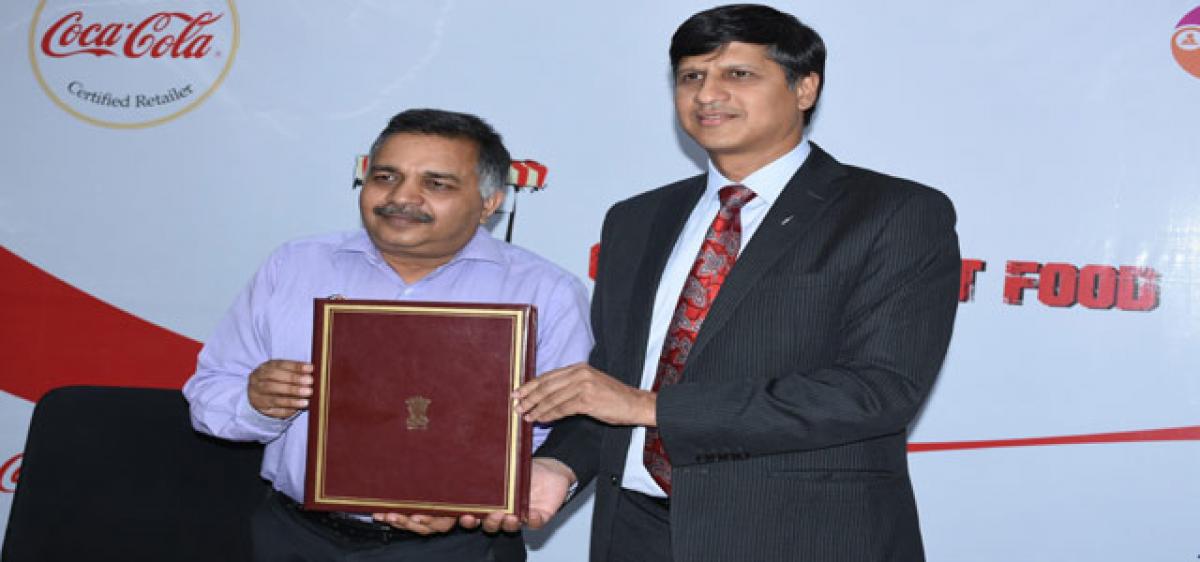
Food Safety and Standard Authority of India and Coca-Cola India (CCI), have signed a Memorandum of Understanding (MoU) to train 50,000 street food vendors under FSSAI’s project ‘Clean Street Food’ across India over next three years.
In order to ensure safe and nutritious food for all, FSSAI has now embarked on a journey with large global and Indian corporates about social impact investment around areas related to safe and nutritious food.
The partnership will further strengthen FSSAI’s vision to ensure health, hygiene and safety standard of street food for all; along with ensuring social and economic upliftment of street vendor community by helping them in improving quality of offerings.
The MoU, signed by Pawan Agarwal, CEO, FSSAI and Venkatesh Kini, president, Coca-Cola India and South West Asia, seeks to contribute extensively to Prime Minister Narendra Modi’s skill India initiative as well as vision of a healthy India.
As part of this initiative, Coca-Cola India, will closely work with FSSAI in upgrading the eating out experience for the Indian populace at large. While Coca-Cola will be responsible for the program execution through its network of trainers and available infrastructure, FSSAI will ensure the relevance of the training content and shall oversee the overall delivery.
While addressing the press conference, CEO, FSSAI said, “I am delighted to see that corporates are taking up the responsibility to ensure safe and nutritious food across the country under FSSAI’s “Safe and Nutritious Food – A shared responsibility”. 
Under the partnership, the program will be rolled out in phased manner with the first leg to be initiated by mid-April in Ludhiana, Punjab. Over the next three years, it plans to expand to 14 other locations through bottling plant network of Coca-Cola India covering 9 states (Uttar Pradesh, Maharashtra, Andhra Pradesh, West Bengal, Chandigarh, Punjab, Chhattisgarh, Delhi NCR).
A push on food safety and hygiene was provided during Eighth National Street Food Festival, 2016 where vendors representing 24 states across India were trained.
FDA, Goa in association with Nestle adopted the project, where about 700 street food vendors were trained during its first phase. Similarly, Sadik Masih Medical Social Servant Society (SMMSSS) is one of the NGOs to take up the project in east Delhi in association with European Commission and Action Aid India.

Mar 30, 2017

DINAMANI NEWS


DINAKARAN NEWS


DINAKARAN NEWS


DINAMANI NEWS


DINAKARAN NEWS


DINAKARAN NEWS


DINAKARAN NEWS


Poop found in Coca-cola can in N Ireland


FSSAI performance comes under CAG scanner

The CAG audit of FSSAI comes in the backdrop of the food regulator’s controversial Maggi ban in 2015 under the helm of former chief Yudhvir Singh Malik
New Delhi: In a first, the Comptroller and Auditor General of India (CAG) is doing a comprehensive performance audit of the country’s food regulator.
The audit of the Food Safety and Standards Authority of India (FSSAI) comes against the backdrop of the food regulator’s controversial decision to ban manufacturing and sales of Maggi noodles—a popular snack sold by Swiss company Nestle in India—in 2015 under the helm of former FSSAI chief executive Yudhvir Singh Malik.
CAG’s audit is looking at issues such as how FSSAI fixes standards, finalizes regulations, approves products, ensures compliance and conducts surveillance.
“This is a fairly comprehensive audit and is being done for the first time since the regulator came into existence,” said a government official requesting anonymity.
FSSAI was set up in August 2011 under the Food Safety and Standard Act, 2006. It has powers to lay down standards for food articles and to regulate their manufacturing, storage, distribution, sale and import. Some of its activities include licencing and surveillance of food and beverages outlets, enforcement of safety regulations across registered food vendors and ensuring safety of imported food items, their standards and labelling.
Pawan Kumar Agarwal, chief executive officer of FSSAI, confirmed the development.
“This started last year and the exit meeting is likely sometime next month. After that, CAG will submit its report to the Parliament. And it’ll be made available to public. Not just FSSAI, the audit includes the food safety offices of the states. This is not a matter of concern. Rather, what comes out of the report will help us in improving our work,” Agarwal said.
A CAG spokesperson said: “A performance audit of FSSAI is being done. No date has been yet decided for the exit meeting.” He declined to elaborate further.
Performance auditing is focused on improving good performance in public administration by examining whether public programmes and services achieve the principles of economy, efficiency and effectiveness and identifying conditions or practices that hamper performance and enable the auditor to make suitable recommendations, according to CAG’s website.
Malik, who came down hard on most of the multinational food and beverages companies operating in India during his short tenure of about a year (October 2014-September 2015), was shifted a month after the Bombay high court overturned the ban on Maggi.
After the crackdown on Maggi, questions were raised on FSSAI’s capabilities and operations including things like product approval process, one of the primary things the regulator used to do. The Bombay high court in July 2015 asked FSSAI to justify its actions against the noodle brand. On 13 August 2015, the Bombay high court set aside the ban imposed by FSSAI on Maggi noodles and asked Nestlé to retest samples at three laboratories certified by the National Accreditation Board for Testing and Calibration Laboratories (NABL). On 5 November, Nestlé India said its Maggi noodles received clearance from three laboratories certified by NABL and relaunched the popular snack on 9 November 2015.
“An audit like this will eventually help the organization enhance its performance. It would find out the loopholes, highlight what the regulator should do to cover up those. It is a good thing,” said Rajat Wahi, partner and head of consumer markets at consulting firm KPMG in India. He added there are questions regarding FSSAI’s capabilities and whether it has the capacity to ensure safe food for a country as big as India with its limited manpower. “Nobody knows if the laboratories it has are sufficient and capable of carrying out testing,” he said.

Training of hoteliers for food safety begins at Pune, Nagpur

MUMBAI: Hotels and restaurants association, western India (HRAWI) with the help of FSSAI and food business operators has already begun training people. In its first leg, the association has successfully concluded the certification programmes at Mumbai, Pune and Nagpur and plans to conduct similar programmes in various cities across Maharashtra, Goa, Gujarat, Madhya Pradesh, Chhattisgarh and the Union Territories of Daman, Diu & Silvassa in the coming months.
"The sessions in Mumbai and Pune turned out to be very successful. It was interesting to note that many hotels and restaurants were aware of the rules and regulations but weren't sure about how exactly to action on them. With Dr V Pasupathy to guide and help them, a lot of queries got addressed and we now have a solution to the grey areas. The sessions include role plays which have helped us to a large extent in understanding how the things may practically unfold once we are on the floor. We are certain that this exercise will benefit our members tremendously and will make them better equipped to become compliant. Also this will go a long way in instilling trust and confidence in our discerning guests who will be able to easily identify with the International Standards that they may have experienced anywhere else in the world," concludes Mr Gurbaxish Singh Kohli, Sr. Vice President, HRAWI.

Activist slams Coca-Cola's hygiene training for street vendors

New Delhi, Mar 29 Criticising the move by India's food regulator to join hands with Coca-Cola to teach street vendors about hygiene, a green body today said the contract should be cancelled as it was against the country's interests
New Delhi, Mar 29 Criticising the move by India's food regulator to join hands with Coca-Cola to teach street vendors about hygiene, a green body today said the contract should be cancelled as it was against the country's interests.
"First, we as citizens of India have the right to know on what basis this contract was allotted to Coca-Cola. Given their past record how did this corporation be given the contract?" said Vandana Shiva, founder of 'Navdanya' under Mahila Anna Swaraj Network.
She alleged that given Coca-Cola's track record of pollution, contamination, water theft, food un-safety, and blatant transgression of Indian environmental laws, it does not qualify to teach Indians about Food Safety.
"We know this is an egregious step taken under corporate pressure by the Food Safety and Standards Authority of India (FSSAI). Far from bringing food safety, this will ruin the diversity of India's street foods and will victimise the honest small street vendors of India, who for generations have been giving us taste and health," said Shiva.
Food regulator FSSAI recently tied up with Coca-Cola India to train 50,000 street food vendors over the next three years and plans to rope in other players like ITC and Mondelez under its 'Clean Street Food' campaign.
FSSAI is also looking to bring other companies such as Yum Restaurants, and tetra pak under the project. The regulator had collaborated with FMCG major Nestle to train street vendors in Goa last year.

FSSAI under fire for Coca-Cola alliance

The move to rope in Coca-Cola by Food Safety and Standards Authority of India (FSSAI) for imparting training to street vendors to ensure safe and nutritious food has run into a rough weather as activists have raised their eyebrows over the initiative. 
Dubbing the food regulator's partnership antithetical to its mission, Amit Srivastava of IndiaResource Centre said, "The step is misguided and must be scrapped. The FSSAI should not enter into partnerships with entities it is supposed to regulate as it ensures conflicts of interest." 
"It is now widely recognised around the world that vast majority of Coca-Cola products are neither safe nor nutritious and Coca-Cola is the least qualified company to provide input on food safety and healthy nutrition," said Srivastava, who has been spearheading a global campaign against the soft drink major over exploitative usage of groundwater. 
"Coca-Cola is a gross violator in India and remained the target of many communities for creating water shortages and pollution," he added. 
Noted environmentalist Vandana Shiva has also condemned the FSSAI's contract with Coca-Cola and other MNCs to teach Indian street vendors about hygiene and food safety. "Given Coca-Cola track record of contamination, water theft, blatant transgression of Indian environmental laws in the past and expulsions from the country, they are not even qualified to teach Indians about food safety. We request FSSAI chairman to cancel the contract as this is against India's interests and unjustly imposes industrial standards on small scale vendors, artisanal producers and women," Shiva said.

Mar 29, 2017

Mukul for stringent food safety requirements

SHILLONG: Chief Minister Mukul Sangma said processing and packaging of food should conform to stringent food safety requirements and brand building should revolve around high-end products, which should be exclusive and unique to the State.
Attending the valedictory function of the two-day state-level workshop on business opportunities in food processing, packaging and tourism under National Mission on Food Processing here on Tuesday, the chief minister urged the entrepreneurs to look at the options available in agriculture, horticulture, tourism and industries and become successful entrepreneurs with dedication, hard work, sincerity and innovation.
Sangma said the workshop is important and relevant for Meghalaya and for the youth who are looking at entrepreneurship.
A.L Hek, chairman of Meghalaya Industrial Development Corporation, said the State is home to a number of temperate and sub-tropical fruits and vegetables that have potential in food processing and will also generate employment in rural areas.
He said the unemployed youth in the State needs handholding and urged the Department of Commerce and Industry to help them explore the potentials in food industry and tourism.
Promotional schemes and policies for horticultural products, management of food processing enterprises, bamboo as source of health food and nutrition, food safety standards authority of Indian Act, exploring the nature and traditional knowledge for business with focus on Meghalaya, flexible packaging materials, promotional schemes and policies for development of tourism and convergence of schemes by various resource persons were the topics discussed during the two-day workshop that was attended by entrepreneurs from all over the State.
Call for hygienic food
The A’chik Youth Council has written to Health and Family Welfare Minister Roshan Warjri through the deputy commissioner of West Garo Hills urging her to send samples of fish, fruits and vegetables brought from outside the State to the laboratory to ensure safety.
The youth council also sought ban on use of newspapers for wrapping food items in the unorganised food sector as per the guidelines of the Food Safety and Standard Authority of India.

Ghaziabad will start issuing online licences to meat shops


Nearly 152 shops have been closed for want of licences, indulging in open slaughtering and not maintaining hygiene conditions.
The district administration has decided to start issuance of licences from Wednesday. However, the food safety department said all licences issued henceforth will adhere to guidelines laid down under the Food Safety and Standards (Licensing and Registration of Food Business), Regulations of 2011.
For the purpose, retailers will now be categorised as those having an annual turnover below Rs 12 lakh and those having an annual turnover above Rs 12 lakh. The officials said all details will have to be filled online on the website of Food Safety and Standards Authority of India (FSSAI) and submit documents, in hard copy, within 15 days to the local administration.
“For the purpose of submission of documents, we will set up a single window at the municipal corporation and nagar palikas where nodal officers for the respective departments will be available. After submission, proper checks will be carried out and thereafter the licences will be issued by the food safety department. Further, all the listed guidelines will have to be followed by the license holders,” said Nidhi Kesarwani, district magistrate (DM).
After the submission of documents, different departments such as the municipal corporation, food safety department, the police and the veterinary department will carry out checks before issuance of licences.
“The applicants will also have to disclose the source of procurement. There will be no open slaughtering permitted. The nearest procurement can be done from Ghazipur Market in Delhi or from the four units (export oriented) operational in Ghaziabad. The four units have consented to provide facility to cater to local demand,” DM added.
Nearly 152 shops have been closed for want of licences, indulging in open slaughtering and not maintaining hygiene conditions. The meat shop owners continued their second day of strike against the decision. The situation has also affected the business in Ghazipur poultry and fish market.
“Nearly 30-35% business has been affected since the crackdown began. We expect a major decline in sales due to Navratra, which has started,” said Mohammad Irfan Qureshi, a supplier from Ghazipur market in Delhi.

UP's meat market set to change forever after Yogi Adityanath's crackdown on industry

With abrupt closure of unlicensed meat shops in Noida, the city dwellers are buying meat at higher rates from the legal meat vendors.
The city saw major crackdown on unlicensed meat shops by police after the new chief minister Yogi Adityanath took charge.
The Times of Indiareported that nearly 1,000 illegal vendors were operating in Greater Noida, which now stand closed.
BP Kumar, who heads the civil administrative wing of the Noida Authority, told Firstpost that none of the meat shops were licensed by it.
“The District Magistrate’s office issues license to meat shops. The drive against the illegal ones is also conducted by them,” he said.
“Police officials came to my shop and told me to wind up business as I do not have license to sell meat,” says Rizwan, a meat seller in Sector 49 in Noida.
Rizwan, who is now vacating his makeshift shop, that he took on rent a couple of years ago, further said that not only the meat sellers but also the fish sellers were told to shut down their business.
“They came again to ensure that we followed the instructions. They checked if we still had stocks of fish and poultry in our shops,” he added.
The police department claimed that there was no dearth of meat in Noida, even after the closure of unlicensed shops, as there were licensed shops too.
“Most of the hundred meat shops in the jurisdiction of Noida and Greater Noida were found to be legal. The illegal ones were immediately sealed, but it has not caused any problem to the general public as they catered to few customers,” Dharmendra Singh, SSP Gautam Budh Nagar said to Hindustan Times.
Despite claims made by police department, buyers complain of high price of meat in licensed shops, as the unlicensed were seen as the cheaper places despite the fact that they did not adhere to many of the food safety standards laid by the ‘Food Safety Standards Act 2006’.
“We used to get chicken at Rs 200 per kilogram and mutton at Rs 400 per kilogram at the most, from the shops in our neighborhood,” says Pushpinder Singh, a resident of Barola village near sector 49 in Noida.
But he says that after the unlicensed shops were closed he went to a licensed meat shop, where he found that chicken was sold at Rs 240 and mutton at Rs 480 per kilogram respectively.
Shakeel Abbas, a worker in a licensed meat shop told Firstpost that the price of meat is higher in licensed shops due to high operating costs.
“Most of these shops have electricity run cold storages to stock meat. Moreover they have trained manpower at work. Most important factor of cost escalation is the location where these shops are functional,” he said.
Most of the licensed shops are in the community markets of various sectors in Noida, which are seen as posh localities in comparison to the slums and villages where unlicensed ones operated.
The unlicensed meat shops that operated in makeshift stalls or on the roadside had hardly any operating cost.
Many unlicensed meat sellers have now applied for permission for their shops, reports The Times of India.
As per norms these vendors have to apply for registration to the officer designated by the Food Safety Commissioner.
But many of these new applicants are unlikely to get permission as they cannot adhere to the food safety norms.
As per norms meat shops must be of concrete structure with adequate sanitation system, setting up of which costs a few lakhs of rupees, which most of them cannot afford.
The National Green Tribunal in the year 2015 imposed a ban on all illegal slaughter houses in Uttar Pradesh and directed state authorities to ensure that there is proper regulation of meat shops.
But, it took Yogi Adityanath to become the chief minister of Uttar Pradesh to ban the illegal meat shops that were seen as major health hazards in the state.
With most of the small players in the meat market wiped out the 100 or so licensed meat sellers are likely to gain control of the supply chain, changing the market forever.

All meat shops in Noida are illegal, says food safety department

The FSDA will be able to issue a licence only if the applicant shows them all required documents, including a no-objection certificate from the municipal body, in this case the Noida authority. 
The Gautam Budh Nagar district administration said on Monday that all meat shops in Noida and Greater Noida selling mutton, chicken, fish or buffalo meat are illegal. Most of these shops in the two cities have been shut in the past few days as they do not comply with the requisite conditions to operate.
Officials of the food safety and drug administration (FSDA) department maintain that all meat shops in the district were running illegally as they did not have a licence.
“Possessing a certificate of registration is irrelevant. They were never issued any licence as they did not fulfil the conditions mandatory to run a meat shop. We will soon begin the process of issuing licences to meat sellers who fulfil all norms,” said Mahendra Srivastava, designated officer for FSDA in Gautam Budh Nagar. FSDA is the licencing authority for selling meat in the district.
When asked how some meat shops are still operational in parts of Noida, he said,“We sealed all of them. If anyone has reopened their shop, we will take action against them.”
He added that the FSDA will be able to issue a licence only if the applicant shows them all the required documents, including a no-objection certificate (NOC).
“A NOC from the local authority (Noida or Greater Noida) is the first important document required to obtain a licence. If the authorities do not issue NOC, we cannot issue a licence,” said Srivastava.
However, the Noida and Greater Noida authorities, which act as municipal corporations in their respective areas, do not have a policy in place for meat shops.
“We are studying the policies of other municipal bodies on giving permissions for meat shops so that we can draft one for Noida and Greater Noida. As of now, we do not have any policy in place to be able to give permissions to meat shop owners,” said Deepak Agarwal, chief executive officer, Noida and Greater Noida authorities.
Officials of the district administration said around 80 meat shops operating in Noida’s sectors 5, 8, 9 and 70, in Noida were shut because they were not following the norms.
However, customers of such shops asked why the administration did not act earlier and had been allowing meat shops to run without a licence.
“Why did the police or the administration not act against these shops earlier if they were operating without fulfilling the conditions? The authorities should have ensured that only authorised shops were operating so that consumers got hygienic meat and chicken. It means the government is not concerned about people consuming meat from these illegal shops,” said Tikam Singh of Sector 27.
Some officials, who were not willing to go on record, said the previous state government did not give them the liberty to act against illegal meat shops.
“Now, the government orders are to shut down all illegal meat shops, so we are doing that,” said Srivastava.

Man posing as food inspector arrested for extorting money

The accused imposter has been booked and arrested by Agra police.
AGRA: Food safety and drug administration of Agra apprehended an imposter posing as food inspector who was extorting money from grocery-store and small food outlets in the city.
The arresting happened amid the ongoing FSDA raids especially on mutton shops, abattoirs and others. The accused imposter was identified as 42-year-old Sujan Singh.
Speaking to TOI, food safety officer Ajeet Singh said, "For last couple of weeks we were receiving inputs about a man claiming himself to be a food inspector and extorting money from shopkeepers."
"On Tuesday we caught him from Bundu Katra area on Gwalior road on a tip from local grocery store owners while he was extorting money. During questioning, the man claimed himself to be attached with commissioner office which was also found to be false," said officer Singh.
Resident of Shahganj, the accused imposter was reportedly found extorting money from Jaipur house, Lohamandi, Sadar and other areas.
The accused imposter has been booked and arrested by Sadar police.

Chennai temple offers burgers, brownies as prasad

Prasadam does not consist of the traditional laddoos or pedhas in this Chennai temple. This little temple in Padappai, a suburb on the outskirts of Chennai has been replaced with fast food. The Jaya Durga Peetham in Chennai offers brownies, burgers, cherry tomato salads and cracker sandwiches. The fast food at the temple is also certified by Food Safety and Standards Authority of India(FSSAI) and products come with an expiry date. The western prasad is not the only thing that the temple offers differently, but the service is also trendy. Visitors have to slip token into the vending machine to collect boxes of their prasadam.
K Sri Sridhar, a herbal oncologist, who was the brains behind the idea said that the new menu has sparked interest among locals as well as tourists. Talking about the American prasadam he said, “The idea was to show that anything that is nutritious and prepared in a clean kitchen with a clean mind can be served to God. It doesn’t have to be only traditional dishes.” 
Not only prasad, the temple delivers cake prasadam to locals on their birthday. They have a computerised register of their birth dates and delivers cake prasadam to people on their birthday. The concept has become a huge hit among elderly devotees who feels special to be treated differently. 81-year-old Subbulakshmi was elated when she received a cake prasadam on her birthday. Times of India quoted Subbulakshmi as saying, “It was so pretty with flowers and icing. And it came with an agar deepam (a traditional oil lamp) instead of candles which was so nice. Just like they light at the temple. When we set up the temple we thought we should give Gods the food we relish.”

DINAKARAN NEWS


DINAKARAN NEWS


சுகாதாரமற்à®± ஓட்டல்களுக்கு நோட்டீஸ்: உணவு பாதுகாப்புத்துà®±ை எச்சரிக்கை

சேலம்: தாரமங்கலம் பஸ் ஸ்டாண்டில், சுகாதாà®° சீà®°்கேடு நிà®±ைந்த இரு ஓட்டல்களுக்கு, நோட்டீஸ் வழங்கி, உணவுபாதுகாப்பு அலுவலர்கள் எச்சரித்துள்ளனர்.
சேலம் à®®ாவட்ட உணவு பாதுகாப்பு நியமன அலுவலர் அனுà®°ாதா தலைà®®ையில், நேà®±்à®±ு தாரமங்கலம் பகுதியில், சோதனை à®®ேà®±்கொள்ளப்பட்டது. பஸ் ஸ்டாண்டு, காய்கறி கடைகள், ஓட்டல்கள், பள்ளிக்கூட பகுதி கடைகள் உள்ளிட்ட நிà®±ுவனங்களில் அலுவலர்கள் இளங்கோவன், சரவணன், சிரஞ்சீவி, à®®ாà®°ியப்பன் ஆகியோà®°் கொண்ட குà®´ுவினர், சோதனையில் ஈடுபட்டனர். மதியம், 2:30 மணிக்கு துவங்கிய சோதனை, இரவு, 7:00 மணிவரை நடந்தது. பஸ் ஸ்டாண்டில், சுகாதாà®° சீà®°்கேடு நிà®±ைந்து, à®®ோசமாக காணப்பட்ட à®®ாயாபஜாà®°் என்à®±, இரு ஓட்டல்களுக்கு நோட்டீஸ் வழங்கி எச்சரிக்கப்பட்டது.
நியமன அலுவலர் அனுà®°ாதா கூà®±ியதாவது: தடை செய்யப்பட்ட, 7,500 à®°ூபாய் மதிப்பிலான புகையிலை பொà®°ுட்கள் பறிà®®ுதல் செய்யப்பட்டன. à®®ேலுà®®், காலாவதியான à®…à®°ை லிட்டர் அளவுள்ள, 120 பாட்டில் குளிà®°்பானங்கள், போலி குளிà®°்பான பாக்கெட்டுகள் பறிà®®ுதல் செய்யப்பட்டன. பதிவுச்சான்à®±ு அல்லது உரிமம் பெà®± நிà®±ுவனங்களுக்கு à®…à®±ிவுà®±ுத்தப்பட்டுள்ளது. இல்லையெனில், சட்ட நடவடிக்கை எடுக்கப்படுà®®் என, எச்சரிக்கை செய்யப்பட்டுள்ளது. இவ்வாà®±ு அவர் கூà®±ினாà®°்.