Feb 22, 2017

Nandini milk packets without packaging dates

Anxiety has gripped a section of consumers in Belagavi who noticed that milk packets with brand name “Nandini” marketed by the Karnataka Cooperative Milk Producers Federation Limited (KMF) were being supplied without due packaging dates since two days.
The KMF’s unit in the city, Belagavi District Cooperative Milk Producers Societies’ Union Limited, has been supplying milk packets with dates stamped on them. However, some of the consumers noticed that the packets carried no date yesterday and on Tuesday and suddenly became apprehensive of its quality, thanks to reports in social media about the manufacturing of adulterated milk using certain oils and chemical compounds.
Taking cognisance of the matter, senior officials in the district administration immediately instructed the authorities to check and take action if there was any foul-play.
Technical snag
J.R. Manneri, Managing Director of KMF Union, Belagavi, admitted to the lapse stating that the stamping/printing machine had developed a technical snag two days ago. Therefore, the packets did not carry the packaging dates. The dealers had been already informed about it but there seemed to be a communication gap with the consumers.
Technicians had already rushed to the unit and taken up repairs. The faults would be set right by tomorrow or Thursday and the system of stamping the packaging dates on the milk packets would be restored, he said.
He allied apprehensions of consumers by saying that there was no need to worry about the quality of Nandini milk being supplied through its dealers.

Feb 21, 2017

After rat in mid-day meal, Delhi food safety department to inspect 33 kitchens

Delhi’s food safety department will conduct emergency inspections of all 33 mid-day meal kitchens and transportation facilities for the food.

Three days after nine children fell ill at a Delhi government school after consuming a mid-day meal that had a dead rat in it, Delhi’s food safety department will conduct emergency inspections of all 33 mid-day meal kitchens and transportation facilities for the food.
“We will finish inspection of all 33 mid-day meal kitchens tomorrow (Tuesday), after which we will move on to MCD and NDMC-run schools and then private schools as a part of the drive,” said Dr Mrinalini Darswal, Delhi’s food commissioner. Twenty-seven samples were picked up from 11 of the 15 schools inspected on Monday.
Delhi deputy chief minister Manish Sisodia, who also holds the education portfolio, issued the order on Sunday, saying all inspections must be completed by February 24.
“After inspection, if required, improvement notices can be issued and if hygiene is found to be too lacking, the kitchen may be ordered to be shut down,” the order signed by Darswal read.
During the current drive, “surveillance samples” will be picked up during this drive and if need be the food safety officers can later collect legal samples. “There is a specific process that needs to be followed when picking up legal samples that can be presented in the court of law. However, it is time-consuming. Since, this is an emergency inspection drive, we will be collecting surveillance samples. We can pick up legal samples from places that fail the preliminary tests,” said Darswal.
The food safety department has also roped in 18 NABL accredited labs to conduct the inspections. “All NABL accredited empanelled private labs may be directed to pick up surveillance samples from kitchens allotted... Also, water meant for cooking be lifted and tested. All kitchens to be sampled for full testing including microbiological test,” the order read.

Govt orders inspection of midday meal kitchens

New Delhi: The Delhi government has directed its officers to visit all midday meal kitchens in their respective districts to check hygiene level there. “If hygiene is found to be lacking, shut down notices will be served,” a government directive said. The move comes in the backdrop of a dead rat being found in the midday meal served in a school due to which nine children were taken ill.
As per the order, issued by the Food Safety Commissioner, all designated officers along with their Food Safety Officers have been directed to visit all midday meal kitchens and transportation facilities falling under their district to check hygiene and cleanliness as per the standards laid down under FSS, 2006 and Rules and Regulations 2011.
“After inspection, they are directed to fill up an inspection format completely and if required improvement notices be issued, if hygiene is found to be lacking, kitchen may be ordered to be shut down,” read the directive.
Besides, NABL (National Accreditation Board for Testing and Calibration Laboratories) accredited empanelled private labs have been directed to pick surveillance samples from the kitchen allotted and take them straight to their labs for testing.
“Also water meant for cooking be lifted and tested. All kitches to be sampled for full testing including microbiological test,” the directive said.
Nine students of a government school in the city were taken ill on February 16 after consuming midday meal which allegedly had a dead rat in it.
The meal was served at Government Boys’ Senior Secondary School in Deoli area, and students were rushed to Madan Mohan Malviya Hospital.

Nine packaged drinking water units to be sealed

After launching a crackdown on erring packaged drinking water units in Thoothukudi district, nine were found functioning without any licenses. Hence, the authorities have been directed to seal these units, said Collector M. Ravikumar.
A total of 53 packaged drinking water units were functioning in the district and of these only eight were found to have all the licenses required, he told the media here on Monday.
To start such units, licenses have to be obtained from the Public Works Department (Groundwater), Pollution Control Board and under the Food Safety and Standards Act they have to obtain licenses from the Bureau of Indian Standards (BIS) and the Food Safety Department.
As nine units did not possess any of these licenses, orders were issued to seal them.

Group of secretaries recommend additional tax on saturated food items

A group of secretaries have recommended putting an additional tax on saturated food items, a top Health Ministry official today said.
A group of secretaries have recommended putting an additional tax on saturated food items, a top Health Ministry official today said. Health secretary C K Mishra today said his ministry too has been making such recommendations from time to time while some amount of work on the issue is also being done by the country’s food regulator. “We have been making these recommendations. There is some amount of work also going on in Food Safety and Standards Authority of India (FSSAI). “A group of secretaries also made a recommendation to tax all saturated food. These things are going on,” Mishra said.
He was asked whether the government, as a serious policy measure, contemplating to put tax on some food items and drinks. According to reports, the group of secretaries had earlier recommended imposition of additional taxes on foods with added sugar and saturated fats.
Higher taxes on junk food and sugary beverages were suggested because consumption of such products is growing fast and fuelling several lifestyle diseases like obesity, diabetes and heart disorders.
Taxing sugary drinks can lower consumption and reduce obesity, type 2 diabetes and tooth decay, a new World Health Organisation report had earlier said.

Govt to come out with policy soon to keep the young away from junk food

Considering the young generation the future of economic prosperity of the nation, Ministry of Health and Family Welfare today said it would soon bring out a legislation or an ordinance or a policy to keep the youths healthy and away from junk food. Ministry of health and family welfare, secretary C K Mishra launching a "Saathiya app' and "Saathiya kit" to address the problems related to physical, mental and overall development of the adolescents said,'' The young constitute 26 crore of the population of the country and they are the future of the nation. If India has to be strong and wealthy, it is imperative that the health of the youngsters is good, therefore junk food has to be bid goodbye and they have to say yes to nutritious and clean food.''
He said,'' the growing years are that phase of the growing up when the youths are on the theshold of becoming 'adults'. Their mind is filled with unanswered questions about their physical and mental development and are puzzled about them. There should be someone to answer their queries in a friendly way and settle them down and therefore this "Saathiya kit". The young can know anything regarding their health using this kit. They can even ask queries and can take suggestions. Children have also been advised to lay off from junk food which is harmful for health.''In reply to a query, Mr Mishra said,'' No concrete policy has been formed as yet to ban junk food available in the market but suggestions have been forthcoming from secretaries of various ministries to stop junk food in all forms easily available in the market. The health ministry in coordination with Food Safety and Standards Authority of India is deliberating upon a strategy because the authority to ban junk food lies with the latter only.

Feb 20, 2017

This young IAS officer is doing all that she can to ensure Kerala eats healthy

T.V. Anupama is a young IAS officer currently working as the Food Safety Commissioner in Kerala. In her stint as the Food Safety Commissioner, she has conducted multiple raids across the state on those conducting the illegal trading of adulterated food items, and has also closed down multiple networks of several such traders.
It all began 15 months ago when she carried out a raid on a famous food brand, with reports revealing that the products contained very high quantities of impermissible substances. After the raid, this product was banned. Following this, many more raids were carried out, which also revealed that the pesticide content in some fruits and vegetables was about 300 percent more than the permissible limit. Over the course of her stint, she has seized and produced about 6,000 samples of adulterated food in front of the court. There have also been around 750 cases filed in the court against traders.With the Food Safety Department being started only in 2011, some time initially went into the setting up of the department and determining how it would function. Resources, office and a lot of other things needed to be set up along with the analysis and work that was going on. While discussing the same, Anupama told the Deccan Chronicle,
Many things happen on a day-to-day basis, but there’s no ready solution, because we haven’t done it before. We know things like harmful pesticides are used. But how do we go about it? People have vegetables on a daily basis. You can’t just ban them. We needed another kind of solution. Everyone was aware of the situation. We were only a part of it. We spoke about it, made presentations on it at meetings, but the rest was done by the government or public. People started becoming so aware, we continued lifting samples (from check-posts and markets).
Anupama also understood that different offences needed to be tackled in different ways. While speaking to Deccan Chronicle, she said,
Then there was the banning of certain products. Only some got highlighted. There are certain kinds of food items that, under the act or by various medical reports, we know are unsafe. You should treat them in one way. Then there are certain habitual offenders you treat a different way.
The numbers, once released in the media, raised awareness among Keralites as well, and pushed them to think on whether it was better to depend on oneself rather than relying on others. Soon, the folks of Kerala started growing vegetables on their own, and this initiative was backed by the government as well. The government soon began to provide subsidies to those who wanted to begin growing their own vegetables. This has led to a massive drop of 70 percent in vegetable purchases from Karnataka and Tamil Nadu.
Anupama had earlier become very famous in 2010, when she was ranked fourth in the Civil Services Examination. She has again shot to fame with the proactiveness and splendid work she has shown as a Food Safety Commissioner in the state. While talking about her popularity, she said,
I haven’t been comfortable with the kind of attention all this brought. I don’t use my personal FB page much. No Twitter and no verified official page. But at some point, you have to open up. It is mandatory that we put all orders on a public platform. Whenever some adulteration comes, we put it up on the website. I didn’t expect this kind of response. The worst situation is when your privacy is encroached upon. My family was dragged into it. Luckily, they were very supportive. Most of the staff were too, as was the public.
This humble and dedicated young woman proves that the actions of a single individual are enough to bring about a change.

Drinking water bottles to come under the scanner

Close scrutiny: Drinking water jars seized by Food Safety officials in Kozhikode on Saturday.
Food safety officials plan checks across Kozhikode as water crisis looms large
Food safety officials are planning to check the quality of drinking water bottles across the district in anticipation of a water shortage this summer.
“There is a possibility of people selling unclean water in such bottles as we have a drought this year and water is going to be in short supply. We will check the quality of the water being sold in one-litre bottles,” said O. Sankaran Unni, assistant commissioner, Food Safety and Standards Authority of India (FSSAI).
Officials recently inspected vehicles transporting drinking water in the city and seized water jars that were not sealed properly. As per rules, the water jars should have the emblem and details of the manufacturing company and should be sealed properly.
“Water jars manufactured by four private companies have been seized and the samples have been sent to the laboratory for tests. Based on the results, we will initiate action against the manufacturers,” said Mr. Unni.
Most of the water jars seized were unclean and had deposits of fungus on them. Such jars are not being sold through shops and some agencies are involved in their sale.
Communicable diseases
Health experts said there was a chance of spreading of communicable diseases if contaminated drinking water was distributed. Last year, Health Department officials had acted against those distributing drinking water through tankers without permission. Officials had inspected areas such as quarries from where lorry operators collected water. Lorry operators were accused of forging certificates to evade inspection.

Officer suspended

A Junior Health Assistant was suspended from service for producing false certificates to get the additional post. 
According to a release from the Commissioner of Health and Family Welfare Department and Food Safety Commissioner, 
Srinivas Reddy of Bidar had submitted the fake document to get the post of food safety officer.

Licence to violate: 60%


The Midday Meal Horros!


Feb 17, 2017

காலாவதியான உணவுப் பொà®°ுட்கள் à®…à®´ிப்பு!

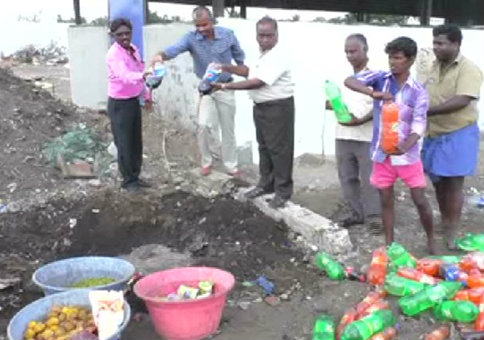
திà®°ுச்சி à®…à®°ுகே காலாவதியான குளிà®°்பானம் மற்à®±ுà®®் உணவுப் பொà®°ுட்களை அதிகாà®°ிகள் தரையில் கொட்டி à®…à®´ித்தனர்.
திà®°ுச்சி அடுத்த சமயபுà®°à®®் மற்à®±ுà®®் கண்ணூà®°் பேà®°ூà®°ாட்சியில் உள்ள கடைகளில் உணவு பாதுகாப்புத் துà®±ை அதிகாà®°ிகள் கடந்த வாà®°à®®் திடீà®°ென ஆய்வு à®®ேà®±்கொண்டனர். அப்போது, காலாவதியான உணவுப் பொà®°ுட்கள் தொடர்ந்து விà®±்பனை செய்வது கண்டுபிடிக்கப்பட்டது. இதனையடுத்து, பல ஆயிà®°à®®் à®°ூபாய் மதிப்புள்ள உணவுப்பொà®°ுட்களை அதிகாà®°ிகள் பறிà®®ுதல் செய்தனர். இதனைத்தொடர்ந்து பறிà®®ுதல் செய்யப்பட்ட உணவுப் பொà®°ுட்களை அதிகாà®°ிகள் இன்à®±ு à®…à®´ிக்குà®®் பணியில் ஈடுபட்டனர். இதில், சுà®®ாà®°் 500 லிட்டர் குளிà®°்பானம் தரையில் கொட்டி à®…à®´ிக்கப்பட்டது. à®®ேலுà®®், பிஸ்கட் உள்ளிட்ட சில உணவு பொà®°ுட்களுà®®் à®…à®´ிக்கப்பட்டன.

Delhi deputy CM orders cooking of mid-day meals to be monitored

NEW DELHI: Deputy Chief Minister Manish Sisodia on Friday directed the Chief Secretary to monitor cooking of mid-day meals served in Delhi schools after a dead rat was found in the food due to which nine children were taken ill.
Police has also lodged an FIR against two operators of an NGO who supplied mid-day meals to Government Boys Senior Secondary School in Deoli.
"I have ordered the Chief Secretary that all senior officers, including secretaries and principal secretaries will inspect kitchens based on my parameters and give me report within one week, similarly all kitchens in Delhi will regularly be inspected," Sisodia told reporters.
"In the morning today, I had sent my officers to this kitchen at 4.30 AM to take stock of the situation there," he added.
Nine students at the government school were yesterday rushed to Madan Mohan Malviya hospital after they were taken ill after consuming the rat-contaminated food.
Sisodia, who is also the Education Minister, had visited the students at the hospital yesterday.
According to police officials, an FIR has been registered against operators of Jan Chetna Jagriti Evam Shaikshik Vikas Manch, K P Singh and Sanjay Malik, under Sections 273 (sale of noxious food or drink) and 336 (act endangering life or personal safety of others) on the complaint of school principal Girirraj Singh Sharma.
"We have sent the food samples for test and are awaiting medical reports of the affected children to move forward. Further sections could be added and more people may be booked if needed. No one has been arrested so far," a senior police official said.
"The school principal also alleged that Malik and his associates who were present at the school ran away carrying the remaining food," he added.
Asked about the allegation of kitchens being operated by a relative of an MLA, Sisodia said, "We will not spare anyone who plays with the lives of students, even if he or she is the relative of MLA, minister and even PM".
"We will ensure strict action against the vendor. We will not tolerate those who play with the lives of students. We will teach them such a lesson that no one in future can do it again," he added.

Indore: Admin launches drive against packaged drinking water, destroys 209 packets

Indore: In a move to save people from consuming contaminated water, especially those which are labeled as mineral water, the district administration and food and drug administration department have launched a drive against packaged drinking water on Thursday.
On the first day of drive, officials raided two units of packaged drinking water – Kanha Beverages and Malhar Beverages – at Palda and destroyed 80 and 123 packets of water respectively.
“We have destroyed water pouch packets without manufacturing details and brand name. No date of manufacturing and expiry were mentioned on these pouches but they were loaded in vehicles to be sold. Along with water pouches, we have also destroyed 48 crates of water bottles,” senior food safety officer Manish Swami said.
He said that more than 15 companies are registered in city for supplying drinking water and samples will be collected from all the units to prepare a report.
Informing about the ongoing ‘Milk Survey’ by Food Safety and Standard Authority of India (FSSAI), Swami said that they had collected 45 samples of milk, including packed milk, from various places in which 10 samples were failed.
“After serving notices to them, we have again collected samples from their shops and will take action if they failed the test again,” he added.
FSSAI to focus on beverages in summer
In view of forthcoming summer, FSSAI has directed the food safety officials to concentrate on quality of beverages and collect at least 40 samples every month.
“We are collecting more than 40 samples in a month and submitting our report to the apex regulatory body. FDA has collected samples of butter milk, cold drinks, fruit juices and other drinks,” he added.

Now, relish tender coconut water from sachets, carry packs

THIRUVANANTHAPURAM, FEB 17: 
Nutrient-rich tender coconut water is now available in powder form in delightful packs, thanks to pioneering work by a Kerala-based startu-p.
NaturUp Consumer Products of Chalakudy in Thrissur uses modern spray drying technology to remove the water/moisture from the nut to generate the powder.
Spray drying
Spray drying is used to heat liquids and emulsions to remove moisture to generate a stable powder, says Antony S Pathadan, NaturUp promoter, and a former IT entrepreneur.
The powder retains the natural attributes of rich nutrients, essential electrolytes, vitamins and minerals associated with tender coconuts.
The powder packs are ideal for gym, camping sites, kid’s events, at work places, and pack neatly into one’s travel bag, Pathadan said.
No preservatives
“We capture the authentic taste of tender coconut water and add no preservative, artificial flavour, or colour. Our product is 100 per cent gluten-free.”
The manufacturing unit is licensed by the Food Safety and Standards Association of India. It also has FDA approval for export to various countries.
The manufacturing plant is based at Puducherry. It uses only coconut water, while the pulp is given to ice-cream manufacturers. Thus, it saves on costs of of storing, processing of whole coconut shells and managing waste.
NatureUP collects coconuts of South Indian origin (said to be the most tasty and nutritious) for sourcing water.
Convenient packs
After a refining process, the water and moisture are removed. This leaves behind the powder rich in nutrients and carbohydrates, which is packed into convenient packs.
It has a shelf-life of a year but once the pack is opened, it lasts for not more than six hours. This is in stark contrast to preservative-laden products which last for days together after opening, Pathadan said.

IGNOU programme on food safety

A two-day training programme on ‘Food safety: hazard analysis critical control points (HACCP),’ organised by the Indira Gandhi National Open University (IGNOU) regional centre here, concluded on Thursday.
The first programme of the series was inaugurated by G. Madhavan Nair, former ISRO chairman. Around 100 students and professionals working in the field of biosciences attended the programme.
The next phase of the programme will be organised on February 19 and 20 by the IGNOU regional centre in association with the Environmental Resources Research Centre (ERRC) and the International Institute for Certification and Training (ICCT).

FSSAI constitutes panel to identify nutritional gaps

In news:
The Food Safety and Standards Authority of India (FSSAI) has constituted a panel to identify critical nutritional gaps in the Indian diet in general and also in specific specific target groups.
What will panel do:
The Panel will identify critical nutritional gaps in the Indian diet in general as well as in specific target groups based on diet surveys and credible scientific evidence, define strategies to address nutritional needs of the general population and vulnerable groups, and review the standards for all suitable food fortifying vehicles,in addition to the healthy dietary intake of Fat, Sugar & Salt. It will also address regulatory and related technological issues, review proposals from industry using modern risk assessment methods, and prescribe standard sampling and test methods for effective monitoring, surveillance and enforcement of the relevant regulations.
Malnutrition in India
  • Micronutrient Malnutrition Disorders are ubiquitously prevalent in all age groups of the population. According to National Family Health Survey (2006-07) and the World Bank (2006), about 70% preschool children suffer from iron deficiency anaemia and 57% preschool children have sub-clinical Vitamin A deficiency respectively. 
  • As per the World Bank (2006), Iodine deficiency is endemic in 85 per cent of districts. Moreover, folate deficiency which leads to Neural Tube Defects (NTDS)are the most common congenital malformation in Indian context with an incidence that varies between 0.5-8/1000 births. It is estimated that 50-70% of these birth defects are preventable.
FSSAI being the standard setting and regulatory body has taken a step in public health domain to address these and other vitamin deficiency-related Malnutrition Disorders through fortification of food. 
What is food fortification:
Food fortification - also known as food enrichment - is when nutrients are added to food at higher levels than what the original food provides. This is done to address micronutrient deficiencies across populations, countries and regions.
  • Food fortification can happen at the household level, the community level or, most commonly, at the industrial level:
  • Mass fortification is when micronutrients are added to foods commonly consumed by the mass population – such as cereals and condiments.
  • Universal fortification is when micronutrients are added to food consumed by animals as well as people, such as with iodization of salt.
  • Targeted fortification exists in such areas as school food programs, when, for example, a cracker is specifically fortified for a targeted age group.
Fortification world over:

Discarded newspapers continue to be a health hazard

Srinagar: Violating the advisory from the Food Safety and Standard Authority of India (FSSAI), street vendors are continuing the usage of newspapers for wrapping the food items in the Valley.
On December 10, FSSAI had issued an advisory in which they have stated to ban the use of newspapers for wrapping and packing of food items, which is practiced by small corner shops and street vendors. They have asked commissioners of food safety of all states and Union territories to take necessary steps to restrict the use of newspapers for packing, serving and storing of food items as the newspaper ink can contaminate food items leading to serious health concerns.
After the advisory from FSSAI, Assistant Food Commissioner Srinagar, Hilal Mir issued a statement, in which it was said that strict action will be taken against those violating the directions of FSSAI.
But the violations are still taking place in civil lines, downtown as well as in uptown areas of Srinagar, not to talk of far-off villages and towns of the Valley. The newspapers continue to be the preferred choice of vendors to wrap the food articles.
The roadside vendors were seen selling snacks to the customers wrapped with the newspapers at many places in and around the Srinagar city. Even fried fish were also sold to the customers wrapped in used newspapers.
As per FSSAI advisory, newspapers should not be used to wrap, cover and serve food or to absorb excess oil from fried food. Older people, teenagers, children and people with compromised vital organs and immune systems are at a greater risk of acquiring cancer-related health complications, if they are exposed to food packed in such materials. Suitable steps need to be taken to restrict and control the use of newspapers for packing food material.
“Since the ink used in newspapers has multiple bioactive materials with known negative health effects can easily leach into foods wrapped or served in them, it poses a potential risk to human health when consumed. Also, the solvent used to dissolve ink on the paper can be potentially carcinogenic,” FSSAI said in an advisory.
“We have filed 58 challans in the month of January this year for the insanitary condition in which majority of the cases were about the usage of newspaper,” Hilal added.
Deputy drug controller, Kashmir Division Irfana said, “We are launching an awareness campaign through radio, television and newspapers to discourage use of newspapers for wrapping food items,” she said.

Feb 15, 2017

TAMIL MURASU NEWS


TAMIL MURASU NEWS


DINAKARAN NEWS


Swallow this: 20 percent of packed food is adulterated

KOCHI: As Aparna, a health-conscious working mother in Kochi, enters a hypermarket, she knows exactly what to buy. But she was in for the shock of her life buying biscuits! The ‘fat-free’ digestive biscuits she bought for her diabetic father contained 15 per cent hidden fat, which hiked his daily caloric intake to precarious levels.
Wrapped in sugar-coated advertisements, grossly misleading health claims on labels of packed food products are shoved down the throats of credulous customers daily.
Now, the bummer. Official data has made a startling revelation that about 20 percent (one-fifth) of all packed food items sold in Kerala are either adulterated or misbranded.
According to the annual report of the Public Laboratory Testing, authorities had registered a total of 586 cases in connection with adulteration and slapped Rs 1.38 crore as a fine between 2014 and 2016. The report notes of the 4,931 samples analysed from Kerala, 923 were adulterated or misbranded. Sources said the samples of various food articles of brands across the spectrum have been found to be adulterated or misbranded.
“Be it coconut oil, milk, tea, rice, spices or items included in our daily diet, adulteration is taking place at an alarming level. Harmful chemicals were also found in many of these products. The best way to tackle the issue is to create awareness and further strengthen the monitoring mechanisms,” said a food safety officer.
While food manufacturers often use nutritional facts to make health claims on their products, the regulations do not have a list of authorised or unauthorised health claims. Most health claims are misleading as health depends on the total diet and lifestyle, not just on one product. Though rules under the Food Safety and Standards (Packaging and Labelling) Regulations, 2011, mandate that such claims are scientifically substantiated, they are vague on the substantiation standards. Experts say the low conviction rate and lack of officers are prime reasons for such food items finding their way into the shelves.

Hotels to oppose menu that mention calories

The United States has made it mandatory for hotel menus to mention the calories, from May 5, 2017.
Hoteliers, however, are in strong opposition to the proposal. 
Hyderabad: The Food Safety and Standards Authority (FSSAI) of India is keen to get hotels to list the calories contained in the food items on their menus. The United States has made it mandatory for hotel menus to mention the calories, from May 5, 2017.
The FSSAI as a part of its health initiative wants all restaurants, hotels, snack bars and eateries to display the amount of calories in their dishes. Hoteliers, however, are in strong opposition to the proposal.
Mr Adarsh Shetty, president of the Indian Hotel and Restaurant Association, told this correspondent, “It is not possible for all small restaurants and eateries to display the calories in their food items. Why must we look at Western laws and try to implement them? Making it mandatory is not in the good interest of a large number of restaurants who are against it.”
The Food and Drug Administration has made it mandatory for hotel chains with more than 20 units to display the calories in their menu. In India, this is the first step towards implementing such an act. A senior food inspector said, “Presently, the regulator is looking at it on a voluntary basis. They are going to ask the larger chain of restaurants and high-end hotels to have calories on their menu.”
Hotelier Kamlesh Barot said, “We are working with the regulator and trying to have 200 members from various metros generate data on calories in the dishes and other nutritional information. None of us have this data, and we have to work from scratch.”
The hoteliers are worried as each of them has a different method of cooking. Besides, it would require engaging the services of a nutritionist to evaluate the exact amount of fats, carbohydrates, sugars and nutrients in the food.
A senior hotelier said, “This is an additional cost for the hotel as the evaluation can’t be done overnight. It will be an exercise of two to three months. How many of them can bear that extra costs? After seeing the calories, is it going to affect the number of customers?”
“What if the biryani in Delhi Barbur has more calories than the biryani in Cafe Almaz? Will the hotels lose out on their business,” he asked. “We do not know if this exercise is going to help us in the business or create trouble.”
Food inspectors state that the objective of FSSAI is to have a healthy menu in the hotels and the exercise was being taken up towards that end. “The ultimate benefit is for the customer, who must know how much calories they are consuming and accordingly consume their meals,” an official said.

Safe food education on FSSAI menu

NEW DELHI, FEBRUARY 14: 
The Food Safety and Standards Authority of India (FSSAI) has now decided to take on a new task of an educator.
As part of its integrated programme to promote safe and nutritious food at various levels, the FSSAI is running a pilot project to train domestic workers.
Pawan Agarwal, CEO, FSSAI, said that as part of the various citizen outreach programmes, FSSAI is running a pilot programme in collaboration with the Domestic Sector Skill Council and resident welfare associations at New Moti Bagh (New Delhi) to train domestic workers to make them aware about practices that need to be adopted for safe, hygienic and nutritious food at home.
“This is one of the pilot projects that have been launched to empower citizens and promote awareness and education about food safety. We want to integrate our programme with the everyday lives of people,” Agarwal said.
FSSAI last year had launched an integrated programme called “10@10” initiatives to promote food safety at home, schools, workplaces, places of worship, street food vendors among others.
The regulator hopes learnings from this pilot will help develop a scalable model of training and educating domestic workers which can be expanded to other regions of the country. This initiative is being undertaken under the aegis of the PM Kaushal Vikas Yojana under Skill India.
Manish Kumar, Managing Director and CEO, National Skill Development, told BusinessLine that, “We have had RPL (recognition of prior learning) courses for street vendors and domestic maids on how to maintain hygiene in food.”
He said this work is being done in collaboration with its partner agencies.
Besides this pilot, FSSAI has also been working with various experts to develop books and e-learning materials that will educate citizens about simple tests that they can conduct to check on adulterants for some of the commonly used ingredients.
“We want food safety and nutrition to become a social movement that is not just driven by the regulator but all the stakeholders including citizens,” Agarwal added.
Food safety and nutrition education and training can also be gained through FSSAI’s FoSTaC (Food Safety and Training) Portal as well.

FSSAI constitutes panel to identify nutritional gaps

The Panel on Food Fortification and Nutrition will also review standards for all suitable food fortifying vehicles in addition to healthy dietary intake of fat, sugar and salt.
Ministries of health, women and child development, biotechnology department and Indian Council of Medical Research will also be working with the panel.
The Food Safety and Standards Authority of India (FSSAI) has constituted a panel to identify critical nutritional gaps in the Indian diet in general and also in specific specific target groups.
The Panel on Food Fortification and Nutrition will also review standards for all suitable food fortifying vehicles in addition to healthy dietary intake of fat, sugar and salt. The panel would include Dr Ambrish Mithal (Medanta) Dr C S Pandav and Major General (Retd) Dr R K Marwaha (AIIMS), Dr Anura Kurpad (St. John’s Medical College), Dr Yogeshwar Shukla (CSIR-Indian Institute of Toxicology Research), Prof H P S Sachdev (Sita Ram Bharatia Institute of Science and Research), Dr K M Nair (National Institute of Nutrition), Dr P Ramachandran (Nutrition Foundation of India), Dr Sumit Arora (National Dairy Research Institute) Dr Sirimavo Nair (MS University, Baroda) and Prof Harsulkar (Bharati Vidyapeeth).
Ministries of health, women and child development, biotechnology department and Indian Council of Medical Research will also be working with the panel. According to National Family Health Survey (2006-07) and the World Bank (2006), about 70 per cent preschool children suffer from iron deficiency anemia. As many as 57 per cent preschool children have sub-clinical vitamin A deficiency.
World Bank (2006) figures say Iodine deficiency is endemic in 85 per cent of districts. Folate deficiency leads to Neural Tube Defects, the most common congenital malformation in India with an incidence that varies between 0.5-8/1,000 births. It is estimated that 50-70 per cent of these birth defects are preventable. To deal with endemic nutritional deficiencies, FSSAI has launched the Food Fortification Resource Centre to promote large-scale fortification of food across India.

Delectable food still a far cry for rail passengers

PATNA: While the railways is focusing more on improving food quality on running trains, general refrain of passengers is that they are still being served poor quality meals on premier trains originating from different stations under East Central Railway (ECR) jurisdiction in Bihar. Railways has not revised its menu for long distance trains, such as Patna-New Delhi Rajdhani Express and Patna-New Delhi Sampoorna Kranti Express, sources said.
Passengers hardly find quality of pulse, rice, vegetables, soup, cutlets and non-vegetarian meals delectable on Rajdhani Express. “Railways is charging flexi fares in the Rajdhani Express these days. At least meals served to elite class of passengers must be fresh and of good quality,” said an aggrieved passenger, adding that meals served on other Rajdhani Express trains are good in taste.
According to an IRCTC official, railways has set up a centralised catering monitoring cell (CCMC) in New Delhi with a view to keeping a tab on food quality served to passengers on running trains. “A toll free number, 1800 111 321, has also been started by railways for registering complaints in case of passengers’ grievances,” he said, adding the cell has been getting passengers’ complaints and suggestions every day.
According to sources, railways has introduced a defined quality assurance programme under which passengers are to give a feedback opinion about the quality of meals served to them on running trains. An interactive voice recording system (IVRS) has also been introduced in select trains to record passengers’ opinion about the food quality being served to them on running trains, sources said, adding this system is not strictly followed in most of the trains running from Bihar.
Reacting to poor quality meals being served to passengers on trains, a Railway Board official said, “Railways had introduced a third party audit of catering services to maintain transparency in its functioning. This practice was made mandatory in every zone, including ECR. The basic purpose of introducing this system was to maintain quality and hygiene in supply of meals and breakfast to passengers either on running trains or on railway platforms,” he said.
A railway board official admitted that several cases were detected about sub-standard food served to passengers on running trains in different zones last year. “Railways imposed fines on the agency concerned in about 52 cases of complaints,” he said.
According to sources, railways is also planning to introduce air-conditioned pantry cars in all important zones on the pattern of Rajdhani Express to ensure better food quality. Railways is keen to abolish gas cylinder cooking system permanently from pantry cars, sources said.
Meanwhile, quality of meals being served to passengers under e-catering services has also drawn flaks from passengers. Most of the complaints are about stale food supply being supplied to passengers under e-catering services, sources said.

The Maggi ban: How India's favourite two-minute noodles lost 80% market share

New Delhi: It was Sanjay Singh, a food inspector at the Uttar Pradesh government's Food Safety and Drug Administration, who spotted the label that claimed "no added MSG (monosodium glutamate)" on the bright-yellow packets of Maggi noodles in March 2014 during one of his routine raids on retail outlets.
A PhD in organic chemistry, Singh picked up a sample and sent it to the state laboratory at Gorakhpur for testing. The result that came a few weeks later was positive-that particular sample of Maggi noodles had MSG. Samples of Maggi noodles were then sent to the Central Food Laboratory in Kolkata in June 2014.
The results that came after almost one year in April 2015 read: "MSG: Present and Lead: 17.2ppm (parts per million)". The amount of lead found was over 1,000 times more than what Nestle India Ltd had claimed. 
The Uttar Pradesh food safety commissioner sent a formal notice to Nestle seeking clarification on presence of MSG and lead in Maggi samples. The company did mail its response along with its internal monitoring documents on 5 May 2015, but did not take any proactive step to counter any possible aftershock. On 7 May, there was a small news item on the episode in one of the Hindi newspapers in Uttar Pradesh.
Still, Nestle did not react. It never thought the news could lead to an estimated half a billion-dollar loss for the company (including erosion of brand value) that would shake the Swiss multinational and that the subject would be debated at length in television studios.
Nestle failed to gauge the depth of the crisis even after national newspapers started writing about it. It did not issue any statement till 21 May. And in its first official statement, it said there was "no order to recall Maggi noodles being sold" and the popular instant noodle was "safe to eat".
Interestingly, Nestle could have settled the issue according to the law under the regulations with the Uttar Pradesh food safety department by paying a penalty of Rs3 lakh as the Maggi sample contained MSG even though the pack said it didn't, making it a punishable offence. However, Yudhvir Singh Malik, chief executive officer of Food Safety and Standards Authority of India (FSSAI) at that time, stepped in on 25 May.
On 5 June 2015, the day FSSAI asked Nestle to recall Maggi noodles, the company's global chief executive Paul Bulcke met the regulators, and addressed the media in New Delhi. Bulcke said: "This is a matter of clarification and we need to sit down together and clear the air. We will look into the safety concerns. We do not add MSG in Maggi noodles. We apply the same quality standards everywhere. Everything we do is keeping consumers in mind. We will do everything it takes, and are fully engaged with the authorities."
But by then, things had spun out of control. Bulcke was left with little choice but to recall the popular noodles from the market. The company got Luca Fichera, then executive vice-president (supply chain) at Nestle India, to lead the recall process.
Between 5 June and 1 September 2015, Fichera's team collected 38,000 tonnes of Maggi noodles from retail stores, and destroyed them by first crushing the noodles and then mixing them with fuel and burning in incinerators at 11 cement plants across the country.
"The entire recall process is huge and complex," Fichera told Mint before he moved to become the director (supply chain) for Nestle Philippines.

Pesticides, Toxic Heavy Metals Found in Organic Rice


Grahak Sathi, a National Consumer Magazine in Hindi, published by the Ahmedabad-based Consumer Education and Research Centre (CERC), Ahmedabad, has released the findings of its in-house comparative product-testing laboratory on seven brands of organic rice. The findings revealed that six out of seven brands had pesticide residues and all seven brands contained toxic heavy metals. The very rationale of buying an organic product is to ensure it is pesticide-free.
The brands carried a variety of logos and certifications from national and international agencies. This is confusing for consumers. Why should a product meant for the domestic market carry so many international logos?
The three heavy metals tested for in the products were lead, copper and arsenic. “We tested the products for 16 pesticides. The four pesticides detected belonged to the organophosphate group,” says the report.
Six of the seven brands of organic rice contained pesticide residues. Fabindia Organics did not have pesticide residues. Two brands, Organic on Call and Sanjeevani Organics, had Chlorpyrifos levels above the prescribed limit. Two of the four non-organic rice brands had pesticide residues.
Over a long duration even microscopic quantities of pesticides can be harmful. The pesticides detected by the tests are not in the US list of pesticides permitted in organic products.
All the organic rice brands showed presence of all three heavy metals, though they were within the prescribed limits. None of the non-organic rice brands had arsenic. Copper levels were higher than in organic rice brands, though within limits. Lead levels were within limits and slightly lower than that in the organic rice brands.
Organic rice brands are much costlier than ordinary brands. Comparing the extremes, you would be paying more than five times the price for the costliest organic rice brand –Fabindia Organics – than you would for the cheapest non-organic rice brand – Hypercity. 
Most organic rice brands claimed to be free of pesticides. Morarka Organic’s Down to Earth, which contained both pesticide residues and toxic heavy metals, claimed to be: “…free from chemicals, fertilizers, pesticides, toxic substances, synthetic hormones…” Two organic rice brands – Vikalp Organic Product and Organic on Call – did not have any organic certification.
Manufacturers’ Response
As a policy, the laboratory conveys the test results to manufacturers. It received the following responses:
Sanjeevani Organics said that organic certification was done for the practices and processes, and not for the products. But consumers are concerned not with processes and practices but with the end product. Certification for processes must reflect in quality of final product.
24 Mantra Organic said that the pesticide detected by the tests, Chlorfenvinphos, was not used even in conventional paddy cultivation and not available in their project area. 
Organic Tattva said that as per the Agricultural and Processed Food Products Export Development Authority (APEDA) guidelines there is no requirement for testing for heavy metals for organic products. While this is true, CERC says “we have tested for them as consumers should be concerned about their presence in foods. Heavy metals accumulate in the human body over a period of time and cause harm.”
CERC has urged that the Bureau of Indian Standards (BIS) should set specific mandatory standards for organic foods. “In response to our appeal over a year ago, we received a letter from Food Safety and Standards Authority of India (FSSAI) saying that BIS has constituted a committee to formulate standards for organic foods. However, no concrete action has been taken as yet,” says CERC. 
It also argues that National Programme for Organic Production (NPOP) certification should be made mandatory. NPOP, which currently certifies organic process standards, should also certify the final product. Also, India needs to follow labelling norms as per global best practices. Regular monitoring of organic food quality, including that sold online, is necessary and advertising claims made by organic product manufacturers should be closely monitored.
Grahak Sathi’s conclusion is that “organic brands of rice are not safer than non-organic ones. There is no concrete evidence that organic food has higher nutritional value than regular food. Also, organic rice brands are much more expensive. Our advice is not to buy organic rice. People want to make healthier choices and the Government must support them in this matter. It should ensure that consumers do not get exploited in the name of organic foods. It is vital that the regulatory authorities set standards and closely monitor the quality of organic food products.”

Feb 14, 2017

Packaged drinking watersale to be streamlined

NO OTHER GO: Waters cans are sold for for Rs.35 to Rs.40 at shops in Thoothukudi.
Collector takes steps to prevent fleecing by water companies
Collector M. Ravikumar has appealed to packaged drinking water companies to bring down the price of canned water.
Speaking to media persons here on Monday, he said that during a recent meeting with the members of packaged drinking water companies association, the proprietors were instructed to sell a can of 20 litres for Rs.20. But they wanted the price to be fixed at Rs.25. The revised price would be notified in the media within a week.
If the price was not brought down soon, the district administration would sell water cans for Rs.15 each through cooperative stores, he said and expressed concern over shopkeepers fleecing the public by selling a can for Rs.35 to Rs.40.
Only nine packaged water companies had received licence and approvals from all the departments of Groundwater, Food Safety and Pollution Control Board. Fifteen other companies had two licences. It was mandatory for all packaged drinking water companies to get all licences and approvals, the Collector said.
Officials concerned should check the quality of packaged water and also whether groundwater was tapped illegally. The functioning of the packaged drinking water companies would be streamlined and new regulations framed within this month, Mr. Ravikumar said.
He said 78 illegal borewells were sealed. A sealed borewell at Deivaseyalpuram, which resumed operations, was sealed again, Mr. Ravikumar added.

Action against misleading advertisements

The Advertising Standards Council of India (ASCI) has upheld complaints about 100 misleading advertisements related to healthcare, personal care, education, food and beverages and E commerce.
The ads in healthcare category included: Dr. Batra’s Homeopathy Family Clinic, which claimed to have cured over 10 lakh patients in 142 cities for hair fall, skin and other disorders. It also offered cure for sexual problems which was in violation of the Drugs & Magic Remedies Act. Similarly “ Nova Pulse IVF Clinic Private Limited” claimed to have carried out over 10,000 IVF pregnancies. The claim was unsubstantiated. Similarly the catch line of the “Richfeel Health & Beauty Pvt. Ltd”’s ad offered better hair growth just for Re.1with a visual of 1 rupee coin. However the body copy of the ad states the treatment costs as Rs. 60,000/-.
Under personal care category the Hindustan Unilever’s ads “The new Lakme Youth Infinity range keeps the contoured look of youth”, and “Percentages of women who have experienced the sculpting power of Lakme Youth Infinity Day Crème” were found to be unsubstantiated and misleading. “ Marico Ltd”s ad “Parachute Advanced apnaiye aur paiye World’s Best Hair”, was found to be misleading and exaggerated.
In education category “Swadesh Competition Classes, Jodhpur, Rajasthan”’s claim of offering Government job in 3 months was found to be unsubstantiated since there was no data to support the claim. “Orane Institute of Beauty & Wellness” made false claim of having largest network of beauty and wellness Institutes in Delhi-Punjab-Chandigarh-Gujarat-Rajasthan-Haryana-Himachal Pradesh”. It also made a false claim of “100 per cent Job Assistance” through the institute .
Under the Food and Beverages category GlaxoSmithKline’s claim that “Horlicks”, “Helps Manage Healthy Blood Pressure”, was found to be misleading by ambiguity and implication.
In E commerce category, “ Amazon India” ad found to be offering “HTC Desire 620G Dual Sim” for the discounted price of Rs.7375, whereas the actual MRP was Rs.9990. “ Cleartrip”’s advertisement was also found to be misleading. Similarly “Magic Bricks” a property site made false leadership claim. Its website did not quantify the total number of properties displayed or sold.
Also, “Bridgestone India”’s claim that its tyres were eco-friendly was exaggerated. The stunts in normal traffic shown in Bajaj Auto’s ad was in disregard to safety and sought to encourages violation of traffic rules. Similarly Idea Cellular’s ad "ek jaroori suchna! abhi call karen 53111 aur payen 50 Rs ka free recharge”, was false and misleading.Philips Appliances’s ad offering life long free service was also misleading.
In other categories, Indigo Airlines’s offer “With fares starting at just Rs.858, book till 8th November 2016 for travel between 11th January 2017 and 11th April 2017”, was false since no such flight fare exist. Besides, there was no specific information about which route or for which flight this offer was valid.
ASCI’s role has been acclaimed by various Government agencies, including The Department of Consumer Affairs (DoCA), Food Safety and Standards Authority of India (FSSAI) and Ministry of AYUSH. The Supreme Court of India in its recent judgement also affirmed and recognized the self-regulatory mechanism put in place for advertising content by ASCI.

What is Food Fortification? Why Milk, Salt and Cereals Need to Be Fortified?

Highlights
  • Food fortification is a common practice that is carried out commercially
  • FSSAI has set up a panel to draft guidelines on fortification of food
  • Food fortification was a measure taken to curb nutrient deficiencies
Familiar with iodised salt or calcium enriched milk? Food fortification or enrichment is a common practice that is carried out commercially. It refers to a process where essential micronutrients, such as vitamins and minerals, are added to food ingredients to make them more nutritious. This is done because sometimes post agriculture, the food products may lack certain vital nutrients due to poor soil conditions or other environmental factors. Also, in some regions the normal diet of the population lacks variety, where they consume only limited food items leading to dietary deficiencies. For example, one often hears tales of farmers living on a meal comprising boiled rice, a pinch of salt and a green chilli; or whole wheat rotis with pickle on the side. To curb such incidences of malnutrition, the staples are hence fortified.
In the early 90s, the WHO (World Health Organisation), FAO (Food and Agricultural Organization of the United Nations), and other nationally recognized organizations brought to light that there were billions of people worldwide who were suffering from a variety of micronutrient deficiencies, particularly Vitamin A, Iodine and Iron. The need for providing additional micronutrients in food sources was thus established.
WHO defines food fortification as “the practice of deliberately increasing the content of an essential micronutrient, i.e. vitamins and minerals (including trace elements) in a food irrespective of whether the nutrients were originally in the food before processing or not, so as to improve the nutritional quality of the food supply and to provide a public health benefit with minimal risk to health.”
What Food Items Can Be Fortified?
While we are all familiar with fortified salts and milk, other ingredients that fall under this category include atta, maida, edible oil, butter, cheese, cereals, infant formulas, teas and other healthy beverages, etc.
The Drawback of Food Fortification
While fortified foods is a stepping stone towards preventing malnutrition on a large scale, health experts point out the fact that there could be chances of increased toxicity as well, if proper method of fortification is not carried out by the respective food brands. According to researchers of the study on Fortification of Foods with Vitamin D in India, done by University of California, “The supplementation strategy certainly has greater specificity of intervention and allows better dose adjustment. However, its disadvantages are: incurred user cost, low compliance, self-prescription and increased risk of toxicity. Fortification strategy has the advantage of universality of the intervention and greater compliance. Drawbacks of the fortification strategy are: the dose is a function of food quantity consumed; lower specificity; and varying standards legislated for each country and quality control and regulatory challenges pertaining to fortification levels with the manufacturers of fortified foods.”
Therefore it is essential to set certain guidelines to prevent any mishap. Addressing this issue at hand, The Food Safety and Standards Authority of India (FSSAI) has set up a panel to draft guidelines on fortification of food items such as salt, milk, wheat flour, rice and edible oil, and prepare strategies to address malnutrition problem. While it is important to boost production and consumption of fortified foods, the guidelines for fortified food production is of greater priority.
Fortified Food Guidelines
The FSSAI draft rules were operationalised in October even as they sought comments from stakeholders before finalising the final regulations. Standards have been set for fortification of salt with iodine and iron; of vegetable oil and milk with vitamin A and D; wheat flour and rice with iron, folic acid, zinc, vitamin B12, vitamin A and some other micro nutrients
“FSSAI has set up a new Scientific Panel on Food Fortification and Nutrition to address issues related to fortification of food,” the regulator said in a statement. The Panel will identify critical nutritional gaps in the Indian diet in general as well as in specific target groups based on diet surveys and credible scientific evidence. It will define strategies to address nutritional needs of the general population and vulnerable groups, besides reviewing the standards for all suitable food fortifying vehicles.
The panel will also address regulatory and related technological issues, review proposals from industry using modern risk assessment methods, and prescribe standard sampling and test methods for effective monitoring, surveillance and enforcement of the relevant regulations. With an effective regulatory mechanism along with the continuous support of all the stakeholders, FSSAI expects that the problem of malnutrition in general and micronutrient malnutrition in particular would be overcome soon.
FSSAI has also unveiled a logo for fortified foods which may be used by food companies.

Poison on your plate

The Law Commission has recommended stringent punishment for adulterators and sent these to the Supreme Court for consideration~By Ramesh Menon
Hungry kya? Food often sets our heart racing with excitement. But, wait. It may not be safe. Pause for a moment before you eat. Are you sure about the contents of your meal?
Here are some imminent dangers: Your chicken fry might contain some harmful antibiotics. The rice biryani might have mercury and aluminium phosphide from tablets that are used as fumigants in rice bags and are poisonous. The silver leaf on sweets may contain an animal residue.
Okay, you like to avoid sugar and opt instead for fruits. But it could have been ripened with carcinogenic calcium carbide. You want to finally sip some tea. But it could have iron filings that are sometimes mixed with the tea leaves when it is cut by iron rollers.
The milk in the tea could have chalk, urea and even soap. It could lead to kidney stones.
After reading this, you may not be hungry anymore. Adulteration has become a thriving business in India, putting our health at risk. But there is hope round the corner.
ENHANCED PUNISHMENT
The Law Commission has now recommended that if someone dies consuming adulterated food or drinks, the punishment for the guilty will be enhanced from six months to life imprisonment under Sections 272 and 273 of the IPC. It recommended that non-grievous injury caused by adulteration could attract a jail term of one year and a fine of Rs 3 lakh. If it results in a grievous injury, it could lead to a jail term of six years and a fine of Rs 5 lakh. And if the person dies, it can lead to life imprisonment and a fine of Rs 10 lakh. These recommendations have been forwarded to the Supreme Court.
In fact, the Supreme Court had asked the Commission to give its view if the centre was required to revisit the Food Safety and Standards Act, 2006, which incidentally, is the single reference point for looking at food and safety standards. Interestingly, while listening to a PIL last year, the Supreme Court had favoured a life term for offences to those adulterating food that proves fatal.
In the case of iron filings in tea, these are usually removed by the manufacturers with the help of magnets. But some particles get left behind. The Consumer Education and Research Centre (CERC) in Ahmedabad cautions that an iron overload could upset the stomach, result in organ damage and even death.
Recently, the centre, which is a credible consumer pressure group, wondered why the Food Safety and Standards Authority of India had increased the permissible limit for iron particles in tea powder to 250 mg/kg from 150 mg/kg.
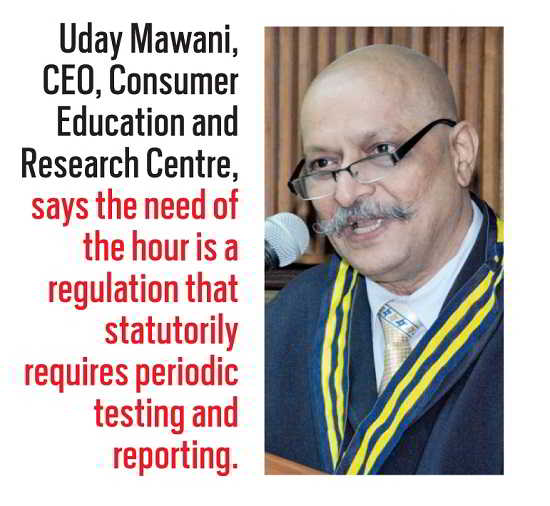
Uday Mawani, CEO, CERC, said: “The Law Commission’s recommendations are a welcome move as adulteration affects all categories of consumers, especially the poor and vulnerable. Consuming adulterated food is like a double whammy as medical bills go up and disposable income for consumption drops even more. It affects their quality of life even further.”
DEVASTATING EFFECT
In 2014, the Centre for Science and Environment had discovered antibiotic residue in chicken samples collected from Delhi and the National Capital Region. These antibiotics are fed to chicken to treat for possible infections of their urinary tract, respiratory tract, eye and ear, blood stream, diarrhoea and tuberculosis. As we all know now, continued exposure to antibiotics could end up in anti-microbial resistance that ultimately leads us to battle superbugs that have no cure.
Wanting to make a quick buck, fruit vendors use calcium carbide, commonly referred by them as “masala” to induce quick ripening of fruits within hours. Though this is banned, it continues on the sly as there are hardly any checks. Calcium carbide is carcinogenic and can cause mouth ulcers, gastric irritation, food poisoning and death.
Food dyes are one of the most widely used and dangerous additives. Your fav-ourite funky blue cocktail could damage your brain and kidneys. Experts say blue colour is known to cross the blood-brain barrier and cause permanent damage over time. Red and green colours are known to cause tumours in the bladder and testes and yellow can trigger hyperactivity in children.
A recent study by the Maharashtra Food and Drug Administration found that 20 percent of milk sold in the state continues to be adulterated. Some had used just tap water which contains impurities. But it isn’t as if bottled water is pure. A study by CERC of 13 leading brands had earlier shown that 10 had foreign objects floating in them, while two contained heavy metals which are toxic.
EXERCISE CAUTION
We just have to watch what we eat. Sugar can have tiny chalk crystals, and salt, powdered stone. Chilli powder can have brick powder, while coriander powder, sawdust or even powdered cow dung. Honey can contain jaggery syrup. Mouth-watering barfis can have harmful dyes and colours that cause cancer, while cumin seeds, coal particles and sooji, coloured sawdust.
Mawani says: “Producers must get their products tested for adulteration from independent laboratories. What we need is a regulation that statutorily requires periodic testing and reporting.”
The Supreme Court is now considering the recommendations of the Commission. Consumer activists feel that life term for food adulterators may be a deterrent.

Zarda packets seized

Acting on a tip off on February 9 from Police Officials of PS, CCS, Port Blair regarding arrival of contraband tobacco products through Andaman Super Express, Courier Service here, Mr R.V. Murugaraj, Food Safety Officer, South Andaman opened two packages of parcel in front of Mr S. Purushotham, Manager, Andaman Super Express, courier service and police personnel from PS, CCS and found Ratna 150 brand Zarda of 50 gms pouches packed in Select Premium CTC tea pouches. Altogether, 151 packets of Zarda were recovered from the tea packets and the prohibited tobacco (Zarda) and tea pouches were seized by the Food Safety Officer in the presence of Police Officials and Manager of the courier service. 
All the courier service/parcel service’s running in A&N Islands have been instructed to pass on information of any suspicious parcel arrived through their courier service to the District Food Safety Office, South Andaman at No. 03192-231024, 03192-238881 and 09434280018 (CFS/DCSA) for thorough check before its released.

Feb 13, 2017

Health staff to keep watch on street food

Bhubaneswar: With summer approaching, the state capital has witnessed mushrooming of juice stalls and other fast food joints, raising the possibility of the spread of waterborne diseases.
Although seasonal flavor and cheap prices are the reasons for crowding of these stalls by people, most of these stalls prepare food at most unhygienic places. “Street foods are tasty and affordable. So we will not think about the hygienic factor,” said Mitun Natyak, a college student who loves street food. 
According to the Food Safety and Standards Act of 2006, any person manufacturing or processing any food item in unhygienic condition shall be liable to pay a penalty of up to `1 lakh. But, sources informed this newspaper that health officials conduct inspection of these stalls only when they receive a complaint. However, staff crunch in the department is hampering its operation. 
“Inspections are done when we receive a complaint. Staff crisis is the major reason for this issue. For instance, we have only one food inspector for Bhubaneswar Municipal Cooperation and entire Khurda district,” said a top official on condition of anonymity.
However, city health official Chandrika Das, who admitted the issue of staff crunch, said that the department has decided to intensify the inspection of these stalls.
“Though we are facing a staff crunch, we have decided to intensify the inspection. Regular inspection is going on at all these stalls and there will be more inspection in the coming days,” Das said. The civic body, which is planning to introduce uniform for street vendors, has decided to intensify the inspection.
“Health officials will monitor these stalls and action will be taken against the offenders,” assured BMC Mayor Ananta Narayan Jena.

FSSAI sets up panel to finalise laws on food fortification

NEW DELHI: Food regulator FSSAI has set up a scientific panel to frame final regulations on fortification of foods and prepare strategies to address malnutrition problem.
The Food Safety and Standards Authority of India (FSSAI) has already issued the draft guidelines on fortification for five food items -- salt, milk, wheat flour, rice and edible oil -- to boost production and consumption of fortified foods.
The draft rules were operationalised in October even as FSSAI sought comments from stakeholders before finalising the final regulations
Fortification means deliberately adding or increasing the content of essential micro nutrients in food items to improve quality.
Standards have been set for fortification of salt with iodine and iron; of vegetable oil and milk with vitamin A and D; wheat flour and rice with iron, folic acid, zinc, vitamin B12, vitamin A and some other micro nutrients
"FSSAI has set up a new Scientific Panel on 'Food Fortification and Nutrition' to address issues related to fortification of food," the regulator said in a statement.
The panel has 11 experts and scientists -- Ambrish Mithal from Medanta; CS Pandav and R K Marwaha (Retd) from AIIMS; Anura Kurpad from St John's Medical College; Yogeshwar Shukla from CSIR - Indian Institute of Toxicilogy Research, HPS Sachdev from Sita Ram Bharatia Institute of Science and Research; KM Nair from NIN; P Ramachandran from Nutrition Foundation of India; Sumit Arora from NDRI; Sirimavo Nair from the MS University, Baroda, and Harsulkar from Bharati Vidyapeeth.
Members from Scientific Panels dealing with food fortifying vehicles such as wheat flour, refined flour, rice, milk, edible oil and salt will also be a part of this committee.
The Panel will identify critical nutritional gaps in the Indian diet in general as well as in specific target groups based on diet surveys and credible scientific evidence.
It will define strategies to address nutritional needs of the general population and vulnerable groups, besides reviewing the standards for all suitable food fortifying vehicles.
The panel will also address regulatory and related technological issues, review proposals from industry using modern risk assessment methods, and prescribe standard sampling and test methods for effective monitoring, surveillance and enforcement of the relevant regulations.
FSSAI had earlier brought out Draft Regulations for fortified food -- Food Safety and Standards (Fortification of Food) Regulations, 2016 which were operationalised in October, 2016.
"Based on the comments received on the draft Regulations, the Panel will finalise the Regulations," FSSAI said.
Apart from framing standards, FSSAI has launched the Food Fortification Resource Centre (FFRC) to promote large-scale fortification of food across India.
An online portal of FFRC to facilitate food businesses and bring fortified foods into government programmes was launched in November.
With an effective regulatory mechanism along with the continuous support of all the stakeholders, FSSAI expects that the problem of malnutrition in general and micronutrient malnutrition in particular would be overcome soon.
FSSAI has also unveiled a logo for fortified foods which may be used by food companies.

Feb 12, 2017

Modi should check FSSAI’s anti-business move

Prime Minister Narendra Modi is keen on enhancing the ease of doing business in India, but the bureaucracy is yet to imbibe this idea. Various organs of the government continue to make the life of entrepreneurs and businesspeople miserable. The Food Safety and Standards Authority of India’s (FSSAI’s) new-found enthusiasm to ensure that restaurants declare the calorific and nutritive value of the food they serve is an instance of unwarranted official intervention in a growing sector.
Hindustan Times (February 10) quoted Pawan Kumar Agarwal, chief executive officer of FSSAI, saying, “Declaring details of calorie intake and nutrition information ensures that consumers are informed. These things are already part of labelling norms for packaged food.” Thankfully, he is not making this a binding requirement: “But Agarwal doesn’t want to make this mandatory—at least, not yet.”
The operative part of the sentence is “not yet,” which keeps the field open for the FSSAI’s intervention. This is what government and its agencies itch for; the itch is institutional.
Make no mistake about it; bureaucrats’ (ostensible) concern for the public is just a pretext to make their obnoxious presence felt. Had they been so concerned for the health of people, they would have eradicated food adulteration, synthetic milk, etc.—the real threats to public health. But, typically, officials would not address the real issues; they would like to carry out a phone campaign, and they are likely to get a lot of support from sundry activists, who are generally anti-business zealots.
The FSSAI chief has already commenced the jihad against the food business, though right now it is low-key. “To start with, let the big ones come forward and do this voluntarily,” he said.
But some restaurateurs are already doing it. “Making it voluntary may make sense. But if it is mandatory, compliance may be an issue. Declaration of nutrition information and calorie details will be a huge task. Even in the western countries, it is not a practice,” National Restaurants Association of India (NRAI) president Riyaaz Amlani was quoted as saying.
Compliance will not only be an issue but also a cost. Top fine-dining restaurants may be able to manage—wasting considerable time, energy, and money—the calorific and nutritive information about the food they serve, but it will be extremely difficult, if not downright impossible, for roadside dhabas and smaller eating joints to comply with the intended stipulation. When compliance is difficult, the proclivity to bypass it becomes stronger which, in turn, becomes a ground for the foot soldiers of the department concerned to fleece small businesses. Another vista opens up for the inspector raj.
The FSSAI seems to be going beyond its mandate by insisting on calorific and nutritive value. “The mandate assigned to the Food Authority is (i) laying down science-based standards for articles of food (ii) to regulate manufacture, storage, distribution, sale and import of food (iii) to facilitate food safety,” this is what the authority’s website says. While the FSSAI has clearly failed in its essential duties pertaining to food standards—as evident from myriad media reports—it wants to arrogate for itself duties not mentioned in its charter.
As former US president Ronald Reagan said, “The government’s view of the economy could be summed up in a few short phrases: If it moves, tax it. If it keeps moving, regulate it. And if it stops moving, subsidize it.” It’s truer in India than in the US where you get a Reagan after Jimmy Carter and a Donald Trump after Barack Obama.
Reagan’s second phrase applies to India’s food services sector, which is estimated to grow from a little over Rs 30,000 crore in 2016 to Rs 49,800 crore by 2021. Surely a matter of concern for mandarins! They ought to regulate it! Even if regulation translates into strangulation!
It is time Modi and his key functionaries restrained bureaucratic hyper-activism, as exemplified by the FSSAI.

Food fortification not a magic bullet


Though fortified foods are promoted as an effective means to combat malnutrition, they have been embroiled in controversy in the past. 
The Supreme Court order on sourcing natural food locally instead of relying on artificially-fortified commercial products is hailed by experts.
On January 2, the Food Safety and Standards Authority of India (FSSAI) issued draft guidelines prescribing standards for fortification of salt, oil, milk, vanaspati (vegetable oil), atta (wheat flour), maida (white flour) and rice. 
The food regulator sought suggestions and objections to the guidelines within a month after which the draft regulations will be taken into consideration. 
Fortification means adding key vitamins and minerals like iron, iodine, zinc, Vitamin A and D to staple foods to improve their nutritional content. These nutrients may or may not have been originally present in the food before processing.
"This should not be made mandatory because fortification by its very nature incentivises centralised production and procurement of food," said Biraj Patnaik, Principal Adviser to the Commissioners of the Supreme Court.
Patnaik added that he had no fundamental objections to the concept of fortification, if it has been proven that the vehicle used for fortification provides for sufficient bio-availability and bio-absorption. 
"My argument is that preference should be equally for promoting dietary diversity as the means for dealing with micro-nutrient deficiency rather than emphasising on fortification."
According to the draft guidelines, the regulator will promote fortified foods in the country and take steps to encourage production, manufacture, distribution, sale and consumption.
It will also advise and promote the use of fortified food in government-funded programmes on distribution of food. Though fortified foods are promoted as an effective means to combat malnutrition, they have been embroiled in controversy in the past. 
Even the Supreme Court, in its order dated October 2004, had said that private contractors should not be used for supply of nutrition in Anganwadis and preferably, ICDS (Integrated Child Development Services) funds should be spent by making use of village communities, self-help groups and Mahila Mandals for buying grains and preparation of meals.
Commercialisation of malnutrition
ICDS is India’s flagship programme and the world’s largest scheme on early childhood care and development.
The scheme serves children under six years as well as pregnant and lactating women. Under this programme, six-year-olds and younger children are entitled to 500 calories and 12-15 grams of protein.
Severely malnourished children are entitled to 800 calories and 20-25 grams of protein regularly, while pregnant and lactating women are entitled to 600 calories of energy and 18-20 grams of protein a day.
This supplementary nutrition is distributed in the form of micronutrient fortified food and/or energy dense food as take-home rations.
The Supreme Court order was hailed by experts who advocated inclusion of locally-sourced natural food in place of artificially-fortified commercial products. Banning private vendors was also seen as an effective way to stop commercialisation of malnutrition. 
Patnaik recommends a wholesome approach to tackle malnutrition which deals with multiple aspects, including junk food consumption and micronutrient deficiency.
"Government and policy efforts should simultaneously attack both problems — reducing dietary diversity and increasing consumption of unhealthy, ultra-processed food; as well as fortification. It should not be seen as a magic bullet," he said.

DIDNAKARAN NEWS